Heterogeneous methodology of racial/ethnic classification
may be responsible for the different risk assessments for
prostate cancer between Black and White men in Brazil
_______________________________________________
Frederico R. Romero
1,2,3,4, Luiz Ricardo T. P. Xavier
2, Antonio W. Romero
1†, Rui Manuel S. de Almeida
2, Jorge Eduardo F. Matias
4, Renato Tambara Filho
41 Hospital Policlínica Cascavel, Cascavel, PR, Brazil; 2 Faculdade Assis Gurgacz (FAG), Cascavel, PR,
Brazil; 3 Instituto Curitiba de Saúde, Curitiba, PR, Brazil; 4 Hospital de Clínicas da Universidade Federal
do Paraná, Curitiba, PR, Brazil †in memorian
ABSTRACT
ARTICLE
INFO
______________________________________________________________ ______________________
Objectives: To evaluate if the different results of prostate cancer risk between black and white Brazilian men may be associated with the varying methodology used to define participants as either Blacks or Whites.
Patients and Methods: We evaluated median PSA values, rate of PSA level ≥4.0 ng/ mL, indications for prostate biopsy, prostate cancer detection rate, biopsy/cancer rate, cancer/biopsy rate, and the relative risk of cancer between blacks versus whites, blacks versus non-blacks (browns and whites), non-whites (browns and blacks) versus whites, African versus non-African descendants, and African descendants or blacks versus non-African descendants and non-blacks.
Results: From 1544 participants, there were 51.4% whites, 37.2% browns, 11.4% bla-cks, and 5.4% African descendants. Median PSA level was 0.9 ng/mL in whites, bro-wns, and non-African descendants, compared to 1.2 ng/mL in blacks, and African descendants or blacks, and 1.3 ng/mL in African descendants. Indications for prostate biopsy were present in 16.9% for African descendants, 15.9% of black, 12.3% of white, 11.4% for non-African descendants, and 9.9% of brown participants. Prostate cancer was diagnosed in 30.3% of performed biopsies: 6.2% of African descendants, 5.1% of blacks, 3.3% of whites, 3.0% of non-African descendants, and 2.6% of browns.
Conclusions: Median PSA values were higher for Blacks versus Whites in all classifi-cation systems, except for non-white versus white men. The rate of prostate biopsy, prostate cancer detection rate, and relative risk for cancer was increased in African descendants, and African descendants or blacks, compared to non-African descen-dants, and non-African descendants and non-blacks, respectively.
Key words:
Epidemiology; Prevalence; Prostatic Neoplasms; Race Relations
Int Braz J Urol. 2015; 41: 360-6
_____________________
Submitted for publication: December 27, 2013
_____________________
Accepted after revision: October 19, 2014
INTRODUCTION
Prostate cancer is the most common visce-ral malignant neoplasm in men. The incidence of prostate cancer varies according to racial differen-ces in several countries, as well as the estimated
lifetime risk of disease and the mortality rate for cancer (1-3).
prostate cancer mortality is 2.4 times higher for Black patients than for Whites (2, 3).
In Brazil, most studies demonstrated a si-milar risk of prostate cancer between Black and White men (4-11), while only some verified an in-creased prevalence of prostate cancer in Black par-ticipants, compared to White ones (12-14). These results have been frequently attributed to the high race mixture index in the Brazilian population as a consequence of centuries of interethnic crosses between Europeans, Africans, and Amerindians, but they may as well be the result of the different methodology used to define participants as either Blacks or Whites in each study, because there is still no consensus in the Brazilian society (15, 16).
In Brazil, unlike US and Europe, race is fre-quently associated to the skin color and physical appearance of the individual, rather than ethnic origin or ancestry, with a number of classification systems available to characterize the vast majority of Brazilians along a white-to-black color conti-nuum, each with a set of categories that vary in number and degree of complexity (15).
To evaluate if the heterogeneous metho-dology of racial/ethnic classification may be responsible for the different risk assessments for prostate cancer in Black and White Brazilian men, we stratified a single cohort of men un-dergoing prostate cancer screening within five working systems of classification, and compared the median PSA values, rate of PSA level ≥4.0 ng/mL, indications for prostate biopsy, prostate cancer detection rate, biopsy/cancer rate, cancer/ biopsy rate, and the relative risk of cancer betwe-en Black and White groups within each racial/ ethnic classification system.
PATIENTS AND METHODS
All men attending a prostate cancer educa-tion program in our Institueduca-tion that accepted to be tested for prostate cancer underwent a free prostate cancer screening that included medical history, di-gital rectal examination (DRE), and serum PSA de-termination. The program was conducted in the city of Curitiba, PR, located in the south region of Brazil, as part of the city employees’ health care system. The study protocol was reviewed and approved by
the Institutional Ethics Committee on Human Rese-arch (registry number 2253.147/2010-06).
At evaluation, all participants were ca-tegorized by a single examiner as white, brown (pardo) or black (hetero-identification), and res-ponded an open-ended question regarding their origin or ancestry (self-identification).
Individuals were classified as blacks when they presented typical physical features of the bla-ck race, including dark skin on clothing-covered areas, and characteristic hair texture and shape of the lips and nose; whites when they had white to pale pink skin color on covered areas; and browns when they did not fit the black or white variables. Participants were also included in two groups: African descendants, when they reported any African origin or ancestry in the family, regardless of their skin color; or non-African descendants.
A Microsoft® Excel® database was speci-fically design for the study purposes. Outcomes of interest included the number of participants, proportion of black, brown, and white men, per-centage of African descendants, and non-African descendants, median (range, mean±SD) PSA va-lue, rate of participants with a PSA level ≥4.0 ng/mL, indications for prostate biopsy, prostate cancer detection rate, biopsy/cancer rate, cancer/ biopsy rate, and the relative risk of cancer betwe-en Blacks and Whites in the differbetwe-ent racial/eth-nic classification systems. For comparison means, participants were grouped as blacks versus tes, blacks versus non-blacks (browns and tes), non-whites (browns and blacks) versus whi-tes, African versus non-African descendants, and African descendants or blacks versus non-African descendants and non-blacks.
melli-tus, vasectomy, and sexually transmitted urethritis (yes versus no, to all). Computations were perfor-med using IBM® SPSS Statistics®, version 20.0.0. Statistical significance was considered for p<0.05.
RESULTS
Among 1544 participants included in the study, 794 (51.4%) men were identified as whites, 574 (37.2%) as browns, and 176 (11.4%) as blacks. African ancestry was reported by 5.4% of partici-pants: 23.3% of blacks, 4.6% of browns, and 1.9% of whites. Demographics of the racial groups are summarized in Table-1.
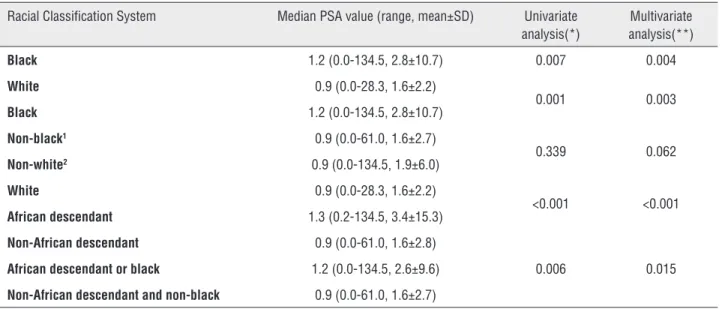
The PSA level was ≥4 ng/mL in 12.0% of African descendants, 11.4% of blacks, 8.6% of whites, 8.0% of non-African descendants, and 7.0% of browns. The median PSA level was 0.9 ng/mL in white men, brown individuals, and non--African descendants, compared to 1.2 ng/mL in blacks, and African descendants or blacks, and 1.3 ng/mL in African descendants. Median PSA level was higher for Blacks versus Whites in all classifi-cation systems, except for non-white versus white individuals (Table-2).
Indications for prostate biopsy were pre-sent in 183 (11.9%) participants, including a PSA level at or above 4.0 ng/mL in 59.6%, a suspicious
Table 1 - Demographics.
Racial Classification System Black1 versus
White2
Black versus non-black3
Non-white4
versus white
African descendant5
versus non-African descendant6
African descendant or black versus non-African descendant and non-black
Black group – No. (%) 176 (18.1) 176 (11.4) 750 (48.6) 83 (5.4) 218 (14.1)
White group – No. (%) 794 (81.9) 1368 (88.6) 794 (51.4) 1443 (94.6) 1326 (85.9)
1 Participants with typical physical features of the black race, including dark skin on clothing-covered areas, and characteristic hair texture and shape of the lips and nose; 2
Participants with white to pale pink skin color on covered areas; 3 White and brown participants together; 4 Brown and black participants together; 5 Participants with any African
origin or ancestry in the family, regardless of their skin color; 6 Participants with no African origin or ancestry in the family
Table 2 - Median PSA values between different racial classification systems.
Racial Classification System Median PSA value (range, mean±SD) Univariate analysis(*)
Multivariate analysis(**)
Black 1.2 (0.0-134.5, 2.8±10.7) 0.007 0.004
White 0.9 (0.0-28.3, 1.6±2.2)
0.001 0.003
Black 1.2 (0.0-134.5, 2.8±10.7)
Non-black1 0.9 (0.0-61.0, 1.6±2.7)
0.339 0.062
Non-white2 0.9 (0.0-134.5, 1.9±6.0)
White 0.9 (0.0-28.3, 1.6±2.2)
<0.001 <0.001
African descendant 1.3 (0.2-134.5, 3.4±15.3)
Non-African descendant 0.9 (0.0-61.0, 1.6±2.8)
0.006 0.015
African descendant or black 1.2 (0.0-134.5, 2.6±9.6)
Non-African descendant and non-black 0.9 (0.0-61.0, 1.6±2.7)
SD = Standard deviation; 1White and brown participants together; 2 Brown and black participants together; * T-Student test; ** Linear regression, including race/ethnicity,
DRE in 30.0%, or both in 10.4%. The indication rate for prostate biopsy was 16.9% for African descendants, 15.9% for blacks, 12.3% for whites, 11.4% for non-African descendants, and 9.9% for browns, being higher for African descendants versus non-African descendants (16.9% versus 11.4%, p<0.05 in multivariate analysis), and for African descendants or blacks versus non-African descendants and non-blacks (16.5% versus 11.1%, p<0.05 in univariate and multivariate analyses).
Among 165 performed biopsies, prostate cancer was detected in 50 (30.3%) subjects. Can-cer rate was 6.2% in African descendants, 5.1% in black men, 3.3% in white men, 3.0% in non-Afri-can descendants, and 2.6% in brown men. The de-tection rate of prostate cancer was increased in African descendants versus non-African descen-dants (6.2% versus 3.0%, p<0.05 in multivariate analyses), and in African descendants or blacks versus non-African descendants and non-blacks (5.2% versus 3.0%, p<0.05 in univariate and mul-tivariate analyses).
The number of biopsies required for the diagnosis of each prostate cancer increased from 2.8 in African descendants and 3.1 in blacks, to 3.8 in browns, and 3.9 in whites and non-African descendants, resulting in a prostate cancer/biopsy rate of 41.7% in African descendants, 36.0% in black, 30.0% in brown, 28.2% in non-African des-cendants, and 27.8% for white participants.
The relative risk of prostate cancer betwe-en black and white groups in each racial/ethnic classification system is summarized in Table-3.
DISCUSSION
PSA levels and the risk of prostate can-cer are increased in Black men compared to Whi-te men in several regions around the world, in-cluding the US, Canada, Caribbean, and England (12, 17-20).In Brazil, most studies evaluating the correlation between prostate cancer and different racial/ethnic groups did not demonstrate a sig-nificant difference in the prevalence of prostate cancer between Black and White individuals (4-11). These results have been frequently attributed to the high race mixture index in the Brazilian population,but other potential source of bias may
include the use of different methodology to classi-fy individuals into racial groups.
The racial/ethnic classification model in Brazil is more complex than the bifurcated US and European model. Brazilian classification is usually based on skin color and other physical characte-ristics such as facial features, hair texture, and the shape of lips and nose, with a diversity of systems currently in use (15, 16).
Within the several systems of racial/eth-nic classification evaluated in this study, we ob-served that the proportion on men grouped as Blacks varied from 5.4% to 48.6%, suggesting that the methodology of racial classification substantially modifies the racial/ethnic pattern of the population in study, with potential impli-cations on the results.
Median PSA levels were higher in all defi-nitions of Black group, similarly to other studies (19, 20), except for non-white versus white men.
Evaluating prostate cancer detection rates, although the relative risk of cancer was increa-sed by 56% to 2-fold in all Black versus White groups, excluding the non-white versus white classification system, the results were statistically significant only in multivariate analysis for the groups defined as African versus non-African descendants, and African descendants or blacks versus non-African descendants and non-blacks. The groups of blacks versus whites, blacks versus non-blacks, and non-whites versus whites did not reach statistically significant difference.
The relatively wide range in the risk of prostate cancer among the different racial/ethnic classification systems reported in the present stu-dy, as well as the non significant results repor-ted in other Brazilian studies (4-11), may reflect the relatively poor accuracy in the assignment of race/ethnicity based exclusively on anthropome-tric features, since these traits are believed to be a combination of genetic inheritance and adapta-tions to geographical factors such as solar radia-tion and heat (20).
spec-trum, the Brown group serves as an umbrella cate-gory for various mixed-race terms such as mulat-tos (descendants of Blacks and Whites), caboclos (Amerindians and Whites), and cafuzos (Amerin-dians and Blacks) (15). Paschoalin et al. (13) de-monstrated by genetic studies that, in Brazil, a higher proportion of Amerindian alleles may be associated with a lower prevalence of prostate can-cer, while a higher proportion of African alleles is significantly related to a higher predisposition for cancer. Therefore, studies that group together bro-wn men either with blacks as non-whites, or with whites as non-blacks, may join distinct groups of race admixture that counterbalance each other in their susceptibility to prostate cancer.
There is also disagreement about the ideal methodology of data collection for racial/ethnic classification in Brazil. Self-identification refers to a race/ethnic choice made by the respondent, and hetero-identification to a race/ethnic attribution assigned by the interviewer to the respondent (15, 16). In the present study, we used hetero-identi-fication to classify individuals in different color
groups (black, brown, or white), and self-identifi-cation to stratify participants by their origin/an-cestry (African, or non-African descendants).
It is interesting to note that, although it is known there are a large number of people with at least partial African origin in Brazil, 76.7% of black participants self-reported to be non-African descendants. A large previous study showed si-milar results, with only about 10% of blacks con-sidering themselves as African descendants (17). The apparent low identity of Brazilians with Afri-can ancestry may be explained because mixing usually occurred during the slavery period or in a state of degradation of the mother, resulting in a widespread social prejudice that can be observed even in present-day. This may explain why peo-ple with a darker compeo-plexion associated their skin color preferably with Amerindian (or Brazilian) ancestry, rather than African origin (16).
Some limitations of our study should be noted. Even though we adjusted PSA levels to age and other confounding variables, we did not include prostate volume and prostate symptoms
Table 3 - 95% CI relative risk between different ethnic/race/color classification groups.
Univariate analysis (*)
Racial Classification System RR (95% CI) p value
Black versus white 1.56 (0.74-3.27) 0.082
Black versus non-black1 1.71 (0.84-3.45) 0.056
Non-white2 versus white 0.98 (0.57-1.69) 0.934
African versus non-African descendant 2.06 (0.84-5.08) 0.070
African descendant or black versus non-African descendant and non-black 1.60 (0.94-2.75) 0.096
Multivariate analysis (**)
Racial Classification System RR (95% CI) p value
Black versus white 1.90 (0.83-4.33) 0.129
Black versus non-black1 2.08 (0.96-4.50) 0.064
Non-white2 versus white 0.81 (0.43-1.53) 0.520
African versus non-African descendant 3.11 (1.13-8.55) 0.027
African descendant or black versus non-African descendant and non-black 2.23 (1.09-4.59) 0.029
1 White and brown participants together; 2 Brown and black participants together; * Fisher exact test or Pearson’s Chi-square; ** Logistic regression,
score in the multivariate analysis. Furthermore, our sample included a relatively small proportion of blacks and African descendants, and a small number of prostate cancers in each subgroup, which can result in relatively wide confidence in-tervals and limit the statistical power of the study. In summary, the racial/ethnic classifi-cation system most accepted recently by gover-nment, Black movement, and media, which uses only two terms (non-white or negro, and white), is
apparently the least adequate model for prostate cancer risk stratification. The assignment of race/ ethnicity based either on anthropometric features (black, brown, and white), or on ethnic origin/ ancestry (African descendant, and non-African descendant) are practical, although they are less accurate when used separately. Therefore, anthro-pometric features should be preferably used in combination with origin/ancestry to increase the accurateness of racial/ethnic classification in the risk assessment of prostate cancer, especially in populations with a high miscegenation index like the Brazilian people.
CONCLUSIONS
Based on several classifications systems used to stratify a single cohort of Brazilian men in different groups of Blacks and Whites, median PSA values were higher in Black versus White groups classified as blacks versus whites, blacks versus non-blacks, African descendants versus non-African descendants, and African descen-dants or blacks versus non-African descendescen-dants and non-blacks. Median PSA values were simi-lar between the groups categorized as non-whites versus whites.
Black groups defined as African descen-dants, and as African descendants or blacks, had an increased rate of prostate biopsy, prostate can-cer detection rate, and relative risk for cancan-cer, compared to the white groups categorized as non--African descendants, and nonnon--African descen-dants and non-blacks, respectively. The indication rate for prostate biopsy, prostate cancer detection rate, and relative risk for cancer were comparable between blacks versus whites, blacks versus non--blacks, and non-whites versus whites.
ACKNOLEDGEMENTS
This article is part of a post-doctoral dis-sertation developed by the main author at the Fe-deral University of Paraná, Brazil.
CONFLICT OF INTEREST
None declared.
REFERENCES
1. Miller BA, Kolonel LN, Bernstein L, Young Jr JL, Swanson GM, West D, et al. Racial/ethnic patterns of cancer in the United States 1988-1992. Bethesda, MD: National Cancer Institute. 1996;96-4104.
2. National Cancer Institute: Genetics of prostate cancer. Avail-able at: http://www.cancer.gov/cancertopics/pdq/genetics/ prostate/HealthProfessional. Last accessed December 24, 2013.
3. Klein EA, Platz EA, Thompson IM: Epidemiology, etiology, and prevention of prostate cancer. In: Wein AJ, Kavoussi LR, Novick AC, Partin AW, Peters CA, eds. Campbell-Walsh urology, 9th ed. Philadelphia, PA: Saunders Elsevier, 2007:
2854-7.
4. Barros MS, Silva VR, Santos GB, Hughes A, Silveira MA. Prevalence of prostate adenocarcinoma according to race in an university hospital. Int Braz J Urol. 2003;29:306-11; discussion 312.
5. Martins AC, Reis RB, Suaid HJ, Maciel LM, Cologna AJ, Falconi RA. Screening for carcinoma of the prostate in volunteers. Int Braz J Urol. 2000;26:516-22.
6. Antonopoulos IM, Pompeo AC, Hayek OR, Sarkis AS, Alfer Jr W, Arap S. Results of prostate cancer screening in non-symptomatic men. Int Braz J Urol. 2001;27:227-34. 7. Glina S, Toscano IL Jr, Mello JF, Martins FG, Vieira VL, Damas
CG. Results of screening for prostate cancer in a community hospital. Int Braz J Urol. 2001; 27:235-43.
8. Biazzi F: Characteristics of the patients undergoing US-guided transrectal prostate biopsy with PSA determination lower or equal to 4.0 ng/ml. Master degree diss., Universidade Estadual Paulista “Julio de Mesquita Filho”, Botucatu, 2010. In: http://www.athena.biblioteca.unesp.br/ exlibris/bd/bbo/33004064006P8/2010/biazzi_f_me_botfm. pdf. Last accessed December 24, 2013.
10. Magrini E: Transrectal prostate biopsy: correlation between digital rectal examination, ultrasonography, prostate specific antigen, and adenocarcinoma. Master degree diss., Universidade Estadual de Campinas, Campinas, 2001. Available at: http://www.bibliotecadigital.unicamp.br/ document/?code=vtls000231002. Last accessed December 24, 2013.
11. Alvarez GA: Frequency of prostate cancer in renal transplant patients: case-control study. Master degree diss., Univer-sidade de São Paulo, São Paulo, 2007. Available at: http:// www.teses.usp.br/teses/disponiveis/5/5153/tde-17022009-105331/es.php. Last accessed December 24, 2013. 12. Bouchardy C, Mirra AP, Khlat M, Parkin DM, de Souza JM,
Gotlieb SL. Ethnicity and cancer risk in São Paulo, Brazil. Cancer Epidemiol Biomarkers Prev. 1991;1:21-7.
13. Paschoalin EL, Martins AC, Pastorello M, Sândis KA, Maciel LM, Silva WA Jr, et al. Racial influence on the prevalence of prostate carcinoma in Brazilian volunteers. Int Braz J Urol. 2003;29:300-5.
14. Antonopoulos IM, Pompeo AC, Goes PM, Chade J, Sarkis AS, Arap S: Racial differences in prostate cancer prevalence. Int Braz J Urol. 2002;28:214-20.
15. Telles EE. Race in another America: the significance of skin color in Brazil. Princeton, NJ: Princeton University Press, 2004.
16. Piza E, Rosemberg F. Color in the Brazilian census. In: Reich-mann RL. Race in contemporary Brazil: from indifference to inequalty. University Park, PE: The Pennsylvania State Uni-versity Press, 1999.
17. Schwartzman S: Out of focus: ethnical diversities and identities in Brazil. Available at: http://www.schwartzman.org.br/simon/ pdf/origem.pdf. Last accessed December 24, 2013.
18. Jack RH, Davies EA, Møller H. Prostate cancer incidence, stage at diagnosis, treatment and survival in ethnic groups in South-East England. BJU Int. 2010;105:1226-30. 19. Henderson RJ, Eastham JA, Culkin DJ, Kattan MW, Whatley
T, Mata J, et al. Prostate-specific antigen (PSA) and PSA density: racial differences in men without prostate cancer. J Natl Cancer Inst. 1997;89:134-8.
20. Moul JW, Sesterhenn IA, Connelly RR, Douglas T, Srivastava S, Mostofi FK, et al. Prostate-specific antigen values at the time of prostate câncer diagnosis in African-American men. JAMA. 1995;274:1277-81.
_______________________ Correspondence address: