Validation of the Portuguese language version of a chronic
venous ulcer quality of life questionnaire (Charing Cross
Venous Ulcer Questionnaire – CCVUQ-Brazil)
Validação do questionário de qualidade de vida na úlcera venosa crônica em língua
portuguesa (Charing Cross Venous Ulcer Questionnaire – CCVUQ-Brasil)
Renata Cardoso Couto1, Flávia de Jesus Leal1, Guilherme Benjamin Brandão Pitta1
Abstract
Background: he use of quality of life instruments has become widespread over recent years. here is an important questionnaire speciically designed for patients with venous ulcers, the Charing Cross Venous Ulcer Questionnaire (CCVUQ), which has already been translated into Portuguese as part of a recent study, but its psychometric properties still need to be tested to complete its validation for use in Brazil. Objectives: To validate the Portuguese version of a venous ulcer quality of life questionnaire, the CCVUQ-Brazil. Methods: he translated version of the questionnaire was administered to 50 individuals and its internal consistency was analyzed. It was re-administered (30 minutes and 7 to 15 days after the irst administration) in order to test its reproducibility. Results were compared with results for the 36-Item Short Form Health Survey (SF-36) to test validity. Results: he Portuguese version is semantically and culturally similar to the original version in English. It has satisfactory internal consistency, it exhibited high correlations in tests of reproducibility and it has signiicant construct validity. Conclusions: he Portuguese version of the CCVUQ-Brazil has been validated for use.
Keywords: questionnaire; quality of life; venous ulcer.
Resumo
Contexto: Instrumentos de qualidade de vida vêm sendo usados nos últimos anos. Para a úlcera venosa, há um importante questionário especíico, o Charing Cross Venous Ulcer Questionnaire (CCVUQ), já traduzido para português em recente estudo, mas necessitando do teste de suas propriedades psicométricas e da consequente validação para ser utilizado no Brasil. Objetivos: Validar o questionário de qualidade de vida na úlcera venosa em língua portuguesa, o CCVUQ-Brasil. Métodos: A versão traduzida do questionário foi aplicada em 50 indivíduos. Sua consistência interna foi analisada, sendo posteriormente reaplicado (30 minutos e entre 7 e 15 dias após a primeira aplicação) para testar a reprodutibilidade. Os resultados foram comparados com o 36-Item Short Form Health Survey (SF-36) para testar a validade. Resultados: A versão em português é semântica e culturalmente semelhante à versão original em inglês, tendo consistência interna satisfatória, alta correlação na veriicação da reprodutibilidade e validade de constructo signiicativa. Conclusões: O CCVUQ-Brasil encontra-se validado na língua portuguesa.
Palavras-chave: questionário; qualidade de vida; úlcera venosa.
1 Universidade Estadual de Ciências da Saúde de Alagoas – UNCISAL, Maceió, AL, Brazil.
Financial support: None.
Conlicts of interest: No conlicts of interest declared concerning the publication of this article. Submitted: July 17, 2015. Accepted: November 13, 2015.
INTRODUCTION
The validation process veriies whether an adapted
instrument has maintained the characteristics of the
original version
1and is performed to ensure that a
questionnaire is understandable and relevant in a new
cultural context.
2An adequate validation process
must test psychometric properties
3and analyze
internal consistency, interobserver and intraobserver
reproducibility
4and validity.
1Internal consistency is the extent to which the
items that make up a given scale measure the same
unobservable theoretical concept (construct).
5The reproducibility assessment tests whether a
measurement instrument is reproducible on different
occasions (intraobserver reproducibility) and with
different examiners (interobserver reproducibility).
1Finally, tests of validity investigate to what extent
scores on the instrument being tested are related to
scores on another instrument that assesses the same
construct or a similar construct.
6Over recent years a number of quality of life
instruments have been validated for patients with
venous disease,
7and one such disease is venous
ulcers. The Charing Cross Venous Ulcer Questionnaire
(CCVUQ) is cited as the only and most important
disease-speciic quality of life questionnaire for
venous ulcers.
8Its simplicity and sensitivity and
the short time required for administration have led
to it being recognized as a valuable instrument for
assessing progression and response to treatment.
7It has
21 items that identify four important health domains:
social interaction, domestic activities, cosmesis and
emotional status.
9The CCVUQ has already been
translated into Portuguese,
10which resulted in the
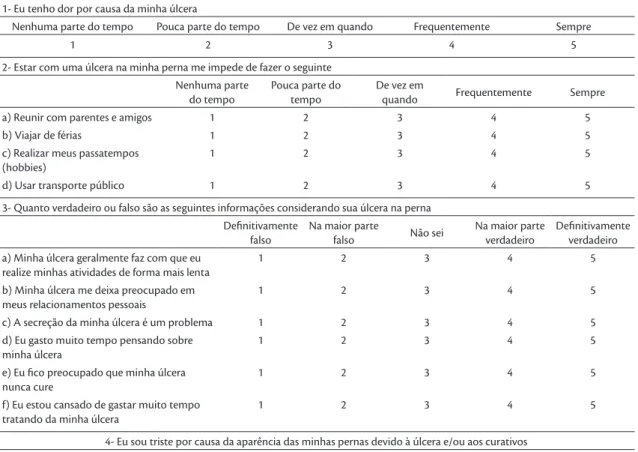
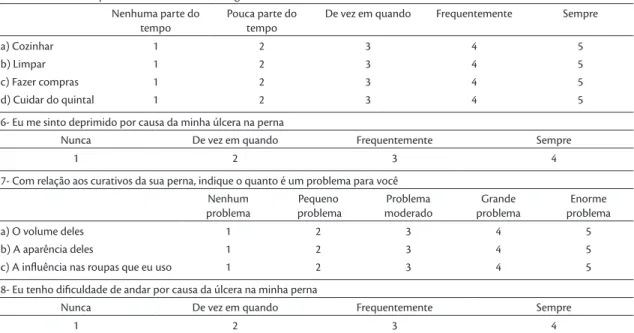
CCVUQ-Brazil version (Table 1); but despite its
great importance, its psychometric properties have
not yet been tested. Doing so would make it available
for use with the Brazilian population.
This study is relevant because of current understanding
of the importance of quality of life studies and
because a speciic questionnaire for venous ulcers,
the CCVUQ-Brazil, already exists in the Portuguese
language, but needs to be validated. Once made possible
by the validation process, using the CCVUQ in Brazil,
should, among other factors, make it possible to:
Table 1. Version of the Charing Cross Venous Ulcer Questionnaire (CCVUQ) translated and adapted for use in Brazil.10
1- Eu tenho dor por causa da minha úlcera
Nenhuma parte do tempo Pouca parte do tempo De vez em quando Frequentemente Sempre
1 2 3 4 5
2- Estar com uma úlcera na minha perna me impede de fazer o seguinte Nenhuma parte
do tempo
Pouca parte do tempo
De vez em
quando Frequentemente Sempre
a) Reunir com parentes e amigos 1 2 3 4 5
b) Viajar de férias 1 2 3 4 5
c) Realizar meus passatempos (hobbies)
1 2 3 4 5
d) Usar transporte público 1 2 3 4 5
3- Quanto verdadeiro ou falso são as seguintes informações considerando sua úlcera na perna Deinitivamente
falso
Na maior parte
falso Não sei
Na maior parte verdadeiro
Deinitivamente verdadeiro a) Minha úlcera geralmente faz com que eu
realize minhas atividades de forma mais lenta
1 2 3 4 5
b) Minha úlcera me deixa preocupado em meus relacionamentos pessoais
1 2 3 4 5
c) A secreção da minha úlcera é um problema 1 2 3 4 5
d) Eu gasto muito tempo pensando sobre minha úlcera
1 2 3 4 5
e) Eu ico preocupado que minha úlcera nunca cure
1 2 3 4 5
f) Eu estou cansado de gastar muito tempo tratando da minha úlcera
1 2 3 4 5
4- Eu sou triste por causa da aparência das minhas pernas devido à úlcera e/ou aos curativos
Não, deinitivamente não De vez em quando Frequentemente Toda hora (sempre)
a) determine the impact of ulcers on daily activities;
b) identify speciic problems; c) assess the impact
of treatments; d) obtain data enabling comparison
of different types of treatment; e) enable use of the
CCVUQ-Brazil in combination with generic instruments;
and f) make an instrument speciically designed for
assessment of venous ulcers available. These factors
justify conducting this study to determine the validity
of the CCVUQ-Brazil in Portuguese.
METHODS
The voluntary nature of patients’ participation was
documented on free and informed consent forms.
The study was conducted at public and private
healthcare centers with venous disease patients.
People were recruited who had chronic lower
limb venous ulcers diagnosed by a vascular surgeon.
Potential participants were excluded if they had
physician diagnoses of psychiatric disorders or
dementia, arterial or lymphatic abnormalities, acute
deep vein thrombosis, erysipelas, non-venous ulcers,
lymphangitis or diabetes. People who did not speak
or understand Portuguese or were 60 years or more
old and had cognitive problems according to the
mini mental state examination (MEEM) were also
excluded. Additional exclusion criteria were presence
of active ulcer for fewer than 15 days prior to the start
of the study, ulcer smaller than 1 cm
2and clinical
instability during the interval between administration
and re-administration of the questionnaire. Clinical
instability was assessed on the basis of criteria such
as: onset of an infectious process, taking antibiotics
and/or phlebotropics, surgical debridement or other
surgical procedures, changes to type of dressing
(starting to use an Unna boot, multi-layer dressings
or dressings with topical medications) and closure
of the ulcer.
The sampling technique was non-probabilistic,
there was no sample size calculation and the sample
was determined on the basis of criteria utilized in
similar studies.
11-15Individuals who met the inclusion
criterion were invited to take part in the study while
they were waiting to be seen at healthcare centers.
After signature of free and informed consent forms,
these people began their participation in the study,
which extended over three separate contacts with
the investigators.
During the first contact, participants were
interviewed by an investigator (Examiner 1) and a data
collection form was administered. Assuming none of
the exclusion criteria were detected, the participants
were instructed (or helped) by the same investigator
to complete the SF-36 questionnaire, an economic
classiication scale and inally the CCVUQ-Brazil
(Table 1). The questionnaire is self-administrable,
but if participants were illiterate or had reading
dificulties the questionnaires and other instruments
were read to them, in a standardized manner, with
no interpretation or interference in the responses.
Participants who were aged 60 years or over were
also assessed with the MEEM.
5- A úlcera da minha perna me limita de fazer as seguintes tarefas de casa Nenhuma parte do
tempo
Pouca parte do tempo
De vez em quando Frequentemente Sempre
a) Cozinhar 1 2 3 4 5
b) Limpar 1 2 3 4 5
c) Fazer compras 1 2 3 4 5
d) Cuidar do quintal 1 2 3 4 5
6- Eu me sinto deprimido por causa da minha úlcera na perna
Nunca De vez em quando Frequentemente Sempre
1 2 3 4
7- Com relação aos curativos da sua perna, indique o quanto é um problema para você Nenhum
problema
Pequeno problema
Problema moderado
Grande problema
Enorme problema
a) O volume deles 1 2 3 4 5
b) A aparência deles 1 2 3 4 5
c) A inluência nas roupas que eu uso 1 2 3 4 5
8- Eu tenho diiculdade de andar por causa da úlcera na minha perna
Nunca De vez em quando Frequentemente Sempre
1 2 3 4
During the second contact, after a 30-minute interval,
the CCVUQ-Brazil was administered once more, by
a second investigator (Examiner 2). The third contact
took place from 7 to 15 days later, when the patient
returned for another consultation and/or to change
dressings, and during which the CCVUQ-Brazil was
administered for a third time, once more by the irst
investigator (Examiner 1).
RESULTS
The sample of 50 patients had a mean age of 63.02
years (standard deviation [SD] = 11.74), and the
majority (66%) had venous ulcers that had been active
for more than 1 year. The majority of the sample were
female (80%). The predominant educational level
category was primary education completed (30%).
According to the social class assessment the sample
was heterogeneous, but with a higher concentration
of the lower social classes, C2 (28%) and D (30%).
Just 14% of the sample was in active employment,
the great majority had retired on the basis of age
(36%) or because of disease (22%), while 28% were
homemakers.
Interobserver reproducibility was excellent (
Table 2).
The intraobserver reproducibility correlation was
also high (Table 3). The internal consistency analysis
showed that all items were highly correlated with total
score on the questionnaire (Table 4). Analysis of items
that comprise the same domain also returned high
correlations, demonstrating homogeneity between
items measuring the same construct and indicating
excellent internal consistency (Table 4).
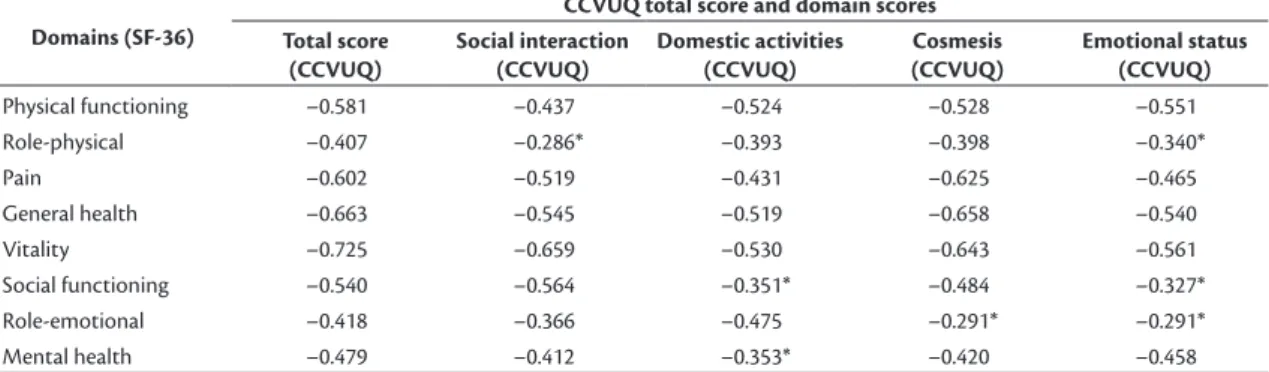
Validity of the CCVUQ-Brazil was assessed in
terms of correlation between its total score and domain
scores and the domain scores of the SF36. Correlations
were negative for all items assessed and varied from
reasonable to moderate and good (within the range
of 0.25 to 0.75), as shown in
Table 5.
Table 2. Interobserver reproducibility: Intraclass Correlation Coeicients (ICC), 95% conidence intervals (95%CI) and p values for total score and domain scores of the Charing Cross Venous Ulcer Questionnaire (CCVUQ) for irst administration (T1) against second administration (T2).
Domains ICC 95%CI p
Total score 0.951 0.914-0.972 0.000*
Social interaction 0.965 0.938-0.980 0.000*
Domestic activities 0.845 0.728-0.912 0.000*
Cosmesis 0.899 0.823-0.943 0.000*
Emotional status 0.884 0.796-0.934 0.000*
* p < 0.0001. > 0.75 excellent agreement; from 0.4 to 0.75 regular to good agreement; < 0.4 poor agreement.
Table 3. Intraobserver Interobserver reproducibility: Intraclass Correlation Coeicients (ICC), 95% conidence intervals (95%CI) and p values for total score and domain scores of the Charing Cross Venous Ulcer Questionnaire (CCVUQ) for irst administration (T1) against third administration (T3).
Domains ICC 95%CI p
Total score 0.951 0.914-0.972 0.000*
Social interaction 0.860 0.754-0.921 0.000*
Domestic activities 0.885 0.797-0.935 0.000*
Cosmesis 0.917 0.854-0.953 0.000*
Emotional status 0.915 0.851-0.952 0.000*
* p < 0.0001. > 0.75 excellent agreement; from 0.4 to 0.75 regular to good agreement; < 0.4 poor agreement.
Table 4. Internal consistency: Cronbach’s Alphas for total score and domain scores of the Charing Cross Venous Ulcer Questionnaire (CCVUQ).
Domains Items Cronbach’s alpha
Total score All 0.917
Social interaction 2A, 2B, 2C, 2D, 3A, 8 0.803
Domestic activities 3A, 5A, 5B, 5C, 5D 0.885
Cosmesis 3C, 3E, 4, 7A, 7B, 7C 0.739
Emotional status 3F, 3B, 6, 3E, 3D 0.734
DISCUSSION
The methodological idea for this study is based
on the proposal of the “magic sextet” of research,
which prescribes a direct and consecutive relationship
between the stages of scientiic publications, proposing
the correct method for planning, execution and
publication of research.
16The current recommendation for quality of life
assessment is that a disease-speciic instrument should
be used in combination with a generic instrument.
4Since no venous ulcer instruments had yet been
validated for use in Brazil, the CCVUQ was chosen,
because it is a speciic instrument that has importance,
applicability and good psychometric properties
demonstrated in previous studies that have successfully
produced satisfactory versions in languages other than
the original.
8,9,17-19A preliminary study was necessary
before this study could be conducted, in which the
CCVUQ questionnaire was translated into Portuguese
and culturally adapted for Brazil.
10The sample size of 50 venous ulcer patients was
deined in accordance with the “Quality criteria for
measurement properties of health status questionnaires”,
20which state that at least 50 participants are needed
for analyses of reproducibility and validity.
The large majority of females (80%) and the
predominance of socioeconomic class D are similar
to the distributions observed in a previous study of
venous disease conducted in the Brazilian state of
Alagoas, which analyzed a sample of 66 people,
83.3% of whom were female and in which the same
social class predominated.
21However, a third study
stated that male sex was a risk factor for ulceration,
since males predominated among their patients.
22The initial intention was to analyze reproducibility
using self-administration of the questionnaire.
However, in the event the examiners had to read the
questions out to people who were illiterate or had
reading dificulties, which is a method that was also
used during the process of creating the questionnaire.
8The interval chosen for re-administration of the
questionnaire was from 7 to 15 days, which, according
to explanations in previous studies,
6would not allow
for memorization of responses, while also making
loss of clinical stability unlikely.
As a precaution to control errors, during validation
of the CCVUQ-Brazil people were excluded from
the sample if they were not clinically stable over
the 7 to 15 day interval before re-administration of
the questionnaire. The criteria used were predeined
by vascular surgeons and were based on ensuring
absence of conditions that could have an inluence
of magnitude on patients’ health status.
Another study has suggested that for analysis of
internal consistency the sample should be proportional
to the number of questions.
2With regard to this
recommendation, it can be stated that the present study
employed a sample comprising more people than the
21 questions contained in the CCVUQ questionnaire,
thereby exceeding the minimum level desirable.
Validity was assessed in terms of correlation
between total and domain scores of the CCVUQ and
the domain scores on the SF-36, which is the same
procedure used in validation of the original CCVUQ.
8It should be pointed out that the correlation with the
SF-36 is based on an inverse comparison of scores,
i.e. there should be a negative relationship, since
the closer the SF-36 scores approach 100, the better
the quality of life indicated, whereas the CCVUQ
indicates better quality of life the closer the score
approaches to zero.
8The results of these analyses did
indeed reveal negative correlations between CCVUQ
and SF-36, varying from reasonable to moderate and
good, similar to the original version.
8Table 5. Validity: Spearman’s correlation coeicients for total score and domain scores of the Charing Cross Venous Ulcer
Questionnaire (CCVUQ) against SF-36 domain scores.
Domains (SF-36)
CCVUQ total score and domain scores Total score
(CCVUQ)
Social interaction (CCVUQ)
Domestic activities (CCVUQ)
Cosmesis (CCVUQ)
Emotional status (CCVUQ)
Physical functioning –0.581 –0.437 –0.524 –0.528 –0.551
Role-physical –0.407 –0.286* –0.393 –0.398 –0.340*
Pain –0.602 –0.519 –0.431 –0.625 –0.465
General health –0.663 –0.545 –0.519 –0.658 –0.540
Vitality –0.725 –0.659 –0.530 –0.643 –0.561
Social functioning –0.540 –0.564 –0.351* –0.484 –0.327*
Role-emotional –0.418 –0.366 –0.475 –0.291* –0.291*
Mental health –0.479 –0.412 –0.353* –0.420 –0.458
According to the original study, the CCVUQ
had good internal consistency and reproducibility.
This is also similar to the present study, since when
administered to a population in Brazil, reproducibility
analysis revealed high correlations between the different
times of administration and different observers, with
Intraclass Correlation Coeficients greater than 0.800
in all domains. Internal consistency results were
satisfactory, with Cronbach’s alphas ranging from
0.7 to 0.95, which is similar to the original validation
study
8and to the results of validation of the Chinese
version.
16Overall, the fact that the correlations were reasonable,
rather than excellent, has been explained by another
study of quality of life in venous disease, which
suggested that those factors to which the CCVUQ is
sensitive are likely to be different from those to which
the SF-36 is sensitive, since the generic instrument
is less sensitive for assessing the effects of disease
on the quality of life of individuals or populations
with a speciic pathology,
4while the CCVUQ is less
sensitive to disease in general.
Additionally, working from the assumption that it is
recommendable to employ the speciic questionnaire
as a supplement to a generic one, rather than as a
substitute, it is acceptable that the correlations are
not particularly high. This has also been justiied
in the other study,
4which explains that moderate
correlations are to expected, since if the values
were very high (close to one), it could indicate that
the questionnaires were redundant. However, if the
values were very low, it could indicate that there is
no evidence that the scales were measuring similar
constructs similar.
The Portuguese language version produced in
Brazil is semantically and culturally similar to the
original version in English. It has satisfactory internal
consistency, it exhibited high correlations in tests of
reproducibility and it has signiicant construct validity.
The Portuguese version of the CCVUQ-Brazil has
therefore been validated for use.
REFERENCES
1. Maher CG, Latimer J, Costa LOP. The relevance of cross-cultural adaptation and clinimetrics for physical therapy instruments. Rev Bras Fisioter. 2007;11(4):245-52. http://dx.doi.org/10.1590/ S1413-35552007000400002.
2. Mengarda CV, Passos EP, Picon P, Costa AF, Picon PD. Validação de versão para o português de questionário sobre qualidade de vida para mulher com endometriose (Endometriosis Health Profile Questionnaire – EHP-30). Rev Bras Ginecol Obstet. 2008;30(8):384-92. http://dx.doi.org/10.1590/S0100-72032008000800003. PMid:19142521.
3. Silva TI, Marques CM, Alonso NB, et al. Tradução e adaptação cultural do Quality of Life in Epilepsy (QOLIE-31). J Epilepsy Clin Neurophysiol. 2006;12(2):107-10. http://dx.doi.org/10.1590/ S1676-26492006000300011.
4. Moura RMF, Gonçalves GS, Navarro TP, Britto RR, Dias RC. Adaptação transcultural do questionário VEINES/QOL-SYM: avaliação da qualidade de vida e sintomas na doença venosa crônica. J Vasc Bras. 2011;10(1):17-23. http://dx.doi.org/10.1590/ S1677-54492011000100004.
5. Soárez PC, Castelo A, Abrão P, Holmes WC, Ciconelli RM. Tradução e validação de um questionário de avaliação de qualidade de vida em AIDS no Brasil. Rev Panam Salud Publica. 2009;25(1):69-76. http:// dx.doi.org/10.1590/S1020-49892009000100011. PMid:19341527. 6. Magalhães MO, Costa LOP, Ferreira ML, Machado LAC. Testes
clinimétricos de dois instrumentos que mensuram atitudes e crenças de profissionais de saúde sobre a dor lombar crônica. Rev Bras Fisioter. 2011;5(3):249-53. http://dx.doi.org/10.1590/ S1413-35552011000300012. PMid:21829990.
7. Leal J, Mansilha A. Como avaliar o impacto da doença venosa crônica na qualidade de vida. Rev Angiol Cir Vasc. 2010;6(4):173-87. 8. Smith JJ, Guest MG, Greenhalgh RM, Davies AH. Measuring
the quality of life in patients with venous ulcers. J Vasc Surg. 2000;31(4):642-9. http://dx.doi.org/10.1067/mva.2000.104103. PMid:10753271.
9. Consuegra RVG, Verdú J. Proceso de adaptación al castellano del Charing Cross Venous Ulcer Questionnaire (CCVUQ) para medir la calidad de vida relacionada con la salud en pacientes con úlceras venosas. Gerokomos. 2010;21(2):80-7.
10. Couto RC, Leal FJ, Pitta GBB, Bezerra RCB, Segundo WSS, Porto TM. Tradução e adaptação cultural do Charing Cross Venous Ulcer Questionnaire - Brasil. J Vasc Bras. 2012;11(2):102-6. http:// dx.doi.org/10.1590/S1677-54492012000200006.
11. Ciconelli RM, Ferraz MB, Santos W, Meinão I, Quaresma MR. Tradução para a língua portuguesa e validação do questionário genérico de avaliação de qualidade de vida SF-36 (Brasil SF-36). Rev Bras Reumatol. 1999;39:143-50.
12. Soárez PC, Kowalski CCG, Ferraz MB, Ciconelli RM. Tradução para o português brasileiro e validação de um questionário de avaliação de produtividade. Rev Panam Salud Publica. 2007;22(1):21-8. http:// dx.doi.org/10.1590/S1020-49892007000600003. PMid:17931484. 13. Fonseca ESM, Camargo ALM, Castro RA, et al. Validação do
questionário de qualidade de vida (King’s health Questionnaire) em mulheres brasileiras com incontinência urinária. Rev Bras Ginecol Obstet. 2005;27(5):235-42. http://dx.doi.org/10.1590/ S0100-72032005000500002.
14. Sousa TC, Jardim JR, Jones P. Validação do Questionário do Hospital Saint George na Doença Respiratória (SGRQ) em pacientes portadores de doença pulmonar obstrutiva crônica no Brasil. J Pneumol. 2000;26(3):119-28. http://dx.doi.org/10.1590/ S0102-35862000000300004.
15. Camelier A, Rosa FW, Salmi C, Nascimento OA, Cardoso F, Jardim JR. Avaliação da qualidade de vida pelo Questionário do Hospital Saint George na Doença Respiratória em portadores de doença pulmonar obstrutiva crônica: validação de uma nova versão para o Brasil. J Pneumol. 2006;32(2):114-22. http://dx.doi.org/10.1590/ S1806-37132006000200006.
16. Pitta GBB, Roque FP, Pitta MR. O sexteto mágico da pesquisa clínica. Rev Bras Cir Cardiovasc. 2009;24(2):113-5. http://dx.doi. org/10.1590/S0102-76382009000200004. PMid:19768287. 17. Wong KY, Lee DT, Thompson DR. Translation and validation of the
J Clin Nurs. 2006;15(3):356-7. http://dx.doi.org/10.1111/j.1365-2702.2006.01307.x. PMid:16466486.
18. Van Korlaar I, Vossen C, Rosendaal F, Cameron L, Bovill E, Kaptein A. Quality of life in venous disease. Thromb Haemost. 2003;90(1):27-35. PMid:12876622.
19. Jull A, Parag V. Error in Charing Cross Venous Ulcer Questionnaire (CXVUQ). J Vasc Surg. 2007;45(5):1092. http://dx.doi.org/10.1016/j. jvs.2006.10.058. PMid:17466813.
20. Terwee CB, Bot SDM, Boer MR, et al. Quality criteria were proposed for measurement properties of health status questionnaires. J Clin Epidemiol. 2007;60(1):34-42. http://dx.doi.org/10.1016/j. jclinepi.2006.03.012. PMid:17161752.
21. Costa LM, Higino WJF, Leal FJ, Couto RC. Perfil clínico e sociodemográfico dos portadores de doença venosa crônica atendidos em centros de saúde de Maceió (AL). J Vasc Bras. 2012;11(2):108-13. http:// dx.doi.org/10.1590/S1677-54492012000200007.
22. Afonso A, Barroso P, Marques G, et al. Úlcera crónica do membro inferior: experiência com cinquenta doentes. Rev Angiol Cir Vasc. 2013;9(4):148-53.
*
Correspondence
Renata Cardoso Couto Rua Walberdson Ferreira, 42 - Bairro Feitosa CEP 57042-295 - Maceió (AL), Brazil Tel.: +55 (82) 9608-2310 E-mail: [email protected]
Author information
RCC and FJL - Physical therapists; MSc in Sciences, Universidade Federal de São Paulo (UNIFESP); Assistant professors, Universidade Estadual de Ciências da Saúde de Alagoas (UNCISAL). GBBP - PhD in Cardiovascular Surgery, Universidade Federal de São Paulo (UNIFESP); Adjunct professor, Universidade Estadual de Ciências da Saúde de Alagoas (UNCISAL).
Author contributions
Conception and design: FJL, RCC, GBBP Analysis and interpretation: FJL, RCC, GBBP Data collection: FJL, RCC Writing the article: RCC Critical revision of the article: FJL, RCC Final approval of the article*: FJL, RCC, GBBP Statistical analysis: FJL, RCC Overall responsibility: FJL, RCC, GBBP