*Correspondence: M. C. R. D. Carvalho. Laboratório de Monitoração de Propaganda de Produtos Sujeitos à Vigilância Sanitária. Departamento de Farmácia, Universidade Federal do Rio Grande do Norte – UFRGN. Av. Gene ral Gustavo Cordeiro de Farias, s/n, 59010180 – Natal – RN, Brasil. Email: [email protected]
A
r
Pharmaceutical Sciences vol. 45, n. 2, abr./jun., 2009
Evaluation of medicines advertising in medical journals
Daliana Maria Berenice de Oliveira Souza, Suellen Cristiane Medeiros de Lima, Almária Mariz
Batista, Maria Cleide Ribeiro Dantas de Carvalho*
Laboratory of Advertising Monitoring for Products Subject to Health Surveillance, Department of Pharmacy, Health Sciences Center, Federal University of Rio Grande do Norte
This work intended to analyze the advertising of medicines requiring medical prescription, divulged into three journals of the neurology and cardiology areas addressed to healthcare professionals. The analysis
was based on current legislation, among other criteria, as well as speciic literature. The presence of the following items was investigated: registration number, drug name, speciic indications, contraindications; cautions and warnings; adverse reactions; possible side effects; posology; legibility of technical-scientiic information and bibliographic references, phrases and/or expressions about the medication beneits, as compared to other drugs; safety warnings, healing promises and pictures of people smiling, and the quotations conirmation based on bibliographic references. Among the evaluated legal criteria, it was observed the absence of legibility in technical-scientiic information in 85% of advertisements; absence of side effects in 23%; absence of cautions and warnings in 15%; of contraindications in 12.8%; of posology in 6.4%; of registration numbers in 2.7% and of the Common Brazilian Denomination/Common
International Denomination (Denominação Comum Brasileira/Denominação Comum Internacional
– DCB/DCI) in 0.6%. Out of 130 statements respecting advantages face to others drugs, 23.8% were not conirmed and out of 48 divulged safety messages, 41.7% could not be found in quoted references. The pictures of people smiling was a resource used in 42.2% of advertisements. Out of 1362 references analyzed, 19.7% were not found and 37.1% of quoted afirmations weren’t conirmed.
Uniterms: Medicines/advertising. Medicines/prescription. Medicines/legislation.
Este trabalho objetivou analisar propagandas de medicamentos sujeitos à prescrição, que foram veiculadas
em três periódicos das áreas de cardiologia e neurologia, dirigidos a proissionais de saúde. A análise envolveu critérios baseados na legislação em vigor, além de outros, e das referências bibliográicas. Averiguou-se a presença dos seguintes itens: número de registro, nome do fármaco, indicações terapêuticas, contra-indicações, cuidados e advertências, reações adversas, efeitos colaterais, posologia, legibilidade das informações técnico-cientíicas e referências bibliográicas, frases e/ou expressões sobre
vantagens ante outros fármacos, mensagens de segurança, promessas de cura e imagens de pessoas
sorridentes, além da conirmação das citações com base nas referências bibliográicas. Dentre os critérios legais avaliados, observou-se a ausência de legibilidade das informações técnico-cientíicas em 85% das peças promocionais; a ausência dos efeitos colaterais em 23%; a ausência de cuidados e advertências em 15%; de contra-indicações em 12,8%; de posologia em 6,4%; do número de registro em 2,7% e da Denominação Comum Brasileira/Denominação Comum Internacional (DCB/DCI) em 0,6%. Das 130 airmações relativas a benefícios frente a outros fármacos, 23,8% não foram conirmadas; e das 48 mensagens de segurança veiculadas, 41,7% não tinham respaldo nas referências citadas. As imagens de pessoas sorridentes foram recurso usado em 49,2 % das peças promocionais. Das 1.362 referências analisadas, 19,7% não foram encontradas e 37,1% das airmações referenciadas não foram conirmadas.
Unitermos: Medicamentos/publicidade. Medicamentos/prescrição. Medicamentos/legislação.
INTRODUCTION
The commercial promotion of medicines refers to
“all informative and persuasive activities developed by medicines producers, in order to induce their prescription, provision, acquisition or utilization” (SOBRAVIME, 2001).
all over the world in mass media. So that in United States in 2004, the American pharmaceutical companies have spent about US$57.5 billion in promotional activities while, in the same year, such companies spent only US$31.5 billion in Research & Development, including also funds from the American government; demonstra ting so that these companies have spent almost the double of their investments in Research & Development of new medicines, with advertising of their products (Gagnon, Lexchin, 2008).
In Brazil, according some studies, the pharmaceuti cal industry spends about 25% of their global invoicing in advertising and correlate activities (Barros, Joany, 2002). Other studies make reference to spends varying from 20 to 40% of the invoicing, representing the double or triple of the amount destined to investigation and development of new drugs (Barros, 2004; Câmara dos Deputados, 2000).
According to Temporão (1986), the pharmaceutical propaganda effectively achieves a change in the physi cians’ standard of prescription, besides to be conside red, for many times, as their main source of therapeutic updating. Therefore, the pharmaceutical industry utilizes diverse techniques, such as the support of multiple medi cal congresses; the regular visitation to physicians by the pharmaceutical representatives (the “reps”), with ample distribution of free samples, gifts and printed material; beyond continuous advertising in specialized magazines and journals (Barros, 1995; Hodges, 1995; Lexchin, 1993; Temporão, 1986; Zipkin, Steinman, 2005).
As an attempt to change the standard of medicines consumption, the pharmaceutical companies make use of different forms of advertising addressed as to outsider public, as to healthcare professionals. Thereby, their commercial messages achieve an extensive range of professionals and people within the healthcare area, from physicians and pharmacists up to drugstore owners and patients, attaining so to decisively inluence the medici nes prescription, sale and consumption. (Pizzol, Silva, Schenkel, 1998).
There are studies evidencing the existence of a di rect relationship between the more advertised medicines in medical journals and magazines, and the frequency of their prescription by physicians (Barros, 2000; Krupa, Vener, 1985).
According to Pizzol, Silva and Schenkel (1998), considering the possible impact of advertising on the rapeutic practices, it should be expected that medicines advertising had always good quality, providing important and reliable information about the advertised product. In addition, another study has concluded that 50% of adver tisements in medical journals do not present the warnings
and precautions respecting the use of respective products, and 40% of them do not include neither contraindications, nor adverse reactions (Barros, Joany, 2002), being so in complete disagreement with the ethical criteria for me dicines advertising that was proposed by WHO (World Health Organization), to assure consumers’ safety and rights (WHO, 1988).
The importance of medicines advertising as incen tive for their consumption is proven by the enormous amounts destined by pharmaceutical industry for this purpose (Pizzol, Silva, Schenkel, 1998). Fagundes et al. (2007), in a research developed with physicians, in order to examine the way they perceive the effects of adverti sing on their professional activity, veriied that 68% of them believe in the direct inluence of advertising on their prescription habits; in addition, 14% of them affirmed to prescribe speciic medicines as a function of rewards reception from the respective pharmaceutical companies. Other studies evaluating the physicians’ behavior face to pharmaceutical industry promotions and advertising, have proven the inluence of these persuasion strategies on the physicians’ prescription habits (Castresana, Mejia, Aznar, 2005).
Any form of medicines divulgence, due to inherent characteristics of these products resulting from a direct relationship between health and disease, should be su pported by ethical and legal groundings, presenting not only the beneits and qualities of the advertised product, but also its risks, precautions of use and contraindications, contributing so for the rational use of medicines and an improvement in population health. However, there is an evident conlict of interests and objectives between the medicines producers and distributors, whose target is to increase their own proits, and the medicines advertising regulatory organs, whose main objective consists in sup port and promote the health assistance improvement, by means of the rational use of medicines (Resener, 2004).
Mejia and Avalos (2001), analyzing medicine ad vertising pieces addressed to physicians, observed that adverse reactions, warnings and contraindications were absent of such promotional material in all evaluated adver tisements. Besides, out of a total of 131 quoted references, 60 (46%) were incorrectly listed and, because of that, it was not possible to have access to them. Out of the 71 correctly listed pieces, 49 (69%) were not found into four large medical bookstores of Buenos Aires. The 22 found references were revised and in 12 of them, the objective of these researches coincided with the established in the advertisements.
Many professionals rely on the sponsorship from pharmaceutical industry, in the same way as medical ma gazines rely in experiments sponsored by pharmaceutical companies, despite the consequent conlict of interests and evidences that sponsored articles are, many times, more promotional than other articles (Bero, Galbraith, Rennie, 1992; Smith, 2003).
The specialized magazines are, almost always, edited by the pharmaceutical companies themselves, being that in some cases, such companies have their own department of communication (house agency), assuring total safety to company (Jesus, 2000).
The companies responsible for the elaboration of advertising campaigns use as one of their most common arguments, the necessity for a given medicine, that is, they generate a necessity, create a problem and present the medicine as a rapid, safe, effective and riskless solution. In a market were many therapeutic options exist for a given purpose, the advertising becomes a differential element to better sell a product (Kessler et al., 1994).
It is obvious that the divulgence of tendentious advertising campaigns, whose objectives are of strictly commercial nature, stimulates the growing irrational use of medicines. So, it is evident the necessity of reevaluation of current legislation, mainly the one about the advertising of medicines sold exclusively under prescription, which should be addressed exclusively to physicians, and, ne vertheless, continues to be addressed by companies to outsider public, by means of diverse medias, in a way to become them more effective and with lower probability of subjective interpretations (Fagundes et al., 2007).
METHODS
This study has analyzed the advertisements of medicines subject to medical prescription, divulged by 3 publications addressed to medical class, in the areas of neurology and cardiology.
The Magazine A is a quarterly journal, indexed in
the EXCERPTA MEDICA, INDEX MEDICUS LATINO-AMERICANO, LILACS and PSYCINFO databases, and classiied as Qualis B National for the Medicine Areas I and II; the Magazine B is a monthly journal, indexed in the Cumulated Index Medicus (NLM Bethesda) ME DLINE; EMBASE; LILACS and SCIELO databases and classiied as Qualis C International for the Medicine Areas I and II and the Magazine C is a quarterly journal, inde xed in the BIREME-LILACS and classiied databases as Qualis B National for the Medicine Areas I and II.
The analyzed advertisements were obtained from volumes corresponding to the years of 2005 to 2007 of Magazines A, B and C.
The advertisements analysis followed to general criteria, as follows: 1) a legal criterion, that is, if they were in accordance to current legislation and 2) a scientific criterion, which has analyzed the reference quotations appearing in the advertisements.
The evaluation of legal criterion was based on De cree n. 79094/1977 (Brasil, 1977) and Resolution RDC n. 102/2000 (Brasil, 2000), where the following items have been observed: 1) registration number; 2) active principle according to DCB or DCI; 3) therapeutic indications; 4) contraindications; 5) cautions/precautions and warnings; 6) adverse reactions; 7) side effects; 8) posology; and 9) legibility of technical-scientiic information (indica tions, contraindications, cautions and warnings, adverse reactions, side effects and posology) and bibliographical references.
Besides to legal criteria, it was also evaluated if the advertisements brought phrases and/or expressions about: 1) advantages face to other drugs; 2) safety messages; 3) healing promises; besides 4) images of smiling people.
The analysis of bibliographical references has veri ied the following items: 1) type of referenced scientiic material (books, journal articles and package inserts); 2) if the refereed materials were localized; 3) if the references were listed according to International Committee of Medi cal Journal Editors (ICMJE) and 4) if the information con tained in advertisements was faithful to quoted reference. For the reading of technical-scientiic information (indications, contraindications, cautions and warnings, adverse reactions, side effects and complete posology) and bibliographic references, it was utilized a manual magniier with increase of 6 times.
RESULTS AND DISCUSSION
occupied a complete page of the respective magazine, and 6 medicines presented small versions of their ‘package insert’ inserted within the respective publication body.
The analyzed issues of Magazine A were composed by 212 pages, being that 30 (14.2%) of these pages contai ned advertisements and a single small version of package insert within the publication body. In every issue of this magazine, an average of 7.5 advertisements was found.
The analyzed issues of Magazine B were compo sed by 1,493 pages, being that 144 (9.6%) of these pages contained advertisements and 5 small versions of package insert within the publication body. In every issue of this magazine, an average of 12 advertisements was found.
The analyzed issues of Magazine C were composed by 329 pages, with advertisements only in the overleaf of superior cover and in the obverse and overleaf of the infe rior cover, totalizing 12 (3.9%) pages. In every issue of this magazine, an average of 3.3 advertisements was found.
It was veriied that, besides the signiicant number of pages destined to advertisement, the magazines A and B presented advertisements from different pharmaceutical companies, while in the magazine C, all advertisements were from a single pharmaceutical company. Should medical journals divulge pharmaceutical advertising? According to Smith (2007), yes they do; because the pharmaceutical advertising represents an excellent source of funds, contributing so for the magazines inancial inde pendence. However, it is necessary to be careful to avoid a pharmaceutical company acquiring the status of exclusive advertiser, in order to preserve the editorial independence of these magazines.
Legal Analysis
The data of legal analysis are demonstrated at Table
I. The analyzed items were based on article 3rd, item I of General Requisites, at article 13th, item I, clauses “a” to ‘f” of Requisites for Medicines Sold under Prescription, established at RDC n. 102/2000 and at article 94th of De cree n. 79094/1977 (Brasil, 2000; 1977).
Table II presents the evaluation of legal criteria per journal. It was noticed that, despite the differences of indexation of these journals, the quality of divulged advertisements is similar.
The trade name has appeared in all advertisements, always detached. The DCB has also appeared in all ad vertisements, always in background, with font size lower than that of trade name, but legible. The emphasis given to trade name to reveals the intention to ix in prescriber memory the medicine trademark. According to Kotler (2000), the advertising is classiied into three types: the
TABLE I – Evaluation of Legal Criteria
EVALUATED ITEMS PRESENCE IN THE
ADVERTISEMENTS
N %
1 Trade name 187 100
2 Registration number 182 97.3
3 Active principle according to DCB or DCI
187 100
4 Indications 187 100
5 Contraindications 163 87.2
6 Caution/Warning 159 85
7 Adverse reactions 160 85.6
8 Side effects 144 77
9 Posology 175 93.6
10 Legibility of information 28 15
TABLE II – Evaluation of legal criteria per journal
LEGAL CRITERIA PRESENCE OF LEGAL CRITERIA
JOURNAL A JOURNAL B JOURNAL C
N° % N° % N/ %
1 Trade name 30 100 144 100 13 100
2 Registration number 27 90 142 98.6 13 100
3 DCB 30 100 144 100 13 100
4 Indications 30 100 144 100 13 100
5 Contraindications 29 96.6 121 84 13 100
6 Caution and Warning 27 90 119 82.6 13 100
7 Adverse reactions 29 96.6 118 81.9 13 100
8 Side effects 26 86.6 118 118.9 0 0
9 Posology 30 100 132 91.6 13 100
persuasive, the reminder and the informative types; and for him, these three forms should be utilized according the life cycle stage in which the product is found in the market. The emphasis given to trade name is related to remember advertising, which is focused in remember the product buyers and aims to maintain visible to consumers the trademark.
The main infraction (85.6%) appearing in the ad vertisements was the presentation of technical-scientiic information (indications, contraindications, cautions and warnings, adverse reactions, side effects and complete posology) written in very small fonts, which practically precluded their visual reading. In some cases, besides the font size, the font color in contrast with paper background color complicated too much the comprehension of infor mation.
According to article 94th of Decree n. 79094/1977, “The labeling, package inserts, labels, lysheets or any printed modality referring to products treated in this Regulation, will have the di-mensions necessary to easy visual reading, observing the minimum height limit of one milli meter and being written in a way to facilitate the consumer comprehension” (Brasil, 1977).
Besides, the RDC n. 102/2000, Title I – General Requisites, in the article 3rd, item I determines that:
In advertising, promotional messages and/or other practices whose objective is the promo tion of medicines, the general requisites should be accomplished, without prejudice of those particularly established for determined types of medicine, being requested:
I – to appear, in Portuguese, in clear and precise form, the main contraindication, if any, such as registered at National Agency of Health Sur veillance (Brasil, 2000).
The analyzed advertisements, therefore, accomplish only partially the current norms regulating medicines advertising, as they present the required information but hamper its access, when presenting it in a non clear way, embarrassing the visual reading. The advertisements lose, in such a way, the objective to become an informative tool for physicians, emphasizing only the elements re ally wished to be memorized, such as the medicine trade name and some pharmacological actions interesting for therapeutics, leaving unperceived, mainly the restrictive and negative information presented by the medicine (con traindications, cautions and warnings, adverse reactions, side effects), which are indispensable for its rational use. In
addition, the suppression of so important information be comes these advertisements deceptive by omission, once the manufacturer lays aside the information of essential product data, which could lead the consumer (in this case, the prescriber) to commit mistakes.
The Code of Consumer Defense (Código de Defesa do Consumidor – CDC) determines as basic consumer rights (item III of article 6th) “The adequate and clear
information respecting different products and services, with correct quality speciication, characteristics, com position, quality and price, as well as respecting the pre sented risks”. Besides, the article 8th determines that “The
products and services put in the consumption market will not result in risks to consumer health or safety, except for those considered normal and foreseeable, resulting from the product nature and possession; being obliged the pro duct suppliers, under any hypothesis, to give the necessary and adequate information respecting it”. Respecting to advertising, the CDC establishes that it is prohibited all deceptive or abusive advertising (article 37) and deines this type of advertising as those that renounced to inform about product or service essential data (§ 3rd of article 37th) (Brasil, 1990). It is observed that, despite to have his rights assured by Law, the consumer is having his rights systematically injured, by deceptive and abusive advertising.
In the same way, Mejia and Avalos (2001), analyzing medicine advertisements addressed to physicians, obser ved that adverse reactions, warnings and contraindications were absent in all evaluated advertisements.
As for many physicians, the advertising is the sin gle source of information respecting medicines (Barros, 1995), it is observed that this knowledge is effectively damaged by the manner of presentation of these reports.
Analysis of other criteria
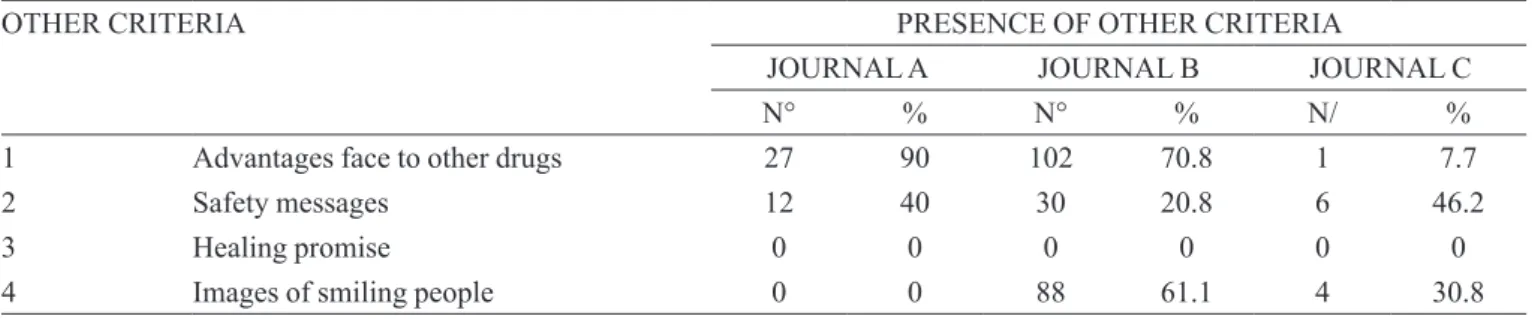
The images of people smiling and demonstrating he alth represent a resource used in 49.2% of advertisements. According to Silva, Barreto and Facin (2006), the images shown through advertising, in the majority of cases, are produced with speciic intentions and, for many times, are mere illusions of reality, once they do not represent the more frequent physical, psychological, social and economical characteristics of people to which they are addressed, but on the contrary, they valorize characteris tics that are typical of a minority, which dificultly could be attained by a common middle citizen. Exactly because the low incidence of such characteristics, the dificulty to attain them and their exhaustive suggestion in the media, they become the aimed ideal of “perfection”. Respecting this, Aumont (1993) afirms that images have as their irst purpose, to assure, reinforce, reaffirm and explicit our relationship with the visual world: they perform a role of visual discovery and this relationship is essential for our intellectual activity. The spectator builds the image and the image builds the spectator. This approach consists, before everything, in treating the spectator as an active partner of the image, emotionally and cognitively; and also as a psychic organism on which the image, by its turn, also acts.
Analysis of references
The bibliographical materials referenced in the ad vertisements were constituted by: journal articles (87.5%), package inserts (7.9%), product monographs (1.3%), books (1.2%), iled data (0.9%), and others unidentiied
(1.1%) due to incomplete references.
Out of 1362 references quoted in the advertisements, 268 (19.7%) were not localized; such material was cons tituted by 223 (83.2%) journal articles, 18 (6.7%) product monographs, 12 (4.5%) iled data and 15 (5.6%) uniden tiied materials.
The unidentiied materials presented minimum data, did not allowing even their classiication respecting the type of bibliographic material. Generally, the non locali zed references omitted some important datum, essential for their localization, and were not according to norms of International Committee of Medical Journal Editors (ICMJE, 2008). Data omission precluding the access to information appearing in advertising pieces, puts in check their own credibility. In the same way, Spielmans et al. (2008), evaluating the accuracy of advertising divulged in medical journals, veriied that more than a half (50.2%) of affirmations done in these advertisements, did not provide an accessible source that could be used to check their veracity.
The bibliographical material found (80.3%) was evaluated to verify if it was in accordance with the quo tation done in the respective advertisement. In 62.9% of cases, the quotations were conirmed.
Table IV demonstrates the evaluation of quotations per type of journal.
It was veriied that 37.1% of afirmations appearing in the analyzed advertisements were not conirmed by their referenced sources; a fact that compromises too much the quality of divulged information. Villanueva et al.(2003),
TABLE III – Evaluation of other criteria per journal
OTHER CRITERIA PRESENCE OF OTHER CRITERIA
JOURNAL A JOURNAL B JOURNAL C
N° % N° % N/ %
1 Advantages face to other drugs 27 90 102 70.8 1 7.7
2 Safety messages 12 40 30 20.8 6 46.2
3 Healing promise 0 0 0 0 0 0
4 Images of smiling people 0 0 88 61.1 4 30.8
TABLE IV – Evaluation of quotations per type of journal
CONFIRMED NOT CONFIRMED TOTAL
N° % N° % N° %
JOURNAL A 130 69.1 58 30.9 188 100
JOURNAL B 497 59.2 343 40.8 840 100
JOURNAL C 61 92.4 5 7.6 66 100
analyzing advertisements published in six Spanish medi cal journals in 1997, observed that 41.1% of promotional affirmations were not supported by references. In the same way, Lankinen et al. (2004), evaluating medicine advertisements divulged in four medical journals, veriied that 21% of quoted references were not relevant for the respective afirmations, concluding that referenced afir mations contained in pharmaceutical advertisements could present a more scientiic image, however, such references do not assure the quality of their respective afirmations.
These results demonstrate that many pharmaceutical advertisements violate the RDC n. 102 in its article 15th, which speciies that “The quotations, tables and other illustration extracted from scientific publications and utilized in any advertisement, publicity or promotion, should be faithfully reproduced and specify the complete bibliographical reference” (Brasil, 2000). These ground less advertisements violate also the Code of Consumer De fense, which establishes at its § 1st of article 37th that “It is deceptive any modality of information or communication of promotional character entirely or partially fake, or that is, by any other mode, even by omission, able to induce the consumer in a mistake […]” (Brasil, 1990). Taking it into account, the referenced and unconirmed afirmations constitute deceptive advertising, being liable, therefore, for applicable legal sanctions.
Usually, physicians do not admit their respective prescription habit is subjected, in higher or lower grade, to influence from promotional activities promoted by pharmaceutical industry, in which substantial resources are invested. Particularly addressed to physicians, such expenses are, ultimately, defrayed by the consumer, as they are inlaid in the products price. So signiicant expenditures (on the order of 20 to 25% of global invoicing) applied in advertising could only be explained, by the expected return in terms of sales and proits. In the United States, just in the year of 2004, US$ 57.5 billion were spent by pharmaceutical companies in promotional activities (Gag non, Lexchin, 2008).
The advertising inserted into medical journals, responsible for their defrayal, was already object of inte rest of different foreign studies. One of them intended to demonstrate the existing relationship between an increase in the prescription rate of a given product, and the respec tive number of divulged advertisements. In this study, the authors observed that high investments in advertising are necessary to successfully achieve high sales levels, for a drug that has no precise effect in the improvement of some speciic psychological conditions (Krupka, Vener, 1985). On the other hand, it was already veriied that a less critical attitude from physicians, face to pharmaceutical
companies promotional strategies, is associated to a low quality prescription (Haaijer-Ruskamp, Hemminki, 1993). In Brazil, according to Barros (1995), the adver tising addressed to physicians succeeds to change their prescription habits. Fagundes et al. (2007), developing a
study with physicians in Brasilia (DF), veriied that 68% of them believe in the direct inluence of advertising on prescription and 14% said to prescribe medicines as a func tion of rewards reception. Trevisol, Ferreira and Karnopp (2007), in a study about medicines advertising developed with medicine teachers and students, veriied that between those teachers, 53.6% considered to be never or rarely influenced by the pharmaceutical industry, and 53.7% afirmed to believe that their professional colleagues are so. Between the students, 43.2% believe that in the future, as graduated physicians, they will not or rarely be inluen ced, however, 42.0% believe that physicians are always or frequently inluenced. For 41.7% of them, the information from pharmaceutical industry representatives is good or optimal, in addition, 74.8% reported that pharmaceutical industry could contribute for their professional practice.
CONCLUSIONS
Among the legal criteria evaluated in advertise ments, it was veriied as the main irregularity, the lack of legibility in technical-scientiic information in 85% of cases; in 23%, the omission of side effects; in 15% the absence of cautions and warnings; in 12.8% the omission of contraindications; in 6.4% the absence of posology; in 2.7% the lack of registration number; and in 0.6% the ab sence of DCB/DCI. In addition, not always true arguments were divulged to proclaim product advantages; which characterizes a violation of current country legal norms, as well as ethical criteria established by WHO.
The marketing strategies utilized in persuasion in volved, mainly, afirmations of advantage face other drugs and safety messages, which not always relected the vera city of quoted bibliographical support. Besides, another much utilized tool was the divulgence of smiling people demonstrating health, in order to reinforce the established idea respecting the role of medicines in health recovery.
The non accomplishment of current legislation, the dificulty and/or impossibility of access to important in formation, and the excess of arguments that are not always true and/or present ambiguities sometimes, compromise the quality of divulged information giving margin to different interpretations, and could induce prescription mistakes and negatively influence the consumption of medicines, becoming irrational their utilization.
Face to these substantiations, in the same way as journals keep an editorial council to evaluate the articles to be published, they could also keep a team to analyze the advertisements to be divulged, correcting possible distor tions and collaborating for the reliability of information presented in their successive editions.
REFERENCES
AUMONT, J. A imagem. Campinas: Papirus, 1993. 350 p.
BARROS, J. A. C. A (des)informação sobre medicamentos: o duplo padrão de conduta das empresas farmacêuticas. Cad. Saúde Pública, Rio de Janeiro, v.16, n.2, p.421-427. 2000. BARROS, J. A. C. Políticas farmacêuticas: a serviço dos interesses
da saúde? Brasília: UNESCO/ANVISA; 2004. 272 p.
BARROS, J. A. C. Propaganda de medicamentos: atentado à saúde? São Paulo: Hucitec/Sobravime. 1995. 207 p.
BARROS, J. A. C.; JOANY, S. Anúncios de medicamentos em revistas médicas: ajudando a promover a boa prescrição? Ciênc. Saúde Colet., v. 7, n. 4, p. 891-898. 2002.
BERO, L.; GALBRAITH, A.; RENNIE, D. The publication of sponsored symposiums in medical journals. N. Engl. J. Med., v. 327, n. 16, p. 1135-1140. 1992.
BRASIL. Código de Defesa do Consumidor. Lei nº. 8.078, de 11 de setembro de 1990. Dispõe sobre a proteção do consumidor e dá outras providências. Available at: <http://www.procon.df.gov.br/005/00502001.asp?ttCD_ CHAVE=4565#>. Accessed on: 10 mar., 2008.
BRASIL. Decreto nº 79.094, de 5 de janeiro de 1977. Regulamenta a Lei nº 6360, de 23 de setembro de 1976, que submete a sistema de vigilância sanitária os medicamentos, insumos, farmacêuticos, drogas, correlatos, cosméticos, produtos de higiene, saneantes e outros. Diário Oicial da União, Brasília, DF, 7 jan. 1977. Available at: <http://e-legis.bvs.br/leisref/ public/showAct.php?id=16611&word=>. Accessed on: 10 mar. 2008.
BRASIL. Resolução RDC nº. 102, de 30 de novembro de 2000. Aprova o regulamento sobre propagandas, mensagens publicitárias e promocionais e outras práticas cujo objeto seja a divulgação, promoção ou comercialização de medicamentos de produção nacional ou importados, quaisquer que sejam as formas e meios de sua veiculação, incluindo as transmitidas no decorrer da programação normal das emissoras de rádio e televisão. Diário Oicial da União, Brasília, DF, 1 Jan. 2000. Available at:
<http://e-legis.anvisa.gov.br/leisref/public/showAct.php?id=11079>. Accessed on: 9 mar. 2008.
CÂMARA DOS DEPUTADOS. Relatório da CPI dos medicamentos. Brasília: Centro de Documentações, Câmara dos Deputados, Coordenação de Publicações. Brasília, 2000. 279p.
CASTRESANA, L.; MEJIA, R.; AZNAR, M. The atitude of physicians regarding the promotion strategies of pharmaceutical industry. Medicina (B Aires), v.65, n.3, p.247-251. 2005.
FAGUNDES, M. J. D.; SOARES, M. G. A.; DINIZ, N. M.; PIRES, J. R.; GARRAFA, V. Análise bioética da propaganda e publicidade de medicamentos. Ciênc. Saúde Colet., v. 12, n. 1, p. 221-229. 2007.
GAGNON, M. A.; LEXCHIN, J. The cost of pushing pills: a new estimate of pharmaceutical promotion expenditures in the United States. PLoS Medicine, v.5, n.1, p.2933. 2008. Available at: <www.plosmedicine.org 0029>. Accessed on: 3 feb. 2008.
HAAIJER-RUSKAMP, F. M.; HEMMINKI, E. The social aspects of drug use. WHO Reg. Publ., Eur. Ser., v.45, número?, p.97-124. 1993.
HODGES, B. Interactions with the pharmaceutical industry: experiences and atitudes of psychiatry residents, interns and clerks. Can. Med. Assoc. J., v.153, n.5, p.553559. 1995.
ICMJE. Uniform Requirements for Manuscripts Submitted to Biomedical Journals: Writing and Editing for Biomedical Publication. Available at: <http://www.icmje.org/>. Accessed on: 9 mar. 2008.
JESUS, P. R. C. Propaganda de medicamentos: os éticos e a ética da indústria farmacêutica no Brasil. 2000. Available at: <http://www.eca.usp.br/alaic/chile2000/10%20GT%20 2000Com%20e%20Salude/Paula%20Renata.doc>. Accessed on: 17 aug. 2007.
KESSLER, D. A.; ROSE, J. L.; TEMPLE, R. J.; SCHAPIRO, R.; GRIFFIN, J. P. Therapeutic-class wars drug promotion in a competitive marketplace. New Eng. J. Med., v. 331, n. 20, p. 13501353. 1994.
KOTLER, P. Administração de marketing. 10. ed. São Paulo: Prentice Hall. 2000. 768p.
KRUPKA, L. R.; VENER, A. M. Prescription drug advertising: trends and implications. Soc. Sci. Med., v.20, n.3, p.191 197. 1985.
LANKINEN, K. S.; LEVOLA, T.; MARTTINEN, K.; PUUMALAINEN, I.; HELIN-SALMIVAARA, A. Industry guidelines, laws and regulations ignored: quality of drug advertising in medical journals. Pharmacoepidemiol. Drug Saf., v. 13, n. 11, p. 789-795. 2004.
LEXCHIN, J. Interactions between physicians and the pharmaceutical industry: what does the literature say? Can. Med. Assoc. J., v.149, n.10, p.1401-1407. 1993.
MEJIA, R.; AVALOS, A. Printed material distributed by pharmaceutical propaganda agents. Medicina (Buenos Aires), v. 61, n. 3, p. 315318. 2001.
PIZZOL, F. D.; SILVA, T. da; SCHENKEL, E. P. Análise da adequação das propagandas de medicamentos dirigidas à categoria médica distribuídas no Sul do Brasil. Cad. Saúde Pública, v. 14, n. 1, p. 8591, 1998.
RESENER, M. C. Análise da qualidade de propagandas de medicamentos fitoterápicos disponibilizadas em Santa Catarina. Florianópolis: UFSC, 2004. 262 p. [Dissertação de Mestrado em Farmácia. Faculdade de Farmácia. Universidade Federal de Santa Catarina].
SILVA, D. R.; BARRETO, M. J.; FACIN, T. C. Publicidade: a fada madrinha da realidade. 2006. In: INTERCOM SUDESTE 2006 – Simpósio de Ciências da Comunicação na Região Sudeste, 11., 2006. Ribeirão Preto, SP. Available at: <http://reposcom.portcom.intercom.org.br/ bitstream/1904/19376/1/Daniela+Silva-Michael+Barreto-Tereza+Facin.pdf>. Accessed on: 9 mar. 2008.
SMITH, R. Medical journals and pharmaceutical companies: uneasy bedfellows. Br. Med. J., v. 326, n. 7400, p. 1202-1205. 2003.
SMITH, R. Should medical journals carry drug advertisement? Yes. Br. Med. J., v. 335, n. 7610, p. 74. 2007.
SOBRAVIME. O que é uso racional de medicamentos. Sociedade Brasileira de Vigilância de Medicamentos, Acción Internacional para la Salud – América Latina y El Caribe. São Paulo: Sobravime, 2001. 123 p.
SPIELMANS, G. I.; THIELGES, S. A.; DENT, A. L.; GREENBERG, R. P. The accuracy of psychiatric medication advertisements in medical journals. J. Nerv. Mental Dis., v. 196, n. 4, p. 267-273. 2008.
TEMPORÃO, J. G. A propaganda de medicamentos e o mito da saúde. Rio de Janeiro: Graal. 1986. 183 p.
TREVISOL, D. J.; FERREIRA, M. B. C.; KARNOPP, Z. M. P. A propaganda de medicamentos em escola de medicina do sul do Brasil.Ciência & Saúde Coletiva. 2007. Available at: <http://www.abrasco.org.br/cienciaesaudecoletiva/artigos/ artigo_int.php?id_artigo=1950>. Accessed on: 6 jun. 2008.
VILLANUEVA, P.; PEIRÓ, S.; LIBRERO, J.; PEREIRÓ, I. Accuracy of pharmaceutical advertisements in medical journals. Lancet, v.361, n. 9351, p.27-32, 2003.
VLASSOV, V.; MANSFIELD, P.; LEXCHIN, J.; VLASSOVA, A. Do drug advertisements in Russian medical journals provide essential information for safe prescribing? West. J. Med., v. 174, n. 6, p. 391-394. 2001.
ZIPKIN, D. A.; STEINMAN, M. A. Interactions between pharmaceutical representatives and doctors in training. Journal of General Internal Medicine, v. 20, n. 8, p. 777-786. 2005. Available at: <http://www.pubmedcentral. nih.gov/articlerender.fcgi?tool=pubmed&pubmed id=16050893>. Accessed on: 9 mar. 2008.
WORLD HEALTH ORGANIZATION. World Health Assembly. Resolution WHA41.17. Ethical Criteria for Medicinal Drug Promotion. Adopted by the Forty-irst World Health Assembly, 13 May 1988. Available at: <http://mednet2. who.int/edmonitor/edition/edm17a.html>. Accessed on: 23 jan. 2006.
Received for publication on 01st april 2008