*Correspondence: C. R. F. Souza. Departamento de Ciências Farmacêuticas, Faculdade de Ciências Farmacêuticas de Ribeirão Preto, University of São Paulo. Via do Café, s/n – Bloco Q – Bairro Monte Alegre – 14040-903 – Ribeirão Preto – SP. E-mail: [email protected]
A
vol. 45, n. 2, abr./jun., 2009
Antioxidant activity and physical-chemical properties of spray and
spouted bed dried extracts of
Bauhinia forficata
Claudia Regina Fernandes Souza
1*, Sandra Regina Georgetti
2, Marcos José Salvador
3, Maria José
Vieira Fonseca
1, Wanderley Pereira Oliveira
11Department of Pharmaceutical Sciences, Faculty of Pharmaceutical Sciences of Ribeirão Preto, University of São Paulo, 2Department of Food and Drugs Technology, Healthy Sciences Center, State University of Londrina, 3Institute of Biology, State
University of Campinas
Two distinct drying methods (spouted bed and spray drying) were used for production of dried extracts of Bauhinia foricata Link (Leguminosae, Caesalpinoideae). High-quality powder products in terms of
physical and chemical properties were obtained. HPLC ingerprints revealed that the chromatographic proiles of lavonoid compounds present in the dried extract did not change signiicantly, due to drying. In general, the spouted bed drying caused a degradation of total lavonoids than was lower than that of the
spray drying. Antioxidant properties of the dried extract, examined by their radical scavenging activity using 2,2-diphenyl-1-picrylhydrazyl radical (DPPH·) and inhibition of lipid peroxidation induced by Fe+2 assays (LPO), conirmed their antioxidant potential. The slight reduction in scavenging activity of
the dried extracts may be associated with the occurrence of oxidative reactions, decomposition or losses of thermolabile compounds, induced by the heat.
Uniterms:Bauhinia foricata/antioxidant activity. Bauhinia foricata/dried extract/properties. Flavonoids/ qualitative analysis. Spouted bed/utilization. Spray drying/utilization.
Neste trabalho foram utilizados dois distintos secadores (leito de jorro e spray dryer) para a produção de extratos secos de Bauhinia foricata Link (Leguminosae, Caesalpinoideae) obtendo-se um produto seco com elevada qualidade em termos de suas propriedades físicas e químicas. Análises qualitativas
obtidas por CLAE revelam que os peris cromatográicos dos compostos lavonóides presentes nos extratos secos não apresentaram signiicativas mudanças durante a secagem quando comparados aos peris obtidos para os extratos concentrados. Em geral, a secagem por leito de jorro acarreta menores perdas dos lavonóides totais do que a secagem em spray drying. A atividade antioxidante dos extratos secos foi examinada pelos métodos de (DPPH·) e peroxidação lipídica induzida por Fe+2 (LPO). Uma
pequena redução na atividade sequestradora de radicais livres observada para os extratos secos pode ser associada com a ocorrência de reações oxidativas, decomposição e/ou perdas de compostos termolábeis induzidas pelo calor.
Unitermos: Bauhinia foricata/atividade antioxidante. Bauhinia foricata/extrato seco/propriedades.
Flavonóides/análise qualitativa. Leito de jorro/utilização. Spray drying/utilização.
INTRODUCTION
Currently, the causes of several diseases such as liver cirrhosis, arteriosclerosis, cancer, and diabetes have been associated with the presence of free radicals. These radicals may cause oxidative damage by oxidizing
bio-molecules, and it results in cellular death and consequent tissue damage. Therefore, free radicals scavenging com-pounds may have a great potential to inhibit or reduce the oxidative damage on the human body (Brighente et al., 2007; Moein et al., 2007; Sabu, Kuttan, 2002).
On the other hand, diabetes disease is increasing rapidly and consuming vast amounts of health care resour-ces worldwide (Sousa et al., 2004). In Latin America, the
having negative impact on quality of life and burdening the health care system (Sartorelli, Franco, 2003).
In the Brazilian folk medicine, Bauhinia forficata
Link (Leguminosae, Caesalpinoideae), commonly known as pata-de-vaca (paw-of-cow), has been widely used as an antidiabetic herbal remedy (Pepato et al., 2002; Pepato
et al., 2004; Silva, Cechinel, 2002). This plant species is
characterized by the accumulation of lavonoids (glyco -sides and aglycones) in their leaves (Jorge et al., 2004). Phytochemical and pharmacological studies carried out with Bauhinia species have demonstrated the presence of several classes of organic compounds of medicinal interest,
including the lavonoids (Silva, Cechinel, 2002). Antioxi -dant properties (Sousa et al., 2004; Damasceno et al., 2004),
anticoagulant and antiibrinogenolytic activities against
Bothrops jararacussu Lacerda, 1884 (Ophidia, Viperidae) venom and its isolated thrombin-like serine protease enzy-me, induced by aqueous extract from this plant, have been also reported (Oliveira et al., 2005). Several chemical cons-tituents, including lactones, terpenoids, glycosyl steroids,
alkaloids, lavonoids, mucilage, essential oils, tannins and quinines have been isolated and identiied from this species.
Several authors have investigated the effects of natural
lavonoids in physiological and pathological conditions of
glucose metabolism as well as in lipid peroxidation (Silva
et al., 2000; Sousa et al., 2004; Damasceno et al., 2004; Menezes et al., 2007; Volpato et al., 2008). Souza et al.
(2004) veriied that the kaempferitrin, a lavonoid fraction
from Bauhinia foricata leaves, posses strong antioxidant potential. Pinheiro et al. (2006) have made attempts in or-der to correlate the attributed antidiabetic properties of the
Bauhinia foricata extract to the kaempferitrin.
The quality of medicinal plants can be affected by many factors, including species variation, climate, harvesting, storage, and processing. Consequently, the standardization and quality control of herbs are important
issues to assure the eficacy and safety of herbal medicines
(Pietta, Mauri, 2001). Commonly, standardized herbal preparations are commercialized as liquid, viscous prepa-rations and powders resulting from dried and comminuted
plants, or from an extract drying. Important advantages
attributed to the dried extracts over conventional forms are the facility of standardization, lower storage costs and higher concentration and stability of active substances. However, the drying method and the operating conditions used for the production of the dried extract may impact the product physicochemical properties, and can originate varying degrees of active compounds loss (Runha et al., 2001; Souza, Oliveira, 2006; Oliveira, Bott, Souza, 2006). The aim of this work was the evaluation of the effects of the spouted bed and spray drying on antioxidant
activity and physical-chemical properties of dried extracts of Bauhinia foricata Link.
MATERIALS AND METHODS
Plant material, chemicals and extract preparation
Dried leaves of Bauhinia foricata were acquired from Santa Rosa´s Farm, located in Jundiaí city, São Paulo State, Brazil. The leaves were pulverized in a knife mill until a mean diameter of 300 mm. This material was cha-racterized by determination of loss on drying, extractable matter and total flavonoid content, used as a chemical
marker for quantiication of the bioactive compounds de -gradation during drying. The procedures used in this cha-racterization are presented in Souza and Oliveira (2006). Ethyl acetate, methanol, acetone, aluminum chlo-ride, ethanol, hydrochloric acid (LabSynth), hexamethy-lenetetramine (Vetec), colloidal silicon dioxide (Tixosil 333®, Rhodia - Brazil), dehydrated quercetin
(Sigma-Al-drich) and 2,2-diphenyl-1-picrylhydrazyl (DPPH·, Sigma-Aldrich) were used as reagents and reference substances.
Dried and powdered leaves were placed in contact with an ethanol:water solution (70:30 in weight) at tempe-rature of 50 ºC in a jacketed stirred vessel. The extraction time lasted 60 min at stirring rate of 200 rpm. The extract
was iltered and concentrated three times in a rotary eva -porator (vacuum pressure of 600 mmHg and 50 °C), and
its density, solid concentration, alcohol, and total lavonoid
content was determined.
Determination of total flavonoid contents
Total lavonoid contents present in the herbal mate -rial, concentrated and dried extracts was used as bioactive marker for the evaluation of thermal degradation during
the processing stages. The total lavonoid contents was de -termined by UV spectrophotometry. The method includes the hydrolysis of glycosides, followed by the extraction of
lavonoids with ethyl acetate and color development with
a solution of aluminum chloride (Kulevanova, Stefova,
Stailov, 2000; Souza, 2003). Absorbance was measured at
425 nm after 30 min, using a spectrophotometer HP 8453 running the software HP Chem-Station®. The percentage
of total lavonoid (FT) was expressed as quercetin (average of three determinations), by means of a calibration curve.
HPLC-DAD fingerprints
for 15 min in an ultrasonic bath (Odontobras, model 802) and put to rest for 24 h. After this period, the samples were
iltered through 0.45 mm polytetraluoroethylene syringe tip ilters into the glass HPLC vials. The analyses were
carried out in a Shimadzu liquid chromatograph equipped with a Supelco RP-18 column (225 x 4.6 mm i.d.; 5 mm) operating at 25 °C. The mobile phase consisted of a linear gradient combining solvent A (acetonitrile) and solvent B (water/acetic acid, 99:1, v/v, pH 2.88) as follows: 15% A (15 min), 15–20% A (7 min), 20% A (5 min), 20–40% A (5 min), 40% A (5 min), 40–15% A (3 min). The analyses
were carried out in triplicate, at a low rate of 0.8 mL/min,
with the photodiode array UV detector set at l = 330 nm and an injection volume of 20 mL. The lavanone naringe -nin (25 mg/mL) was used as internal standard.
Extracts drying
Two distinct drying systems (spouted bed and spray dryer) were used for production of the dried extracts. The spouted bed dryer consists of a conical base with
inter-nal angle of 40° and inlet oriice diameter of 33 mm. A
cylindrical column with diameter of 150 mm and height of 400 mm is connected to the conical base of the dryer. The upper part of the equipment is constituted by another cone and by a cyclone. All parts are made in stainless steel.
Telon® beads of concave-cylindrical shape with mean
diameter of 5.45 mm, shape factor of 0.96, speciic surface
of 5.27cm2/g and density of 2.16 g/cm3 were used as inert
material. Telon was selected due to its inert nature, high thermal stability, low coeficient of friction, insolubility
and lack of toxicological effects (Tzeng et al., 1997). The main components of the system are a 7.5 HP blower, a
low meter, an electric heater (power of 5000 W), and a
temperature controller. The extract feed system consists
of a double luid atomizer with internal mixing (0.8 mm
hole), a peristaltic pump and an air compressor. The dried product was collected in a stainless steel Lapple type cyclone with diameter of 0.095 m, having a cut diameter of 4.1 mm (for the experimental conditions used). Ther-mocouples, pressure transducers and a thermo-hygrometer were employed in the equipment instrumentation.
Spray drying was carried out in a bench-top spray dryer, model SD-05 (Lab-Plant, U.K.), with concurrent
low regime. The drying chamber has diameter of 215 mm
and height of 500 mm. The main components of the system were the extract feed unit, constituted of a peristaltic pump,
a two luid atomizer (inlet oriice diameter of 0.5 mm) and
an air compressor; a feed mechanism of the drying gas
(constituted of a blower and an air ilter), and a tempera -ture control unit of the drying gas. The dried product was collected in a Lapple cyclone with diameter of 0.085 m (cut diameter of 3.9 mm).
The drying runs were performed at optimized ope-rating conditions obtained from previous studies (Souza, 2003). The drying operation started with injection of the drying air to the dryers. The air was heated and, when reached the desired temperature, the feed of the
concen-trated extracts with a preset low rate together with the
atomizing air was started. Measurements of the outlet gas temperature, Tgo, were taken at regular intervals in order to detect the moment when the dryers attained the steady state (± 15 min). Once the steady state was reached, samples of the dried extract were withdrawn. The samples were used for the assessment of the antioxidant activity and charac-terization of the physical and chemical properties. The size distribution was determined by an optical microscope Olympus BX60MI connected to an image analysis system
(Image Pro-plus4.5). Colloidal silicon dioxide (Tixosil®
333 – Rhodia, Brazil) was added to the concentrated ex-tracts before drying, to improve the dryer performance
(80 % calculated on the solid contents). Table I shows the
operational parameters used in the drying runs.
Assessment of the antioxidant activity of concentrated and dried extracts
DPPH· is a stable free radical that reacts with com-pounds, which are able to donate a hydrogen atom (Blois, 1958; Brand-Willians et al., 1995). The hydrogen donating ability of the concentrated and dried extracts of B. foricata to DPPH· was determined according to Blois (1958).The concentrated extract (10 mL) at different dilutions (1:10, 1:20, 1:50, 1:100, and 1:200) and of the dried extract of B.
TABLE I- Spouted bed and spray drying parameters used in manufacture of the dried extract
Dryer Tgi ( °C ) Ws/Wmax ( % ) Ws ( g/min ) Wg ( kg/s )
SB 150 45 33.0 0.0340
SD 150 15 4.0 0.0227
foricata (6.25-0.375 mg/mL) in ethanol were added in a reaction mixture containing 1 mL of 0.1 M acetate buffer pH 5.5, 1 mL of ethanol, and 0.5 mL of 250 mM DPPH· mM in ethanol solution. The resulting samples concentra-tions in the reaction medium were 0.02-0.4 mL/mL and 1.5-25 mg/mL, respectively. The change in absorbance was measured at 517 nm after 15 min (at room temperature). All measurements were made in quintuplicate (Fejes et al., 2002; Nuutila, Kammiovirta, Oksman-Caldentey, 2006; Georgetti et al., 2006; Casagrande et al., 2007).
Lipid peroxidation induced by Fe+2/citrate (LPO)
was assayed by malondialdehyde (MDA) generation (Ro-drigues et al., 2002; Cain, Skilleter, 1987) in the presence of different concentrations of B. foricata extracts. Mito-chondria were prepared by standard differential centrifu-gation techniques as described by Rodrigues et al. (2002) and by Cain and Skilleter (1987). 10 mL of the concentrated extract (1:10-1:200) and dried extract (0.15-2.5 mg/mL) a t different concentrations (12.5-300 mg/mL in DMSO) were added to 1.0 mL of a reaction mixture (125 mmol/L sucrose, 65 mmol/L KCl and 10 mmol/L Tris-HCl, pH 7.4
– medium I). Mitochondria were added to yield a inal con -centration of 1 mg of protein plus 50 mM (NH4)2Fe(SO)4
and 2 mM sodium citrate for 30 min at 37 ºC. The inal
concentrations of the concentrated and dried extracts in the reaction medium were 0.02-0.4 mL/mL and 0.6-10 mg/mL, respectively. To determine MDA, 1 mL of 1% thiobarbi-turic acid (TBA), prepared in 50 mM NaOH, and 0.1 mL of 10 M NaOH and 0.5 mL of 20% H3PO4 were added, followed by incubation for 20 min at 85 ºC. The MDA-TBA complex was extracted with 2 mL of isobutanol. The samples were then centrifuged at 1660 g for 10 min. The measurement was performed on the supernatant at 535 nm (Casagrande et al., 2007; Rodrigues et al., 2002; Santos et al., 1998). Two controls were used, a positive control (samples absence) and a negative control (iron
absence). The blank was prepared from the medium I
without mitochondria. Thus, the positive control indicates the maximum MDA formation, which was considered 100% of peroxidation to calculate the inhibition of lipid peroxidation by the antioxidants retained in the dried ex-tracts. All measurements were performed in quintuplicate. Quercetin was used as a reference sample for both assays.
Statistical analysis
The concentration of dried extract that caused 50% of the hydrogen-donating ability and/or lipid peroxidation
was considered as the IC50 in each assay. These values were determinate through the GraphPad Prism® software.
Experimental IC50 results were statistically analyzed by one-way ANOVA, followed by Bonferroni’s multiple comparisons t-test to evaluate the effect of the drying process on antioxidant activity. Results were expressed
as mean ± standard deviation and considered signiicant
when P < 0.05.
RESULTS AND DISCUSSION
Characterization of the herbal material and extractive solution
The herbal material presented moisture content (loss on drying) of 9.5 ± 0.2 (% w/w), extractable matter (ethanol:water mixture) of 26.7 ± 0.05 (% w/w) and total
lavonoid content of 1.36 ± 0.2 (% w/w). The extractive solution was prepared by placing the pulverized herbal material in contact with ethanol:water solution (70:30 in weight) at temperature of 50 ºC in a jacketed stirred vessel with controlled temperature. The extractive solu-tion was concentrated three times in order to increase the solids content to approximately 8.0%. The properties of the extractive solution and of the concentrated extract are
presented at Table II. The results of total lavonoid contents
(FT) in the concentrated extract (EC) showed a thermal degradation rate of the order of 5.89%, as compared to the results of the extractive solution. Ethanol is more volatile and has a lower boiling point than water, presenting a gre-ater tendency to be removed from the extractive solution during concentration, than water does. This fact leads to a concentrated extract with reduced alcohol concentration.
Drying performance and product properties
Spouted bed and spray drying performances were evaluated through determination of the elutriation ratio, E; product recovery ratio, R; and, product accumulation
TABLE II- Properties of the extractive solution and of the concentrated extract
Extracts FT ( % mg/gextract ) r ( g/cm3 ) Solid contents ( % w/w ) Alcohol content ( °GL )
ES 13.92 ± 0.05 0.96 ± 0.009 2.66 ± 0.02 70.0
EC 13.10 ± 0.03 0.95 ± 0.010 8.05 ± 0.06 0.0
(only for the spouted bed), Ac (Souza, Oliveira, 2006; 2005). The dried extracts were characterized by the loss
on drying, total lavonoids concentration and HPLC-DAD ingerprint, product size distribution, antioxidant activity, and physical properties. Table III presents the spray and
spouted bed dryers’ performance and the properties of
the dried extracts. It can be observed at Table III that
the spouted bed dryer gives an end product with higher concentration of chemical markers and small loss on drying values (≈ low residual moisture content) than the spray dryer does. The spouted bed dryer also presented a better performance than the spray dryer, leading to higher product recovery. The spouted bed drying gives an end product with higher concentration of the chemical markers and lower loss on drying values than the spray drying; even both processes working at similar relation Ws/Wmax and inlet gas temperatures. Similar results have been reported elsewhere (Oliveira, Bott, Souza, 2006).
The particle size distribution is an important pro-perty, which may be related with bioavailability and uni-form and constant release of the product (Freitag, 2001). Polydisperse particles within a limited range (0 to 30 mm) were obtained by both drying systems. Spouted bed drying
generates irregular particles with lakes shape, whereas
the spray drying process gives a high proportion of near rounded particles.
In general, during hot air drying the product is exposed to high temperatures and high oxygen levels. In
addition, the solids concentration increases during drying (removal of solvent). These factors may increase the rate of oxidative and degradation reactions, reducing the pro-duct quality (Giovanelli, Paradiso, 2002). Degradation rates of 0.2% were observed for the spouted bed dried, smaller than the observed for the spray dried product (39.9%). This behavior possibly is related with the distinct drying mechanism involved in both dryers and may be re-lated with the different residence time of the product in the
dryers. In order to verify the occurrence of alteration in the lavonoid compounds chromatographic proiles presented
in the concentrated and in the dried extract, HPLC-DAD
analyses were carried out. The chromatographic proiles were used only to ind out changes in the relative magni -tudes of the peaks, in order to know if major changes have occurred. Figure 1 shows typical chromatograms obtained for the concentrated extracts (reference sample) and for the spouted bed and spray dried extracts. HPLC-DAD analy-ses performed for the B. foricata extracts did not indicate
signiicant alteration in the chromatographic proiles of
the dried product, comparatively with the concentrated ex-tracts. However, although the same peaks were presented in the HPLC chromatograms, the peaks magnitude may differ, suggesting molecular changes due to the drying (oxidation, enzymatic hydrolyses, etc).
Antioxidant activity of concentrated and dried extracts
The antioxidant properties of the concentrated (used as a control) and resulting dried extracts were assessed by the DPPH· and LPO methods. The parameter IC50 (con-centration needed to inhibit the oxidative reaction by 50%) was used to interpret the experimental data. Quercetin, a natural antioxidant, was used here as a standard referen-ce material. This flavonoid presented a conreferen-centration-
concentration-dependent hydrogen-donating ability and showed an IC50
of 1.17 mg/mL. The maximum percentage of hydrogen-donating ability (89.0%) was obtained using 4 mg/mL; at a higher concentration (10 mg/mL) a plateau effect was observed (Casagrande et al., 2007). Table IV shows, res -pectively, the results of the DPPH·inhibitionproduced by the concentrated extract (EC), for the spouted bed (SB) and for the spray dried extract (SD). The results indicate that the free radical scavenging activity of the analyzed samples were concentration dependent. The maximum DPPH· reduction promoted by the concentrated extract was approximately 76% at a concentration of 39.2 mg/mL,
giving an IC50 = 16.2 mg/mL. A maximum DPPH
·
inhibi-tion of 69.2 and 70.4%, respectively, were obtained for the TABLE III- Spray and spouted bed dryers performance and properties of the dried extracts
Dryer Dryer performance Dried extract properties
R**
( % )
E ( % )
Ac*
( % )
Ws (g/min)
Tgo ( °C )
FT**
(% mg/gextract)
D ( % )
Xp ( % )
dp ( mm )
SB 78.44 19.36 2.20 33.18 116.2 13.08 ± 0.01 0.2 3.99 ± 0.22 21.8
SD 48.90 51.10 – 2.90 108.0 7.87 ± 0.05 39.9 3.78 ± 1,21 14.4
*Ac: accumulation rate (only for SB); R: product recovery; E: elutriation; F
T: total lavonoid contents; D: thermal degradation of lavonoid compounds; Xp: loss on drying; dp: mean particle diameter; Tgo: outlet gas temperature.
spouted bed and for the spray dried extracts. These results were reached at concentrations of 55.5 mg/mL of the
ex-tract material, giving IC50 values of 12.2 and 12.9 mg/mL, respectively. The slight decreases in the maximum scaven-ging activity of the dried extracts may be associated with the occurrence of oxidative reactions, decomposition of thermo labile compounds or even losses of volatile substances
induced by the heat. A review of the inluence of the pro -cessing on the antioxidant properties of foods was presented by Nicoli, Anese and Parpinel (1999). According to these authors, the changes occurred during the processing are
expected to affect the content, activity and bioavailability of
the bioactive compounds. In addition, compounds capable
of providing a synergistic effect for antioxidant activity could be damaged or removed due the drying, contributing for the reduction of the antioxidant effectiveness of the dried product (Cousins et al., 2007; Djeridane et al., 2006; Ungar, Osundahunsi, Shimoni, 2003).
The effects of the B. foricata extracts on inhibition of lipid peroxidation induced by Fe+2/citrate were
inves-tigated by the production of MDA-TBA complex (absor-bance reading at 535 nm). Quercetin inhibited the lipid peroxidation following a concentration-dependent manner, as shown in Casagrande et al., (2006). Signiicant inhibi -tory activity of the lipid peroxidation as compared to the positive control (100% complex MDA-TBA) was
demons-trated by quercetin, which presented an IC50 = 0.34 mg/mL.
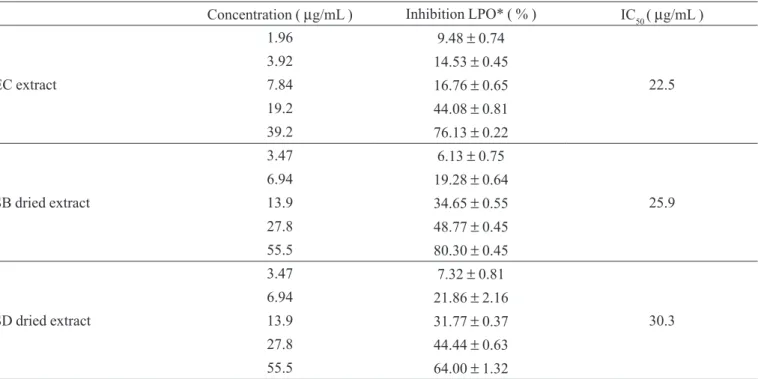
The maximum percentage of formed MDA inhibition was obtained using 1 mg/mL for quercetin. At a higher concen-tration (2.5 mg/mL), a plateau effect was observed. Table V show the experimental results of the lipid peroxidation inhibition obtained for the concentrated, spouted bed and
spray dried extracts. It can be seen that the anti-lipid pero -xidation activity of the extracts of B. foricata is concentra-tion dependent. The maximum inhibiconcentra-tion falls from 80.3
to 64.0%. The IC50 values obtained for the concentrated, spouted bed and spray dried extracts were, respectively, 22.5, 25.9, and 19.4 mg/mL in the reaction medium. Thus, the B. foricata extracts were able to inhibit the lipid pe-roxidation induced by the Fe+2/citrate, evidencing their
strong antioxidant properties.
Sousa et al., (2004), investigated the in vitro antioxi-dant potential of kaempferitrin (a isolate compound found in the Bauhinia foricata leaves) by the scavenging of free radicals (DPPH), inhibition of the prooxidant enzyme myeloperoxidase (MPO), and prevention of the lipid pe-roxidation. The results showed high reactivity with
1,1-di-phenyl-2-picrylhydrazyl, IC50 of 84.0 ±7.8 µM, inhibition of the myeloperoxidase activity (K0.5 = 86.0 ±9.9 µM), and a decrease in the lipid peroxidation induced by ascor-byl radical either in microsomes or in asolectin and
phos-phatidylcholine liposomes with IC50 of 320.0 ±14.1 µM, 22.3 ±8.3 µM and 112.0 ±8.8 µM, respectively. The authors used quercetin as a positive control, obtaining (as expected), a strong antioxidant activity against lipid
peroxidation with an IC50 in liver microsomes of 125.0 ±5.0 µM and, essentially, the same value of 80 ±6.0 µM in asolectin and phosphatidylcholine liposomes. These results indicate that kaempferitrin is 2-3 times less potent than quercetin.
Hot air drying (spray and spouted bed dryers) implies thermal treatment, and losses of polyphenols compounds FIGURE 1 - HPLC ingerprint analysis of the Bauhinia foricata
TABLE IV- Antiradical activity of Bauhinia foricata extracts observed with DPPH
Concentration ( mg/mL ) DPPH Inhibition* ( % ) IC50 ( mg/mL )
EC extract
1.96 9.48 ± 0.74
16.2
3.92 14.53 ± 0.45
7.84 16.76 ± 0.65
19.2 44.08 ± 0.81
39.2 76.13 ± 0.22
SB dried extract
3.47 21.18 ± 0.38
12.2
6.94 36.26 ± 0.74
13.9 56.90 ± 0.74
27.8 68.80 ± 0.46
55.5 69.17 ± 0.76
SD dried extract
3.47 17.34 ± 0.76
12.9
6.94 30.77 ± 0.48
13.9 53.05 ± 0.38
27.8 70.13 ± 0.46
55.5 70.44 ± 0.26
* n = 5; mean ± sd
TABLE V - Antiradical activity of Bauhinia foricata extracts observed with lipidic peroxidation assays (LPO)
Concentration ( mg/mL ) Inhibition LPO* ( % ) IC50 ( mg/mL )
EC extract
1.96 9.48 ± 0.74
22.5
3.92 14.53 ± 0.45
7.84 16.76 ± 0.65
19.2 44.08 ± 0.81
39.2 76.13 ± 0.22
SB dried extract
3.47 6.13 ± 0.75
25.9
6.94 19.28 ± 0.64
13.9 34.65 ± 0.55
27.8 48.77 ± 0.45
55.5 80.30 ± 0.45
SD dried extract
3.47 7.32 ± 0.81
30.3
6.94 21.86 ± 2.16
13.9 31.77 ± 0.37
27.8 44.44 ± 0.63
55.5 64.00 ± 1.32
* n = 5; mean ± sd
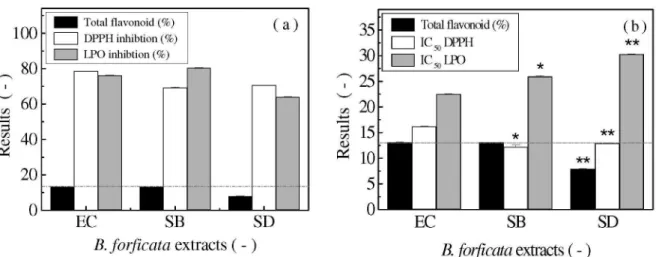
may be expected. The degradation of the polyphenols depends on the herbal matrix and processing conditions (Sensoy et al., 2006). Figure 2.a presents a comparison
between the concentration of the total lavonoids and the
inhibition of lipid peroxidation methods do not present a
direct relationship with the total lavonoids concentration. Interestingly, although the spray dried extract presented lower concentration of total lavonoids than the spouted
bed one, they presented similar antioxidant activity in both
experimental models. The relation between the total lavo
-noid content and the IC50 values is presented in Figure 2.b.
According to Mrkìc et al. (2006), oxidation reac-tions may take place during drying and polyphenols with an intermediate oxidation state can exhibit higher radical scavenging activity than non-oxidized polyphenols. High temperature drying could further cause the formation of Maillard reaction products (MRPs). These compounds have been shown to act as antioxidants in dried foodstuffs, individually or in synergism with the naturally occurring antioxidants. Maillard reactions, which occurs when su-gars condense with free amino acids, peptides or proteins, leads to the formation of a wide variety of brown melanoi-dins. Thus, the loss of natural antioxidants in heated foods could be minimized or compensated by the formation of non-nutrient antioxidants such as MRPs, enhancing the overall antioxidant properties of the product (Nicoli et al., 1997). These factors may be the responsible agents for the behavior shown in Figure 2.b.
The spouted bed and spray dried extracts present distinct color characteristics, as can be seen in Figure 3. Changes in coloration (yellow-green for spouted bed extracts and yellow-brown for spray dried extract), may indicate the development and the extent of browning that contributes to the formation of compounds with pro-oxidant properties, justifying the antipro-oxidant properties presented by the spray dried extracts, even with the high
lavonoids degradation rate (39.9%) obtained.
ACKNOWLEDGEMENT
The authors thank to The State of São Paulo
Rese-arch Foundation (FAPESP) for the fellowship to the irst author and for the whole project inancial support (Proc.
03/08317-1 and 01/10140-7).
REFERENCES
BLOIS, M.S. Antioxidant determinations by the use of a stable
free radical. Nature, v.26, p.1199-1200, 1958.
BRAND-WILLIAMS, W.; CUVELIER, M.E.; BERSET, C.
Use of a free radical method to evaluate antioxidant activity. Lebensm. Wiss. u.-Technol., v.25, p. 25-30, 1995.
BRIGHENTE, I.M.C.; DIAS, M.; VERDI, L.G.; PIZZOLATTI,
M.G. Activity and total phenolic content of some Brazilian species. Pharm. Biol., v.45, n.2, p.156-161, 2007.
FIGURE 2 - Comparison between total lavonoid contents, maximum anti-radical activity (Fig. a), and IC50 (Fig. b), for the Bauhinia foricata extracts. Statistical analysis was performed by one-way ANOVA followed by Bonferroni’s test of multiple comparisons test. *Signiicant statistical difference compared to EC (P<0.05). **Signiicant statistical difference compared to EC and SB (P<0.05).
CAIN, K.; SKILLETER, D.N. Preparation of and use of mitochondria in toxicological research, In: Snell K, Mullock
B (Eds.). Biochemical Toxicology - A Practical Approach.,
Oxford: IRL Press, 1987. p. 217-254.
CASAGRANDE, R.; GEORGETTI, S.R.; VERRI Jr, W.; BORIN, M.F.; LOPEZ, R.F.V.; FONSECA, M.J.V. In vitro
evaluation of quercetin cutaneous absorption from topical formulations and its functional stability by antioxidant activity. Int. J. Pharm. , v.328, p. 183-190, 2007.
COUSINS, M.; ADELBERG, J.; CHEN, F.; RIECK, J.
Antioxidant capacity of fresh and dried rhizomes from four clones of turmeric (Curcuma longa L.) grown in vitro. Ind. Crops Prod., v.25, n.2, p.129-135, 2007.
DAMASCENO, D.C.; VOLPATO, G.T.; CALDERON, I.M.P.;
AGUILAR, R.; RUDGE, M.V.C. Effect of Bauhinia
forficata extract in diabetic pregnant rats: maternal repercussions. Phytomedicine, v.11, p.196-201, 2004.
D J E R I D A N E , A . ; Y O U S F I , M . ; N A D J E M I , B . ; BOUTASSOUNA, D.; STOCKER, P.; VIDAL, N.
Antioxidant activity of some algerian medicinal plants extracts containing phenolic compounds. Food Chem., v.97, p.654-660, 2006.
F E J E S , S . A . ; B L Á Z O V I C S , A . ; L U G A S I , E . ; LEMBERKOVICS, G.; PETRI, A.K. In vitro antioxidant
activity of Anthriscus cerefolium L. (Hoffm.) extracts. J. Ethnopharmacol., v.69, p.259-265, 2000.
FREITAG, G. Guidelines on dissolution proiles comparison.
Drug Inf. J., v.35, p.865-874, 2001.
GEORGETTI, S.R.; CASAGRANDE, R.; VICENTINI, F.T.M.D.; VERRI, W.A.; FONSECA, M.J.V. Evaluation
of the antioxidant activity of soybean extract by different in vitro methods and investigation of this activity after its incorporation in topical formulations. Eur. J. Pharm. Biopharm., v.64, n.1, p.99-106, 2006.
GIOVANELLI, G.; PARADISO, A. Stability of dried and
intermediate moisture tomato pulp during storage. J. Agric. Food Chem., v.50, p.7277-7281, 2002.
JORGE, A.P.; HORST, H.; SOUSA, E.; PIZZOLATTI, M.G.; SILVA, F.R.M.B. Insulinomometic effects of kaempferitrin
on glycaemia and 14C-glucose uptake in rat soleus muscle.
Chemico-Biol. Interactions, v.149, p.89-96, 2004.
KULEVANOVA, S.; STEFOVA, M.; STAFILOV, T. Determination of total lavonoids and quercetin in Hyperici herba and its aqueous, aqueous-ethanolic and oil extracts. Acta Pharm., v.50, p.29-37, 2000.
MENEZES, F.S.; MINTO, A.B.M.; RUELA, H.S.; KUSTER, R.M.; SHERIDAN, H.; FRANKISH, N. Hypoglycemic
activity of two Brazilian Bauhinia species: Bauhinia
forficata L. and Bauhinia monandra Kurz. Braz. J. Pharmacogn., v.17 n.1, p. 08-13, 2007.
MOEIN, S.; FARZAMI, B.; KHAGHANI, S.; MOEIN, M.R.; LARIJANI, B.A. Antioxidant properties and protective
effect on cell cytotoxicity of Salvia mirzayani. Pharm. Biol., v.45, n.2, p.458-463, 2007.
MRKÌC, V.; COCCI, E.; DALLA ROSA, M.; SACCHETTI,
G. Effect of drying conditions on bioactive compounds and antioxidant activity of broccoli (Brassica oleracea L.). J. Sci. Food Agric., v.86, p.1559-1566, 2006.
NICOLI, M.C.; ANESE, M.; PARPINEL, M.T.; FRANCESCHI, S.; LERICI, C.R. Loss and/or formation of antioxidants
during food processing and storage. Cancer Lett., v.114, p.71-74, 1997.
NICOLI, M.C.; ANESE, M.; PARPINEL, M. Influence of
processing on the antioxidant properties of fruit and vegetables. Trends Food Sci. Technol., v.10, p.94-100, 1999.
NUUTILA, A.M.; KAMMIOVIRTA, K.; OKSMAN-CALDENTEY, M. Comparison of methods for the
hydrolysis of flavonoids and phenolic acids from onion and spinach for HPLC analysis. Food. Chem., v.76, p.519-525, 2002.
OLIVEIRA, C.Z.; MAIORANO, V.A.; MARCUSSI, S.; SANT’ANA, C.D.; JANUÁRIO, A.H.; LOURENÇO, M.V.; SAMPAIO, S.V.; FRANÇA, S.C.; PEREIRA, P.S.;
SOARES, A.M. Anticoagulant and antifibrinogenolytic properties of the aqueous extract from Bauhinia foricata against snake venoms. J. Ethnopharmacol., v.98, p.213-216, 2005.
OLIVEIRA, W.P.; BOTT, R.F.; SOUZA, C.R.F. Manufacture of
PEPATO, M.T.; BAVIERA, A.M.; VENDRAMINI, R.C.; BRUNETTI, I.L. Evaluation of toxicity after one-months
treatment with Bauhinia foricata decoction in
streptozotocin-induced diabetic rats. BMC Complement. Altern. Med.
(abreviar conforme ISSN), v.4, n.7, p.1-7, 2004.
PEPATO, M.T.; KELLER, E.H.; BAVIERA, A.M.; KETTELHUT, I.C.; VENDRAMINI, R.C.; BRUNETTI, I.L. Anti-diabetic
activity of Bauhinia forficata decoction in streptozotocin-diabetic rats. J. Ethnopharmacol., v.81, p.191-197, 2002.
PIETTA, P.; MAURI, P. Analysis of lavonoids in medicinal
plants. Methods Enzimol., v.335, p.26-45, 2001.
PINHEIRO, T.S.D.B.; JOHANASSON, L.A.P.; PIZZOLATTI, M.G.; BIAVATTI, M.W. Comparative assessment of
kaempferitrin from medicinal extracts of Bauhinia foricata Link. J. Pharm. Biomed. Anal., v.41, p. 431-436, 2006.
RODRIGUES, T.; SANTOS, A.C.; PIGOSO, A.A.; MINGATTO, F.E.; UYEMURA, S.A.; CURTI, C. Thioridazine interacts
with the membrane of mitochondria acquiring antioxidant activity toward apoptosis – potentially implicated mechanisms British. J. Pharmacol., v.36, p.136-142, 2002.
RUNHA, F.P.; CORDEIRO, D.S.; PEREIRA, C.A.M.; VILEGAS, J.; OLIVEIRA, W.P. Production of dry extracts
of medicinal Brazilian plants by spouted bed process: development of the process and evaluation of thermal
degradation during drying operation. Food Bioprod.
Process., v.79, n.C3, p.160-168, 2001.
SABU, M.C.; KUTTAN, R. Anti-diabetic activity of medicinal plants and its relationship with their antioxidant property. J. Ethnopharmacol., v.81, p.155-160, 2002.
SANTOS, A.C.; UYEMURA, S.A.; LOPES, J.L.C.; BAZON, J.N.; MINGATTO, F.E.; CURTI, C. Effect of naturally occurring lavonoids on lipid peroxidation and membrane
permeability transition in mitochondria. Free Radic. Biol. Med., v.24, p. 1455-1461, 1998.
SARTORELLI, D.S.; FRANCO, L.J. Trends in diabetes mellitus
in Brazil: the role of the nutritional transition. Cad. Saúde Púb., v.19, n.1, p.S29-S36, 2003.
SENSOY, I.; ROSEN, R.T.; HO, C.T,; KARWE, M.V. Effect of
processing on buckwheat phenolics and antioxidant activity. Food Chem., v.99, p.388-393, 2006.
SILVA, K.L.; BIAVATTI, M.W.; LEITE, S.N.; YUNES, R.A.; MONACHE, F.; CECHINEL-FILHO, V. Phytochemical
and pharmacognostic investigation of Bauhinia foricata
Link. Z. Naturforsch. C., v.55, p.478-480, 2000.
SILVA, K.L.; CECHINEL-FILHO, V. Plantas do gênero
Bauhinia: composição química e potencial farmacológico. Quim. Nova, v.25, n.3, p.449-454, 2002.
SOUSA, E.; ZANATTA, L.; SEIFRIZ, I.; CRECZYNSKI-PASA, T.B.; PIZZOLATTI, M.G.; SZPOGANICZ, B.; SILVA, F.R.M.B. Hypoglycemic effect and antioxidant
potential of kaempferol-3,7-O-(a)-dirhamnoside from
Bauhinia foricata leaves. J. Natural Product, v.67, p.829-832, 2004.
SOUZA, C.R.F. Comparative study of the production of dried
extract of Bauhinia foricata Link by spray and spouted bed drying. Master Thesis, PPG-FCFRP/USP, Ribeirão Preto, SP, Brazil, p.180, 2003.
SOUZA, C.R.F.; OLIVEIRA, W.P. Powder properties and system
behavior during spray drying of Bauhinia foricata Link extract. Drying Technol., v.24, n.6, p.735-749, 2006.
SOUZA, C.R.F.; OLIVEIRA, W.P. Spouted bed drying of
Bauhinia foricata Link extract: effect of the position of the feed atomizer and operating conditions on equipment performance and product properties. Braz. J. Chem. Eng., v.22, n.2, p.239-247, 2005.
TZENG, G.S.; CHEN, H.J.; WANG, Y.Y.; WAN, C.C. The effects of roughening on telon surfaces. Surface Coatings Technol., v.89, p.108-113, 1997.
UNGAR, Y.; OSUNDAHUNSI, O.F.; SHIMONI, E. Thermal
stability of genistein and daidzein its effect on their antioxidant activity. J. Agric. Food Chem., v.51, p.4394-4399, 2003.
VOLPATO, G.T.; DAMASCENO, D.C.; RUDGE, M.V.C.;
PADOVANI, C.R.; CALDERON, I.M.P. Effect of Bauhinia
foricata aqueous extract on the maternal-fetal outcome
and oxidative stress biomarkers of streptozotocin-induced diabetic rats. J. Ethnopharm., v.116, p. 131-137, 2008.
Received for publication on 18th february 2008