The effect of the SpeechEasy® device on acoustic and
speech motor parameters of adults who stutter
Impacto do uso do SpeechEasy® nos parâmetros acústicos e
motores da fala de indivíduos com gagueira
Ana Paula Ritto1, Fabiola Staróbole Juste2, Claudia Regina Furquim de Andrade2
ABSTRACT
Purpose: To investigate variations in speech motor skills in adults who stutter and those who do not, using the SpeechEasy® altered auditory feedback device. Methods: Twenty adults participated, 10 of whom stuttered (nine males and one female - mean age 30.9 years) and 10 of whom were fluent controls (nine males and one female - mean age 25.2 years). The study compared the performance of participants in four tasks: spontaneous speech, alternating diadochokinesis, sequential diadochokinesis and target phrase production, with and without the device. The following variables were analyzed acoustically: (1) diadochokinesis tasks: syllable duration, mean duration between syllables, peak intensity and diadochokinesis rate; (2) target phrase production task: reaction time, voice onset time (VOT) duration, total production duration, fundamental frequency and intensity. Results: The spontaneous speech task was the only task to show significant differences in both the intragroup and intergroup comparisons. In this task, the use of SpeechEasy® resulted in significant improvement in speech fluency, as measured by the percentage of stuttered syllables, for the group who stuttered. For the fluent group, the device produced the opposite effect: a significant increase in the frequency of stuttered disfluencies was observed with the device. No significant differences were found in either intragroup or intergroup comparisons relating to the acoustic aspects of the diadochokinesis and target phrase production tasks. Conclusion: The results indicated that the use of SpeechEasy® improved the fluency of participants who stutter, without appearing to interfere with speech naturalness.
Keywords: Speech, language and hearing sciences; Stuttering; Voice; Speech acoustics; Speech production measurement
RESUMO
Objetivo: Investigar variações nas habilidades motoras da fala em adul-tos com e sem gagueira, utilizando o dispositivo de alteração do feedback
auditivo SpeechEasy®. Métodos: Participaram 20 adultos, dez com ga-gueira (nove do gênero masculino e um do feminino – média 30,9 anos) e dez controles fluentes (nove do gênero masculino e um do feminino – média 25,2 anos). O estudo comparou o desempenho dos participantes em quatro tarefas: fala espontânea, diadococinesia alternada, diadoco-cinesia sequencial e emissão de frase alvo, com e sem o dispositivo. Os aspectos analisados acusticamente foram: (1) tarefas de diadococinesia: duração das sílabas, período médio entre as sílabas, pico de intensidade e taxa de diadococinesia; (2) tarefa de emissão da frase alvo: tempo de reação, duração do voice onset time, duração total da emissão, frequência fundamental e intensidade. Resultados: Tanto na comparação intragru-pos quanto intergruintragru-pos, apenas a tarefa de fala espontânea apresentou diferenças significativas. Nesta tarefa, o uso do SpeechEasy® resultou em melhora significativa da fluência de fala, medida pela porcentagem de sílabas gaguejadas, para o grupo com gagueira. Para o grupo fluente, o dispositivo produziu o efeito oposto (aumento significativo na frequência de rupturas gagas com o dispositivo). Os resultados encontrados quanto aos aspectos acústicos das tarefas de diadococinesia e emissão da frase alvo não indicaram diferença significativa nas comparações intragru-pos e intergruintragru-pos. Conclusão: Os resultados indicaram que o uso do
SpeechEasy® melhorou a fluência dos participantes com gagueira, sem parecer interferir na naturalidade de fala.
Descritores: Fonoaudiologia; Gagueira; Voz; Acústica da fala; Medida da produção da fala
The study was conducted in the Laboratory of Speech Therapy Research into Fluency, Facial Functions and Dysphagia, Department of Physical, Speech and Occupational Therapy, School of Medicine, Universidade de São Paulo – USP – São Paulo (SP), Brazil.
(1) Graduate Program (Doctorate) in Rehabilitation Sciences, Department of Physical, Speech and Occupational Therapy, School of Medicine, Universidade de São Paulo – USP – São Paulo (SP), Brazil.
(2) Department of Physical, Speech and Occupational Therapy, School of Medicine, Universidade de São Paulo – USP – São Paulo (SP), Brazil.
Funding: Fundação de Amparo à Pesquisa do Estado de São Paulo (FAPESP), case number 2011/15184-4.
Conflict of interests: No
Authors’ contribution: APR literature search, data collection and analysis, manuscript drafting, submission and procedures; FSJ literature review, data analysis, correction of manuscript writing, article submission and procedures; CRFA supervisor, principal investigator, study development, schedule preparation, literature review, data analysis, approval of final version of the manuscript.
Correspondence address: Claudia Regina Furquim de Andrade. R. Cipotânea, 51, Campus Cidade Universitária, São Paulo (SP), Brazil, CEP: 05360-160. E-mail: [email protected]
INTRODUCTION
Speech is a complex neural function that involves segmental (linguistic) and suprasegmental (paralinguistic) components, processed by different neural pathways. When integrated and synchronized, these components are critical for maintaining a smooth and continuous flow, which we call fluency. Breaks in this flow represent disfluencies, which are classified as common (hesitations, interjections, revisions, unfinished words and repetition of words, segments or phrases) or stuttering (repetition of sounds or syllables, prolongations, blockages, pauses and intrusions)(1).
Developmental stuttering is a chronic, genetically based communication disorder characterized by involuntary breaks in the flow of speech at a greater frequency than that observed in the general population and with a prevalence of stuttering-type disfluencies. It is a complex disorder with no single nosological entity, and it is multidimensional in nature(1,2).
Although it is clear that many psychological, emotional, linguistic and environmental variables can influence the development of stuttering, this does not mean that these variables play a role in its cause. It is widely accepted in the literature that the symptoms observed in stuttering reflect an impairment in the coordination of the different components of the speech motor system(3).
The study of the performance of the stuttering population in other oral motor sequencing tasks, such as the diadochokinesis task, is of great importance in understanding the neuromotor skills of these individuals. Speech-related diadochokinesis, termed oral diadochokinesis, is the ability to perform rapid repetitions of simple patterns of opposing muscle contractions, i.e., the ability to move one’s muscles quickly in opposite directions(4). The task
of repeating a simple speech segment at high speed is used to evaluate this skill. This evaluation may include the repetition of the same vowel (which provides a laryngeal-level evaluation), the repetition of the same syllable (/pa/, /ta/ or /ka/, for example, called alternating diadochokinesis) or the joining of different syllables (e.g., /pataka/, sequential diadochokinesis). This test reflects the individual’s neuromotor maturity and integrity(4-6).
Although an oral diadochokinesis assessment measures speech motor programming skills, there are very few studies on the application of this type of assessment, or similar ones, to individuals who stutter. The results of these studies are not conclusive because the currently published studies on the application and analysis of this assessment vary greatly in variables such as participant age, data collection method, type of task analyzed and others(6-8).
Studies have been conducted relating stuttering to other cortical systems, in an attempt to better understand the mechanisms underlying stuttering symptoms and to facilitate and improve treatment. Among these are positron emission tomography (PET) studies, which have indicated that the activation of the auditory cortical areas in individuals who
stutter during speech differs from the activation of these areas in fluent individuals. These findings suggest that individuals who stutter cannot activate, or insufficiently activate, the auditory cortex during speech(9,10).
The results of neuroimaging studies have led to a better understanding of the so-called “choral speech phenomenon” in which speech breaks are significantly reduced or even eliminated when another person speaks in unison with the person who stutters. The effect of promoting fluency from choral speech is based on its role in providing an external auditory stimulus that facilitates the activation of the auditory cortex. This second speech signal can be interpreted as additional signal information that promotes fluent speech. Thus, the additional auditory feedback provided by the chorus functions as an exogenous speech motor control, i.e., fluent production takes place through motor recovery, made possible by increased activation of the cortex. With the chorus, the speaker adopts motor control strategies that maximize feedback, which makes monitoring more efficient, resulting in an improvement in fluency(11).
Altered auditory feedback (AAF) devices are derived from the choral speech phenomenon and arose as an attempt to simulate the chorus effect. The term AAF refers to all conditions that alter the way in which the speaker hears his/her own speech (auditory return or feedback). This alteration may be called delayed auditory feedback (DAF) when auditory feedback is delayed or frequency altered feedback (FAF) when the speaker hears his/her voice with an altered frequency – (i.e., deeper or sharper)(12).
In recent years, AAF devices have been increasingly used as a treatment for stuttering. The literature contains a large number of studies on the effects of AAF on the speech of people who stutter. Thus far, major methodological differences between studies preclude a definitive conclusion about the efficacy of such treatments, although most studies agree that AAF devices can decrease the number of stuttering events(12-16).
In addition to investigating treatment efficacy in terms of reducing the frequency of speech disfluencies when using AAF devices, it is also necessary to investigate the effect of these devices on speech naturalness. By altering the way sounds are perceived by speakers, device users can modify the structural aspects of speech (such as intensity and fundamental frequency) in an attempt to compensate for this effect, which may generate unnatural speech. There are few studies in the literature that have investigated speech naturalness with the use of different types of AAF devices. Furthermore, these studies have produced contradictory results(17,18). It is necessary to take
In this regard, acoustic analysis can be a useful tool because it allows for the measurement of the sound signal coming from the voice, based on acoustic parameters that can be obtained through specific programs for voice recording and analysis. Acoustic measure analysis, especially spectrographic analysis, makes it possible to find acoustic correlates of vocal physiological behaviors, along with prosodic and paralinguistic aspects and those related to vocal quality(20-22). Acoustic analysis can therefore
assist in the investigation of the effects of AAF on the structural characteristics that compose speech sounds, thus providing objective data on certain parameters related to speech naturalness.
The objective of this study was to investigate possible variations in speech motor skills in individuals who stutter and fluent individuals using acoustic analysis to examine the auditory feedback variable “use of SpeechEasy®” compared to a control condition when the device was not used.
METHODS
Participants
A total of 20 adults participated in this study and were divided into two groups.
The first group, the Study Group (G1), consisted of 10 adults with developmental stuttering who sought speech therapy between March 2012 and June 2013. Of these, nine were male and one was female. They were between 21 and 41 years old (mean age 30.9 years), and there was no difference in socioeconomic and cultural variables between the groups. They met the following inclusion criteria:
a) Speech Fluency Profile score(23) outside the reference values
for age;
b) 25 points or more (minimum severity at a moderate level) on the Stuttering Severity Instrument – 3(24);
c) Monolingual (Brazilian Portuguese);
d) Free from oral communication comorbidities, any degree of hearing loss or neurological and/or degenerative diseases. The second group, the Control Group (G2), consisted of 10 fluent adults, nine male and one female, between 22 and 31 years old (mean age 25.2 years) who met the following inclusion criteria:
a) Speech Fluency Profile score(23) within the reference values
for age;
b) Up to 10 points on the Stuttering Severity Instrument – 3(24),
classified as normal fluency;
c) Monolingual (Brazilian Portuguese);
d) Free from oral communication disturbances, any degree of hearing loss or neurological and/or degenerative diseases. The participant selection and evaluation processes followed the relevant ethical procedures. The project was approved by the Research Ethics Committee of the Universidade de São Paulo
(USP), School of Medicine (CEP 116/11), and all participants signed informed consent forms.
Preliminary procedures
Before inclusion in the study, all participants underwent a basic audiological evaluation (pure tone audiometry, speech audiometry with speech discrimination and intelligibility and impedance tests), case history assessment and speech fluency evaluation procedures (Speech Fluency Profile tests(23) and
Stuttering Severity Instrument – 3(24))for confirmation of
inclusion criteria.
Device adaptation and programming procedures
All G1 participants used an individual Completely-In-Canal (CIC) (microcanal) SpeechEasy® device. Device molding and monaural adaptation (right ear) were performed by licensed professionals from the Microsom company.
All G2 participants used a SpeechEasy® device similar to the G1 device, but with a standard universal mold.
The programming interface provided by the company (Audio-Pro Plus) and the software SpeechMasterinstalled on a VPC-SA Sony Vaio® notebook were used to program the devices. Unitron Hearing® batteries were used in the devices.
Device programming was individualized and performed by the researcher, as specified by the manufacturer, and all options for the modification of DAF and FAF effects were tested until the optimal configuration for the participant was found.
First, the device was adapted in DAF configuration, with a delay of 60 ms, and FAF, at a frequency of +500 Hz. The researcher then asked the participant to perform small speech tasks, such as reading a passage of text, and the auditory feedback delay time was changed from 60 ms to 90 ms and then to 120 ms. The participant indicated which of the three delay options was most comfortable for his/her speech. The FAF was adjusted using the same procedure: during speech activities requested by the researcher, frequency alteration options were tested, starting with a frequency of +500 Hz and progressing to a frequency of +1000 Hz, later testing frequencies of -500 Hz and -1000 Hz. The participant had to indicate which altered frequency option was most comfortable for his/her speech.
With the device configured, the participants were asked to produce the vowel /a/ for 5 to 10 seconds to check the volume. Participants were instructed to choose a volume intense enough for him/her to hear comfortably.
Data collection and analysis
sequential diadochokinesis and emission of the target phrase “Boat on the water” (“Barco na água” in Portuguese).
Spontaneous speech task
According to the method proposed in the Speech Fluency Profile test(3), samples of 200 syllables of spontaneous speech
elicited by one figure were recorded. A Sony® DRC-SR62 digital camcorder was used, and all material was transferred to a Dell® Studio XPS desktop computer. HP200F Maxwell® headset earphones were used for transcription, which was performed according to the standardized method described in the test. For this study, only measures of the percentage of syllables stuttered in the 200 syllable sample and the speech rate in this period (in syllables expressed per minute) were considered.
Alternating and sequential diadochokinesis tasks
Samples of these speech tasks were directly collected and analyzed in an acoustically treated room using a Dell® Studio XPS desktop computer with the software PRAAT Acoustic Analysis version 4.2 (with a sampling rate of 44,100 Hz and 16-bit quantization), using an Audio-Technica® MB3k professional table microphone. The distance between the microphone and the participant’s mouth was 8-10 cm, and the microphone was at a 45° angle.
The participant was asked to produce, without interruption, the syllable /pa/ (for the alternating diadochokinesis) or the sequence /pataka/ (for the sequential diadochokinesis) for 15 seconds, as quickly as possible without losing articulatory precision, and to start as soon as he heard a beep indicating timer activation.
From these samples, the following measurements were made using the same method used in previous studies(1):
a) Syllable duration: this was measured (in seconds) from the beginning of the consonant burst to the end of the vowel nucleus (the presence of formants and their combination). b) Peak intensity of each syllable: the point at which there was
the greatest intensity (dB) during production of the syllable visually identified on the spectrogram.
c) Mean time between syllables: the time between the end of one syllable sound and the next was measured (in seconds) (i.e., from the end of a vowel sound to the same point of the subsequent vowel). Therefore, each time included the duration of the syllable and the interval between syllables. The diadochokinesis rate, in syllables per second, was also measured, counting the total number of syllables produced in each of the diadochokinesis tasks and dividing this value by the production time.
Task of producing the target phrase “Boat on the water”
Samples of this speech task were collected and analyzed with the same material used for the diadochokinesis tasks
discussed above.
The participant was required to produce the target phrase “boat on the water” upon hearing a beep that indicated timer activation. Only fluent productions, free of breaks, were accepted for this task. Thus, in some instances, it was necessary to repeat the task to obtain fluent production.
The following measurements were made for each speech sample:
a) Voice onset time (VOT) duration: measured manually (in seconds), using the spectrograph. The measurement was performed from the beginning of the vocalization to the burst of the “b” consonant.
b) Reaction time: the time (in seconds) from issuance of the beep (timer activation) until the beginning of vocalization of the “b” consonant.
c) Total production duration: the total duration (in seconds) of the phrase “boat on the water” was measured, based on the image obtained in the spectrograph. The measurement was obtained from the start of vocalization for production of the “b” consonant to the end of the energy of the last vowel “a” in the word “água” (water).
d) Analysis of fundamental frequency and production intensity: the fundamental frequency (in Hz) and the mean intensity (in dB) of each “boat on the water” phrase were obtained; these measurements were provided automatically by the program.
Statistical analysis
In this study, both intragroup and intergroup analyses was performed. The intragroup analyses compared the same participants in each of the conditions studied (with and without the use of the SpeechEasy® device), and the intergroup analyses compared the study group subjects (G1) to the control group (G2).
First, a descriptive analysis was performed on the quantitative data, and the means and standard deviations were obtained.
The assumption of a normal distribution in each group was tested using the Kolmogorov-Smirnov test. As some of the variables studied were normally distributed but others were not, the nonparametric Mann-Whitney test was used in the intergroup inferential analyses and the Wilcoxon test was used for paired samples in the intragroup analyses. The significance level was set at 5% for all inferential analyses.
Descriptive and inferential statistical analyses were performed using the software SPSS version 13 (SPSS 13.0 for Windows).
RESULTS
be referred to as “Device” and the condition in which the participant did not use the device will be called “Without Device”.
Intergroup data
The between-group comparison in the spontaneous speech task revealed a significant difference (p<0.001) between the two groups in all variables, as expected, as this evaluation is used to diagnose stuttering.
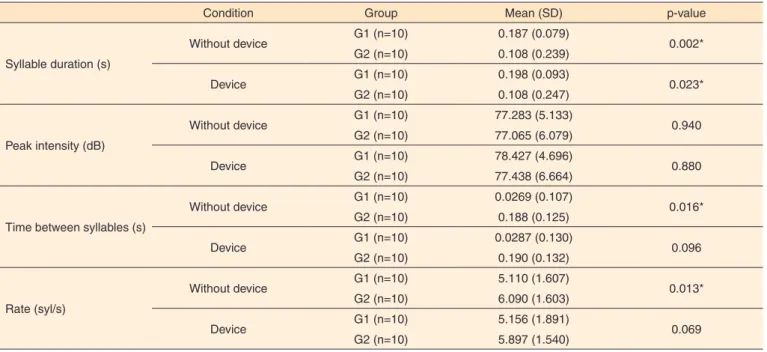
The analysis of the results of the alternating diadochokinesis task revealed that there was a significant difference between the two groups regarding the duration of syllables in both the Without Device condition (p=0.002) and in the Device condition (p=0.023). For the variables “time between syllables” and “diadochokinesis rate”, there was a significant difference between the two groups only in the Without Device condition (p=0.016 and p=0.013, respectively). For the “peak intensity” variable, there was no significant difference between the groups in any of the conditions (with and without the SpeechEasy® device)(Table 1).
In the sequential diadochokinesis task, the results observed were similar to those obtained in the alternating diadochokinesis task. Again, there was a significant difference in syllable duration between the two groups in both the Without Device condition (p=0.003) and the Device condition (p=0.010). For the variable “diadochokinesis rate”, there was a significant difference between the groups only in the Without Device condition (p=0.034). For the “peak intensity” variable, there was no significant difference between the groups in any condition. The only difference observed in the intergroup
results between the alternating and sequential diadochokinesis tasks was in the time between syllables. For this variable, in the alternating diadochokinesis task, there was no significant difference between the groups in either of the conditions (with and without the SpeechEasy® device) (Table 2).
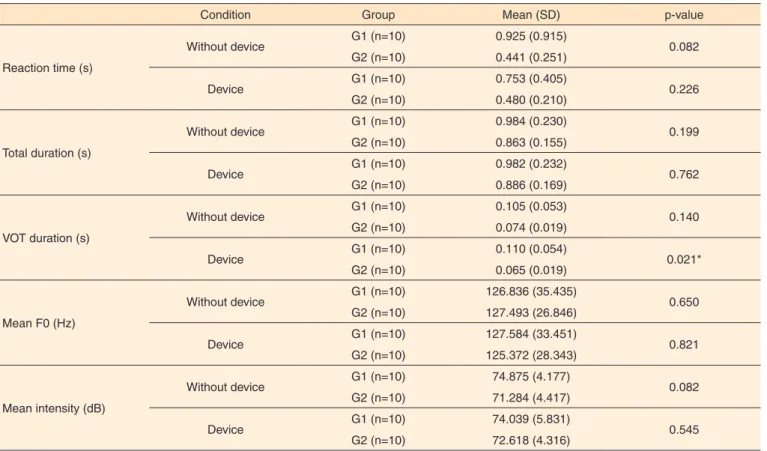
In the intergroup analysis, for the task of producing the target phrase “boat on the water,” a significant difference was observed between the groups only for VOT duration in the Device condition (p=0.021) (Table 3).
Intragroup data
The results of the intragroup descriptive and inferential analyses, comparing the two conditions (Without Device and Device) in each of the study groups, are presented below.
The results of the G1 (Study Group) analyses regarding the percentage of stuttered syllables revealed a reduction of over 45% in the mean frequency of stuttered disfluencies in the Device condition compared to the Without Device condition, representing a significant difference (p=0.014). With respect to speech rate, there was a significant increase (p=0.005) in the amount of syllables per minute in the Device condition. Regarding the alternating and sequential diadochokinesis tasks, only the peak intensity value increased significantly in the Device condition (p=0.037 for alternating and p=0.013 for sequential). Regarding the task of repeating the phrase “boat on the water,” none of the variables changed significantly between the two conditions.
In G2 (Control Group), the analysis revealed a significant increase in the frequency of stuttered disfluencies in the Device condition (p=0.046). There was no significant change
Table 1. Intergroup analysis of the alternating diadochokinesis task
Condition Group Mean (SD) p-value
Syllable duration (s)
Without device G1 (n=10) 0.187 (0.079) 0.002*
G2 (n=10) 0.108 (0.239)
Device G1 (n=10) 0.198 (0.093) 0.023*
G2 (n=10) 0.108 (0.247)
Peak intensity (dB)
Without device G1 (n=10) 77.283 (5.133) 0.940
G2 (n=10) 77.065 (6.079)
Device G1 (n=10) 78.427 (4.696) 0.880
G2 (n=10) 77.438 (6.664)
Time between syllables (s)
Without device G1 (n=10) 0.0269 (0.107) 0.016*
G2 (n=10) 0.188 (0.125)
Device G1 (n=10) 0.0287 (0.130) 0.096
G2 (n=10) 0.190 (0.132)
Rate (syl/s)
Without device G1 (n=10) 5.110 (1.607) 0.013*
G2 (n=10) 6.090 (1.603)
Device G1 (n=10) 5.156 (1.891) 0.069
G2 (n=10) 5.897 (1.540)
*Significant values (p<0.05) – Wilcoxon test for paired samples
in speech rate when comparing the conditions. Regarding the alternating diadochokinesis tasks, none of the variables differed significantly between the two studied conditions. In
the sequential diadochokinesis task, only the peak intensity value increased significantly in the Device condition (p=0.019). Regarding the task of repeating the phrase “boat on the
Table 2. Intergroup analysis of the sequential diadochokinesis task
Condition Group Mean (SD) p-value
Syllable duration (s)
Without device G1 (n=10) 0.132 (0.056) 0.003*
G2 (n=10) 0.085 (0.039)
Device G1 (n=10) 0.137 (0.063) 0.010*
G2 (n=10) 0.087 (0.031)
Peak intensity (dB)
Without device G1 (n=10) 74.380 (5.228) 0.650
G2 (n=10) 75.851 (7.001)
Device G1 (n=10) 76.324 (5.495) 0.496
G2 (n=10) 77.842 (5.120)
Time between syllables (s)
Without device G1 (n=10) 0.202 (0.084) 0.070
G2 (n=10) 0.176 (0.135)
Device G1 (n=10) 0.200 (0.090) 0.058
G2 (n=10) 0.163 (0.136)
Rate (syl/s)
Without device G1 (n=10) 5.110 (1.607) 0.034*
G2 (n=10) 6.216 (1.544)
Device G1 (n=10) 5.156 (1.891) 0.081
G2 (n=10) 6.183 (1.613)
* Significant values (p<0.05) – Wilcoxon test for paired samples
Note: G1 = study group; G2 = control group; n = number of subjects; SD = standard deviation
Table 3. Intergroup analysis of the “Boat on the water” phrase repetition task
Condition Group Mean (SD) p-value
Reaction time (s)
Without device G1 (n=10) 0.925 (0.915) 0.082
G2 (n=10) 0.441 (0.251)
Device G1 (n=10) 0.753 (0.405) 0.226
G2 (n=10) 0.480 (0.210)
Total duration (s)
Without device G1 (n=10) 0.984 (0.230) 0.199
G2 (n=10) 0.863 (0.155)
Device G1 (n=10) 0.982 (0.232) 0.762
G2 (n=10) 0.886 (0.169)
VOT duration (s)
Without device G1 (n=10) 0.105 (0.053) 0.140
G2 (n=10) 0.074 (0.019)
Device G1 (n=10) 0.110 (0.054) 0.021*
G2 (n=10) 0.065 (0.019)
Mean F0 (Hz)
Without device G1 (n=10) 126.836 (35.435) 0.650
G2 (n=10) 127.493 (26.846)
Device G1 (n=10) 127.584 (33.451) 0.821
G2 (n=10) 125.372 (28.343)
Mean intensity (dB)
Without device G1 (n=10) 74.875 (4.177) 0.082
G2 (n=10) 71.284 (4.417)
Device G1 (n=10) 74.039 (5.831) 0.545
G2 (n=10) 72.618 (4.316)
* Significant values (p<0.05) – Wilcoxon test for paired samples
water,” none of the acoustically analyzed variables differed significantly between the two conditions.
DISCUSSION
Comparison between groups
Some of the results presented above lead to interesting findings. The intergroup outcomes, i.e., the comparison between G1 (individuals who stutter) and G2 (fluent individuals) will be discussed first.
In this study, the only difference between groups that was consistently significant in the diadochokinesis tasks is related to syllable duration. This result was not expected but seems to indicate that individuals who stutter have a deficit in motor readiness; therefore, they do not reach the same speed as fluent individuals when terminating the activation of a particular motor drive and replacing the motor drive with its opposite. This observation had already been noted in a previous study(25).
For this study, however, the longer duration of syllables did not result in differences in the diadochokinesis rate (syllables per second) between groups. In fact, there was slight difference in performance in the diadochokinesis tests between the two groups. As explained in the introduction, individuals who stutter have a neuromotor sequencing deficit that affects speech motor control strategies and generates the speech breaks encountered. These difficulties are evident in spontaneous speech tasks that involve the intricate coordination of multiple systems, both motor and cognitive-linguistic. The diadochokinesis task, because it is an automatic motor task, uses much less complex forms of monitoring. Therefore, the deficit in speech motor control has little effect on these tasks and allows performance similar to that of fluent individuals(3).
Likewise, in the task of producing the target phrase “boat on the water”, there were no significant differences between the groups in any of the studied aspects. These data support the above hypothesis that linguistic complexity is a factor that contributes to difficulties in speech motor control. Therefore, the fluent repetition of a simple phrase by individuals who stutter does not differ from that of individuals without this condition(25).
Effects of SpeechEasy® on participants’ speech
The intragroup results, i.e., the results comparing each of the test conditions (Device and Without Device) within each group will now be discussed.
In this study, in accordance with the literature(12-16), the
use of the AAF device resulted in improved stuttering during spontaneous speech, which is demonstrated by the significant reduction in G1’s percentage of stuttered syllables in the Device condition compared to the Without Device condition.
The G2 results for the spontaneous speech task are also consistent with those reported in the literature(26). Other
researchers have observed that the use of AAF devices causes fluent speakers to adopt motor control strategies based primarily on auditory feedback, similar to speakers who stutter, which results in interference in a speaker’s previously efficient monitoring system. Thus, the effect is the opposite of that found in individuals who stutter, i.e., there is an increase in the frequency of stuttered disfluencies.
With respect to spontaneous speech, G1’s significant increase in the number of syllables per minute in the Device condition disagrees with studies that attribute the improvement in stuttering brought about by the use of the AAF to a reduced speech rate(27). In the present study, it was
clear that the use of the device did not lead to a decreased speech rate. However, the increase in this value most likely occurred because the time spent in disfluency episodes was not removed from the speech rate calculation. Therefore, the significant reduction in break frequency led to an increase in speech rate. These results suggest that SpeechEasy® had no effect on speech speed.
With respect to the other tasks analyzed (alternating and sequential diadochokinesis tasks and target phrase production), this study found significant individual variability in performance for both G1 and G2. The intragroup results, both in G1 and in G2, show no significant difference between the two conditions studied in practically any of the variables analyzed.
The absence of differences in acoustic analysis suggests that global changes in supralinguistic speech characteristics (such as changes in fundamental frequency, for example), which have been identified as facilitators of fluency(28), are not important
factors in the SpeechEasy’s®fluency promoting effect(29). This
result implies that the fluency improvement observed with the use of the AAF device does not appear to interfere with speech naturalness, as observed in other studies(17,18,21,29).
The significant increase in peak intensity in both diadochokinesis tasks analyzed most likely occurred because the SpeechEasy® device provides gains of up to 25 dB, which can interfere with the intensity of the speaker’s voice. This change in intensity is an involuntary vocal response (increase in voice amplitude) in the presence of background noise. The gain provided by the device does not inconvenience the user, although it has been suggested in the literature that device users need to have regular audiological examinations(30).
In conclusion, regarding the comparison between groups, among the tasks analyzed in this study, there was a significant difference between the group of individuals who stuttered and the fluent group only for spontaneous speech. In the rest of the tasks, there was little difference in performance between the two groups.
who stuttered. The fluent group showed an increase in the frequency of stuttered disfluencies using the device.
CONCLUSION
The absence of differences in the variables studied via acoustic analysis suggests that the device did not produce global changes in speech characteristics. Therefore, in this study, the use of the SpeechEasy® device reduced the number of stuttering events and did not appear to interfere with speech naturalness, according to the variables analyzed.
It is important to note that the results presented are based only on the immediate effect of the device, in a single event, and that participants did not have prior contact or training with the device, suggesting the need for controlled studies that evaluate the effect of the use of AAF devices on the speech of individuals who stutter over the long term.
ACKNOWLEDGEMENTS
The Department of Physical, Speech and Occupational Therapy, School of Medicine, Universidade de São Paulo.
REFERENCES
1. Oliveira BV, Domingues CEF, Juste FS, Andrade CRF, Moretti-Ferreira D. Familial persistent developmental stuttering: genetic perspectives. Rev Soc Bras Fonoaudiol. 2012;17(4):489-94. http:// dx.doi.org/10.1590/S1516-80342012000400021
2. Andrade CRF. Abordagem neurolinguística e motora da gagueira. In: Ferreira LP, Befi-Lopes DM, Limongi SCO, organizadores. Tratado de fonoaudiologia. São Paulo: Roca; 2004. p.1001-26.
3. Max L, Guenther FH, Gracco VL, Ghosh SS, Wallace ME. Unstable or insufficiently activated internal models and feedback-biased motor control as sources of dysfluency: a theoretical model of stuttering. Contemp Issues Commun Sci Disord. 2004;31:105-22.
4. Padovani M, Gielow I, Behlau M. Phonarticulatory diadochokinesis in young and elderly individuals. Arq Neuropsiquiatr. 2009;67(1):58-61. http://dx.doi.org/10.1590/S0004-282X2009000100015 5. Walsh B, Smith A. Articulatory movements in adolescents: evidence
for protracted development of speech motor control processes. J Speech Lang Hear Res. 2002;45(6):1119-33. http://dx.doi. org/10.1044/1092-4388(2002/090)
6. Juste FS, Rondon S, Sassi FC, Ritto AP, Colalto CA, Andrade CRF. Acoustic analyses of diadochokinesis in fluent and stuttering children. Clinics. 2012;67(5):409-14. http://dx.doi.org/10.6061/ clinics/2012(05)01
7. Sasisekaran J. Nonword repetition and nonword reading abilities in adults who do and do not stutter. J Fluency Disord. 2013;38(3):275-89. http://dx.doi.org/10.1016/j.jfludis.2013.06.001
8. Smith A, Kleinow J. Kinematic correlates of speaking rate changes in stuttering and normally fluent adults. J Speech Lang Hear Res. 2000;43(2):521-36. http://dx.doi.org/10.1044/jslhr.4302.521
9. Braun AR, Varga M, Stager S, Schulz G, Selbie S, Maisog JM et al. Altered patterns of cerebral activity during speech and language production in developmental stuttering: an H2(15)O positron
emission tomography study. Brain. 1997;120(5):761-84.
10. De Nil LF, Kroll RM, Kapur S, Houle S. A positron emission tomography study of silent and oral single word reading in stuttering and nonstuttering adults. J Speech Lang Hear Res. 2000;43(4):1038-53. http://dx.doi.org/10.1016/j.jfludis.2003.07.002
11. Kalinowski J, Saltuklaroglu T. Choral speech: the amelioration of stuttering via imitation and the mirror neuronal system. Neurosc Biobehav Rev. 2003;27(4):339-47. http://dx.doi.org/10.1016/S0149-7634(03)00063-0
12. Andrade CRF, Juste FS. Systematic revie of delayed auditory feedback effectiveness for stuttering reduction. J Soc Bras Fonoaudiol. 2011;23(2):187-91. http://dx.doi.org/10.1590/S2179-64912011000200018
13. Lincoln M, Packman A, Onslow M. Altered auditory feedback and the treatment of stuttering: a review. J Fluency Disord. 2006;31(2):71-89. http://dx.doi.org/10.1016/j.jfludis.2006.04.001 14. Armson J, Kiefte M, Mason J, De Croos D. The effect of SpeechEasy
on stuttering frequency in laboratory conditions. J Fluency Disord. 2006;31(2):137-52. http://dx.doi.org/10.1016/j.jfludis.2006.04.004 15. Gallopa RF, Runyanb CM. Long-term effectiveness of the
SpeechEasy fluency-enhancement device. J Fluency Disord. 2012;37(4):334-43. http://dx.doi.org/10.1016/j.jfludis.2012.07.001 16. Guntupalli VK, Kalinowski J, Saltuklaroglu T, Nanjundeswaran
C. The effects of temporal modification of second speech signals on stuttering inhibition at two speech rates in adults. Neurosc Lett. 2005;385(1):7-12. http://dx.doi.org/10.1016/j.neulet.2005.05.010 17. Stuart A, Kalinowski J. The perception of speech naturalness of
pos-therapeutic and altered auditory feedback speech of adults with mild and severe stuttering. Folia Phoniatr Logop. 2004;56(6):347-57. http://dx.doi.org/10.1159/000081082
18. Armson J, Kiefte M. The effect of SpeechEasy on stuttering frequency, speech rate, and speech naturalness. J Fluency Disord. 2008;33(2):120-34. http://dx.doi.org/10.1016/j.jfludis.2008.04.002 19. Schiavetti N, Metz DE. Stuttering and the measurement of speech
naturalness. In: Curlee RF, Siegel GM, editors. Nature and treatment of stuttering: new directions. Boston: Allyn & Bacon; 1997. p. 398-412.
20. Behlau M, Madazio G, Feijó D, Pontes P. Avaliação de voz. In: Behlau M, organizador. Voz: o livro do especialista. São Paulo: Revinter; 2005. p. 85-180.
21. Sassi FC, Andrade CRF. Acoustic analyses of speech naturalness: a comparison between two therapeutic approaches. Pró Fono. 2004;16(1):31-8.
22. Prins D, Hubbard CP. Acoustical durations of speech segments during stuttering adaptation. J Speech Hear Res. 1990;33(3):494-504. 23. Andrade CRF. Perfil da fluência de fala: parâmetro comparativo
diferenciado por idade para crianças, adolescentes, adultos e idosos (CD-ROM). Barueri: Pró-Fono; 2006.
25. Andrade CRF, Sassi FC, Juste FS, Meira MIM. Speech and non-speech activities in stuttering:a preliminary study. Pró Fono. 2008;20(1):67-70. http://dx.doi.org/10.1590/S0104-56872008000100012
26. Chon H, Kraft SJ, Zhang J, Loucks T, Ambrose NG. Individual variability in delayed auditory feedback effects on speech fluency and rate in normally fluent adults. J Speech Lang Hear Res. 2013;56(2):489-504. http://dx.doi.org/10.1044/1092-4388(2012/11-0303)
27. Howell P, Sackin S. Speech rate modification and its effects on fluency reversal in fluent speakers and people who stutter. J Dev Phys Disabil. 2000;12(4):291-315. http://dx.doi. org/10.1023/A:1009428029167
28. Ramig P, Adams MR. Vocal changes in stutterers and nonstutterers during high- and low-pitched speech. J Fluency Disord. 1981;6(1):15-33. http://dx.doi.org/10.1016/0094-730X(81)90028-0 29. Natke U, Grosser J, Kalveram KT. Fluency, fundamental
frequency, and speech rate under frequency-shifted auditory feedback in stuttering and nonstuttering persons. J Fluency Disord. 2001;26(3):227-41. http://dx.doi.org/10.1016/S0094-730X(01)00099-7