Arq Neuropsiquiatr 2004;62(3-B):774-777
Departamento de Ciências Neurológicas da Faculdade de Medicina de São José do Rio Preto (FAMERP), São José do Rio Preto SP, Brasil: 1Professor Assistente Mestre; 2Professor Adjunto Doutor; 3Professor Adjunto Livre Docente.
Received 26 December 2003, received in final form 25 March 2004. Accepted 15 May 2004.
Dr. José Carlos Busto Galego - Rua Prof. Nelson I. Bento Lutaif 145 - 15091-550 São José do Rio Preto SP - Brasil. E-mail: [email protected]
DEPRESSION AND MIGRAINE
José Carlos Busto Galego
1, José Paulo Cipullo
2,
José Antonio Cordeiro
3, Waldir Antonio Tognola
3ABSTRACT - The objective of this study was to evaluate both the presence and intensity of depressive symp-toms in patients with episodic migraine (EM) and transformed migraine (TM) or chronic migraine, com-paring them with a control group. Beck Depression Inventory (BDI) was used for this purpose. The medi-an of BDI score of the control group was significmedi-antly lower thmedi-an the EM medi-and TM groups (p<0.0005). Either the EM or the TM did not show any significant difference in relation to the median of BDI scores (p=0.12). The TM group showed a higher frequency of severe depression when analyzed qualitatively by depend-ence analysis. Symptoms of severe depression by means of qualitative analysis may strengthen a co-mor-bidity between depression and transformed migraine. This association might be considered rather a fac-tor of TM perpetuation than a risk facfac-tor for the transformation of EM into TM.
KEY WORDS: transformed migraine, chronic migraine, migraine, depression, Beck Depression Inventory.
Depressão e migrânea
RESUMO - O objetivo deste estudo foi avaliar a presença e a intensidade de sintomas depressivos entre pacientes com migrânea episódica (ME) e migrânea transformada (MT) ou migrânea crônica, comparan-do-os com um grupo controle. O Inventário de Depressão de Beck (IDB) foi aplicado para esta finalidade. A mediana das pontuações do IDB do grupo controle foi significantemente menor que a dos grupos ME e MT (p< 0,0005). Os grupos ME e MT não apresentaram diferenças significantes em suas medianas das pontuações (p=0,12). Quando avaliados de forma qualitativa, pela análise de dependência, o grupo MT apresentou freqüência maior de depressão severa. Sintomatologia depressiva mais severa do ponto de vista qualitativo poderia reforçar possível co-morbidade entre depressão e migrânea transformada. Esta asso-ciação poderia ser considerada mais como um fator de perpetuação da MT do que um fator de risco de transformação da ME para a MT.
PALAVRAS-CHAVE: migrânea transformada, migrânea crônica, migrânea, Inventário de Depressão de Beck.
Several epidemiological and prospective stud-ies have reported an association between migraine and depression1-6. Breslau et al.4, using longitudinal data, examined the association between migraine and major depression in a sample of 1,007 young adults (21-30 years of age). These authors conclu-ded that association might result from bi-direction-al influences; that is, each disorder increased the risk for first onset of the other. It remains unclear if common etiological factors might share migraine and depression pathophisiology, although some findings strengthen this hypothesis7,8. Episodic mi-graine (EM) may evolve to a daily-type headache known as transformed migraine9(TM) or chronic migraine. The term chronic migraine was recent-ly introduced in the classification review of Inter-national Headache Society10. The reason for the in-crease of frequency in the migraine attacks,
Arq Neuropsiquiatr 2004;62(3-B) 775
This study aimed at evaluating both the presen-ce and intensity of depressive symptoms among pa-tients with EM and TM, comparing them with a con-trol group.
METHOD
A sample of 80 patients, both genders, ages rang-ing from 18 to 60 years, were examined at the headache outpatient service of Hospital de Base, Medical School of São José do Rio Preto, SP. In this clinical prospective study, the patients were consecutively admitted and di-vided into two groups. The first group comprised 40 pa-tients with the EM diagnosis, according to the Interna-tional Headache Society‘s criteria14. The second group, 40 patients with TM or chronic migraine diagnosis, ac-cording to Silbertein et al. criteria15. A control group of 40 patients (without migraine or chronic headache) was selected among patients from the gynecological and cli-nical outpatient services of this hospital. Patients with some chronic diseases were not admitted in the study. A psychologist evaluated the presence of some depres-sive symptoms by means of Beck Depression Inventory16 (BDI). The BDI is a 21-item inventory developed to measu-re the extend of an individual’s depmeasu-ressive symptoms. Tests of Variance Analysis, Kruskal-Wallis and Dependence Analysis17were used for statistical analysis. The Ethics Re-search Committee of Medical School of São José do Rio Preto, SP, approved this study.
RESULTS
The EM group comprised 33 females (82.5%) and 7 males (17.5%); the TM, 38 females (95%) and 2 males (5%). The control group comprised 37 females (92.5) and 3 males (7.5%). At the first evaluation, evidence of different mean ages was not observed among the three groups (p=0.95) (Variance Analysis, Table 1). Table 2 shows the BDI scores of the EM, TM and control groups. There were significant dif-ferences among the medians of BDI scores of the three groups (p<0.05, Kruskal-Wallis test). The
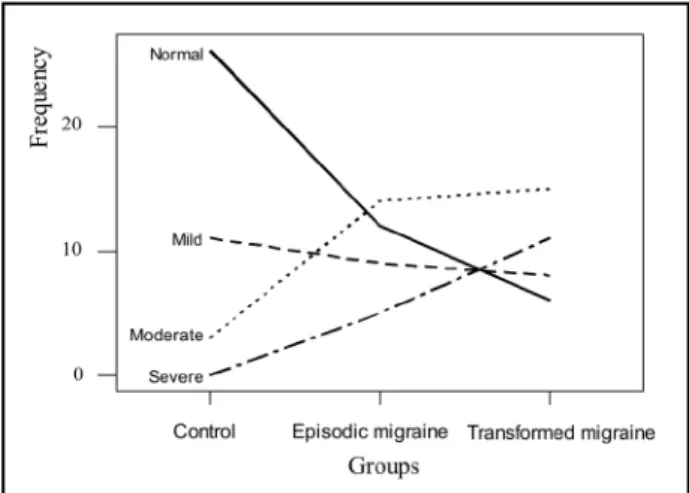
medi-an of the control group was significmedi-antly lower than the EM and TM groups (p=0.05). According to the BDI scores, the patients’ depression of the EM, TM and the control group was classified as: normal, mild, moderate and severe (Fig 1). As shown in Fi-gure 2, the normal pattern (descending curve) is cor-related with the control group, while the severe (as-cending curve) with transformed migraine. When analyzed qualitatively (Dependence Analysis), the patients with TM showed a higher association of severe depression, while the patients with EM sho-wed higher frequency and association of moder-ate depression (Fig 3).
DISCUSSION
TM is the most common type of chronic daily headache (CDH)18-21. Taking into account that pa-tients with EM may evolve into TM9, it is important to recognize this transformation process. Analgesic overuse11,22 and depression co-morbidity11,13 are Fig 1. Level of depression measured by Beck Depression Inventory.
Fig 2. Frequency profile of depression according to the groups.
776 Arq Neuropsiquiatr 2004;62(3-B)
factors, which may be associated with the transfor-mation of EM into TM. The objective of this study was to evaluate both the presence and intensity of depressive symptoms among patients with EM and TM, comparing them with a control group (wi-thout migraine). The BDI has been intensively va-lidated, and it was the instrument used for this eval-uation. The BDI was not developed for depression diagnosis, but as an instrument for quantifying and qualifying depressive symptoms at the time of the evaluation16. Patients with chronic diseases were not admitted in the selection of the three groups, since this might produce a bias in the interpretation of depressive symptoms.
The results showed that the depressive symp-toms were more common in TM and EM when com-pared to the control group. Several studies have reported an association between migraine and de-pression, although their patholophysiogical mech-anism as well as their concomitance is still an issue of discussion in the literature1,4,7,8,23-25.
Patients with EM and TM did not show signifi-cant difference in the BDI scores; however there was a qualitative tendency for more severe depres-sion levels in the TM group.Magnusson and Be-cker13, applying the BDI in 50 patients with EM and 37 with TM, did not find significant difference in the scores of both groups, however they pointed out that 29.7% of the patients with TM present-ed a higher percentage of a moderately severe de-pression compared with only 18% of the patients with EM. Based on these results, the authors have suggested that the greater level of depression
ob-served in the TM group might strengthen Mathew at al. hypothesis9, that is, the depression might be a factor for the transformation of EM into CDH.
In the present study, both the EM and TM groups have presented depression. However, a more ex-pressive depression, according to qualitative evalua-tion, occurred in the TM group. In TM, the presen-ce of depressive symptoms qualitatively more se-vere might suggest a greater co-morbidity with de-pression. Another possible suggestion is that this association performs as a factor of perpetuation of TM, rather than a factor for transformation. The measure of depressive symptoms in patients with EM or TM by means of the BDI provides the clini-cian an effective subsidy in relation to the best deci-sion for the therapeutic procedure.
In conclusion, patients with TM have present-ed depressive symptoms more severe according to qualitative analysis, strengthening some co-morbidity with depression. This qualitative associa-tion with severe depression might be considered rather a factor of TM perpetuation than a risk fac-tor for the transformation of EM into TM.
Acknowledgements - We are grateful to Adília M. Pires Sciarra for the help in the English version.
REFERENCES
1. Merikangas KR, Merikangas JR, Angst J. Headaches syndromes and psy-chiatric disorders: association and familial transmission. J Psychiat Res 1993;27:197-210.
2. Breslau N, Merikangas K, Bowden CL. Comorbidity of migraine and major affective disorder. Neurology 1994;44 (Suppl. 7):17-S22. 3. Merikangas KR, Stevens DE, Angst J. Psychopathology and headache
syndromes in the community. Headache 1994;34:17-26.
Table 2. Beck Depression Inventory scores.
Statistic Episodic migraine Transformed migraine Control group
Mean (SD) 17.5 (10.7) 21.3 (10.9) 6.9 (6.0)
Median 16 21 5.5
Range 0 – 51 2 – 44 0 – 22
SD, standard deviation; values in years.
Table 1. Age of the three groups at first examination.
Statistic Episodic migraine Transformed migraine Control group
Mean (SD) 37.3 (10.3) 37.1 (11.7) 36.8 (11.5)
Median 35.5 34 34
Range 18 – 55 19 – 59 18 – 59
Arq Neuropsiquiatr 2004;62(3-B) 777
4. Breslau N, Davis GC, Schultz LR, Peterson EL. Migraine and major depression: a longitudinal study. Headache 1994;34:387-393. 5. Breslau N, Andreski P. Migraine, personality and psychiatric
comor-bidity. Headache 1995;35:382-386.
6. Breslau N. Psychiatry comorbidity in migraine. Cephalalgia 1998;18 (Suppl. 22):S56-S61.
7. Cox D, Thomas D Relationship between headaches and depression. Headache 1981;21:261-263.
8. Garvey MJ, Tollefson GD, Schaffer CB. Migraine headaches and depres-sion. Psychiatry 1984;141:986-988.
9. Mathew NT, Reuveni U, Perez F. Transformed or evolutive migraine. Headache 1987;27:102-106.
10. Headache Classification Committee of The International Headache Society. The international classification of headache disorders, 2nded.
Cephalalgia 2004;24 (Suppl. 1):S1-S160.
11. Mathew NT, Stubits E, Nigam MR Transformation of episodic migraine into daily headache: analysis of factors. Headache 1982;22:66-68. 12. Galego JC, Cipullo JP, Cordeiro JA, Tognola WA. Clinical features of
episodic migraine and transformed migraine: a comparative study. Arq Neuropsiquiatr. 2002;60:912-916.
13. Magnusson JE, Becker WJ. A comparison of disability and psycholog-ical factors in migraine and transformed migraine. Cephalalgia 2002;22:172-178.
14. Headache Classification Committee of the International Headache Society. Classification and diagnostic criteria for headache disorders, cranial neuralgias and facial pain. Cephalalgia 1988;8 (Suppl. 7):S1-S96.
15. Silberstein SD, Lipton RB, Solomon S, Mathew NT. Classification of dai-ly and near-daidai-ly headaches: proposed revisions to the IHS criteria. Headache 1994;34:1-7.
16. Beck AT. Beck Depression Inventory. San Antonio, Texas: Harcourt Brace, The Psychology Corporation, 1993.
17. Cordeiro JA. Análise de dependência. Tese, UNESP. São José do Rio Preto; 1990.
18. Solomon S, Lipton RB, Newman LC. Clinical features of chronic daily headache. Headache 1992;32: 325-329.
19. Manzoni GC, Micieli G, Granella F, Martignoni E, Malferrari G, Nappi G. Daily chronic headache: classification and clinical features. Obser-vation on 250 patients. Cephalalgia 1987;7 (Suppl 6):S169-S170. 20. Manzoni GC, Sandrini G, Zanferrari C, Verri AP, Franco Granella F,
Giuseppe Nappi G. Clinical features of daily chronic headache and its different subtypes. Cephalalgia 1991;11(Suppl 11):S292-S293. 21. Jevoux Cda, Moreira PF Filho, Souza JA. Primary chronic daily headache:
a report on 52 cases. Arq Neuropsiquiatr 1998;56:69-70.
22. Mathew NT, Kurman R, Perez F. Drug induced refractory headache: clinical features and management. Headache 1990;30:634-638. 23. Couch JR M, Ziegler DK, Hassanein RS. Evaluation of the relationship
between migraine headache and depression. Headache 1975;15:41-50. 24. Holm JE, Penzien DB, Holroyd KA, Brown TA. Headache and depres-sion: confounding effects of transdiagnostic symptoms. Headache 1994;34:418-423.