Slavica Vujisi}
,
1Ljiljana Radulovi},
1Sanja Vodopi}
1COMORBIDITY OF EPILEPSY
AND MIGRAINES EPIDEMIOLOGICAL
AND CLINICAL ASPECTS
Primljen/Received 07. 09. 2012. god. Prihva}en/Accepted 10. 10. 2012. god.
Summary: In patients with migraines, epilepsy occurs in 5.9% (1–17%) of cases compared to a preva-lence of 0.5–1% in the general population. Comorbi-dity of migraines and epilepsy can be explained by ne-uronal hyperexcitability, while cortical spreading de-pression is considered to be a pathophysiological mec-hanism that lies in the basis of the migraine aura.
The study included 259 patients with epilepsy and 40 patients with both epilepsy and migraines. The aim of the investigation was to determine the prevalence of migraines, the existence of a temporal association bet-ween epileptic and migraine attacks, to determine the clinical characteristics of joint epileptic and migraine attacks, the existence of a significant connection bet-ween a certain type of epileptic seizure and type of hea-dache, and finally to determine heredity for epilepsy and migraines in patients who have these conditions associated. Patients were diagnosed clinically, neu-rophysiologically and neuroradiologically. The rese-arch results show that the frequency of associated epi-lepsy and migraines occurred in 15.44%. The results of this investigation point to a significantly higher frequ-ency of epilepsy and migraines in female patients (ratio 5 : 1), which is different from the data we found in exi-sting studies. Temporally connected attacks of epi-lepsy and migraines were observed in 48% of patients. Preictal headaches appeared in 20% of patients, postic-tal in 28% of patients. There was no significant associ-ation between migraines and the particular type of epi-leptic attack. Heredity for migraines was present in 35% of patients with both epilepsy and migraines. This
data is significantly lower than the data found in other studies.
Key words:epilepsy, migraine, adults, comorbi-dity.
INTRODUCTION
Migraines and epilepsy are two chronic disorders characterized by repeated attacks of neurological dys-function and are variously accompanied by gastrointe-stinal, autonomic and other pathophysiological disor-ders. Migraines and epilepsy are linked by their symp-tom profiles, comorbidity and treatment. A person suf-fering from one of these diseases is twice as at risk of having the other one, too (1, 2).
The association of epilepsy and migraines indica-tes comorbidity which does not occur by accident, ac-cording to epidemiological studies. The reasons are partly genetic (3, 4), but at the same time both disor-ders exhibit common pathophysiological and elec-trophysiological phenomena (5). These two disorders also exhibit comparable clinical phenomena which may lead to confusion.
The prevalence of epilepsy in patients with migra-ines varies from one author to another and it ranges from 1–17% (mostly reported 5.9%), while in the gen-eral population it ranges from 0.5–1% (6). The pat-hophysiological mechanism of the association betwe-en epilepsy and migraines is still unclear. There is an opinion that neuronal hyperexcitability may explain the comorbidity of these two disorders (7, 8). Cortical spreading depression during migraine aura (9, 10) is considered to be a pathophysiological mechanism which lies at the root of epileptic seizures in patients suffering from epilepsy and migraines with aura. The
association of epilepsy and migraines may be classi-fied as:
1. Association of epilepsy and migraines with in-dependent seizure occurrence
2. Migraine-induced epilepsy 3. An epilepsy-induced headache 4. Epilepsy-migraine syndromes
5. Symptomatic epilepsy-migraine syndromes Anamnestic data has an important place in differ-ential diagnosis of epilepsy and migraines without aura (11, 12). Many symptoms of migraine and epilepsy overlap and the most useful symptoms in its diagnosis are those that differentiate these two diseases. The dif-ferential diagnosis: a) between migraines with aura and epilepsy without tonic-clonic movements, in the case of a b) migraine equivalent (the occurrence of migraine aura without headache), c) basilar migraine, d) confu-sion migraine and e) migraine associated with occipital epilepsy, may be very difficult.
AIM OF RESEARCH
The goal of this study was to estimate the frequ-ency of migraine occurrence in adult patients with epi-lepsy, to determine the temporal association of epilep-tic and migraine attacks, the clinical characterisepilep-tics of these associated attacks, to explore the possible con-nection between specific types of epileptic seizure and headache, as well as to determine the heredity of pati-ents suffering from epilepsy and migraines.
METHOD AND PATIENTS
In this study we investigated a group of 259 con-secutive outpatients, with a confirmed diagnosis of ep-ilepsy. The group consisted of 115 male and 144 fema-le patients. Patients were treated in the Dispensary for Epilepsy at the Clinical Centre of Montenegro, Podgo-rica. The investigation lasted for 30 months. Patients were followed up at intervals ranging between 3 and 6 months. Criteria for the diagnosis of epilepsy were ba-sed on clinical symptoms and electroencephalographic findings (EEG), neuroradiological methods such as computed tomography (CT) and/or magnetic resonan-ce imaging of the brain (MRI). The study included 86 patients with connected epilepsy and headaches. Out of 259 patients, 40 patients reported the coexistence of epilepsy and migraines. Patients with a progressive di-sease of the brain or recent brain injury were excluded from the study. Patients included in the study were in-terviewed using a standardized questionnaire.
The questionnaire contained:
A.General information: gender, age.
B. Information related to epilepsy: age of onset, duration of epilepsy, data regarding seizure semiology, data regarding the phenomena before and after epilep-tic seizure, the incidence of attacks, the presence of aura attacks, heredity of epilepsy, heredity of migraine headaches. Types of seizures were determined accord-ing to the Classification of the International League Against Epilepsy (ILAE, 1989). According to ILAE criteria epileptic syndromes were classified as partial and generalized seizures.
C.Issues related to the headache:does the patient have pain all over the head or on one side of the head, quality of pain (tightness, pulsation, throbbing, pressu-re-like feeling), the intensity of pain, pain worsened by physical activity, pain followed by associated symp-toms, the presence of migraine aura, family history of migraines. According to the ICDH II criteria, headac-hes were classified as: a) Migraine headacheadac-hes; or b) Ot-her, non-migraine headaches.
D. Questions about the temporal association of epilepsy and migraines:a temporally associated epi-lepsy and headache is defined as a headache occurring one hour before or after an epileptic attack or both. This criterion has been adopted in a similar sur-vey regarding the association of epilepsy and headac-hes in a population of patients with epilepsy (Leniger et al, 2001).
The time of headache onset in relation to the epi-leptic attack was defined as: preictal; ictal; postictal; or interictal.
EEG findings were categorized into 5 categories: normal EEG, focal-specific activity, generalized epi-leptiform activity, nonspecific focal activity, diffuse nonspecific activity.
CT results were classified into two categories: a) normal; and b) pathological.
MRI was carried out in all patients with migraines and epilepsy, except for two patients, where MRI was contraindicated. Magnetic resonance angiography (MRA) was performed in 3 patients, who had headac-hes always on the same side of the head. MRI was per-formed on a device with a magnetic field strength of 1 Tesla.
The results are classified into two categories: a) normal; and b) pathological.
The control group consisted of: a) Patients with migraine headaches without epilepsy; and b) Patients with epilepsy without headaches.
RESULTS
headaches, while epilepsy without headaches was fo-und in 173 (66.80%) patients (graph 1). In this rese-arch, migraines occurred prior to the onset of epilepsy. Out of the total number of patients suffering from epi-lepsy and migraines, 85% were females. Out of the to-tal of 40 patients, 32 (80.00%) had a generalized type of seizure (with or without focal onset) and partial sei-zures were found in 8 (20.00%) patients. Most patients
40 years old or younger had generalized seizures with or without partial onset which was statistically significant in comparison to patients older than 40 years (p < 0.05). The association of a specific type of epileptic seizure and migraine headaches was not statistically significant. Temporal association of epileptic and migraine at-tacks was found in 19 (47.5%) out of 40 patients with epilepsy and migraines. Eight of them (20%) had pre-ictal migraines while in 11 (28%) patients migraines occurred postictally. The rest of the patients (52%) had interictal migraine headaches. Preictal temporal asso-ciation of a migraine and epileptic seizure was statisti-cally significantly more common in patients with epi-lepsy and migraines than in patients with epiepi-lepsy and other, non-migraine headaches (p < 0.05). Patients with postictal headaches more frequently suffered from non-migraine headaches associated with epileptic seizu-res (32 or 74.42%) than from migraines (11 or 25.58%).
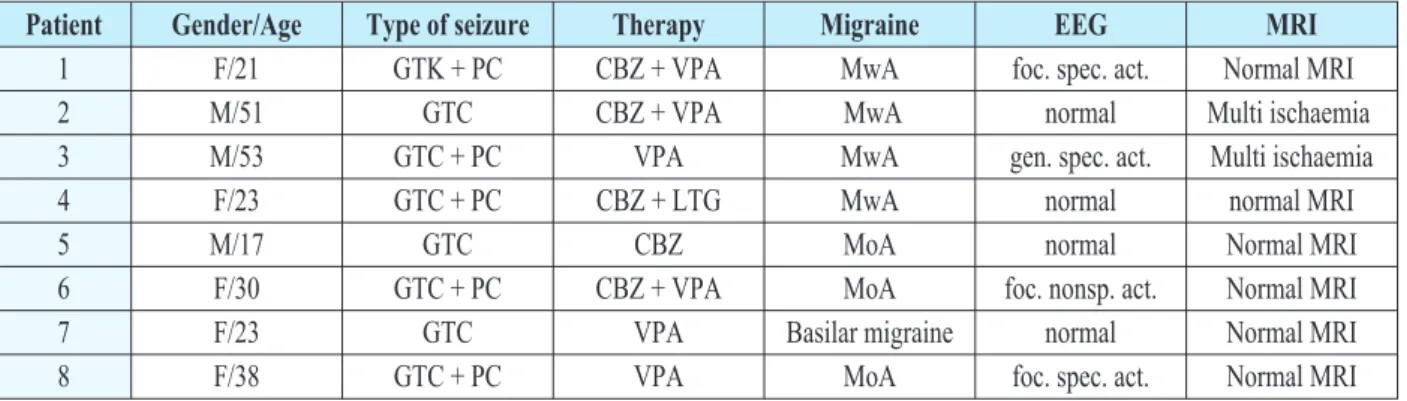
Tables 1 and 2 show the temporal association of epileptic seizures and migraines, in relation to the pres-ence of migraines with aura.
Graph 1: Incidence of migraine and non-migraine headaches in the population of epilepsy sufferers
Patient Gender/Age Type of seizure Therapy Migraine EEG MRI
1 F/21 GTK + PC CBZ + VPA MwA foc. spec. act. Normal MRI
2 M/51 GTC CBZ + VPA MwA normal Multi ischaemia
3 M/53 GTC + PC VPA MwA gen. spec. act. Multi ischaemia
4 F/23 GTC + PC CBZ + LTG MwA normal normal MRI
5 M/17 GTC CBZ MoA normal Normal MRI
6 F/30 GTC + PC CBZ + VPA MoA foc. nonsp. act. Normal MRI
7 F/23 GTC VPA Basilar migraine normal Normal MRI
8 F/38 GTC + PC VPA MoA foc. spec. act. Normal MRI
Table 1. Patients with preictal migraine attacks
Patient Gender/Age Type of seizure Therapy Migraine EEG MRI
1 F/26 PC CBZ + TPM MoA gen. spec. act. Normal
2 F/42 GTC VAL + TPM MoA gen. spec. act. Normal
3 F/31 GTC VPA MoA gen. spec. act. Normal
4 F/48 GTC CBZ + VPA + PB MoA gen. spec. act. Hippocampal
sclerosis
5 F/48 PC CBZ MoA foc. nonspec. act. Hippocampal
hypotrphy 6 F/18 GTC + Myoclonic VPA + LTG MwA gen. spec. act. Normal
7 F/20 GTC VPA MoA normal Normal
8 F/48 PC CBZ + PB MoA foc. Spec. act. Normal
9 F/20 GTC VPA MoA normal Normal
10 F/43 PC CBZ + LTG MwA normal Normal
11 F/23 GTC VPA MoA normal Normal
Legend: F — female, M — male, PC — partial complex seizures, GTC — generalized tonic-clonic seizure, CBZ — carbamazepine, TPM — topira-mate, VAL — valproate, VPA — valproic acid, PB — phenobarbitone, LTG — lamotrigine, MoA — migraine without aura, MwA — migraine with aura, gen. spec. act. — generalized specific activity, foc. nonspec. act. — focal nonspecific activity.
The temporal association of migraines with aura and epileptic seizures was statistically significantly mo-re fmo-requently found than migraines with aura not tempo-rally associated with epileptic seizures (p < 0.05).
A positive family history for migraines was found in 14 (35.0%) patients with epilepsy and migraines, in 27 (67.25%) patients with migraines and in 5 (10.86%) patients with epilepsy and other non-migraine headac-hes. Heredity of migraines was statistically signifi-cantly more common in patients with migraines than in patients with epilepsy and migraines (p < 0.05).
In a group of patients suffering from epilepsy and migraines, 25% of patients had migraines with aura while in a group of patients with migraines but without epilepsy this percentage was 47.5%. Migraines with aura were significantly more frequent in patients with migraines but without epilepsy, than in patients suffer-ing from epilepsy and migraines, p < 0.05.
DISCUSSION
Our study has demonstrated a connection between epilepsy and migraine headaches in 15.44% (40) of our patients. The prevalence of migraines in the general po-pulation is around 11% in contrast with an estimated 15% for patients with epilepsy (13, 14). These figures are consistent with the results of our study. Similar re-sults were obtained in another study where the prevalen-ce of migraines was 14% (15). A slightly higher preva-lence of migraines in the epileptic population was found in a study where 42% of patients had headaches associa-ted with their primary condition (16). Among the total number of patients suffering from epilepsy and migrai-nes, 85% were females. This result was statistically sig-nificant in comparison to male patients (p < 0.001). Such a high frequency of female patients with the fema-le to mafema-le ratio 5 : 1 among patients with epifema-lepsy and migraines was not found in the available literature. Studies regarding this problem usually reported the fe-male to fe-male ratio as 3 : 1 (17). A strong association be-tween epilepsy and migraines, irrespective of the type of attack, etiology, sex, age of onset and family history, was reported by the authors Othman and Lipton (18). The authors found a cumulative incidence of migraines in 24% of patients with epilepsy under the age of 40, which is slightly higher than in our study. In our rese-arch, out of a total of 40 patients with epilepsy and mi-graines, 32 (80%) patients had generalized seizures, and 8 (20%) patients had partial seizures. A higher
in-cidence of partial seizures compared to generalized se-izures was found in the study of associated epilepsy and migraines in 341 patients with epilepsy. 67.2% (174) of those patients had focal seizures (19).
Of the total 259 patients, 3.08% had preictal mi-graines, while a lower incidence (1.7% of patients) of preictal migraine headaches was found in the survey by the Turkish authors (14), in contrast to our rese-arch.
Ito et al. (20) investigated postictal headaches that occurred immediately after partial seizures, and found that 5.5% of patients had migraine headaches, which is slightly higher than in our study. Overall, both preictal and postictal occurrences of migraine headaches in our study were equally represented. Similar results were found in the research papers of several different aut-hors (21, 22, 23).
In our study, in patients with epilepsy and a family history of migraines, migraines were discovered in 35% of the total number of patients. A similar frequ-ency of positive family history of migraines was found in a related survey (18), where a positive history of mi-graines was present in 40.6% of patients.
CONCLUSION
In conclusion, the results of this study indicate that the prevalence of headaches associated with epilepsy was 33.20%, while the prevalence of migraines in the same group was 15.44%. Of the total number of patients with epilepsy and migraines, 85% were women.
Sa`etak
KOMORBIDITET EPILEPSIJE I MIGRENE,
EPIDEMIOLO[KI I KLINI^KI ASPEKT
Slavica Vujisi},1Ljiljana Radulovi},1Sanja Vodopi}11 — Klini~ki centar Crne Gore, Klinika za neurologiju, Medicinski fakultet Univerziteta Crne Gore
Epilepsija kod pacijenata sa migrenom javlja se u 5.9% (od 1–17%) slu~ajeva u pore|enju sa prevalenci-jom od 0,5–1% u op{toj populaciji. Komorbidnost migre-ne i epilepsije bi se mogla objasniti migre-neuronskom hierekci-tabilno{}u, dok se kortikalna {ire}a depresija smatra pato-fizilo{kim mehanizmom koji je u osnovi migrenske aure.
Studija je obuhvatila 259 pacijenata sa epilepsi-jom, a u istra`ivanje je uklju~eno 40 pacijenata sa udru`enom epilepsijom i migrenom. Cilj istra`ivanja je bio da se utvrdi prevalenca migrene u epilepti~noj populaciji, postojanje vremenske udru`enosti izme|u epilepti~kih i migrenskih napada, zna~ajna povezanost izme|u tipa epilepti~kog napada i tipa glavobolje, da se utvrdi hereditet za epilepsiju i migrenu kod pacije-nata kod kojih postoji udru`enost ova dva entiteta.
Paci-jenti su dijagnostikovani klini~ki, neurofiziolo{ki i ne-uroradiolo{ki. Rezultati istra`ivanja su pokazali da prevalenca migrene u epilepti~koj populaciji iznosi 15.44%. Rezultati ovog istra`ivanja upu}uju na zna-~ajno ve}u udru`enost epilepsije i migrene kod `en-skog pola (5 : 1), {to se razlikuje od podataka iz litera-ture. Vremenski udru`eni napadi migrene i epilepsije javljali su se u 48% pacijenata. Preiktusne glavobolje javile su se kod 20% a postiktusne kod 28% pacijenata. Nije bilo zna~ajne udru`enosti migrene i odre|enog ti-pa epilepti~nog nati-pada. Hereditet za migrenu prisutan je kod 35% bolesnika sa epilepsijom i migrenom, zna-~ajno manje nego u literaturi.
Klju~ne rije~i: epilepsija, migrena, odrasli, ko-morbiditet.
REFERENCES
1. Andermann E, Andermann FA. Migraine-epilepsy rela-tionships: epidemiological and genetic aspects. In: Andermann F, Lugaresi E, editors. Migraine and epilepsy. Boston: Butter-worth; 1987. p. 281–91.
2. De Simone R, Ranieri A et al. Migraine and epilepsy: clinical and pathophysiological relations. Neurol Sci. 2007; (28): 150–55.
3. Samuel F. Berkovic and Douglas E. Crompton. The bor-derland of epilepsy: A clinical and molecular view, 100 years on. Epilepsia. 2010: 51(1): 3–4.
4. Strug LJ, Pal DK. Evidence of shared genetic risk fac-tors for migraine and Rolandic epilepsy. Epilepsia. 2009; 50(11): 2428–33.
5. Binchin MM, Londero RG, et al. Migraine and epilepsy: A Focus on overlapping Clinical, Pathophysiological, Molecu-lar and Therapeutics Aspects. Current pain and headache re-ports. 2010; 14(4): 276–83.
6. Stewart W F, Lipton R B, Celentano D D, Reed M L. Prevalence of migraine headache in United States. Relation to age, income, race, and other sociodemographic factors. JAMA. 1992; 267: 64–9.
7. Rogavski MA. Common pathophysiological mecha-nisms in migraine and epilepsy. Arch Neurol. 2008; 65(6): 709–14.
8. Meikangas K R, Angst J, Isler H. Migraine and psycho-pathology: results of the Gurich Cohort Study of young adults. Arch Gen Psychiatry. 1990; 47: 849–53.
9. Goadsby AD. Cortical Spreading Depression — Better Understanding and More Questions. Focus on “Distinct Vascu-lar Conduction With Cortical Spreading Depression”. JN Physiol. 2007; 97(6):3827.
10. Ruppin E, Reggia JA. Cortical spreading depression and the pathogenesis of brain disorders: a co-mutational and ne-ural network-based investigation. Neurol Res. 2001; 23(5): 447–56.
11. Panayiotopoulos CP. Difficulties in Differentiating Mi-graine and Epilepsy Based on Clinical and EEG Findings. In: Andermann F, Lugaresi E, editors. Migraine and epilepsy. But-terworth: Boston; 1987. p. 31–47.
12. Paul TG, Davies CP. Migraine-triggered seizures and epilepsy-triggered headache and migraine attacks: a need for re-assessment. J Headache Pain. 2011; 12: 287–88.
13. Stewart W F, Shechter A, Lieberman J. Physician con-sultation for headache pain and history of panic: Results from population-based study. Am J Med. 1992; 92: 35–40.
14. Lipton R B, Stewart W F, Diamond S, Diamond M, Reed M L. Prevalence and burden of migraine in the United Sta-tes: results from the American Migraine Study II. Headache. 2001; 41: 646–57.
15. Velioglu S K, Ozmenoglu M. Migraine-related seizu-res in an epileptic population. Cephalgia. 1999; 9(19): 797–801.
16. Förderreuther S, Henkel A, Noachtar S, Straube A. He-adache associated with epileptic seizures: epidemiology and cli-nical characteristics. Headache. 2002; 42(7): 649–55.
17. Rasmussen B K, Jensen R, Schrol ML, et al. Epidemio-logy of headache in a general population: a prevalence study. J Clin Epidemiol. 1991; 44: 1147–57.
18. Ottman R, Lipton B. Comorbidity of migraine and epi-lepsy. Neurology. 1994; 44: 2105–10.
19. Leniger T, Dreich S, Isbruch K, Diener HC, Hufnagel A. Clinical Characteristics of Patients With Comorbidity of Mi-graine and Epilepsy. Headache. 2003; 43: 672–7.
hea-Correspondence to/Autor za korespodenciju
Prof. dr Slavica Vujisi} Ul. Ljubljanska bb 81000 Podgorica Montenegro
Tel. +382 69 017 107 fax +382 20 225 284
dache in patients with epilepsy. Acta Neurol Scand. 2000; 102: 129–13.
21. Cao Y, Welch KMA, Aurora S, Vikingstad EM. Functi-onal MRI- BOLD of visually-triggered headache in patients with migraine. Neurology. 1999; 59: 72–8.
22. Sanchez del Rio M, Bakker D, Wu O, et al. Perfu-sion-weighted imaging during migraine: spontaneous visual aura and headache. Cephalalgia. 1999; 19(8): 701–7.