Peruvian Amazon: Impact of
pfhrp2
Gene Deletions and
Cross-Reactions
Jessica Maltha1*, Dionicia Gamboa2,3, Jorge Bendezu2, Luis Sanchez2, Lieselotte Cnops1, Philippe Gillet1, Jan Jacobs1
1Department of Clinical Sciences, Institute of Tropical Medicine, Antwerp, Belgium,2Instituto de Medicina Tropical ‘‘Alexander von Humboldt’’, Universidad Peruana Cayetano Heredia, Lima, Peru,3Departamento de Ciencias Celulares y Moleculares, Facultad de Ciencias y Filosofia, Universidad Peruana Cayetano Heredia, Lima, Peru
Abstract
Background:In the Peruvian Amazon,Plasmodium falciparumand Plasmodium vivaxmalaria are endemic in rural areas, where microscopy is not available. Malaria rapid diagnostic tests (RDTs) provide quick and accurate diagnosis. However, pfhrp2gene deletions may limit the use of histidine-rich protein-2 (PfHRP2) detecting RDTs. Further, cross-reactions ofP. falciparumwithP. vivax-specific test lines and vice versa may impair diagnostic specificity.
Methods:Thirteen RDT products were evaluated on 179 prospectively collected malaria positive samples. Species diagnosis was performed by microscopy and confirmed by PCR.Pfhrp2gene deletions were assessed by PCR.
Results:Sensitivity forP. falciparumdiagnosis was lower for PfHRP2 compared toP. falciparum-specificPlasmodiumlactate dehydrogenase (Pf-pLDH)- detecting RDTs (71.6% vs. 98.7%, p,0.001). Most (19/21) false negative PfHRP2 results were associated withpfhrp2gene deletions (25.7% of 74P. falciparumsamples). Diagnostic sensitivity forP. vivax(101 samples) was excellent, except for two products. In 10/12P. vivax-detecting RDT products, cross-reactions with the PfHRP2 or Pf-pLDH line occurred at a median frequency of 2.5% (range 0%–10.9%) ofP. vivaxsamples assessed. In two RDT products, two and oneP. falciparumsamples respectively cross-reacted with the Pv-pLDH line. Two Pf-pLDH/pan-pLDH-detecting RDTs showed excellent sensitivity with few (1.0%) cross-reactions but showed faint Pf-pLDH lines in 24.7% and 38.9% of P. falciparumsamples.
Conclusion:PfHRP2-detecting RDTs are not suitable in the Peruvian Amazon due topfhrp2gene deletions. Two Pf-pLDH-detecting RDTs performed excellently and are promising RDTs for this region although faint test lines are of concern.
Citation:Maltha J, Gamboa D, Bendezu J, Sanchez L, Cnops L, et al. (2012) Rapid Diagnostic Tests for Malaria Diagnosis in the Peruvian Amazon: Impact ofpfhrp2 Gene Deletions and Cross-Reactions. PLoS ONE 7(8): e43094. doi:10.1371/journal.pone.0043094
Editor:Georges Snounou, Universite´ Pierre et Marie Curie, France
ReceivedMay 30, 2012;AcceptedJuly 16, 2012;PublishedAugust 28, 2012
Copyright:ß2012 Maltha et al. This is an open-access article distributed under the terms of the Creative Commons Attribution License, which permits unrestricted use, distribution, and reproduction in any medium, provided the original author and source are credited.
Funding:Part of the work performed by JM was funded by the ‘‘Steunfonds Marguerite-Marie Delacroix’’. Part of the work performed by DG and JB was funded by a National Institute of Health grant (U19 AI089681) and by Directorate General for Development Cooperation (DGCD) of the Belgian Government (framework agreement 3, project 95502). The funders had no role in study design, data collection and analysis, decision to publish, or preparation of the manuscript. Competing Interests:The authors have declared that no competing interests exist.
* E-mail: [email protected]
Introduction
In Peru, malaria is mainly endemic in the Amazon region, where it is the primary cause of morbidity in adults and the fourth in children [1]. According to the recommendations of the World Health Organization (WHO), diagnosis and treatment should be based on parasitological confirmation by either microscopy or malaria rapid diagnostic tests (RDTs) [2]. In Peru, most cases occur in rural areas where no microscopy is available. Currently, thick blood films (TBFs) of malaria suspected patients are sent for analysis to the most nearby health center, but this process takes several days and patients are often treated presumptively [3]. In such conditions RDTs could be useful, providing quick and accurate diagnosis, thereby leading to timely and correct treatment and reducing the severity and economic burden of disease. Besides, use of RDTs in the Peruvian Amazon has been demonstrated to be cost-effective [4].
RDTs are handheld cassettes detecting malaria parasites by an antigen-antibody reaction on a nitrocellulose strip which become visible as blue or cherry-red test lines. There are several detection antibodies, directed to different antigens: histidine-rich protein-2 (PfHRP2) and Plasmodium falciparum-specific Plasmodium lactate dehydrogenase (Pf-pLDH) for P. falciparum; Plasmodium vivax -specific pLDH (Pv-pLDH) for P. vivax, and pan-pLDH and aldolase which are common to all fourPlasmodiumspecies.
respectively-have been recently described in Peru [8] indicating that the use of PfHRP2 detecting RDTs may be limited [8]. Previous evaluations of two PfHRP2 detecting RDTs in Peru demonstrated sensitivity forP. falciparumdiagnosis of 95% [9] and 53.5% [10].
The aims of the present study were to assess diagnostic accuracy of a panel of different RDT products for malaria diagnosis in the Peruvian Amazon, with particular focus on the impact ofpfhrp2
and pfhrp3 gene deletions on diagnostic sensitivity and of cross-reactions on diagnostic specificity.
Methods
Ethics statement
The study was approved by the Ethical Review Board of the Universidad Peruana Cayetano Heredia, Lima, Peru (Code SIDISI: 55587 and 55239). All patients with a positive TBF, performed as part of routine patient care, were included after signing informed consent. Written informed consent was obtained from the patient himself in the case of adults or from the parent/ guardian in case of a minor (,18 years).
Study site and population
Several health centers around Iquitos (Figure 1) were included. Malaria in the Peruvian Amazon is perennial with a peak during the rainy season (November – May) and an incidence of 10–50 malaria cases per 1000 inhabitants per year [11]. Patients were included by either passive case detection (symptomatic patients presenting at the health centers) or active case detection (outreach teams performing malaria screening in epidemic communities). All patients with a positive TBF were included after signing informed consent. Previous antimalarial treatment, symptoms and travel history were recorded.
Samples
EDTA anti-coagulated venous blood samples were drawn and transported to the laboratory of San Juan where RDTs were performed. After RDT performance, samples were aliquoted and stored at220uC, usually within 24 hours (range 2–72 hours) after sample collection, pending further analysis.
Malaria rapid diagnostic tests
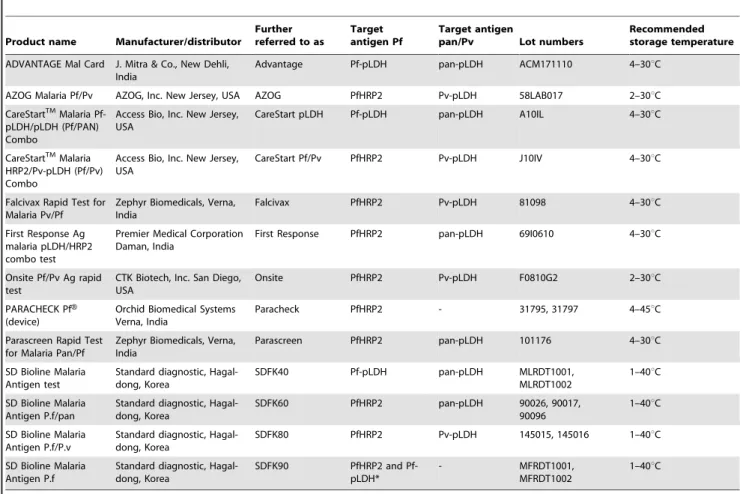
Thirteen RDT products detecting several target antigens were selected (Table 1), based on good performance as documented by the WHO/Foundation for Innovative New Diagnostics (FIND) malaria RDT evaluation program [12,13] or recent release on the market.
Both SDFK90 and Paracheck detect onlyP. falciparumand were included for evaluation of P. falciparum diagnosis. SDFK90 was only performed on P. falciparum samples and mixed infections. RDTs were purchased at the Institute of Tropical Medicine (ITM), Belgium and shipped to Peru. For logistic reasons (delays of delivery and shipment), some RDTs had to be performed on stored samples, in these cases median period of sample storage was 51 days (range 29–131 days).
Test procedures
RDTs were performed according to the manufacturer’s instructions except that the supplied transfer device was replaced by a micropipette. The first observer read test results within the specified reading time, the second and, when available, third observer within 10 additional minutes. Observers were blinded to each other’s readings. In case of absence of the control line the test was repeated. A scoring system of five categories was used to assess line intensities [14]. Test results were based on consensus agreement in case of three observers. In all other cases, the result of the first observer was considered.
Microscopy
At the laboratory of San Juan, species and parasite density were determined by TBF microscopy, assuming a white blood cell count of 8,000/ml [15]. For quality control (QC), 20% randomly selected slides, including those with interpretive problems, discordant RDT results, negative slides and suspected mixed infections were reexamined by two blinded expert microscopists at ITM. For parasite density the results of the first microscopist were considered except when QC indicated a density of more than two fold difference with the original count, in such cases mean of the two QC readings was considered.
DNA extraction
DNA was extracted from 200ml whole blood using QIAamp DNA blood Mini kit (QIAGEN, Venlo, The Netherlands), according to the manufacturer’s instructions except for a dilution in 100ml instead of 200ml elution buffer.
Species-specific PCR
In case of discordances between RDT and microscopy or between initial and QC microscopy, real-time PCR (P. falciparum/ P. vivax) was performed [16] which was considered conclusive.
Assessment ofpfhrp2andpfhrp3gene deletions
Confirmed P. falciparum samples were assessed for pfhrp2 and
pfhrp3 gene deletions by conventional PCR using primers and conditions as described elsewhere [8,17]. For pfhrp2, two amplifications were performed: one of entire exon 2 (encoding PfHRP2) and another across exon 1 and exon 2 (exon1–2). Samples were considered lacking the pfhrp2 gene when both amplifications failed to generate a PCR product. For pfhrp3, a single amplification of entire exon 2 was performed.
PfHRP2 ELISA
The presence of PfHRP2 protein in whole blood samples was determined by enzyme linked immune sorbent assay (ELISA,
Figure 1. Map of included health centers.The village of Atalaya (23.58,273.75), located 59 km to the West of Iquitos, is not displayed on the map.
Standard Diagnostic, Hagal-Dong, Korea) according to the manufacturer’s instructions. ELISA was performed in all samples withP. falciparuminfection, mixed infections and inP. vivaxsamples generating visible PfHRP2 lines.
Statistical analysis
Diagnostic sensitivity (calculated with 95% confidence intervals (C.I.)) of the RDT products was defined as the number of P. falciparumorP. vivaxsamples with a visibleP. falciparum-specific or Pv-/pan-pLDH test line respectively (regardless of the presence of another test line), divided by the total number ofP. falciparumorP. vivaxsamples respectively. Mixed infections were not included for calculation. Cross-reactions were defined asP. falciparumsamples generating a visible Pv-pLDH line orP. vivaxsamples generating a visible PfHRP2 or Pf-pLDH line.
Proportions were assessed for statistical significance using the Chi-square test or, in case of small sample size, the Fisher-exact test. Ap-value,0.05 was considered significant.
Interobserver agreement was determined by kappa values (k) for positive and negative readings and line intensity readings between the first pair of observers.
Additional analysis
All microscopically confirmedP. falciparumsamples that did not show a visible PfHRP2 line in more than one RDT product were repeated two times with all PfHRP2-detecting RDTs.
Results
Patients and samples
From December 2010–July 2011, 182 patients were included, in three patients malaria was not confirmed by microscopy nor by PCR. Final sample collection consisted ofP. falciparum (n = 74), P. vivax
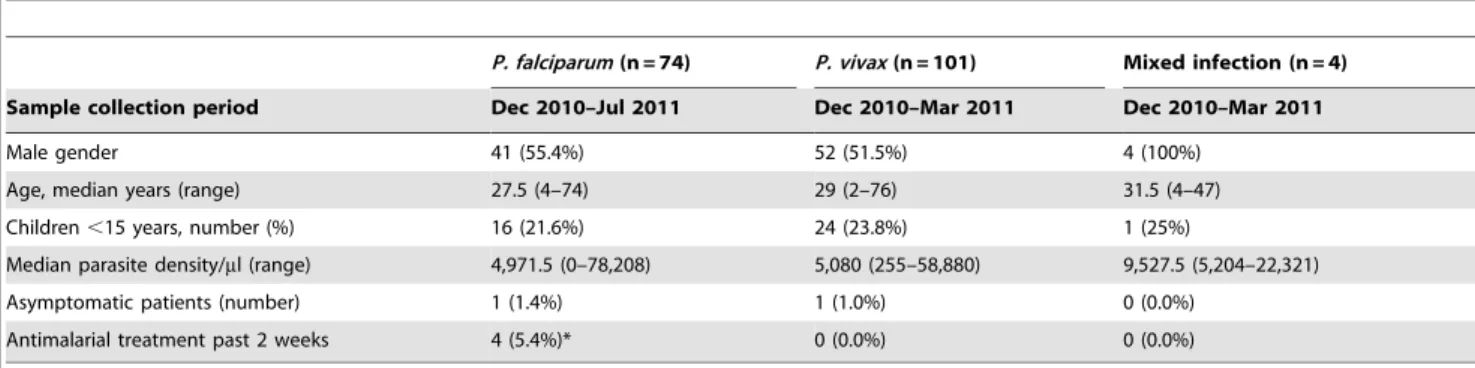
(n = 101) and four mixed infections. The collected samples comprised 5% of allP. falciparumandP. vivaxinfections reported in Loreto region in that time period [1,18]. Data of demography and parasite density are shown in Table 2. Nineteen patients, including the two asymptomatic cases, were included through active case detection performed once in Tarapoto (n = 5) and once in Atalaya (n = 14).
Diagnostic sensitivity of the RDT products
PfHRP2-detecting RDTs had significantly lower sensitivity for
P. falciparum diagnosis compared to Pf-pLDH-detecting RDTs (p,0.0001, Table 3), due to a subset of samples that consequently failed to generate a PfHRP2 line in all PfHRP2 RDT products tested, see results below.
For P. vivax diagnosis, most RDTs performed equally well, except for AZOG (detecting Pv-pLDH) and Parascreen (detecting pan-pLDH) (Table 3), which failed to detectP. vivaxsamples at a median parasite density of 1,075/ml (range 255–4,532/ml) and 600.5/ml (range 255–10,720/ml) respectively.
The mixed infections were detected by all RDT products except for AZOG which displayed a single PfHRP2 line for a sample consisting predominantly ofP. falciparumparasites.
Table 1.Overview of RDT products and their lot numbers.
Product name Manufacturer/distributor
Further referred to as
Target antigen Pf
Target antigen
pan/Pv Lot numbers
Recommended storage temperature
ADVANTAGE Mal Card J. Mitra & Co., New Dehli, India
Advantage Pf-pLDH pan-pLDH ACM171110 4–30uC
AZOG Malaria Pf/Pv AZOG, Inc. New Jersey, USA AZOG PfHRP2 Pv-pLDH 58LAB017 2–30uC CareStartTMMalaria
Pf-pLDH/pLDH (Pf/PAN) Combo
Access Bio, Inc. New Jersey, USA
CareStart pLDH Pf-pLDH pan-pLDH A10IL 4–30uC
CareStartTMMalaria
HRP2/Pv-pLDH (Pf/Pv) Combo
Access Bio, Inc. New Jersey, USA
CareStart Pf/Pv PfHRP2 Pv-pLDH J10IV 4–30uC
Falcivax Rapid Test for Malaria Pv/Pf
Zephyr Biomedicals, Verna, India
Falcivax PfHRP2 Pv-pLDH 81098 4–30uC
First Response Ag malaria pLDH/HRP2 combo test
Premier Medical Corporation Daman, India
First Response PfHRP2 pan-pLDH 69I0610 4–30uC
Onsite Pf/Pv Ag rapid test
CTK Biotech, Inc. San Diego, USA
Onsite PfHRP2 Pv-pLDH F0810G2 2–30uC
PARACHECK PfH
(device)
Orchid Biomedical Systems Verna, India
Paracheck PfHRP2 - 31795, 31797 4–45uC
Parascreen Rapid Test for Malaria Pan/Pf
Zephyr Biomedicals, Verna, India
Parascreen PfHRP2 pan-pLDH 101176 4–30uC
SD Bioline Malaria Antigen test
Standard diagnostic, Hagal-dong, Korea
SDFK40 Pf-pLDH pan-pLDH MLRDT1001,
MLRDT1002
1–40uC
SD Bioline Malaria Antigen P.f/pan
Standard diagnostic, Hagal-dong, Korea
SDFK60 PfHRP2 pan-pLDH 90026, 90017,
90096
1–40uC
SD Bioline Malaria Antigen P.f/P.v
Standard diagnostic, Hagal-dong, Korea
SDFK80 PfHRP2 Pv-pLDH 145015, 145016 1–40uC
SD Bioline Malaria Antigen P.f
Standard diagnostic, Hagal-dong, Korea
SDFK90 PfHRP2 and Pf-pLDH*
- MFRDT1001,
MFRDT1002
1–40uC
For P. falciparum, faint test line intensities occurred more frequently among Pf-pLDH compared to PfHRP2-detecting RDTs (p,0.001, Table 3). For P. vivax, no overall difference in proportion of faint test lines was observed between Pv-pLDH versus pan-pLDH-detecting RDTs.
Failure ofP. falciparumdiagnosis by PfHRP2-detecting RDTs andpfhrp2 gene deletions
All PfHRP2-detecting RDTs failed to diagnose 21P. falciparum
samples (Table 4), whereas the Pf-pLDH-detecting RDTs detected all of them. Most samples (19/21) were lacking pfhrp2 (no amplification of exon1–2 and exon2). The remaining two samples
(PI151 and PI156) generated PCR products forpfhrp2exon1–2 and exon2.Pfhrp2gene deletions occurred at both low and high parasite densities (Table 4) and all patients were symptomatic. PfHRP2 ELISA of the 21 samples confirmed the absence of PfHRP2, with only one sample (PI26) showing a weak positive result (optical density ten-fold lower than other ELISA positive samples).
Pfhrp2:percentage of samples with gene deletions and geographic origin
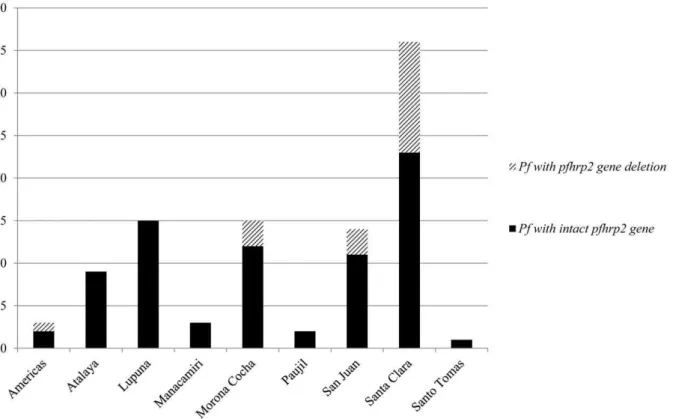
Pfhrp2 gene deletions occurred among 19 (25.7%)P. falciparum
samples. Thirteen (68.4%) were obtained from patients presenting at the health center of Santa Clara (Figure 2), with most patients
Table 2.Patient data and parasite density of the final sample collection.
P. falciparum(n = 74) P. vivax(n = 101) Mixed infection (n = 4)
Sample collection period Dec 2010–Jul 2011 Dec 2010–Mar 2011 Dec 2010–Mar 2011
Male gender 41 (55.4%) 52 (51.5%) 4 (100%)
Age, median years (range) 27.5 (4–74) 29 (2–76) 31.5 (4–47)
Children,15 years, number (%) 16 (21.6%) 24 (23.8%) 1 (25%)
Median parasite density/ml (range) 4,971.5 (0–78,208) 5,080 (255–58,880) 9,527.5 (5,204–22,321)
Asymptomatic patients (number) 1 (1.4%) 1 (1.0%) 0 (0.0%)
Antimalarial treatment past 2 weeks 4 (5.4%)* 0 (0.0%) 0 (0.0%)
*artesunate+mefloquine since 2 days (n = 1), chloroquine since 2 days (n = 2), full course of chloroquine/primaquine (n = 1) at least.1 week ago (exact date not known).
doi:10.1371/journal.pone.0043094.t002
Table 3.Sensitivity, faint line intensity and cross-reactions of the different RDT products for detection ofP. falciparumandP. vivax.
% Sensitivity (95% C.I.)
% of positive test lines with faint
intensity* Number of cross-reactions (%)
RDT product
P. falciparum
(n = 74) P. vivax(n = 101)
PfHRP2
/Pf-pLDH Pv-/pan-pLDH{
P. vivaxwith PfHRP2/Pf-pLDH test line
P. falciparumwith Pv-pLDH test line
PfHRP2-detecting RDT
Paracheck 70.3 (58.5–80.3) - 5.8 - 0 (0.0)
-PfHRP2 and pan-pLDH detecting RDTs
First Response 71.6 (60.0–81.5) 100.0 (94.6–100.0) 3.8 2.0 3 (3.0)
-Parascreen 71.6 (60.0–81.5) 89.1 (81.4–94.4) 1.9 21.1 7 (6.9)
-SDFK60 71.6 (60.0–81.5) 100.0 (94.6–100.0) 7.1 4.0 5 (5.0)
-PfHRP2and Pv-pLDH detecting RDTs
AZOG 71.6 (60.0–81.5) 87.1 (79.0–93.0) 17.0 79.5 2 (2.0) 0 (0.0)
CareStart Pf/Pv 71.6 (60.0–81.5) 100.0 (94.6–100.0) 5.7 10.9 11 (10.9) 0 (0.0)
Falcivax 71.6 (60.0–81.5) 100.0 (94.6–100.0) 1.9 7.9 5 (5.0) 0 (0.0)
Onsite 71.6 (60.0–81.5) 100.0 (94.6–100.0) 5.7 4.0 0 (0.0) 2 (2.7)
SDFK80 71.6 (60.0–81.5) 100.0 (94.6–100.0) 1.9 0.0 1 (1.0) 1 (1.4)
Pf-pLDH and pan-pLDH detecting RDTs
Advantage 98.7 (92.7–100.0) 100.0 (94.6–100.0) 24.7 4.0 1 (1.0)
-CareStart pLDH 98.7 (92.7–100.0) 99.0 (94.6–100.0) 9.6 8.0 10 (9.9)
-SDFK40 97.3 (90.6–99.7) 100.0 (94.6–100.0) 38.9 1.0 1 (1.0)
-PfHRP2 and Pf-pLDH detecting RDT
SDFK90 PfHRP2 line 71.6 (60.0–81.5) - 1.9 - -
-SDFK90 Pf-pLDH line 98.7 (92.7–100.0) - 40.5 - -
-*cross-reactions excluded. {only
living in Tarapoto (8/13, 61.5%). The remaining six were distributed among three other health centers (Figure 2). Pfhrp2
gene deletions were found throughout the study period and sometimes P. falciparum samples with and without pfhrp2 gene deletions were found simultaneously in the same village. One patient with apfhrp2 gene deletion diagnosed at Morona Cocha had been travelling to Angamos (close to the Brazilian border) during the month previous to sampling.
Pfhrp3gene deletion
In total 34 (43.6%)P. falciparumsamples lacked thepfhrp3gene: they included all samples lacking thepfhrp2gene (n = 19) as well as 15 additional samples which contained pfhrp2, and which were correctly diagnosed by all PfHRP2-detecting RDTs.
Occurrence of cross reactions
In most (10/12) RDT products that were assessed withP. vivax
samples,P. falciparumtest lines (either PfHRP2 or Pf-pLDH) were visible at a median frequency of 2.5% (range 1.0%–10.9%). In total, 27 (26.7%) P. vivaxsamples were involved. In all of these samples, mixed infection withP. falciparumwas excluded by PCR and none of the patients had reportedP. falciparuminfection in the month prior to sampling. In six of these samples however, HRP2 ELISA yielded a weak positive result. There was no apparent relation between parasite density and the occurrence of cross-reactions (range 255–58,880/ml).
In two RDT products,P. falciparumsamples generated a visible Pv-pLDH line: one faint line for SDFK80 (parasite density
78,208/ml); and a faint and medium line for Onsite (parasite density 53,333/ml and 3,480/ml). Mixed infection withP. vivaxwas excluded by PCR and none of the patients reported recentP. vivax
infection.
Interobserver agreement
For positive/negative readings, mediankper RDT product was 1.00 (range 0.84–1.00). For line intensity readings, mediankwas 0.87 (range 0.62–0.99).
Discussion
The present study evaluated a panel of RDT products for malaria diagnosis in the Peruvian Amazon. It showed that Pf-pLDH-detecting RDTs performed significantly better for P. falciparumdiagnosis compared to PfHRP2-detecting RDTs in this geographical region. The low sensitivity of PfHRP2-detecting RDTs was related topfhrp2gene deletions which invariably leaded to false negative PfHRP2 results irrespective of the parasite density. ForP. vivaxdiagnosis all but two RDT products performed well with no overall difference in sensitivity and line intensity between Pv-pLDH and pan-pLDH detecting RDTs. Cross-reactions with the P. falciparum line were observed in 10/12 P. vivax-detecting RDT products at a median frequency of 2.5% (range 1.0%–10.9%) of P. vivax samples assessed. In two RDT products, false positive Pv-pLDH lines were observed in up to 2.7% ofP. falciparumsamples.
Table 4.P. falciparumsamples not detected by PfHRP2-detecting RDTs:pfhrp2andpfhrp3PCR results and PfHRP2 ELISA results.
Sample and patient information
Sample number Sex Age Parasite density (/ml) pfhrp2exon 1–2 pfhrp2exon 2 pfhrp3exon 2 PfHRP2 ELISA
PI138 f 56 0*
2 2 2 2
PI139 m 6 79 2 2 2 2
PI137 m 41 80 2 2 2 2
PI136 m 53 270 2 2 2 2
PI 24 f 20 752 2 2 2 2
PI113 f 30 876 2 2 2 2
PI142 m 21 1,000 2 2 2 2
PI151 m 28 1,222 + + 2 2
PI 18 f 12 1,400 2 2 2 2
PI 78 m 37 2,808 2 2 2 2
PI156 f 36 3,480 + + + 2
PI135 m 7 4,784 2 2 2 2
PI153 m 70 5,080 2 2 2 2
PI140 f 20 5,640 2 2 2 2
PI 26 m 48 7,227 2 2 2 +/2
PI 27 f 67 7,840 2 2 2 2
PI163 m 65 16,552 2 2 2 2
PI 81 m 46 18,800 2 2 2 2
PI148 f 34 19,600 2 2 2 2
PI 74 m 38 22,560 2 2 2 2
PI 65 m 27 43,089 2 2 2 2
Impact ofpfhrp2gene deletions
The exact incidence of pfhrp2gene deletions in the Peruvian Amazon is not known. We presently found 25.7% ofP. falciparum
samples lackingpfhrp2, in a previous study this was 41.0% [8]. In the present studypfhrp2gene deletions were found at different sites, but not at all health centers.Pfhrp2gene deletions have however been reported throughout the Peruvian Amazon [8] as well as in Brazil [19] and one of the presently included patients might have acquired infection near the Brazilian border. By consequence, the findings as currently described may be applicable to the whole Amazon region.
The impact ofpfhrp2gene deletions is further highlighted by the fact that all samples lackingpfhrp2were not detected by any of the PfHRP2-detecting RDT products. In addition, all samples lacking
pfhrp2were found in symptomatic patients and occurred at both high and low parasite densities, in contrast to a previous study [20] which demonstrated pfhrp2gene deletions only in asymptomatic patients and at low parasite densities. Of note is that in 1998–1999 an evaluation of the PfHRP2-detecting RDT Parasight-F around Iquitos showed sensitivity forP. falciparum diagnosis of 95% [9]. Possibly,pfhrp2gene deletions have become common in this area only recently.
Discordances between pfhrp2PCR and PfHRP2 RDT results
For samples PI151 and PI156, the presence ofpfhrp2exon2 was demonstrated by both PCRs but PfHRP2 RDT and ELISA results were negative. Parasite density of both samples was far above the RDT detection threshold and does not explain failure of detection. A mutation or deletion may have occurred, leading to failure of production of the antigen or production of an antigen that is not recognized. Failure of detection of both samples may also be due
to errors in transcription or translation, causing low parasite protein expression and consequently failure of detection by RDTs and ELISA [21]. Further research is needed to investigate the occurrence and cause of this phenomenon.
Role ofpfhrp3
It has been postulated that PfHRP3 might compensate for absence of PfHRP2 in PfHRP2-detecting diagnosis, due to cross-reaction of PfHRP3 with PfHRP2 antibodies [8,17]. In the present study this could not be assessed since allpfhrp2negative samples lacked thepfhrp3gene as well.
Cross-reactions
In all samples showing cross-reactions, mixed infections were excluded andPlasmodiuminfection during the month previous to sampling was not reported. In the case of P. vivax samples generating a PfHRP2 line, past subclinical infection with PfHRP2 persistence (caused by slow clearance of PfHRP2 [22]) may have occurred in at least part of the samples, as supported by the weak positive ELISA results in six samples. However, optical density values in these samples were low and PfHRP2 lines were only visible in few RDT products, which makes non-specific reactions a more plausible explanation. In the case of visible Pf-pLDH lines amongP. vivax samples and Pv-pLDH lines amongP. falciparum
samples, genuine antigen-antibody reactions [23] or non-specific reactions [7] may have occurred. Cross-reactions (false positiveP. falciparum test lines) among P. vivax samples are particularly relevant in RDTs detecting pan-pLDH: in these cases RDT results are interpreted asP. falciparuminfection and the patient will not be treated with primaquine, which is needed to eradicate the liver stages. Conversely, false positive Pv-pLDH test lines among P. Figure 2. Number ofP. falciparumsamples containing or lacking thepfhrp2gene per health center.The village of Atalaya is not a health center, but is displayed separately as all samples in Atalaya were collected by an outreach team during an epidemic.
falciparum samples indicate mixedP. falciparum/P. vivax infection, which will lead to unnecessary treatment with primaquine.
Limitations
The present study did not includePlasmodiumnegative patients, precluding calculation of specificity and positive and negative predictive values. However, it provides relevant data about RDT diagnostic sensitivity and its relation with pfhrp2 gene deletions, based upon which suitable RDTs can be selected. Further, we included a large panel of simple one-step RDT products but did not include RDTs with a more complex procedure such as the previously evaluated OptiMAL [24]. Not all RDTs could be performed on fresh samples, though samples had been stored for a short period and had not been exposed to repeated freezing and thawing. Besides, no apparent differences were found between RDT results on stored versus fresh samples. Finally, observers of RDT results were not always blinded to microscopy results provided by the health center.
Which RDT for the Peruvian Amazon?
From the present study it is clear that PfHRP2-detecting RDTs are not suitable for the Peruvian Amazon, due to the high prevalence ofP. falciparumsamples lacking thepfhrp2gene which was invariably associated with false negative results. Pfhrp2 gene deletions occurred at all parasite densities and all patients were symptomatic. The three Pf-pLDH-detecting RDTs - all combining
pan-pLDH - performed excellently forP. falciparum and P. vivax
diagnosis. Among one of them however, an unacceptably high proportion ofP. vivaxsamples generated cross-reactions with the Pf-pLDH line, impeding its use. For the remaining two, the high number of faint test lines is of concern as especially in field settings faint lines tend to be overlooked or disregarded as negative [25,26,27]. Besides, general limitations of Pf-pLDH-detecting RDTs are a lower sensitivity at low parasite densities [7,12,14] and less heat stability, although the latter is currently less important than originally described [7,14] and SDFK40 reports heat stability up to 40uC (Table 1).
Despite the excellent diagnostic accuracy of SDFK40 and Advantage in the present study, prospective field evaluation on all malaria suspected patients is needed to determine positive and negative predictive values and end user performance. In the long term, the development of an RDT targeting both Pf-pLDH and Pv-pLDH could be considered. Such a combination could, besides diagnosing each of both species, also differentiate between P. falciparumand mixedP. falciparum/P. vivaxinfections, but is not yet commercially available.
Author Contributions
Conceived and designed the experiments: JM DG PG JJ. Performed the experiments: JM LS LC PG. Analyzed the data: JM DG JB LC PG JJ. Wrote the paper: JM JJ. Coordinated sample collection: JM DG.
References
1. Gobierno regional de Loreto (2011) Ana´lisis de la situacio´n de salud de la regio´n Loreto an˜o 2010. Available: www.diresaloreto.gob.pe. Accessed 2011 Dec 15. 2. WHO (2010) Guidelines for the treatment of malaria, second edition. Geneva,
Switzerland.
3. Durand S, Ramal C, Huilca M, Cabezas C (2005) Oportunidad en el diagno´stico y tratamiento de la malaria en comunidades periurbanas de la amazonı´a peruana. Rev Peru Med Exp Salud Publica 22, (1): 47–53. 4. Rosas Aguirre AM, Llanos Zavalaga LF, Trelles de Belaunde M (2009) Relacio´n
costo-efectividad del uso de pruebas ra´pidas para el diagno´stico de la malaria en la Amazonia peruana. Rev Panam Salud Publica 25, (5): 377–88.
5. Cho D, Kim KH, Park SC, Kim YK, Lee KN, et al. (2001) Evaluation of rapid immunocapture assays for diagnosis of Plasmodium vivax in Korea. Parasitol Res 87: 445–448.
6. Maltha J, Gillet P, Cnops L, van den Ende J, van Esbroeck M, et al. (2010) Malaria rapid diagnostic tests: Plasmodium falciparum infections with high parasite densities may generate false positive Plasmodium vivax pLDH lines. Malar J 9: 198.
7. WHO (2011) Malaria Rapid Diagnostic Test Performance. Results of WHO product testing of malaria RDTs: Round 3 (2010–2011). Available: http://www. finddiagnostics.org/export/sites/default/resource-centre/reports_brochures/ docs/RDTMalariaRd3_web.pdf. Accessed 2011 Dec 5.
8. Gamboa D, Ho MF, Bendezu J, Torres K, Chiodini PL, et al. (2010) A large proportion of P. falciparum isolates in the Amazon region of Peru lack pfhrp2 and pfhrp3: implications for malaria rapid diagnostic tests. PLoS One 5: e8091. 9. Forney JR, Wongsrichanalai C, Magill AJ, Craig LG, Sirichaisinthop J, et al. (2003) Devices for rapid diagnosis of Malaria: evaluation of prototype assays that detect Plasmodium falciparum histidine-rich protein 2 and a Plasmodium vivax-specific antigen. Journal of clinical microbiology 41: 2358–2366.
10. Bendezu J, Rosas A, Grande T, Rodriguez H, Llanos-Cuentas A, et al. (2010) Field evaluation of a rapid diagnostic test (Parascreen) for malaria diagnosis in the Peruvian Amazon. Malar J 9: 154.
11. WHO (2011) World Malaria Report 2011. Available: http://www.who.int/ entity/malaria/world_malaria_report_2011/9789241564403_eng.pdf. Ac-cessed 2012 Mar 28.
12. WHO (2009) Malaria Rapid Diagnostic Test Performance. Results of WHO product testing of malaria RDTs: Round 1 (2008). Available: http://www. finddiagnostics.org/export/sites/default/media/press/pdf/Full-report-malaria-RDTs.pdf. Accessed 2011 Dec 5.
13. WHO (2010) Malaria Rapid Diagnostic Test Performance. Results of WHO product testing of malaria RDTs: Round 2 (2009). Available: http://whqlibdoc. who.int/publications/2010/9789241599467_eng.pdf. Accessed 2011 Dec 5. 14. Maltha J, Gillet P, Cnops L, Bottieau E, Van Esbroeck M, et al. (2011)
Evaluation of the rapid diagnostic test SDFK40 (Pf-pLDH/pan-pLDH) for the diagnosis of malaria in a non-endemic setting. Malar J 10: 7.
15. WHO (2010) Basic Malaria Microscopy - Part I. Learner’s Guide, second edition. Geneva, Switzerland. Available: http://www.searo.who.int/LinkFiles/ Malaria_malaria_microscopy_Learners_guide2010.pdf. Accessed 2010 Dec 27. 16. Cnops L, Jacobs J, Van Esbroeck M (2010) Validation of a four-primer real-time PCR as a diagnostic tool for single and mixed Plasmodium infections. Clin Microbiol Infect.
17. Baker J, McCarthy J, Gatton M, Kyle DE, Belizario V, et al. (2005) Genetic diversity of Plasmodium falciparum histidine-rich protein 2 (PfHRP2) and its effect on the performance of PfHRP2-based rapid diagnostic tests. J Infect Dis 192: 870–877.
18. Minesterio de Salud (2011) Boletines epidemiolo´gicas an˜o 2011. Available: http://www.diresaloreto.gob.pe/portal/index.php/boletines-epidemiologicos. Accessed 2011 Dec 22.
19. Houze S, Hubert V, Le Pessec G, Le Bras J, Clain J (2011) Combined deletions of pfhrp2 and pfhrp3 genes result in Plasmodium falciparum malaria false-negative rapid diagnostic test. Journal of clinical microbiology 49: 2694–2696. 20. Koita OA, Doumbo OK, Ouattara A, Tall LK, Konare A, et al. (2012)
False-negative rapid diagnostic tests for malaria and deletion of the histidine-rich repeat region of the hrp2 gene. The American journal of tropical medicine and hygiene 86: 194–198.
21. Baker J, Gatton ML, Peters J, Ho MF, McCarthy JS, et al. (2011) Transcription and expression of Plasmodium falciparum histidine-rich proteins in different stages and strains: implications for rapid diagnostic tests. PLoS One 6: e22593. 22. Mayxay M, Pukrittayakamee S, Chotivanich K, Looareesuwan S, White NJ (2001) Persistence of Plasmodium falciparum HRP-2 in successfully treated acute falciparum malaria. Trans R Soc Trop Med Hyg 95: 179–182. 23. Piper RC, Buchanan I, Choi YH, Makler MT (2011) Opportunities for
improving pLDH-based malaria diagnostic tests. Malaria journal 10: 213. 24. Arro´spide N, Flores R, Ruı´z J (2006) Evaluacio´n de una prueba ra´pida para el
diagno´stico de malaria en a´reas ende´micas del Peru´. Rev Peru Med Exp Salud Publica 23.
25. Harvey SA, Jennings L, Chinyama M, Masaninga F, Mulholland K, et al. (2008) Improving community health worker use of malaria rapid diagnostic tests in Zambia: package instructions, job aid and job aid-plus-training. Malar J 7: 160. 26. Mayxay M, Newton PN, Yeung S, Pongvongsa T, Phompida S, et al. (2004) Short communication: An assessment of the use of malaria rapid tests by village health volunteers in rural Laos. Trop Med Int Health 9: 325–329.