https://doi.org/10.1590/0004-282X20170125
ARTICLE
Implementing an epilepsy surgery center.
Initial experience at a university hospital
in Brazil
Implementação de um centro de cirurgia de epilepsia. Experiência inicial
em um hospital universitário no Brasil
Gabriel Pereira Escudeiro1, Rafael Teixeira Magalhães Leal1, Heros Henrique Melo de Almeida1,
Marcus Andre Acioly1, José Alberto Landeiro1, Bruno Lima Pessoa1
Epilepsy is a serious neurological condition, which is often neglected as a major public health problem1. It was irst
described approximately 4,000 years ago. hroughout his -tory, it has been considered a contagious disease, or witch-craft, with a demonic or spiritual etiology, for which many treatments have been proposed2,3. Since then, our knowledge
regarding epilepsy has greatly increased. Numerous studies have been conducted and novel treatments have been sug-gested. However, even today, our knowledge remains limited
and there is no fully efective treatment for this condition2,3.
Several diagnostic criteria have been indicated for
refrac-tory epilepsy. Juul-Jensen deined as refracrefrac-tory seizures
those that failed with at least two irst-line drugs4. Further,
Gilman et al. characterized as refractory seizures those in which the irst-line anticonvulsant drugs were attempted
in their usual doses but did not yield the desired response5.
he International League Against Epilepsy (ILAE) deines
the term “drug resistant epilepsy” as “failure of adequate trials of two tolerated and appropriately chosen and used
anti-epileptic drug schedules (whether as monotherapies or in combination) to achieve sustained seizure freedom”6.
Approximately 1% of the world’s population is afected
by epilepsy1. Unfortunately, there are very few studies
regard-ing the prevalence and incidence of epilepsy in Brazil. It is
1Hospital Universitário Antônio Pedro, Niterói RJ, Brasil.
Correspondence: Gabriel Pereira Escudeiro; Rua Marques do Paraná, 303 / prédio principal / 3° andar; 24033-900 Niterói RJ, Brasil; E-mail: [email protected]
Conflict of interest: There is no conflict of interest to declare.
Support: This project had FAPERJ´s (Fundação de Amparo à Pesquisa do Estado do Rio de Janeiro) incentives.¨, register: E-26/110.245/2014
Received 31 May 2017; Received in final form 07 July 2017; Accepted 17 July 2017.
ABSTRACT
Epilepsy is a serious neurological condition, often without a full and effective treatment. In some cases, surgery is beneficial, despite being underused. Our aim herein is to describe the implementation of an epilepsy surgery center in a federal university hospital, sharing the initial experience gained, as well as describing the main challenges and first results. Methods: Experience report of an epilepsy surgery center implementation. Retrospective review of 13 drug-resistant patients who underwent surgical treatment. Results: Thirteen patients underwent surgical epilepsy treatment, five patients categorized as the International League Against Epilepsy class 1, two in class 2, three in class 3, zero in class 4, and two in class 5; with a 30.76% complication rate. Conclusion: Despite the challenges, it was possible to implement an epilepsy surgery center with favorable results and acceptable incidence of complications, which were not higher than the incidences found in more experienced centers.
Keywords:epilepsy; neurocirurgical procedures; developing countries.
RESUMO
Epilepsia é um problema neurológico sério e para o qual não há um tratamento efetivo e definitivo. Apesar de o tratamento cirúrgico ser bastante benéfico em alguns casos, ainda é subutilizado. O objetivo deste trabalho é descrever a implementação de um Centro de Cirurgia de Epilepsia em um Hospital Universitário Federal, divulgar a experiência inicial obtida, os principais desafios, as dificuldades e os resultados iniciais. Método: Relato da experiência na implementação do Centro de Epilepsia. Análise retrospectiva de série de treze pacientes com epilepsia resistente a medicação e que foram submetidos a tratamento cirúrgico. Resultados: Treze pacientes submetidos a tratamento cirúrgico, 5 com a Liga Internacional Contra Epilepsia classe 1, 2 com classe 3, três com classe 3, zero com classe 4 e 2 com classe 5; com uma taxa de complicação de 30, 76%. Conclusão: Apesar das dificuldades, foi possível a implementação de um Centro de Cirurgia de Epilepsia com resultados favoráveis e taxas de complicação não superiores aos centros de países desenvolvidos.
estimated that there were 340,000 new epilepsy cases in 2005 and the prevalence reached 1.8 million patients in the coun-try the same year7. Depending upon the criteria used, 9% to
24% of the patients are considered inadequately controlled
with antiepileptic drugs8.
In 1828, Benjamin Dudley reported on one of the irst epi -lepsy surgeries, conducted on a patient who developed
sei-zures after brain trauma. he surgery consisted of decom -pressive trepanation, and a good result was obtained9. In 1886,
Sir Victor Horsley, guided by Hughlings Jackson, performed surgery on a 22-year-old man with a long-term epilepsy after an accident resulting in a depressed skull fracture. Horsley found an area of brain scarring, which was resected with a
0.5 cm margin and the patient became seizure free10. Since
then, knowledge regarding epilepsy surgery has increased with contributions from many famous surgeons, highlighted by Fedor Krause, Harvey Cushing, Otfrid Foerster, Wilder
Penield, Herbert Jasper and Paulo Niemeyer11.
hrough the years, both pathophysiology and surgical tech -niques for this disease have greatly improved. Epilepsy surgery
has become more efective, especially in patients with mesial
temporal atrophy and extratemporal lesions12. A Cochrane
Library meta-analysis found that the group of patients who underwent surgery was 15 times more likely to become seizure
free compared with exclusive clinical treatment13.
Our aim is to describe the implementation of an epi-lepsy surgery center at a university hospital in the
south-eastern region of Brazil. By sharing our initial experience and
describing the main challenges found, we hope to stimulate the implementation of new epilepsy surgery centers. In addi-tion, we present the results of a series of patients treated with epilepsy surgery at our institution.
METHODS
We reviewed all charts of patients with
medically-resis-tant seizures who underwent a surgical treatment from September 2012 to April 2016. he diagnostic criteria used were those proposed by the ILAE, as previously mentioned.
Regarding the surgical technique, all patients under-went a neuronavigation-based craniotomy. Non-selective
amydalohippocampectomy (NSAH), Spencer’s technique,
was performed for mesial temporal sclerosis, with or without associated tumor. In patients with tumor-associated epilepsy in the mesial portion of temporal lobe, standard tumor
resec-tion was performed, associated with NSAH. Lateral tempo -ral lobe tumors and extratempo-ral ones were treated with tumor resection by standard neurosurgical technique.
All information was obtained from our registry platform (electronic chart). he outcomes of interest were the Engel Classiications after surgery14 (Box 1) and the ILAE scores15
(Box 2). Both complications and clinical outcomes were
registered.
RESULTS
From September 2012 to April 2016, 13 patients met the inclusion criteria. Eight men and ive women were included. he mean age was 33 years old (17 to 57 years), and the fol -low-up was seven to 43 months, excluding one case of death
in the postoperative period. All but one patient had tempo
-ral lobe epilepsy, MRI positive indings and concordant EEG.
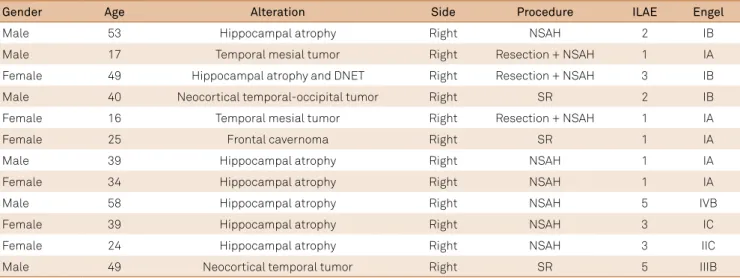
Demographic data such as age, gender, etiology, laterality, type of surgery and outcome scores are shown in the Table.
According to the Engel outcome classiication, there were ive patients classiied as IA, 3 as IB, one IC, one IIC, one IIIB,
and one IVB; there were no patients in the other categories
(Figure 1). According to the ILAE outcome scale, ive patients were class 1, two class 2, three class 3, and two class 5 (Figure 2).
Of the 13 patients who underwent surgery, four (31%) had some sort of complication. One (8%) patient developed a tempo -ral bleed immediately after surgery, which was promptly drained, but this patient eventually died due to pulmonary sepsis. Only
one patient (8%) developed symptomatic quadrantanopia, con
-irmed by complementary examinations. Two (16%) developed a psychiatric disorder; one characterized by childish behavior
Box 2. International League Against Epilepsy outcome scale.
Class 1: Completely seizure free; no auras Class 2: Only auras; no other seizures Class 3: 1 to 3 seizure days per year; ± auras
Class 4: 4 seizure days per year to 50% reduction of baseline seizure days; ± auras
Class 5: Less than 50% reduction of baseline seizure days; ± auras Class 6: More than 100% increase of baseline seizure days; ± auras
Box 1. Engel surgical outcome classification.
Class I: Free of disabling seizures
IA: Completely seizure-free since surgery
IB: Non-disabling simple partial seizures only since surgery IC: Some disabling seizures after surgery, but free of disabling seizures for at least 2 years
ID: Generalized convulsions with antiepileptic drug withdrawal only
Class II: Rare disabling seizures (“almost seizure-free”) IIA: Initially free of disabling seizures but has rare seizures now
IIB: Rare disabling seizures since surgery
IIC: More than rare disabling seizures after surgery, but rare seizures for at least 2 years
IID: Nocturnal seizures only
Class III: Worthwhile improvement IIIA: Worthwhile seizure reduction
IIIB: Prolonged seizure-free intervals amounting to greater than half the follow-up period, but not less than 2 years
and visual hallucinations and one developed depression; both were referred for psychiatric and psychological care.
Considering the diiculties found in the implementation
process, we highlight the following:
Firstly, because of the under-referral from other physicians, such as neurologists and general physicians from basic health care centers, it became necessary, in some cases, to actively recruit patients. Furthermore, there were not enough hospital beds, especially ones dedicated to epilepsy patients.
Secondly, there was diiculty accessing video EEG. Although EEG video equipment had been obtained through
a research project, there was, at the time, no medical room or
personnel (medical and non-medical) for its full operation.
Moreover, there was neither transoperative stimulation or electrocorticography in our service.
DISCUSSION
In the United States, in 1987, there were only 26 epi-lepsy surgery centers. In 1992, this increased to 67 centers16.
Unfortunately, to the best of our knowledge, there is no such
data in Brazil. However, it is well known that the number of centers that ofer this type of surgery is not enough to care for this country’s population. hus, the implementation of epi -lepsy surgery centers is critical.
Ours is the only public institution with an epilepsy surgery team in a subregion made up by seven cities and a popula-tion of 1,857,34517. It is the referral center for many specialties,
including neurosurgery and neurology. When epidemiologi-cal data1,8,18 is extrapolated to our population, it is estimated
that approximately 1,650 to 7,350 refractory epilepsy patients
could potentially beneit from surgery, or, at least, a surgical
evaluation. However, our sample consisted of only 13 patients, a much lower number compared to the estimated population.
Other authors have reported that, despite the currently available evidence, surgery for refractory epilepsy is
underuti-lized. As Jatté et al. mentioned in their review, that there is a
gap between evidence and practice, and that epilepsy surgery
is underused in countries such as the USA, UK and Canada. hey pointed out some factors that might contribute to the
phenomenon: incomplete or biased data, under-referral to
surgery centers, access issues, eicacy of new antiepileptic drugs, efectiveness of surgery in children, lack of knowledge
and misconceptions, and behavioral or cultural issues12.
We had similar problems to those experienced by more economically-developed countries, such as under-referral.
However, we also have diferent problems, more typical of
developing countries, such as the lack of supplies and
hos-pital beds. his observation is of utmost importance, since
the regional characteristics of the health care system impose
diferent issues for the implementation of an epilepsy center.
5 3 0 1 3 4 5 6 0 1 0 1 0 0 0 0 0 1 1 IV C IV B IV A III B III A II D IIC IIB ID IC IB IA IIA
Figure 1. Engel surgical outcome classification
5 2 0 1 3 4 5 6 0 2 3 ILAE Classification ILAE 4 ILAE 3 ILAE 2
ILAE 1 ILAE 5
Number of Patients
Figure 2. International League Against Epilepsy outcome scale.
Table.Demographic data of age, gender, etiology, laterality, type of surgery and outcome scores.
Gender Age Alteration Side Procedure ILAE Engel
Male 53 Hippocampal atrophy Right NSAH 2 IB
Male 17 Temporal mesial tumor Right Resection + NSAH 1 IA
Female 49 Hippocampal atrophy and DNET Right Resection + NSAH 3 IB
Male 40 Neocortical temporal-occipital tumor Right SR 2 IB
Female 16 Temporal mesial tumor Right Resection + NSAH 1 IA
Female 25 Frontal cavernoma Right SR 1 IA
Male 39 Hippocampal atrophy Right NSAH 1 IA
Female 34 Hippocampal atrophy Right NSAH 1 IA
Male 58 Hippocampal atrophy Right NSAH 5 IVB
Female 39 Hippocampal atrophy Right NSAH 3 IC
Female 24 Hippocampal atrophy Right NSAH 3 IIC
Male 49 Neocortical temporal tumor Right SR 5 IIIB
herefore, we consider the report of the current active epi
-lepsy surgery centers’experiences, as well as the information
exchange, to be very important.
Despite the diiculties faced, our patients had good out
-comes, as established by the Engel and ILAE classiications,
and a relatively low complication rate. De Tisi et al.19, in a
series of 649 patients undergoing surgical treatment for
epi-lepsy in the UK found that 40% became entirely seizure free and 11% improved (simple partial seizure only). heir results
were very similar to ours. With respect to complications, they
had a 3% mortality, 8% visual ield defects in temporal lobe epilepsy, 5% wound infections, <1% hemiparesis; 2% frontalis muscle weakness; 1% dysphasia; 3% cerebro spinal luid leaks
needing intervention, and one deep venous thrombosis, with
an overall complication rate of 22%19.
In a meta-analysis conducted by Téllez-Zenteno et al.20,
with data from 76 studies, they found a 66% seizure-free rate after surgery (Engel I) for temporal lobe epilepsy, including
tumor and non-tumor diseases. In this same meta-analysis,
they found a 46% seizure-free rate after occipital and parietal resections and a 27% seizure-free rate after frontal lobe resec
-tions; and 35% of the patients became free of incapacitating seizures after callosotomy20.
hus, considering that temporal lobe epilepsy has a better
outcome after surgical treatment19, we decided to select patients
with this condition, if possible, for our initial experience. Psychosocial disabilities are more prevalent in patients
with refractory seizures, with lower social interaction and
reduced marriage rates21. Vickrey et al.22 compared the
qual-ity of life in patients with epilepsy and other diseases (hyper
-tension, diabetes, heart disease and depression). hey con
-cluded that patients who became seizure free after surgery
had a better quality of life than the others22.
In a review of the causes of epilepsy-related death, Rufo-Campos23 listed sudden death, status epilepticus, trauma
in general, aspiration pneumonia, drowning and burns. In a study by Ferreira and Silva24, the authors conducted a
subsys-tem information survey on mortality in the Ministry of Health between 1980 and 2003 and found 32,655 deaths to bea direct consequence of epilepsy, which was calculated as an average of
1,236 deaths per year. he authors emphasized that these data
are probably underestimated due tounder-reporting24.
Berg et al.25 reported a 20-year delay between the onset of
seizures and the referral for surgery evaluation. Sillanpääet al.26
performed a long-term follow-up with 220 children diagnosed
with epilepsy in Finland. hey pointed out that the most important predictor for seizure control was a rapid response to initial therapy, deined as the reduction of seizures– at least 75% in three months – and when this percentage was not
achieved, surgery should be considered.
Considering the lack of a center for epilepsy surgery in our region, we are committed to the implementation of this project. So far, great results have been attained.
We decided to publish our initial results and our major
diiculties to encourage other neurosurgical teams, withcon -ditions similar to ours, to implement an epilepsy center.
Epilepsy is a serious health problem and the surgical
approach is potentially beneicial for a considerable pro -portion of patients with this disease, although, in some areasofthe world, the access of these patients to a surgery team is not possible.
In conclusion, we present the implementation of an epi-lepsy surgery center with favorable results and low incidence
of complications (very similar to more developed centers).
We believe that, in a region without this resource, neurosur-geons should be encouraged to implement an epilepsy center.
References
1. Bruce M, Griffiths C, Brock A, Majeed A. Trends in mortality and hospital admissions associated with epilepsy in England and Wales during the 1990s. Health Stat Q. 2004; (21):23-9.
2. Li LM, Sander JW. National demonstration project on epilepsy in Brazil. ArqNeuropsiquiatr, 2003; 61(1):153-6. https://doi.org/10.1590/S0004-282X2003000100033
3. Gomes MM. [History of epilepsy: a epistemologic point of view]. J Epilepsy ClinNeurophysiol. 2006; 12(3):161-7. Portuguese. https://doi.org/10.1590/S1676-26492006000500009
4. Berg AT, Vickrey BG, Langfitt JT, Sperling MR, Walczak TS, Shinnar S et al. The multicenter epilepsy surgery: recruitment and selection for surgery. Epilepsia. 2003; 44(11):1425-33. https://doi.org/10.1046/j.1528-1157.2003.24203.x
5. Gilman JT, Duchowny M, Jayakar P, Resnick TJ. Medical
intractability in children evaluated for epilepsy surgery. Neurology. 1994; 44(7):1341-3. https://doi.org/10.1212/WNL.44.7.1341
6. Kwan P, Arzimanoglou A, Berg AT, Brodie MJ, Allen Hauser W, Mathern G et al. Definition of drug resistant epilepsy: consensus proposal by the ad hoc Task Force of the ILAE Commission on Therapeutic Strategies. Epilepsia. 2010; 51(6):1069-77. https://doi.org/10.1111/j.1528-1167.2009.02397.x
7. Gallucci Neto J, Marchetti LR. [Epidemiologic aspects and relevance of mental disorders associated with epilepsy]. Rev Bras Psiquiatr. 2005; 27(4):323-8. Portuguese. https://doi.org/10.1590/S1516-44462005000400013
8. Berg AT, Kelly MM; Defining intractability: comparisons among published definitions. Epilepsia. 2006; 47(2):431-6. https://doi.org/10.1111/j.1528-1167.2006.00440.x
9. Jensen RL, Stone JL. Benjamin Winslow Dudley and early American trephination for posttraumatic epilepsy. Neurosurgery. 1997; 41(1):263-8.
https://doi.org/10.1097/00006123-199707000-00045
10. Sengoku A. The contribution of J. H. Jackson to
present-day epileptology. Epilepsia. 2002; 43 Suppl 9:6-8. https://doi.org/10.1046/j.1528-1157.43.s.9.3.x
11. Feindel W. Leblanc R, Almeida AN. Epilepsy surgery: historical highlights 1909–2009. Epilepsia. 2009; 50(Suppl. 3):131-51. https://doi.org/10.1111/j.1528-1167.2009.02043.x
13. West S, Nolan SJ, Cotton J, Gandhi S, Weston J, Sudan A et al. Surgery for epilepsy (Review). Cochrane Database of Systematic Reviews. 2015; (7):120.
14. Engel J, Cascino GD, Ness PCV, Rasmussen TB, Ojemann LM. Outcome with respect to epileptic seizures. In: Engel J, editor. Surgical treatment of the epilepsies. NY: Raven Press; 1993. p. 609-21.
15. Wieser HG, Blume WT, Fish D, Goldensohn E, Hufnagel A, King D et al. Proposal for a new classification of outcome with respect to epileptic seizures following epilepsy surgery. ILAE Commission Report. Epilepsia. 2001; 42(2):282-6
16. Passaro EA. Identification of potential epilepsy surgery candidates. Medscape. 2014 [cited 2017 Jan 10] Available from: http:// emedicine.medscape.com/article/1185635-overview
17. Instituto Brasileiro de Geografia e Estatística - IBGE. Contagem da População 2007. Rio de Janeiro: Instituto Brasileiro de Geografia e Estatística; 2008. p. 82-3.
18. Fernandes J, Schmidt M, Monte T, Tozzi S, Sander J. Prevalence of epilepsy: the Porto Alegre Study. Epilepsia. 1992; 33 Suppl 3:132.
19. Tisi J, Bell GS, Peacock JL, McEvoy AW, Harkness WF, Sander JW et al. The long-term outcome of adult epilepsy surgery, patterns of seizure remission, and relapse: a cohort study. Lancet. 2011; 378(9800):1388-95. https://doi.org/10.1016/S0140-6736(11)60890-8
20. Téllez-Zenteno F, Dhar R, Wiebe S. Long-term seizure outcomes following epilepsy surgery: a systematic review and meta-analysis. Brain. 2005; 128:1188-98. https://doi.org/10.1093/brain/awh449
21. Sperling MR. The consequences of uncontrolled epilepsy. CNS Spectr. 2004; 9(2):98-101. https://doi.org/10.1017/S1092852900008464
22. Vickrey BG, Hays RD, Rausch R, Sutherling WW, Engel J Jr, Brook RH. Quality of life of epilepsy surgery patients as compared with outpatients with hypertension, diabetes, heart disease, and/or depressive symptoms. Epilepsia. 1994; 35(3):597-607. https://doi.org/10.1111/j.1528-1157.1994.tb02480.x
23. Rufo-Campos M. Mortalidadenlas epilepsias. RevNeurol. 2000; 30 Supl1:S110-4.
24. Ferreira ILM, Silva TPT. [Mortality from epilepsy in Brazil, 1980-2003]. CienSaúdeColetiva. 2009; 14(1):89-94. Portuguese. http://dx.doi.org/10.1590/S1413-81232009000100014
25. Berg AT, Langfitt J, Shinnar S, Vickrey BG, Sperling MR, Walczak T et al. How long does it take for partial epilepsy to become intractable? Neurology. 2003; 60(2):186-90. https://doi.org/10.1212/01.WNL.0000031792.89992.EC
http://dx.doi.org/10.1590/0004-282x20170125err
ARTICLE
Erratum
Arq Neuropsiquiatr 2017;75(10):722-726. DOI: http://dx.doi.org/10.1590/0004-282x20170125
he name of the authors:
Gabriel Pereira Escudeiro1 , Rafael Teixeira Magalhães Leal1 , Heros Henrique Melo de Almeida1 , Marcus Andre Aciolly1 , José
Alberto Landeiro1 , Bruno Lima Pessoa1
Should be:
Gabriel Pereira Escudeiro1 , Rafael Teixeira Magalhães Leal1 , Heros Henrique Melo de Almeida1 , Marcus Andre Acioly1 , José