342 Rev Panam Salud Publica/Pan Am J Public Health6(5), 1999
Epilepsy in Latin America and the
Caribbean: a survey on needs and resources
Itzhak Levav,
1Carolyn Stephenson,
2and William Theodore
3A survey was done on the needs and resources available to control epilepsy in the countries of Latin America and the Caribbean. Responses came from ministries of health, prominent neu-rologists, and epilepsy advocacy organizations. A mailed questionnaire was used, and the re-sponse rate was excellent, 89%. The survey results showed that the private sector is better equipped to deal with epilepsy than is the public sector, in terms of both specialized personnel and access to a variety of drugs. Public policies are lacking, and linkages between medical per-sonnel and social workers are almost nonexistent. Primary care doctors and nurses are some-what able to diagnose some types of epilepsy but do less well with other types of the disorder. There is a strong justification for the new “Out of the Shadows” initiative, in which the In-ternational League Against Epilepsy, the InIn-ternational Bureau for Epilepsy, the World Health Organization, and the Pan American Health Organization are working to improve epilepsy health-care services, treatment, and social acceptance.
ABSTRACT
Epilepsy is one of the most common and serious neurological disorders af-fecting populations worldwide (1). De-spite the fact it is a treatable disorder, epilepsy frequently remains untreated in developing countries, where only 10%–40% of patients receive adequate care for their seizures (2). Recognizing this situation, in September 1997 the Directing Council of the Pan American Health Organization (PAHO) adopted Resolution CD40.R19 (3) urging the
Or-ganization’s Member States to develop programs to control epilepsy. To imple-ment the resolution, PAHO sought the cooperation of the International League Against Epilepsy (ILAE) and the Inter-national Bureau for Epilepsy (IBE) in jointly launching a major initiative in Latin America and the Caribbean (LAC). This effort in the Americas is part of the worldwide “Out of the Shadows” campaign initiated by the ILAE, the IBE, and the World Health Organization (WHO), which seeks to improve epilepsy health-care services, treatment, and social acceptance (2).
This PAHO/ILAE/IBE initiative will use nine programmatic strategies in providing technical collaboration to the LAC countries:
• strengthening capacity at the pri-mary-care level to find untreated cases and to properly diagnose and treat with drugs and counseling
• assuring a steady supply of drugs at a price affordable to the countries’ health services and patients
• coordinating relevant actions with such community agents as religious leaders, the police, and faith healers • organizing required referrals to and
from specialists
• establishing mutual-support groups for patients and families
• promoting the establishment of new advocacy groups and strengthening existing ones
• organizing programs for psychoso-cial rehabilitation and promoting public policies to fully integrate people with epilepsy into society • preparing and implementing
com-munity health education programs in order to increase understanding of these disorders and to eradicate stigma
• establishing a system to monitor and evaluate both the processes and
1 Pan American Health Organization, Washington,
D.C., United States of America. Send correspon-dence to: Itzhak Levav, Pan American Health Or-ganization, 525 23rd St., N.W., Washington, D.C. 20037, United States of America. Telephone: (202) 974-3330; fax: (202) 974-3631; e-mail: levavitz@ paho.org
2 U.S. Department of Health and Human Services,
Substance Abuse and Mental Health Services Ad-ministration, Rockville, Maryland, United States of America.
3 U.S. National Institutes of Health, Bethesda,
Mary-land, United States of America.
impact of this initiative in Latin America and the Caribbean
Working together, PAHO, ILAE, and IBE created a plan of action to imple-ment their initiative (4). As part of the plan, PAHO and its two partners con-ducted a limited survey among LAC countries on their perceived needs and available resources for controlling epilepsy. This report describes the pro-cedures used in the survey, the sur-vey’s main findings, and the implica-tions for program and service planning.
METHODS AND PROCEDURES
A brief questionnaire was devel-oped to explore how countries are an-swering some of the needs of persons affected by epilepsy and those per-sons’ families, and the countries’ avail-able resources. The questionnaire con-sisted of 26 items covering public policies, human resources and train-ing, availability of antiepileptic drugs, community attitudes, epidemiological estimates, and the existence of non-governmental organizations engaged in advocacy and support. The
ques-tionnaire was sent to the ministries of health, prominent ILAE-affiliated neu-rologists, and representatives of local IBE chapters. Prepared in English and Spanish, the questionnaire was distrib-uted by PAHO/WHO offices in all the Latin American and Caribbean coun-tries during the second half of 1998.
RESULTS
Survey compliance was high. Out of the 37 participating countries, 33 responded (89%). Twenty-four minis-tries of health provided information. Multiple responses came from 12 countries. Where there was more than one response from a single country, we coded the information provided by the ministry of health.
Public policies
Only 34% of the countries had pub-lic popub-licies that specifically addressed the needs of persons affected by epilepsy. Notably, the absence of such policies was not confined to countries with a limited number of neurologists.
Competence of primary care workers
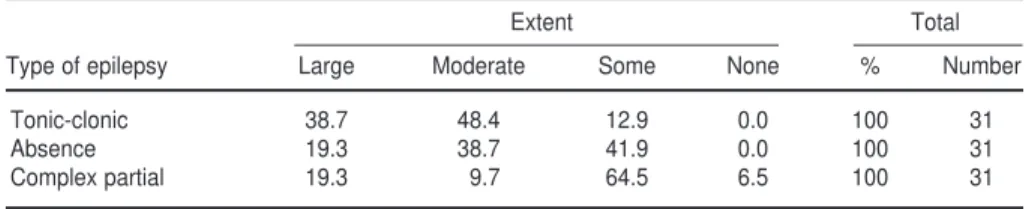
The informants reported that pri-mary care physicians were more often able to identify epilepsy than were pri-mary care nurses. This was true even though nurses play a pivotal role in case detection, education, and commu-nity involvement. With both physi-cians and nurses, the ability to identify epilepsy varied by the type of the dis-order, with the ability higher for the tonic-clonic type, intermediate for ab-sence, and lowest for complex partial. Table 1 and Table 2 summarize the findings regarding primary care work-ers. (When we received multiple re-sponses on this subject from a single country, we used the most conserva-tive response.)
Practicing neurologists
The number of neurologists varied from none in the smaller countries to almost 1 900 in Brazil. The number of neurologists in training ranged from 109 in Cuba to none in the smaller countries of the English-speaking Ca-ribbean. Of great concern was the in-equity in the distribution of human re-sources. Informants reported there were 3 560 specialists practicing in the private sector but only 1 875 in the public sector.
Availability of antiepileptic drugs
The availability of drugs varied by type and from the public to the private sector. In the public sector the drug most frequently available was pheno-barbital, always available in 85% of the countries. On the other hand, ethosux-imide was rarely available. Seventy-six percent of the countries reported that antiepileptic drugs were available for free from the public sector.
All five of the drugs we inquired about were more often available in the private sector than in the public sector. For example, in 40% of the countries ethosuximide was always available in the private sector, but the same was
Rev Panam Salud Publica/Pan Am J Public Health6(5), 1999 343
TABLE 1. Extent to which local primary care physicians are able to identify different types of epilepsy (% of countries), Latin America and the Caribbean, 1998
Extent Total
Type of epilepsy Large Moderate Some None % Number
Tonic-clonic 38.7 48.4 12.9 0.0 100 31
Absence 19.3 38.7 41.9 0.0 100 31
Complex partial 19.3 9.7 64.5 6.5 100 31
TABLE 2. Extent to which local primary care nurses are able to identify different types of epilepsy (% of countries), Latin America and the Caribbean, 1998
Extent Total
Type of epilepsy Large Moderate Some None % Number
Tonic-clonic 19.3 48.4 32.3 0.0 100 31
Absence 3.2 16.1 54.8 25.8 100 31
true for the public sector in only 13% of the countries. Table 3 and Table 4 provide more details on drug avail-ability in the public and private sec-tors, respectively.
Patient referrals
Primary care practitioners most often referred patients to neurologists (al-ways or most of the time in 50% of the countries), followed by psychiatrists (29%) (in many countries persons with epilepsy are cared for by the mental health services, especially so in the pub-lic sector), and social workers (23%).
Professional societies and other epilepsy-related groups
The existence of epilepsy-related or-ganizations in the LAC countries is shown in Table 5. Almost two-thirds of the countries have professional soci-eties, and a slightly smaller proportion (58%) have national advocacy
organi-zations. However, in the Caribbean few of the English-speaking countries and Dutch-speaking entities have ei-ther type of organization. Community self-help groups are uncommon, being reported by only 5 of the 33 countries responding to the survey.
Educational campaigns
Forty-six of the informants, from 20 of the countries, indicated that educa-tional campaigns had been conducted in their countries, generally in 1997 and/or 1998.
Societal attitudes
The reported attitudes varied widely. Of the 31 countries that responded to this question, 14 indicated that a nega-tive attitude towards persons with epilepsy was common. In the other countries, attitudes ranged from neu-tral to somewhat positive.
Epidemiology
All the above results become more significant when compared with the needs shown by epidemiological stud-ies. Prevalence rates from 17 selected Latin American studies published be-tween 1974 and 1998 showed a wide range, from a low of 5.8 per 1 000 to a high of 57.0 per 1 000, with a median of 14.3 per 1 000 (4).
Based on that median prevalence rate, we estimated that in 1998 there were at least 5 million persons with epilepsy in Latin America and the Caribbean. Of that number, some 3.5 million of them were not receiving treatment for the disorder, according to L. Sanders of ILAE and E. Stein of PAHO (personal communication, 1998). This is despite the almost universal availability of such medications as phenobarbital and, to a lesser extent, carbamazepine.
DISCUSSION
Is the PAHO/ILAE/IBE initiative justified? Based on the above results, the answer is certainly “yes.” The sci-entific literature makes it abundantly clear that epilepsy constitutes a dis-order meeting the criteria of a public
344 Levav et al. • Epilepsy in Latin America and the Caribbean
TABLE 3. Availability of antiepileptic drugs in the public sector (% of countries), Latin Amer-ica and the Caribbean, 1998
Availability Total
Drug Always Most of the time Occasionally Never % Number
Carbamazepine 42.2 45.5 6.1 6.1 100 33
Ethosuximide 13.3 10.0 13.3 63.3 100 30
Phenobarbital 84.8 15.2 0.0 0.0 100 33
Phenytoin 59.4 34.4 6.3 0.0 100 32
Valproic acid 28.1 25.0 28.1 18.8 100 32
TABLE 4. Availability of antiepileptic drugs in the private sector (% of countries), Latin America and the Caribbean, 1998
Availability Total
Drug Always Most of the time Occasionally Never % Number
Carbamazepine 90.6 6.3 18.8 3.1 100 32
Ethosuximide 40.0 13.3 20.0 26.7 100 30
Phenobarbital 84.4 12.6 3.1 0.0 100 32
Phenytoin 90.6 6.3 3.1 0.0 100 32
Valproic acid 80.6 9.7 6.5 3.2 100 31
TABLE 5. Countries reporting the existence of epilepsy-related organizations and commu-nity self-help groups (% of countries), Latin America and the Caribbean, 1998
Existence Total
Type of organization Yes No % Number
Professional 63.6 36.4 100 33
Advocacy & education 57.6 42.4 100 33
Rev Panam Salud Publica/Pan Am J Public Health6(5), 1999 345 Se realizó una encuesta sobre las necesidades y los recursos disponibles para contro-lar la epilepsia en los países de América Latina y el Caribe. Se utilizó un cuestionario postal que fue enviado a los ministerios de salud, a destacados neurólogos y a orga-nizaciones no gubernamentales de defensa y apoyo a los pacientes epilépticos. La tasa de respuesta fue excelente: 89%. Los resultados obtenidos revelaron que el sector pri-vado está mejor equipado que el sector público en términos tanto de disponibilidad de personal especializado como de acceso a diferentes medicamentos. El sector pú-blico carece de políticas definidas y apenas existen relaciones entre el personal médico y los trabajadores sociales. Los médicos y el personal de enfermería de atención pri-maria están capacitados para diagnosticar algunos tipos de epilepsia, pero no todos. Está plenamente justificada la nueva iniciativa, denominada “Fuera de las sombras”, en la que están trabajando la Liga Internacional contra la Epilepsia, la Oficina Inter-nacional para la Epilepsia, la Organización Mundial de la Salud y la Organización Panamericana de la Salud con el fin de mejorar los servicios de atención a los pa-cientes epilépticos, la aceptación social de estos y el tratamiento de la enfermedad.
RESUMEN
Epilepsia en
América Latina y el Caribe:
encuesta sobre las
necesidades y los recursos
1. Reynolds E. Global campaign against epilepsy launched. Epigraph, The Newsletter of the In-ternational League Against Epilepsy 1997;2:2. 2. Reynolds E. Out of the shadows. New Scientist
1997;155(2100):48.
3. Pan American Health Organization. Directing Council Resolution CD40.R19. September 1997.
4. Pan American Health Organization. A regional initiative to control epilepsy: Out of the Shad-ows campaign against epilepsy. Washington, D.C.: PAHO, Division of Health Promotion and Protection, Healthy Lifestyles and Mental Health Program; 1998.
Manuscript received on 26 May 1999. Revised version accepted for publication on 28 June 1999.
REFERENCES
health problem. What our survey ad-ditionally revealed was the extent to which epilepsy control in the LAC countries was based on a truncated model. To increase its odds of success, a sustainable model of intervention has to address components that in-clude the individual with epilepsy, that person’s family, the community and such gatekeepers as teachers and police officers, the health system, and the society as a whole. Any initia-tive to first control the disorder and then prevent it whenever possible may fail if it neglects any of those components.
The PAHO/ILAE/IBE initiative is starting with a baseline well above zero. The availability of some
re-sources in Latin America and the Ca-ribbean, if applied properly, may fa-cilitate the initiative’s implementation and increase its chances for success. Epilepsy-related professional associa-tions and national leagues exist in the majority of the LAC countries. Those groups could and should be mobi-lized for their own national efforts and, whenever called for, to assist the Caribbean countries that do not have such organizations. Furthermore, the competence that primary care physi-cians already have in identifying tonic-clonic epilepsy should facilitate those professionals’ active participa-tion in the PAHO/ILAE/IBE initia-tive and reduce the amount of further training needed.