ACE Inhibitors and Plasma B-type Natriuretic Peptide Levels in
Elderly Patients with Heart Failure
Felicio Savioli Neto, Hélio M. Magalhães, Michel Batlouni, Leopoldo S. Piegas
Instituto Dante Pazzanese de Cardiologia, São Paulo, SP - Brazil
Summary
Background: Clinical trials have demonstrated the benefits of ACE inhibitors (ACEI) in the neurohormonal activity and in the functional capacity of patients with heart failure (HF), and also that these effects are dose dependent. However, since elderly individuals have been systematically excluded from the majority of these studies, the validation and incorporation of these results in the geriatric population has been questioned.
Objectives: To evaluate the effects of different doses of quinapril, an ACEI with a > 24-hour biological half-life, on plasma BNP levels, on the distance walked in the 6-minute walk test (6MWT) and on the incidence of adverse reactions in elderly individuals with systolic HF.
Metods: A total of 30 patients (76.1 ± 5.3 years; 15 women), in NYHA functional class II-III HF, with left ventricular EF < 40% (33.5 ± 4.5%), on diuretics (30), digoxin (24) and nitrates (13) were included. The patients were assessed at baseline and every two months, with escalating doses of quinapril of 10, 20, 30 and 40 mg.
Results: After eight months, BNP levels were 67.4% lower and the distance walked in the 6MWT was 64.9% longer in relation to baseline. Arterial hypotension with symptoms of low cerebral blood flow and/or renal dysfunction was not observed, so that the maximum quinapril dose could be used in all patients.
Conclusion: The results demonstrated the benefits of ACEI on the neurohormonal profile and functional capacity of elderly individuals with systolic HF, as well as the positive relationship between dose and effect of these drugs. (Arq Bras Cardiol 2009;92(5):320-326)
Key words: Natriuretic peptide, B-Type; heart failure; angiotensin-converting enzyme inhibitors; aged.
Mailing address: Felicio Savioli Neto •
Avenida Doutor Dante Pazzanese, 500 - Vila Mariana - 04012-909, São Paulo, SP - Brazil
E-mail: [email protected]
Manuscript received March 27, 2008; revised manuscript received October 07, 2008; accepted November 10, 2008.
Introduction
Heart failure (HF) affects more than 22 million people worldwide1, with approximately six million in Europe2, five
million in the United States3, and two million in Brazil4. Of
this total, 17.6 million (80%) are individuals older than 65 years of age5. This syndrome is uncommon among younger
individuals, and its prevalence and incidence increase exponentially from the fifth decade of life, affecting mainly the elderly.Important peculiarities distinguish HF in the geriatric population: a higher proportion of women; hypertension as the most common cause; atypical clinical manifestations; frequent comorbidities; changes in the pharmacological properties of the drugs; and a higher proportion of HF with preserved systolic function6,7. Additionally, the natural aging
process is associated with cardiovascular changes that can interfere with the pathophysiology of HF, thus hindering the clinical diagnosis and complicating therapy8. Nonetheless,
mortality, hospitalizations, and the combined risk of both
are substantially higher among elderly patients with HF in comparison to younger patients9.
In the current pathophysiological model, HF is characterized by a constant stimulation of several neurohormonal systems, which are able to restore the cardiac output in early phases of the process, but become inefficient, harmful and responsible for the progression of the myocardial dysfunction in the long term10,11. Thus, the efficacy of drug therapy in blocking
or even attenuating the activity of these systems has been suggested as a new strategy for the treatment of HF. Among these systems, the natriuretic peptides have been the most frequently recommended, given their good correlation with the severity of ventricular dysfunction and the consistent methodology for their analyses.
Table 1 – Patients characteristics
Age 76.2±5.3 (70-91)
> 75 years 15
Gender
Male 15
Female 15
Ejection Fraction (%) 33.5±4.5 (25-39)
NYHA FC n;%
II: 7; 23.4%
III: 23; 76.6%
Etiology (n)
CAD 9
Hypertension 18
Both 3
Comorbidities
Diabetes 7(23.3%)
COPD 5(16.6%)
Previous Medication
Digoxin 24
Furosemide 30
Nitrates 13
Chest Radiography
CT ratio > 0.5 30(100%)
ECG
Abnormal 30(100%)
Methods
This is a non-randomized, prospective, open clinical trial comprising elderly patients diagnosed with HF, as defined by the guidelines of the European Society of Cardiology11.
Patients with age ≥ 70 year of age, New York Heart Association
(NYHA) functional class II or III, ejection fraction (EF) < 40%, as calculated by echocardiography, and not receiving treatment with ACE inhibitors for the past four weeks were included in the study. Patients with hemodynamically significant heart valve diseases, atrial fibrillation, angina pectoris, history of myocardial infarction in the past three months, thyroid diseases, systolic blood pressure lower than 100 mmHg, serum creatinine levels higher than 2.5 mg/dl, disabling conditions, treatment with beta-adrenergic blockers and /or angiotensin-receptor antagonists in the past 30 days, and history of intolerance to ACE inhibitors were excluded from the study. Between July 1999 and August 2001, 54 patients with clinically suspected HF were selected among patients from the public health system who were not receiving ACE inhibitors for at least four weeks. Of these, 30 patients with echocardiographically confirmed left ventricular systolic dysfunction were included. Fifteen were men and 15 were women, with ages between 70 and 91 years, mean of 76.2 ± 5.3 years, and left ventricular EF between 25% and 39%, mean of 33.5 ± 4.5%. The medications previously prescribed were maintained at the usual doses: loop diuretics in all patients, digoxin in 24 of them, and nitrates in 12. The patient characteristics, ejection fraction values, functional class (NYHA) and probable causes of HF are shown in Table 1.
Echocardiography was performed in a Hewlett Packard equipment (MS, USA), and the images acquired with the patient in the left lateral position. Left ventricular (LV) EF was calculated using the Simpson’s rule. Immediately after echocardiography, the patients underwent resting electrocardiography and chest radiography in the posteroanterior and left lateral views. After inclusion, the patients were advised to return fasted the next morning for venous blood sample collection. After a light meal, they would undergo clinical examination and the walk test. At the end of this phase, treatment with quinapril 10 mg was started at single daily doses, always taken in the morning, for two months. After that, the tests were repeated and the medication dose was increased by 10mg. This procedure was repeated every two months, until the 40mg/ day dose was reached. Thus, the patients were evaluated in five different time points: at baseline and on 10, 20, 30 and 40 mg of quinapril.
In the clinical assessment, symptoms and clinical signs associated with HF, as well as occasional adverse reactions related to the ACE inhibitors were recorded. Blood pressure and heart rate were measured with the patient in the supine position, after a five-minute rest. At the end of the visit, treatment compliance was estimated by the number of quinapril pills returned by the patients.
Serum BUN levels were analyzed using the automated urease method, with reference values between 10 and 50 mg/ dL; serum creatinine levels were analyzed using the automated enzyme-colorimetric method with reference values lower than 1.4 mg/dl. Plasma B-natriuretic peptide concentrations
were analyzed using fluorescent imunnoassay, with the Biosite Diagnostic equipment (Triage BNP Test – Biosite, San Diego, CA, USA), able to quantify concentrations between 5 and 1300 pg/mL, with reference values < 100 pg/ml. Levels higher than 1300 pg/ml were recorded as ≥ 1300 pg/ml, since they could not be quantified by use of this method. The tests were performed in pre-scheduled dates, always between 8 and 10 a.m., with the patients undergoing a 12-hour fast. After a 20-minute rest, 10ml samples of venous blood were collected in test tubes containing ethylenediaminetetraacetic acid (EDTA) and centrifuged at 2500 rpm for 15 minutes. Next, the samples were deposited in specific devices and analyzed by a Biosite Diagnostic instrument.
Table 2 – Mean values of systolic and diastolic blood pressure, heart rate, BUN and creatinine at the different time points
Baseline 10 mg 20 mg 30 mg 40 mg
SBP 141.2±19.7 133.2±17.1 130.2±19.2 128.5±17.6 127.3±16.1
DBP 78.6 ±10.3 133.2±11.4 130.2±11.2 128.5±10.7 127.3±9.4
HR 90.7±11.7 86.2±11.0 84.5±9.4 84.7±8.4 86.8±7.8
BUN 56.6±11.4 55.8±12.3 54.4±11.1 56.0±10.3 57.4±12.6
Creatinine 1.23±0.29 1.24±0.30 1.26±0.26 1.28±0.28 1.28±0.28
Statistical analysis
Descriptive, quantitative and comparative analyses were carried out. Comparative analyses between the means were carried out using the analysis of variance model (ANOVA), with repeated measures with one factor (dose) at five levels (baseline, 10, 20, 30, and 40 mg), and also using Bonferroni’s multiple comparison test. Pearson linear correlation was used to evaluate the correlation between mean plasma BNP levels and the distance walked in the 6MWT. All tests were two-tailed, and p values < 0.05 were considered statistically significant. Calculations were made using the SPSS for the Windows version 10.0 software program (SPSS, Inc., Chicago, IL).
The study was conducted according to the “Declaration of Helsinki”, and was approved by the Ethics Committees of
Instituto Dante Pazzanese de Cardiologia and Hospital das Clínicas da Faculdade de Medicina da Universidade de São Paulo (FMUSP). All patients received the necessary information on the study and gave their written informed consent to participate in the study.
Results
All patients assessed at the five different time points completed the study. Systolic blood pressure values ranged from 105 to 180 mmHg (141.2 ± 19.7) at baseline; from 100 to 160 mmHg (133.2 ± 17.1) at the 10mg dose; from 100 to 160 mmHg (130.2 ± 19.2) at 20 mg; from 105 to 162 mmHg (128.5 ± 17.6) at 30mg; and from 100 to 156 mmHg (127.3 ± 16.1) at 40 mg. The comparison of the five time points showed statistically significant differences only between baseline and the 10mg quinalapril time point. Systolic levels decreased by more than 20 mmHg in two patients at the 10mg and 40mg doses. Both were asymptomatic and none of them had systolic blood pressure lower than 100 mmHg.
Mean diastolic blood pressure levels ranged from 50 to 93 mmHg (78.6 ± 10.3) at baseline; from 50 to 90 mmHg (73.0 ± 11.4) at 10 mg; from 50 to 90 mmHg (73.1 ± 11.2) at 20 mg; from 50 to 93 mmHg (10.7 ± 17.6) at 30 mg; and from 52 to 90 mmHg (70.8 ± 9.4) at 40 mg. The comparison between the different time points showed a statistically significant difference only between baseline and the 10mg quinalapril time point. A higher than 10 mmHg decrease in diastolic blood pressure levels was observed in seven patients, all asymptomatic, four at 10 mg and one at each of the other time points. However, in none of them was diastolic blood pressure lower than 50 mmHg.
Heart rate ranged from 65 to 112 bpm (90.7 ± 11.7) at baseline; from 64 to 120 bpm (86.2 ± 11.0) at 10 mg; from 72 to 106 bpm (84.5 ± 9.4) at 20 mg; from 70 to 108 bpm (84.7 ± 8.4) at 30 mg; and from 72 to 105 bpm (86.8 ± 7.8) at 40 mg. We can observe that neither the administration of the pharmacologic agent nor the successive increases in their doses were associated with statistically significant changes in the mean heart rate.
Serum BUN levels ranged from 36 to 82 mg/dl (56.6 ± 11.4) at baseline; from 34 to 86 mg/dl (55.8 ± 12.3) at 10 mg; from 37 to 81 mg/dl (54.4 ± 11.1) at 20 mg;from 38 to 88 mg/dl (56.1 ± 10.3) at 30 mg; and from 38 to 88 mg/dl (57.4 ± 12.6) at 40 mg. Serum creatinine levels, in turn, ranged from 0.8 to 2.2 mg/dl (1.23 ± 0.29) at baseline; from 0.9 to 1.9 mg/dl (1.24 ± 0.30) at 10 mg; from 0.8 to 2.1 mg/dl (1.26 ± 0.26) at 20 mg; from 0.9 to 2.2 mg/dl (1.28 ± 0.28) at 30 mg; and from 1.0 to 2.1 mg/dl (1.28 ± 0.28) at 40 mg. In the comparative analysis of the different time points, serum BUN and creatinine levels did not show statistically significant differences. Values of systolic and diastolic blood pressure, heart rate, serum BUN and creatinine levels at the five time points are shown in Table 2.
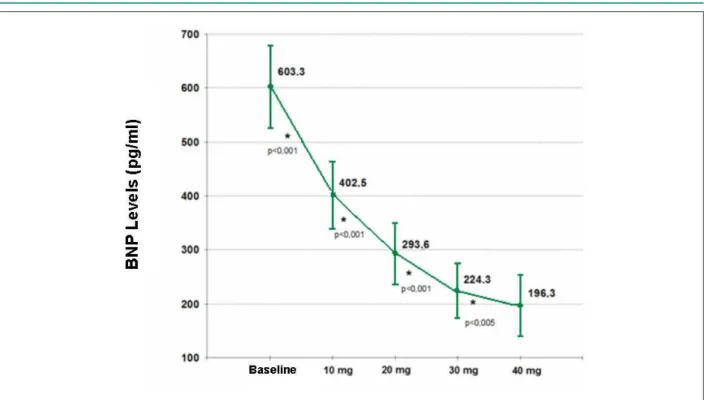
Plasma BNP levels ranged from 165 to ≥1300 pg/ml (603.3 ± 417.3) at baseline; from 101 to ≥1300 pg/ml (402.5±337.8) at 10 mg; from 50.5 to ≥1300 pg/ml (293.5±311.2) at 20 mg; from 32.3 to ≥1300 pg/ml (224.3 ± 278.7) at 30 mg; and from 30.4 to ≥1300 pg/ml (196.3 ± 310.1) at 40 mg. In the comparisons between the different time points, we observed a mean reduction by 200.8 pg/mL at 10 mg quinapril (33.3%) in relation to baseline; by 108.9 pg/mL at 20 mg (27%) in relation to 10 mg; by 69.3 pg/ml at 30 mg (23.6%) in relation to 20 mg; and by 12.5 pg/ml at 40 mg (12.5%) in relation to 30 mg. These differences were statistically significant in all comparisons (p<0.001), with a dose-dependent response (Figure 1). By the end of eight months, plasma BNP levels were 67.4% lower in relation to baseline.
At the beginning of the study and two months after the administration of quinalapril 10mg, all patients presented plasma levels above the reference values (> 100 pg/mL). Throughout the study, these levels returned to normal in 15 patients: nine with the quinalapril 20mg dose and three with each of the subsequent doses.
Figure 1 -Comparisons of mean plasma BNP levels at the different time points.
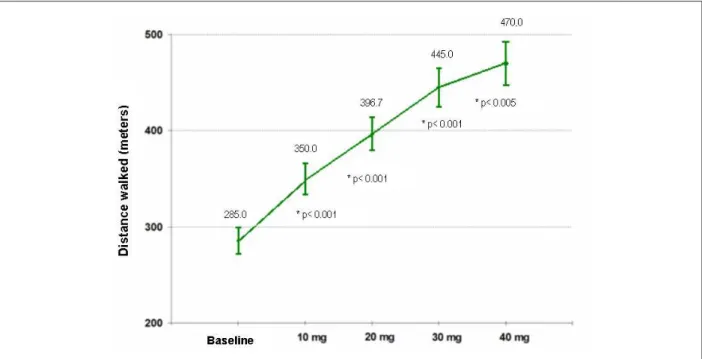
meters (470.0 ± 125.0) at 40 mg. In the comparisons between the different time points, the distances increased, on average and progressively: 65 meters at 10 mg (22.8%); 46.7 meters at 20 mg (13.3%); 48.3 meters at 30 mg (12.2%); and 25 meters at 40 mg (5.6%). In the comparative analysis, the differences between the different time points were significant (p<0.05), with a dose-dependent response (Figure 2). We observed that, by the end of eight months, the distances walked in the walk test were 64.9% (185 meters) longer in relation to baseline.
The significant linear correlation (p=0.003) between mean plasma PNB concentrations and mean distances walked in the 6MWT are shown in Figure 3. This correlation was negative and significant (r = - 0.983).
All patients completed the study, having received the four different quinapril doses. Among the adverse reactions associated with the use of ACE inhibitors, dry cough was reported by three patients soon after the first quinapril dose, and persisted at a mild intensity despite the increased dose.
Discussion
Significant reductions in plasma BNP levels are associated with the use of therapeutic agents known to be efficient in the treatment of HF, including ACE inhibitors, angiotensin-receptor blockers, beta blockers, and spironolactone12-14.ACE inhibitors
– agents with vasodilator and diuretic actions - reduce intravascular plasma volume, ventricular filling pressure, and, consequently, plasma BNP levels. In the treatment of HF, reductions in plasma BNP concentrations, when detected by sequential analyses of the same patient, are correlated with improved symptoms, increased functional capacity, reduced
rate of clinical endpoints and better prognosis. On the other hand, persistently elevated plasma BNP levels despite treatment identify patients with worse prognosis15,16.
Our results showed the effects of the chronic inhibition of angiotensin converting enzyme on plasma BNP levels in elderly patients with systolic HF, as well as the positive relationship between dose and effect of ACE inhibitors. Additionally, exercise tolerance, as assessed by the distance walked in the 6MWT, significantly increased with the pharmacological intervention and with the escalating quinapril doses. Likewise, all patients, including two octogenarians and two nonagenarians, tolerated the four different quinalapril doses.Thus, by the end of eight months of treatment with quinapril, plasma BNP levels were 67.4% lower in relation to baseline, with statistically significant reductions in all comparisons. Considering that none of the patients used other ACE inhibitors, beta blockers, angiotensin II-receptor blockers, or aldosterone antagonists in the four weeks preceding the study, and that the treatment time with each quinapril dose was relatively long (eight weeks), it can possibly be assumed that these results correspond to the chronic effects of ACE inhibition.
Except for diuretics, the drugs recommended for the treatment of heart failure should be administered at the doses used in the major clinical trials, according to the individual tolerance, regardless of the clinical response or of neurohormonal concentrations17-19. However, the
Figure 3 -Linear correlation between mean plasma BNP levels and the distances walked in 6MWT.
Figure 2 -Comparisons of the mean distances walked in the 6MWT at the different time points.
processes and their respective treatments, increase the likelihood of drug interactions and reduce tolerance to standard doses, especially to the maximum doses recommended by the major clinical trials8. In this study, immediate effects
of quinapril were observed when the mean systolic and diastolic blood pressure levels were compared before the therapeutic intervention and after eight weeks with quinapril 10mg. Significant blood pressure reductions were observed
absence of adverse reactions may have resulted from the fact that no patients with baseline systolic blood pressure lower than 100 mmHg were included, previous diuretic doses were maintained, escalating doses of ACE inhibitor were used, and no other antihypertensive agents were combined.
According to the results of the Valsartan Heart Failure Trial (Val-HeFT)20, plasma BNP levels had a direct correlation with
the severity of heart failure and with the end-diastolic LV internal diameter, and inversely with LVEF. Thus, the findings of the present study can suggest a favorable result of the therapeutic intervention on the ventricular remodeling process after two months of treatment. Considering normal values those < 100 pg/mL, treatment with quinapril 20 mg may have attenuated the ventricular remodeling process in nine patients (30%); in 11 patients (36%) with 30 mg; and in 15 patients (50%) with 40 mg. However, despite treatment with full quinalapril doses, neurohormonal activation remained high in half of the patients. In these cases, the increased RAAS hyperactivity probably exceeds the suppressive effects of the treatment with full doses of ACE inhibitors. Additionally, in severe heart failure, angiotensin II is mainly synthesized by alternative pathways which do not depend on ACE20.
In the pharmacological treatment of heart failure, quantitative and sequential analyses of plasma BNP levels have been used to guide therapy, with maximum suppression of this hormonal system as one of the goals. Several studies have demonstrated the superiority of the BNP-guided pharmacological treatment of heart failure in comparison to that guided by clinical criteria, with higher neurohormonal suppression and higher reductions in mortality rates and hospitalization for heart failure21-23.
However, despite these evidences, the magnitude of these reductions and the values to be reached remain unknown. In the STARS-BNP study23 – Systolic Heart Failure Treatment
Supported by BNP, plasma BNP levels returned to normal (< 100 pg/mL) in only 40% of the patients. Similar results were found in the present study, with plasma BNP concentrations lower than 100 pg/mL in 50% of the patients after eight months of treatment with quinapril.
BNP is a hormone secreted by pulses at approximately 48-minute intervals, and its plasma levels follow the circadian rhythmicity of blood pressure and heart rate, with maximum values detected between 8 and 10 a.m.24. Bruins et al24 studied
patients with stable heart failure and observed considerable variations of 8.2%, 25% and 40%, between samples analyzed at intervals of two hours, one day and one week, respectively. Recent studies have demonstrated intraindividual biological variations of plasma BNP levels between 30% and 50%, despite a stable clinical condition, thus suggesting that only variations higher than 30% would be clinically relevant25.
Clerico et al26 suggest clinical evaluation as a criterion for
the analysis of the pathophysiologic relevance of variations in plasma BNP levels, regardless of their magnitude. In our study, higher than 30% reductions in plasma BNP levels were observed only in the comparisons between baseline and the different quinapril doses. However, in all comparisons, these reductions were associated with substantial increases in the distances walked in the 6MWT, even when lower than 30%.
Regarding the value to be reached, some authors suggest
plasma BNP levels slightly higher than 100 pg/mL as adequate levels, especially in elderly patients. According to the STARS-BNP study investigators, the benefits of the treatment of heart failure, aimed at reaching plasma BPN levels lower than 100 pg/mL, were reduced by the higher rate of hospitalizations for non-cardiovascular causes23. Among these are hypovolemia,
renal failure and falls, probably due to the aggressiveness of the treatment regimen. Thus, plasma BNP concentrations slightly higher than 100 pg/mL would be more appropriate, especially among elderly patients.
The correlation between plasma BNP concentrations and the distance walked in the 6MWT has been described by several authors in different studies26. In our study, a strong
negative correlation was observed between mean plasma BNP levels and the mean distance walked in the 6MWT (p=0.003, r=-0.983).
Study limitations and practical applications
One of the possible limitations of this study is its small number of patients. However, unlike in the large clinical trials, the characteristics of the patients included in this study reflect the clinical practice. Additionally, the known difficulties for the inclusion of elderly individuals in clinical trials account for the admission of only 10% of the elderly specifically selected. In our study, 55% of the patients selected were included. The power of the sample to detect differences of 67.4% between mean BNP concentrations at baseline and at 40 mg was 99.5%. Since the association between the magnitude of the differences in plasma BNP levels obtained in sequential analyses and clinical relevance is not yet recognized, we chose to establish the statistical difference.
The absence of a control group could represent another study limitation. The comparison with a group of younger patients could clarify the possible interferences of the aging process in the effects of chronic ACE inhibition.
The results of this study confirmed the benefits of treatment regimens with high doses of ACE inhibitors on the neurohormonal profile and functional capacity of elderly individuals with heart failure. Thus, the use of ACE inhibitors with escalating doses up to those recommended by the large clinical trials may bring significant additional benefits without increasing the incidence of adverse reactions, even among the oldest elderly.
Potential Conflict of Interest
No potential conflict of interest relevant to this article was reported.
Sources of Funding
There were no external funding sources for this study.
Study Association
References
1. Saxon LA, Ellenbogen KA. Resynchronization therapy for the treatment of heart failure. Circulation. 2003; 108: 1044-8.
2. Tendera M. Epidemiology, treatment, and guidelines for the treatment of heart failure in Europe. Eur Heart J. 2005; 7(Suppl J): J5-J9.
3. Heart and stroke statistical update. Dallas, TX: American Heart Association; 1997.
4. Albanesi Fº FM. Insuficiência cardíaca no Brasil. Arq Bras Cardiol. 1998; 71: 561-2.
5. Senni M, Tribouilloy CM, Rodeheffer RJ, Jacobsen SJ, Evans JM, Bailey KR, et al. Congestive heart failure in the community: a study of all incident cases in Olmsted County, Minnesota, in 1991. Circulation. 1998; 98: 2282-9.
6. Rich MW. Epidemiology, pathophysiology and etiology of congestive heart failure in older adults. J Am Geriatr Soc. 1997; 45: 968-74.
7. Barretto AC, Wajngarten M. Insuficiência cardíaca nos idosos: diferenças e semelhanças com os mais jovens. Arq Bras Cardiol. 1998; 71: 801-6.
8. Batlouni M, Savioli Neto F, Magalhães HM. Alterações farmacocinéticas e farmacodinâmicas relacionadas à idade: terapêutica cardiovascular no idoso. In: Batlouni M, Ramires JAF, (eds). Farmacologia e terapêutica cardiovascular. São Paulo: Atheneu; 1999. p. 27-46.
9. Bourassa MG, Gurné O, Bangdiwala SI, Ghali JK, Young JB, Rousseau M, et al. Natural history and patterns of current practice in heart failure. J Am Coll Cardiol. 1993; 22 (Suppl A): 14A-19A.
10. Packer M. Pathophysiology of chronic heart failure. Lancet. 1992; 340: 92-5.
11. Packer M. The neurohormonal hypothesis: a theory to explain the mechanism of disease progression in heart failure. J Am Coll Cardiol. 1992; 20: 248-54.
12. Brunner-LaRocca HP, Weilenmann D, Kiowski W, Maly FE, Candinas R, Follath F. Within-patient comparison of effects of different dosages of enalapril on functional capacity and neurohormone levels in patients with chronic heart failure. Am Heart J. 1999; 138: 654-62.
13. Van Veldhuisen DJ, Genthzotz S, Brouwer J, Boomsma F, Netzer T, Manintveld AJ, et al. High-versus low-dose ACE inhibition in chronic heart failure: a double-blind, placebo-controlled study of imidapril. J Am Coll Cardiol. 1998; 32: 1811-8.
14. Rousseau MF, Gurne O, Duprez D, Van Mieghem W, Robert A, Ahn S, et al. Beneficial neurohormonal profile os spironolactone in severe congestive heart failure: results from the RALES neurohormonal substudy. J Am Coll Cardiol. 2002; 40: 1596-601.
15. Cheng V, Kazanegra R, Garcia A, Lenert L, Krishnaswamy P, Gardetto N, et al. A rapid bedside test for B-type natriuretic peptide predicts treatment out comes in patients admitted for decompensated heart failure: a pilot study. J Am Coll
Cardiol. 2001; 37: 386-91.
16. Packer M. Should B-type natriuretic peptide be measured routinely to guide the diagnosis and management of chronic heart failure? Circulation. 2003; 108: 2950-3.
17. Sociedade Brasileira de Cardiologia. Revisão das II Diretrizes da Sociedade Brasileira de Cardiologia para o diagnóstico e tratamento da insuficiência cardíaca. Arq Bras Cardiol. 2002; 79 (supl 4): 1-30.
18. Hunt SA. ACC/AHA Task Force on Practice Guidelines. ACC/AHA 2005 guideline update for the diagnosis and management of chronic heart failure in the adult: a report of the American College of Cardiology/American Heart Association Task Force on Practice Guidelines. Writing Committee to Update the 2001 Guideline for the Evaluation and Management of Heart Failure. J Am Coll Cardiol. 2006; 47: 1503-5.
19. Krum H. The Task Force for the diagnosis and treatment of chronic heart failure. of the European Society of Cardiology. Guidelines for the diagnosis and treatment of chronic heart failure. Eur Heart J. 2005; 26: 2473-4.
20. Latini R, Masson S, Anand I, Judd D, Maggioni A, Chiang Y, et al. and Valsartan Heart Failure Trial Investigators. Effects of valsartan on circulating brain natriuretic peptide and norepinephrine in symptomatic chronic heart failure: the Valsartan Heart Failure Trial (Val-HeFT). Circulation. 2002; 106 (19): 2454-8.
21. Murdoch DR, McDonagh TA, Byrne J, Blue L, Farmer R, Morton JJ, et al. Titration of vasodilator therapy in chronic heart failure according to plasma brain natriuretic peptide concentration: randomized comparison of the hemodynamic and neuroendocrine effects of tailored versus empirical therapy. Am Heart J. 1999; 138: 1126-32.
22. Troughton RW, Frampton CM, Yandle TG, Espiner EA, Nicholls MG, Richards AM. Treatment of heart failure guided by plasma amino terminal brain natriuretic peptide (N-BNP) concentrations. Lancet. 2000; 355: 1126-30.
23. Jourdain P, Jondeau G, Funck F, Gueffet P, Le Helloco A, Donal E, et al. Plasma brain natriuretic peptide-guided therapy to improve outcome in heart failure: the STARS-BNP Multicenter Study. J Am Coll Cardiol. 2007; 49: 1733-9.
24. Bruins S, Fokkema MR, Römer JWP, Dejongster MJL, van der Dijs FPL, van den Ouweland JMW, et al. High intraindividual variation of B type natriuretic peptide (BNP) and amino-terminal proBNP in patients with stable chronic heart failure. Clin Chem. 2004; 11: 2052-8.
25. Bettencourt P, Azevedo A, Pimenta J, Friões F, Ferreira S, Ferreira A. NTerminal-proBrain natriuretic peptide predicts outcome after hospital discharge in heart failure patients. Circulation. 2004; 110: 2168-74.