Original Article
Sexual Activity after Myocardial Infarction: Taboo or Lack of
Knowledge?
Rosana Pinheiro Lunelli, Eneida Rejane Rabello, Ricardo Stein, Sílvia Goldmeier, and Maria Antonieta Moraes
Instituto de Cardiologia do Rio Grande do Sul/Fundação Universitária de Cardiologia, Laboratório de Fisiopatologia do Exercício do Hospital de Clínicas de Porto Alegre, Porto Alegre, RS - BrazilSummary
Background: Despite its clinical and social relevance, resumption of sexual activity after an acute coronary syndrome (ACS) is a subject that is poorly addressed by healthcare providers and one that is given scant emphasis during hospitalization. Erectile dysfunction is a common complaint among cardiac patients, and these patients are in doubt regarding the safety of resuming sexual activity after a cardiovascular event.
Objective: To describe how well informed patients are in regard to acute an myocardial infarction (AMI) and what sort of guidance they receive regarding resumption of sexual activity.
Methods: A cross-sectional study was performed from June to July 2005 with patients on the sixth day of AMI. A questionnaire was applied to assess not only patients’ knowledge of AMI, but also their expectations regarding their resumption of sexual activity – and frequency of same – following hospital discharge.
Results: Ninety-six patients were included in the study (mean age 59 ± 12); 70% of them were male and 80% had experienced their first AMI. Of these, 96% lacked any knowledge of AMI clinical manifestations and possible limitations,
63% reported an active sex life before the event, 60% were in doubt regarding their sex life following hospital discharge,
and only 4% received sexual guidance from healthcare providers during their hospital stay.
Conclusion: According to our findings, the recommendations patients receive during hospitalization are suboptimal in regard to both AMI and resumption of sexual activity. The updating of healthcare providers may change this situation. This
is especially true for the nursing staff, since they spend more time with patients. (Arq Bras Cardiol 2008; 90(3):156-159)
Key words: Myocardial infarction; sexual behavior; nurses.
Mailing address: Rosana Pinheiro Lunelli •
Rua Humberto Accorsi, 100/406 – 95185-000, Carlos Barbosa, RS - Brazil E-mail: [email protected]
Manuscript received November 20, 2006; revised manuscript received September 27, 2007; accepted September 27, 2007.
Introduction
Despite its clinical and social relevance, resumption of sexual activity after acute coronary syndrome (ACS) is a subject that is poorly addressed by healthcare providers and one that is given scant emphasis during hospitalization1. Healthcare providers usually fail to broach this issue with their patients because they feel it is too private, and when they actually do it, the discussion is only on a superficial level2,3.
Erectile dysfunction is a common complaint among patients with heart disease, and these patients lack knowledge regarding the safety of resuming sexual activity. Likewise, nurses who care for these patients, especially in the acute phase of a severe ischemic episode, feel insecure about providing sexual guidance during their stay in hospital.
Literature data show that erectile dysfunction is highly prevalent at the time of AMI diagnosis, as well as sexual disorders
after the coronary event, which affect 24% to 89% of the patients4,5. It is estimated that 10% to 15% of cardiac subjects are sexually impotent, and 40% to 70% of coronary patients have lower frequency of sexual activity and decreased quality of live, in addition to those who simply do not resume their sex life after a coronary event3,6. Many factors have been studied, including the expected physiological changes that accompany aging, drug-induced dysfunctions, vascular changes associated with risk factors such as diabetes, hypertension, dyslipidemia, in addition to the emotional impact of heart disease7.
A multidisciplinary team approach, including active participation of the nursing staff, is necessary to elucidate the multifactorial aspects of coronary artery disease, its rehabilitation process, and educational interventions to help patients to resume their sex life. In this study, we sought to describe the patients’ knowledge regarding resumption of sexual activity following an AMI in a cardiac hospital in order to identify subsidies and implement strategies aiming to improve care for patients with heart disease.
Patients and Methods
This was a cross-sectional study carried out in a cardiac
Original Article
Lunelli et al Sexual Activity after Infarction: Taboo or Lack of Knowledge?
Arq Bras Cardiol 2008; 90(3) : 156-159 among others, is well-established6,8. By inducing endothelial dysfunction, these risk factors may play a role in the genesis of atherosclerotic vascular disease, plaque rupture, and thrombosis. Management of patients with cardiovascular disease includes a diverse range of agents and varying degrees of invasive and non-invasive procedures. Some procedures may place restrictions on physical activity levels and therefore have different impact on the patient’s sex life9. Importantly, sex should be seen as any other physical activity that contributes significantly to improvement of patients’ functional capacity and thereby enhance their quality of life6,10.
Lack of information about the disease and resumption of sexual activity is not related solely to schooling. Both healthcare providers and patients often regard sex as a touchy and hard-to-broach subject because it continues to be surrounded by prejudice and taboo in our society.
Only 4% of the patients in our study were able to list a few risk factors, signs or symptoms of AMI. These are quite likely the same 4% who reported being informed during hospital stay that coronary artery disease may be a complicating factor in regard to sexual activity. Heart disease is not uncommon. Sexual dysfunction potentially affects thousands of patients, and healthcare teams must be prepared to discuss this subject openly with patients and their partners.
It has been estimated that after a cardiac diagnosis or interventional procedure about 25% of patients resume their normal sex life with the same frequency and intensity. Half of the patients resume their sex life at a reduced level in terms of frequency and/or intensity, and the remaining 25% never resume sexual activity11. In the studied sample, 71% of the patients wanted to remain sexually active after hospital discharge, and half of them believed that they would be able to maintain the same frequency and quality of sexual relations, hospital in the state of Rio Grande do Sul, Brazil, from June to
July 2005. Patients included were men and women, 18 years or older, who were on the sixth day of AMI and agreed to sign an informed consent form to take part in the study.
A questionnaire was drawn up to collect data related to patients’ knowledge about AMI (clinical manifestations and risk factors), monthly frequency of sexual relations prior to the coronary event, and expectations regarding resumption of sexual activity after hospital discharge. This questionnaire was applied one day prior to discharge, before the patients had received any formal sexual guidance from the nursing staff.
The study was approved by the Institutional Ethics Committee, and all patients were included in the study only after having read and signed an informed consent form.
Statistical Analysis
Data analysis was performed using the Statistical Package for the Social Sciences (SPSS) software version 12.0. Categorical variables were expressed as relative frequencies (%). Continuous variables were expressed as mean and standard deviation. The Mann-Whitney test was used to compare variables between genders and age groups. To compare categorical variables, either the Pearson’s chi-square test or Fisher’s exact test was used. P values < 0.05 were considered statistically significant. The sample size estimated for this study was 96 patients, considering a 95% confidence level and 10% standard error.
Results
Clinical Features
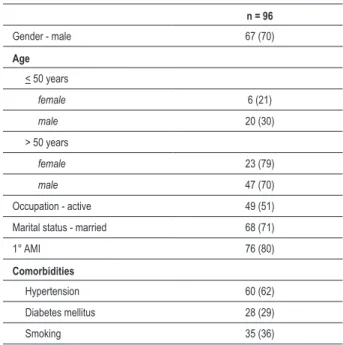
Ninety-six AMI patients over 50 years of age were included in the study, 70% of them male, and 80% after a first AMI. All patients remained in hospital for at least six days. Study sample characteristics are presented in Table 1.
Patients’ knowledge, frequency of sexual activity prior to AMI and expectations regarding sex after hospital discharge
When patients’ knowledge about the AMI was analyzed, 4% showed a good understanding of their disease, while 96% knew nothing about AMI clinical manifestations or its attendant limitations. During hospital stay, 4% of the patients were warned that coronary artery disease could affect their sex life adversely. Regarding frequency of sexual relations prior to the AMI, 63% (p < 0.002) of the patients claimed to have been sexually active prior to the event, 60% expressed interest in resuming their sex life after discharge; while 44% admitted a decrease in the frequency of sexual relations following the event. Our study indicates that as many as 69% of the patients leave the hospital with unanswered questions regarding their disease, and 60% with concerns about the timing of resumption of sexual activity.
The above data are shown in Table 2.
Discussion
The relationship between erectile dysfunction and major risk factors for ischemic heart disease, such as smoking, sedentary life stile, diabetes, hypertension, and dyslipidemia,
Table 1 - Sample characteristics.
n = 96
Gender - male 67 (70)
Age
< 50 years
female 6 (21)
male 20 (30)
> 50 years
female 23 (79)
male 47 (70)
Occupation - active 49 (51)
Marital status - married 68 (71)
1° AMI 76 (80)
Comorbidities
Hypertension 60 (62)
Diabetes mellitus 28 (29)
Smoking 35 (36)
Categorical variables n (%).
Original Article
Lunelli et al
Sexual Activity after Infarction: Taboo or Lack of Knowledge?
Arq Bras Cardiol 2008; 90(3) : 156-159
but 44% admitted the possibility of reducing the frequency of sexual activity after the AMI event.
A number of factors are well-established in regard to the possibility of decreasing sexual activity after cardiac events. Such factors include fear of coital death or reinfarction, dyspnea, angina, exhaustion, loss of libido, depression, impotence, anxiety or concern on the part of the partner, as well as guilt feelings12. These factors may be related to lack of knowledge of the disease and the need for adequate rehabilitation after a cardiac event, in addition to ignorance of the risks that sexual activity may actually entail. It is well-known fact that hemodynamic changes, increase in heart rate and increase in blood pressure during sexual intercourse are capable of triggering another cardiac event13,14. However, after adequate stratification the absolute risk is slight15. Our study showed that 60% of the patients are still in doubt when leaving the hospital and are unable to inform the recommended time for resumption of sexual activity. These data underscore the need for healthcare providers to seek scientific data on sexual activity that will enable them to instruct their patients regarding resumption of sexual activity. This applies especially to members of the nursing staff since they spend more time with patients.
Recent AMI - less than six weeks - is classified as intermediate risk for sexual activity. Studies have shown an increase in maximal oxygen uptake and systolic blood pressure after physical exertion or sexual activity. Therefore, stratification of patients is essential for the medical team to provide optimal guidance regarding resumption of sexual activity after hospital discharge16,17. It is clear that both patients and healthcare
providers are unsure about how to address and/or include sexual counseling in cardiac rehabilitation programs.
In this regard, strategies that could add to verbal and/or written orientation have been found to produce beneficial results. One example is a randomized clinical trial performed with 115 post-AMI patients who were followed up for 1, 3, and 5 months. In this study, patients in the control group received written instructions, and those in the intervention group received a videotape. Issues related to quality of life, anxiety, and timing of resumption of sexual activity were directly and objectively addressed in the video. This study’s findings showed that the videotape was an important tool not only to provide post-AMI with sexual counseling, but also to help them to resume their sex life earlier. The authors came to this conclusion after comparing the videotape method with other strategies used in other studies10.
It is important to note that lack of knowledge about the disease and resumption of sexual activity can be identified during the hospitalization, providing that both, institutions and professionals, should pay special attention to these patients. Moreover, sexual counseling is an important aspect that should be discussed with the patients and their partners during hospitalization. Sexual recommendations will help to reduce the fear and anxiety of post-AMI patients and, thus, improve their quality of life14,18.
Final Remarks
Based on our findings, we can suggest that sexual guidance provided to patients by healthcare teams during hospitalization Table 2 - Knowledge of AMI and sexual activity.
All
n = 96
Gender
p Female Male
Knowledge of AMI* 4 (4) 1 3 0.999
Lack of knowledge of AMI* 92 (96) 28 64
Received sexual guidance after AMI 4 (4) 1 3 0.999
Frequency of sexual activity prior to AMI 0.002
1 to 4 times a week 60 (63) 11 49
Once a month and none 36 (36) 18 18
Sexual relations after hospital discharge – Yes 68 (71) 15 53 0.014
Frequency of sexual relations after hospital discharge 0.595
Maintain the same frequency 54 (56) 18 36
Reduce frequency 42 (44) 11 31
Resumption of sexual activity 0.309
After hospital discharge 17 (18) 6 11
From one week to one month 19 (20) 3 16
Were not able to inform 57 (61) 19 38
Doubts - Yes 62 (68) 19 43 0.714
About AMI* 66 (69) 18 48 0.491
About resumption of sexual activity 57 (60) 21 36 0.138
* AMI - Acute myocardial infarction; Categorical variables n (%).
Original Article
Lunelli et al Sexual Activity after Infarction: Taboo or Lack of Knowledge?
Arq Bras Cardiol 2008; 90(3) : 156-159 may be suboptimal. Updated knowledge of risk stratification,
depending on the extent of AMI and impairment of left ventricular function, is essential if healthcare professionals, particularly nurses who are involved in the pre- and post admission management, would instruct these patients safely and with scientific basis.
Guidance for post-AMI patients follows the American Heart Association recommendations, according to the patient’s clinical condition: a) Patients at low risk for cardiovascular disease are: Asymptomatic; with less than three risk factors for coronary artery disease (CAD) (excluding gender); controlled hypertension; class I or II stable angina of the Canadian Cardiovascular Society (CCS); successful coronary revascularization; history of uncomplicated AMI, mild valvular disease, congestive heart failure (CHF) without left ventricular (LV) dysfunction and/or in NYHA class I). These patients can be encouraged to resume sexual activity or receive prompt treatment for sexual dysfunction. b) Patients at intermediate risk: at least three risk factors for CAD (excluding gender), class II or III stable angina of the CCS classification, recent AMI (from 2 to 6 weeks), left ventricular (LV) dysfunction and/or NYHA class II CHF, noncardiac sequel from atherosclerotic disease (stroke [AVC] and/or peripheral vascular disease). These patients should undergo a thorough cardiac evaluation before resuming sexual activity. c) Patients at high cardiovascular risk:
unstable or refractory angina, uncontrolled hypertension, NYHA class III-IV CHF, recent AMI (<2 weeks); high-risk arrhythmias, severe cardiomyopathies, moderate-to-severe valvular disease. For these patients sexual activity should be delayed until they are stabilized for their heart condition, since it poses a significant risk. They must obtain the cardiologist’s clearance before resuming normal sex life, because risk may outweigh benefit.
It must be emphasized that in patients with established coronary artery disease, coitus, as well as vigorous physical activity and/or intense emotional response, presents a low risk for triggering myocardial infarction. Additionally, compared with METs of daily activities, total body oxygen demand and increase
in myocardial oxygen demand during marital sexual activity are modest, and the duration of the increase is brief (vigorous sexual activity may raise energy expenditure to 5 to 6 METs). For example, patients with stable angina under optimal treatment for their cardiac condition apparently present no significant increase in cardiovascular risk during sexual activity.
Finally, the risk of a cardiovascular event during sexual activity has been reported to be significantly lower in subjects who engage in regular, chronic, physical activity. Moreover, it should be kept in mind that cardiovascular symptoms during sex rarely occur in patients who experienced no similar symptoms during exercise stress testing, especially those who achieved 6 METs and remained asymptomatic, with no electrocardiographic changes suggestive of ischemia.
Potential Conflict of Interest
No potential conflict of interest relevant to this article was reported.
Sources of Funding
There were no external funding sources for this study.
Study Association
This article is part of a Graduate Level Specialization Course Monograph: Nursing in Cardiology from the Instituto de Cardiologia do Rio Grande do Sul/Fundação Universitária de Cardiologia submitted by Rosana Pinheiro Lunelli, Eneida Rejane Rabelo, Ricardo Stein, Silvia Goldmeier, Maria Antonieta Moraes, from Instituto de Cardiologia do Rio Grande do Sul/Fundação Universitária de Cardiologia; Hospital de Clínica de Porto Alegre e Laboratório de Fisiopatologia do Exercício do Hospital de Clínicas de Porto Alegre.
References
1. Maiello JR. Retorno ao trabalho e qualidade de vida pós-infarto do miocárdio. Rev Soc Cardiol Estado de São Paulo. 1995; 5 (1): 94-9.
2. Vacanti, LJ, Caramelli B. Idade e distúrbio psicológicos: variáveis associadas à disfunção sexual no período pós-infarto. Arq Bras Cardiol. 2005; 85 (2): 110-3.
3. Tuttle WB, Cook WLJR, Ficth E. Sexual behavior in postmyocardial infarction patient. (abstract). Am J Cardiol. 1964; 13:140.
4. Papadopoulos C, Beaumont C, Shelley SI, Lamrrimore P. Myocardial infartion and sexual activity of female patient. Arch Intern Med. 1983; 143: 1528-30.
5. Gupta MC, Singh MM, Gurnani KC, Pandey DN. Psychopathology of delayed resumption of sexual activity after myocardial infarction. J Assoc Physicians India. 1990; 38: 545-8.
6. McLane M. Psychosexual adjustment and counseling after myocardial infarction. Ann Int Med. 1980; 92: 514-9.
7. Dantas RS, Aguillar OM, Barbeira CS. Retorno às atividades ocupacionais e sexuais após cirurgia de revascularização do miocárdio. Rev Latino-am Enfermagem. 2001; 9 (4): 26-31.
8. Kimmel SE. Sex and myocardial infarction: an epidemiologic perspective. Am Heart J. 2000; 86: 10-3.
9. Stein R, Hohmann C. Atividade sexual e coração. Arq Bras Cardiol. 2006; 86 (1): 61-7.
10. Steinke E, Swan J. Effectiveness of a videotape for sexual counseling after myocardial infarction. Research in Nursing & Health. 2004; 27: 269-80.
11. Thorson Al. Sexual activity and the cardiac patient. Am J Geriatr Cardiol. 2003; 12: 38-40.
12. Rerkpattanapipat P, Stanek MS, Kotler MN. Sex and the heart: what is the role of the cardiologist? Eur Heart J. 2001; 22: 201-8.
13. Drory Y, Shapira I, Fisman E. Myocardial ischemia during sexual activity in patients with coronary artery disease. Am Heart J. 1995; 75: 835-6.
14. Taylor HA. Sexual activity and the cardiovascular patient: guidelines. Am J Cardiol. 1999; 84 (5B): 6N-10N.
15. Muller JE, Mitlleman MA, Maclure M, Sherwood GH. Triggering myocardial infarction by sexual activity: low absolute risk and prevention by regular physical exertion. JAMA. 1996; 275: 1405-9.
16. Nemec ED, Mansfield L, Kennedy JW. Heart rate and blood pressure responses during sexual activity in normal males. Am Heart J. 1976; 92 (3): 274-7.
17. Debusk R, Goldstein I, Jackson G, Kaul S, Kimmel SE, Kostis JB, et al.