Offi cial Publication of the Brazilian Society of Anesthesiology www.sba.com.br
REVISTA
BRASILEIRA DE
ANESTESIOLOGIA
Abstract
Background and objectives: We evaluated the effects of epidural injection with levobupivacaine or serum physiologic, epidural volume extension (EVE), when using combined spinal-epidural anesthesia (CSEA) for cesarean delivery.
Methods: One-hundred and thirty-eight patients with a full-term pregnancy of 37-42 weeks that were scheduled for cesarean delivery were included. Group 1 (n = 48) received single-shot spinal anesthesia (SSS), group 2 (n = 45) received CSEA-EVE with saline, group 3 received CSEA-EVE with levobupivacaine. The characteristics of motor and sensory block, the effects on maternal hemodynamic changes and the effects on the newborn were compared.
Results: Time to reach maximum sensory block was signifi cantly shorter in groups 3 than in group 1 and 2 (p < 0.05). Two-segment regression time of sensory block was signifi cantly shorter in group 1, whereas it was signifi cantly longer in group 3 than in group 2 (p < 0.05). Time to onset of motor block was signifi cantly longer in group 1 than in groups 2 and 3 (p < 0.05). Time to reach maximum motor block was signifi cantly shorter in group 3 than in groups 1 and 2 (p < 0.05). Time to recovery of motor block was signifi cantly longer in group 3 than in groups 1 and 2 (p < 0.05). The time to fi rst analgesic was signifi cantly longer in group 3 (p < 0.05).
Conclusions: Suffi cient and rapid motor and sensory block was achieved in all the patients in the present study; however, motor and sensory block had faster onset, lasted longer, and was of a higher level in groups 2 and 3; these effects were more pronounced in the group 3.
© 2013 Sociedade Brasileira de Anestesiologia. Published by Elsevier Editora Ltda. All rights reserved.
Combined Spinal-Epidural Anesthesia with Epidural
Volume Extension causes a Higher Level of
Block than Single-Shot Spinal Anesthesia
Canan Salman
1, Nurten Kayacan*
2, Fatma Ertuğrul
2, Zekiye Bıgat
2, Bilge Karslı
21.Medical Park Hospital, Department of Anesthesiology and Reanimation, Antalya, Turkey
2. Akdeniz University, School of Medicine, Department of Anesthesiology and Reanimation, Antalya, Turkey
Received from Akdeniz University School of Medicine, Department of Anesthesiology and Reanimation Antalya-Turkey.
Submitted on April 24, 2012. Approved on June 4, 2012.
Keywords: Anesthesia, Spinal, Epidural;
Injections, Epidural; Anesthetics, Local; Bupivacaine/ levobupivacaine; Cesarean Section.
SCIENTIFIC ARTICLE
*Corresponding author: Akdeniz University School of Medicine, Department of Anesthesiology and Reanimation Antalya-TURKEY. Phone: +90.242.249 6238
E-mail: [email protected]
ISSN/$ - see front metter c 2013 Sociedade Brasileira de Anestesiologia. Published by Elsevier Editora Ltda. All rights reserved.
Introduction
Combined spinal epidural anesthesia (CSEA) is the preferred method for cesarean delivery. The spinal component provides rapid onset of anesthesia and the drugs that are administered through the catheter placed in the epidural space maintain
analgesia during the postoperative period 1. The epidural
volume extension (EVE) technique is a modifi cation of CSEA in which the level of sensory analgesia obtained via subara-chnoid block is increased by a small volume of saline or local
anesthetic administered through the epidural catheter 2-6.
the analgesic effect of the local anesthetic administered into the epidural space, but to the effect of the volume of the epidural solution causing cephalic movement of the local
anesthetic in the subarachnoid space 5,7-9.
Researchers have reported that epidural administration of saline increases the level of sensory block without altering the intensity of spinal anesthesia; however, epidural injec-tion of plain bupivacaine caused more intense motor block of longer duration for sensory and motor block, as well as analgesia, when used for volume extension during cesarean
delivery 10. Another study reported that when saline was used
for EVE, the level of the spinal block obtained using hyper-baric bupivacaine did not increase; however, the maximum level of sensory block increased signifi cantly in spinal block
obtained using plain bupivacaine 11.
In the present study we hypothesized that, in comparison to single-shot spinal anesthesia (SSS), an increase might be observed in intrathecal local anesthetic distribution when CSEA is administered in combined EVE. The purpose is to assess whether we can achieve more potent and more rapid onset of anesthesia this way.
Methods
The study included patients that had cesarean delivery. The Ethical Committee of Akdeniz University approved this study and all the participants provided informed consent. In total, we included in this study 138 ASA I-II patients aged 18-40 years with a full-term pregnancy of 37-42 weeks that were scheduled for cesarean delivery. Exclusionary criteria included history of allergy to local anesthetics, diabetes mellitus, height < 155 cm or weight > 100 kg, pre-eclampsia, placenta previa, fetal anomalies, fetal bradycardia, neuro-logic or psychiatric disorders. All patients received 1,000 mL of Ringer’s lactated intravenously before spinal anesthesia. Patients were monitored for non-invasive blood pressure, ECG, and peripheral oxygen saturation. We evaluated fetal heart rate prior to anesthesia.
The patients were randomly assigned to one of three groups using sealed opaque envelopes: each envelope contai-ned one of the three codes: SSS, CSEA-EVE with saline, and CSEA-EVE with levobupivacaine. Care providers in the labour room generated the random allocation sequence. Group 1 (n = 48) received SSS anesthesia; Group 2 (n = 45) received CSEA (EVE with 5 mL saline); Group 3 (n = 45) received CSEA (EVE with 5 mL of 0.5% levobupivacaine).
In Group 1 (SSS), following identifi cation of the L3-4 or L4-5 intervertebral space while in the right lateral recumbent position, the following doses of 0.5% levobupivacaine were injected in addition to 20 µg of fentanyl over the course of 30 seconds using a 27G spinal needle (Quincke, Egemen, Izmir, Turkey): 10 mg in patients with a height ≤ 160 cm, 12 mg in those 161-164 cm in height, 14 mg in those 165-169 cm in height, and 15 mg in those with a height ≥ 170 cm.
In Group 2 (CSEA-EVE with 5 mL saline), we identifi ed the epidural space using an 18G Tuohy needle and performed dural puncture using a 27G spinal needle (Combifi x, Egemen, Izmir, Turkey). Spinal anesthesia doses according to patient height in Group 2 were the same as described for Group 1, and a 20-G epidural catheter was inserted 4 cm into the epidural space. Five minutes after insertion of the epidural catheter, 5 mL of saline was administered through it for EVE.
In Group 3 (CSE-EVE with 5 mL of 0.5% levobupivacaine), after identifi cation of epidural space, we performed dural puncture (Combifi x, Egemen, Izmir, Turkey). Spinal anesthesia doses according to patient height in Group 3 were the same as described for Groups 1 and 2, and a 20G epidural catheter was inserted 4 cm into the epidural space. Five minutes after insertion of the epidural catheter, 5 mL of % 0.5 levobupi-vacaine (Chirocaine, Abbott Laboratories, Istanbul, Turkey) was administered through it for EVE. Following the anesthetic procedure, all patients were placed in the supine position and their right hip was elevated with a pillow to prevent aortocaval pressure. We allowed surgery to proceed after a sensory height block of T4-5 was achieved.
To avoid inter-operator variability, the principal author performed all the blocks. At the end of each regional techni-que, an anesthesiologist who was unaware of the technique and drug received by each patient recorded hemodynamic status and block profi le. Systolic blood pressure, diastolic blood pressure, mean blood pressure (MBP), heart rate, and
oximetry (SpO2) levels were periodically monitored during
surgery. In order to evaluate the characteristics of the block, the Bromage scale was used for motor block (0 = normal motor function, 1 = loss of motor function at the hip, 2 = loss of motor function at the hip and knee, and 3 = loss of motor function at the hip, knee, and ankle) and the pinprick test was used for sensory block. We recorded time to onset of sensory block, time for sensory block to reach T10, the level of maximum sensory block, time to reach maximum sensory block, 2 segment-regression time of sensory block,
and regression of sensory block to T10, time to onset of motor
block, time to reach maximum motor block, time to recover
from motor block. We scored the quality of intraoperative anesthesia as follows: 0: unsuccessful block; 1: insuffi cient block (insuffi cient anesthesia, insuffi cient relaxation, need for adjuvant therapy, need for general anesthesia); 2: suffi -cient block. The need for the fi rst postoperative analgesia was determined using the visual analogue scale (VAS), and the fi rst analgesic was administered if the VAS score was > 3.
We administered prophylactic ephedrine 5 mg intrave-nously on all patients immediately following the anesthetic procedure in order to prevent hypotension. We administered an additional 5 mg of ephedrine when blood pressure dropped to 20% below the baseline value, noting the total dosage.
New-born were also noted Apgar scores (1st and 5th min).
We used SPSS (Statistical Package for Social Sciences) v.13.0 for Windows for statistical analysis of the obtained data. Quantitative data were analyzed using One-Way ANOVA. Qualitative data were analyzed using Pearson Chi-square test. Statistical signifi cance was set at p < 0.05. When aiming to detect a time to reach maximum sensory block, with a power 99.7%, and α = 0.05, each group required a sample size of 45.
Results
269 Single-Shot Spinal Anesthesia
similar in all 3 groups, whereas time for sensory block to re-ach T10 was signifi cantly shorter in Group 3 (levobupivacaine was used for EVE) than in Groups 1 and 2 (p < 0.05). Time to reach maximum sensory block was signifi cantly shorter in Groups 3 than in Group 1 and 2; the shortest time to reach maximum sensory block was observed in Group 3 (p < 0.05). Two-segment regression time of sensory block was signifi can-tly shorter in Group 1, whereas it was signifi cancan-tly longer in Group 3 than in Group 2 (p < 0.05).
Time for sensory block to regress to T10 was signifi -cantly longer in Group 3 than in Groups 1 and 2. Maximum sensory block in Group 1 was at the T2-3 level in 79.17% of
the patients, versus the T4-5 level in 20.83%. In Group 2, maximum sensory block was at the T1-2 level in 20% of the patients, the T2-3 level in 66.67%, and the T4-5 level in 13.33%. In Group 3, maximum sensory block was at the T1-2 level in 37.78% of the patients and the T2-3 level in 66.22%. Analysis of the quality of block showed that only 1 patient in Group 1 required fentanyl; suffi cient block was achieved in all other patients and there was not a need for additional analgesics or sedatives.
Time to onset of motor block was signifi cantly longer in Group 1 than in groups 2 and 3 (p < 0.05). Time to reach ma-ximum motor block was signifi cantly shorter in Group 3 than
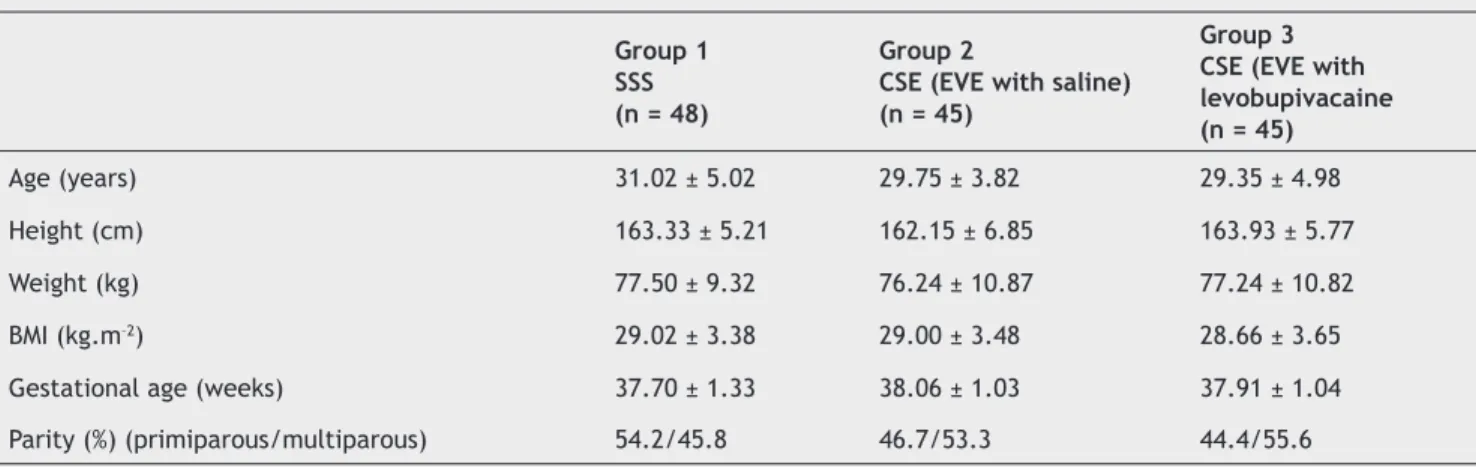
Table 1 Patient characteristics.
Group 1 SSS (n = 48)
Group 2
CSE (EVE with saline) (n = 45)
Group 3 CSE (EVE with levobupivacaine (n = 45)
Age (years) 31.02 ± 5.02 29.75 ± 3.82 29.35 ± 4.98
Height (cm) 163.33 ± 5.21 162.15 ± 6.85 163.93 ± 5.77
Weight (kg) 77.50 ± 9.32 76.24 ± 10.87 77.24 ± 10.82
BMI (kg.m–2) 29.02 ± 3.38 29.00 ± 3.48 28.66 ± 3.65
Gestational age (weeks) 37.70 ± 1.33 38.06 ± 1.03 37.91 ± 1.04
Parity (%) (primiparous/multiparous) 54.2/45.8 46.7/53.3 44.4/55.6
Data are presented as mean ± SD or (%).
Table 2 Blockade characteristics.
Group 1 SSS (n = 48)
Group 2 CSEA(EVE with saline) (n = 45)
Group 3 CSEA(EVE with levobupivacaine) (n = 45)
Time to onset of sensory block(min) 1.00 ± 0.00 1.00 ± 0.00 1.00 ± 0.00
Time to reach T10 level (min) 1.81 ± 1.06 1.44 ± 0.84* 1.00 ± 0.00* * 
Maximum sensory block reached (%) 79.17% (T2-3) 20.83% (T4-5)
20% (T1-2) 66.67% (T2-3) 13.33% (T4-5)
37.78% (T1-2) 66.22% (T2-3)
in groups 1 and 2 (p < 0.05). Time to recovery of motor block was signifi cantly longer in Group 3 than in groups 1 and 2 (p < 0.05). There were not any statistically signifi cant differences in MBP or heart rate when intraoperative hemodynamic data were considered between the groups (P > 0.05). None of the patients had bradycardia requiring atropine treatment. There was not a difference in patient need for additional ephedrine between the groups (5.88 ± 1.96 mg in Group 1, 5.38 ± 1.38 mg in Group 2, and 5.41 ± 1.44 mg in Group 3). Comparison
of 1st and 5th minute APGAR scores in the new-borns showed
that there was not a signifi cant difference between the groups (p > 0.05) (Table 3). The time to fi rst analgesic was signifi cantly longer in Group 3 than in Groups 1 and 2 (p < 0.05) (142.97 ± 15.81 min in group 1, 146.73 ± 10.39 min in Group 2, and 163.35 ± 12.91 min in Group 3).
Discussion
The most important fi nding in the present study is that admi-nistration of CSEA and EVE with both saline and levobupiva-caine resulted in faster onset and longer duration of sensory and motor block than SSS, even though the same dose of intrathecal local anesthetic was given. Using EVE with saline, small-dose spinal block can be extended to provide adequate
anesthesia for cesarean delivery 4. Several mechanisms were
reported to play a role in the enhancement of spinal block by EVE with saline, including the volume effect, in which the theca is compressed by epidural saline, resulting in the squeezing of cerebrospinal fl uid and more extensive spread
of subarachnoid local anesthetic 5,6,8,12. This effect differs
from the enhancement of block following EVE with local anesthetic, as saline extends the block height by a mechani-cal volume effect (that appears to be time-dependent) and does not prolong the duration of block. Beyond 30 minutes or after 2-segment regression has begun, EVE with saline has no effect on block extension and may even accelerate spinal
block regression 6,9.
Delayed administration of epidural saline beyond 10 mi-nutes may have been the cause of frequent failure reported
by Choi et al. 10 when administering EVE and spinal block
induced with 8 mg of hyperbaric bupivacaine; the incidence
of intraoperative pain exceeded 50%. Bremerich et al. 13 used
7.5, 10, and 12.5 mg of hyperbaric 0.5% levobupivacaine in patients receiving spinal anesthesia for elective cesarean delivery. In all, 40% of their patients that received 7.5 mg of levobupivacaine required additional intraoperative intra-venous opioid analgesic, and motor block was not complete.
There were not any signifi cant differences in sensory or motor characteristics between the patients that received 10 mg and 12.5 mg of levobupivacaine; however, postoperative duration of analgesia was longer in the patients that received 10 mg and 12.5 mg of levobupivacaine.
Celleno et al. 14 studied the use of CSEA for cesarean
deli-very and concluded that the minimum dose of local anesthe-tic (levobupivacaine) administered to the spinal component
must be 11.10 mg, whereas Parpaglioni et al. 15 reported that
it should be 10.58 mg. In the present study we administered 10-15 mg of levobupivacaine, based on patient height, and achieved complete analgesia in all patients. There is no con-sensus on the mechanism of action of EVE in conjunction with
CSEA. Blumgart et al. 12 administered 10 mL of saline, 10 mL
of bupivacaine, or 0.5 mL of saline (control group) after ad-ministration of local anesthetic into the epidural space. The level of sensory block was signifi cantly higher in the groups that received 10 mL saline or 10 mL of bupivacaine through epidural catheter than in the control group, and there were not any signifi cant differences in hemodynamic parameters or complications between the groups. In a similar study by
Stienstra et al. 16 patients were divided into 5 groups after
administration of 10 mg of bupivacaine into the epidural space. The patients received 10 mL of 0.25% bupivacaine, 5 mL of 0.25% bupivacaine, 10 mL of saline, 5 mL of saline, or nothing through epidural catheters. The increase in the level of sensory block was signifi cantly higher in the patients that received 10 mL of 0.25% bupivacaine than in the other patients, and the level of maximum sensory block increased
to C8. The researchers concluded that the increase in the
level of anesthesia was not only related to the volume of the agent administered into the epidural space, but also in part to the dose effect of the local anesthetic agent. Similarly, in our study anesthesia was achieved faster, reached a higher level, and lasted longer in the patients that received CSEA - EVE with saline or levobupivacaine (Groups 2 and 3, respec-tively) than in those that received SSS (Group 1); however, anesthesia was achieved faster, reached a higher level, and lasted longer in Group 3 than in Group 2. As such, we think that the dose effect of the anesthetic administered to the epidural space may have caused the observed increase in the level of anesthesia.
The level of the sensory block achieved with adminis-tration of local anesthetic into the epidural space following administration of intrathecal local anesthetic in CSEA is not only related to the analgesic effect of the local anesthetic
Table 3 Neonatal outcomes.
Group 1 SSS (n = 48)
Group 2
CSE -EVE with saline (n = 45)
Group 3
CSE -EVE with 5 mL of 0.5% levobupivacaine
(n = 45)
Apgar score at 1 min 8.68 ± 0.46 8.71 ± 0.45 8.77 ± 0.42
Apgar score at 5 min 9.97 ± 0.14 9.95 ± 0.20 9.95 ± 0.20
271 Single-Shot Spinal Anesthesia
solution, but also to the cephalic movement of the intrathecal local anesthetic due to the volume effect of the administered
solution. Tokiguchi et al. 8 studied CSEA in patients scheduled
for elective surgery and administered 7.5 mg of 3% hyperba-ric bupivacaine into the subarachnoid space. They alocated the patients into two groups; the treatment group received 10 mL of 0.9% isotonic NaCl solution through the epidural catheter 10 minutes after administration of bupivacaine, and the control group received nothing additional through the epidural catheter. In the treatment group, the level of sensory block 15 and 20 minutes after the spinal anesthesia was signifi cantly higher than in the control group.
EVE also increases the duration of anesthesia. In our study, the time to fi rst need for analgesic was signifi cantly longer in Group 3 than in Groups 1 and 2. Numerous studies report an increase in the level of sensory block with CSEA, even though no agents or saline were administered through the
epidural catheter. Ithin et al. 1 studied spinal anesthesia and
CSEA using 10 mg of 0.5% hyperbaric bupivacaine in patients that underwent cesarean delivery. The epidural space was identifi ed with 2 mL of air in the CSEA group and an epidural catheter was not inserted after intrathecal injection. The maximum level of sensory block in the spinal anesthesia group was T2-4, versus C5-8 in the CSEA group; CSEA without use of an epidural catheter or administration of an epidural agent resulted in a higher level of sensory block than spinal anesthe-sia when similar doses to intrathecal local anesthetics were administered. The researchers reported that, even though negative pressure was maintained in the epidural space using spinal anesthesia, negative pressure in the epidural space was equalized to the atmospheric pressure via the epidural needle used for CSEA and dural sac volume decreased; hen-ce, there was an increase in the level of sensory block after administration of the spinal dose of local anesthetic.
Goy et al. 17 reported that the level of sensory block
achieved using CSEA was 2 segments higher that that achieved using spinal anesthesia in patients that underwent minor
gy-necologic surgery. Lew et al. 4 administered intrathecal spinal
anesthesia (9 mg of 0.5% bupivacaine and 10 µg of fentanyl) only to one group, and administered CSEA (intrathecal 5 mg of 0.5% bupivacaine and 10 µg of fentanyl) to the other group, followed 5 minutes later with epidural 6 mL of 0.9% isotonic NaCl solution through the catheter. In both groups, the level of sensory block necessary for painless cesarean delivery
(T5) was achieved; however, motor recovery was faster in
the group that received 6 mL of 0.9% isotonic NaCl solution through the epidural catheter. Intergroup comparison showed that the time to fi rst need for analgesic and VAS pain scores were similar in both groups. The researchers concluded that CSEA and EVE may decrease the anesthetic dose needed by 55%, as well as enable suffi cient anesthesia for elective ca-esarean delivery and facilitate a shorter stay in the recovery room due to its associated rapid motor recovery time.
Intrathecal levobupivacaine seems to have a lower po-tency for motor block than bupivacaine, but the ideal dose of intrathecal levobupivacaine for cesarean delivery remains
uncertain 18-20. Bouvet et al. 21 reported that, when combined
with opioids, ED95 of intrathecal levobupivacaine is 12.9 mg
for caesarean delivery. Gori et al. 22 evaluated infl uence of
positioning on 12.5 mg plain levobupivacaine spinal anesthe-sia in cesarean section. In our study, the same spinal doses
according to the patient height was administered to all the patients to ensure a suffi cient level of anesthesia, especially in Group 1, and not to adversely infl uence the comfort of the patient during cesarean delivery.
Since the spinal is usually a single-shot technique, it is not possible to improve an inadequate block or provide ex-tended post-operation pain relief. When we have a look at the studies regarding application duration and cost of SSS and CSEA techniques, Choi et al. compared CSEA versus SSS for cesarean section and concluded that anesthetic procedure time was signifi cantly longer in CSEA group (CSEA: 4.6 ± 1.6 min). Although time difference between the two techniques is considered statistically signifi cant, in cases of elective cesarean section the CSEA technique can overcome the limits
connected with the SSS technique 23,24.
Edward et al. retrospectively reviewed the chars of patients who had received epidural or spinal anesthesia for non-emergent cesarean section. Their data supported that spinal anesthesia resulted in a shorter operating room time than epidural anesthesia did. Epidural block is inherently more time–consuming than a spinal block. In this study, spinal anesthesia is reported to be more cost effective than
epidural anesthesia 25.
Butwick et al. reported that there is increased use of a CSEA technique in morbidly obese patients (BMI ≥ 40
kg.m-2), compared with non-obese patients undergoing
elective cesarean delivery. The cost for the anesthesia kit used for neuraxial block placement was signifi cantly higher in morbidly obese patients. In this study, a higher percen-tage of morbidly obese patients received a CSEA technique, which was associated with higher equipment costs than SSS
anesthesia 25.
Although the CSEA technique seems to be disadvanta-geous compared to the SSS anesthesia in terms of application duration and cost, its use for patients undergoing cesarean section is advantageous as it allows neuraxial blockade to be maintained (with additional doses of local anesthetic via the epidural catheter) after establishing adequate surgical
anesthesia with a spinal technique 24.
Choi et al.10 administered epidural 10 mL of saline or
In conclusion, suffi cient and rapid motor and sensory block was achieved in all the patients in the present study. However, motor and sensory block had faster onset, lasted longer, and was of a higher level in Groups 2 and 3; these effects were more pronounced in Group 3. We think that CSEA with EVE decreases the need for a spinal dose, and facilitates earlier onset of anesthesia and faster regression of spinal block due to low dosage, which results in faster mobilization.
Acknowledgement
This study was supported by a Grant from the Akdeniz University School of Medicine’s Research and Application Centre (Project N◦ 2007.04.0103.011).
Confl ict of interest
No confl icts of interest were declared in relation to this article.
References
1. Ithnin F, Lim Y, Sia AT, Ocampo CE. Combined spinal epidural causes higher level of block than equivalent single-shot spinal anaesthesia in elective cesarean patients. Anesth Analg. 2006; 102:577-580.
2. Rawal N. Combined spinal-epidural anaesthesia. Curr Opin Anaesthesiol. 2005; 18:518-521.
3. Beale N, Evans B, Plaat F, Columb MO, Lyons G, Stocks GM. Effect of epidural volume extension on dose requirement of intrathecal hyperbaric bupivacaine at caesarean section. Br J Anaesth. 2005;95:500-503.
4. Lew E, Yeo SW, Thomas E. Combined spinal-epidural anaesthesia using epidural volume extension leads to faster motor recovery after elective cesarean delivery: a prospective, randomized, double-blind study. Anesth Analg. 2004;98:810-814.
5. Stienstra R, Dahan A, Alhadi BZ, van Kleef JW, Burm AG. Mechanism of action of an epidural top-up in combined spinal epidural anaesthesia. Anesth Analg. 1996;83:382-386. 6. Mardirosoff C, Dumont L, Lemédioni P, Pauwels P, Massaut J.
Sensory block extension during combined spinal and epidural. Reg Anesth Pain Med. 1998;23:92-95.
7. Cook TM. Combined spinal-epidural techniques. Anaesthesia. 2000;55:42-64.
8. Takiguchi T, Okano T, Egawa H, Okubo Y, Saito K, Kitajima T. The effect of epidural saline injection on analgesic level during combined spinal and epidural anaesthesia assessed clinically and myelographically. Anesth Analg. 1997;85:1097-1100. 9. Trautman WJ 3rd, Liu SS, Kopacz DJ. Comparison of lidocaine
and saline for epidural top-up during combined spinal-epidural anaesthesia in volunteers. Anesth Analg. 1997;84:574-577. 10. Choi DH, Park NK, Cho HS, Hahm TS, Chung IS. Effects of
epidural injection on spinal block during combined spinal and epidural anaesthesia for cesarean delivery. Reg Anesth Pain Med. 2000;25:591-595.
11. Tyagi A, Kumar A, Sethi AK, Mohta M. Epidural volume extension and intrathecal dose requirement: plain versus hyperbaric bupivacaine. Anesth Analg. 2008;107:333-338.
12. Blumgart CH, Ryall D, Dennison B, Thompson-Hill LM. Mechanism of extension of spinal anaesthesia by extradural injection of local anaesthetic. Br J Anaesth. 1992;69:457-460.
13. Bremerich DH, Kuschel S, Fetsch N, Zwissler B, Byhahn C, Meininger D. Levobupivacaine for parturients undergoing elective caesarean delivery. A dose-finding investigation. Anaesthesist. 2007;56:772-779.
14. Celleno D, Parpaglioni R, Frigo MG, Barbati G. Intrathecal levobupivacaine and ropivacaine for cesarean section. New perspectives. Minerva Anestesiol. 2005; 71:521-525.
15. Parpaglioni R, Frigo MG, Lemma A, Sebastiani M, Barbati G, Celleno D. Minimum local anaesthetic dose (MLAD) of intrathecal levobupivacaine and ropivacaine for caesarean section. Anaesthesia. 2006; 61:110-115.
16. Stienstra R, Dilrosun-Alhadi BZ, Dahan A, van Kleef JW, Veering BT, Burm AG. The epidural “top-up” in combined spinal-epidural anaesthesia: the effect of volume versus dose. Anesth Analg. 1999; 88:810-814.
17. Goy RW, Sia AT. Sensorimotor anaesthesia and hypotension after subarachnoid block: combined spinal-epidural versus single-shot spinal technique. Anesth Analg. 2004;98:491-496.
18. Camorcia M, Capogna G, Berritta C, Columb MO. The relative potencies for motor block after intrathecal ropivacaine, levobupivacaine, and bupivacaine. Anesth Analg. 2007;104:904-907.
19. Gautier P, De Kock M, Huberty L, Demir T, Izydorczic M, Vanderick B. Comparison of the effects of intrathecal ropivacaine, levobupivacaine, and bupivacaine for caesarean section. Br J Anaesth. 2003;91:684-689.
20. Bremerich DH, Fetsch N, Zwissler BC, Meininger D, Gogarten W, Byhahn C. Comparison of intrathecal bupivacaine and levobupivacaine combined with opioids for caesarean section. Curr Med Res Opin. 2007;23:3047-3054.
21. Bouvet L, Da-Col X, Chassard D et al. ED50 and ED95 of intrathecal levobupivacaine with opioids for caesarean delivery. Br J Anaesth. 2011;106:215-220.
22. Gori F, Corradetti F, Cerotto V, Peduto VA. Influence of positioning on plain levobupivacaine spinal anaesthesia in caesarean section. Anesthesiol Res Pract. 2010; pii: 212696. 23. Choi DH, Ahn HJ, Kim JA. Combined low-dose spinal-epidural
anesthesia versus single-shot spinal anesthesia for elective cesarean delivery. Int J Obstet Anesth. 2006;15:13-17. 24. Brizzi A, Greco F, Malvasi A, Valerio A, Martino V. Comparison
of sequential combined spinal-epidural anesthesia and spinal anesthesia for cesarean section. Minerva Anestesiol. 2005;71:701-709.