GOOD PRACTICES: FUNDAMENTALS OF
CARE IN GERONTOLOGICAL NURSING
RESEARCH
Antonio Herculano de Araújo Neto
I, Anna Cláudia Freire de Araújo Patrício
II,
Milenna Azevedo Minhaqui Ferreira
I, Brenda Feitosa Lopes Rodrigues
I, Thayná Dias dos Santos
I,
Thays Domingos de Brito Rodrigues
I, Richardson Augusto Rosendo da Silva
III Centro Universitário de João Pessoa, Undergraduate Nursing. João Pessoa, Paraíba, Brazil.
II Universidade Federal do Rio Grande do Norte, Department of Nursing, Postgraduate Program in Nursing. Natal,
Rio Grande do Norte, Brazil.
How to cite this article:
Araújo Neto AH, Patrício ACFA, Ferreira MAM, Rodrigues BFL, Santos TD, Rodrigues TDB, et al. Falls in institutionalized older adults: risks, consequences and antecedents . Rev Bras Enferm [Internet]. 2017;70(4):719-25. [Thematic Edition “Good
Practices: Fundamentals of care in Gerontological Nursing”] DOI: http://dx.doi.org/10.1590/0034-7167-2017-0107
Submission: 02-15-2017 Approval: 03-18-2017
ABSTRACT
Objective: To analyze the occurrence of falls in institutionalized elderly addressing the risks, consequences and antecedents.
Method: Cross-sectional study carried out with 45 older adults in Long-Term Care Facilities for the Older adult in João Pessoa, Brazil, in June and July 2016. A socio-demographic questionnaire and the Berg Balance Scale were applied, classifying as risk of fall scores lower than 45. Descriptive statistics and tests were conducted: independent t-test, Anova (Tukey), Chi-square, Mann Whitney. Statistically signifi cance was p <0.05. Data were processed in SPSS version 19.0. Results: A total of 66.7% (30) falls occurred, 20% (9) of them in the external area, with 66.7% (30) of the participants having hypertension as a previous disease and, as consequence, the fracture was highlighted with 11.2% (5). The Berg Scale had different scores when compared to the falls suffered by the elderly and previous diseases infl uenced the occurrence of falls (p <0.05). Conclusion: It is necessary to implement public fi nancing policies or partnerships that allow environments adaptations aiming at reducing the risks of falls.
Descriptors: Accidental Falls; Homes for the Aged; Risk; Aged; Nursing.
RESUMO
Objetivo: Analisar a ocorrência de quedas em idosos institucionalizados quanto aos riscos, consequências e antecedentes. Método: Estudo transversal, realizado com 45 idosos em Instituições de Longa Permanência para Idosos em João Pessoa/PB, Brasil, em junho e julho de 2016. Aplicou-se questionário sociodemográfi co e Escala de Equilíbrio de Berg classifi cando risco de quedas quando escore inferior a 45. Realizou-se estatística descritiva e testes: t independente, Anova (Tukey), Qui-quadrado, Mann Whitney. Considerado signifi cativamente estatístico p < 0,05 e processados no SPSS versão 19.0. Resultados: As quedas ocorreram em 66,7% (30), sendo 20% (9) na área externa, 66,7% (30) com doença prévia hipertensão e como consequência destacou-se fratura com 11,2% (5). A Escala de Berg avaliou pontuações diferentes (p < 0,05) quando comparadas às quedas sofridas pelos idosos, e as doenças prévias infl uenciaram ocorrência de quedas (p < 0,05). Conclusão: Neces sita-se implementar políticas públicas de fi nanciamento ou parcerias que possibilitem adaptação dos ambientes visando a redução dos riscos de quedas.
Descritores: Acidentes por Quedas; Instituição de Longa Permanência para Idosos; Risco; Idoso; Enfermagem.
RESUMEN
Objetivo: Analizar los riesgos, consecuencias y antecedentes de caídas en personas mayores institucionalizadas. Método: Se trata de un estudio transversal, realizado entre 45 personas mayores e internadas en Instituciones de Cuidado a Largo Plazo en João Pessoa, Paraíba, Brasil, entre junio y julio de 2016. Se aplicó el cuestionario sociodemográfi co y la Escala de Equilibrio de Berg clasifi cando el riesgo de caídas cuando la puntuación era inferior a 45. Se utilizó la estadística descriptiva y las pruebas: t de Student independiente, Anova (Tukey), distribución de Pearson (Ji-Cuadrado), Mann Whitney y se consideró signifi cativamente estadístico p < 0,05. Se procesó en el SPSS versión 19.0. Resultados: Las caídas ocurrieron en el 66,7% de las personas mayores (30), el 20% (9) en el área externa y el 66,7% (30) con enfermedad previa de hipertensión; cabe resaltar fracturas en el 11,2% (5). La Escala de Berg evaluó puntuaciones
Falls in institutionalized older adults: risks, consequences and antecedents
Quedas em idosos institucionalizados: riscos, consequências e antecedentes
INTRODUCTION
The aging of the population is seen as a great triumph for mankind and, at the same time, as a challenge to the quality of life and well-being of the population. In Brazil, it is estimated that there are approximately 17.6 million older adults, and this population will grow 16 times by 2025, ranking sixth in the world regarding older adults population(1).
Due to the significant increase in the longevity and conse-quent growth of the older adults population, there is a greater demand for long-term care facilities for the older adult (LTCF) in Brazil; in several situations admittance in a LTCF is an ex-pected and volunteer alternative, capable of assuring a good quality of life to the older adult(2).
According to ANVISA (National Health Surveillance Agen-cy), LTCFs are governmental or non-governmental institutions intended for the collective residence of older adults with or without family support, in a condition of freedom, dignity and citizenship. In summary, a LTCF is a collective residence that attends independent older adults in a situation of family and/ or income difficulties, as well as those with difficulties to per-form activities of daily living, who need long-term care(3).
Institutionalization may be a contributing factor to the risk of falls, since the change from the family environment to an LTCF can lead to psychological, cognitive and functional changes that may be associated with isolation and lack of physical activities. Added to this, the fear of falling is frequent in institutionalized elderly and considered as a risk factor for the individual’s independence(4).
A fall is defined as the unintentional movement of the body to a level lower than the initial position, without proper cor-rection in time. It is determined by several factors that may compromise stability, ie, the mechanisms involved in main-taining posture. It is considered an important cause of morbid-ity and mortalmorbid-ity in the elderly population and one of the main clinical and public health problems due to its high incidence, complications and high care costs(5).
Falls are more common in older women. Women with nu-tritional dysfunctions, four or more comorbidities and symp-toms of depression are more likely to experience falls(6).
Approximately 17% of the recorded cases of falls are suffered by older adults living alone, and almost half of them have a level of education lower than Elementary Education. Among the old-er adults, the most common comorbidities that can triggold-er falls are: cardiovascular disease; osteoarthritis and osteoporosis(6).
The etiology of falls is multifactorial and is related to intrinsic factors such as vision impairments, balance or walking disorders and extrinsic factors such as environmental risks. The factors in-herent to the person are responsible for most of the falls suffered
by institutionalized older adults, while extrinsic factors are more responsible for falls of older adults living in the community(7).
Falls are the most common cause of accidents that can have serious consequences, such as fear of falls, fractures, loss of inde-pendence or even mortality. Approximately 25% of people over 65 years of age fall every year, and about 20% of falls require medical attention(8).
Falls are the most common cause of injuries and hospital-izations in older adults and also a major factor for disability and dependence. They represent one of the main medical misfortunes observed in this population and are considered a public health problem because of its high incidence(9).
Therefore, due to the importance of this event in older adults health and the expenses generated to the public expenses with the treatment of these individuals, it is essential to study falls in older adults, in order to reduce or control the determinant factors.
Considering that the occurrence of falls and the magnitude of their risk factors may vary according to the living arrangement, with an impact on the aging process, the guiding question of this study emerges: What is the prevalence of falls in older adults in long-term care facilities? What factors contribute to the occur-rence of falls in older adults in long-term care facilities?
From this perspective, the hypotheses of the study are: 1. H1: The mean age of the elderly who fell is different.
H0: The mean age of the elderly who fell is the same. 2. H1: The mean amount of medication among the elderly
is different when correlated to falls. The amount of med-ication influenced the falls.
H0: The mean amount of medication among the elderly is equal when correlated to falls. The amount of medica-tion did not influence the falls.
3. H1: Previous diseases influenced the occurrence of falls. H0: Previous diseases did not influence the occurrence of falls.
4. H1: The Berg Scale score is related to the falls in older adults. H0: The Berg Scale score is not related to the falls in older adults.
OBJECTIVE
To analyze the occurrence of falls in institutionalized older adults addressing the risks, consequences and antecedents.
METHOD
Ethical aspects
The research followed the ethical standards established by Res-olution 466/2012 of the Brazilian National Health Council, which refers to the Guidelines and Norms Regulating Research Involving
Anna Cláudia Freire de Araújo Patrício Email: [email protected]
CORRESPONDING AUTHOR
diferentes (p < 0,05) al comparar las caídas sufridas por las personas mayores resaltando que las enfermedades previas influenciaron el suceso de caídas (p < 0,05). Conclusión: Es necesario implantar políticas públicas de financiación o crear asociaciones que posibiliten la adaptación de los diversos ambientes con el objetivo de reducir los riesgos de caídas.
Human Beings(10). In addition, it complied with the provisions of
the Older adults Statute regulated by Law 10.741/2003(11).
The research project was approved by the Research Ethics Committee of the University Center of João Pessoa.
Design, study setting and period
This is a cross-sectional quantitative study carried out in two Long-Term Care Facilities in the city of João Pessoa / PB, Brazil. Data collection was conducted in June and July 2016.
Population or sample; inclusion and exclusion criteria
The inclusion criteria were being 60 years or older and having preserved cognitive activity (criterion reported by the health care team). The exclusion criteria were: not residing in a long-term care facility, not signing the Consent Form and having altered cognitive capacity.
The study population consisted of 50 older adults who met the inclusion criteria; after sample calculation with 95% confidence and 5% margin of error, a sample of 45 elderly subjects was ob-tained. This procedure was performed in the program Statdisk U.S.A for Windows.
Study protocol
Two instruments were used. One was a socio-demographic questionnaire containing the variables: gender, age, level of education, previous diseases (diabetes, hypertension, acute myocardial infarction, osteoporosis, arthritis, arthrosis, laby-rinthitis), use of medication organized according to the drug class as categorized by the National Relation of Essential Med-ication - Rename(12). The following variables are also added:
falls, medical referral and consequences.
The second instrument was the Berg Balance Scale, a scale with maximum score of 56, composed by 14 items evaluated by an ordinal scale of five alternatives ranging from 0 to 4 points. It contemplates activities such as reaching, turning, transferring, standing still and standing up (13).
The items evaluated in the Berg Scale include the individual’s ability to maintain positions of increasing difficulty, such as the de-crease of the base of support to sit, reaching a comfortable posture, standing with the feet together and maintaining posture in a single leg. The most difficult items are: retrieving an object from the floor, how well can the individual move from sitting to standing or trans-fer from chair to chair, among others. To apply the test a chronome-ter and a ruler were used, and its performance lasted 15 minutes(13).
The Berg scale was adapted for application in Brazil(13),
pre-senting 14 items with scores from 0 to 4, “zero” being moderate or maximum need for assistance to perform the activity and “four” the ability to perform the task without assistance. The score differs regarding the time to perform activity and the assistance needed. The risk of falls is set when the score is below 45 points.
Statistical analysis
Frequency and descriptive statistics were used with mean, stan-dard deviation, minimum and maximum. In addition, to verify the relationship between the variables, tests were used for the hypothe-ses listed. The independent t-test was used to verify the association of age with the falls suffered. The Anova test (Tukey) was used to
verify the relation of the use of medication with the falls. The chi-square test was to verify the relationship of previous diseases with falls, and the Mann Whitney test was used to verify the relationship of the Berg Scale score with the falls suffered. For all these tests, a p <0.05 was considered statistically significant. These procedures were processed in SPSS version 19.0 for Windows.
RESULTS
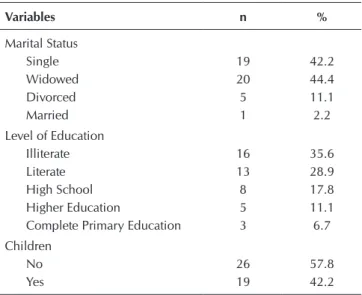
The older adults in this study were 79.8 ± 9.4 years and 62.2% (28) were female. The socio-demographic characteris-tics are shown in Table 1.
Table 1 – Socio-demographic characteristics of institutionalized elderly, João Pessoa, Paraíba, Brazil, 2016 (N = 45)
Variables n %
Marital Status
Single 19 42.2
Widowed 20 44.4
Divorced 5 11.1
Married 1 2.2
Level of Education
Illiterate 16 35.6
Literate 13 28.9
High School 8 17.8
Higher Education 5 11.1
Complete Primary Education 3 6.7
Children
No 26 57.8
Yes 19 42.2
Table 2 – Previous diseases of institutionalized older adults, João Pessoa, Paraíba, Brazil, 2016 (N = 45)
Previous disease n %
Diabetes mellitus
Yes 15 33.3
No 30 66.7
Hypertension
Yes 30 66.7
No 15 33.3
Acute myocardial infarction
Yes 2 4.4
No 43 95.5
Osteoporosis
Yes 5 11.1
No 40 88.9
Arthritis
Yes 9 20
No 36 80
Arthrosis
Yes 9 20
No 36 80
Labyrinthitis
Yes 2 4.4
Regarding previous diseases, 82.2% (37) of the participants reported having one, as shown in Table 2.
Regarding the event “fall”, 66.7% (30) of the older adults reported falls. The location, referral and consequences are shown in Table 3.
Regarding the variable “medication used”, Table 4 presents the drug classes.
The Berg Scale obtained a mean score of 38.46±16.25, with a minimum of zero and a maximum of 56. Among the older adults, 51.1% were classified as having risk of falls and 48.9% with absence of risk.
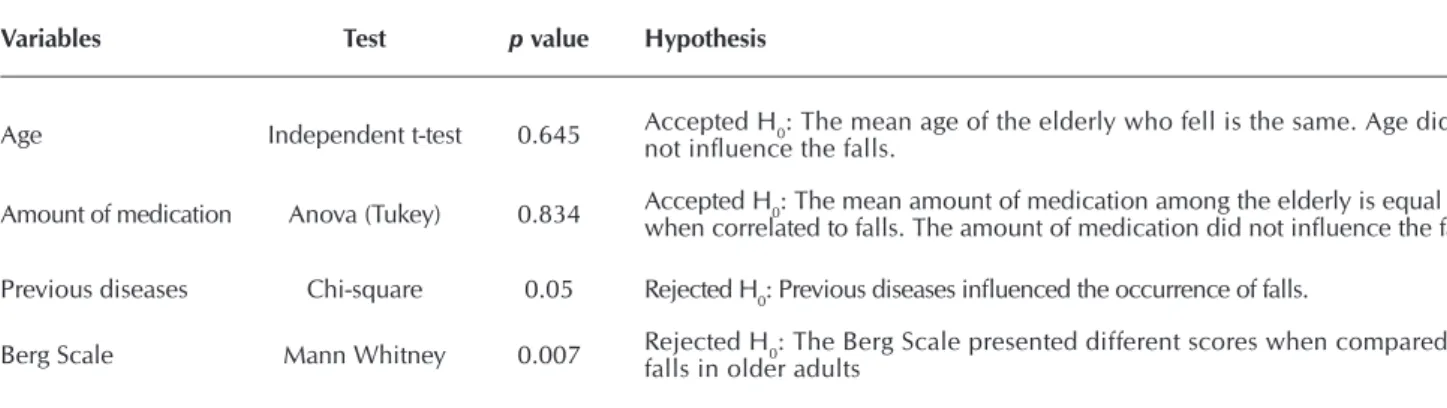
When correlating “fall” variable with age, amount of medi-cations used and Berg Scale score, p values were obtained as shown in Table 5.
Table 4 – Use of medication by the institutionalized older adults assessed, João Pessoa, Paraíba, Brazil, 2016 (N = 45)
Variables n %
Use of medication
Yes 37 82.2
No 6 13.3
Did not answer 2 4.4
Amount of medication used
Not reported or none 8 17.8
One 5 11.1
Two 6 13.3
Three 7 15.6
Four 10 22.2
More than four 9 20
Drug class
Analgesic 8 17.7
Anxiolytic 8 17.7
Antihypertensive 30 66.5
Antianemic 1 2.2
Anticholinergic 5 11
Antidiabetic 12 26.6
Anti-inflammatory 1 2.2
Antiparkinson 4 8.8
Antipsychotic 7 15.4
Anti-ulcers 4 8.9
Diuretic 16 35.6
Hypnotic 2 4.4
Neuroleptics 5 11
Bone calcium regulator 1 2.2
Vasodilator 5 11
Antiarrhythmic 1 2.2
Anticonvulsant 4 8.8
Antidepressant 2 4.4
Antiemetic 2 4.4
Vitamin 1 2.2
Antilipemic 6 13.2
Beta blocker 2 4.4
Antineoplastic 1 2.2
Phytotherapy 1 2.2
Note: *It is important to note that there were older adults who used more than one medication of the same type.
Table 3 – Location, referral and consequences of falls suf-fered by elderly, João Pessoa, Paraíba, Brazil, 2016 (N = 45)
Variables n %
Location of the fall
External area 9 20
At home 1 2.2
Did not answer 7 15.6
Room 6 13.3
Cafeteria 1 2.2
In the street 6 13.3
Referral
Family health unit 2 4.4
Local treatment 18 40
Hospital 10 22.2
Consequences
Cut on arm 2 4.4
Cut on face 1 2.2
Pain 3 6.7
Fracture 5 11.2
Inflammation of the coccyx 1 2.2
Dislocation of arm 1 2.2
Fear of falling 1 2.2
Table 5 – Association between the determinant variables for risk of falls in older adults, João Pessoa, Paraíba, Brasil, 2016 (N = 45)
Variables Test p value Hypothesis
Age Independent t-test 0.645 Accepted H0: The mean age of the elderly who fell is the same. Age did
not influence the falls.
Amount of medication Anova (Tukey) 0.834 Accepted H0: The mean amount of medication among the elderly is equal
when correlated to falls. The amount of medication did not influence the falls.
Previous diseases Chi-square 0.05 Rejected H0: Previous diseases influenced the occurrence of falls.
Berg Scale Mann Whitney 0.007 Rejected H0: The Berg Scale presented different scores when compared to
DISCUSSION
Fall might have a negative impact on older adults mobility, and it may also lead to anxiety, depression and fear of falling again, thus increasing the risk of recurrence(14).
The prevalence of women in the context of aging is due to the higher life expectancy of this gender. Still, there is no definitive explanation regarding the higher rate of falls among women; however, the lower quality and strength of muscle mass in women as well as the prevalence of chronic diseases may increase the likelihood of frailty in women (15).
The variable “age” in the older adults of the present study did not present statistical significance in relation to falls, as demonstrated through the independent t-test. However, when correlated to the Berg Scale, there was a standard deviation in the score for the older adults between 80 and 89 years old, vealing the individual limitation of each one to perform the re-quested activities. This age range directly influences this scale, since it is one of the predictors for the risk of falls.
A cross-sectional study conducted with 7,315 older adults in 59 cities of the State of Rio Grande do Sul found a rela-tionship between level of education and occurrence of falls among older adults, showing that individuals with more years of formal education presented lower risk of falling, which re-mained significant after adjusting the analysis. This situation may be related to the fact that elderly people with higher edu-cational levels tend to have higher income and, consequently, better living conditions and access to health care(16). This
cor-roborates the present study, which found 66.7% of falls with 35.6% of the older adults being illiterate.
The prevalence of falls found in another study(17) was
37.2%; a study with institutionalized older adults in Bahia(18),
found a 29.4% prevalence of the event. These data corrobo-rated the present study, since the frequency of falls reached 30% of the institutionalized older adults.
Among the diseases listed by the elderly, hypertension (66.7%) stands out, which is a risk factor for falls, since to control the blood pressure level it is necessary to use antihy-pertensives that can cause postural hypotension (dizziness)(19).
The chi-square test p <0.05 showed that the previous diseases variable influences the occurrence of falls. A study(20) conducted
with 108 older adults observed that the alteration of parameters related to cardiovascular diseases and the use of medications are important factors for the risk of falls in the elderly.
The use of medication is an intrinsic factor strongly related to falls. However, no statistically significant relationship be-tween the number of drugs used by the older adult and the presence of falls was found in this study.
Due to the diversity of diseases presented by the older adult, it is common to find “polypharmacy” among them. This is worri-some, since the effects of drug interaction are more pronounced in the older adult, due to changes resulting from the aging pro-cess in drug absorption, metabolism and elimination(17).
Regarding the aspect of the location where the fall occurred, the item “ground surface type” and the material ceramic de-scribed the locations where there had more falls(21). It is worth
noting that the results were collected from the patients’ charts in
the Geriatrics and Gerontology outpatient clinic of the Taguatin-ga Unit of the State Department of Health of the Distrito Federal. In a study with 466 older adults in 23 long-term facilities in the city of Pelotas, RS, the results pointed to referral to the hos-pital in 56% of the cases in which the older adults suffered acci-dents due to falls and a 19.2% of fractures as an outcome(22). This
information confirms the results showed in the present study, which exhibited fractures in 11.2% of the older adults falls.
The preventive measures in the institutions should be intensi-fied since the fracture rates in this context are particularly high. Prevention should be the established intervention. Measures should be implemented immediately after institutionalization, as the risk of fractures is higher during the first months, which may be related to the individual’s maladaptation to the new environment. Measures such as bed height adjustment, use of non-slippery material, adequate lighting, fixed floor mats and hip protectors can be made available to reduce these risks(23).
Limitation of movement is a relevant factor for the risk of fall(24), a result also found in this study through the Mann
Whit-ney test, that found a p-value = 0.007 when correlated to Berg Scale score to the presence of falls.
Limitations of the study and contributions to nursing, health, or public policy
Although this study presents limitations regarding the cross-sectional design and the quantitative of the older adults, the findings suggest that measures regarding the physical, structural and biological conditions verified by the Berg Scale can be applied to this public. The knowledge and use of this instrument still contribute to the process of nursing care aimed at the elderly, especially in long-term care facilities.
In order to reduce the rate of falls, the nurse working in this area should conduct educational lectures with older adults and employees, illustrating the conditions with a higher incidence of events, demonstrating how to avoid them, and raising awareness focusing on prevention. In addition, nurses should evaluate the general health of individuals, with attention to factors that may compromise safety, including chronic or debilitating disorders, use of various medication and recent trauma.
It is necessary to implement public policies and find finan-cial support or partnerships that allow the implementation of such interventions to prevent falls in all long-term facilities.
CONCLUSION
The objective of this study was to analyze the occurrence of falls in institutionalized elderly people, addressing the risks, con-sequences and antecedents. A total of 66.7% (30) older adults fell, 20% (9) of them in the external area, with 66.7% (30) of the participants having hypertension as a previous disease and, as consequence, fracture was highlighted with 11.2% (5).
After statistical tests, this study can affirm that the Berg Scale had different scores when compared to falls occurred by the older adults and that previous diseases influenced the occurrence of falls.
REFERENCES
1. Pereira-Llano PM, dos Santos F, Rodrigues MCT, Lemões MAM, Lange C, Santos SSC. A família no cuidado ao idoso após o
acidente por quedas. Rev Fundam Care [Internet]. 2016 [cited 2016 Dec 27];8(3):4717-24. Available from: http://www.seer.unirio. br/index.php/cuidadofundamental/article/view/2973
2. Teixeira CS, Schmidt FC, Muraro MFR, Meereis ECW, Gonçalves MP. Prevalência do risco de quedas em idosos de uma instituição
de longa permanência de Santa Maria (RS). Rev Kairós Gerontol [Internet]. 2014 [cited 2016 Dec 27];17(1):45-56. Available from: https://revistas.pucsp.br/index.php/kairos/article/view/19755
3. Bentes ACOB, Pedroso JS, Falcão DVS. Vivências de idosos não dependentes em instituições de longa permanência. Rev Psicol
Estudo [Internet]. 2015 [cited 2016 Dec 27];20(4):563-73. Available from: http://periodicos.uem.br/ojs/index.php/PsicolEstud/ article/view/27668
4. Meereis ECW, Favretto C, Souza J, Gonçalves MP, Mota CB. Influência da hidrocinesioterapia no equilíbrio postural de idosas
institucionalizadas. Motriz: Rev Educ Fis [Internet]. 2013[cited 2017 Jan 10];19(2):269-77. Available from: http://www.scielo.br/ pdf/motriz/v19n2/04.pdf
5. Menezes C, Vilaca KHC, Menezes, RL. Falls and quality of life of people with cataracts. Rev Bras Oftalmol [Internet]. 2016 [cited
2016 Dec 27];75(1):40-4. Available from: http://www.scielo.br/pdf/rbof/v75n1/en_0034-7280-rbof-75-01-0040.pdf
6. Paula Júnior NF, Santo SMA. Epidemiology of accidental falls among the elderly: survey of the period 2003-2012. Rev Min Enferm
[Internet]. 2015 [cited 2017 Jan 10];19(4):994-1004. Available from: http://www.reme.org.br/exportar-pdf/1054/en_v19n4a15.pdf
7. Sandoval RA, Sá ACAM, Menezes RL, Nakatani AYK, Bachion MM. Ocorrência de quedas em idosos não institucionalizados:
revisão sistemática da literatura. Rev Bras Geriatr Gerontol [Internet]. 2013 [cited 2017 Jan 10];16(4):855-63. Available from: http://www.scielo.br/pdf/rbgg/v16n4/1809-9823-rbgg-16-04-00855.pdf
8. Obrist S, Rogan S, Hilfiker R. Development and evaluation of an online fall-risk questionnaire for nonfrail community-dwelling
elderly persons: a pilot study. Rev Current Gerontol Geriat Res [Internet]. 2016 [cited 2016 Dec 27];1-16. Available from: https:// www.ncbi.nlm.nih.gov/pmc/articles/pmid/27247571/.
9. Milos V, Bondesson A, Magnusson M, Jakobsson U, Westerlund T, Midlov P. Fall risk-increasing drugs and falls: a cross-sectional
study among elderly patients in primary care. Rev BMC Geriatr [Internet]. 2014 [cited 2017 Jan 10];14(40):1-7. Available from: https://www.ncbi.nlm.nih.gov/pmc/articles/pmid/24674152/.
10. Brasil. Ministério da Saúde. Resolução nº 466, de 12 de dezembro de 2012.
11. Brasil. Ministério da Saúde. Lei No10.741, de 1º de outubro de 2003. Dispõe sobre o Estatuto do Idoso e dá outras providências.
12. Brasil. Ministério da Saúde. Secretaria de Ciência, Tecnologia e Insumos Estratégicos. Departamento de Assistência Farmacêutica e Insumos Estratégicos. Relação Nacional de Medicamentos Essenciais: Rename. Brasília: Editora do Ministério da Saúde, 2008.
13. Miyamoto ST. Brazilian version of the Berg balance scale. Braz J Med Biol Res[Internet]. 2004 [cited 2016 Dec 27];37(9):1411-21. Available from: http://www.scielo.br/pdf/bjmbr/v37n9/5292.pdf.
14. Brasil. Ministério Da Saúde. Protocolo Prevenção De Quedas: protocolo elaborado pela equipe técnica do Proqualis; 2013.
15. Alves AHC, Patrício ACFA, Albuquerque KF, Duarte MCS, Santos JS, Oliveira MS. Ocorrência de quedas entre idosos institucionalizados: prevalência, causas e consequências. Rev Fundam Care [Internet]. 2016 [cited 2017 Jan 10];8(2):4376-86. Available from: http://www.seer.unirio.br/index.php/cuidadofundamental/article/view/4438/pdf_1885
16. Pereira GN, Morch P; Lopes DGC, Trevisan MD, Ribeiro A, Navarro JHN, Bós DSG, Vianna MSS, Bós AJG. Fatores socioambientais
associados à ocorrência de quedas em idosos.Ciênc Saúde Colet [Internet]. 2013 [cited 2016 Dec 27];18(12):3507-14. Available
from: http://www.scielo.br/pdf/csc/v18n12/a07v18n12.pdf
17. Ferreira DCO, Yoshitome AY. Prevalência e caraterísticas das quedas de idosos institucionalizados. Rev Bras Enferm [Internet]. 2010 [cited 2017 Jan 10];63(6):991-7. Available from: http://www.scielo.br/pdf/reben/v63n6/19.pdf
18. Santos MLC, Andrade MC. Incidência de quedas relacionada aos fatores de risco em idosos institucionalizados. Rev Baiana Saúde Pública{Internet]. 2005[cited 2017 Jan 10];29(1):57-68. Available from: http://inseer.ibict.br/rbsp/index.php/rbsp/article/ view/1208/pdf_532
19. Patrício ACF, Alves KL, Costa SMG, Duarte MCD, Rodrigues TP, Aguiar MSB. Medidas pressóricas, glicemia capilar, comorbidades e medicamentos autorreferidos por idosos. Rev Fundam Care [Internet]. 2014 [cited 2017 Jan 10];6(2):676-84. Available from: http://pesquisa.bvs.br/brasil/resource/es/lil-712338
20. Chianca TCM, Andrade CR, Albuquerque J, Wenceslau LCC, Tadeu LFR, Macieira TGR, Ercole FF. Prevalência de quedas em idoso cadastrados em Centro de Saúde de Belo Horizonte-MG. Rev Bras Enferm [Internet]. 2013 [cited 2017 Jan 10];66(2):234-40. Available from: http://www.scielo.br/pdf/reben/v66n2/13.pdf
22. Duca GF, Antes DL, Hallal PC. Quedas e fraturas entre residentes de instituições de longa permanência para idosos.Rev Bras Epidemiol [Internet]. 2013 [cited 2016 Dec 27];16(1):68-76. Available from: http://www.scielo.br/pdf/rbepid/v16n1/1415-790X-rbepid-16-01-0068.pdf
23. Rapp K, Becker C, Lamb SE, Icks A, Klenk J. Hip fractures in institutionalized elderly people: incidence rates and excess mortality. J Bone Miner Res. 2008; 23(11): 1825-31.