w ww . e l s e v i e r . c o m / l o c a t e / b j p
Original
Article
Isovitexin
as
marker
and
bioactive
compound
in
the
antinociceptive
activity
of
the
Brazilian
crude
drug
extracts
of
Echinodorus
scaber
and
E.
grandiflorus
Claudia
Lea
Strada
a,
Karoline
da
C.
Lima
a,
Virginia
C.
da
Silva
a,
Reginaldo
V.
Ribeiro
b,
Eliana
F.G.
de
C.
Dores
a,
Evandro
L.
Dall’Oglio
a,
Guillermo
Schmeda-Hirschmann
c,
Carlos
A.
Carollo
d,
Domingos
T.O.
Martins
b,
Paulo
Teixeira
de
Sousa
Júnior
a,∗aDepartamentodeQuímica,UniversidadeFederalMatoGrosso,Cuiabá,MT,Brazil
bDepartamentodeCiênciasBásicasemSaúde,FaculdadedeMedicina,UniversidadeFederaldeMatoGrosso,Cuiabá,MT,Brazil cInstitutodeQuímicadelosRecursosNaturales,UniversidaddeTalca,Talca,Chile
dDepartamentodeFarmáciaeBioquímica,UniversidadeFederalMatoGrossodoSul,CampoGrande,MS,Brazil
a
r
t
i
c
l
e
i
n
f
o
Articlehistory:
Received6February2017
Accepted9May2017
Availableonline12August2017
Keywords:
Chapéu-de-couro Flavonoids
Isovitexinmarker
Fingerprint
Antinociceptiveactivity
a
b
s
t
r
a
c
t
Echinodorusscaber Ratajand Echinodorusgrandiflorus(Cham. &Schltdl.) Micheli,Alismataceae,are popularlyusedtorelieveinflammatorycomplaints andasdiuretic.Astudyontheantinociceptive effectandselected markercompounds inelevenextractsfrom differentlocationswas undertaken andtheirantinociceptiveeffectwasassessed.ThefingerprintswerecomparedbyHPLC-DADandthe contentofvitexin,isovitexin,isoorientinandvitexin-2-O-rhamnosideweredetermined.Allsamples pre-sentedantinociceptiveactivityreducingthewrithesby36.4–62.5%and47.4–79.8%at10and50mg/kg, respectively;indomethacin(5mg/kg)reducedwrithesby82.6–90.1%.Thecontentoftheflavonoids
C-glycosides,however,presentedastrongvariation.Isovitexinandisoorientinwerefoundinallthe samples,withcontentrangingfromtracesto14.70g/mgand2.12–84.27g/mgextract,respectively,
whilevitexin-2-O-rhamnosideoccurredinquantifiableamountsonlyin3outof11samplesranging from5.43to33.13g/mgextract;vitexinwasnotdetectedatallordetectedintraceamounts.
Accord-ingtothefingerprints,thesamplescouldbearrangedinfourmaingroups.Allelevenextractsshowed antinociceptiveactivity.Isovitexinwastheonlyflavonoidpresentinallsamplesandcanberegarded, actinginsynergywiththeothercompoundsornot,astheresponsiblefortheantinociceptiveactivity. Therefore,isovitexinisagoodchoiceaschemicalmarkerwhentheantinociceptiveactivityofE.scaber
andE.grandiflorusisinvestigated.
©2017SociedadeBrasileiradeFarmacognosia.PublishedbyElsevierEditoraLtda.Thisisanopen accessarticleundertheCCBY-NC-NDlicense(http://creativecommons.org/licenses/by-nc-nd/4.0/).
Introduction
The genus Echinodorus, Alismataceae, comprises about 45 species,occurringmainlyintropicalareasandabout25ofthem have been described in Brazil (Lehtonen, 2008; Matias et al., 2015). The best-known Echinodorus species used as medicinal plantinBrazilisEchinodorus scaberRataj,heterotypicsynonym ofEchinodorusmacrophyllussubsp.scaber(Rataj)R.R.Haynesand Holm-Niels,but alsoEchinodorus grandiflorus(Cham.&Schltdl.) Micheliis mistakenly collectedand used as a substitute ofthe officialcrudedrug.Bothplantsareknownas“chapéu-de-couro”,
∗ Correspondingauthor.
E-mails:[email protected],[email protected](P.T.SousaJúnior).
“chá-mineiro”,“erva-de-pântano”,“erva-de-brejo”,amongothers. Aleafinfusionordecoctionisusedasanti-inflammatory, antinoci-ceptive,diuretic, hypotensiveand antirheumatic(Brandãoetal., 2009).
PreviouschemicalstudiesinE.scaberledtounusual nitrogen-containingclerodanediterpenes(Kobayashietal.,2000a,b,c).From themethanolicleafextractseveralcembranediterpenes(Manns andHartmannn,1993;Tanakaetal.,1997;Shigemorietal.,2002), phenolics(Tanus-Rangeletal.,2010),flavonoidsandcaffeicacid derivatives(Schnitzleretal.,2007)werereported.Acomparative studyoffiveEchinodorusspecieswasundertakenbyTanaka(2000)
usinghyphenated methods.Diterpenes, steroidsandfattyacids wereusedaschemicalmarkers.
The anti-inflammatory activityof E. scaber (E. macrophyllus) leaf extract in acute and sub-chronic models of inflammation
http://dx.doi.org/10.1016/j.bjp.2017.05.011
0102-695X/©2017SociedadeBrasileiradeFarmacognosia.PublishedbyElsevierEditoraLtda.ThisisanopenaccessarticleundertheCCBY-NC-NDlicense(http://
Table1
Botanicalidentification,voucherspecimennumber,collectionplace,geographiccoordinatesandextractionyieldsofEchinodorusscaberandE.grandiflorussamples
investigated.
Plantspeciesandsample Collection placeandstate
Geographical coordinates(GPS)
Voucherherbarium number
w/wextraction yield%
E.grandiflorus–L1 Juína,MT 15◦56′70′′S
56◦36′07′′W
31645 18.50
E.scaber–L2 Poconé,MT 16◦31′40′′S
56◦43′53′′W
33635 12.70
E.grandiflorus–L3 Chapadados
Guimarães,MT
15◦36′30′′S
56◦03′44′′W
33637 13.80
E.grandiflorus–L4 DomAquino,
MT
15◦48′40′′S
54◦55′02′′W
33638 20.60
E.scaber–L5 Cuiabá,MT 15◦42′80′′S
55◦53′20′′W
33639 18.70
Echinodorussp.–L6 Comercial
sample, Chapadados Guimarães,MT
– – 41.50
E.scaber–L7 CampoGrande,
MS
20◦30′79′′S
54◦34′87′′W
33665 47.38
E.scaber–L8 CampoGrande,
MS
20◦30′79′′S
54◦34′87′′W
33665 41.31
E.scaber–L9 CampoGrande,
MS 20
◦28′28′′S
54◦34′06′′W
33665 50.21
E.scaber–L10 CampoGrande,
MS
20◦29′84′′S
54◦35′52′′W
33665 48.95
E.scaber–L11 CampoGrande,
MS
20◦30′02′′S
54◦36′52′′W
33665 43.32
StatesofMatoGrosso(MT)andMatoGrossodoSul(MS).
wasassessedbyTanus-Rangeletal.(2010)usinghydroethanolic extractin miceandrats.Potent acute,systemic andtopic anti-inflammatoryactivitywasfound.Thesameauthorsreportedthe isolationofisovitexinfromtheethylacetatefractionoftheextract andthedetectionofthecloserelatedvitexininthesample.
TheimmunosuppressiveeffectofE.scaberaqueousextractwas describedbyPintoetal.(2007).
AtoxicologicalstudyonaqueousextractofE.scaberwas under-takenby Lopes et al. (2000).The authors foundminor hepatic toxicitybutnogenotoxiceffectatthedailydoserecommendedin traditionalmedicine.However,Vidaletal.(2010)usingabacterial assay,foundmutageniceffectintheaqueousextractandsolvent partitionfractionsoftheplant.
Therefore,consideringtheimportanceof“chapéu-de-couro”to thelocalfolkmedicineandtheseveralscientificstudiesreported abovethatseemstoconfirmitstraditionaluse,itisimportantto developasimple andcheapmethodforthequalitycontrolof a possible“chapéu-de-couro”phytotherapicmedicine.So,theaimof thisworkistoperformHPLC-DADfingerprintanalysesin “chapéu-de-couro”samplescollectedindifferentsitesfromMatoGrosso andMatoGrossodoSulstates,andtoinvestigatethepossibleuse ofvitexin,vitexin-2-O-rhaminoside,isovitexinandisoorientinas chemicalmarkersinthecrudedrugspresenting antinociceptive activity.
Materialsandmethods
Chemicals
ThesolventsusedwereofACSgradefromVetec(RiodeJaneiro, Brazil),andfor HPLCanalysiswereofspectroscopicgradefrom Tedia(Fairfield,OH,USA).Ultrapure waterwasobtainedbythe Milli-Qsystem(Waters,Darmstadt,Germany). Aceticacidfrom Merck(Darmstadt,Germany)andNaClProquimios(RiodeJaneiro, RJ,Brazil).Indomethacin,sodiumbicarbonateandstandard com-pounds for the chromatographic analyses from Sigma–Aldrich (St. Louis, MO, USA). The purity of the standards used in the HPLC analysis was as follows: vitexin (>95%), isovitexin (98%),
vitexin-2-O-rhamnoside (>98%), catechin (>98%). Isoorientin (≥97%)wasisolatedfromleavesofE.scaber,anditsidentitywas confirmedby1Hand13CNMRanalysesonaVarianMercury300
(PaloAlto,CA,USA),inagreementwiththeliterature(Pengetal., 2005).
Plantmaterial
TheplantswerecollectedinMay2011inelevendifferent loca-tionsfromtheMatoGrossoandMatoGrossodoSulstates,Brazil andwereidentifiedbyMSc.ValiJoanaPott.Voucherherbarium specimenshavebeendepositedattheCentralHerbariumofUFMS (Table1).Theaerialpartsoftheair-driedplantmaterialwereused fortheanalyses,accordingtothetraditionaluse.Thepowdereddry material(20–25mesh;5g)wasextractedwithEtOH–H2O(100ml;
70:30,v/v)atr.t.during4hunderstirring.Afterfiltration,the sol-ventwasevaporatedtodrynessunderreducedpressure,andthe remainingsyrupwaslyophilized.Theextractionswerecarriedout intriplicate.
Animals
TheantinociceptiveassayswerecarriedoutusingSwissalbino mice (20–35g) from the Central Animal House of UFMT. Ani-malswerekeptinpolypropylenecageswithfreeaccesstowater and commercialPurina®
(Labina, SãoPaulo, Brazil) at 25±1◦C
and12h(light)/12h(darkness)cycles.Experimentswerecarried outaccording totheethicalprinciplesonAnimal Experimenta-tion,adoptedbytheBrazilianCollegeofAnimalExperimentation (COBEA).TheexperimentswereallowedbytheAnimalUseEthics
Committee (CEUA) of the UFMT under authorization number
23.108043016/10-6.
Totalphenoliccontent
The total phenolic content (TP) was determined by the
testtubesand250lFolin–Ciocalteureagentwereadded.The
mix-turewaslefttostandfor5min,and750lof20%sodiumcarbonate
solutionand5mldistilledwaterwereadded.After30minof incu-bationatroomtemperature(20◦C)theresultingabsorbancewas
measuredat765nm.Thecalibrationcurvewasperformedwith cat-echin(concentrationsrangingfrom4mg/mlto15mg/ml)andthe resultswereexpressedasmgofcatechinequivalentsper100gof dryplantmaterial.
Totalflavonoidscontent
Determination of the total flavonoids content (TF) of the hydroalcoholicextractwasperformedasreportedpreviously,using theAlCl3colorimetricmethod(Simirgiotisetal.,2008).
Quantifica-tionwasexpressedbyreportingtheabsorbanceinthecalibration graphofvitexinusedasstandardflavonoid(from1to29g/l; R2=0.992).Resultsareexpressedasmgvitexinequivalents/gdry mass.
HPLCanalysesofmarkercompounds
HPLC analyses were carried out using Varian Pro Star 5.5 (PaloAlto,CA,USA)equipmentwithaquaternarypump(model
240), autosampler (model 410) and UV-DAD detector (model
330). The conditions were as follows: column HiChrom C-18
[250mm×4.6mm×5m] (Reading, UK), pre-column Kromasil
C-18 [3.0mm×4.6mm] (Bohus,Sweden), mobilephase CH3CN (solventA),MeOH(solventB)and0.05%(v/v)aqueous trifluoro-aceticacid(TFA)solution(solventC);flowrate,1ml/min;injection volume,4l.Thegradientprogramusedwasasfollows:0–20min
(75%C:15%B:10%A);20–25min(65%C:20%B:15%A);20–25min (55%C:25%B:20%A);25–30min(75%C:15%B:10%A).Theanalyses weremonitoredbytheProStar5.5softwareandthespectrawere detectedusingthePoliView2000program. Thechromatograms wereobtainedat270nm,andspectrafromtheextractconstituents weremeasuredintherange218–400nm.Underourexperimental conditions,theretentiontimeofthereferencecompoundswere: isoorientin (8.6min), vitexin-2-O-ramnoside (11.2min), vitexin (11.6min)andisovitexin(12.4min).Calibrationcurvesforthe ref-erencecompoundswerebuiltusingtheinternalstandardmethod (catechinasinternalstandard),ineightconcentrationsforvitexin, isovitexinandvitexin-2-O-rhamnoside(0.25–20g/ml),andinten
concentrationsforisoorientin(7–100g/ml),injectingeach
con-centration intriplicate. Theinternal standard and theanalyzed compoundsweredissolved(1mg)separatelyinCH3CN:0.05%TFA
(10ml,1:1,v/v),theinjectionvolumewas4l.Thelinearityofthe
detectorforvitexin,vitexin-2-O-rhamnoside,isoorientinand iso-vitexinwasobtainedfromlinearplotsofcurves,built-upusingthe MicrosoftOfficeExcel2007program.Theconcentrationsofvitexin, vitexin-2-O-rhamnoside,isovitexin,andisoorientininleavesofE. scaberandE.grandifloruswerecalculatedfromthepeakareasusing theequationfor linearregressionobtainedfromthecalibration curve.Thedetectionlimit andquantification limitfor the com-poundswereasfollowing/l,respectively:vitexin(0.29and0.9),
vitexin-2-O-rhamnoside(0.68and2.05),isovitexin(0.25and0.75) andisoorientin(1.55and4.7).Themethodwasvalidated (speci-ficity,linearity,detectionandquantificationlimits,accuracyand precision),accordingtotheliterature(Anvisa,2003).
PrincipalComponentAnalysis
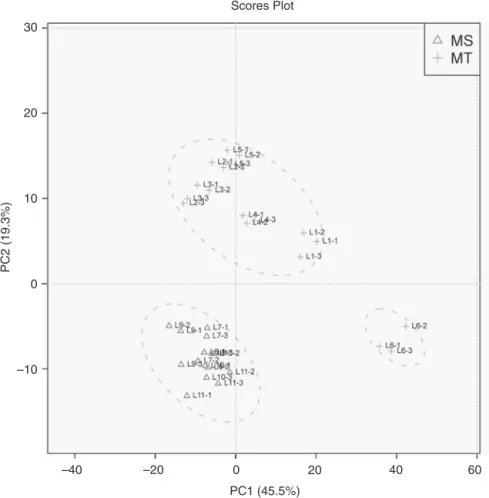
Unsupervised Principal Component Analysis (PCA) was per-formedwithselectspeaksobtainedbymatchingfromHPLC-DAD date,alignedbyChromalignerplatform(Wangetal.,2010).The aligneddatawereanalyzedinMetaboAnalystplatform(Xiaetal., 2012).Sampleswere clustered intotwo groups based on their
geographicallocation:MatoGrosso(MT)andMatoGrossodoSul (MS)states.PCAwasperformedwiththelog-transformedand auto-scaleddata,atUFMS.
Antinociceptiveactivity
The antinociceptive activity was determined in mice as
describedbyKosteretal.(1959).Theexperimentswerecarried outemploying6–8animalspertreatmentgroup.Theextractswere administeredorallyatdosesof10or50mg/kgbodyweight,60min beforeintraperitoneal injectionof 0.6%acetic acidin 0.9% nor-malsaline(0.1ml/10gbodyweight)toinducethecharacteristic writhings.Vehicle(10ml/kgbodyweight,p.o.)andindomethacin (5mg/kgbody weight,p.o.)weredissolvedin 2%NaHCO3
solu-tionandweregiventomiceinthecontrolandreferencegroups, respectively.Themicewereobservedandcountedforthenumber ofabdominalwrithesandstretchingsinaperiodof0–30min.The responsesinthetreatedgroupswerecomparedwiththoseof ani-malsinthecontrolgroupandreferencecompound.Thepercentage ofinhibitionofthenumberofwrithingswascalculatedandresults arepresentedaspercentinhibition.
Statisticalanalyses
Theresultsareexpressedasmeans±S.E.M.Onewayanalysisof variance(ANOVA)wasusedforthecomparisonofmorethantwo meansfollowedbyStudent–Newman–Keulstest;pvalues<0.05 wereconsideredsignificant.GraphPadInStat®
version2.01 was usedfordataanalysis.
Results
Taxonomicauthentication
Elevensamples(L1–L11)from“chapéu-de-couro”werecollected
orpurchasedindifferentlocationsofMatoGrosso(MT)andMato GrossodoSul(MS)statesin2011,duringthefloweringtime.From theelevensamples,sevenwereconfirmedasE.scaber,whilethree turnedout tobe thecloserelated species E.grandiflorus and a commercialsampleremainsasEchinodorussp.Thew/wextraction yieldsfortheE.scabersamplesrangedbetween12.70and50.21% whileforE.grandiflorusthesolublecontentwas13.80and20.60%, respectivelyand41.50%fortheEchinodorussp.sample.Thebest extractionyields(41.31–50.21%)wereobservedfromthesamples collectedinMSsites(Table1).
Thetotalphenolic,flavonoidandC-glycosideflavones quantification
Thetotalphenolsandflavonoidcontent,aswellastheC-glycosyl flavonoid content of hydroethanolic extracts from “chapéu-de-couro”leavesare givenin Table2.Table3 providescalibration curvedata,obtainedusingstandardC-glycosideflavones.Thetotal phenolicconcentrationdidnotvaryappreciablyamongtheeleven analyzedsamples,rangingfrom283.25mg/g(Echinodorussp.,from MT)to330.00mg/g(E.scaberfromMS).However,greatvariation wasobservedregardingthetotalflavonoidconcentration,ranging from3mg/g(E.scaber,fromMS)to233.75mg/g(E.scaberfromMT). Thecontentof theC-glycosideflavonesalsopresented great variation(Table2).Vitexinwasnotdetectedinanybutoneofthe elevenanalyzed samples, whereas vitexin-2-O-rhamnoside was quantified in onlythree sites(all from MT), rangingfrom 5.43 to33.13g/mg,andisovitexinand isoorientinweredetectedin
allsampleswithconcentrationrangingfromtraces14.70g/mg
fortheformerand2.12–84.27g/mgforthelatter.An
Table2
Totalphenolic(TP),totalflavonoid(TF)(mgofcatechinandvitexinequivalentspergofdryplantmaterial,respectively),isovitexin,vitexin-2-O-rhamnosideandisoorientin
(gpermgofhydroethanolicextractsofEchinodorusscaberandE.grandiflorus).
Plantspeciesandsample TP(mg/g) TF(mg/g) Isovitexin(g/mg) Vitexin-2-O-rhamnoside (g/mg)
Isoorientin(g/mg)
E.grandiflorus–L1 290.00 25.50 nq nd 2.12
E.scaber–L2 292.50 198.00 0.72 13.46 21.82
E.grandiflorus–L3 296.75 39.25 1.06 nd 22.24
E.grandiflorus–L4 296.00 145.5 0.62 nq 21.54
E.scaber–L5 324.00 233.75 nq 5.43 14.34
Echinodorussp.–L6 283.25 95.00 2.44 33.13 84.27
E.scaber–L7 308.75 141.75 6.75 nq 12.22
E.scaber–L8 298.50 61.25 14.70 nq 34.27
E.scaber–L9 287.50 100.50 9.22 nq 18.10
E.scaber–L10 330.00 123.00 6.99 nq 35.54
E.scaber–L11 308.75 3.00 5.71 nq 16.89
CollectionplacesL1–L5andL7–L11arefromtheMatoGrosso(MT)andMatoGrossodoSul(MS)states,respectively;L6referstoacommercialsample(pleaseseeTable1);
nq,detected,butnotquantified(belowquantificationlimit);nd,notdetected.
Table3
Linearregressionequation,correlationcoefficient,detectionandquantificationlimitsforvitexin-2-O-rhamnoside,vitexin,isovitexinandisoorientin.
Standard Conc.range(g/ml) Linearregression(y=a+bx) Correlationcoefficient(r2) Detection limit(g/ml)
Quantification limit(g/ml) Vitexin-2-O
-rhamnoside
0.50–8.00 y=0.0280+0.1051x 0.9967
0.68 2.05
8.00–20.00 y=0.1651+0.0877x 1.0000
Vitexin 0.25–8.008.00–20.00 yy==0.01360.574++0.15620.2242xx 1.00000.9994 0.29 0.90
Isovitexin 0.25–8.008.00–20.00 yy==0.00720.3473++0.25120.2073xx 0.99970.9996 0.25 0.75
Isoorientin 40.00–100.007.00–40.00 yy==8.33637.109x+6.1229x 0.9982 1.55 4.70
−36,274 0.9997
theEchinodurussp.analyzed; whileE.grandiflorussamples pre-sented only traceamounts or none of vitexin-2-O-rhamnoside andvery smallamountsof isovitexin(traces–1.06g/mg) but appreciablecontent ofisoorientin (2.12–22.24g/mg), a differ-entpattern can be observed toE. scaber,also presenting trace amountsofvitexin-2-O-rhaminoside(exceptsites2and5;13.46 and 5.43g/mg respectively)along with higher concentrations ofisovitexin (traces– 14.70g/mg)and highconcentrations of isoorientin(12.22–35.54g/mg).ThecommercialEchinodorussp. sample presented very high concentration of isoorientin and vitexin-2-O-rhaminoside (84.27 and 33.13g/mg respectively) andamoderateamountofisovitexin(2.44g/mg).
Antinociceptiveactivity
Oraladministrationoftheextractselicitedantinociceptionin theanimalsatbothselecteddosesof10and50mg/kg.Invehicle treated groups,injection ofacetic acidcaused an intense noci-ceptiveresponse in mice, ranging from 38.9±2.5 to 40.4±4.0 writhings(Table4).
Pretreatmentof theanimalswithhydroethanolic extractsof “chapéu-de-couro”(10mg/kg),resultedininhibitionofwrithings, attainingthelowestvalue(36.4%,p<0.001)withE.scaber–L5and
highestvalue(62.5%,p<0.001)withE.scaber–L10,whencompared
tothevehiclegroup.Whena50mg/kgextractdosewasemployed, reductioninnumberofwrithingswasgreaterthanatthelower dose,reachingthelowestvalue(47.4%,p<0.001)withE.scaber– L1,andthehighestvalue(79.8%;p<0.001)withE.scaber–L7,when
comparedtothevehiclegroup.
Animalsthatreceived5mg/kgindomethacin,thestandarddrug forthistest,hadthehighestpercentageinhibitionofnociceptive response,withvaluesrangingfrom82.6%to90.1%(p<0.001).
Discussion
Thisworkperformedfingerprintanalyses,aswellasflavonoid quantification on samples of the popular phytotherapic drug namedas“chapéu-de-couro”.Thesampleswerecollectedin dif-ferentplacesfromMatoGrossoandMatoGrossodoSulStatesin Brazil,tosearchforphytochemicaldifferences,andforchemical markersinthecrudedrugspresentingantinociceptiveactivity.
ThedosesofE.scaberandE.grandiflorusextractsin antinocicep-tivetestsmodelswerechosenbasedonmurinepilotexperimentsof ourlabwiththeaceticacidtest,andfrompreviousliteraturereports onother inflammatory or antinociceptive models.The classical methodofWhittle(1964),usingaceticacid,waschosenbecauseit isasimple,rapidandcheaptest,beinganon-selectivemodelthat servesforbothperiphericandcentralanalgesia,withoutaltering consciousness.Indomethacinwasusedasapositivecontrolsince itisaclassicalstandardnon-steroidaldrugthatassuresits speci-ficityasaninhibitorofcyclooxygenase(Whittle,1964;Cabral-Silva, 2013).
Despitethedistinctprofileofthetwostudiedspeciesand
Echin-odorussp.(commercialsample)regardingflavonoidcontent,the
amountoftheC-glycosylatedflavonoidscanbesuccessfullyused inthequalitycontrolifa“chapéu-de-couro”drugistobe com-mercialized.ThePCA(Fig.1)showsthatthegeographicallocation ofthespeciesisthemaindifferentiatingfactorinthepolar sec-ondarymetabolism.Inthelastyearsseveralauthorsshowedthat edaphoclimatic factors may substantially change metabolomics composition(Gobbo-NetoandLopes,2007).
Table4
EffectoforaladministrationofEchinodorusscaberandE.grandiflorushydroethanolicextractsonaceticacid-inducedwrithesinmice.
Extracts Dose(mg/kg) No.ofwrithes %inhibition
Vehicle – 38.9±2.5 –
E.grandiflorus–L1 10 21.0±2.2
b 46.0
50 20.4±2.6b 47.4
E.grandiflorus–L3 10 15.9±1.7
b 59.2
50 13.0±3.6b 66.5
E.scaber–L10 10 14.6±2.6
b 62.5
50 9.4±3.3b 75.7
Indomethacin 5 5.3±0.9b 86.3
Vehicle – 40.1±3.0b –
E.scaber–L2 10 19.0±2.7
b 52.7
50 14.1±2.1b 64.8
Echinodorussp.–L6 10 21.3±4.2
b 46.9
50 18.1±3.6b 54.8
Indomethacin 5 4.8±1.1b 88.0
Vehicle – 40.4±4.0 –
E.scaber–L7 10 23.4±3.9
a 42.1
50 8.2±1.7b 79.8
E.scaber–L8 10 18.7±4.7
b 53.8
50 8.6±2.5b 78.6
E.scaber–L9 10 19.8±2.3
b 51.0
50 12.6±1.6b 68.9
Indomethacin 5 4.0±1.2b 90.1
Vehicle – 40.3±1.7b –
E.grandiflorus–L4 10 19.0±2.8
b 52.9
50 15.7±3.0b 61.1
E.scaber–L5 10 25.7±4.1
b 36.4
50 15.0±2.0b 62.8
E.scaber–L11 10 22.8±2.5
b 43.4
50 10.3±1.8b 74.5
Indomethacin 5 7.0±1.1b 82.6
Resultsarepresentedasmeanvalues±S.E.M.forn=6–8animals/group.OnewayANOVAfollowedbytheStudent–Newman–Keulstest.
ap<0.01vsvehicle.
bp<0.001vsvehicle.
P
C2 (19.3%)
30
20
10
0
–10
–40 –20 0 40 60
PC1 (45.5%) 20 Scores Plot
a
b
c
d
E. grandiflorus - L4
E. scaber - L5
E. scaber - L8 Echinodorus - L6
0 5 10 15 20 25 Minutes
Fig.2.RepresentativeHPLCchromatogramsoftheEchinodorusscaberandE.grandiflorussamplesfromtheBrazilianPantanal.(A)E.grandifloras:L4(representativefrom
collectionplacesL1,L3,andL4fromMTstate);(B)E.scaber:L5(representativefromplacesL2andL5–MTstate);(C)Echinodorussp.–L6(commercialsample);(D)E.scaber:L8
(representativefromcollectionplacesL7toL11fromMSstate).Peakidentities:(1)catechin(internalstandard),retentiontime:5min,max324and279nm;(2)isoorientin*,
retentiontime:8.6min,max348and269nm;(3)swertiajaponin**,retentiontime:9.2min,max344and269nm;(4)vitexin-2-O-rhamnoside,retentiontime:11.2min,
max334and269nm;(5)vitexin*,retentiontime:11.6min,max335and269nm;(6)isovitexin*,retentiontime:12.4min,max335and269nm;(7)caffeoyl/feruloylacid
derivatives,retentiontime:18.2min,max327,290shand245nm;(8)caffeoyl/feruloylacidderivative,retentiontime:25.1min,max328,290shand243nm.*Identity
confirmedbyco-injectionofstandards.**IdentityconfirmedbyNMRdata,UVspectrumandcomparisonwithliterature(Schnitzleretal.,2007;Pengetal.,2005).
effectsuggestthatthecrudedrugfromMSpresentabetterprofile regardingthetraditionalindicationsofuse.Therelatedspecies,E. grandiflorus,withthesamecommonnameanduse,showedsimilar antinociceptiveeffectthanthatobservedfortheMTcollectionsof
E.scaber.
The analgesic and anti-inflammatory activity of extracts obtainedfromtherhizomesofE.grandifloruswasreportedbyDutra etal.(2006)andthehypotensiveeffectoftheleafethanolextract onspontaneoushypertensiveratswasalsodescribed(Lessaetal., 2008).
Garciaetal.(2010)publishedacombinedphytochemicaland anti-inflammatorystudyofE.grandiflorusleavesextractandfound activityatthehighestdoseof1g/kg,toohightoexplainthe tradi-tionalindicationsofuse.
Themaindifferencesofthepresentworkwithpreviousstudies istheethnopharmacologicalapproach,usingthecrudedrug follow-ingthetraditionalindicationsofuseandthedosesusedwhichare lowerthaninthestudyofDutraetal.(2006).Inaddition,ourwork wasundertakenusingalargernumberofplantsamples,including materialfromdifferentlocationsandpurchasedatlocalmarkets. Inthisway,acloserpictureofthecrudedrug“chapéu-de-couro”is obtained.
AllextractswerecomparedbyHPLClookingforcharacteristic compoundsinthepolarextracts.Accordingtothefingerprints,our samplescanbearrangedinfourmaingroups,twoofthem represen-tativeofE.scaberfromMTandMSandathirdsetinagreementwith
E.grandiflorus,beingthefourthsamplethecommercialEchinodorus
sp.Thechromatogramsrepresentingthedifferentprofilesare pre-sentedinFig.2.Table5presentstheretentiontime,theUVdata andthetentativeidentificationofthemainphenoliccompounds foundintheanalyzed“chapéu-de-couro”leafextracts.
TheHPLCchromatogramsrepresentativeofallofourE.scaber
samplesfromMSshowstwomaincompoundsidentifiedas isoori-entinandisovitexin(Fig.2,traceD;peaks2and6,respectively). However,asubsetfromthesamplescanberecognizedby com-paringtheoccurrenceoftwocompoundselutingatretentiontime (Rt)of18.2and25.1min(peaks7and8),respectively,both pre-sentingUV spectrawith maximaat327, 290sh and 245nm, in agreementwithcaffeoyl/feruloylacidderivatives(Schnitzleretal.,
Table5
IdentificationofphenoliccompoundsinEchinodorusscaberandE.grandiflorus
hydroethanolic”extractsbyHPLC-DAD.
Peak Rt(min) max(nm) Tentativeidentificaction
1 5.0 324,279 Catechin(internalstandard)
2 8.6 348,269 Isoorientina
3 9.2 344,269 Swertiajaponinb
4 11.2 334,269 Vitexin-2-O-rhamnosidea
5 11.6 335,269 Vitexina
6 12.4 335,269 Isovitexina
7 18.2 327,290sh,245 Caffeoyl/feruloylacidderivativeb
8 25.1 328,290sh,243 Caffeoyl/feruloylacidderivativeb
Rt:Retentiontime;HPLC-DAD:HighPerformanceLiquidChromatographywith
DiodeArrayDetector.
aIdentityconfirmedbycoinjectionofstandards.
bIdentityconfirmedbyUVspectrumandcomparisontotheliterature(Schnitzler
etal.,2007).
2007).Fig.2,traceB, representing samplesL2 and L5 from MT
showsisoorientin(peak2)asthemainconstituentand
vitexin-2-O-rhamnoside(peak4)assecondarycompound,differentlyfrom theMSplants,whichshowverylowcontentofthiscompound.The unidentifiedcrudedrugsampleofEchinodorussp.purchasedinMT (L6inFig.2,traceC)isclosetoE.scaberfromMTaccordingtothe
phenoliccompoundspatternandshowedthehighestcontentin vitexin-2-O-rhamnosidefromallthesamplesinvestigated.
TheHPLCprofileoftheE.grandiflorusextractscorrespondingto “chapéu-de-couro”(L1,L3andL4–Fig.2,traceA)weresimilarto
thosereportedbyGarciaetal.(2010)forasamplefromthesame speciescollectedintheParanástateinsouthernBrazil.Peaks2and 3fromoursampleshowthesameUVspectrumsuggestingthatthey areflavonoidsfromthesamestructuralgroup,namelyisoorientin andapparentlyswertiajaponin.
InastudyofthephenolicconstituentsfromE.grandiflorusssp.
The main flavonoids occurring in the polar hydroethanolic extractsof“chapéu-de-couro”areC-glycosylflavonoidsdifferingin thenumberoffreehydroxyand/ormethoxygroupsintheflavonoid ring,namelyisoorientin,swertiajaponin,vitexin-2-O-rhamnoside andisovitexin.
VitexinisaC-glycosylflavoneusedasachemical markerfor
Passifloraspecies(Dhawanetal.,2004).TheC-glycosylflavonoids foundintheplanthave beenassociatedwithantiinflammatory (Sridharetal.,2006)andantinociceptiveeffect(Kumaretal.,2012). Isoorientinispresentinhighconcentrationsinallextractsof “chapéu-de-couro”(Table2);thisflavoneisalsofoundinspecies ofPassifloraandisfrequentlyassociatedwithanti-inflammatory andantinociceptiveactivities.However,thiscompoundcannotbe consideredthemainresponsiblefor theantinociceptiveactivity of“chapéu-de-couro”,sincetheantinociceptive testsresponded randomlytoisoorientinconcentrations.Swertiajaponinwas ten-tatively identified(Table5)only in E.grandiflorus extractsand, therefore,cannotbethemainresponsiblefortheantinociceptive activity.
Vitexin-2-O-rhaminosideisoftenfoundinPassifloraspecies.In thepresentworkthiscompoundwasquantifiedonlyinextractsof
E.scaberfromMTaswellasthecommercialsample(Table2).In extractswherethisflavonewasnotdetected,however,therewas considerablepercentageofpaininhibition,indicatingthat vitexin-2-O-rhaminosidecannotbethemainresponsiblebytheanalgesic activitypresentedby“chapéu-de-couro”samplesanalyzedinthis work.
IsovitexinwasdetectedinallextractsfromE.scaber,in con-centrationrangingfromtraces to14.60g/mg;higheramounts
weredetectedinsamplesfromMS(Table2).Adose-dependent antinociceptiveactivitycouldbeobserved,whencomparing iso-vitexinconcentrationandthepercentageofinhibitionofE.scaber
extracts(Table4).Thesametrendwasobservedwhenanalyzing
E.grandiflorussamples.AscommercialEchinodorusandPassiflora
speciessharethesameC-glycosylflavonoidconstituents,new stud-iesontheanxiolyticeffectof“chapéu-de-couro”areofinterest. RecentreportsontheeffectofPassifloraextractsonthecentral nervoussysteminclude theisoorientinand isovitexin (Li etal., 2011).
OveralltheHPLCmethodpresentedallowedaclearandrapid differentiationofE.scaberanditssubstituteE.grandiflorusandis suitableforcomparativeanalysesofEchinodorussamples.
Thecollectionsdisplayingbetterantinociceptiveeffectshows thehigherisovitexincontentandalsobetterw/wyields,making theMSsamplesthebettersourceforthecrudedrug.Further stud-iesshouldbecarriedout,includingtheharvestingsourcesofthe crudedrugforcommercialpurposestoproviderecommendations onqualitycontrolbasedontheactiveconstituentsandextraction yields.Thus,isovitexincanberegarded,atleastinpart,as respon-siblefortheantinociceptiveactivityandseemstobea suitable chemicalmarkerfor“chapéu-de-couro”crudedrug.
Ethicaldisclosures
Protectionofhumanandanimalsubjects. Theauthorsdeclare thattheproceduresfollowedwereinaccordancewiththe regula-tionsoftherelevantclinicalresearchethicscommitteeandwith thoseoftheCodeofEthicsoftheWorldMedicalAssociation (Dec-larationofHelsinki).
Confidentialityofdata. Theauthorsdeclarethatnopatientdata appearinthisarticle.
Righttoprivacyandinformedconsent. Theauthorsdeclarethat
nopatientdataappearinthisarticle.
Authors’contributions
CLE,KCLandELDparticipatedinphytochemicalanalysis.VCS participatedininterpretationofNMRspectraldata.EFGCD partici-patedinHPLCanalysis,acquisitionandinterpretationofdata.RVR andDTOMparticipatedintheevaluationofantinociceptive activ-ity,acquisitionandinterpretationofdata.CACparticipatedinPCA analysis,acquisitionandinterpretationofdata.PTSJauthoredthe projectandsuperviseditsexecutionandthedraftingofthispaper andGSHparticipatedinthediscussionofthedatapresentedherein aswellasthedraftingofthemanuscript.
Conflictsofinterest
Theauthorsdeclarenoconflictsofinterest.
Acknowledgements
WearegratefultoINCT-ÁreasÚmidas(INAU)/CNPq,Centrode PesquisasdoPantanal(CPP-MCTI)andCAPESforscholarshipsand financialsupport.WearealsogratefultoM.Sc.IsaneteGeraldini CostaBieskiforvaluablehelpinplantcollection.
References
Anvisa,2003. Resoluc¸ão REn◦ 899,de 29de maiode 2003.Dispõe sobre o
regulamentotécnico para a validac¸ão de métodosanalíticos e
bioanalíti-cos.AgênciaNacional deVigilânciaSanitária,Ministérioda Saúde,Anvisa,
http://s.anvisa.gov.br/wps/s/r/gP(access10.03.16).
Brandão,M.G.L.,Cosenza,G.P.,Grael,C.F.F.,Netto-Junior,N.L.,Monte-Mór,R.L.M.,
2009.TraditionalusesofAmericanplantspeciesfromthe1steditionofBrazilian
OfficialPharmacopoeia.Rev.Bras.Farmacogn.19,478–487.
Cabral-Silva, J., (Dissertac¸ão de Mestrado) 2013. Efeito antinociceptivo e
anti-inflamatóriodeAnnonavepretorumMart.(Annonaceae)emroedores. Uni-versidadeFederaldoValedoSãoFrancisco,RecursosNaturaisdoSemiárido, Petrolina,Pernambuco,183pp.
Dhawan,K.,Dhawan,S.,Sharma,A.,2004.Passiflora:areviewupdate.J.
Ethnophar-macol.94,1–23.
Dutra,R.C.,Tavares,C.Z.,Ferraz,S.O.,Sousa,O.V.,Pimenta,D.S.,2006.Investigac¸ão
dasatividadesanalgésicaeantiinflamatóriadoextratometanólicodosrizomas deEchinodorusgrandiflorus.Rev.Bras.Farmacogn.16,469–474.
Garcia,E.F.,Oliveira,M.A.,Godin,A.M.,Ferreira,W.C.,Bastos,L.F.S.,Coelho,M.M.,
Braga,F.C.,2010.Antiedematogenicactivityandphytochemicalcompositionof
preparationsfromEchinodorusgrandiflorusleaves.Phytomedicine18,80–86.
Gobbo-Neto,L.,Lopes,N.P.,2007.Plantasmedicinais:fatoresqueinfluênciano
con-teúdodemetabólitossecundários.Quim.Nova30,374–381.
Kobayashi,J.,Sekiguchi,M.,Shigemori,H.,Ohsaki,A.,2000a.EchinophyllinsAand
B,novelnitrogen-containingclerodanediterpenoidsfromEchinodorus macro-phyllus.TetrahedronLett.41,2939–2943.
Kobayashi,J.,Sekiguchi,M.,Shimamoto,S.,Shigemori,H.,Ohsaki,A.,2000b.
Echino-phyllinsC–F,newnitrogen-containingclerodanediterpenoidsfromEchinodorus macrophyllus.J.Nat.Prod.63,1576–1579.
Kobayashi,J.,Sekiguchi,M.,Shigemori,H.,Ohsaki,A.,2000c.ChapecoderinsA–C,
newlabdane-derivedditerpenoidsfromEchinodorusmacrophyllus.J.Nat.Prod. 63,375–377.
Koster,R.,Anderson,M.,Debee,E.J.,1959.Aceticacidforanalgesicscreening.Fed.
Proc.18,412–414.
Kumar,V.S.,Venumadhav,V.,Jagadeeshwar,K.,Bhaskar,B.,Lahkar,M.,2012.
Eval-uationofantioxidant,antinociceptiveactivitiesofOxaliscorniculataindiabetic neuropathyrats.Int.J.Pharmacol.8,122–127.
Lehtonen,S.,2008.AnintegrativeapproachtospeciesdelimitationinEchinodorus
(Alismataceae)andthedescriptionoftwonewspecies.KewBull.63,525–563.
Lessa,M.A.,Araújo,C.V.,Kaplan,M.A.,Pimenta,D.,Figueiredo,M.R.,Tibiric¸a,E.V.,
2008.AntihypertensiveeffectsofcrudeextractsfromleavesofEchinodorus
grandiflorus.Fundam.Clin.Pharmacol.22,161–168.
Li,H.,Zhou,P.,Yang,Q.,Shen,Y.,Deng,J.,Li,L.,Zhao,D.,2011.Comparativestudies
onanxiolyticactivitiesandflavonoidcompositionsofPassifloraedulis‘edulis’ andPassifloraedulis‘flavicarpa’.J.Ethnopharmacol.133,1085–1090.
Lopes,L.C.,Albano,F.,Laranja,G.A.T.,Alves,L.M.,MartinseSilva,L.F.,Souza,G.P.,
Araujo,I.M.,Nogueira-Neto,J.F.,Felzenszwalb,I.,Kovary,K.,2000.Toxicological
evaluationbyinvitroandinvivoassaysofanaqueousextractpreparedfrom Echinodorusmacrophyllusleaves.Toxicol.Lett.116,189–198.
Manns,D.,Hartmannn,R.,1993.Echinodol:anewcembrenederivativefrom
Echin-odorusgrandiflorus.PlantaMed.59,465–466.
Matias, L.Q., Lopes, R.C., Sakuragui, C.M., 2015. Alismataceae in Lista
de Espécies da Flora do Brasil. Jardim Botânico do Rio de Janeiro,
Peng,J.,Fan,G.,Hong,Z.,Chai,Y.,Wu,Y.,2005.Preparativeseparationof isovi-texinandisoorientinfromPatriniavillosaJussbyhigh-speedcounter-current chromatography.J.Chromatogr.A1074,111–115.
Pinto,A.C.,Rego,G.C.G.,Siqueira,A.M.,Cardoso,C.C.,Reis,P.A.,Marques,E.A.,Coelho,
M.G.P.,Sabino,K.C.C.,2007.ImmonosuppressiveeffectsofEchinodorus
macro-phyllusaqueousextract.J.Ethnopharmacol.111,435–439.
Schnitzler,M.,Petereit,F.,Nahrstedt,A.,2007.Trans-aconiticacid,glucosylflavones
andhydroxycinnamoyltartaricacidsfromtheleavesofEchinodorusgrandiflorus ssp.aureus,aBrazilianmedicinalplant.Rev.Bras.Farmacogn.17,149–154.
Shigemori,H.,Shimamoto,S.,Sekiguchi,M.,Ohsaki,A.,Kobayashi,J.,2002.
Echin-odolidesAandB,newcembranediterpenoidswithaneight-memberedlactone ringfromtheleavesofEchinodorusmacrophyllus.J.Nat.Prod.65,82–84.
Simirgiotis,M.J.,Adachi,S.,To,S.,Yang,H.,Reynertson,K.A.,Basile,M.J.,Gil,R.R.,
Weinstein,I.B.,Kennelly,E.J.,2008.Cytotoxicchalconesandantioxidantsfrom
thefruitsofSyzygiumsamarangense(WaxJambu).FoodChem.107,813–819.
Sridhar,C.,Krishnaraju,A.V.,Subbaraju,G.V.,2006.Antiinflammatoryconstituents
ofTemamnuslabialis.Ind.J.Pharm.Sci.68,111–114.
Tanaka,C.M.A.,Sarragiotto,M.H.,Zukerman-Schpector,J.,Marsaioli,A.J.,1997.A
cembranefromEchinodorusgrandiflorus.Phytochemistry44,1547–1549.
Tanaka,C.M.A.,2000.ConstituintesquímicosdecincoespéciesdeEchinodorus
e avaliac¸ão dobeta pineno como substrato para a obtenc¸ão de quirons maiselaborados.Instituto deQuímicadaUniversidade deCampinas, Tese Doutorado.
Tanus-Rangel,E.,Santos,S.R.,Lima,J.C.,Lopes,L.,Noldin,V.,Monache,F.D.,
Cechinel-Filho,V.,Martins,D.T.O.,2010.Topicalandsystemicanti-inflammatoryeffects
ofEchinodorusmacrophyllus(Kunth)Micheli(Alismataceae).J.Med.Food13, 1161–1166.
Vidal,L.S.,Alves,A.M.,Kuster,R.M.,Lage,C.,Leitão,A.C.,2010.Genotoxicityand
mutagenicityofEchinodorusmacrophyllus(chapéu-decouro)extracts.Gen.Mol. Biol.33,549–557.
Wang,S.Y.,Ho,T.J.,Kuo,C.H.,Tseng,Y.J.,2010.Chromaligner:awebserverfor
chromatogramalignment.Bioinformatics26,2338–2339.
Whittle,B.A.,1964.Releaseofakininbyintraperitonealinjectionofchemicalagents
inmice.Int.J.Neuropharmacol.3,369–378.
Xia,J.,Mandal,R.,Sinelnikov,I.V.,Broadhurst,D.,Wishart,D.S.,2012.MetaboAnalyst