ABSTRACT: Human immunodeiciency virus (HIV) continues to disproportionately afect men who have sex with men (MSM); therefore, we investigated the sociodemographic, biological, and sexual behavioral risk factors associated with HIV infection in the city of Salvador, Bahia. This study is part of the national survey Behavior, Attitudes, Practices and Prevalence of HIV and Syphilis among men who have sex with men in 10 Brazilian Cities, which is a cross-sectional survey whose participants were selected by means of the respondent-driven sampling. Exact logistic regression analysis was used to measure the association of potential risk factors with HIV infection due to an HIV prevalence lower than 10% and a small sample size (383). The prevalence of HIV was 6.3% (95%CI 3.9–8.8) and the risk factors associated with HIV infection in our adjusted inal model included having never been tested for syphilis (OR = 3.1; 95%CI 1.3 – 7.3) and having more than eight sexual partners (OR = 3.3; 95%CI 1.4 – 8.1). This study highlights the high prevalence of HIV among MSM in the sample compared with the general population and conirms the importance of testing for syphilis in the context of the HIV epidemic as early detection may provide opportunities to prevent sexually transmitted diseases.
Keywords: HIV. Syphilis. Vulnerable populations. Male homosexuality. Risk factors. Logistic models.
Factors associated with HIV infection among
a respondent-driven sample of men who have
sex with men in Salvador, Brazil
Fatores associados a infecção por HIV numa amostra respondent-driven
sampling de homens que fazem sexo com homens, Salvador
Sandra BrignolI, Ligia KerrII, Leila Denise AmorimIII, Inês DouradoIV ORIGINAL ARTICLE / ARTIGO ORIGINAL
IDepartment of Epidemiology and Biostatistics, Universidade Federal Fluminense – Niterói (RJ), Brazil. IIDepartment of Community Health, Universidade Federal do Ceará – Fortaleza (CE), Brazil. IIIInstitute of Mathematics, Universidade Federal da Bahia – Salvador (BA), Brazil. IVCollective Health Institute, Universidade Federal da Bahia – Salvador (BA), Brazil.
Corresponding author: Sandra Mara Silva Brignol. Rua Marquês do Paraná, 303, 3º andar, prédio anexo ao HUAP, Centro, CEP: 24033-900, Niterói, RJ, Brasil. E-mail: [email protected]
Conlict of interests: nothing to declare. Financial Support: Ministry of Health/Public Health Surveillance Oice/Department of
STD, AIDS and Viral Hepatitis, through the Project of International Technical Cooperation AD/BRA/03/H34 between the Brazilian
INTRODUCTION
The growing human immunodeficiency virus (HIV) epidemic in the popula-tion of men who have sex with men (MSM) has reignited the debate on the factors associated with the high prevalence of HIV in this population in different parts of the world1. This increase is more pronounced in countries with limited capacity to implement social, and health policies guided by the human rights, especially on those countries where relationships between people of the same sex are criminal-ized and homophobia is high2. Furthermore, the low socioeconomic status that the MSM population is often exposed to and the high prevalence of sexual risk behav-iors for sexually transmitted diseases (STDs) and HIV1, contribute to increase the vulnerability of this population3.
In Brazil, the prevalence of HIV among MSM is approximately 22 times higher than in the general population, 18 times higher than in the general male population and two times higher than among drug users and female sex workers4,5. This trend is similar in other coun-tries where the risk of HIV infection among MSM has remained high in recent years in com-parison to other population groups1.
In Salvador (BA), the epidemiological studies of HIV epidemic among MSM are rare. Scientiic studies and on the ground analysis can contribute to the implementation of intervention actions among MSM and their personal network. Therefore, this study aimed at estimating the prevalence of HIV infection and investigating its associated risk factors within a network of personal relationships (social networking) of sampled MSM living in the city of Salvador.
RESUMO: Diante das evidências de que os homens que fazem sexo com homens são afetados de forma desproporcional pelas infecções por HIV, investigamos os fatores de risco sociodemográicos, biológicos e de comportamentos sexuais associados à infecção por HIV, na cidade de Salvador, Bahia. Este trabalho é um recorte da pesquisa nacional “Comportamento, atitudes, práticas e prevalência de HIV e Síilis entre homens que fazem sexo com homens em 10 cidades brasileiras”, que foi do tipo corte transversal e selecionou participantes via técnica Respondent Driven Sampling. Devido à prevalência do HIV ser menor do que 10% e ao reduzido tamanho da amostra (383), utilizamos regressão logística exata nas análises para medir associação entre os fatores de risco e a infecção por HIV. A prevalência do HIV foi de 6,3% (IC95% 3,9 – 8,8), e após o ajuste do modelo inal, os fatores de vulnerabilidade que se associaram à infecção por HIV foram: não fez teste de síilis na vida (OR = 3,1: IC95% 1,3 – 7,3), ter mais de 8 parceiros sexuais (OR = 3,3; IC95% 1,4 – 8,1). Este estudo mostrou a alta prevalência do HIV na amostra, em comparação a população geral, bem como conirmou a importância da realização do teste de síilis na vida no contexto da epidemia do HIV, sendo que essa detecção precoce permite uma aproximação das ações de prevenção para DST.
METHODS
This analysis is part of a multicenter study: Behavior, Attitudes, Practices and Prevalence of HIV and Syphilis among Men Who Have Sex with Men in 10 Brazilian Cities. We con-sidered data from Salvador (BA), which is one of the surveyed cities. This is a cross-sec-tional study whose targeted population was MSM living in that city. Inclusion criteria were men aged 18 years or more, who reported having at least one physical sexual contact with another man in the past year, presented a recruitment coupon within the validity period, were not under the inluence of drugs or alcohol, did not identiied themselves as transsex-ual or transvestite, and accepted the conditions of participation in the study by signing the informed consent form4.
The sampling technique used to select the participants was the respondent-driven sam-pling (RDS)6,7, which consists of recruiting individuals who are part of the same social net-work and allow estimating the selection probability a posteriori. RDS is a sampling method for studying hard-to-reach populations6-8. The recruitment process begins with the inten-tional selection of the “seed” subjects, who are then responsible for recruiting their peers. Each recruited subject is responsible for recruiting other individuals of their social network, consequently creating a recruitment chain.
The sampling plan of the study forecasted the selection of 350 participants in Salvador4, according to the requirement of the Health Ministry, which is described in the public notice. However, an increase in the number of participants in that city was necessary when sam-ple size was calculated. A total of 394 MSM were recruited, and 383 (97%) met the inclu-sion criteria previously described. Data collection occurred between October 29, 2008 and October 30, 2009.
Six MSM (“seeds”) were selected during formative research by means of a focus group. These individuals began recruiting participants who formed the irst wave— the irst sequence of MSM recruited in the study. Each seed and the other participants received three numbered coupons in an invitation format to invite other MSM of their social network. The following waves — recruitment sequences — were thus structured9. Subsequently, 12 seeds were added to replace those who failed to recruit. At the end of the sampling process, 4 seeds were able to continue with the recruitment process, pro-ducing the recruitment chain of the study9.
HIV infection (response variable) was determined by rapid test (Rapid Check HIV– 1&2 and Bio-Manguinhos HIV–1&2). The rapid test SD BIOLINE Syphilis 3.0 was also used to detect antibodies to Treponema pallidum, which identiies the occurrence of syph-ilis throughout life.
The questionnaire addressed key issues in the context of HIV infection but questions were disposed in diferent blocks. These questions were grouped and included the follow-ing: “Told someone he is sexually attracted to men;” “Experienced some kind of discrim-ination or name-calling (ever or in the last year);” “Had access to information on STD or condoms;” “Is engaged in or have information about any activity organized by church, reli-gious group, non-governmental organization, human rights/AIDS/HIV groups;” “Social class,” and “STD symptoms.”9. Based on the literature review the following sexual practices in the 6-month period prior to the interview were selected9:
1. number of sexual partners, including men, women, and transvestites (steady, casual, and commercial partners);
2. unprotected receptive anal intercourse (URAI) with casual male partners; and 3. URAI with steady male partners9.
Potential risk factors associated with HIV infection were grouped according to: 1. sociodemographic factors;
2. sexual risk behavior; 3. biological factors; and 4. health-care services.
Such grouping aimed at facilitating the comparison of the results found in the study to the literature9.
To estimate the prevalence of HIV, missing or undeined data for rapid test result were completed as negative for those that self-reported being HIV negative. Two regression mod-els were adjusted to perform the sensitivity analysis for this procedure: one considering data imputation for the missing results of the HIV test and the other without data imputation. No signiicant diferences between these models were found. It is worth noting that missing data for the response variable (HIV infection) “breaks” the recruitment chain, which can cause under or overestimation of the prevalence of HIV when using RDS method. Thus, we chose the regression model with inclusion of imputed data, which follows the same methodology adopted for the analysis of the data for the 10 cities, allowing comparability of the results4. The 18 seeds were included in the analysis to avoid loss of information for the estimated sample.
and recruit (homophily)7 (Table 1). Frequency calculations of the variables of interest and homophily were conducted using the software RDSAT Respondent-Driven Sampling Analysis Tool 6.0.1. (www.respondentdrivingsampling.org). Bivariate and multivariate analyses used exact logistic regression10 since the prevalence of HIV in the study sample was lower than 10%, characterizing a rare event from the statistical perspective. Furthermore, the sample size (383 MSM) generated low frequencies for the categories of risk factors selected for the analyses, which could compromise the estimating process for the association measure11.
The selection of variables included in the inal logistic regression model was based on p-value. Variables with p-value lower than 0.10 in bivariate analysis and those variables that
MSM: men who have sex with men.
Factors Homophily (% of recruitment)
HIV Negative Positive
Negative –0.009 (0.93) 0.009 (0.07)
Positive 0.078 (0.94) –0.078 (0.06)
Sex category MSM Homosexual/gay
MSM 0.22 (0.62) –0.22 (0.38)
Homosexual/gay –0.475 (0.27) 0.475 (0.73)
Education (in years of schooling) More than eight years Up to eight years
More than eight years 0.485 (0.84) –0.485 (0.16)
Up to eight years –0.04 (0.667) 0.04 (0.333)
Income More than 600.00 BRL Up to 600.00 BRL
More than 600.00 BRL 0.276 (0.76) –0.276 (0.24)
Up to 600.00 BRL –0.11 (0.59) 0.11 (0.41)
Age (in years) Between 30 and 53 Under 30
Between 30 and 53 0.372 (0.5) –0.372 (0.5)
Under 30 –0.246 (0.15) 0.246 (0.85)
Bar Did not go Went
Did not go –0.013(0.87) –0.013(0.13)
Went 0.843(0.98) –0.843 (0.02)
Nightclub Did not go Went
Did not go –0.018(0.85) 0.018 (0.15)
Went 0.277 (0.90) –0.277 (0.10)
regardless of their statistical signiicance were indicated in literature as important factors associated with HIV infection1 were considered risk factor. The estimation of the odds ratio (OR) in the inal model was presented with a 95% conidence interval (95%CI).
The software STATA® (Statistical Data Analysis, version 12.0) was used for bivariate and multivariate analyses. The RDS sample weights were not included in these analyses because this approach has not been deined by the RDS-analysis methodology12 and the weights were also not used in the descriptive analysis to maintain the same standards.
The research protocol was conducted in compliance with the ethical criteria in the Resolution No. 196/96 of the National Health Council on research involving human sub-jects. The National Bioethics Commission of the Ministry of Health (CONEP, Protocol No. 14494) and the Research Ethics Committee of the Bahia State Department of Health (SESAB, Protocol No. 241/2008) approved the project. The authors of this study state that there are no conlicts of interest related to the multicenter study described in this article.
RESULTS
The 394 participants of this study were selected by 18 recruiters or “seeds.” Of the total, 383 MSM (97.0%) met the inclusion criteria and were included in the data analy-sis. Four seeds recruited 92% of the total MSM. The expense reimbursements by means of meal vouchers were not retrieved by 22.4% of the participants, and 67.4% of the dis-tributed recruitment coupons were not redeemed — meaning that MSM who received a numbered coupon from their recruiters did not visit the health-care facility to participate in the research. More details about the recruitment method can be found in already pub-lished studies that describe the methodology comprehensively and contain igures that illustrate the recruitment chain4,9.
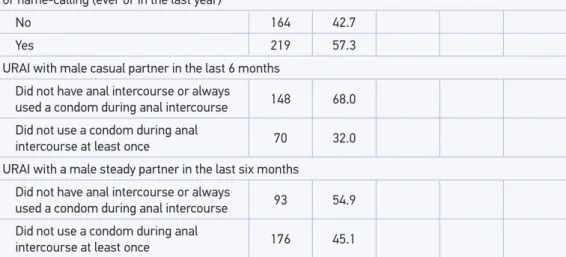
The prevalence of HIV infection among MSM who underwent rapid testing (94.0%) was 6.3% (95%CI 3.9 – 8.8), and rapid testing for syphilis was positive for 9.7% of the participants. HIV or syphilis test at least once in life was reported by 44% and 73% of the participants respectively. In addition, 24.4% of the participants reported STD symp-tom in the last year (Table 2). Respondents were predominantly young adults aged 25 years, with an educational level equivalent to high school, that is, 11 years of schooling. The average family income was 1,733.33 BRL (approximately 984 USD at the time of the interviews), and the median was of 1,000.00 BRL (approximately 568 USD at the time of the interviews) for an average of three people living in the same household. Most participants belonged to the lower-middle class (84.3%) and were predominantly black (91.1%) (Table 2).
Factors n Mean Median Min. Max.
Family income 271 1,733.30 1.000 0 60,000a
Number of people living in your household 381 3.1 3 0 54b
Education (in years of schooling) 382 11.4 11 1 22c
Current age 382 25.3 24 18 53
With how many partners have you had
sexual intercourse (in the last 6 months)? 362 8.2 3 1 451
Age at irst intercourse 383 14.5 15 6 28
Variables n %
Result of the rapid screening test for HIV
Negative 359 93.7
Positive 24 6.3
Result of the rapid screening test for syphilis
Negative 335 90.3
Positive 36 9.7
Syphilis testing at least once in life
No 100 27.7
Yes 274 73.3
HIV testing at least once in life
No 214 55.9
Yes 169 44.1
STD symptomsd
No 289 75.6
Yes 94 24.4
Race/color
White/others 34 8.9
Black 349 91.1
Economic class (Brazilian Economic Classiication Criteria) Upper class/upper middle class 60 15.7
Lower middle class/
working class/lower class 323 84.3 Sex category
MSM 184 48.2
Homosexual/gay 198 51.6
Told someonee you are sexually attracted to men
Yes 161 48.8
No 169 51.2
Table 2. Descriptive analysis of socioeconomic, demographic and other risk factors for HIV infection in men who have sex with men, Salvador (2008–2009).
The analysis of the similarity measure (homophily) between recruiter and recruit (Table 1), according to the HIV serology, generated a homophily measure of –0.078 among HIV-positive recruiters who also recruited other MSM with positive serology. Among HIV-negative recruiters, who recruited other participants with the same serol-ogy, homophily was –0.009, close to zero. However, when considering some sociodemo-graphic factors, it was found that participants who identified themselves as homosex-uals or gays recruited participants with the same sexual identity, more similarly (0.48) in comparison to the recruiting similarity for men classified as MSM, who recruited participants in the same category (0.22). With regard to age, peer recruitment among younger participants (0.37) and among MSM aged more than 30 years (0.25) presented low homophily measures. Similar pattern was observed when considering the income categories. However, recruiting among those with higher level of education (with more than 8 years of schooling) presented homophily of 0.49 while this measure is 0.04 among the less educated who recruited participants in the same category. Considering the reg-ularity to some gay sociability locations to look for sexual partners, it was found that among bar-goers, recruitment indicated high homophily (0.84) different from those participants who went to nightclubs (-0.28).
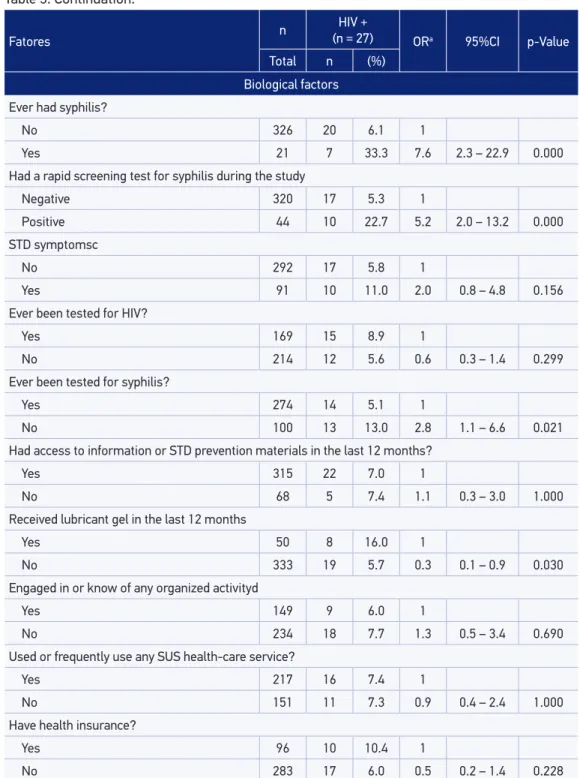
In the bivariate analysis (Table 3), no socioeconomic factor was signiicantly associated with HIV infection (p > 0.10). The factors associated with HIV infection were: have had over eight partners in the last 6 months (OR = 3.5; 95%CI 1.4 – 8.7); irst physical sexual contact before 15 years of age (OR = 2.8; 95%CI 1.1 – 7.6); occurrence of syphilis throughout life
Variáveis n %
Experienced some kind of discrimination regarding race/color, social status, age, sexual orientation, or name-calling (ever or in the last year)
No 164 42.7
Yes 219 57.3
URAI with male casual partner in the last 6 months Did not have anal intercourse or always
used a condom during anal intercourse 148 68.0 Did not use a condom during anal
intercourse at least once 70 32.0
URAI with a male steady partner in the last six months
Did not have anal intercourse or always
used a condom during anal intercourse 93 54.9 Did not use a condom during anal
intercourse at least once 176 45.1
aFamily income: four families declared an income equal to or exceeding 17,000.00 BRL, and only one family declared
an income of 60,000.00 BRL; bsome participants lived in public institutions; cconsidering the years spent in graduate
school; dSelf-report of the occurrence of sores, blisters, warts, and discharge on or from the penis or anus; efather,
Fatores n
HIV +
(n = 27) ORa 95%CI p-Value
Total n (%) Socioeconomic and demographic factors Family income
Up to 1,000 BRL 143 8 5.6 1
More than 1,000 BRL 128 11 8.6 1.6 0.6 – 4.7 0.467
Education (in years of schooling)
More than 8 years 314 24 7.6 1
Up to 8 years 68 3 4.4 0.6 0.1 – 1.9 0.513
Current age (in years)
Between 18 and 29 290 16 5.5 1
Between 30 and 53 92 11 12.0 2.3 0.9 – 5.6 0.071
Sexual behavioral factors Compared to you, your last casual sex partner is
Less exposed to risks 87 4 4.6 1
Exposed to the same amount of risks 192 19 9.9 2.3 0.7 – 9.5 0.202
More exposed to risks 89 4 4.5 0.9 0.2 – 5.4 1.000
Told someoneb you are sexually attracted to men
Yes 161 5 1
No 169 22 2.5 0.9 – 8.7 0.088
URAI with male casual partner in the last 6 months Did not have anal intercourse or always
used a condom during anal intercourse 183 14 8.1 1 Never used a condom during anal
intercourse 70 5 7.6 0.9 0.2 – 2.8 1.000
URAI with a male steady partner in the last 6 months
Did not have anal intercourse or always
used a condom during anal intercourse 101 8 7.9 1
Never used a condom during anal intercourse 96 5 5.2 0.64 0.2 – 2.3 0.634
Total number of sexual partners (men, women, and transvestites) in the last 6 months
Less than three partners 184 11 1
Between three and eight partners 105 3 0.46 0.8 – 1.8 0.369
More than eight partners 73 11 2.8 1.03 – 7.5 0.042
Age at irst intercourse (years)
15 or over 200 8 4.0 1
Under 15 182 19 10.4 2.798 1.14 – 7.61 0.023
Table 3. Bivariate analysis of the association between risk factors and HIV infection in men who have sex with men, Salvador (2008–2009).
Fatores n
HIV +
(n = 27) ORa 95%CI p-Value
Total n (%) Biological factors Ever had syphilis?
No 326 20 6.1 1
Yes 21 7 33.3 7.6 2.3 – 22.9 0.000
Had a rapid screening test for syphilis during the study
Negative 320 17 5.3 1
Positive 44 10 22.7 5.2 2.0 – 13.2 0.000
STD symptomsc
No 292 17 5.8 1
Yes 91 10 11.0 2.0 0.8 – 4.8 0.156
Ever been tested for HIV?
Yes 169 15 8.9 1
No 214 12 5.6 0.6 0.3 – 1.4 0.299
Ever been tested for syphilis?
Yes 274 14 5.1 1
No 100 13 13.0 2.8 1.1 – 6.6 0.021
Had access to information or STD prevention materials in the last 12 months?
Yes 315 22 7.0 1
No 68 5 7.4 1.1 0.3 – 3.0 1.000
Received lubricant gel in the last 12 months
Yes 50 8 16.0 1
No 333 19 5.7 0.3 0.1 – 0.9 0.030
Engaged in or know of any organized activityd
Yes 149 9 6.0 1
No 234 18 7.7 1.3 0.5 – 3.4 0.690
Used or frequently use any SUS health-care service?
Yes 217 16 7.4 1
No 151 11 7.3 0.9 0.4 – 2.4 1.000
Have health insurance?
Yes 96 10 10.4 1
No 283 17 6.0 0.5 0.2 – 1.4 0.228
Table 3. Continuation.
OR: odds ratio; 95%CI: 95% conidence interval; aexact logistic regression without the use of respondent-driven
sampling weights; bco-worker, father, mother, relatives; URAI: unprotected receptive anal intercourse; cself-report
of the occurrence of sores, blisters, warts, and discharge on or from the penis or anus; dchurch/religious
(OR = 7.6; 95%CI 2.3 – 22.9); positive result on the rapid test for syphilis (OR = 5.2; 95%CI 2.0 – 13.2); not telling anyone he is attracted to men (OR = 2.5; 95%CI 0.9 – 8.7); have had over eight sexual partners in the 6 months prior to the interview (OR = 2.8; 95%CI 1.03 – 7.5); never have been tested for syphilis (OR = 2.8; 95%CI 1.1 – 6.6); and not receiving lubri-cant gel in the last year (OR = 0.3; 95%CI 0.1 – 0.9).
In the final multivariate logistic regression model (Table 4), the following factors remained associated with increased chance of HIV infection: never have been tested for syphilis (OR = 3.5; 95%CI 1.4 – 9.0) and have had over eight sexual partners in the 6 months prior to the interview (OR = 3.0; 95%CI 1.1 – 8.3). The goodness of fit assess-ment of this model was performed by means of the Hosmer–Lemeshow test10, which indicated the acceptance of the hypothesis that the model revealed a good fit for the present factors (p-value = 0.29; n = 353).
DISCUSSION
The demographic proile of the participants is similar to the one found in other RDS studies13–15 and also in studies that used diferent recruiting methodologies16–18, which indicate greater risk to HIV among MSM with such characteristics, that is, lower income, median schooling, and age around 25 years.
The prevalence of HIV among the MSM participating in the study (6.3%), despite being lower than the average found in the 10 cities (14.2%)4, is considered high since this prev-alence is 0.6% in the Brazilian general population and 0.8% in the general male popula-tion. Therefore, the prevalence found is approximately 10 times higher5 if compared to the Brazilian general or male populations. This prevalence is also higher compared to that of young population (0.12%), young gay men (1.2%), and male industrial workers (1.7%)5,19. High prevalences of HIV among MSM were also found in lower and lower-middle-income countries in a variety of studies1,16,20. Results of RDS studies in those populations in difer-ent countries also reveal high prevalences of HIV infections or even higher than those found in this sample15,21,22.
Vulnerability factor OR 95%CI* p-Value
Have never been tested for syphilis 3.5 1.4 – 9.0 0.007
Number of sexual partners
Between three and eight partners 0.5 0.1 – 2.0 0.467
More than eight partners 3.0 1.1 – 8.3 0.032
Table 4. Multivariate analysis of factors associated with HIV infection in men who have sex with men, Salvador (2008–2009).
Self-report of a syphilis infection history was associated with HIV infection. It is known that syphilis and other ulcerative STDs facilitate HIV transmission17, an associa-tion demonstrated in several studies with MSM in diferent countries1,20,23–25. The associ-ation between the number of sexual partners in the 6 months prior to the interview and HIV infection is consistent with the indings in recent literature, including similar results in other studies using RDS13,21,22,26,27. A large number of sexual partners is considered a sexual risk behavior for HIV infection in the MSM population1,16,28–30. Although the cut-of point for the number cut-of sexual partners varies widely in the studies, in this study and in research conducted in other countries MSM had a high number of sexual partners in the 6 months preceding the survey.
Age at irst intercourse was associated with HIV infection; it is also known that the early onset of sexual life may increase the risk of HIV infection and other STDs18. Furthermore, risky behaviors adopted at the onset of a person’s sex life may be repeated in other sexual encounters throughout life such as not using condoms31. As the individuals become older, they accumulate risks to many health problems in life. In this context, early sexual debut extends the risk period, as there is more exposure. This factor has been little explored in studies with MSM and in RDS research, more often being analyzed in studies with young populations in the STD and reproductive health contexts18,31. The early onset of sexual life found for the MSM in this study follows the tendency of the general population, accord-ing to the latest Survey of Knowledge, Attitudes and Practices in the Brazilian Population aged 15 – 64 years (PCAP)19.
The test for syphilis ever in life was associated with HIV infection. This may suggest a distance between this population and the health services since there is available information by means of counseling in addition to tests for DSTs in such health-care locations. Without proper information and support that may be provided by the health services, these men are potentially more vulnerable, and consequently more likely to be infected with HIV, either by their sexual risk practices or by not being regularly tested for syphilis or HIV. Access to these tests is important for the prevention of syphilis and HIV and also fundamental for the diagnosis of other STDs5,32. We also observed a higher percentage of the test for syphilis at least once (73.3%) compared to the test for HIV in the lifetime (44.1%). Thus, health ser-vices are missing an opportunity to test HIV in the MSM population and also the chance to include those men in prevention actions for STDs, because syphilis is recognized as a risk factor for HIV and other STDs13,16,18,31.
Final regression model shows the association of each variable with HIV infection adjusted by the other variables. The factors that associated with HIV infection were also identiied in other RDS studies, indicating the consistency of this study based on the liter-ature. However, age at irst physical sexual contact has been little explored in studies con-cerning risk factors related to HIV infection in Brazil, frequently appearing in reproductive health studies with young populations18,31. In this study, age at irst physical sexual contact was associated to HIV infection.
and syphilis tests, among other preventive actions related to HIV and STDs. We also rec-ommended that studies continue to be conducted within the MSM population to monitor the prevalence of HIV in the population. We should also consider that this population is at an increased risk within the context of the HIV epidemic1 as MSM are embedded in socio-cultural, political, and institutional contexts33–37 that do not always favor the reduction of their exposure to HIV3.
LIMITATIONS
Because of the unfeasibility of obtaining a random MSM sample in the city of Salvador, as it is a stigmatized and hard-to-reach population, we used the RDS method. The recommended sample size for RDS studies is ive times higher than that estimated for simple random samples38,39, thereby incorporating the design efect in the calculation. Another unresolved issue in the data analysis from the RDS is the dependence between sampling units (recruiter–recruit) due to the selection bias in the choice of MSM who receive the invitation, understood as a non-random subjective criterion that may afect the results of the inferential analyses38,39. Despite such limitations, RDS has proved to be an efective alternative to access hard-to-reach populations, as a diferent option for convenience samples8,40.
Due to potential selection bias in the participant’s recruitment by means of RDS, mainly because there is a degree of similarity (homophily) between recruiters and recruits regarding sexual identity, education, and regularity to gay sociability locations, the association results should be interpreted with caution, as they may be inluenced by the recruitment charac-teristics presented in this study sample.
The sample size (383 MSM) in this study, as a counterpoint to RDS limitations, surpass the size of many other RDS studies with MSM, thus becoming an important aspect for the esti-mation of the prevalence of HIV considering the proile of MSM of this study. Nonetheless, recruitment was conducted by 4 of the 18 seeds, and only one seed was responsible for the recruitment of most MSM. Therefore, the diversity of the MSM population characteristics in Salvador may not have been represented in the sample, thus inluencing the estimates found.
CONCLUSION
to expand the ofer for HIV and syphilis testing, among other preventive actions related to HIV and STDs. Large number of sexual partners is a factor associated with the infection in this study, thus requiring an objective approach regarding preventive actions for HIV infec-tion. We must also consider that this population is at an increased risk within the context of the HIV epidemic1 as MSM are embedded in sociocultural, political, and institutional contexts33,34 that do not always favor the reduction of their exposure to HIV3. We also rec-ommended that studies continue to be conducted within the MSM population to monitor the prevalence of HIV in this population.
ACKNOWLEDGEMENTS
The authors would like to thank the Department of STD, AIDS, and viral hepatitis of the Brazilian Ministry of Health, the Center for Global Health Equity at the Tulane University, the Global Health Group at the University of California San Francisco, the Brazilian Federal Agency for the Support and Evaluation of Graduate Education (CAPES), and the National Council for Scientiic and Technological Development (CNPq). We would like to thank Dr. Cristina Possas, Dr. Márcio Antônio Sá, Dr. Gerson Pereira, Dr. Ana Roberta Pascom, and Dr. Aristides Barbosa (from the Centers for Disease Control and Prevention/GAP-Brazil). We also would like to thank the Gay Group of Bahia (GGB), the men that participated in the study, and the research group Center for Teaching and Research on AIDS and other Infectious Diseases of the Institute of Collective Health of the Universidade Federal da Bahia. And our thanks to Sandra Reis and Alexandre Teles, scientiic research interns in the Fellowship Program, the team of interviewers, the health professionals, and the indispens-able ield supervision provided by Rafaela Santos.
1. Beyrer C, Baral SD, van Griensven F, Goodreau SM, Chariyalertsak S, Wirtz LA, et al. Global epidemiology of HIV infection in men who have sex with men. Lancet 2012; 380(9839): 367-77.
2. Beyrer C, Sullivan PS, Sanchez J, Dowdy D, Altman D, Trapence G, et al. A call to action for comprehensive HIV services for men who have sex with men. Lancet 2012; 380(9839): 424-38.
3. Gruskin S, Tarantola D. Universal access to HIV prevention, treatment and care: assessing the inclusion of human rights in international and national strategic plans. AIDS 2008; 22(Suppl 2): S123-32.
4. Kerr LR, Mota RS, Kendall C, Pinho AA, Mello MB, Guimarães MD, et al. HIV among MSM in a large middle-income country. AIDS 2013; 27(3): 427-35.
5. Brasil. Ministério da Saúde. Secretaria de Vigilância em Saúde. Departamento de DST, Aids e Hepatites Virais. Relatório de progresso da resposta brasileira ao HIV/AIDS (2010-2011). Brasília: Ministério da Saúde; 2012.
6. Heckathorn DD. Respondent-driven sampling: a new approach to the study of hidden populations. Soc Probl 1997; 44(2): 174-99.
7. Salganik MJ, Heckathorn DD. Sampling and estimation in hidden populations using respondent-driven sampling. Sociol Methodol 2004; 34(1): 193-240.
8. White RG, Lansky A, Goel S, Wilson D, Hladik W, Hakim A, et al. Respondent driven sampling: where we are and where should we be going? Sex Transm Infect 2012; 88(6): 397-9.
9. Brignol, SMS. Estudo epidemiológico da infecção por HIV entre homens que fazem sexo com homens no município de Salvador-BA [tese de doutorado]. Salvador: Universidade Federal da Bahia; 2013.
10. Hosmer DW, Lemeshow S. Exact methods for logistic regression models. In. Hosmer DW, Lemeshow S. Applied logistic regression. New York: Wiley; 2000. v. 2, p. 330-9.
11. Derr RE. Performing exact logistic regression with the SAS® system. Asymptot Anal 2000; 254(25): 1-19.
12. Volz E, Heckathorn DD. Probability based estimation theory for respondent driven sampling. J Of Stat 2008; 24(1): 79-97.
13. Dahoma M, Johnston LG, Holman A, Miller LA, Mussa M, Othman A, et al. HIV and related risk behavior among men who have sex with men in Zanzibar, Tanzania: results of a behavioral surveillance survey. AIDS Behav 2011; 15(1): 186-92.
14. Mizuno Y, Borkowf C, Millett GA, Bingham T, Ayala G, Stueve A. Homophobia and racism experienced by Latino men who have sex with men in the United States: correlates of exposure and associations with HIV risk behaviors. AIDS Behav 2012; 16(3): 724-35.
15. Carballo Diéguez A, Balan I, Dolezal C, Mello MB. Recalled sexual experiences in childhood with older partners: a study of Brazilian men who have sex with men and male to female transgender persons. Arch Sex Behav 2012; 41(2): 363-76.
16. Baral S, Burrell E, Scheibe A, Brown B, Beyrer C, Bekker LG. HIV risk and associations of HIV infection among men who have sex with men in peri urban Cape Town, South Africa. BMC Public Health 2011; 11(1): 766.
17. Chow EP, Wilson DP, Zhang L. HIV and syphilis co infection increasing among men who have sex with men in China: a systematic review and meta analysis. PLoS One 2011; 6(8): e22768.
18. Kaestle CE, Halpern CT, Miller WC, Ford CA. Young age at irst sexual intercourse and sexually transmitted infections in adolescents and young adults. Am J Epidemiol 2005; 161(8): 774-80.
19. Brasil. Ministério da Saúde. Secretaria de Vigilância em Saúde. Departamento de DST, Aids e Hepatites Virais. Pesquisa de conhecimentos, atitudes e práticas na população brasileira 2008. Brasília: Ministério da Saúde; 2011.
20. Cáceres CF, Konda K, Segura ER, Lyerla R. Epidemiology of male same sex behaviour and associated sexual health indicators in low and middle income countries: 2003 2007 estimates. Sex Transm Infect 2008; 84(Suppl 1): i49-56.
21. Ber r y M, Wir tz AL, Janayeva A, Ragoza V, Terlikbayeva A, Amirov B, et al. Risk factors for HIV
and unprotected anal intercourse among men who have sex with men (MSM) in Almaty, Kazakhstan. PLoS One 2012; 7(8): e43071.
22. Deiss RG, Brouwer KC, Loza O, Lozada RM, Ramos R, Cruz MA, et al. High risk sexual and drug using behaviors among male injection drug users who have sex with men in 2 Mexico US border cities. Sex Transm Dis 2008; 35(3): 243-9.
23. Pando MA, Balán IC, Marone R, Dolezal C, Leu CS, Squiquera L, et al. HIV and other sexually transmitted infections among men who have sex with men recruited by RDS in Buenos Aires, Argentina: high HIV and HPV infection. PLoS One 2012; 7(6): e39834.
24. Clark JL, Konda KA, Segura ER, Salvatierra HJ, Leon SR, Hall ER, et al. Risk factors for the spread of HIV and other sexually transmitted infections among men who have sex with men infected with HIV in Lima, Peru. Sex Transm Infect 2008; 84(6): 449-54.
25. Zoni AC, González MA, Sjögren HW. Syphilis in the most at risk populations in Latin America and the Caribbean: a systematic review. Int J Infect Dis 2013; 17(2): e84-92.
26. Lauby JL, Millett GA, LaPollo AB, Bond L, Murrill CS, Marks G. Sexual risk behaviors of HIV positive, HIV negative, and serostatus unknown Black men who have sex with men and women. Arch Sex Behav 2008; 37(5): 708-19.
27. Johnson CV, Mimiaga MJ, Reisner SL, Tetu AM, Cranston K, Bertrand T, et al. Health care access and sexually transmitted infection screening frequency among at risk Massachusetts men who have sex with men. Am J Public Health 2009; 99(Suppl 1): S187-92.
28. Rocha GM, Kerr LR, de Brito AM, Dourado I, Guimarães MD. Unprotected receptive anal intercourse among men who have sex with men in Brazil. AIDS Behav 2013; 17(4): 1288-95.
29. Baggaley RF, White RG, Boily MC. HIV transmission risk through anal intercourse: systematic review, meta analysis and implications for HIV prevention. Int J Epidemiol 2010; 39(4): 1048-63.
30. Van Kesteren NM, Hospers HJ, Kok G. Sexual risk behavior among HIV positive men who have sex with men: a literature review. Patient Educ Couns 2007; 65(1): 5-20.
31. Paiva V, Calazans G, Venturi G, Dias R. Idade e uso de preservativo na iniciação sexual de adolescentes brasileiros. Rev Saúde Pública 2008; 42(Suppl 1): 45-53.
32. Joint United Nations Programme on HIV/AIDS (UNAIDS). Together We Will End AIDS. UNAIDS; 2012.
34. Venturini G. Diversidade sexual e homofobia no Brasil: intolerância e respeito às diferenças sexuais. Revista Teoria e Debate, 8. São Paulo: Fundação Perseu Abramo/Fundação Rosa Luxemburgo Stiftung; 2009. Disponível em: http://novo.fpabramo.org.br/ content/diversidade-sexual-e-homofobia-no-brasil-intolerancia-e-respeito-diferencas-sexuais (Acessado em 15 junho de 2014).
35. Mimiaga MJ, Reisner SL, Bland S, Skeer M, Cranston K, Isenberg D, et al. Health system and personal barriers resulting in decreased utilization of HIV and STD testing services among at risk black men who have sex with men in Massachusetts. AIDS Patient Care STDS 2009; 23(10): 825-35.
36. Mimiaga MJ, Reisner SL, Cranston K, Isenberg D, Bright D, Dain G, et al. Sexual mixing patterns and partner characteristics of black MSM in Massachusetts at increased risk for HIV infection and transmission. J Urban Health 2009; 86(4): 602-23.
37. Reisner SL, Mimiaga MJ, Skeer M, Bright D, Cranston K, Isenberg D, et al. Clinically signiicant depressive symptoms as a risk factor for HIV infection among black MSM in Massachusetts. AIDS Behav 2009; 13(4): 798-810.
38. Goel S, Salganik MJ. Assessing respondent driven sampling. Proc Natl Acad Sci U S A 2010; 107(15): 6743-7.
39. Salganik MJ. Commentary: respondent driven sampling in the real world. Epidemiology 2012; 23(1): 148-50.
40. Malekinejad M, Johnston LG, Kendall C, Kerr LR, Rif kin MR, Rutherford GW. Using respondent driven sampling methodology for HIV biological and behavioral surveillance in international settings: a systematic review. AIDS Behav 2008; 12(Suppl 4): S105-30.
Received on: 04/27/2015