RBCDH
Licence Creative Commom
CC
1 Universidade do Estado de Santa Catarina. Florianópolis. SC. Brasil. 2 Universidade do Federal de Santa Catarina. Programa de Pós--Graduação em Educação Física. Florianópolis, SC. Brasil.
Received: 22 October 2012 Accepted: 02 January 2013
Ballroom dance: chronic responses on blood
pressure in medicated hypertensives
Dança de salão: respostas crônicas na pressão arterial de
hipertensos medicados
Fernanda Christina de Souza Guidarini1,2
Isabel de Castro Schenkel1
Victor Carvalho Kessler1
Tânia Rosane Bertoldo Benedetti2
Tales de Carvalho1
Abstract– he importance of physical exercise for patients with systemic hypertension is well established in the literature. However, ballroom dance has been little investigated in this context. he objective of this study was to determine the chronic efect of ball-room dance on blood pressure in medicated hypertensives. he sample was the number of blood pressure measurements obtained during the patients’ participation in the dance program. hus, 92 blood pressure measurements were taken and divided into four groups: 1) pre-session systolic blood pressure, 2) post-session systolic blood pressure, 3) pre-session diastolic blood pressure, 4) post-session diastolic blood pressure. We used a mercury sphygmomanometer and stethoscope. As measuring protocol, we considered the Brazilian Guidelines. Blood pressure was measured before and ater each ballroom dance session. he mean age of the 23 medicated hypertensive patients studied was 62.5 ± 7 years and 34.8% of them were male. Forty sessions were held three times a week, lasting one hour/session. he mean pre-session systolic blood pressure was 131,8 ± 17mmHg and 117,8±13mmHg ater the session, with statistically signiicant diference (p <0.001); in diastolic blood pressure values were 70,7±6mmHg and 67,7±9mmHg (p <0.075). We conclude that ballroom dance can contribute to a better control of blood pressure in medi-cated hypertensive patients, which may be considered as a cardiac rehabilitation exercise. Key words: Blood pressure; Dancing; Hypertension; Motor activity.
Ballroom dance: chronic responses on blood pressure Guidarini et al.
INTRODUCTION
Systemic hypertension is one of the leading risk factors for cardiovascular
morbidity and mortality, incurring high medical and socioeconomic costs1.
It is estimated that one billion of the world’s population is hypertensive and approximately 7.6 million deaths can be attributed to systemic
hy-pertension2. In Brazil, about 30% of the adult population is hypertensive
and the disease is a major public health problem3. Within this context,
the prevention and treatment of systemic hypertension are fundamental healthcare measures.
Since physical activity has known and proven hypotensive efects that contribute to blood pressure control, the combination of exercise and
medicamentous treatment is an interesting and advisable approach4. Studies
have shown the acute eicacy of aerobic exercise in lowering blood pressure in hypertensive patients, particularly systolic blood pressure, at rest, in
ambulatory settings and ater exercise5-7. However, the adherence to
car-diac rehabilitation programs is low, with 50% of patients remaining in the
program in the irst year and 30% in the second year8. Traditionally, most
programs in Brazil include walking, jogging and cycling on ergometers. Changes are necessary to make these activities more attractive. Within this context, other types of exercise that are pleasant and increase patient adherence to treatment without the loss of eicacy are desirable. Little
has been done to reassess this situation and to encourage new methods9.
Ballroom dancing is a promising alternative for cardiac rehabilitation
due to its physiological, psychological and social beneits10,11. However,
studies investigating the efects of ballroom dancing on the cardiovascular
system are rare12,13. In this respect, it is important to validate ballroom
danc-ing as an exercise alternative for the prevention of systemic hypertension and cardiac rehabilitation.
he objective of the present study was to evaluate the chronic efect of ballroom dancing on the blood pressure of medicated hypertensive patients participating in cardiac rehabilitation.
METHODOLOGICAL PROCEDURES
A cross-sectional, semi-experimental study was conducted to analyze blood pressure variations in a group of hypertensive patients before and ater a ballroom dance program lasting 3 months.
cording to interest, with a minimum class attendance of 90%. he medica-tions prescribed to the patients were maintained during the study period. Comorbidities and the results of maximal exercise tests requested by the physicians before the rehabilitation program were obtained from the patient records. Criteria for inclusion were stably medicated hypertension for at least 6 months, an ergometer test in the current year, and no participation in a regular exercise program for at least 2 months. Excluded were patients with osteoarticular problems worsening with dance movements, and pa-tients developing medical complications during the program.
Blood pressure was measured at the following times: 1) pre-session systolic blood pressure; 2) post-session systolic blood pressure; 3) pre-session diastolic blood pressure, and 4) post-pre-session diastolic blood pres-sure. Systemic blood pressure was measured over a period of 15 min before the beginning of the classes and up to 10 min ater the end of the dance sessions. he same examiner performed the blood pressure measurements with a mercury column sphygmomanometer (Sankey) and stethoscope (Premium) according to the Brazilian Guidelines on Systemic Hypertension
(2010)14. he intensity of the dance classes was monitored with a portable
heart rate monitor (Polar FS1) and was established at 70-80% of the peak heart rate achieved in the individual maximal exercise test obtained from the patient record.
he ballroom dance modality started in March 2010 and was ofered in a single group from 7:30 to 8:30 am, three times per week for 3 months, for a total of 40 sessions. he classes consisted of a warm-up period of 10 min during which the students separately and continuously practiced the basic steps of the rhythms to be learned, imitating the teacher without concern about excellence. he main part of the class lasted 40 min, with rest periods when learning the steps and in the intervals between dancing continuously a whole music. Depending on the objective of each class and the need to maintain a moderate training intensity, smooth and strong movements were combined in the same session. he following rhythms were learned: Forro, Bolero, Samba, Merengue, Rock, and Salsa. he patients learned the basic and intermediate steps of each rhythm. Relaxation exercises, particularly stretching, were performed in the last 10 min of the class.
Ballroom dance: chronic responses on blood pressure Guidarini et al.
he results were analyzed by descriptive statistics and their
distribu-tion was evaluated by the Shapiro-Wilk test. he paired Student t-test was
used to compare mean systolic (SBP) and diastolic (DBP) blood pressure before and ater the ballroom dance program. A level of signiicance of 5% was adopted. Statistical analysis was performed using the SPSS 15.0 program.
he study was approved by the Ethics Committee on Human Research of Universidade do Estado de Santa Catarina (Permit No. 136/06). he subjects received detailed information about the procedures and agreed to participate in the study by signing a free informed consent form.
RESULTS
Table 1 shows the age, gender, anthropometric indices and associated risk factors of the subjects. As can be seen, most subjects were overweight and had dyslipidemia, in addition to hypertension previously diagnosed by their physicians.
Table 1. Characteristics of the subjects studied.
Gender (female/male) 15/8
Age (years) 62.5 ± 7
Body weight (kg) 72.34 ± 12.7 Height (m) 1.65 ± 0.1 BMI (kg/m²) 26.57 ± 3.6 Waist circumference (cm) 95.33 ± 11.6 Associated risk factors, n (%)
Overweight (BMI 25 to 29 kg/m²)* 14 (60.9) Obesity (BMI >30 kg/m²)* 2 (8.7) Dyslipidemia 17 (73.9)
BMI: body mass index. * WHO classiication (1997).
he characteristics shown in Table 1 are commonly seen in patients un-dergoing cardiopulmonary and metabolic rehabilitation. he relationship between obesity and hypertension is well established in the literature, with
a weight loss of 1 kg resulting in a 1-mmHg reduction of blood pressure15.
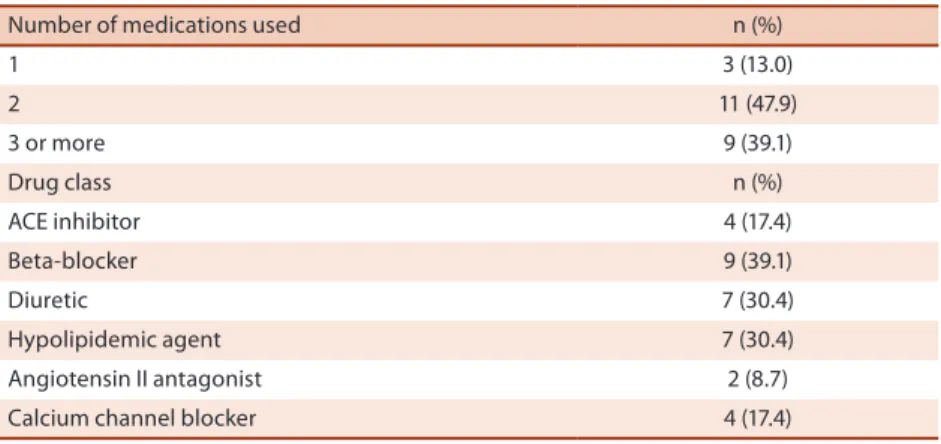
he number and class of medications used by the subjects are shown in Table 2.
As can be seen in Table 2, patients with systemic hypertension use more than one type of medication for blood pressure reduction because
of the diferent mechanisms involved in the etiology of the disease14. Only
few hypertensive patients are able to control their blood pressure with only one drug and combination therapy is required, especially in older
adults with comorbidities16. In addition, hypertensive patients usually take
1 3 (13.0)
2 11 (47.9)
3 or more 9 (39.1)
Drug class n (%)
ACE inhibitor 4 (17.4)
Beta-blocker 9 (39.1)
Diuretic 7 (30.4)
Hypolipidemic agent 7 (30.4) Angiotensin II antagonist 2 (8.7) Calcium channel blocker 4 (17.4) ACE inhibitor: angiotensin-converting enzyme inhibitor.
he mean systemic blood pressure values obtained before and ater the ballroom dance program and the diference between them are shown in Table 3.
Table 3. Comparison of systemic blood pressure before and after the ballroom dance program.
Systemic blood pressure Before After Δ (before-after) p SBP (mmHg) 131.83 ± 16.9 117.83 ± 13.1 -14.0 <0.001 DBP (mmHg) 70.70 ± 6.0 67.71 ± 9.1 -2.99 <0.075
SBP: systolic blood pressure; DBP: diastolic blood pressure. n = 23 per time point.
he baseline mean SBP and DBP values were lower than the cut-of
used for the diagnosis of systemic hypertension (140/90 mmHg)14. his
inding can be explained by the fact that the patients received pharmaco-logical treatment. he hypotensive efect of exercise has been shown to be
more expressive in patients with high baseline systemic blood pressure17. A
marked decline in blood pressure, particularly in SBP, was observed ater the ballroom dance program. DBP reductions usually do not accompany the reduction in SBP and are always of lower magnitude, as reported in
other studies17,18
.
DISCUSSION
he chronic efect of a ballroom dance program on the blood pressure of medicated hypertensive patients participating in cardiac rehabilitation was demonstrated by reductions in SBP and DBP ater the dance sessions. hese results were statistically (SBP) and clinically (SBP and DBP) signiicant. In the general population, 2-mmHg reductions in SBP and/or DBP result in reductions of 14% and 17% in cerebrovascular accident, respectively, and
reduce the risk of coronary artery disease by 9% and 6%, respectively19. In
contrast, in hypertensive subjects, a reduction of 2 mmHg in SBP reduces mortality due to cerebrovascular accident by 6% and due to coronary artery
Ballroom dance: chronic responses on blood pressure Guidarini et al.
he physiological mechanisms involved in chronic post-exercise hypo-tension are multifactorial and are related to adaptations that occur during training. Factors associated with this hypotension are the improvement of
endothelial function21,22 and a reduction of sympathetic nerve activity and
barorelex sensitivity23,24. Sympathetic nerve activity, which is responsible
for the control of heart rate and vasoconstriction, is inhibited during
post-exercise hypotension, reducing peripheral vascular resistance25. In addition,
vasoactive substances, such as adenosines, prostaglandins and nitric oxide,
contribute to blood pressure reduction ater exercise25. Chronic exercise
increases barorelex sensitivity and improves endothelial function, which
are compromised by the presence of hypertension26.
he hypotensive response to ballroom dancing was promising and statistically signiicant for SBP, although the component of this modality difers from that of walking, the exercise modality traditionally prescribed for the non-medicamentous treatment of patients with hypertension. Ballroom dancing uses interval training, with rest periods when learning the steps and intervals between dancing continuously a whole music. his interval training minimizes cardiovascular overload when compared to
continuous exercise at the same intensity27,28, indicating that intermittent
exercise is adequate for cardiac rehabilitation programs.
Studies evaluating the eicacy of hypotension ater exercise programs in medicated hypertensive patients are scarce. hese studies used
walk-ing17,18 and mixed exercise programs (walking and cycle ergometer)29 for
the treatment of hypertension. Comparison of the walking17,18 and mixed
exercise programs29 with the ballroom dance program showed that the last
modality resulted in lower exercise SBP. he mean reduction of post-exercise SBP in medicated hypertensive patients in response to walking
was -13 mmHg17, -8 mmHg18 and -6 mmHg29, whereas an SBP reduction
of -14 mmHg was observed ater ballroom dancing. With respect to DBP, only small diferences were observed between pre- and post-exercise values, which were -2.99 mmHg for the ballroom dance program, -3 to -4 mmHg
for walking trainings17,18 and -3 mmHg for the mixed exercise program29.
hese magnitudes of blood pressure reductions favor the implementation of ballroom dancing as an exercise modality for the treatment of medicated hypertensive patients.
Although not the objective of the present study, it should be noted that the blood pressure reductions that occur in response to the acute efect of
exercise persist for at least 48 h30, a fact supporting the proposal of
ball-room dancing as an adequate exercise modality for cardiac rehabilitation. his modality can be performed three times per week on alternate days to maintain the pressure reduction for most days of the week. Furthermore, the efect of training has been shown to be reversible, with the loss of its
beneicial efects ater return to physical inactivity30.
non-in a maximum of four classes/3 months). One of the manon-in advantages of ballroom dancing is that it is a lucid and pleasant activity, increasing quality of life and adherence to rehabilitation. his set of positive factors of ballroom dancing, together with the health beneits of regular physical activity, favors the long-term reduction of all-cause morbidity and mortality
in patients who require cardiopulmonary and metabolic rehabilitation9.
One limitation of the present study was the lack of a control group, which would increase the precision of the magnitude of blood pressure reductions in response to ballroom dancing and would contribute to bet-ter understand the efect of the medications used. However, this was the objective of the study, i.e., to evaluate medicated hypertensive patients in a rehabilitation setting and also to select the subjects in such a way as to demonstrate to them their reality in terms of plurality. Patients undergoing rehabilitation generally present other hypertension-associated risk factors for heart disease and use several types of medications for the treatment of their conditions. In this setting, the ballroom dance program showed positive efects in terms of SBP and DBP reductions.
CONCLUSIONS
he ballroom dance program showed an interesting chronic hypotensive response in the treatment of patients with systemic hypertension. he blood pressure reduction observed in the present study suggests that ballroom dancing combined with pharmacological treatment improves blood pressure control and may be used as an exercise modality for cardiac rehabilitation.
REFERENCES
1. Banco Mundial. Enfrentando o desaio das doenças não transmissíveis no Brasil. Relatório No 32576-BR: Brasil. 2005; Disponível em: <tp://tp.cve.saude.sp.gov.br/ doc_tec/cronicas/relatorio_bancomundial.pdf> [2010 jun 07].
2. Williams B. he yearin hypertension. J Am Coll Cardiol 2010;55(1):66-73.
3. Rosario TM, Scala LCNS, Franca GVA, Pereira MRG, Jardim PCBV. Prevalência, controle e tratamento da hipertensão arterial sistêmica em Nobres, MT. Arq Bras Cardiol 2009;93(6):672-8.
4. Whelton SP, Chin A, Xin X, He J. Efect of aerobic exercise on blood pressure: a meta-analysis of randomized, controlled trials. Ann Intern Med 2002;136(7):493-503.
5. Mendes R, Barata T. Exercício aeróbio e pressão arterial no idoso. Rev Port Clin Geral 2008;24:251-7.
6. Eicher JD, Maresh CM, Tsongalis GJ, hompson PD, Pescatello LS. he additive blood pressure lowering efects of exercise intensity on post-exercise hypotension. Am Heart J 2010;2:513-20.
7. Lee LL, Watson MC, Mulvaney CA, Tsai CC, Lo SF. he efect of walking in-tervention on blood pressure control: a systematic review. Interl J Nurs Stud 2010;47:1545-61.
Ballroom dance: chronic responses on blood pressure Guidarini et al.
9. Carvalho T, Monte FG, Mara LM. Exercício físico: os dois lados da mesma moeda. Florianópolis: Insular, 2009.
10. Alpert PT, Miller SK, Wallmann H, Havey R, Cross C, Chevalia T, et al. he efect of modiied jazz dance on balance, cognition, and mood in older adults. J Am Acad of Nurse Pract 2009;21:108-15.
11. Eyigor S, Karapolat H, Durmaz B, Ibisoglu U, Cakir S. A randomized controlled trial of Turkish folklore dance on the physical performance, balance, depression and quality of life in older women. Arch Gerontol Geriatr 2009;48:84-8.
12. Belardinelli R, Lacalaprice F, Ventrella C, Volpe L, Faccenda E. Waltz dancing in patients with chronic heart failure new form of exercise training. Circ Heart Fail 2008;1;107-14.
13. Monte FG, Pereira CSA, Kessler VC, Ulbrich AZ, Grams ST, Pimenta JA, et al. Efects of a dance program on blood pressure of patients with hypertension [Abstract]. Circulation 2010;122(2):e319.
14. Sociedade Brasileira de Hipertensão. VI Diretriz Brasileira de Hipertensão. Diag-nóstico e classiicação. Rev Hipertens 2010;13(1):14-8.
15. Petrella RJ. Lifestyle approaches to managing high blood pressure – new Canadian guidelines. Can Fam Physician 1999;45:1750-5.
16. Zaitune MPA, Barros MBA, César CLG, Carandina L, Goldbaum M. Hiperten-são arterial em idosos: prevalência, fatores associados e práticas de controle no Município de campinas, São Paulo, Brasil. Cad Saúde Pública 2006;22(2):285-94.
17. Rodriguez D, Costa RF, Vieira AL, Girolamo L, Raymundi LY, Guiselini M, et al. Eiciência da caminhada em duas sessões semanais para a redução da pressão arterial de idosas hipertensas previamente sedentárias. Fit Perf J 2008;7(3):169-74.
18. Monteiro HL, Rolim LMC, Squinca DA, Silva FC, Ticianeli CCC, Amaral SL. Efe-tividade de um programa de exercícios no condicionamento físico, peril metabólico e pressão arterial de pacientes hipertensos. Rev Bras Med Esporte 2007;13(2):107-12.
19. Pescatello LS, Franklin BA, Fagard R, Farquhar WB, Kelley GA, Ray CA. Ameri-can College of Sports Medicine. exercise e hypertension. Med Sci Sports Exerc 2004;36(3):533-53.
20. Cornelissen VA, FAgard RH. Efects of endurance training on blood pressure, blood pressure-regulating mechanisms, and cardiovascular risk factors. Hypertension 2005; 46:667-75.
21. Goto C, Higashi y, Kimura M, Norma K, Hara K, Nakagawa k, et al. Diferent in-tensities of exercise on efect of endothelium-dependent vasodilatation in humans. Circulation 2003;108:530-5.
22. Pontes jr FLP, Bacurau RFP, Moraes MR, Navarro F, Casarini DE, Pesquero JL, et al. Kalilrein kinin system activation in post exercise hypotension in water running of hypertensive volunteers. Int Imunopharmacol 2008;8:261-6.
23. Kohno K, Matsuoka H, Takenaka K, Miyake Y, Okuda S, Nomura G, et al. Depres-sor efect by exercise training is associated with amelioration of hyper insulinemia and sympathetic over activity. Intern Med 2000;39(12):1013-9.
24. Brum PC, Da Silva GJ, Moreira ED, Ida F, Negrão CE, Kriegre EM. Exercise training increases barorreceptor gain sensitivity in normal and hypertensive rats. Hypertension 2000;36:1018-22.
25. Halliwill JR, Minson CT, Joyner MJ. Efect of sustemic nitric oxide synthase inhibi-tion on postexercise hypotension in humans. J Appl Physiol 2000;89(5):1830-36.
26. Pontes Jr FL, Prestes J, Leite RD, Rodriguez D. Inluência do treinamento aeróbio nos mecanismos isiopatológicos da hipertensão arterial sistêmica. Rev Bras Ciênc Esporte 2010;32(2-4):229-44.
27. Jones H, Taylor CE, Lewis NC, George k, Atkinson G. Post-exercise blood pres-sure reduction is greater following intermittent than continuous exercise and is inluenced less by diurnal variation. Chronobiol Int 2009;26(2):293-306.
Rua: Apeninos, 76, Plaza Valência. Apto 206. Córrego Grande. CEP: 88037-620. Florianópolis, SC. Brasil
E-mail: [email protected] de indivíduos hipertensos. Rer Soc Cardiol Estado de São Paulo. 2006; 1A:9-20.