Emergence of the irst
permanent molar in
5-6-year-old children: implications from a
longitudinal analysis for occlusal
caries prevention
Irrompimento do primeiro molar
permanente em crianças de 5 e
6 anos de idade: implicações da
análise longitudinal para prevenção
da cárie oclusal*
Paulo Frazão
Departamento de Prática de Saúde Pública da Faculdade de Saúde Publica da Universidade de São Paulo.
* Parte da pesquisa “Custo-efetividade da escovação dental supervisionada na prevenção da cárie
dentária infantil” inanciada pela FAPESP (Processo 06/51300-0).
Correspondência: Prof. Paulo Frazão. Departamento de Prática de Saúde Pública, Faculdade de Saúde Pública, Universidade de São Paulo, Av. Dr Arnaldo 715 São Paulo, SP, CEP 01246-904. E-mail: [email protected]
Abstract
The timing of tooth emergence is of con-siderable importance in the planning of prevention of occlusal caries. Objective: The aim was to estimate the trends of emergence of the irst permanent molars in girls and boys between 5-6 years of age, since more children are included in the irst grade after Brazilian elementary education has been extended from eight to nine years of dura-tion. Methods: Dental spaces of 497 children aged 60 months or older were examined four times by a calibrated dentist (kappa > 0.97) during 18 months in a longitudinal study. The irst permanent molar was con-sidered emerged when any tooth surface could be reached by a ball point probe. Participants’ age was measured in months; 95% conidence intervals were obtained for prevalence and incidence values for each sex in three age groups - 60.0 to 65.9; 66.0 to 71.9; 72.0 to 77.9 months. Incidence rate ratios were estimated by Poisson regression analysis. Results: The majority of children from 66.0 to 71.9 months and 72.0 to 77.9 months presented at least one emerged permanent molar. For each three children in the 66.0-71.9-month group, at least one had all four permanent molars emerged.
Conclusion: The emergence trends obser-ved justify the need for speciic protection and surveillance measures for occlusal caries prevention.
Resumo
O tempo de irrompimento dentário é es-sencial para o planejamento de medidas de prevenção da cárie oclusal. Com a am-pliação do ensino fundamental de oito para nove anos de duração, um número maior de crianças entre cinco e seis anos de idade é incluído na primeira série do ensino funda-mental. Objetivo: O objetivo foi estimar as tendências do irrompimento dos primeiros molares permanentes em meninos e me-ninas de 5 e 6 anos de idade. Métodos: Em estudo longitudinal, espaços dentários de 497 crianças de 60 meses e mais de idade foram examinados quatro vezes por um dentista calibrado (kappa > 0,97) durante 18 meses. O primeiro molar permanente foi considerado irrompido quando qualquer parte de sua superfície podia ser tocada por uma sonda de ponta esférica. A idade dos participantes foi medida em meses. Inter-valos para 95% de coniança dos valores de prevalência e incidência foram apurados conforme o sexo para três coortes etárias: 60,0 a 65,9; 66,0 a 71,9; 72,0 a 77,9 meses. A razão entre as taxas de incidência foi esti-mada por meio de análise de regressão de Poisson. Resultados. A maioria das crianças entre 66,0 e 71,9 meses e entre 72,0 e 77,9 meses tem pelo menos um molar perma-nente irrompido. No grupo de 66,0 a 71,9 meses, de cada três crianças pelo menos uma apresentou os quatro primeiros mo-lares permanentes irrompidos. Conclusão.
As tendências de irrompimento observadas justiicam a necessidade da adoção de me-didas de vigilância e de proteção especíica em relação à lesão de cárie oclusal.
Palavras-chave: Epidemiologia.Erupção dentária. Dentição permanente. Molar. Idade. Sexo.
Introduction
The majority of caries lesions in school-aged population is concentrated on the masticatory surfaces of the irst permanent molars, whose pits and fissures are less beneited by treatment with luoride than smooth surfaces1,2. Initial oclusal caries le-sions occur during the irst 36 months after emergence of this tooth group3-5. Given this intra-oral distribution and the challenges to control it in the population groups that are more vulnerable to this disease, knowledge about the timing of tooth emergence is es-sential to plan diagnostic, preventive and therapeutic measures6.
Several factors can be associated with the timing of permanent tooth emergence, such as gender, ethnicity, environment and socioeconomic level7. As these factors can vary from one area to another, there is not a standard table applicable to all children. In a city of Southern Brazil, a longitudinal study with 359 children showed that tooth emergence depends on nutritional and developmental characteristics measured at birth and during the irst year of life. Children showing a height-for-age deicit at six months of age had a higher probability of their irst molars not emerging at the age of six years8. Given the variability of emergence patterns, they should be origi-nated from the populations to which they will be applied9.
the irst permanent molars could be direct-ed towards newly enrolldirect-ed children (agdirect-ed six years) who had one or more partially or completely emerged irst permanent mo-lars. In this sense, information about irst permanent molar emergence in the oral cavity and the effect of demographic factors can be useful to guide the planning of stud-ies on the activitstud-ies and materials aimed at oclusal caries prevention and to subsidize the implementation of oral health actions in primary health care.
The present study, part of the broader research project entitled “Custo-efetividade da Escovação Dental Supervisionada na Prevenção da Cárie Dentária Infantil” (Cost-effectiveness of Supervised Toothbrushing in Child Dental Caries Prevention), aimed to estimate the emergence trends of irst permanent molars in children aged from 5 to 6 years and to quantify the differences between boys and girls in this life cycle.
Methods
The main research project was approved by the Comitê de Ética em Pesquisa da Universidade Católica de Santos (Catholic University of Santos Research Ethics Com-mittee – Process 4843-20-2005).
The study population was comprised of all children aged 60 months of age or more, enrolled in the six public primary education units situated in an impoverished area of the city of São Vicente, SP, Brazil.
In a longitudinal study, dental spaces corresponding to the first permanent molars were analyzed four times by a ca-librated dentist (kappa>0.97) during 18 months (from May 2007 to November 2008). The dentist was calibrated by a standard-examiner before the irst and third exam cycles. Training courses lasted 20 hours and were held in a primary education unit not selected for this study. Individuals were examined in the supine position, under na-tural lighting conditions, on the schoolyard, using a wooden spatula, lat mirror and ball point probe. The irst permanent molar was considered emerged when any part of its
surface could be reached by the ball point probe. Age was measured in days between the date of birth and the exam day. The year was standardized as 360 days and 12 months and the value was converted into the month unit. In the present study, data on children aged between 60.0 and 77.9 months in any of the exams were analyzed.
As the emergence incidence values are not constant throughout time, varying ac-cording to each individual’s age, the study population was stratified into three age cohorts: between 60.0 and 65.9 months; between 66.0 and 71.9 months; and betwe-en 72.0 and 77.9 months. Population size characteristics in each age cohort enabled estimation with a margin of error between 5.0 and 7.5%. Pearson’s chi-square test was applied in each age cohort to evaluate the differences in composition between sexes. The prevalence of individuals was esti-mated according to the number of molars emerged in each age cohort. Incidence rate was analyzed and 95% conidence inter-vals were compared according to sex and age. Incidence rate ratio was estimated to compare tooth emergence between boys and girls in each age cohort, using Poisson regression model. A value of p 0.05 was adopted to reject the null hypothesis. Stata 10.0 software was used.
Results
A total of 497 children aged between 5 and 6 years participated in this study, of which 311 were evaluated in the irst exam, 473 in the second exam, and 497 in the third exam. Of these, 24 participated in only one follow-up, 162 in two follow-ups, and 311 in three follow-ups, comprising 1,281 obser-vations. Table 1 shows the distribution of observations according to sex and age co-hort in each follow-up. There was a balance between sexes in all age cohorts (p>0.05).
groups. Less than 40% of children had two or more molars emerged between the ages of 60.0 to 65.9 months.
Table 2 shows the distribution of girls and boys according to the number of molars emerged. In the younger age cohort, half of the children did not have any emerged molars. Between 66.0 and 71.9 months of age, 60.1% of girls had two or more molars emerged, whereas 50.4% of boys showed this condition. Between 66.0 and 71.9 months and between 72.0 and 77.9 months, the ma-jority of children were found to have at least one permanent molar emerged. Among girls, rates varied from 76.9% to 89.7%, for each age cohort respectively, whereas the-se rates varied between 60.8% and 77.7% among boys.
Mean values and respective conidence intervals of emerged molar incidence are shown in Table 3. There was a slight and not statistically signiicant advantage for girls in the two younger age cohorts (between
60.0 and 65.9 months and between 66.0 and 71.9 months). This trend was then inverted, favoring boys in the age cohort from 72.0 to 77.9 months, thus revealing that these tren-ds do not have the same direction in short time intervals, such as those considered in the present study.
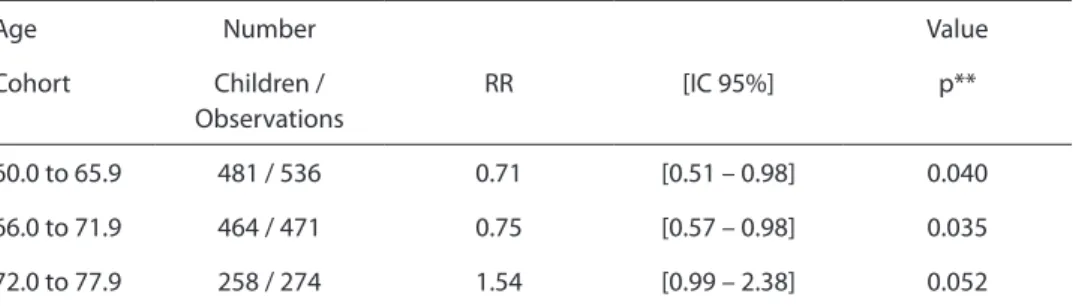
Differences in incidence as a function of demographic characteristics were esti-mated using Poisson regression model to check these trends. Thus, the effect of sex in the incidence rate of first permanent molar emergence was evaluated in each age cohort, considering girls as the reference category. Boys and girls showed incidence values that were statistically different in the age cohorts included in the interval from 60.0 to 77.9 months of age. The results are shown in Table 4. The incidence of tooth emergence was 29% and 25% higher in girls, when compared to boys, in the age cohorts from 60.0 to 65.9 months and 66.0 to 71.9 months, respectively, whereas this
Table 1 - Number and percentage of observations according to sex and age group in each follow-up. São Vicente, SP, Brazil, 2008.
Tabela 1 - Número e percentual de observações segundo sexo e coorte etária em cada seguimento. São Vicente, SP, Brasil, 2008.
SEX
Age Cohort Follow-up Girls % Boys % TOTAL %
60.0 to 65.9 a
First 117 49.0 122 51.0 239 100.0
Second 132 53.0 117 47.0 249 100.0
Third 25 52.1 23 47.9 48 100.0
TOTAL 274 51.1 262 48.9 536 100.0
66.0 to 71.9 b
First 20 57.1 15 42.9 35 100.0
Second 88 49.4 90 50.6 178 100.0
Third 133 51.6 125 48.4 258 100.0
TOTAL 241 51.2 230 48.8 471 100.0
72.0 to 77.9 c
First 21 56.8 16 43.2 37 100.0
Second 27 58.7 19 41.3 46 100.0
Third 97 50.8 94 49.2 191 100.0
TOTAL 145 52.9 129 47.1 274 100.0
Chi-square (Pearson) between sexes in each cohort a p=0.662; b p=0.695; c p=0.553
Figure 1 - Percentage of children according to sex and number of irst permanent molars emerged in each age group. São Vicente, SP, Brazil, 2008.
Figura 1 - Percentual de crianças segundo o sexo e o número de primeiros molares permanentes irrompidos em cada coorte etária. São Vicente, SP, Brasil, 2008.
Table 2 - Children according to emerged molars, sex and age group. São Vicente, SP, Brazil, 2008. Conidence intervals and point estimates.
Tabela 2 - Crianças segundo número de molares irrompidos, sexo e a coorte etária. São Vicente, SP, Brasil, 2008. Estimativas por ponto e por intervalo de coniança.
Age Emerged Girls Boys
Cohort Molar % CI 95% % CI 95%
60.0 to 65.9
None 56.8 48.3 - 65.3 56.5 47.4 - 65.5
One 6.8 2.5 - 11.1 6.8 2.2 - 11.40
Two 14.4 8.4 - 20.4 17.1 10.2 - 23.9
Three 3.8 0.5 - 7.1 1.7 0.6 - 4.1
Four 18.2 11.6 - 24.8 17.9 10.9 - 24.9
66.0 to 71.9
None 33.1 25.0 - 41.1 39.2 30.6 - 47.8
One 6.8 2.5 - 11.1 10.4 5.0 - 15.8
Two 11.3 5.9 - 16.7 8.0 3.2 - 12.8
Three 9.0 4.1 - 13.9 5.6 1.5 - 9.6
Four 39.8 31.5 - 48.2 36.8 28.3 - 45.3
72.0 to 77.9
None 10.3 4.2 - 16.4 22.3 13.9 - 30.8
One 2.1 0.80 - 4.9 11.7 5.1 - 18.2
Two 11.3 4.9 - 17.7 7.4 2.1 - 12.8
Three 7.2 2.0 - 12.4 8.5 2.8 - 14.2
incidence was 50% higher in boys in the oldest age cohort.
Discussion
Knowledge about the time of irst per-manent molar emergence is essential to plan diagnostic, preventive and therapeutic measures6, given the fact that a higher den-tal caries burden in a relevant number of children is concentrated in this tooth group. With the extension of primary educa-tion from eight to nine years of duraeduca-tion, a higher number of children aged six years tend to be included in the irst grade of pri-mary education, thus making it necessary to evaluate the relevance of speciic programs aimed at oclusal caries prevention in irst
permanent molars. When tooth emergence is investigated, it is impossible to assess the exact moment this occurs. One alternative is to analyze this phenomenon between two exams. The collected data enabled the production of valid information about the presence of irst permanent molars, accor-ding to the age cohorts deined in intervals of six months, separated into boys and girls. In certain studies, this information was produced from annual exams11,12.
Using the data obtained in conjunction with the educational system, it is possible to estimate the number of children and emerged molars that require attention and surveillance, using speciic measures which must be object of more in-depth studies. By providing resources for future studies
Table 3 - Incidence of emergence of irst permanent molar according to sex in each age group. Mean values and conidence intervals.
Tabela 3- Incidência de irrompimento do primeiro molar permanente segundo sexo em cada coorte etária. Média e intervalo de coniança.
Age Cohort Both Girls Boys
60.0 a 65.9 0.72 [0.63 – 0.82] 0.83 [0.69 – 0.97] 0.61 [0.48 – 0.74]
66.0 a 71.9 0.97 [0.85 – 1.09] 1.10 [0.94 – 1.27] 0.83 [0.67 – 1.00]
72.0 a 77.9 0.60 [0.48 – 0.72] 0.46 [0.33 – 0.59] 0.75 [0.55 – 0.95]
TOTAL 0.65 [0.60 – 0.71] 0.69 [0.62 – 0.77] 0.61 [0.54 – 0.69]
Table 4 - Relative risk values* (RR) and 95% conidence intervals for emergence incidence of irst permanent molar among girls and boys in each age group. Estimates from Poisson regression analysis.
Tabela 4 - Valores de risco relativo* (RR) e intervalos de coniança (95%) para a incidência do irrompimento do primeiro molar permanente entre meninas e meninos em cada coorte etária. Estimativas obtidas por análise de regressão de Poisson.
Age Number Value
Cohort Children / Observations
RR [IC 95%] p**
60.0 to 65.9 481 / 536 0.71 [0.51 – 0.98] 0.040
66.0 to 71.9 464 / 471 0.75 [0.57 – 0.98] 0.035
72.0 to 77.9 258 / 274 1.54 [0.99 – 2.38] 0.052
* Ratio between incidence rates - Girls as reference category; ** Wald test
and for the planning of oral health actions in primary health care, the main indings were the prevalence rates of two or more emerged molars in each age cohort and the incidence rates estimating differences between boys and girls.
With the use of a longitudinal study, researchers investigated the emergence of the irst permanent molars in a group of 69 children13. Tooth emergence was observed in intervals not longer than four months, until functional occlusion was obtained. In girls, the irst molar emerged at the age of 73.6 months (6.1 years), whereas mean age was 75.2 months among boys (6.3 years), without statistically signiicant differences. A great variation in age of tooth emergen-ce was found (in girls, between 63 and 92 months of age; in boys, between 62 and 94 months), with the duration of emergence of the four molars corresponding to a total time of 15.4 months in girls (variation from 5 to 32 months) and 15.0 months in boys (variation from 7 to 28 months).
In a different study11, which followed the same type of design, although with a much larger sample (more than 30,000 records of children from the public dental service of Denmark), emergence of all permanent teeth was described. Authors concluded that teeth emerge irstly in girls, rather than in boys – the difference varied between two to ten months, without a clear dependence on the age of tooth emergence or type of tooth. Age distribution during tooth emer-gence corresponded to a normal curve for teeth with a low proportion of aplasia. In the present study, there was also a trend towards earlier tooth emergence in girls. First per-manent molar emergence was compared in three age cohorts, with a higher emergence incidence trend in girls, in the two younger age cohorts. In the oldest age cohort, this trend inverted, showing that such trends do not have the same direction in short time intervals.
Differences in mean age of permanent tooth emergence between girls and boys was also observed in other studies7,12,14. In addition, hereditary factors, ethnicity,
place of residence (urban or rural), and nutritional and hormonal characteristics are aspects that have been investigated in the literature7,9.
Although socioeconomic condition can have an effect on general body growth, its impact on tooth emergence remains con-troversial9,15. A longitudinal analysis with Brazilian children did not show an associa-tion between socioeconomic variables and tooth emergence8. For this reason, the fact that this study was conducted with a popu-lation living in a low-income area may not represent a limitation to the generalization of the results.
It is admitted that there is an uncertainty of 4 to 5 months as to the emergence age corresponding to the mean time interval (in months) between exams. However, as this interval was similar in both sexes, the comparison shown between girls and boys can be considered valid. In addition to this gender difference, the prevalence rate values of emerged molars in the three age cohorts studied were an important result found. Between 66.0 and 71.9 months of age and between 72.0 and 77.9 months, two age groups that begin to be included in the irst grade due to the primary education exten-sion, the majority of children were found to have at least one emerged permanent molar, a fact that justiies the adoption of surveillance measures and speciic protec-tion against oclusal caries lesion.
Children with four emerged molars can require more individualized measures to-wards oclusal caries lesion. In the age group between 66.0 and 71.9 months, at least one of each three children had their four irst permanent molars emerged. In the age group between 72.0 and 77.9 months, 69.1% [CI95% 59.8 – 78.3] of girls and 50% [CI95% 39.8 – 60.2] of boys were in this condition.
programs funded by the Fundo Nacional de Saúde (Brazilian Health Fund)17. Many dental assistants are involved and a large amount of resources is spent annually. This action consists of oral health education and dental plaque observation, followed by supervised tooth-brushing with luoride toothpaste, conducted by dental assistants every three months18. Oral health care has been considered one of the dimensions of primary health care and coverage of the above mentioned action has been one of the indicators established in the primary health care statement19. The majority of programs focus on the irst grades of primary school, the period when the irst permanent teeth emerge, among which the first molar is most frequently affected by caries, reason why protection measures are needed20. The results shown justify the efforts aimed at
the newly enrolled schoolchildren, with the extension of primary education.
Conclusion
The incidence of tooth emergence was 29% and 25% higher in girls, when compa-red to boys, in the age cohorts of 60.0 to 65.9 months and 66.0 to 71.9 months, respecti-vely, whereas this incidence was 50% higher in boys, in the oldest age cohort. Between 66.0 and 71.9 months and between 72.0 and 77.9 months, the two age groups that begin to be included in the irst grade with the ex-tension of primary education, the majority of children were found to have at least one emerged permanent molar, a fact that has important repercussions for the adoption of speciic surveillance and protection measu-res against oclusal caries lesion.
References
1. Pereira AC, Meneghi MC, Moreira BW. Condições bucais de escolares de 7 a 12 anos de idade, após 20 anos de luoretação das águas de abastecimento público de
Piracicaba. Rev Paul Odontol 1995; 17: 30-6.
2. Batchelor PA, Sheiham A. Grouping of tooth surfaces by susceptibility to caries: a study in 5–16 year-old children.
BMC Oral Health 2004, 4: 2.
3. Von der Fehr FR. Epidemiology of dental caries. In:
Thylstrup A, Fejerskov O. Textbook of Cariology.
Copenhagen: Munksgaard; 1986.
4. Sagretti OMA, Guedes-Pinto AC, Chelotti A. Risco de cárie dentária em primeiros molares permanentes com
diferentes graus de erupção. RGO1989;37: 384-8.
5. Barbosa JP. Erupção dos primeiros molares permanentes
e surgimento da cárie em crianças de 5 e 6 anos de idade
[dissertação de mestrado]. Faculdade de Saúde Pública da Universidade de São Paulo: São Paulo; 1994.
6. Helm S, Seidler B. Timing of permanent tooth
emergence in Danish children. Community Dent Oral
Epidemiol 1974; 2: 122-9.
7. Virtanen JI, Bloigu RS, Larmas MA. Timing of eruption of permanent teeth: Standard Finnish patient documents.
Community Dent Oral Epidemiol 1994; 22: 286-8.
8. Bastos JL, Peres MA, Peres KG, Barros AJD. Infant growth, development and tooth emergence patterns: a
longitudinal study from birth to 6 years of age. Arch Oral
Biol 2007; 52: 598-606.
9. Demirjian A. Dentition. In: Falkner F, Tanner JM.
growth. New York: Plenum Press, 1978.
10. Brasil. Ministério da Educação. Secretaria de Educação
Básica. Ampliação do ensino fundamental para no
anos: 3º relatório do programa. Brasília: Ministério da
Educação; 2006.
11. Parner ET, Heidmann JM, Vaeth M, Poulsen S. A longitudinal study of time trends in the eruption of
permanent teeth in Danish children. Arch Oral B
2001; 46: 425-31.
12. Leroy R, Bogaerts K, Lesaffre E, Declerck D. The emergence of permanent teeth in Flemish childr
Community Dent Oral Epidemiol 2003; 31: 30-9.
13. Ekstrand KR, Christiansen J, Christiansen MEC. T and duration of eruption of irst and second permanent
molars: a longitudinal investigation. Community D
Oral Epidemiol 2003; 31: 344-50.
14. Helm S. Secular trends in tooth eruption: a compar study of Danish school children of 1913 and 1965.
Oral Biol 1969; 14: 1177-91.
15. Garn SM, Nagy JM, Sandusky ST, Trowbridge F.
Economic impact on tooth emergence. Am J Phys
Anthropol 1973; 39: 233-7.
16. Narvai PC, Frazão P, Roncalli AG, Antunes JLF. Cár dentária no Brasil: declínio, polarização, iniqüidade e
exclusão social. Rev Panam Salud Pública 2006; 19:
17. Frazão P. Vinte anos de Sistema Único de Saúde: avanços
e desaios para a saúde bucal [editorial]. Cadernos de
Saúde Pública 2009; 25: 712-3.
18. Frazão P, Castellanos RA. Participación del personal auxiliar de odontología en los sistemas locales de salud.
Pan Am J Pub Health 1999; 5: 106-15.
19. Carvalho LAC, Scabar LF, Souza DS, Narvai PC.
Procedimentos coletivos de saúde bucal: gênese, apogeu
e ocaso. Saude Soc 2009; 18: 490-9.
20. Frazão P. Effectiveness of the bucco-lingual technique within a school-based supervised toothbrushing program on preventing caries: a randomized controlled
trial. BMC Oral Health 2011, 11:11