Vertical distribution of phytoplankton functional groups
in a tropical shallow lake: driving forces on a diel scale
Distribuição vertical de grupos funcionais fitoplanctônicos em um
lago tropical raso: forças direcionadoras em escala nictemeral
Luciana Gomes Barbosa1, Paulina Maria Maia Barbosa2 and Francisco Antonio Rodrigues Barbosa2
1Laboratório de Ecologia Vegetal, Departamento de Fitotecnia e Ciências Ambientais, Centro de Ciências Agrárias, Universidade Federal da Paraíba – UFPB, Campus II, CEP 58397-000, Areia, PB, Brazil
e-mail: [email protected]
2Departamento de Biologia Geral, Instituto de Ciências Biológicas,
Universidade Federal de Minas Gerais – UFMG, CP 486, CEP 30161-970, Belo Horizonte, MG, Brazil e-mail: [email protected]; [email protected]
Abstract: Aim: This study analyzed the vertical distribution of phytoplankton functional groups in two diel cycles in a warm monomictic shallow tropical lake; Methods: Sampling of the abiotic variables, phytoplankton and zooplankton communities was performed at intervals of 3 hours over 24 hours in vertical profiles, in the stratification (February) and circulation (July) periods; Results: The high thermal stability and the partial atelomixis favored the coexistence of functional groups that are sensitive to destratification, NA and F, composed by desmids and Chlorophyceae coccoids, and groups S2 and Lo, which persisted during the circulation, and were composed by filamentous cyanobacteria which do not fix N2 and dinoflagellates, respectively. The discontinuity in the vertical distribution of the functional groups, with dominance of NA and F in the epilimnion and R and Lo in the metalimnion and hypolimnion, was characteristic of the stratification, and differences between the daytime and nighttime periods were not significant. Conclusions: The reduction of 80% of the biomass of the NA group during the mixing period indicates the influence of thermal stability and partial atelomixis as determinant factors in the compartmentalization of functional groups, restricting daytime vertical migration (DVM) and loss by sedimentation during the stratification period.
Keywords: partial atelomixis, daytime variations, stability, functional groups.
Resumo: Objetivo: Analisar a distribuição vertical dos grupos funcionais fitoplanctônicos em dois ciclos nictemerais em um lago tropical monomítico raso; Métodos: As amostragens das variáveis abióticas, comunidades fitoplanctônica e zooplanctônica foram realizadas a intervalos de 3 horas ao longo de 24 horas em perfis verticais, nos períodos de estratificação (fevereiro) e de circulação (julho); Resultados: A elevada estabilidade térmica e a atelomixia parcial favoreceram a coexistência de grupos funcionais sensíveis a desestratificação NA e F, compostos por desmidias e clorofícias cocoides e pelos grupos S2 e Lo, persistentes durante a circulação, e compostos por cianobactérias filamentosas não fixadoras de N2 e dinoflagelados, respectivamente. A descontinuidade na distribuição vertical dos grupos funcionais com dominância de NA e F no epilímnioe de R e Lo no metalímnio e hipolímnio foi característica da estratificação, e diferenças entre períodos diurno e noturno não foram significativas. Conclusões: A redução em até 80% da biomassa do grupo NA durante a circulação indica a influência da estabilidade térmica e atelomixia parcial como fatores determinantes na compartimentalização dos grupos funcionais, restringindo a migração vertical diurna (MVD) e a perda por sedimentação durante a estratificação.
Palavras-chave: atelomixia parcial, variações diurnas, estabilidade, grupos funcionais.
B
iological L
2.2. Sampling and data analyses
The study was based on samples collected in the periods of thermal stratification (February, 2000) and destratification (July, 2000) in the deepest point (Zmax = 11.8 m) of the limnetic region of Carioca Lake, at intervals of 3 hours, during 24 hours. Samples of phytoplankton were collected with a van Dorn bottle at the subsurface (100% of incident light), Secchi depth (10% of incident light), three times the Secchi depth (1% of incident light), and the aphotic zone (Cole, 1994).
Data for precipitation (mm), air temperature (°C), and wind speed (m/s) were provided by a meteorological station located at Ipatinga, 10 km distant from the Rio Doce State Park.
Vertical profiles of water temperature, dissolved oxygen, pH, and electrical conductivity were measured in situ using a Horiba multi-probe sensor, model U-22, at intervals of 0.5 m from the surface to the bottom of the lake (Zmáx = 11.8 m).
The strata in the stratified period (epilimnion, metalimnion and hypolimnion) were defined from the thermal profile, using differences of 0.6 °C, with the Zmix considered as equivalent to the epilimnion. The thermocline was identified as the largest difference (°C) between one meter and the next lower meter in the thermal profile.
Transparency (m) was estimated with a Secchi disk, and the euphotic zone (Zeu) was calculated as three times the Secchi disk extinction depth (Cole, 1994). The vertical light attenuation coefficient (k) was calculated using the equation k = 1.7 × ZDS-1 (Poole and Atkins, 1929). The ratio of the euphotic zone (Zeu) to Zmix was used as an index of light availability in the mixing zone (Jensen et al., 1994).
The heat content was calculated according to Cole (1994), expressed in cal.cm-2. The stability (s) was determined according to the equation of Idso (1973), and thermal exchanges were calculated from the values of heat content (cal.cm-2), deducting the values among times, converting them into percentages (%).
The ammonium concentrations were measuredaccording to Koroleff (1976), total nitrogen, nitrate and nitrite according to Mackereth et al. (1978), and reactive soluble phosphorus and total phosphorus according to Golterman et al. (1978). Chlorophyll-a was
determined by the method of Lorenzen (1967). The trophic state was calculated by the index of Toledo et al. (1983) and the limiting nutrients according to Redfield (1958).
1. Introduction
The daytime variations in the vertical position of the phytoplankton reflect the influence of ecophysiological factors such as the presence of structures such as aerotopes, biotic relationships such as predation and herbivory (Elser and Goldman, 1990; Reynolds, 2006), and environmental factors such as the availability of light and nutrients, wind-induced mixing, and thermal stratification (Frempong, 1981; Reynolds, 2006).
The dynamics of circulation and stratification of a water body, including seasonal and daytime patterns, is the main factor regulating the distribution of abiotic variables and organisms in the water column, as demonstrated for Carioca Lake (Barbosa and Tundisi, 1989; Barbosa and Padisák, 2002). Daytime turbulent mixing restricted to the epilimnetic layer (partial atelomixis) is characteristic of tropical water bodies, where a permanent thermocline may be established (Lewis Junior, 1977). The high incidence of desmids in the epilimnion of tropical lakes was emphasized by Reynolds et al. (2002) and Barbosa and Padisák (2002) as a consequence of partial atelomixis.
Several studies have indicated the determinant role of partial atelomixis in low-latitude lakes in the maintenance of epilimnetic maxima of species of different phylogenetic and functional origins (Tavera and Martínez-Almeida, 2005; Lopes et al., 2005; Becker et al., 2008; Souza et al., 2008). In the present study, was hypothesized that the diel thermal structure (partial atelomixis) of Carioca Lake regulates the vertical position of phytoplankton organisms.
2. Material and Methods
2.1. Study area
water column, during the day and the night, were calculated according to Dini et al. (1993). (Equation 1)
(
)
(
XiZi)
Pmi Xi
= ∑
∑ (1)
where:
Xi = relative biovolume (phytoplankton and desmids) and relative density (zooplankton), Zi = depth of sample i.
The phytoplankton functional groups that occurred in at least 80% of the sampling periods were included in the analyses. The existence of daytime vertical migration (DVM) was determined by comparing the daytime and nighttime periods through a two-tailed t test for each population.
The Kruskal-Wallis non-parametric analysis was used to compare the variables among depths and hours; and the Spearman correlation to estimate the relationship among the phytoplankton and zooplankton populations. These analyses were performed through the Statistica software version 5.1 (Statsoft). Multivariate descriptive analyses were carried out by applying principal components analyses (PCA) to the abiotic data using a covariance matrix with data transformed by ranging. The programs used were FITOPAC (Shepherd, 1996) to transform data, and PC-ORD, version 3.0 for Windows (McCune and Mefford 1997) for the execution of the analyses.
3. Results
3.1. Chemical and physical scenario
The analyses of the abiotic factors evidenced seasonal differences in the thermal and chemical behavior of the lake. The seasonal dynamics were determined by the stratification pattern, and the diel dynamics by the effect of the atelomixis.
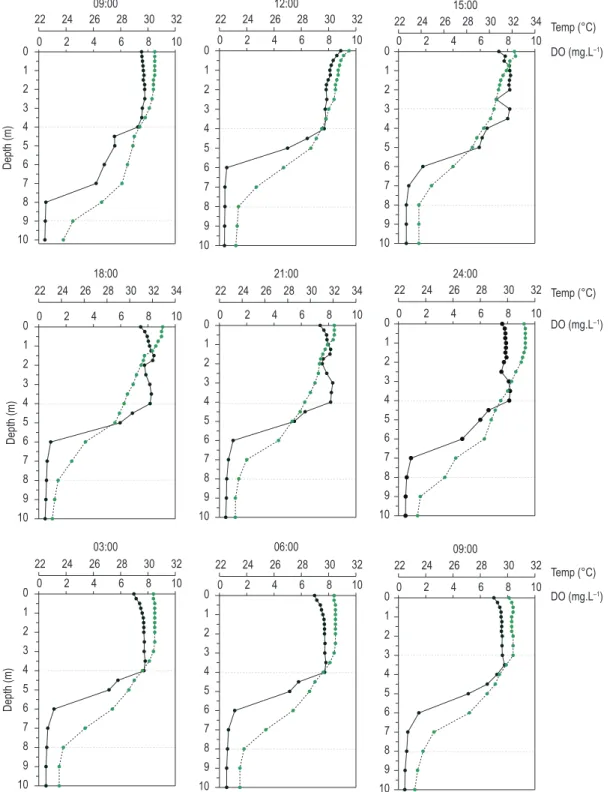
The vertical profile during the stratification period indicated high thermal stability (86.4 g.cm.cm-2), and the occurrence of partial atelomixis was recognized through the “breaking” of micro-stratifications (<6 °C) to 4 m (= epilimnion), favored by the air-temperature reduction during the night (14 °C difference between the daytime and nighttime periods) (Figure 1).
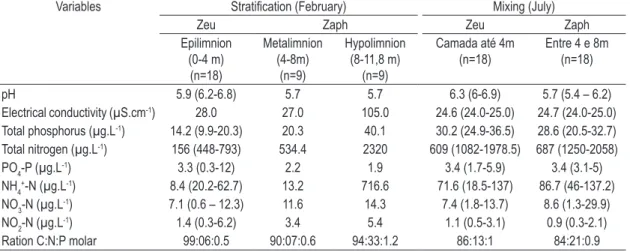
In this period, the surface layers (to 4 m) were more oxygenated, with a clinograde oxygen distribution and anoxia in the hypolimnion. The epilimnetic layer was deficient in nitrogen and phosphate forms (Table 1).
Samples for taxonomic determinations were collected a plankton net of 20 µm mesh, and were preserved in a 4% formaldehyde solution.
The samples of phytoplankton were fixed with neutral lugol solution. The quantitative analyses followed Utermöhl (1958), counting 400 individuals of the most frequent species (Lund et al., 1958). The density of the organisms was calculated according to Villafañe and Reid (1995), and expressed as individuals.mL-1.
The biovolume (mm3.L-1) was estimated from the geometric shapes that were closest to the cell shape, individually or combined (Sun and Liu, 2003; Hillebrand et al., 1999), from the mean values of the measurements of 20 to 30 individuals. The biovolume was expressed in units of fresh weight, where 1 mm3.L-1 = 1 mg.L-1 (Wetzel and Likens, 1991).
Zooplankton community samples were obtained by filtering 10 L of water collected with a Van Dorn bottle in a plankton net of 68 µm, stained with rose Bengal, fixed with 4% formalin, with pH corrected to 7.0 with borax (Haney and Hall, 1973). The organisms were counted in a Sedgwick-Rafter chamber (1.0 mL) with a minimum of 250 individuals per sample, and a variation coefficient of 0.20 or less (McCauley, 1984). Nauplii, copepodids and adults were counted separately.
Phytoplankton taxa were classified according to the following criteria:
i) L if e f o rm o f d es m id s : u ni c el l u la r nonflagellate with projections (UNFp), unicellular non-flagellate without projections (UNF), and colonial filamentous (CFi); ii) Size: evaluated from the values of the
maximum linear dimension (MLD) (adapted from Sieburth et al., 1978). Class 1: < 10 µm, class 2: between 11 and 20 µm, class 3: between 21 and 50 µm, and class 4: > 50 µm; iii) Functional groups were defined for
species that contributed at least 5% of the mean phytoplankton biomass in each period (Reynolds et al., 2002; Reynolds, 2006; Padisák et al., 2009); and
the season (oligotrophic during the stratification, and eutrophic during turnover).
The period of stratification coincided with the maximum values of water transparency (1.5 m; n = 9) and the Zeu (5 m; n = 18) exceeded the Zmix (4 m; n = 18), indicating availability of light in this layer (Zmix: Zeu = 1.2). However, the values of During the mixing period (July), the loss of
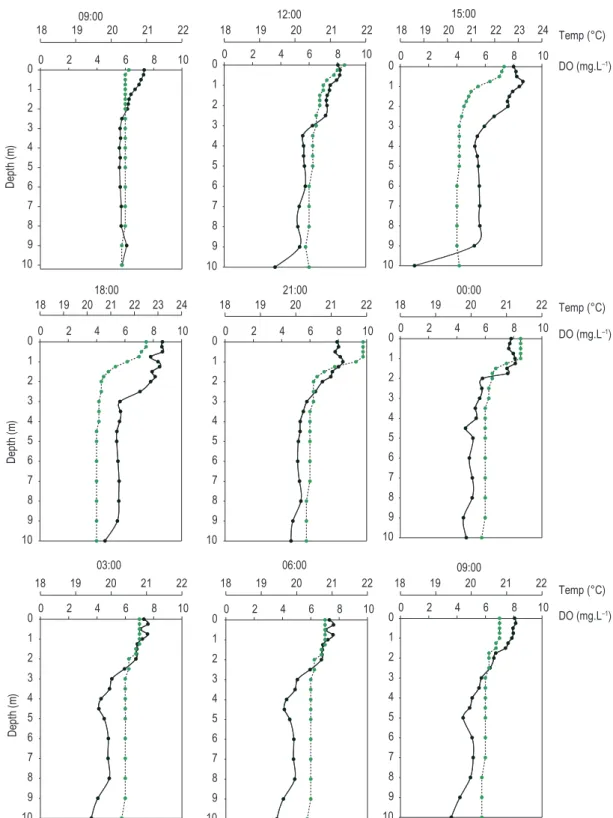
heat in the surface layers led to almost complete thermal mixing, except for short-term stratifications in the surface layers between 3:00 PM and 12:00 AM (Figure 2). The water column was totally oxygenated (orthograde profile) and with nutrients available. The trophic state depended on
Table 1. Summary of the physical and chemical variables (means and range of variation) of Carioca Lake during the stratification period (February) and mixing period (July) (total number of samples in the two periods = 72).
Variables Stratification (February) Mixing (July)
Zeu Zaph Zeu Zaph
Epilimnion (0-4 m) (n=18)
Metalimnion (4-8m)
(n=9)
Hypolimnion (8-11,8 m)
(n=9)
Camada até 4m
(n=18) Entre 4 e 8m(n=18)
pH 5.9 (6.2-6.8) 5.7 5.7 6.3 (6-6.9) 5.7 (5.4 – 6.2)
Electrical conductivity (µS.cm-1) 28.0 27.0 105.0 24.6 (24.0-25.0) 24.7 (24.0-25.0)
Total phosphorus (µg.L-1) 14.2 (9.9-20.3) 20.3 40.1 30.2 (24.9-36.5) 28.6 (20.5-32.7)
Total nitrogen (µg.L-1) 156 (448-793) 534.4 2320 609 (1082-1978.5) 687 (1250-2058)
PO4-P (µg.L-1) 3.3 (0.3-12) 2.2 1.9 3.4 (1.7-5.9) 3.4 (3.1-5)
NH4+-N (µg.L-1) 8.4 (20.2-62.7) 13.2 716.6 71.6 (18.5-137) 86.7 (46-137.2)
NO3-N (µg.L-1) 7.1 (0.6 – 12.3) 11.6 14.3 7.4 (1.8-13.7) 8.6 (1.3-29.9)
NO2-N (µg.L-1) 1.4 (0.3-6.2) 3.4 5.4 1.1 (0.5-3.1) 0.9 (0.3-2.1)
Ration C:N:P molar 99:06:0.5 90:07:0.6 94:33:1.2 86:13:1 84:21:0.9
the light attenuation coefficient were high (between 1 and 3 m).
Differences in the heat content between the daytime and nighttime periods (during the rainy and dry seasons) were not observed, indicating a predisposition to a conservative behavior on the diel scale. During the stratification, the thermal exchanges occurred in the entire water column, and the thermocline was not an obstacle. In general, only 1% of the total heat was exchanged during the stratification, with reduction during the circulation period (< 0.5%) (Figure 3).
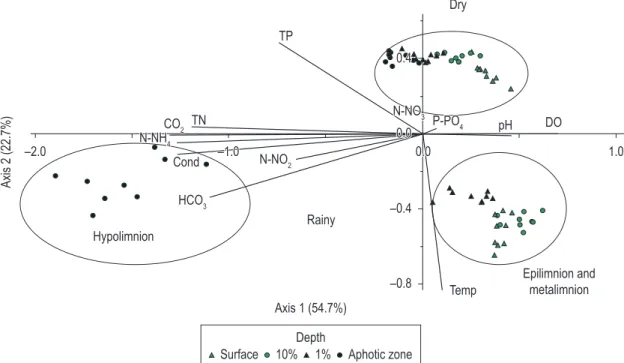
PCA using 13 abiotic variables explained 77.5% of the data variability on the first two ordination axes (Figure 4), with the samples grouped independently of the hour and as a function of the depth, mainly during the stratification. The variables contributing most to the ordination of axis 1 were: Dissolved oxygen (r = 0.4), total nitrogen (r = -0.3), free CO2 (r = -0.4), N-NH4 (r = -0.3), electrical conductivity (r = -0.4) and HCO3 (r = -0.4), respectively. For axis 2, temperature (r = -0.8) and total phosphate (r=0.3) showed the highest correlations (Figure 4).
The samples from the stratification period (subsurface, 10% and 1% of incident light) grouped on the negative side of axis 2, associated with high temperatures. The samples from the aphotic zone grouped on the negative side of axis 1. The samples associated with the mixing period (subsurface, 10% and 1% of incident light and aphotic zone) grouped on the positive side of axis 2, positively correlated with the high values of total phosphorus (r = -0.3).
3.2. Daytime pattern of the plankton communities
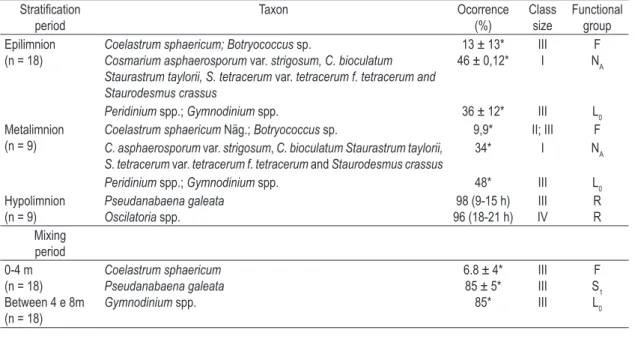
In the two periods, 86 phytoplankton taxa wee identified, members of 8 classes, 20 families and 39 genera. Of this total, 15 described species were accommodated in 6 functional groups (Table 2).
The total biomass differed among depths, mainly between subsurface and hypolimnion (H = 11.0; p = 0.00). The maximum value was identified at 6:00 PM (82.6 mg.L-1), associated with functional group R (mainly Oscillatoria sp.) in the hypolimnion.
During the stratified period, the groups NA, R, L0 and F, composed by small desmids (< 10 µm), filamentous cyanobacteria, dinoflagellates and colonial green algae, respectively, were the most numeroud (Table 2). During the mixing period, coinciding with the increase of the trophic state and reduction of thermal stability (7.7 g.cm.cm-2), groups S1 (Pseudanabaena galeata Böchner) and Lo (Gymnodinium spp.) were dominant.
In stratification, three trends in the vertical profile were identified: 1) Epilimnion: high values of biomass of the functional group NA (46% of the total), with MDL between 5 and 10 µm, coexisting with group F (13% of the total), with MDL between 20.1 and 64 µm; 2) Metalimnion: Functional group Lo (48%), with a discontinuous distribution in hours, and MDL between 20.1 and 64 µm; and 3) Hypolimnion: higher biomasses of functional group R (> 90%), with MDL > 64.1 µm (Table 2).
H = 10.9, p = 0.00, n = 72), and the highest densities and biomasses below 4 m.
For the zooplankton community, the omnivorous cyclopoid copepod Thermocyclops minutus (Lowndes, 1934) was dominant during the
stratification and in the turnover (values above 80%) in each depth sampled, despite the high richness and and hypolimnion (Kruskal–Wallis H = 10.9,
p = 0.00, n=72) with reductions in the density and biomass as the depth increased. The metalimnion and hypolimnion were the preferential habitat of group R, with significant differences between the epilimnion and hypolimnion (Kruskal–Wallis
greater volume (values between 680 and 1840 µm3) compared to unicellular forms. The differences between daytime and nighttime periods were not significant, indicating the efficiency of the thermal stability and partial atelomixis in reducing losses of desmids through sinking.
During the turnover, associations adapted to stratified environments and with differentiations of resources in the vertical profile (NA, F, R) were replaced by species that are tolerant of shade and completely mixed, shallow environments (group S1). Thus, functional group S1 (Pseudonabaena galeata) was dominant in the layer between 0 and
4.5 m (comprising 85% of the total biomass; n = 72); and the Lo group, comprising 85% of the total biomass, predominated between 4.5 and 7 m.
4. Discussion
The composition and vertical structure of the phytoplankton proved to be dependent on the physical contrasts, directly influenced by the thermal structure on both the seasonal and diel scales. This influence of the thermal regimen on the functional groups is evidenced in tropical and subtropical regions, where thermal stratification is lasting and the partial atelomixis exerts a selective force on the functional groups in the 24-hours cycle (Barbosa and Padisák, 2002; Becker et al., 2008).
During the stratification, the main functional groups present in the epilimnion were composed by non-mobile Chlorophyceae, colonial forms with high MDL and mucilaginous sheaths (group F), densities of rotifers present (values < 10%). During
the stratification, T. minutus was dominant between the epilimnion and metalimnion (86% of the total density during the period).
The analyses of the DVM for T. minutus
(adults and nauplii) indicated that the species did not show typical migratory behavior. Groups R and NA showed no significant changes in vertical distribution between daytime and nighttime (Figure 5). The habitat overlap between T. minutus
(adults and nauplii) and group NA was confirmed through positive correlations (r = 0.5, p ≥ 0.05, n = 72).
The classification of the life habit of the desmids indicated a dominance of unicellular non-flagellates (UNF), except Teilingia granulata (Roy & Biss.) Bourr. and Spondylosium panduriforme (Heim.) Teil. (filamentous). Such differences in the life habit were determinant for the vertical distribution, as indicated by DVM analyses (Figure 6): the filamentous forms were slightly more sensitive to sinking, due to their larger size (MDL between 24 and 30 µm) and
Table 2. Dominant phytoplankton taxa (%, contribution to total biomass), class size, and their functional groups identified in Carioca Lake during the 24-hours cycle in the stratification (February) and mixing periods (July).
Stratification
period Taxon Ocorrence (%) Class size
Functional group Epilimnion
(n = 18) Coelastrum sphaericum; BotryococcusCosmarium asphaerosporum var. strigosum, C. bioculatum sp. Staurastrum taylorii, S. tetracerum var. tetracerum f. tetracerum and Staurodesmus crassus
13 ± 13* 46 ± 0,12* IIII
F
NA
Peridinium spp.; Gymnodinium spp. 36 ± 12* III L0
Metalimnion
(n = 9) Coelastrum sphaericumC. asphaerosporum var. Näg.; strigosumBotryococcus, C. bioculatum Staurastrum taylorii, sp. 9,9* II; III F S. tetracerum var. tetracerum f. tetracerum and Staurodesmus crassus
34* I NA
Peridinium spp.; Gymnodinium spp. 48* III L0
Hypolimnion
(n = 9) Pseudanabaena galeata Oscilatoria spp.
98 (9-15 h) 96 (18-21 h) IVIII
R R
Mixing period 0-4 m (n = 18) Between 4 e 8m (n = 18)
Coelastrum sphaericum Pseudanabaena galeata Gymnodinium spp.
6.8 ± 4* 85 ± 5* 85*
III III III
F
S1
L0
In temperate environments, desmids seldom comprise a significant part of the phytoplankton biomass (Yung et al., 1986). These species do not remain permanently in the epilimnion of stratified tropical lakes, a function only associated with the resistance of cells to sinking (Reynolds et al., 2002; Padisák et al., 2003).
Small-sized species (10 µm) with a volume less than 1000 µm3 (O´Farrel et al., 2007) are generally identified as efficient in light-limited lakes. The high attenuation of light produced by high concentrations of dissolved organic carbon and colored organic matter (Bezerra-Neto et al.,
and non-mobile forms with small MDL (>5 µm) and occasional mucilaginous sheaths (group NA), adapted to clear, stratified, nutrient-poor lakes (Reynolds et al., 2002; Padisák et al., 2009). The action of atelomixis as a determinant factor in the maintenance of the desmids (group NA) (Tavera and Martínez-Almeida, 2005; Souza et al., 2008) and the Chlorophyceae coccoids (group F) in the epilimnion (Becker et al., 2008) was identified.
Figure 4. PCA ordination diagram of the sampling units for the abiotic variables in Carioca Lake, emphasizing the depths.
Figure 5. Diel variation of the mean depths of phytoplankton functional groups and Thermocyclops minutus (Lowndes, 1934) during the stratification (a) and turnover (b) seasons. Absence of statistical differences between daytime and nighttime periods.
a
b
T. minutus with group NA, and this factor is not indicative of herbivory.
In Carioca Lake, the virtual absence of vertebrate predators of zooplankton may be the main reason that no migration in the zooplankton community is observed (Bezerra-Neto et al., 2009).
In summary, the functional groups were influenced by the thermal regimen on both the seasonal and diel scales. The results show that the thermal stratification and partial atelomixis are operating forces influencing the vertical distribution of phytoplankton. The absence of MVD confirms this factor, indicating reduction of losses by sedimentation of the functional groups NA and F. During the period of circulation, the reduction in up to 80% of the relative biomass of group NA indicates the importance of the stratification regimen and the partial atelomixis in maintaining the epilimnetic maximum. The restriction of vertical mixing to the epilimnion plays a key role in the survival of groups NA and F.
Acknowledgements
We thank the Limnology Laboratory of the Instituto de Ciências Biologicas of the Universidade Federal de Minas Gerais. We are grateful to FAPEMIG for a master’s scholarship to the first author, and to the Brazilian Long-Term Program (Grant No. 520031/98-9) for financial and logistical support. Dr. Janet W. Reid translated the manuscript into English.
References
BARBOSA, FAR. and PADISÁK, J. 2002. The forgotten lake stratification pattern: atelomixis, and its ecological importance. Verhandlungen des Internationalen Verein Limnologie, vol. 28, p. 1385-1395.
BARBOSA, FAR. and TUNDISI, JG. 1989. The influence of temperature variation on the distribution of dissolved oxygen and nutrients. Archiv für Hydrobiologie, vol. 116, no. 3, p. 333-349.
BECKER, V., CARDOSO, LS. and HUSZAR, VLM. 2008. Diel variation of phytoplankton functional groups in a subtropical reservoir in southern Brazil during an autumnal stratification period. Aquatic Ecology, vol. 42, no. 2, p. 1-10.
BEZERRA-NETO, JF., BARBOSA, PM. and BARBOSA, FAR. 2006. Temporal variation of attenuation of the visible radiation in four lakes of Parque Estadual do Rio Doce (PERD), Minas Gerais, Brasil. Acta Limnologica Brasiliensia, vol. 18, no.1, p. 39-46. BEZERRA-NETO, JF., BRIGUENTI, LS. and
PINTO-COELHO, RM. 2010. A new morphometric study of Carioca Lake, Parque Estadual do Rio Doce 2006), together with the nutrient limitation in the
epilimnion, potentially select for small-sized species (>10 µm), with longer residence times in the Zeu, indicating that size differences may act as a selective factor, attenuating losses by sedimentation.
Functional group NA, typical of low latitudes, is composed by small-sized desmids (Souza et al., 2008; Pádisak et al., 2009). In these regions, the lower viscosity increases the sinking velocity, which is also increased in conditions of limitation by light and nutrients (Peperzak et al., 2003). Thus, the partial atelomixis and the small sizes of the species (MDL < 10 µm) appear to be ecologically important for the maintenance of the maximum biomass.
Group R, adapted to the metalimnion and hypolimnion of oligo-mesotrophic lakes and to shading, form maximum population layers (Padisák et al., 2009) in stratified lakes such as Carioca, where metalimnetic and hypolimnetic populations of cyanobacteria had been identified for at least three decades (Reynolds et al., 1983; Barbosa and Padisák, 2002; Padisák et al., 2003), coincident with the chlorophyll-a maxima. The
predominance of elongated forms with high surface:volume ratios (Reynolds, 1997) reflects the, advantage of this shape in absorbing light energy, even in near-limiting conditions.
Species from the Lo group often dominate the phytoplankton community in water bodies that are thermally stratified, with vertically separated resources (Reynolds, 2006). The flagellates are considered as good indicators of the concentrations of organic matter and dissolved organic carbon (Grigorszky et al., 2003), conditions observed in Carioca Lake.
Besides the thermal structure, the daytime vertical distribution of the functional groups and phytoplankton classes of size also may be influenced by the presence of more efficient herbivores (Rangel et al., 2009). In Carioca Lake, the overlapping of microhabitats between copepod nauplii, copepodids and adults may occur because of the differentiation of resources and feeding habits; since nauplii are rather bacteriophagous (Sherr and Sherr, 1987) and copepodids and adults of
Canadian Journal of Fisheries and Aquatic Sciences, vol. 51, p 1692-1699. http://dx.doi.org/10.1139/ f94-170
KOROLEFF, F. 1976. Determination of ammonia. In GRASSHOFF, K., ed. Methods of Seawater Analysis. Weinheim:Verlag Chemie. p. 126-133.
LEWIS JUNIOR, WM. 1977. Feeding selectivity of a tropical Chaoborus population. Freshwater Biology, vol. 7, no. 4, p. 311-325. http://dx.doi. org/10.1111/j.1365-2427.1977.tb01679.x
LOBO, E. and LEIGHTON, G. 1986. Estructuras comunitarias de las fitocenosis planctonicas de los sistemas de desembocaduras de rios y esteros de la zona central de Chile. Revista de Biología Marina, vol. 22, no. 1, p. 1-29.
LOPES, MR., BICUDO, CEM. and FERRAGUT, MC. 2005. Short term spatial and temporal variations of phytoplankton in a shallow tropical oligotrophic reservoir, southeast Brazil. Hydrobiologia, vol. 542, p. 235-247. http://dx.doi.org/10.1007/s10750-004-8332-z
LORENZEN, CJ. 1967. Determination of chlorophyll and pheo-pigments: spectrophotometric equations. Limnology and Oceanography, vol. 12, p. 343-346. http://dx.doi.org/10.4319/lo.1967.12.2.0343 LUND, JW., KIPLING, C. and LE CREN, ED., 1958.
The inverted microscope method of estimating algal number and the statistical basis of estimation by count. Hydrobiologia, vol. 11, no. 2, p. 143-170. http://dx.doi.org/10.1007/BF00007865
MACKERETH, FJH., HERON, J. and TALLING, JF. 1978. Water analysis: some revised methods for limnologists. England: Titus Wilson and Son. 124 p. MAIA-BARBOSA, PM., ESKINAZI-SANT’ANNA,
EM. and BARBOSA, FAR. 2003. Zooplankton composition and vertical distribution in a tropical, monomictic lake (Dom Helvécio lake, Southeastern Brazil). Acta Limnologica Brasiliensia, vol. 15, p. 65-74.
MATSUMURA-TUNDISI, T. 1997. Composition and vertical distribution of Zooplankton in lake Dom Helvécio. In TUNDISI, JG. and SAIJO, Y., eds. Limnological studies on the Rio Doce Valley Lakes, Brazil. Rio de Janeiro: BAS; USP; CWRAE. p. 265-274.
McCAULEY, E. 1984. The estimation of the abundance and biomass of zooplankton in samples. In Downing, JA. and Rigler, AJ. (Eds.). A manual on methods for the assessment of secondary productivity in fresh waters. London: Blackwell Scientific Publishers, p. 228-265. McCUNE, B. and MEFFORD, MJ. 1997. PC-ORD:
Multivariate analysis of ecological data, version 3.0. MjM Software Design, Oregon. p. 47.
O’FARRELL, I., TEZANOS-PINTO, P. and IZAGUIRRE, I. 2007. Phytoplankton morphological response to the underwater light conditions in a vegetated wetland. Hydrobiologia, vol. 578, p. 65-77. http://dx.doi.org/10.1007/s10750-006-0434-3 (PERD), Minas Gerais State, Brazil. Acta Scientiarum.
Biological Sciences, v. 32, no. 1, p. 49-54.
BEZERRA-NETO, JF., MELLO, NAST., MAIA-BARBOSA, PM. and PINTO-COELHO, RM. 2009. The role of predation in the diel vertical migration of zooplankton in two tropical freshwaters ecosystems. Acta Limnologica Brasiliensia, vol. 21, no.1, p. 45-56.
COLE, GA. 1994. Textbook of limnology. 4th ed. Illinois: Waveland Press. 412p.
DINI, ML., SORANNO PA., SCHEUERELL, M. and CARPENTER, SR. 1993. Effects of predators and food supply on diel vertical migration of Daphnia. In CARPENTER, SR. and KITCHELL, JF., eds. The trophic cascades in lakes. Cambridge: Cambridge University Press. 379 p.
ELSER, JJ. and GOLDMAN, CR. 1990. Experimental separation of the direct and indirect effects of herbivorous zooplankton on phytoplankton in a subalpine lake. Verhandlungen des Internationalen Verein Limnologie, vol. 24, p. 493-498.
FREMPONG, E. 1981. Diel Variation in the Abundance, Vertical Distribution, and Species Composition of Phytoplankton in a Eutrophic English Lake. Journal of Ecology, vol. 69, no. 3, p. 919-939. http://dx.doi. org/10.2307/2259645
GOLTERMAN, HL., CLYMO RS. and OHNSTAD, MAM. 1978. Methods for Physical and Chemical Analysis of Freshwaters. Oxford: Blackwell Scientific Publications. 214 p.
GRIGORSZKY, I., BORICS, G., PADISÁK, J., TÓTMÉRÉSZ, B., VASAS, G., NAGY, S. and BORBÉLY, G. 2003. Factors controlling the occurrence of Dinophyta species in Hungary. Hydrobiologia, vol. 506-509, p. 203-207. http://dx.doi. org/10.1023/B:HYDR.0000008552.60232.68 HANEY, JF. and HALL, DJ. 1973. Sugar-coated Daphnia:
a preservation technique for Cladocera. Limnology and Oceanography, vol. 18, no. 2, p. 331-333. http:// dx.doi.org/10.4319/lo.1973.18.2.0331
HENRY, R. and BARBOSA, FAR. 1989. Thermal structure, heat content and stability of two lakes in the national Park of Rio Doce Valley (Minas Gerais, Brazil). Hydrobiologia, vol. 171, no. 3, p. 189-199. http://dx.doi.org/10.1007/BF00008142
HILLEBRAND, H., DÜRSELEN, CD., KIRSCHTEL, D., POLLINGHER, D. and ZOHARY, T. 1999. Biovolume calculation for pelagic and benthic microalgae. Journal of Phycology, vol. 35, p. 403-424. http://dx.doi.org/10.1046/j.1529-8817.1999.3520403.x
IDSO, S. 1973. On the concept of lake stability. Limnology and Oceanography,vol. 18, p. 681-683. http://dx.doi.org/10.4319/lo.1973.18.4.0681 JENSEN, P., JEPPESEN, E., OLRIK, K. and
SHEPHERD, GJ. 1996. FITOPAC 1: manual de usuário. Campinas: Universidade Estadual de Campinas. 95 p. SHERR, EB. and SHERR, BF. 1987. High rates
of consumption of bacteria by pelagic ciliates. Nature, vol. 325, p. 710-711. http://dx.doi. org/10.1038/325710a0
SIEBURTH, JMCN., SMETACEK, V. and LENZ, J. 1978. Pelagic ecosystem structure: heterotrophic compartments of the plankton in their relationship to plankton size fractions. Limnology and Oceanography, vol. 23, p. 1256-1263. http://dx.doi.org/10.4319/ lo.1978.23.6.1256
SOUZA, MBG., BARROS, C., BARBOSA, FAR., HAJNAL, É. and PADISÁK, J. 2008. Role of atelomixis in replacement of phytoplankton assemblages in Dom Helvécio Lake, South-East Brazil. Hydrobiologia, vol. 607, p. 211-224. http:// dx.doi.org/10.1007/s10750-008-9392-2
SUN, J. and LIU, D. 2003. Geometric models for calculating cell biovolume and surface area for phytoplankton. Journal Plankton Research, vol. 25, p. 1331-1346. http://dx.doi.org/10.1093/plankt/ fbg096
TAVERA, R. and MARTÍNEZ-ALMEIDA, V. 2005. Atelomixis as a possible driving force in the phytoplankton composition of Zirahuén, a warm-monomictic tropical lake. Hydrobiologia, vol. 533, p. 199-208. http://dx.doi.org/10.1007/s10750-004-2418-5
TOLEDO, AP., TALARICO, M., CHINEZ, JS. and AGUDO, EG. 1983. A aplicação de modelos simplificados para a avaliação de processo de eutrofização em lagos e reservatórios tropicais. In Anais do 12 Congresso Brasileiro de Engenharia Sanitária e Ambiental, 1983. Camboriú. p. 1-34. UTERMÖHL, H. 1958. Zur Vervollkommung
der quantitativen Phytoplankton-Methodik. Verhandlungen der Internationalen Vereinigung für Theoretische und Angewandte Limnologie, vol. 9, p. 1-38.
VILLAFAÑE, VE. and REID, FMH. 1995. Metodos de microscopia para la cuatificacion del fitoplancton. In AVEAL, K., FERRARIO, ME. and OLIVEIRA, EC., eds. Manual de metodos ficológicos. Concepción: Universidad de Concepción. p.169-185.
WETZEL, RG. and LIKENS, G. 1991. Limnological analyses. 2th ed. New York: Springer Verlag. 391 p. YUNG, YK., STOKES, P. and GORHAM, E. 1986.
Algae of selected continental and maritime bogs in North America. Canadian Journal of Botany, vol. 64, p. 1825-1833. http://dx.doi.org/10.1139/b86-241
Received: 27 August 2010 Accepted: 19 August 2011 PADISÁK, J., BARBOSA, FAR., KOSCHEL, R. and
KRIENITZ, L. 2003a. Deep layer cyanoprokaryota maxima in temperate and tropical lakes. Archives of Hydrobiology Special Issues in Advanced Limnology, vol. 58, p. 175-199.
PADISÁK, J., CROSSETTI, LO. and NASELLI-FLORES, L. 2009. Use and misuse in the application of the phytoplankton functional classification: a critical review with updates. Hydrobiologia, vol. 621, p.1-19. http://dx.doi.org/10.1007/s10750-008-9645-0
PEPERZAK, L., COLIJN, F., KOEMAN, R., GIESKES, WWC. and JOORDENS JCA. 2003. Phytoplankton sinking rates in the Rhine region of freshwater influence. Journal of Plankton Research, vol. 25, no. 4, p. 365-383. http://dx.doi.org/10.1093/ plankt/25.4.365
POOLE, HH. and ATKINS, WRG. 1929. Photo-electric measurements of submarine illumination throughout the year. Journal of the Marine Biological Association of India, vol. 16, p. 297-324. http:// dx.doi.org/10.1017/S0025315400029829
RANGEL, LM., SILVA, LHL., ARCIFA, MS. and PERTICARRARI, A. 2009. Driving forces of the diel distribution of phytoplankton functional groups in a shallow tropical lake (Lake Monte Alegre, Southeast Brazil). Revista Brasileira de Biologia = Brasilian Journal of Biology, vol. 69, no. 1, p. 75-85.
REDFIELD, AC. 1958. The biological control of chemical factors in the environment. American Scientist, vol. 46, p. 205-221.
REYNOLDS, CS. 1997. Vegetation Processes in the Pelagic: a model for ecosystem theory. In KINNE, O., ed. Excellence in Ecology. Oldendorf: ECI. 378 p. REYNOLDS, CS. 2006. Ecology of Phytoplankton.
Cambridge: Cambridge University Press. 535 p. REYNOLDS, CS., HUSZAR, VLM., KRUK, C.,
NASELLI-FLORES, L. and MELO, S. 2002. Towards a functional classification of the freshwater phytoplankton. Journal of Plankton Research, vol. 24, no. 5, p. 17-428.
REYNOLDS, CS., TUNDISI, JG. and HINO, K. 1983. Observations on the metalimnetic Lyngbya population in a stably stratified tropical lake (Lagoa Carioca, Eastern Brazil). Archive fur Hydrobiologie, vol. 97, p. 7-17.