MAKING WISHFUL THINKING A REALITY – FROM SDGS TO COP21
JOÃO GUERRA1
LUÍSA SCHMIDT2
Sustainable Development slippage
Global sustainability, which Agyeman, Bullard & Evans (2004) rightly identify as the outcome of the interaction of more localized “just sustainabilities”, is an intrinsically inclusive area for which it is hard to define boundaries or absolute immunities. By defini-tion, the effects and risks associated with the retroactive chain of ecological degradation interact and have repercussions on everything and everybody, albeit unequally. They appear in hierarchical form because they affect the weakest and the least protected first of all but, at the same time, they spread democratically, because it is difficult to limit their effects and consequences (Beck, 2009).
Promoting global sustainability thus depends on safeguarding not only the future of all humanity but also its present, adopting the precautionary principle in the use of natural resources and equity in their distribution and use. It is necessary to ensure that the persistence or, worse still, the spread of poverty and economic scarcity does not consign the precautionary principle to the background and lead to valuing the present over the future. This vicious circle dynamic is more likely to occur in materially poorer societies, where immediate survival may be at stake (Redclift, 2005).
It is moreover this inclusive foundation which has gradually garnered support and enabled many national governments and representatives of Non-governmental Orga-nizations to meet over recent decades in various conferences promoted by the United Nations (Schmidt, Nave & Guerra, 2006, Schmidt & Guerra, 2013). From Stockholm (United Nations Conference on the Human Environment, 1972) to Rio de Janeiro (Uni-ted Nations Conference on Environment and Development, 1992), via Johannesburg (World Summit on Sustainable Development, 2002) and Rio de Janeiro again (Rio+20, 2012). More recently, to mention just one of the many events associated with the new UN “Sustainable Development Goals” and another connected with the United Nations Framework Convention on Climate Change, there was the United Nations Summit on Sustainable Development (New York, 2015) and the 21st Conference of the Parties – COP-21 (Paris, 2015).
With greater or lesser success, encouraged by the various global conferences un-der UN auspices, by the warning issued by the Club of Rome in “The Limits to Growth” (Meadows et al., 1972) and the publication of the Brundtland Report – Our Common Future (CMAD, 1987), the idea of sustainable development – development which attends to the needs of the present without affecting the ability of future generations to attend to their needs (ibid.) – has become a dominant and cross-cutting idea, one which has shaped global environmental governance and thereby also regional, national and local governance (Carter, 2007; Byrch et al. 2009; Schmidt, Guerra & Nave, 2010; Guerra, 2011). These world conferences have, moreover, placed a number of significant docu-ments on the international agenda, some of them reflecting successful experidocu-ments like the Global Green New Deal (UNDP 2009), a manifesto for world policy which outlines a very clear framework of that which is widely referred to as “the crisis” and puts forward a package of varied and concrete incentives and measures to overcome it (UNDP, 2009).
In this context, a number of successes should be mentioned, e.g. access to primary education, with increases of 11% and 15% in Southern Asia and Sub-Saharan Africa between 2000 and 2012; reduction of extreme poverty in some countries; environmental awareness, and in its wake, environmental quality, which are showing signs of recovery, albeit for the moment limited to areas of greater economic affluence (UNDP, 2014). Nevertheless, despite these advances, the weakness and inconsistency of the results of so-called sustainable development are commonly highlighted aspects of a trajectory which is overly tortuous and ambiguous (Adjer & Jordan, 2009), aligned with the economic
status quo (Dryzek, 2006) and subject to the dictates of the market (Redclift, 2009). After all, the concept has become something of an ‘oxymoron’, as Michael Redclift (2005) called it, its ubiquity having encouraged such diverse and varied uses that the original idea became diluted and followed a much less glamourous path than the exam-ples mentioned above. For example, despite the rhetoric of sustainable development, greenhouse gas emissions have increased exponentially (Flannery, 2009), producing one of the greatest threats of our time – climate change.
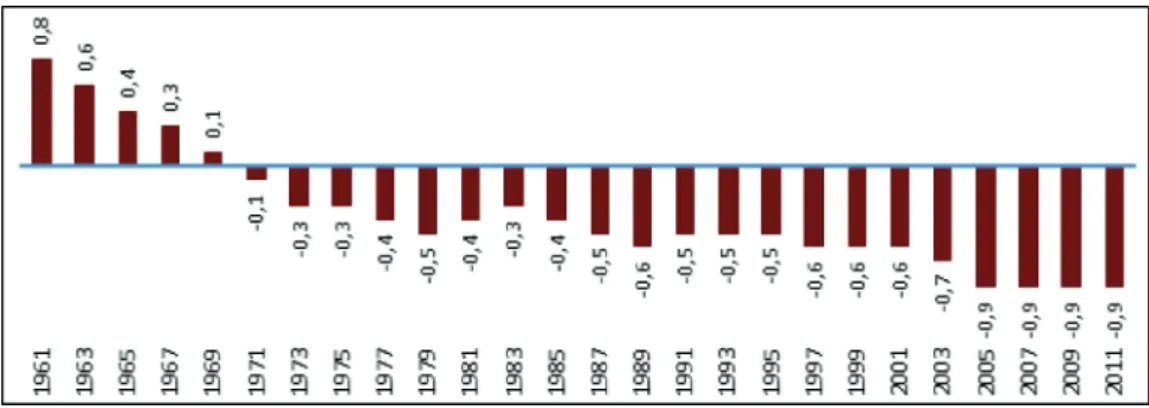
Figure 1. World ecological deficit – per capita (1961-2011)
Figure 1 clearly shows this relative slippage. The ecological deficit or, in other words, the gap between the global ecological footprint (which is increasing) and the planet’s bio-capacity (which is declining) has widened since at least the 1970s. This is a trajectory which points to a loss of direction for a civilization which was assumed to be lasting (Latouche, 2011) and to the conclusion that the promised redemption of the early days of sustainable development has not, in the final analysis, succeeded in throwing off superficiality and wishful thinking (Dryzek, 2005; Redclift, 2005).
While it is true that the idea of sustainable development implies correcting the capitalist/productivist model (the planet’s limits will not allow the continuous growth which today’s societies consistently demand), little has been done to reverse or even slow down the squandering of natural resources. On the contrary, the market imperative, “grow or perish”, has not only survived (Redclift 2009; Flinders, 2012) but has even flourished, in times of economic hardship, driven by the contingencies of the moment which tend to see growth as the most obvious solution (Guerra, Schmidt & Valente, 2017).
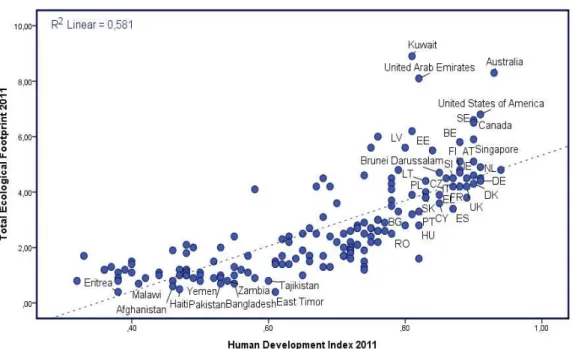
Figure 2. Ecological Footprint and Human Development Index in 2011
Source: Global Footprint Network. 2015
to confirm in practice, given the interdependence of these two areas, even so it means that most countries remain far removed from sustainability: rich countries, by default because the decline in environmental quality derives from excessive consumption; poor countries, by default because of the lack of quality of life in society due to scarce resources and above all to their unequal distribution.
As is argued in the 2011 Human Development Report, we are faced with an in-complete and counterproductive thought process which sees “sustainability, equity and the drama of the poor as separate and unrelated realities” (UNDP, 2011: 22), despite the growing interdependence between environmental decay and social decline which cannot be dissociated from the socio-economic model adopted. This, moreover, is one of the major concerns of Pope Francis in the “Laudato Si” encyclical, which states that it is impossible to dissociate environment and poverty. In this perspective, it is of fun-damental importance to look for comprehensive solutions which take into account the interactions of natural systems within themselves and with social systems. “There are not two separate crises, but a single, complex social and environmental crisis deriving from the trend towards increasing consumption and the consequently greater pressure on limited resources on the ecosystems which supply them, and also on the economies and societies which depend on them.” (Francis, 2015: 108).
The rate of consumption, waste, and alteration of the environment have exceeded the planet’s capacity to such an extent that current lifestyles can only end in disasters, as is already happening in several regions of the world. Scarcity is promoted, and socio--economic inequalities increase as a result, given that neither population nor resources are uniformly distributed, and even less so the ability to claim the use of those resources. That is why attenuating the effects of today’s imbalances depends, above all, on what we do now, especially if we think of the responsibilities with which we will be charged by those who will have to suffer the worst consequences, that is to say, both future generations and disadvantaged groups today (ibid.: 123).
The figures published by international institutions like the UN and the World Bank continue to be discouraging. According to the 2014 Human Development Report, the number of people living in extreme poverty is currently 836 million, that is 90 million more than what was expected before the financial crisis, albeit with some regional varia-tions. Some Latin American countries, like Brazil, are currently displaying a regressive tendency which may jeopardize the earlier gains of a period of straight growth and clear improvement in living standards and the fight against poverty.
Figure 3. Ecological Footprint in 2011 according to per capita GDP
Source: Global Footprint Network. 2015
Figure 3 makes these differences even clearer, and if there is no change, they will tend to widen. In 2011, populations of low-income countries limited themselves to 57% of the resources available to them to meet their consumption needs. This means that if everyone consumed at the level of those countries, world productive capacity would be more than enough for everyone’s needs. But if we look at the figures for high-income countries, consumption patterns are far in excess of the planet’s regenerative capacity, by a factor of almost three times the maximum (2.97). In other words, in order for all of us to enjoy the same level of consumption, we would need three planet Earths if regenerative load/capacity were not to be exceeded.
In sum, as Serge Latouche and others have emphasized, “if we take the ecological footprint of our lifestyle as the index of its environmental ‘weight’ on the surface of the Earth or in the required bio-productive space, we get unsustainable results in terms of equi-ty, of the right to extract natural resources, and of the planet’s load capacity” (2011: 38). It is therefore as part of a globally integrated approach to rescuing the multidi-mensionality of sustainable development that Sustainable Development Goals (SDGs) emerged, as adopted by all UN member states in New York in 2015. Along similar lines are the Paris Agreement Commitments achieved at COP 21, to be ratified in 2016 and entering into force subject to the fulfilment of two conditions: ratification by at least 55 countries accounting for at least 55% of global emissions.
The redefinition of the post-2015 UN development agenda seeks to address the challenge of achieving effectively sustainable development which goes beyond wishful thinking by embodying in Sustainable Development Goals better integration of the various aspects of sustainability. Based on the success of the earlier Millennium Development Goals, the aim now is to act on measurable targets and goals, incorporating less successful aspects and addressing failures and gaps, not forgetting the necessary involvement of all, in the change undertaking now being advocated (UN General Assembly, 2015). There are 17 SDGs and 169 targets, covering aspects as diverse and significant as the eradication of poverty and hunger, the reduction of social inequalities, access to health, education, water and sanitation, climate change and the decay of maritime and land-based ecosys-tems, accessible clean energy, gender equality, responsible production and consumption, urban sustainability, new job creation, access to justice and fighting corruption, and strengthening institutions which safeguard the common good.
As Jeffrey Sachs mentions, if this cross-cutting strategy is followed effectively, and it includes a monitoring plan with concrete targets, it may offer “the potential for effective change, on the way to a new agenda involving the whole global community” (Sachs, 2015: 505). Sachs is also confident that SDGs are more likely to succeed because, basically, unequal social needs are better integrated with the cross-cutting environmental imperatives in them, meaning that the necessary universality and transversality is achie-ved whereby all, without exception, are enjoined to “promote social inclusion, gender equality, and resilient low-carbon energy systems” (2015: 341).
Some equally important planning documents, further contributing to results, have been drawn up by several international organizations, notably including the European Commission, the OECD and above all the UN. These initiatives point to potential and viable pathways for implementing a more intelligent economic model in order to counter the prospect of human societal collapse.
Independent international organizations – the EC, the OECD, the UN, WBGU, SDC, etc. – thus produced, in 2009 and 2013, over thirty documents containing new proposals for responding to crises, putting forward concrete solutions as well as ideas for restoring environmental and social policies in an innovative way (Ferrão, 2014). These documents set out the economic assumptions on which world environmental, social and economic recovery must be based. In other words, they show how to restore the “health” of the economic system by creating jobs and enterprises and at the same time dealing with the “the crises of the crisis”: a dependence on fossil fuels, the depletion of finite resources and the global loss of biodiversity, the food disaster and tenacious poverty – problems which in turn affect the climate cycle, bringing huge risks in terms of climate change and its consequences.
particularly for vulnerable groups; promoting sustainable and inclusive growth, with a view to fulfilling Millennium Goals and Sustainable Development Goals, in particular by eliminating extreme poverty; and reducing dependency on carbon and ecosystem decay. In other words, to develop, yes, but without the poor multiplying beneath our feet and without feeding the two most significant risks faced by humanity today: climate instability and ecological scarcity.
The GGND favours investment in “green jobs” and “green growth”, while at the same time recommending political changes in key areas, such as subsidies which per-versely encourage intensive agriculture, over-fishing and the use of fossil fuels; a system of incentives to socially and environmentally responsible behaviour on the part of both individuals and businesses; and undertaking “green” fiscal reform which will create jobs and reduce emissions.
This reformist vision may be criticised for overly encouraging the greening of the economy, when what is needed are models of transition requiring deeper social and econo-mic change. There is accordingly an alternative vision, with closer ties to welfare econoecono-mics and the paradigm of more radical change, as exemplified in the document produced by the UK’s Sustainable Development Commission (SDC-UK) entitled Prosperity without Growth (Jackson, 2009), which has inspired policies not only for economic recovery, but also environmental and social regeneration in some regions of Europe. This includes, for example, moves to redefine the idea of “prosperity” in modern terms, offering a new culture of more sophisticated consumption, less addicted to heaps of useless products and the spiral of consumerism which has led to the crisis burdening us with unrepayable debt. It argues for a culture of environmentally and socially motivated consumption involving better use of knowledge and innovation, deploying new economic sectors with a different growth profile or, in other words, following energy and environment policies which are less predatory in terms of natural resources and fairer in social terms.
From the societal point of view, Jackson suggests a more collaborative economy, offering new lifestyles, combatting social inequalities through redistributive policies and mechanisms, providing universal access to quality education, investing in effective trai-ning processes, and regulating consumption and therefore advertising, with improved consumer protection and the promotion of fair trade.
From the political point of view he recommends effective support to countries of the South, encouraging the transfer of appropriate and culturally graspable technology along the lines of ‘Small is Beautiful’ (Schumacher, 1973), as well as institutional changes in line with the restructuring of the economy.
These planning documents are in harmony with SDGs and the analytical framework of the Paris Agreement: to find ways and forms of contributing to greater equity in the world by way of offsets and climate justice.
Climate Change: unsustainability in action
practi-ce little has been achieved to limit the consequenpracti-ces of human action on a planet with limits. Moreover, the increasingly rapid growth of the so-called “emerging economies”, especially China and India, at the beginning of the twenty-first century, exponentially aggravated the pressure on resources, making it even more urgent that there should be a plan for sustainable development, in other words for reconciling socio-economic and environmental needs.
Global warming, and the impact of climate change we are witnessing today, also revive the question of limits, providing confirmation of the most catastrophic forecasts. Over thirty years after the publication of the Brundtland Report, critiques of the ine-ffectiveness and ambiguity of sustainable development have taken on new life. Over all these years, it is argued, it has been possible for “business as usual” to continue, with permanent environmental decay as its consequence, so that climate change and the socio--economic impact it is having today take us back to the question first posed in “The Limits to Growth”, and which is even more acutely relevant today: how to reconcile long-term environmental goals with short-term economic logic, often shot through with national egotisms which are so difficult, or even more difficult, to overcome?
Contributing to this re-evaluation of environmental values, the decay of which is already affecting current generations, is the impact of climate change (extreme weather events, droughts, floods, ocean acidification, rising sea levels, coastal erosion …). Accor-ding to the most recent data, the human influence on the climate system today is clear, and the changes noted over recent decades (in every continent and ocean) not only have no known precedents, but also cannot be divorced from human action (IPCC, 2015). Today’s societies are faced with unprecedented risks and challenges which already affect the day-to-day lives of millions of human beings in the most diverse corners of the planet.
Again according to the IPCC - Intergovernmental Panel for Climate Change, in a context of progressive technical and scientific knowledge, the climate risk is the outcome of the interaction of two main factors:
i) The dangers associated with climate conditions (including extreme events and change trends);
ii) The vulnerability and degree of exposure of natural and human systems (in-cluding their capacity to adjust to change).
This means that the speed and magnitude of global warming and other changes in the climate system, together with the increasing acidification of the oceans, will only increase the risk of severe, diffuse and in some cases irreversible negative impacts, and that risk will increase globally, but particularly in certain regions or communities which are less well prepared to deal with change (IPCC, 2015: 13).
way they consume energy. For better or worse, and whether we want it or not, as Tim Jackson mentions (2009), we will be compelled to adjust to new environmental conditions and change our lives, that is to say, to seek prosperity without growth and without carbon.
What is certain is that, in today’s world, over ninety tons of CO2 are emitted every second, in a dynamic which makes it ever more plausible that the effects of climate chan-ge will be irreversible and its effects ever greater. Whatever may be done in the future, some facts are already irreversible, such as the rise in sea levels, and this means there is an urgent need to prepare ourselves for adjusting to climate change. Gas emissions from the use of fossil fuels have drastically altered the structure of Earth’s atmosphere. While on the one hand this destroys the planet’s equilibrium and human life in general, on the other hand, and more importantly, it puts at risk, above all, the lives of those who are least able to meet the challenges ahead, either because they live in areas prone to extreme events and other geographically determined climate phenomena, or because the place they occupy in the economy and society does not give them sufficient room for manoeuvre.
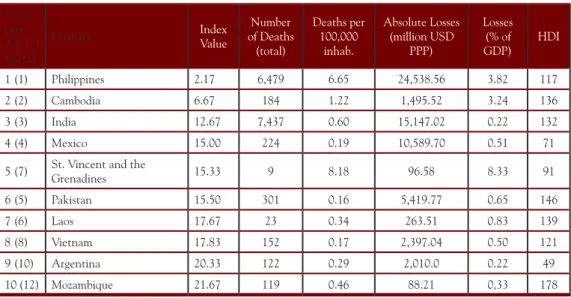
Table 1. Climate Risk Index 2013: 10 countries most affected
P o s i -tion 2 0 1 3 (2012) Country Index Value Number of Deaths (total) Deaths per 100,000 inhab. Absolute Losses (million USD PPP) Losses (% of GDP) HDI
1 (1) Philippines 2.17 6,479 6.65 24,538.56 3.82 117
2 (2) Cambodia 6.67 184 1.22 1,495.52 3.24 136
3 (3) India 12.67 7,437 0.60 15,147.02 0.22 132
4 (4) Mexico 15.00 224 0.19 10,589.70 0.51 71
5 (7) St. Vincent and the
Grenadines 15.33 9 8.18 96.58 8.33 91
6 (5) Pakistan 15.50 301 0.16 5,419.77 0.65 146
7 (6) Laos 17.67 23 0.34 263.51 0.83 139
8 (8) Vietnam 17.83 152 0.17 2,397.04 0.50 121
9 (10) Argentina 20.33 122 0.29 2,010.0 0.22 49
10 (12) Mozambique 21.67 119 0.46 88.21 0,33 178
Source: Kreft et al., 2015
The data set out in Table 1 once again confirm, and here taking only climate change into account, the relative vulnerability of poorer countries which, obviously, are home to the vast majority of disadvantaged groups, whose living standards are low and for whom the resources available to them to deal with its effects are scarce.
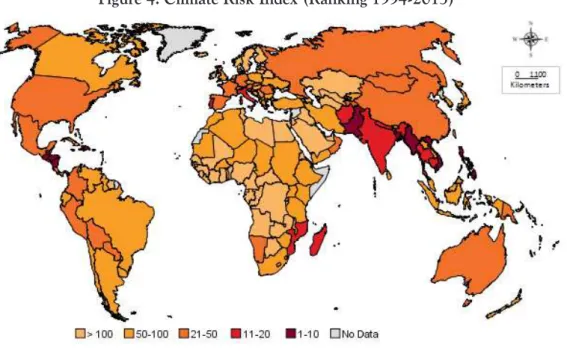
Nonetheless, while in terms of extreme weather events 2013 is likely to be remem-bered for typhoon Haiyan, which in November of that year caused over 1 billion dollars’ worth of damage and over 6,000 deaths, mainly in the Philippines, the Global Climate Risk Index for 1994 to 2013, based on the averages of these two decades, shows there are two relatively distinct groups: those which tend to be affected constantly by extreme events (e.g. Honduras, Haiti, Nicaragua, the Philippines, Bangladesh, Vietnam, Domi-nican Republic, Guatemala, Pakistan…) and those which are high up in the Index in specific years due to exceptional disasters (e.g. Myanmar, where in 2008 cyclone Nargis caused over 95% of the damage caused in that year; Honduras, where over 80% of the damage recorded between 1994 and 2013 was caused by hurricane Mitch in 1998; and Thailand, where the floods of 2011 represented 87% of all damage recorded in these two decades (Kreft et al., 2015)). In addition to these, there are the specific cases of Tuvalu, the Maldives, and Bangladesh, among others, which are particularly prone to damage from rising sea levels, regardless of greenhouse gas emissions.
Figure 4. Climate Risk Index (Ranking 1994-2013)
Source: Kreft et al., 2015
This does not mean that the most pernicious effects of climate change are limited to countries with a lower ranking on the HDI and lower incomes. The inclusion of some European countries in the list of most affected countries, including Portugal, is due to the number of deaths in the 2003 heatwave, in which over 70,000 people died in the whole of Europe (ibid.).
in extreme weather events in continental Europe, existing capabilities for dealing with them (including already ongoing forms of adjustment) mean that their impact and the resulting losses are lower.
Large swathes of public opinion and the powers in place at the various levels of environmental governance have thus demanded a comprehensive strategy for dealing with climate change. The meeting held in Paris between November 30th and December
11th of 2015, COP21 (the 21st annual session of the Conference of the Parties to the
1992 Framework Convention on Climate Change) sought to respond to that challenge. The agreement reached there, which was approved by 195 nations (COP 21, 2015) is a marker of a paradigm shift which, in the fight against climate change, recognizes the need to include the contribution of all (developed and developing countries), in an approach which reflects fairness in the distribution of effort and responsibility.
In other words, the Paris Agreement seems to have emerged as a new architecture for global environmental governance, one which seeks to be universal, balanced, ambi-tious and lasting. It seeks to address i) the feelings of despair and fatalism which seem to have taken hold of modern life, in a pattern where “the idea of ‘crisis’ is almost a cultural metaphor for contemporary politics” (Flinders, 2012: 138) and ii) the “cosmopolitan imperative: co-operate or fail!” (Beck, 2009: 258), which is the result of that widespread apprehension and of the real impact of the climate change being felt all over the world.
It is true that the COP 22 (Marrakesh, Morocco, November 2016) was overshadowed by the American elections results, and the victory of the ‘negationist’ Donald Trump. The consequences of this fact are still difficult to foresee, yet the impact of climate change, and the societal apprehension which has gradually produced the consensus surrounding it constitute factors which are driving governments to subscribe to the Paris Agreement
and to its efforts to ensure adjustment to change and the reduction of emissions. This is an impetus which is all the stronger on account of the urgency of achieving results and because it has become difficult to perceive any alternative to the broad, inclusive commitment which the Paris Agreement represents. Its provisions include:
• Reducing significantly the use of fossil fuels and committing to renewable energy; • Restating the objective of 2 degrees C and pursuing all efforts to limit the increase
in temperature to 1.5 degrees C;
• Significantly blurring the differences which marked the Kyoto Convention and
Protocol, thereby permitting all countries to contribute, according to their abilities, to meeting this challenge.
• Establishing 5-year contribution stocktaking cycles for all countries.
• Establishing the possibility of international co-operation using market mechanisms; • Restating commitments to supporting developing countries from various sour -ces, public and private, making countries responsible for mobilizing funding to implement measures necessary to mitigate and adapt to climate change.
by the presence of almost 200 countries at the talks. The Paris Agreement, signed and ratified by countries such as China (the first GHG emitter), includes a commitment to cut CO2 emissions and recognizes that the industrialized countries (the most obvious and unambiguous culprits) should contribute to the adjustment process in developing countries, in terms of both funding and technology transfer. However, along with re-newed hopes, there appears to be still a degree of mistrust among representatives of the latter. After the Paris Conference, the international media stated that some 100 billion dollars were envisaged in climate change aid to developing countries. But they also quickly drew attention to the fact that the agreement did not specify who should pay it and how it should be paid, and who has specific responsibilities in this domain. We shall see if the ratification of the Paris Agreement by the various countries and international organizations,in the current context and with a less successful COP 22, does not bring some unpleasant surprises and transforms a victory declared into a stack of empty and inconsequential promises.
Conclusion
The Sustainable Development Goals are universally applicable and encompass diverse countries and groups, which makes them more effective than the earlier Millennium Go-als. Along the same lines, the Paris Agreement acknowledges the need to incorporate the contribution of all countries, in an approach which distributes effort and responsibility fairly. 2015 thus drew to close with a new impetus at an international level, including new forms of governance and public involvement. No-one is exempt from efforts to achieve convergence, and it is to be hoped that countries both rich and poor will promote social inclusion, gender equality, environmental quality, low-carbon energy systems, etc. (Sachs 2015: 341), while recognizing that this effort should be weighted according to differing capabilities and responsibilities. It remains to be seen whether the blatant inequalities highlighted here will hinder the success of this strategy, if only because, in the contexts of almost permanent crisis which characterize periods of transition, risk and fear threaten to become omnipresent and to encourage national and group differences and egotisms.
Even so, according to Jackson (2009), we are approaching the “end of the era of irresponsibility”, which assumed resources were infinite, and it has become clear that prosperity will derive not so much from increasing consumption of natural resources, which are scarce and will become scarcer, but from the ability to engage citizens and their capacity, in the final analysis, for intervention in public life. Overcoming mistrust is the keystone in this process of change, requiring special attention to protecting the environ-ment (on which, in the end, human life depends) but also the necessary rebalancing of societal inequalities.
economic system – one which is socially and environmentally sustainable and, for that reason, economically viable.
The most fundamental point is to activate that most difficult factor of all: the public conscience, followed by civic and environmental culture and political leadership and decision-making. The first of these can only be achieved through education which breaks the vicious circle of ‘incapacitation’ (Sen, 2006; Schmidt, Nave, O’Riordan and Guerra, 2011).
The second aspect – activating a new civic and environmental culture – involves mass communication, beyond science and schools, and involves appealing to new social responsibility on the part of traditional media. National and international virtual com-munities also have a crucial role to play here (e.g. AVASE, Right2Water). It also involves wider access to scientific knowledge on the environment, with new forms of disseminating that knowledge so that it reaches many more people in accessible and comprehensible form. Finally, it also involves new forms of public participation, using new methodologies and newer, more inclusive civic spaces, starting at the local level.
The third aspect – mobilizing political leadership and decision-making and putting pressure on them – involves new forms of governance, opening them up to different actors and helping them to learn using multi-scale models. This is a pre-condition for sustainabi-lity, one which we might call ‘sustainable involvement’. To this end, among other things, it is recommended that knowledge be shared through a system of monitoring, information and transparency regarding the way resources (and incentive packages) are being used or wasted, defining evaluation tools according to statistically comparable criteria, as COP21 seeks to implement for greenhouse gas emissions. An essential component too is the ability to measure the contribution of the environment and environmental services to economic growth.
It is thus important to monitor the ongoing pursuit of SDGs and the implemen-tation of the Paris Agreement, where quantifiable and monitorable goals and objectives are posited and thus additional pressure on national governments are expected. We shall see whether the promised monitoring ability will properly guide the process of change or whether, despite all efforts, and as has happened in the past, the socio-economic status quo
will allow predatory approaches to persist, to the detriment of essential change in a future which, even more than desiring, we actually need. Especially because the aforementioned results of the US elections may once again undermine policies to combat climate change that, even a year ago, seemed guaranteed.
Bibliography
Adger, Neil and Andrew Jordan (2009) (eds). Governing Sustainability. Cambridge, Cam-bridge University Press.
Agyeman, Julian, Bullard, Robert & Evans, Bob (2004) (eds). Just Sustainabilities – De-velopment in an Unequal World. London: Earthscan Publications.
Beck, Urlich (2009). World at Risk. Cambridge: Polity Press.
Bulkeley, Harriet, Castán Broto, Vanesa, Hodson, Mike & Marvin, Simon (2011). Cities and Low Carbon Transitions. London: Routledge.
Byrch, Christine, Kate Kearins, Markus Milne and Richard Morgan (2007). “Sustainable ‘what’? A cognitive approach to understanding sustainable development”. Qualitative Research in Accounting & Management, Vol. 4 (1): 26 – 52.
Carter, Neil (2007). The Politics of the Environment – Second Edition. Cambridge: Cambridge University Press.
COP 21 (2015). Adoption of the Paris Agreement - Proposal by the President (Draft decision -/CP.21). Conference of the Parties – Twenty-first session, Paris, 30 November to 11 December 2015.
Dryzek, John (2005). The Politics of the Earth – Second Edition. Oxford, Oxford Uni-versity Press.
Dryzek, John (2006). Deliberative Global politics - Discourse and Democracy in a Divided World. Cambridge: Polity Press.
Ferrão, João (Ed.) (2004). Que economia queremos? Estudos da Fundação, Lisboa: Fundação Francisco Manuel dos Santos.
Flannery, Tim (2009). Now or Never - Why We Must Act Now to End Climate Change and Create a Sustainable Future. New York: Atlantic Monthly Press.
Flinders, Matthew (2012). Defending Politics - Why Democracy Matters in the Twenty-First Century. Oxford: Oxford University Press.
Francis, Holy Father (2015). ‘Laudato Si’ – Sobre o Cuidado da Casa Comum. Segunda Carta Encíclica do Papa Francisco, Lisboa: Paulus Editora.
General Assembly of the United Nations (2015). Sixty-ninth session - Transforming our world: the 2030 Agenda for Sustainable Development. New York: United Nations Orga-nization.
Global Footprint Network (2015). 2011 Ecological Footprint and Biocapacity Results for all countries included in National Footprint Accounts 2015. Oakland, CA: Global Footprint Network.
Guerra, João, Schmidt, Luisa & Valente, Susana (2017). Dilemmas of sustainability in turbulent times. In Telesiené, Audroné & Gross, Mathias (Eds) Green Europeans – envi-ronmental behavior and attitudes in Europe in a historical and cross-cultural comparative perspective. Oxon, Uk: Rutledge. 221-242.
IPCC (2015). Climate Change 2014: Synthesis Report. Contribution of Working Groups I, II and III to the Fifth Assessment Report of the Intergovernmental Panel on Climate Change. Geneva: IPCC. 151 pp.
Jackson, Tim (2009). Prosperity without Growth – Economics for a Finite Planet. London: Earthscan.
Kreft, Sönke, Eckstein, David, Junghans, Lisa, Kerestan, Candice & Hagen, Ursula (2015). Global Climate Risk Index 2015 - Who Suffers Most From Extreme Weather Events? Weather-related Loss Events in 2013 and 1994 to 2013. Bonn: Germanwatch.
Latouche, Serge (2005). Décoloniser l’imaginaire - La pensée créative contre l’économie de l’absurde. Lyon: Parangon/Vs.
Latouche, Serge (2011). Pequeno Tratado do Crescimento Sereno. Lisboa: Edições 70. Meadows, Donella, Meadows, Dennis, Randers, Jorgen & Behrens, William. 1972. Os Limites do Crescimento. Lisboa: Publicações Dom Quixote.
Redclift, Michael (2005). «Sustainable development (1987-2005): an oxymoron comes of age». Sustainable Development, 13 (4): 212-227.
Redclift, Michael (2009). “The Environment and Carbon Dependence: Landscapes of Sustainability and Materiality”. Current Sociology, 57 (3): 369–387.
Sachs, Jeffrey (2015). The age of sustainable development. New York: Columbia University Press.
Schmidt, Luísa & Guerra, João (2013). Do Ambiente ao Desenvolvimento Sustentável - Contextos e Protagonistas da Educação Ambiental em Portugal Revista Lusófona de Educação, 25: 193-211.
Schmidt, Luísa, Guerra, João & Nave, Joaquim Gil (2010). The role of non-scholar or-ganisations in environmental education: a case study from Portugal. International Journal of Environment and Sustainable Development, 9 (1/2/3): 16 – 29.
Schmidt, Luísa, Nave, Joaquim G., O´Riordan, Tim & Guerra, João (2011). “Trends and Dilemmas Facing Environmental Education in Portugal”. Journal of Environmental Policy and Planning, 13 (2): 159-177.
Schmidt, Luísa, Nave, Joaquim Gil & Guerra, João (2006). Who’s afraid of Local Agenda 21? Top-down and bottom-up perspectives on local sustainability. International Journal of Environment and Sustainable Development, 5 (2): 181-198.
Sen, Amartya (2006). “Human Rights and Capabilities”, Journal of Human Development and Capabilities, 7:151-166.
UNDP (2009). Global Green New Deal – Policy Brief, New York: United Nations Envi-ronment Programme.
UNDP, 2011. Human Development Report 2011 (Portuguese Version) – Relatório de De-senvolvimento Humano 2011 - Sustentabilidade e Equidade: Um Futuro Melhor para Todos.
Washington: Communications Development Incorporated.
UNDP, 2014. Human Development Report 2014 (Portuguese Version) – Relatório do Desenvolvimento Humano 2014 - Sustentar o Progresso Humano: Reduzir as Vul-nerabilidades e Reforçar a Resiliência. Washington: Communications Development Incorporated.
WCED (1987). Our Common Future. Oxford: Oxford University Press.
Submitted on: 07/03/2016 Accepted on: 26/08/2016
Abstract: The drive to economic growth has persisted in contemporary societies, despite its effects on the very foundations of the global economy, whereas the discourse of sus-tainability has not surpassed the level of “wishful thinking”. The evolution of the global ecological footprint, which underlines climate change impact, points to a narrow path in the reconciliation of social and environmental imperatives for present and future genera-tions and to a redoubled need for social and environmental equity. Within an approach that postulates a stronger connection between discourse and practice, both Sustainable Development Goals and COP21 Paris Agreement strengthen the strategy of universal involvement and commitment, recognizing the meagre nature of results obtained so far, and demanding alternative action for effective change regarding a new and strategic glo-bal agenda. This article reflects on this universal desideratum which requires redoubled attention to the decline – and also recovery - of environmental and social conditions.
Key words: Climate change, OP 21, SDG, Ecological Footprint, Sustainable development, COP 21, SDG.
Resumo: Apesar dos seus impactos sobre a base de sustentação da economia mundial, o impulso para o crescimento económico persiste transversalmente nas sociedades contempo-râneas, ao mesmo tempo que o discurso da sustentabilidade ainda não ultrapassa o nível do “wishfull thinking”. A evolução da pegada ecológica global, de que as alterações climáticas são a consequência mais mediática, aponta para um caminho estreito onde se anteveem dificuldades quer para as gerações futuras, quer para as gerações presentes e respetiva equi-dade sócio ambiental. Numa perspetiva que postula maior correspondência entre discursos e práticas, os Objetivos de Desenvolvimento Sustentável e a COP21 reforçam a estratégia de envolvimento e comprometimento universal, reconhecendo a magreza de resultados e reclamando uma alternativa de ação com potencial de efetiva mudança envolvente e global. Este texto procura refletir sobre este desiderato que, para ser bem-sucedido, implica uma atenção redobrada sobre a degradação e regeneração das condições ambientais e sociais.
Palavras-Chave: Alterações climáticas, Pegada Ecológica, Desenvolvimento sustentável, ODS, COP 21.
MAKING WISHFUL THINKING A REALITY – FROM SDGS TO COP21
el impulso para el crecimiento económico ha persistido transversalmente en las sociedades contemporáneas, independientemente del grado de bienestar adquirido (Latouche, 2005; PNUD, 2011). Esto se contrapone al discurso de sustentabilidad que ha ganado terreno considerablemente, pero sin sobrepasar el nivel de “wishful thinking” (Dryzek, 2005). A partir de postular una mayor integración de las distintas dimensiones del desarrollo susten-table y una mayor correspondencia entre discursos y prácticas, emergieron los Objetivos de Desarrollo Sustentable y transcurrió la COP 21. A raíz de ello, podremos presenciar un reforzamiento de la estrategia de participación y compromiso universal, que reconoce la escasez de resultados alcanzados hasta ahora y reclama una alternativa de acción “con potencial para un cambio efectivo”. Este texto buscar reflexionar sobre este deseo universal del siglo XXI que, para conseguir el éxito, necesita una atención redoblada, no solamente sobre la degradación de las condiciones ambientales, sino también sobre las sociales.