273 Sergio Pastor Ontiveros-Pérez
Doutorando
Universidade Federal do Rio Grande do Sul - UFRGS Departamento de Engenharia Mecânica Porto Alegre - Rio Grande do Sul - Brasil [email protected]
Letícia Fleck Fadel Miguel
Professora - Doutora
Universidade Federal do Rio Grande do Sul - UFGRS Departamento de Engenharia Mecânica
Porto Alegre - Rio Grande do Sul - Brasil [email protected], [email protected]
Leandro Fleck Fadel Miguel
Professor - Doutor
Universidade Federal de Santa Catarina - UFSC Departamento de Engenharia Civil
Florianópolis - Santa Catarina – Brasil [email protected]
Optimization of location
and forces of friction dampers
Abstract
Damper optimization is a new area which has been investigated in recent years. There are various methods employed in optimization, among which are highlighted the classic and the most recent that are functioning with reliability, eficiency and speed for optimum results. This paper proposes a method for simultaneous optimization of placement and forces of friction dampers using the Firely Algorithm, which is a recent meta-heuristic algorithm inspired in the behavior of irelies.
Herein, three different optimization objective are presented: i) minimize the maximum displacement at the top of the structure; ii) minimize the maximum inter-story drift; iii) minimize the maximum acceleration at the top of the structure. The three objective functions were evaluated in two civil structures (a nine-story building and a sixteen-story building) subjected to two real seismic records. The irst seismic record is El Centro, which took place in the southeastern California on the boarder of the United States and Mexico in 1940. The second one is the earthquake that oc-curred in Caucete, province of San Juan, Argentina, in 1977. The results showed that the proposed method was able to optimize the friction dampers, reducing considerably the response of the structures.
Keywords: damper optimization, friction dampers, Firely Algorithm. http://dx.doi.org/10.1590/0370-44672015700065
Civil Engineering
Engenharia Civil
1. Introduction
The effect of vibrations in buildings caused by dynamic loads such as earth-quakes have been the focus of study by sev-eral researches as well as the methods used for energy dissipation avoiding structural damage. Energy dissipation in structures is possible through damping device imple-mentation. These devices can be active or passive and their application depends on the investment for the project. Because of their characteristics, passive devices stand out among energy dissipation systems, increasing the development of several of these devices, such as, viscoelastic damp-ers, metallic yield dampers and friction dampers (Soong and Dargush, 1997).
Recently, several researchers have been working in the optimization of the
location of the dampers in structures and their parameters. In this way, it is possible to ind many papers about the optimiza-tion of passive dampers in literature (e.g., Fang et al. (2012) and Takewaki et al.
(2012)). With the aim to allow an eco-nomic use of friction dampers, several authors have developed methodologies for the optimization of friction dampers in civil structures and their research can be found in literature (e.g, Ontiveros-Pérez (2014); Miguel et al. (2015); Miguel et al.
(2016a) Miguel et al. (2016b)).
However few studies have been con-ducted on the simultaneous optimization of locations and friction forces of friction dampers. Metaheuristic algorithms are able to deal with this kind of optimization
problem. Some of the salient characteris-tics of these kinds of algorithms are: (a) they do not require gradient information; (b) if the metaheuristic algorithm is cor-rectly tuned, it does not become trapped in local minima; (c) it is possible to apply in problems with discontinuous functions; (d) they provide a set of optimal solutions rather than a single one, giving to the designer a range of options to choose from; (e) it is possible to use to solve mixed-variable optimization problems (Miguel et al., 2012, 2013). Thus, note
that the optimization of friction dampers is a relatively unexplored subject in the world, and this paper proposes a method for optimization of this kind of passive energy dissipation device.
2. Problem formulation
2.1 Equation of motion
Mx+Cx +Kx = Fex- Ffn (1)
274
force is represented in Equation 1, where
M and K are the n×n size structural mass
and stiffness matrices respectively and n is the degree of freedom number. The damp-ing matrix C is proportional to the M and K matrices. The n -dimensional vector x
represents the relative displacement with respect to the base, and the differentiation with respect to the time is represented
with a dot over the displacement vector symbol. The external force and the Cou-lomb friction force are represented by the n -dimensional vector Fex and Ffn respectively. Fex = -MBxg, where B is a n×d matrix that
contains the cosine directors of the angles formed between the base motion and the direction of the displacement considered degree of freedom (DOF). d is the number
of directions of the ground motion and xg
is the d-dimensional ground acceleration vector of the seismic excitation.
Coulomb friction force is represent-ed by Equation (2) where μ is the friction coeficient (assumed as constant), N is the
normal force vector, sgn() is the signal
func-tion and v(t) is the relative velocity vector
between the ends of the damper.
¨
¨
Ffn= µ N sgn (v (t)) (2)
It is important to note that the mag-nitude of the friction force is constant but its direction is always opposite to the sliding velocity. The changes in the direction of the velocity cause disconti-nuities in the friction force, leading to dificulties to evaluate the response of a system with friction dampers. For this reason, herein is implemented one of four
continuous functions proposed by Mo-staghel and Davis (1997) that represents the discontinuity of the Coulomb friction force. Each one of these functions uses a (αi) parameter which controls the level
of accuracy of the function representing the friction force. The continuous func-tion used in this paper is the funcfunc-tion
f2 (α2 v)=tanh(α2 v) with α2=1000, as
already used in previous studies, as Miguel et al. (2008), Miguel et al. (2014),
Ontiveros-Pérez (2014)).
A computational routine based on the inite differences method was devel-oped in MATLAB to solve the Equation 1, determining the dynamic response in terms of displacement of a system with friction dampers.
2.2 Friction damper operation
This device uses the solid friction mechanism to give the desired energy dis-sipation in order to reduce the amplitude of the vibration system. The friction devel-oped between two solid bodies sliding in relation to one another inside the friction damper allows the energy dissipation in a civil structure subjected to an earthquake.
Herein, the numerical scheme of
the friction damper Model A proposed by Miguel (2002) (see Figure 1 b)) is used. This damper used brass as mate-rial to generate friction and consequently energy dissipation. Thus, the control of normal force at the contact between the brasses is given by two compression springs. This model can be applied in structures subjected to any type of
dy-namic load, such as earthquakes, both in metallic structures and in concrete structures. It may be placed as diagonal bracing bars, as shown in the diagram of Figure 1 a). In addition, if the reader requires more information about the friction damper Model-A, the authors recommended read the Master disserta-tion of Miguel (2002).
(a) (b)
Figure 1
a) n-story building with friction dampers.
b) Friction damper Model-A.
2.3 Analyzed structures
A nine-story building and a six-teen-story building, 3 m high on each
loor and 4 m wide have been simulated.
Figure 1(a) shows the diagonal disposi-tion of the fricdisposi-tion dampers and the arrows represent the degrees of freedom of each story for both structures. The
properties of each structure are presented in Table 1.
Initially, the natural frequencies of the structures were determined, which are important parameters to determine the integration step ∆t=1×10⁻⁴)s that
must be less than a critical time step to
275
Nine-story mass lumped structure properties.
Story (i) Mass (mi) in kg Stiffness (ki) in N/m
1 to 2 103017.33 9.89E8
3 to 6 103017.33 7.90E8
7 103017.33 4.04E8
8 103017.33 2.89E8
9 103017.33 1.85E8
Sixteen-story mass lumped structure properties
Story (i) Mass (mi) in kg Stiffness (ki) em N/m
1 68530 2.56E9
2 to 13 57940 2.56E9
14 to 16 56660 1.74E9
Table 1 Properties of the buildings.
Building f1 f2 f3 f4 f5
9-Story 2.26 5.35 8.89 11.64 14.72
16-Story 3.18 9.28 14.96 20.74 26.59
Table 2 First five natural frequencies of the structures.
In order to illustrate the proposed optimization procedure, two real seismic records were chosen as excitation to the structures analyzed. The irst seismic record is the earthquake that occurred in Caucete, province of San Juan, Argentina, in 1977
and the second is the El Centro earthquake, which occurred in the southeastern Califor-nia on the boarder of the United States and Mexico in 1940. As known, earthquakes are stochastic in nature and because of that, researchers have been working on
develop-ing robust optimization methodologies that allow projections for friction dampers that are less sensitive to the uncertainties of these phenomena and it is possible to ind some works in literature (e.g., Miguel et al. (2014)
and Miguel et al. (2016b)).
2.4 Dampers optimization
In this work, the simultaneous optimization of friction dampers is used with the aim of minimizing three differ-ent objective functions (see Table 3): (i) the maximum displacement at the top of the structure Dmax, (ii) the maximum
inter-story drift dmax and (iii) the maximum
acceleration at the top of the structure Amax.
In order to ind the best local minima, the authors developed a computational routine using MATLAB, linked with the Firely Algorithm. The Firely Algorithm
is a metaheuristic algorithm developed by Xin-She Yang, in 2008. If the reader requires more information about the Fire-ly Algorithm, the authors recommended
reading the book Yang (2008). Notably, the optimization problem considered in this paper is complex because there are discrete and continuous design variables at same time. The location of the friction dampers is a discrete design variable, whereas the friction force of each device is best represented by a continuous number; this is a continuous design variable. The constraints are the number of available
positions for the friction dampers (np) and
the maximum number of dampers to be installed in the structures (nd). In the
nine-story building, the maximum number of positions is np=9 (one in each story) and
the maximum number of friction damp-ers to be optimized is nd=3. Whereas, in
the sixteen-story structure, the maximum number of positions is np=16 and the
maximum number of friction dampers is nd=4. For the discrete design variables
(P positions), the lower and upper
boundaries highlight stories of the structure. For the continuous design variables (friction forces), the limits adopted for both the nine-story struc-ture and sixteen-story strucstruc-ture are
500kN≤Ffn≤1500kN for Caucete
earth-quake and 1400kN≤Ffn ≤2400kN for El
Centro earthquake. Due to convenience of notation, design variables are grouped into y = [ P Ffn].
For purposes of ensuring optimal response, preventing the Firely Algo-rithm from converging at local
opti-mum, the irelies’ population was set
at ifty irelies and the iterations at one thousand. In each iteration, the Firely Algorithm will analyze ifty objective
functions, saving the best objective in each iteration and comparing it with the above until it completes the number of iterations. In terms of computational time, convergence criteria by iteration number present a moderated cost, around ive hours using an Intel Core I7-4700MQ processor. In order to improve the optimization technique, the authors developed other convergence criteria us-ing a counter that counts the iteration number without changing the incum-bent (best objective of present iteration) until getting to one hundred (the 10% of the iterations previously determined, that is, one thousand). Thus, the Firely Algorithm may converge by either of
276
Find y
Minimize Z1 (y)=Dmax(y) Z2 (y)=dmax (y) Z3 (y)=Amax(y)
Subjected to
3. Analyzing results
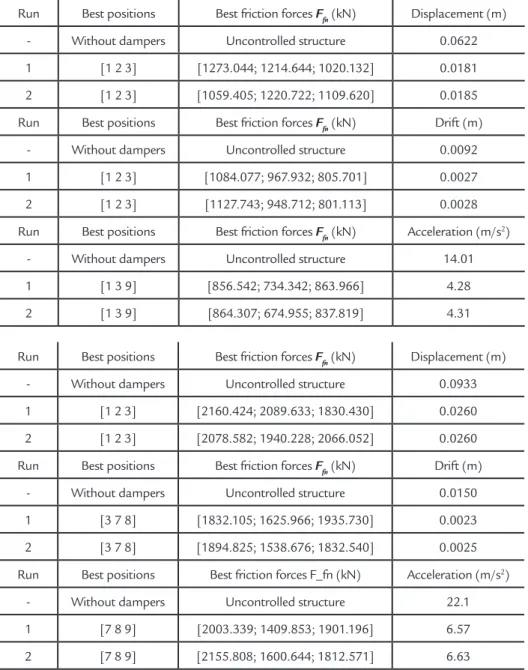
The results of the friction damper optimization for each structure subjected to two seismic records are present in this section. Thus, regarding the nine-story building, Table 4 and 5 show that in each objective function (displacement, inter-story drift and acceleration) the optimal place for the friction dampers in two independent runs is the same, obtaining a reduction between 69% and 83% for both cases of the Caucete and El Centro
earth-quakes. In the case of Caucete earthquake, for the displacement and inter-story drift objective functions, the best positions are the three irst stories, obtaining reduction over 70% and for acceleration at the top, the positions have changed, so the second and third damper took a different posi-tion; that is, the new positions are close to the middle and in the top of the structure, thus, ensuring better acceleration control. For the case of El Centro earthquake,
for each objective function the positions are different, since El Centro has a peak ground acceleration greater than the Cau-cete earthquake and possibly excited the second and third vibration mode of the structure. On the other hand, the results show that the structure presents a good performance with three friction damp-ers when it is subjected to two different seismic records, as is possible to be seen in Figure 2 a), Figure 2 b) and Figure 2 c).
(a)
(b)
(c)
(e) (d)
(f) Figure 2a) Maximum displacement
per story for nine-story building. b) Maximum inter-story
drift per story for nine-story building. c) Maximum acceleration
per story for nine-story building. d) Maximum displacement per story for sixteen-story building. e) Maximum inter-story drift per story for sixteen-story building. f) Maximum acceleration
per story for sixteen-story building. Table 3
277
Run Best positions Best friction forces Ffn (kN) Displacement (m)
- Without dampers Uncontrolled structure 0.0622
1 [1 2 3] [1273.044; 1214.644; 1020.132] 0.0181
2 [1 2 3] [1059.405; 1220.722; 1109.620] 0.0185
Run Best positions Best friction forces Ffn (kN) Drift (m)
- Without dampers Uncontrolled structure 0.0092
1 [1 2 3] [1084.077; 967.932; 805.701] 0.0027
2 [1 2 3] [1127.743; 948.712; 801.113] 0.0028
Run Best positions Best friction forces Ffn (kN) Acceleration (m/s2)
- Without dampers Uncontrolled structure 14.01
1 [1 3 9] [856.542; 734.342; 863.966] 4.28
2 [1 3 9] [864.307; 674.955; 837.819] 4.31
Run Best positions Best friction forces Ffn (kN) Displacement (m)
- Without dampers Uncontrolled structure 0.0933
1 [1 2 3] [2160.424; 2089.633; 1830.430] 0.0260
2 [1 2 3] [2078.582; 1940.228; 2066.052] 0.0260
Run Best positions Best friction forces Ffn (kN) Drift (m)
- Without dampers Uncontrolled structure 0.0150
1 [3 7 8] [1832.105; 1625.966; 1935.730] 0.0023
2 [3 7 8] [1894.825; 1538.676; 1832.540] 0.0025
Run Best positions Best friction forces F_fn (kN) Acceleration (m/s2)
- Without dampers Uncontrolled structure 22.1
1 [7 8 9] [2003.339; 1409.853; 1901.196] 6.57
2 [7 8 9] [2155.808; 1600.644; 1812.571] 6.63
Run Best positions Best friction forces Ffn (kN) Displacement (m)
- Without dampers Uncontrolled structure 0.0309
1 [1 2 3 4] [1347.064; 1261.545; 1284.420; 977.418] 0.0111
2 [1 2 3 4] [1435.804; 1402.845; 934.765; 1029.105] 0.0114
Run Best positions Best friction forces Ffn (kN) Drift (m)
- Without dampers Uncontrolled structure 0.003
1 [1 2 3 4] [1170.998; 1017.468; 827.659; 653.227] 0.001
2 [1 2 3 4] [1374.319; 1054.604; 871.663; 744.612] 0.001
Run Best positions Best friction forces Ffn (kN) Acceleration (m/s2)
- Without dampers Uncontrolled structure 13
1 [1 2 3 4] [1268.854; 1101.253; 1245.189; 911.714] 4.73
2 [1 2 3 4] [1328.322; 1197.209; 1063.332; 967.793] 4.78
Table 4 Optimal force and placement of friction dampers for nine-story structure subjected to Caucete earthquake.
Table 5 Optimal force and placement of friction dampers for nine-story structure subjected to El Centro earthquake.
On the other hand, concerning a sixteen-story building, Tables 6 and 7 show that for each objective function, the optimal place for the friction dampers
did not change in two independent runs, obtaining a reduction between 54% and 69% for both the Caucete earthquake and El Centro earthquake. This optimal
results show that the structure presents a good behavior with four friction damp-ers, as is possible to appreciate in the Figure 2 d), Figure 2 e) and Figure 2 f).
278
Run Best positions Best friction forces Ffn (kN) Displacement (m)
- Without dampers Uncontrolled structure 0.0481
1 [1 2 3 4] [2273.058; 2017.112; 1684.062; 1781.484] 0.0149
2 [1 2 3 4] [2289.553; 2207.992; 2062.549; 1738.898] 0.0155
Run Best positions Best friction forces Ffn (kN) Drift (m)
- Without dampers Uncontrolled structure 0.0047
1 [1 2 3 4] [2326.140; 1959.337; 1970.104; 1806.928] 0.0015
2 [1 2 3 4] [1765.789; 1791.773; 1726.467; 1711.397] 0.0016
Run Best positions Best friction forces Ffn (kN) Acceleration (m/s2)
- Without dampers Uncontrolled structure 18.72
1 [1 2 3 4] [2109.650; 2013.593; 1902.379; 1628.848] 8.19
2 [1 2 3 4] [1861.356; 1814.622; 1539.999; 1795.197] 8.65
Table 7
Optimal force and placement of friction dampers for sixteen-story structure subjected to El Centro earthquake.
4. Conclusions
Damper optimization using meta-heuristic algorithms is a relatively new area, and today is one of the most explored ields of knowledge because there is the need to confront new chal-lenges for designing safer, economically feasible structures in locations with high seismic activity. Thus, this paper proposed an optimization methodology for optimum use of friction dampers. It is noteworthy that the optimization of
this sort of damper (friction damper) is a relatively unexplored subject in the world, which proves the innovative character of this paper.
Through the numerical simulations presented, it was concluded that in all cases studied the proposed methodology proved to be very effective in reducing the dynamic response, reaching reduc-tions of over 70%, and in a worst case scenario, reached reductions in the
or-der of 54%. It is noteworthy that these reductions have been achieved with a limited number of friction dampers due to the fact that these dampers have been optimized, i.e., they are positioned in places where they dissipate more energy and their capacities (frictional forces) are also optimal.
Finally, this study showed that it is possible to design friction dampers through an economical and effective way.
Acknowledgments
References
The authors acknowledge the inancial support of CNPq and CAPES.
FANG, J., WANG, Q., WANG, S., WANG, Q. Min-max criterion to the optimal de-sign of vibration absorber in a system with Coulomb friction and viscous damping.
Nonlinear Dynamics, v. 70, p. 393-400, 2012.
MIGUEL, L. F. F. Estudo teórico e experimental de amortecedores de vibração por atrito. Brasil: Programa de Pós-Graduação em Engenharia Civil, Laboratório de
Dinâmica Estrutural e Coniabilidade, UFRGS, 2002. (Master Dissertation). MIGUEL, L.F.F., RIERA, J.D. Controle de vibrações de estruturas utilizando
amor-tecedores por atrito. Revista Internacional de Desastres Naturales, Accidentes e Infraestructura Civil, v. 8, n. 1, p. 57–70, 2008.
MIGUEL, L. F. F., FADEL MIGUEL, L. F. Shape and size optimization of truss struc-tures considering dynamic constraints through modern metaheuristic algorithms.
Expert Systems with Applications, 39, p. 9458-9467, 2012.
MIGUEL, L.F.F., LOPEZ, R.H., MIGUEL, L.F.F. Multimodal size, shape, and to-pology optimisation of truss structures using the Firely algorithm. Advances in Engineering Software, v. 56, p. 23–37, 2013.
MIGUEL, L.F.F., MIGUEL, L.F.F., LOPEZ, R.H. Robust design optimization of friction dampers for structural response control. Structural Control and Health Monitoring, v. 21, n. 9, p. 1240-1251, 2014.
MIGUEL, L. F. F., FADEL MIGUEL, L. F., LOPEZ, R. H. A irely algorithm for the design of force placement of friction dampers for control of main-induced vibra-tions in footbridges. Optimization Engineering, v. 16, p. 633-661, 2015.
opti-279
mization of force and placement of friction dampers under seismic loading. Engine-ering Optimization, v.48, n.4, p. 582-602, doi:10.1080/0305215X.2015.1025774
MIGUEL, L. F. F., FADEL MIGUEL, L. F., AND LOPEZ, R. H. Failure probability minimization of buildings through passive friction dampers. The Structural De-sign of Tall and Special Buildings, Online, 2016b. doi: 10.1002/tal.1287
MOSTAGHEL, N., DAVIS, T. Representations of Coulomb friction for dyna-mic analysis. Earthquake Engineering and Structural Dynamics, v. 26, n. 5,
p.541–548, 1997.
ONTIVEROS-PÉREZ, S. P. Otimização simultânea de posições e forças de amor-tecedores de vibração por atrito para controle de vibrações de estruturas. Brazil: PROMEC/UFRGS, 2014. (Dissertação de Mestrado).
SOONG, T.T., DARGUSH, G.F. Passive energy dissipation system in structural engi-neering. Chichester, U.K., Wiley, 1997.
TAKEWAKI, I., TSUJI, M., YOSHITOMI, S., ADACHI, F. Nonlinear optimal oil damper design in seismically controlled muli-story building frame. Soil Dynamic and Earthquake Engineering, v. 44, p.1-13, 2013.
YANG, XS. Nature-inspired metaheuristic algorithms. United Kingdom: Luniver Press, 2008, 116 p.