DESIGN INADEQUACIES ANALYSIS IN LOW
INCOME HOUSING SERVICE AREAS
Mariana M. X. Lima1; Sara C. Maia2; José de Paula Barros Neto3
ABSTRACT
Satisfaction surveys for housing units in Brazil have shown low levels regarding the service areas inside the units (kitchen and laundry spaces). In many cases, the poor quality of built environment is a consequence of overlooking user’s value-based requirements. This paper presents the results of a research conducted with an objective to identify and comprehend service spaces design inadequacies. We used qualitative methods of data collecting and analyzing, such as interviews, observations, physical and photographic surveys. The results presented can be used as inputs to the funding agencies’ evaluation on housing projects, as building standards for regulatory agencies, and as new standards for the development of housing products; which will contribute to improve technical, functional and spatial quality of such buildings.
KEY WORDS
Housing, Requirements Management, Value-Adding, Architecture, Service Areas.
INTRODUCTION
The current programs of housing provision initiative in Brazil set financial limits that demand more rigorous control of costs and productivity from the construction companies. Often the cost control is reversed into diminished technical, functional and spatial quality of the buildings. This indiscriminate or ill-considered reduction in quality, in turn, leads to low levels of user satisfaction.
Satisfaction surveys that consider value-adding to housing products in Brazil (Costa et al. 2008, Sampaio et al. 2009) highlight, among the problems related to architectural design, a constant dissatisfaction with service areas (kitchen, laundry and other spaces for service activities) in the evaluated houses. This result is recurrent in diverse standards of enterprises, not limited to units of smaller area or those aimed to low income families. However, it’s in this last case that the results are the worst, also considering the inadequacy of equipments designed for such units’ standards.
The study was delimited for projects that comprehend residential units geared for families with income of approximately U.S. $ 775 to $ 27004 per month.
Despite the verification of dissatisfaction regarding the service areas in housing, studies had not advanced to the identification of issues that could induce such dissatisfaction nor to the proposal of improvements and solutions to these issues. It is,
1
M.Sc. Civil Engineering, Department of Structure and Construction Engineering
(www.deecc.ufc.br), Federal University of Ceara; PhD Student, Department of Architecture and Construction, School of Civil Engineering, Architecture and Urban Design, University of Campinas – Campinas, SP, Brazil, [email protected]
2
Architect, Department of Architecture and Urbanism, Federal University of Ceara, Fortaleza, CE, Brazil, [email protected]
3
Full Professor, Department of Structure and Construction Engineering (www.deecc.ufc.br), Federal University of Ceara, Fortaleza, CE, Brazil, Phone +55 85 3366-9607, [email protected]
4
however, necessary to convert the data obtained in satisfaction surveys and post-occupancy evaluations into design inputs.
From this, the present research aims to identify design inadequacies in the service areas inside housing units, setting up the basis for new design guidelines proposals5 that allow improvement of housing quality, based on the concept of value generation for the client, as suggested by the principles of Lean Thinking. According to Lean Construction and TFV theories, the value of production aspects can only be defined by the client, as the satisfaction of their needs and expectations is the main goal of production in all its stages. However, it is in the design phase that customer requirements are captured and where the concept of value becomes the most relevant. Therefore, this research seeks to understand especially the design factors that contribute to the users’ dissatisfaction.
Surveys of built environment evaluation are plotting a major role in the diagnosis of contemporary housing production situation in Brazil and its relation to the final client of the buildings. This research goes beyond diagnosis and contributes to the generation of important information to feed back into the design process and encourage improvements in the quality of newly built environments, by considering the users’ needs to add value to the product.
VALUE GENERATION FOR THE CLIENT
The problems identification and the posterior solutions recommendations for real estate products proposed by this research are based on the concept of generating value for the client, according to TFV (Transformation-Flow-Value) Theory of Production. This theory integrates the concepts of production associated with transformation, flow and value and with their corresponding principles, not treating them as adverse.
According to Koskela (2000), in the first concept (transformation) production is seen as the transformation of inputs into finished products. According to this view, the total transformation can be decomposed into a sequence of smaller ones. Thus, overall process improvement is obtained by improving the sub processes individually. In the second concept (flow), production is not only seen as the sum of sub processes. Apart from these, activities to connect them - the flow activities - must be considered as well, e.g. moving, waiting and inspection. However, such activities, except in very specific cases, do not add value to the product. The concept of flow in production suggests as the main starting point for production improvement the reduction of non value-adding activities, therefore eliminating waste.
In the third concept (value), production incorporates the client. In its essence, production value can only be set contingent on the clients given that satisfaction of their needs and requirements is the main goal of production. In this case, the input of production processes is derived of clients’ dependent information. The client’s requirements are captured and processed in the design phase into product attributes. The client also provides the delivery order, which, along with design data, triggers production. The production completes the cycle, turning the design into finished product. Generation of value consists in the perceived possibility of fulfillment of clients’ needs through provided product or service (Maia et al. 2011).
with time and context. For this purpose, post-occupancy evaluations (POE) play a very important role. POE measures users’ satisfaction with the built environment and identify attitudes and behavior of the occupants (Green and Moss, 1997). Its results serve as inputs for the continuous improvement of design and product. On Lean Project Delivery System, POE results may be used as input at the project definition phase (Ballard, 2000).The POE techniques are the basis for the present research’s method development.
After capture the client’s requirements, it must be translated on product attributes. To do so, some methods were developed, one of which is Quality Function Deployment (QFD). This method was developed within manufacturing, but has been largely applied on construction industry to prioritize needs and transforming them into product attributes (Delgado-Hernandez et al. 2006; Lima et al. 2008).
METHODOLOGY
For this research, our objects of study are buildings that had been subject to satisfaction survey developed by the Research and Consulting Group in Construction Management at Federal University of Ceara (GERCON/UFC). A total of 14 housing units were analyzed in three different buildings. All buildings are composed of blocks whose units are comprised of two bedrooms, one bathroom, living room and kitchen with integrated laundry. The units’ private areas are: 47.06m2, 45.30m2 and 43.00m2.
The diversity of units’ family profiles surveyed allowed a greater richness in data collection, considering use diversity of space in each case. We used multiple data sources and therefore multiple collection procedures to obtain data that would allow identification of functional, constructive, environmental comfort, cost and user’s appropriation aspects. Through literature review (Romero and Vianna 2002, Creswell 2003, Pinheiro and Gunther 2008, Angrosino 2009) and considering the issues to be identified, we selected the procedures listed below, followed by their products:
• spatial reading: observational notes and characterization form; • unstructured open interview: transcripts and report sheet; • physical survey of the unit: graphic record, and
• photographic survey: a photographic record.
In addition to collecting information about user’s needs, we conducted interviews with: two professionals from a company manufacturer of appliances for low income homes (a manager of advanced engineering for new product development and a product designer); an engineer from the institution responsible for administration and maintenance of such buildings; and an engineer and an architect directly related to the process of design evaluation from the institution that finances those enterprises.
Data analysis consisted in extracting meaning from texts, drawings and images. In this qualitative case study, this involves a detailed description of scenery and people. The analysis procedure adopted was based on Creswell (2003) and Gibbs (2008) proposals, culminating in the following sequence of steps.
• To get a general sense from the observations: data were coded by their readings and identified commonalities. Elements referring to a code were named evidences.
• To categorize data: the evidences were grouped by similarity between the ideas they refer to, composing categories. The categories were developed from characteristics identified in literature review and from the satisfaction surveys of studied buildings.
• To relate categories: it was identified how categories interfere with each other. The study of the relationship between them allowed the identification of problems, causes and of some design attributes consequences.
• To interpret data: the organized data was processed and interpreted. In a following stage of this study, it resulted in the definition of new design parameters for the service areas in social housing (Lima, 2010).
This paper presents the analysis of identified design inadequacies.
ANALYSIS OF DESIGN INADEQUACIES IN SERVICE AREAS
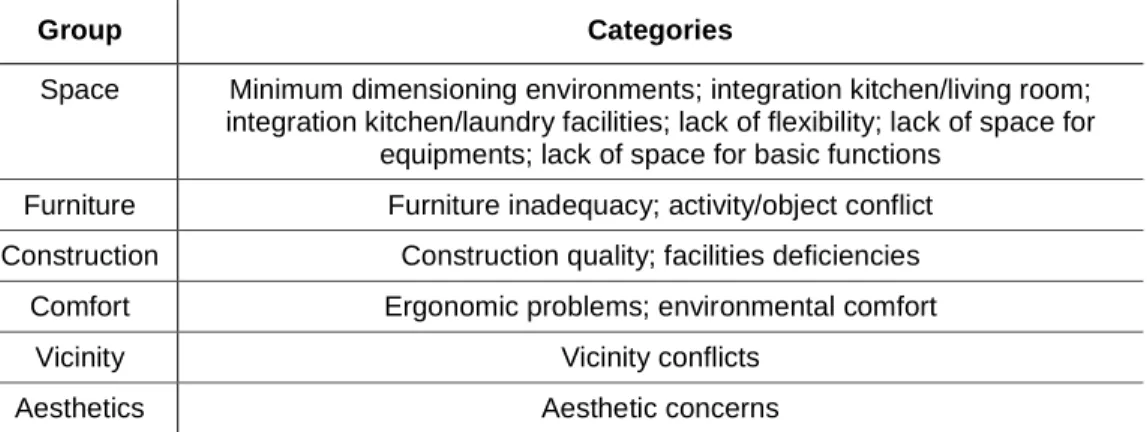
The inadequacies identified were divided into 14 categories, which were gathered into six groups according to their affinities. Table 1 illustrates the groupings.
Table 1: Groups of categories
Group Categories
Space Minimum dimensioning environments; integration kitchen/living room; integration kitchen/laundry facilities; lack of flexibility; lack of space for
equipments; lack of space for basic functions
Furniture Furniture inadequacy; activity/object conflict
Construction Construction quality; facilities deficiencies
Comfort Ergonomic problems; environmental comfort
Vicinity Vicinity conflicts
Aesthetics Aesthetic concerns
Next we explain each category, highlighting the main findings of this research.
MINIMUM DIMENSIONING OF SPACES
The minimum dimensioning refers to the adoption of the smallest possible spaces for the exercise of a given set of activities, established by legislation, literature or empirical observation. The first evidences of inadequacy’s causes point to the minimum dimensions of the service spaces, which is a result of the minimal dimensioning of the whole housing unit. The kitchens and laundries of the studied cases have a total of 5.80 m2, 6.63 m2 and 8.08 m2.
user’s profile. It is also observed that the design did not consider all the furniture necessary for the set of activities performed by the building’s final clients.
The pursue of minimum dimensioning of spaces in the design phase, as found in the studied cases, resulted in a lack of flexibility and induced the spatial integration of both laundry and living room to the kitchen. There’s also a link between minimum dimensioning and the inadequacy of adopted furniture. In part because the design does not consider all furniture required and partly because the furniture is not scaled taking into account the space where it will be arranged. Design should therefore consider the possibility of flexible space to suit the different needs of users.
SPACES INTEGRATION: KITCHEN/LIVING ROOM
The integration of the kitchen with the living room is a habitual solution to mitigate the feeling of confinement that arises from the small kitchen areas. In general, this solution is well accepted, because, besides allowing a greater visual range for both environments, this integration also contributes to a more tenuous differentiation between sectors, allowing wider interaction between hosts and visitors or between family members while they perform different activities.
The need for the user to execute multiple tasks simultaneously is also eased with this spatial arrangement. We frequently observed tasks of food preparation and child care occurring at the same time. The possibility to watch television from the living room while working in the kitchen has also been repeatedly cited as an advantage.
The main result of this integration is a major aesthetic concern with the service areas as they merge visually and spatially with the social areas. The acceptance of the open kitchen reflects a change in habits and customs of the population, which results in changes in the design and use of living space. This service area is no longer a space for household chores, but has instead merged with the prime area of the house to become a space for family meetings and receiving guests or visitors.
SPACES INTEGRATION: KITCHEN/LAUNDRY FACILITIES
Unlike the consensus that exists regarding kitchen and living room integration, the combination of kitchen and laundry raises disagreements between users. The integration between these spaces, kitchen and laundry, is a solution to the confinement of laundry that results from its restricted dimensions. One problem arising from this integration is the conflict between certain activities and objects; as an example, the stove is often too close to the laundry area.
On the other hand, because of this integration, the kitchen benefits from using the natural lighting and ventilation from the laundry’s window. That is: even if the laundry room was big enough, if there were no window in the kitchen, these spaces would still need to be integrated with the other. The impossibility of opening specific window in the kitchen is a consequence of the great density of units in the site, which increases the confined perimeter of the units and reduces their rates of externalization.
LACK OF FLEXIBILITY
A key consequence of minimum dimensioning, as observed in the analyzed buildings, is the lack of space flexibility. The concept of flexibility adopted here refers to adaptability, i.e., the versatility of use of the housing units’ spaces, without the need for interventions of constructive order. The service areas are normally sized according to a given predesigned layout and, as the dimensioning is restricted to that layout, the rooms only allow a single arrangement, which, when not obeyed, compromises the functionality of the entire space.
The need for specific facilities for certain equipments, such as gas plant for the stove or water drainage for the washing machine, as well as the stiffness of basin and tank positioning, they make of kitchen and laundry rooms very little flexible in terms of spatial arrangement. Aggravating it, design does not consider all the furniture and equipments required for all the tasks users need to perform in that space, resulting in undersized rooms; also electrical facilities are over rationalized and have deficient number of outlets, hampering the possibility of different arrangements for appliances.
Moreover, it is important to consider the need for customization and space appropriation by the users. Since the main structure of such mass-produced standard units cannot readapt to every user’s needs and particularities, it must be left to the residents the possibility of planning and customization of internal space as a mean of place attachment. Thus, the problem is not only of functional order. The simple obedience of the proposed layout, as it is suggested, would not be the best solution. It is important to allow the space to be occupied differently by different families.
LACK OF SPACE FOR EQUIPMENTS
Often pre-designed layouts and furniture sets can’t adapt to users’ real needs for equipments arrangements. It was observed that the lack of space flexibility, as well as the use of inappropriate furniture, results in impairment of the space demanded by equipments. In turn, their positioning in an inadequate space affects the space required for basic functions and generates conflict between functions and objects.
It was noticed that the lack of space for equipments is a consequence of the lack of space flexibility together with furniture inadequacy. That is, the adoption of furniture that do not fit properly into the space designated to them, or an arrangement that is different from the one proposed in the original design, they compromise the appropriate location of part of the equipment.
LACK OF SPACE FOR BASIC FUNCTIONS
One of the main consequences of the lack of space for equipment is the lack of space for execution of activities and basic functions inherent of kitchen and laundry spaces.
FURNITURE INADEQUACY
We found some functionality impairment in the service areas due to the inadequacy of the furniture used by the residents. This inadequacy does not have a direct cause/consequence relation with the minimum dimensioning design. However, the more restrictive the space available is for the furnishing, the more important is accuracy in the design of furniture. That is usually not possible, since it is common the purchase of ready-made furniture for the analyzed building’s users, and it is also therefore essential the commitment of furniture industry in the development of appropriate furniture for the actual needs of this particular market segment.
A quantitative study in this research identified that 98% of kitchens in the analyzed projects presented a solution of linear wall for the service areas and that 94.64% of the of them proposed service spaces with areas of 6.12m2 and 8.90m2 (Lima et al. 2010 .) This combination leads to very narrow kitchens, as it is the case of the housing units in two of the analyzed buildings, whose kitchens have a width of 1.50m and 1.80m. The third building’s units, with kitchens width of 2.45 m, have presented minor functionality problems due to inappropriate furniture.
ACTIVITY/OBJECT CONFLICT
This category refers to the evidence of conflicts caused by the incompatibility of objects (architectural, equipments or furniture) and the activities conducted in the space. This is mainly due to the integration of kitchen with laundry facilities and lack of space for equipments residents normally make use of.
It was observed that the most intense conflicts occur due to excessive proximity between laundry and kitchen. This incurs technical problems and discomfort for users. For instance, the activities of washing and drying clothes accelerate the wear of cooking and storage equipments. Moreover, as reported by users, proximity of fire to clothes and overheating equipments occasion feelings of discomfort and insecurity.
CONSTRUCTIVE ASPECTS QUALITY
The wet areas of buildings, which comprehend kitchen and laundry areas, are usually the ones of most expensive construction due to the type of finishing, the need for waterproof sealing and the concentration of electrical, plumbing and gas facilities. In the attempt to reduce this cost, decisions are made that often compromise the construction quality and functionality of the housing units.
As an example, the location of all plumbing outlets in the same wall and the short distance between them, on one hand reduces the cost of facilities, but on the other hand creates functional conflicts as outlined in the previous item. In addition, poor construction quality, especially when it leads to problems such as leaks and fissures that degrades environment ambience of the house, often fails to attend basic expectations of the final client.
The search for cost reduction can also be observed in finishing materials, for example the lack of washable coating on the walls adjacent to the laundry tank and the reduction of sealed area. In addition, we observed that poor construction quality also affects facilities, but these were grouped into a specific category.
FACILITIES DEFICIENCIES
need for specific facilities in the service areas limits the possibility of variations in the spatial arrangement of these spaces, while a larger amount of outlets enable different locations for equipments, and thus greater flexibility. It is essential to study the best distribution of facilities’ outlets for fixed equipments considering the user’s habits and needs in order to promote value-adding (instead of derogatory) savings.
Also, problems caused by deficiencies in facilities, both electrical and plumbing, are of difficult solution by the residents. They usually represent higher costs and greater demand of work, such as breaking walls for placement of ducts and pipes, and often requiring skilled labor. These factors make good design and good execution indispensable for achieving long lasting housing quality and user’s satisfaction.
ERGONOMIC PROBLEMS
From observations and surveys, the main ergonomic problems identified are the ones regarding posture, spatial displacement and accessibility.
The postural problems were due to harmful postures resulting from furniture inadequacies and inappropriate reaching ranges. The inconvenient route distances to conduct activities, such as the case of residents who use the building’s common areas for drying clothes, were identified as the main problem regarding spatial displacement. As for accessibility, users complain about the restricted area to perform certain activities, which compromises mobility within the proposed space.
One of the factors that contribute to these problems is the lack of consideration of user’s displacement patterns in the kitchen, concentrated in the areas of food cleaning and preparation, storage and cooking. Another factor is the area restriction, which makes many activities overlap or to be transferred out of the housing unit.
ENVIRONMENTAL COMFORT
The main problems related to environmental comfort are inadequate ventilation and lighting. These problems arise from the impossibility of opening windows in the kitchen due to the low externalization rate of the units. The lighting and ventilation of kitchen is indirect, occurring through the laundry’s window that often, in the densest buildings, opens into a shaft.
The solution adopted affects the comfort of the whole apartment, since it makes it difficult for cross ventilation to happen. For the laundry, the solution is not ideal because the sunstroke incident in the well is insufficient to dry clothes. The situation is further aggravated by residents often closing this frame for privacy, which ends up affecting the kitchen, that gets dimly lit, hot and with an impaired exhaustion.
VICINITY CONFLICTS
It was found that vicinity conflicts occur mainly due to: (1) lack of privacy caused by visual access between apartments, (2) appropriation of building’s common areas by some residents for drying clothes, and (3) units’ damage due to poor building quality.
AESTHETIC CONCERN
The service areas have become more exposed as it was integrated into the social areas of the housing units. The change, which resulted in a greater visual permeability of those spaces and its associated objects from the social rooms of the housing unit, led to a higher aesthetic concern with the service areas. This attribute implies a greater appreciation of the visual aspects that compound the service sector at the expense of, or in complementation with, functional aspects. Thus, it is value-adding everything that suggests aesthetic benefits, especially those associated with social status.
Importantly, from a symbolic point of view, the kitchen is strongly related to the standard of housing wealth. For many of the residents interviewed, the richer the resident, the better is the kitchen.
Residents seek furniture and equipments that have strong visual appeal. It’s also in order to improve visual appeal that they modify the finishing of service spaces, replacing plastics tops and cement countertops for granite countertops; change ceramic tile 20x20cm by others of larger dimensions; replace the half-wall coating for a full-wall one (usually with fillets details); among other symbols related to economic standards. Such behavior reveals the need to satisfy aspects of self-esteem and achievement.
CONCLUSIONS
There is a change in the use of living spaces related to changes in habits and customs of the population, with its corresponding reflection in the service areas’ space. This space that initially was leisure, living and workspace place, currently consists of kitchen and laundry facilities, often in a single room that does not allow the presence of more than one person, due to the continuous reduction of housing areas.
This reduction is connected, on one hand, to demographic aspects, such as the reduction in the number of inhabitants per household over the past years in Brazil. However, other social changes have occurred without yet being reflected in the spatial structure of housing, especially in the studied areas. Among these changes, we highlight the increased purchasing power of lower economic classes in Brazil and women's participation in the labor market.
The justification for the restricted dimensions of the service area spaces, as well as its inferior constructive standards, below recommended, is based upon the pursuit of cost reduction. This arises from the idea that these spaces are the most expensive ones in a housing unit construction; therefore, they’re the ones with higher margins for cost reduction. However, this reduction directly affects user satisfaction and hampers the overall housing quality. Thus, a discrepancy was noticed about the living spaces, specially service areas: how they were originally designed, the way it is actually occupied by the users and the activities developed in these spaces.
It emphasizes the importance of searching for new design guidelines for service areas in social housing. Such guidelines should consider, besides the costs, new consumption patterns and target families habits and behaviors.
ACKNOWLEDGMENTS
REFERENCES
Angrosino, M.V. (2009). “Ethnography and participant observation.” Artmed, Porto Alegre. (in Portuguese)
Ballard, G. (2000). Lean Project Delivery System. LCI White Paper #8. 7pp.
Costa, G.S.; Barros Neto, J.P; Alves, T.C.L. (2008). “Customer satisfaction researches in civil engineering and value generation in housing projects.” Proceedings of the 28th National Conference in Industrial Engineering, ENEGEP, Rio de Janeiro, Brazil. (In Portuguese)
Creswell, J.W. (2003). “Research design: Qualitative, quantitative, and mixed method approaches.” 2nd ed. Sage Publications, UK.
Delgado Hernandez, D.J., Bampton, K.E., Aspinwall, E., (2007). “Quality function deployment in construction”. Construction Management and Economics, 25, pp. 597–609.
Gibbs, G. (2008). “Analyzing qualitative data”. Sage Publications, USA.
Green, S.D., Moss, G.W., (1998). “Value management and post-occupancy evaluation: closing the loop”. Facilities, 16, pp.34–39.
Koskela, L. (2000). “An exploration towards a production theory and its application to construction”, PhD Thesis, Technical Research Centre of Finland-VTT, Helsinki.
Lima, L.P., Formoso, C. T. , Echeveste, M.E.S., Tzortzopoulos, P. and Kagioglou., M. (2008). “Client requirements processing in low-income house-building using visual displays and the house of quality”. Proceedings of the 16th Annual Conference on Lean Construction, IGLC, Manchester, University of Salford, UK, pp.459–470.
Lima, M.M.X. (2011). “Design inadequacies analysis in low income housing service sector from the users’ value generation point of view”. Dissertation in Civil Engineering. Federal University of Ceara, Fortaleza. (In Portuguese)
Maia, S., Lima, M., and Barros Neto, J. P. (2011). “A systemic approach to the concept of value and its effects on lean construction.” Proceedings of the 19th Annual Conference on Lean Construction, IGLC, Lima, Perú, pp.22-32
Pinheiro, J.Q. and Gunther, H. (2008). “Research methods in person-environment studies.” Casa do Psicólogo, São Paulo. (In Portuguese)
Romero, M.A.; Vianna, N.S. (2002). “Research methods for post-occupancy evaluation in low-income housing projects: from urban design to housing units.” In: ABIKO, A.K.; ORNSTEIN, S.W. (ed). Inserção Urbana e Avaliação Pós-Ocupação APO da Habitação de Interesse Social. FINEP, São Paulo, pp. 210-241. (In Portuguese)