The new great promise
in drug innovation: RNA
interference from the
laboratory to the clinic
C
arlos
F
rederiCo
M
artins
M
enCk
Introduction
T
he RNA molecule has been recently identified as a possible drug capa-ble of revolutionizing the way we provide treatment for a large number of human diseases. The biological activities of these molecules, which are generally used in the form of double-stranded RNA, were discovered in the 1990s through the identification of mechanisms of RNA interference and are based on the ability of these molecules to reduce (interfere with) the expression of certain target genes. The therapeutic potential of double-stranded RNA is enormous, particularly in genetic processes that require inhibition of gene prod-ucts. Among the target diseases are therapies for tumors and infectious agents, especially viruses, but several other human diseases will also be controlled by the action of these molecules. The relatively large size of RNA molecules, especially compared to some chemical drugs, can be one of the problems to be faced by research on the topic, but what draws attention is the ease with which these molecules can be designed, depending solely on the sequence of the target gene basis. Several clinical protocols have been tested in humans in recent years, with promising results. It is possible that soon this type of drug will be found in phar-macies: it pays to know why!RNA is not just a mere DNA messenger
The molecular mechanism leading to gene silencing remained unknown for a few years until the groups of American scientists Andrew Z. Fire and Craig C. Mello, working with the nematode worm Caenorhabditis elegans, found that double-stranded RNA molecules (dsRNA) could silence gene expression (Fire et al. 1998). The experiments that led to this finding are extremely simple: when analyzing the effect of gene silencing of antisense as well as sense single-stranded RNA molecules (in relation to the direction of the target gene’s mRNA ecule), the researchers found that the effect of the use of double-stranded mol-ecule increased by 100-fold. In view of the ability of dsRNA to interfere with gene expression, the mechanism began to be called RNA interference or simply RNAi.
The mechanism of RNA interference works in human cells
This silencing mechanism was initially demonstrated in worms, plants and insects, but it took three years for its existence to be demonstrated in human cells (elbashir et al., 2001). These experiments indicated the evolutionary im-portance of RNAi mechanisms in eukaryotes in general and sparked ideas for the potential technological use of dsRNA molecules as the basis for gene silencing for therapeutic purposes in humans. Furthermore, researchers also identified small dsRNA molecules (in the form of hairpins) synthesized by the cells them-selves from their genome, whose function is to control the expression of cellular genes. These endogenous RNA, which became known as microRNA (miRNA), demonstrate that the RNA functions in the cell far exceed those of a simple message. Doctors Fire and Mello were awarded the Nobel Prize for Medicine in 2006 for their discovery.
How RNA interference works in the cell
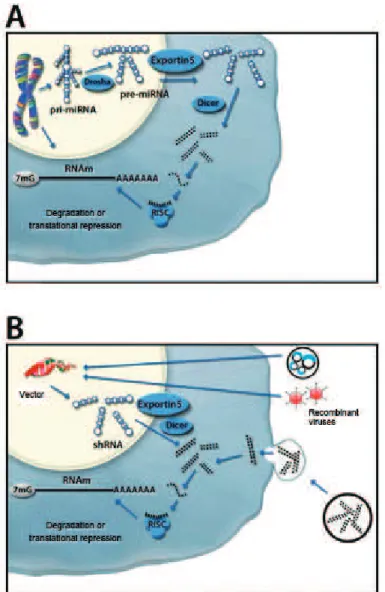
miRNA can regulate hundreds of genes and each target gene can be regulated by multiple miRNA, thus demonstrating the complexity of this gene regulatory network. Figure 1 shows a scheme depicting in simplified form how the RNA interference mechanism works (for a review, see Liu, 2008).
Figure 1 – RNA interference activity in animal cells. A) Schematic of the RNA inter-ference mechanism indicating the main proteins/protein complexes in-volved; B) schematic showing how we can use these mechanisms to guide gene silencing, with RNA duplexes (siRNA), or viral or non-viral vectors for shRNA expression.
experi-ments the sequence of dsRNA molecule is defined by the researcher to interfere in the target gene of choice. This strategy can also be used directly in vivo (in animals or in humans), and hence the possibility of drug development (Tiemann & Rossi, 2009).
Basically, two different approaches may be used. In the first, gene vectors usually derived from viruses (such as adenoviruses, retroviruses or adeno-asso-ciated viruses) are transduced into cells to express genes that are transcribed in dsRNA molecules in the form of a hairpin (similar to miRNA). These molecules are known as shRNA (short hairpin RNA) and target the gene to be silenced. The shRNA is cleaved by Drosha and processed by the cellular RNA interfer-ence machinery. Although this approach requires the production of viral vec-tors, which is not a simple process from the drug production perspective, as we shall see there are some therapeutic strategies being tested, such as clinical protocols in humans using vectors expressing shRNA.
In a second approach, small dsRNA molecules can be introduced directly into cells in culture, aiming at the specific degradation of the target gene. These molecules are known as siRNA (small interfering RNA) and can be introduced into the cell using different strategies. Currently, several biotech companies of-fer siRNA molecules for any human (or mouse) gene the researcher wishes to silence. An important feature is the size of the duplex, which should be between 19 and 30 base pairs, since larger sizes can induce nonspecific interferon re-sponses in animal cells.
In cell culture, the introduction of siRNA molecules is generally made by the formation of complexes of these duplexes with chemical or lipid polymers, usually cationic. The complex is endocytosed by cells, and RNA duplexes are released into the cytoplasm and processed by the RNA interference machinery, promoting the target gene silencing. siRNA has been widely used in functional genomics studies and in different clinical trials because of the robust and specific gene silencing induced by these molecules. easy manipulation and the existence of siRNA sequences for any human genome gene have made the use of this tool accessible to different groups of basic and applied research.
Interfering with gene expression in vivo
completed and it was found that siRNA molecules have been introduced in in-dividuals with no regard for any possible toxic effects. More than that, in several cases it was possible to identify the functioning of these duplexes in silencing the target gene, as desired.
The development of RNAi-based therapy has become an attractive and promising research area, particularly in cases where inhibition of certain pro-teins was unsuccessful by traditional pharmacological methods. Furthermore, as the development of RNA duplexes depends only on knowledge of the target gene sequence, the development of these drugs is extremely simple compared to traditional drug design, which requires knowledge of the crystallographic structure of the target protein, which is no guarantee of success in determining the active ligands in these structures. Although there are cases in which duplexes may act on targets other than the expected ones (effect known as off-target), several experimental protocols have demonstrated the specificity provided by the sequence of these molecules, thus encouraging further research in the area.
Figure 2 – Main pathways used for gene silencing through direct action in human protocols with RNA interference.
Interfering in the human genome for therapeutic purposes
Although the existence of the RNA interference mechanism in human cells has been known for a relatively short time (since 2001), it is surprising to see how quickly clinical protocols using RNAi were initiated in humans. This speed and relative success in some of these protocols enable predicting that in a few years these molecules will be sold in our pharmacies and/or applied in our hospitals (Tiemann & Rossi, 2009).
Among the main indications for the use of RNA interference are those involved in ophthalmic therapies. This is basically due to the compartmentaliza-tion of the eye, which allows direct administracompartmentaliza-tion of intravitreal injeccompartmentaliza-tions. The eye compartment is freed of nucleases, and siRNA molecules are introduced into target cells. These advantages have been exploited by drug therapies using oligonucleotides, already on the market (Vitravene®, Novartis and Macugen®, Pfizer). With RNA duplexes (siRNA), clinical trials have focused on the treat-ment of age-related macular degeneration (AMD). The developtreat-ment of vas-cularization at the back of the eye, especially in persons over sixty years of age, impairs vision in AMD patients, and treatment with siRNA aims to silence the expression of genes related to vessel development, such as VeGF-I (vascular endothelial growth factor). Phase II/III clinical trials in 217 patients showed an improvement in visual acuity in two-thirds of the patients, demonstrating that this technology may be close to being approved for marketing. however, there are some problems related to the administration system (intraocular injection) and interestingly, despite positive results, there is controversy as to the fact that part of the effects is due to non-specific immune responses, and not to specific silencing by siRNA (hubschman et al. 2009). Similar studies have been con-ducted using siRNA against VeGF-A in diabetic patients with macular edema.
Phase II clinical protocols are also being conducted to combat infections by respiratory syncytial virus (RSV). In this case, siRNA molecules against viral genes are administered to the patients by inhalation. Apparently, RSV viruses replicate super-ficial epithelial cells from the lung which, in turn, are able to endocystose RNA du-plexes, so that viral silencing is efficient. Clinical trials with 88 healthy adult individuals demonstrated that siRNA molecules were safe, with infection levels significantly lower compared to individuals who received placebo (De Vincenzo et al., 2010).
In addition to the clinical protocols mentioned here, the RNA interfer-ence technology is also being used in clinical trials for many other diseases, such as hepatitis B, different types of tumors (including melanoma), hypercholes-terolemia, acute kidney injury, etc. Many target genes are being tested against cancer: oncogenes, cell-cycle and apoptosis mediators, genes involved in protein degradation and stability, angiogenesis, molecules related to metastatic invasion and cell adhesion. Moreover, our proposal is the use of siRNA as co-adjuvants in therapeutic treatments with ionizing radiation and chemotherapeutic agents. To that end, we are currently testing the silencing of target genes such as those en-coding anti-apoptotic, multidrug resistant proteins and even proteins involved in DNA repair. Certainly, given the number of preclinical tests under way, the list of target diseases to be tested directly in humans through different strategies using RNA interference should be greatly expanded.
The gold rush in the development of new RNAi-based therapies
The discovery of RNA interference mechanisms, although recent, has sparked a true revolution in the way the functioning of genes in the cells is studied, and also opened up prospects for direct in vivo intervention in gene action. In many cases of human diseases there is an increase in the expression of some genes, and controlling these genes through silencing sparks hope for novel forms of therapy. Chemical inhibitors remain an extremely interesting alternative for many of these diseases, but the RNA interference mechanism provides a simple approach (search for sequence complementarity) for obtain-ing drugs, thus expandobtain-ing its potential use and reach. efforts to use this new biotechnology in the clinic have been in tune with one of the most important recent examples of translational medicine, in which trials move quickly form the laboratory to the patient’s bedside. The challenges are still great, with the need for new strategies to maximize the action of effector molecules within cells, as well as of mechanisms of molecule administration and delivery to target organs. Many strategies are proposed, in theory, for targeting these molecules to with a view to ensuring greater specificity in the target tissue, but tests are necessary to demonstrate effectiveness in practice.
developing therapeutic protocols. In Brazil these studies are still in their infancy, so that only a few research groups in universities have mastered the technology for the use of RNA interference. even fewer groups are directly involved in the development of new technologies based on this approach. If this true intellec-tual silencing persists in the area, we will have to pay dearly for the patents and the use of novel drugs that will most likely be sold in the coming decades.
References
De VINCeNZO, J. et al. A randomized, double-blind, placebo-controlled study of an RNAi-based therapy directed against respiratory syncytial virus. Proc. Natl. Acad. Sci. USA, v.107, p.8800-5, 2010.
eLBAShIR, S. M. et al. Duplexes of 21-nucleotide RNAs mediate RNA interference in cultured mammalian cells. Nature, v.41, p.494-8, 2001.
FIRe, A. et al. Potent and specific genetic interference by double-stranded RNA in Caenorhabditis elegans. Nature, v.391, p.806-11, 1998.
hUBSChMAN, J. P. et al. Age-related macular degeneration: experimental and emer-ging treatments. Clin. Ophthalmol., v.3, p.167-74, 2009.
LIU, J. Control of protein synthesis and mRNA degradation by microRNAs. Curr. Opin. Cell Biol., v.20, p.214-21, 2008.
SINGh, S. K.; GAUR, R. K. Progress towards therapeutic application of RNA interfe-rence for hIV infection. BioDrugs, v.23, p.269-76, 2009.
TIeMANN, K.; ROSSI, J. J. RNAi-based therapeutics - current status, challenges and prospects. EMBO Mol. Med., v.1, p.142-51, 2009.
abstraCt – The discovery of gene silencing mechanisms in our own cells using Rna
interference is very recent. however, in less than a decade scientific investigation has progressed enough to make us see that, very soon, we will use this knowledge for therapeutic purposes. RNA duplexes are potential pharmaceutical drugs and there are high investments in this new strategy. The promising gene therapy seems to finally reach maturity with these new tools.
Carlos Frederico Martins Menck is a professor at the Department of Microbiology, In-stitute of Biomedical Sciences (ICB), University of São Paulo. @ – [email protected]