* Corresponding author. Mailing address: Instituto de Ciências Biomédicas II, Departamento de Microbiologia, Universidade de São Paulo, Av. Prof. Lineu Prestes, 1374, Cidade Universitária, CEP 05508-900, São Paulo SP, Brasil. Fax: (+5511) 3818-7354. E-mail: [email protected].
MYCOFLORA AND AFLATOXIN/FUMONISIN PRODUCTION BY FUNGAL ISOLATES FROM FRESHLY HARVESTED CORN HYBRIDS
Adriana P. Almeida1*; Benedito Corrêa1; Marisa A. B. Mallozzi2; Eduardo Sawazaki3; Lúcia M. Valente Soares4
1Instituto de Ciências Biomédicas, Departamento de Microbiologia, Universidade de São Paulo, São Paulo, SP, Brasil. 2Instituto
Biológico de São Paulo; São Paulo, SP, Brasil. 3Instituto Agronômico de Campinas, Campinas, SP, Brasil. 4Faculdade de
Engenharia de Alimentos, Universidade Estadual de Campinas, Campinas, SP, Brasil.
Submitted: March 17, 2000; Returned to authors for corrections: June 15, 2000; Approved: October 20, 2000
ABSTRACT
The mycoflora of 3 hybrids of freshly harvested corn grains collected from three regions of the state of São Paulo, Brazil (Assis, Capão Bonito and Ribeirão Preto) was investigated. A total of 66 samples were analyzed focusing on the influence of abiotic factors (moisture content, water activity, temperature and rainfall) on both the prevalence of Aspergillus flavus and Fusarium moniliforme, and the ability of these genera isolates to produce aflatoxins and fumonisins, respectively. In the three surveyed regions, the fungal population comprised mainly Fusarium spp., Penicillium spp., Aspergillus spp. and 2 others filamentous fungal genera, which were isolated from corn kernels showing water activity of 0.30 to 0.99 and moisture content of 5.0% to 20.2%. Among the genera Fusarium and Aspergillus, the most frequent species were
F. moniliforme and A. flavus, respectively. Concerning the toxigenic potential of F. moniliforme, all isolated strains (40) produced fumonisins at 20 µg/g to 2168 µg/g (FB1) and/or 10 µg/g to 380 µg/g (FB2). From the 10 A. flavus isolates, 6 strains (60.0%) produced aflatoxins at 615 µg/kg to 30.750 µg/kg (AFB1) and/or 11 µg/kg to 22 µg/kg (AFB2).
Key words: aflatoxins, Aspergillus flavus, fumonisins, Fusarium moniliforme, corn
INTRODUCTION
The corn in Brazil has an important role in both human and animal nutrition, and has been ranked as the third world producer following the USA and China. Recently, the Brazilian annual corn yield reached 32 tons (32), of which 41% was used for poultry and swine consumption, where approximately 24.7% is directly used in farms, produced significantly by small producers (26).
The mean productivity of 2.747 kg corn/ha recorded in the state of São Paulo in 1990-94 reflects a poor local technology (31). The corn fields in this state correspond to7% of cultivated land and cover a mean area of 13.28 ha (10); 61.93% of the farmers receive technical assistance, 44.14% use soil analysis, and 46.23% use hybrid grains (10).
Grain spoilage reduces the nutritional value of cereals, resulting in world losses of foodstuff in 5% (14). Improved storage
MATERIALS AND METHODS
Grain samples
Three corn cultivars (hybrids BR-201, C-901 and CX-322) of 1995 crop were selected according the harvest period required from seeding to harvest. The hybrids were cultivated in three regions of the state of São Paulo: Assis (22°40 latitude, 50°28 longitude), Capão Bonito (24°02 latitude, 48°22 longitude) and Ribeirão Preto (22°11 latitude, 47°48 longitude), Brazil. Sixty six samples were analyzed, 30 of which were from Assis, 18 from Capão Bonito and 18 from Ribeirão Preto.
Moisture content and water activity
The moisture content of the corn grains was determined in the storage in loco immediately after sampling, using a Brow
Duvel moisture meter (Model CA 25II, Gehaka Co.). Water activity was determined by automated analysis using AQUALAB CX-2 (Decagon Devices Inc.). Each sample was measured five times.
Recovery, identification and enumeration of the mycoflora (5) Ten grams of sampled corn was ground and mixed with 90 ml of sterile distilled water, followed by ten fold serial dilutions up to 10-4. Duplicate 1 ml volumes of each dilution
were added to Petri dishes containing 10 to 15 ml of Potato Dextrose Agar (PDA); the plates were incubated at 25°C for 5 days and observed daily. Plates that contained 15 to 150 CFU were used for counting and the results were expressed as CFU per gram of sample. The fungal colonies recovered were identified according to methods recommended for each genus (2,22,28).
Toxicity of F. moniliforme strains
One ml spore suspensions of F. moniliforme strains cultured in Sabouraud Dextrose Agar (SDA) at 25°C were inoculated into Erlenmeyer flasks containing 50 g of sterilized rice. The Erlenmeyer flasks were incubated for 15 days at 25°C, followed by another period of 15 days at 15°C. The rice samples were then tested for fumonisins according to the method of ORSI et al. (25). Briefly, 10 grams of rice cultures were added to 50 ml of acetonitrile/water (1:1) and stirred for 30 minutes. The extract was filtered, 2 ml of the filtrate was added to 5 ml of water and the mixture was applied to a preconditioned Sep-pak C-18 cartridge (Waters, Division of Millipore, Milfort MA). The cartridge was washed with 2 ml of acetonitrile/water (20:80) and the toxin eluted with 2 ml of acetonitrile/water (70:30). The final extract was collected in Eppendorf tubes and stored at 20°C until use.
Two hundred microliters of the final extract were derivatized with 50 µl of o-phthaldialdehyde (OPA) (40 mg of OPA dissolved in 1 ml of methanol and diluted in 5 ml of 0.1 M sodium tetraborate containing 50 µl of mercaptoethanol). The reaction
product was analyzed by a reverse-phase isocratic HPLC system consisting of a Shimadzu SCL-6B pump, an RF55 fluorescent detector (Shimadzu; excitation and emission wavelength of 355 and 440, respectively) and a 150 x 4.6 mm C18 column (50DS-20, Phenomenex). The eluent was methanol/ sodium acetate buffer (77:23) pH 3.6. Calibration of the apparatus was made using solutions of standard fumonisins (Sigma) at the concentrations of 0.0125, 0.025 and 0.05 µg/ml for FB1 and 0.005, 0.01 and 0.02 µg/ml for FB2. A recovery test was conducted in quadruplicates at levels that ranged from 4 to 24 ng of FB1 and 8 to 56 ng of FB2 per g of ground corn. The recoveries of FB1 and FB2 were 88% and 94%, respectively. The detection limit was 50 ng/g for both FB1 and FB2,with a minimum detectable concentration of 10 ng/g.
Toxicity of A. flavus strains
A small fragmentof A. flavus colony in SDA at 25°C was
inoculated on the center of a Petri dish with Coconut Agar (21). Incubation was carried out at 25°C for 10 days, and the cultures were assayed for aflatoxins as describe by Lin and Dianese (21). The Coconut Agar cultures were extracted with chloroform (30 ml chloroform per 10g culture) by shaking for 30 minutes. The content was filtered through a Whatman #1 filter paper and evaporated to dryness. The suspended extracts were quantified by thin-layer chromatography (TLC) using standard aflatoxins (Sigma) (1).
Climatic data
Temperature (°C) and rainfall (mm) were recorded as monthly averages by the Agronomic Institutes of Assis, Capão Bonito and Ribeirão Preto.
Statistical analysis (9,30)
The statistical analysis of the data was performed in two stages, using the Statistical Software SAS (SAS Institute, 1985): 1) In the preliminary analysis the variables were selected accounting the growth of Fusarium spp., which can also indicate differences between hybrids per region. To determine the multiple regression model, simple correlation and partial correlation analyses were performed, so as to describe the nature of the relationship between the dependent variable (Fusarium spp growth) and the independent variables (water activity, moisture content, mean temperature and rainfall). Next, the multiple linear regression model was determined taking into account all the variables of the experiment. Variables were then selected by the Stepwise Method and a residual analysis of the chosen model was performed. The analysis of parallel lines was applied in order to test for possible differences between hybrids per region.
2) In a second stage, a comparison of means was performed to analyze, for each hybrid, the effect of regions on Fusarium
RESULTS AND DISCUSSION
The analysis of 66 samples of freshly harvested corn grains (hybrids BR-201, C-901 and CX-322) collected in three regions of the state of São Paulo revealed the following compositions of fungal microbiota: Region of Assis, - Fusarium spp. (80.0%), Penicillium spp. (40.0%) Aspergillus spp. (23.3%) and Geotrichum spp. (23.3%); Region of Capão Bonito, - Fusarium
spp. (55.5%), Penicillium spp. (50.0%), Geotrichum spp. (38.9%)
and Aspergillus spp. (22.2%); Region of Ribeirão Preto, -Fusarium spp. (77.8%), Penicillium spp. (50.0%) and Non
Sporulated Fungi (5.5%) (Table 1).
The predominance of Fusarium spp., Aspergillus spp. and Penicillium spp. in freshly harvested corn grains was also
shown by Lillehoj and Zuber (20) in a work carried out with samples from different countries. Julian et al. (15) reported
similar findings on corn from Honduras, as González et al. (11)
in corn from five different regions of Argentina.
The Fusarium spp. frequencies, shown in Table 1, agree
with data reported by other workers (7,17,24,27), whom describe this genus as the most prevalent filamentous fungus in freshly harvested Brazilian corn. At the species level, 60.6% were identified as F. moniliforme and 9.1% as F. subglutinans.
Among the Aspergillus isolates, the species identified were A. flavus (15.1%) and A. glaucus (3.0%). The presence of A. flavus in freshly harvested corn was previously observed
(17,18,19). Although Aspergillus spp. has been typically
considered a storage fungus, these findings demonstrate its field occurrence.
The high frequency of F. moniliforme (60.6%) and A. flavus
(15.1%) in the samples surveyed in our work emphasizes the importance of research on fumonisin and aflatoxin
contamination of freshly harvested corn. The presence and extent of fungal growth not only can indicate what mycotoxin is to be expected but also may point to adequate strategies for prevention of toxin production (23).
The results on CFU/g (Table 2) showed that Fusarium spp.
prevailed in all the samples, with maximum values of 3.6 x 10⁶ in
Assis, 4.8 x 10⁵ in Capão Bonito and 1.7 x 10⁶ in Ribeirão Preto;
these numbers stand above the tolerance limits (102 to 104 CFU/
g) recommended by the International Commission on Microbiological Specification for Foods (13). The highest
Aspergillus sppand Fusarium spp. counts were detected in
samples from Assis; on the other hand, Penicillium spp. was
detected as the main contaminant of corn grains from Capão Bonito.
The fungal isolates were recovered from corn with moisture content (MC) and water activity (aw) at5.0% to 20.2% and 0.30 to 0.99, respectively (Table 3). The highest frequencies of the three major toxigenic genera were detected in grains with aw of 0.60 to 0.70 and MC 10% to 12%, which are values considered adequate for corn trading in Brazil (3).
Table 2: Total counts of Fusarium, Aspergillus and
Penicillium recovered from 66 samples of freshly harvested corn sampled in Assis, Capão Bonito and Ribeirão Preto (State of São Paulo, Brazil).
Fusarium spp.
Region CFU/g a x 104
BR-201 C-901 CX-322
Assis 400.0 418.0 1108.0 Capão Bonito 65.0 49.0 45.0 Ribeirão Preto 312.0 442.0 448.0
Aspergillus spp.
Region CFU/g x 104
BR-201 C-901 CX-322
Assis 86.0 200.0 19.0 Capão Bonito 7.0 6.0 4.0 Ribeirão Preto NDb NDb NDb
Penicillium spp.
Region CFU/g x 104
BR-201 C-901 CX-322
Assis 64.0 24.0 9.0
Capão Bonito 13.0 83.0 37.0 Ribeirão Preto 14.0 15.0 14.0
a. CFU/g = Colony forming units per gram of food b Not detected at dilution 104
Table 1: Absolute and relative frequencies (%) of fungi isolated from 66 samples of freshly harvested corn samples (hybrids BR-201, C-901 and CX-322) in Assis (30), Capão Bonito (18) and Ribeirão Preto (18) during February to December 1995 (State of São Paulo, Brazil).
Planted Area
Fungus Assis Capão Bonito Rib. Preto AFa RFb AF RF AF RF
Fusarium spp. 24 80.0 10 55.5 14 77.8
Aspergillus spp. 7 23.3 4 22.2 0 0.0
Penicillium spp. 12 40.0 9 50.0 9 50.0
Geotrichum spp. 7 23.3 7 38.9 0 0.0
N.S.F.c 0 0.0 0 0.0 1 5.5
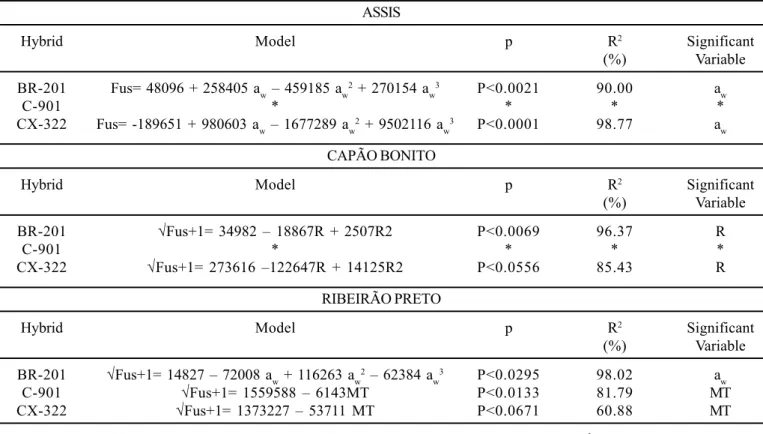
The statistical data (Table 4) of abiotic factors indicated a significant influence of aw on Fusarium spp. growth in hybrids BR-201 and CX-322 from the Assis region, and the models for these two hybrids differed significantly (p<0.05). In the Capão Bonito region, a strong correlation was detected between
Fusarium spp. growth and rainfall for both BR-201 e CX-322, but the analysis of parallel lines indicated a similar behavior for these two hybrids. None of the independent variables analyzed affected the growth of Fusarium spp. in cultivar C-901 in both Assis and Capão Bonito, suggesting that, in this case, some
other factor(s) must be exerting an effect on the degree of fungal contamination. In the Ribeirão Preto region, a significant correlation was shown between Fusarium spp. growth and aw for hybrid BR-201 and between Fusarium spp growth and MT for both hybrids C-901 and CX-322.
An analysis of means per region showed that significant differences of Fusarium spp growth occurred in C-901 when comparing Capão Bonito with Ribeirão Preto (p<0.05). However, no significant regional differences were found for both BR-201 and CX-322 at the same level of significance.
Table 3 : Climatic data and moisture content and water activity of 66 samples of freshly harvested corn kernels (hybrids BR-201, C-901 e CX-322) collected in Assis, Capão Bonito and Ribeirão Preto (State of São Paulo, Brazil) from February to December 1995.
ASSIS REGION
Moisture content (%) Water activity (aw) Rainfall Temperature BR-201 C-901 CX-322 BR-201 C-901 CX-322 (mm) (°C)
1 10.6 12.1 10.5 0.63 0.63 0.63 4.8 24.6
2 11.4 11.8 11.1 0.63 0.63 0.62 5.8 24.8
3 9.3 10.1 10.5 0.65 0.63 0.63 5.3 24.4
4 10.9 11.3 10.2 0.64 0.62 0.64 5.6 24.3
5 10.4 20.2 9.9 0.63 0.62 0.64 5.1 23.6
6 6.0 10.0 5.6 0.53 0.48 0.50 5.2 23.3
7 10.6 8.8 5.4 0.49 0.48 0.50 4.6 23.1
8 11.8 6.0 8.8 0.55 0.49 0.50 2.7 21.3
9 10.6 10.6 11.1 0.65 0.65 0.68 2.8 21.3
10 10.6 10.6 11.1 0.65 0.65 0.68 4.7 26.1
CAPÃO BONITO REGION
Moisture content (%) Water activity (aw) Rainfall Temperature BR-201 C-901 CX-322 BR-201 C-901 CX-322 (mm) (°C)
1 11.0 13.5 14.0 0.68 0.69 0.70 4.7 22.1
3 10.5 11.6 10.8 0.61 0.62 0.30 5.5 22.2
5 11.3 11.8 10.6 0.74 0.73 0.99 5.0 20.9
7 5.0 16.8 16.2 0.60 0.54 0.53 3.0 19.5
9 8.6 8.9 9.3 0.57 0.54 0.56 3.1 18.9
11 11.8 11.3 10.6 0.61 0.60 0.62 2.7 19.0
RIBEIRÃO PRETO REGION
Moisture content (%) Water activity (aw) Rainfall Temperature BR-201 C-901 CX-322 BR-201 C-901 CX-322 (mm) (°C)
1 11.5 12.0 12.5 0.69 0.73 0.74 6.3 25.1
3 10.6 9.6 10.8 0.65 0.65 0.65 7.4 24.7
5 9.6 11.4 9.4 0.65 0.65 0.66 6.3 23.9
7 10.6 11.0 10.3 0.61 0.61 0.62 5.2 23.0
9 9.0 8.6 9.0 0.56 0.52 0.53 6.3 24.2
The toxigenic potential of 10 A. flavus isolated from the
66 samples of freshly harvested corn grains (hybrids BR-201, C-901 e CX-322) was found to include 6 aflatoxin producers, with toxin concentrations ranging from 615 mg/kg to 30.750 mg/kg (AFB1) and from 11 mg/kg to 22 mg/kg (AFB2). Two (33.3%) of these strains produced only AFB1 while 4 (66.7%) produced both AFB1 and AFB2.
Concerning the production of fumonisins by F. moniliforme
isolates, the data showed that all the 40 strains tested were positive for FB1 and FB2; the concentration ranged from 20 mg/ g to 2168 mg/g for FB1 and 10 mg/g to 380 mg/g for FB2. Out of the total analyzed, 4 strains produced only FB1 (10.0%), 2 only FB2 (5.0%) and 34 both FB1 and FB2 (85.0%).
The highest aflatoxin and fumonisin concentrations were detected among A. flavus and F. moniliforme isolates from the
Assis region; these strains were recovered from hybrids C-901 and CX-322, respectively. Such regional high production of aflatoxins and fumonisins may reflect the effect of temperature on fungal growth and consequent mycotoxins production. Lacey et al. (16) showed that the ideal temperature concerning
growth and mycotoxin production ranges from 22 to 28°C for F. moniliforme strains and 25 to 35°C for A. flavus strains; our
temperature values recorded in the Assis region (21 to 26°C) fell within this range.
Although the detection of toxigenic fungi in a substrate does not necessarily indicate that mycotoxins are naturally occurring in the field, it alerts to the potential risk of contamination (4). If both the substrate and the environmental conditions are adequate for mycotoxin production, such risk may increase and reach dangerous proportions. Our data contribute to the understanding of regional factors that may influence the growth of toxigenic fungi in three different freshly harvested corn hybrids in Brazil.
RESUMO
Microbiota fúngica e produção de aflatoxinas e fumonisinas por cepas de fungos isoladas de híbridos de grãos de milho
recém-colhidos
A microbiota fúngica de 66 amostras de três híbridos de grãos de milho recém-colhido, provenientes de 3 regiões do Estado de São Paulo Brasil (Assis, Capão Bonito e Ribeirão Preto), foram analisadas perante a influência dos fatores
Table 4: Statistical model, p-value and significant variable selected for hybrids BR-201, C-901 and CX-322, collected in Assis, Capão Bonito and Ribeirão Preto (State of São Paulo, Brazil).
ASSIS
Hybrid Model p R2 Significant
(%) Variable
BR-201 Fus= 48096 + 258405 aw 459185 aw2 + 270154 a w
3 P<0.0021 90.00 a w
C-901 * * * *
CX-322 Fus= -189651 + 980603 aw 1677289 aw2 + 9502116 a w
3 P<0.0001 98.77 a w
CAPÃO BONITO
Hybrid Model p R2 Significant
(%) Variable
BR-201 √Fus+1= 34982 18867R + 2507R2 P<0.0069 96.37 R
C-901 * * * *
CX-322 √Fus+1= 273616 122647R + 14125R2 P<0.0556 85.43 R
RIBEIRÃO PRETO
Hybrid Model p R2 Significant
(%) Variable
BR-201 √Fus+1= 14827 72008 aw + 116263 aw2 62384 a w
3 P<0.0295 98.02 a w
C-901 √Fus+1= 1559588 6143MT P<0.0133 81.79 MT CX-322 √Fus+1= 1373227 53711 MT P<0.0671 60.88 MT
abióticos (teor de umidade, atividade de água, precipitação pluvial e temperatura média) na frequência de isolamento de fungos, bem como a potencialidade toxigênica das cepas de
Aspergillus flavus e Fusarium moniliforme quanto à produção
de aflatoxinas e fumonisinas, respectivamente. As análises microbiológicas demonstraram predominância de Fusarium
spp., Penicillium spp.e Aspergillus spp. e outros dois gêneros
de fungos filamentosos, isolados de grãos com atividade de água entre 0,30 e 0,99 e teor de umidade entre 5,0% e 20,2%. Entre Fusarium spp, F.moniliforme foi a mais frequentemente
isolada, enquanto que, em relação ao gênero Aspergillus,
predominou A. flavus nas três regiões. Todas as cepas de Fusarium moniliforme isoladas (40), produziram fumonisinas,
que variaram de 20 mg/g a 2168 mg/g (FB1) e 10 mg/g a 380 mg/ g (FB2). Referente a 10 cepas de Aspergillus flavus isoladas, 6
cepas (60,0%) produziram aflatoxinas, que variaram de 615 mg/ kg a 30.750 mg/kg (AFB1) e 11 mg/kg a 22 mg/kg (AFB2).
Palavras-chave: Aflatoxinas, Aspergillus flavus, fumonisinas, Fusarium moniliforme, milho
REFERENCES
1. AOAC. Official Methods of Analysis. 3ª. ed. Washington, DC: Association of Analytical Chemists, 1980, 3rd. ed.
2. Barnett H.L. and Hunter B.B. Illustrated Genera of Imperfect Fungi, Minneopolis: Burgess, 1972, 3rd ed.
3. Brazilian Ministry of Agriculture. Resolution # 845, November, 1976. 4. Bullerman L.B. Significance of mycotoxins to food safety and human
health. J. Food Protection 42:65-86, 1979.
5. Busta F.F., Petterson E.H., Adams D.M., Johnson M.G.. Colony count method. In: Compendium of methods for the microbiological examination of foods. Washington, DC: American Public Health Association, 1984, P.62-77.
6. Carvalho F.C., Ferreira C.R.R.P.T., Tsuneshiro A., Freitas S.M. Avaliação econômica das perdas pós-colheita de milho no Brasil. In: XVIII Congresso Nacional de Milho e Sorgo. Vitória, 1990. 7. Castro M.F.P.M., Soares L.M.V., Furlani R.R.Z. Mycoflora,
aflatoxigenic species and mycotoxins in freshly harvested corn (Zea mays L.) : a preliminary study. Rev. Microbiol. 26:289-95, 1995. 8. Christensen C.N. and Kaufmann H.H. Grain Storage: the role of fungi
quality loss. Minneapolis. University of Minnesota Press, 1969. 9. Draper N.R. and Smith H. Applied regression analysis. New York,
John Wiley. 2 ed. 1981.
10. Francisco V.L.F.S.F., Sueyoshi M.L.S., Pino F.A. Camargo A.M.M.P. Censo Agropecuário no Estado de São Paulo: Resultados Regionais. São Paulo, 1997.
11. González H.H.L., Resnik S.L., Boca R.T., Marasas W.F.O. Mycoflora of Argentinian corn harvest in the main production area in 1990. Mycopathologia, 130: 29-36, 1995.
12. Hill R.A., Wilson D.M., McMillian W.W., Widstron N.W., Cole R.J., Sanders T.H., Blankenship P.D. Ecology of the Aspergillus flavus group and aflatoxin formation in corn and groundnut. In: LACEY J.
ed. Trichotecenes and other mycotoxins. Chichester. Wiley J., Publisher, 1985.
13. International Comission On Microbiological Specifications For Foods. Microbiological ecology of foods. New York, Academic Press, 1980. 14. Joint Fao/Who/Unep. Conference on mycotoxins. Global Perspective
on mycotoxins. Nairobi, 1977.
15. Julian A.M., Warring P.W., Phillips S.I., Medlock V.F.P., Macdonald M.V., Río L.E. Fungal contamination and selected mycotoxins in pre- and post-harvest corn in Honduras. Mycopathologia 129:5-16, 1995.
16. Lacey J., Ramakrishna N., Hamer A., Magan N., Marfleet C. Grain fungi. In: Arora, D.K.; Mukerji, K.G.; Marth, E.H. eds. - Handbook of Applied Micology: foods and feeds.New York, Marcel Dekker, 1991. 17. Leoni L.A.B. and Soares L.M.V. Desenvolvimento de uma metodologia para determinação e confirmação de moniliformina em milho. In: Congresso Latino de Micotoxicologia, 1. Encontro Nacional De Micotoxinas, 8. Rio de Janeiro, 1994, p.114-15.
18. Lillehoj E.B., Fennell D.I., Kwolek K.F. Aspergillus flavus and aflatoxin in Iowa corn before harvest. Science 495-496, 1976. 19. Lillehoj E.B., Kwolek K.F., Horner E.S., Widstrom N.M., Joséphson
L.M., Franz A.O., Catalano E.A.. Aflatoxin contamination of pré-harvest corn: role of Aspergillus flavusinoculum and insect damage. Cereal Chem. 57:255-257, 1980.
20. Lillehoj E.B. and Zuber M.S. Distribution of toxin-producing fungi in nature corn kernels from diverse environments. Trop. Sci. 28:19-24, 1988.
21. Lin M.T. and Dianese J.C. A Coconut-Agar Medium for rapid detection of aflatoxin production by Aspergillus spp.Phytopathology 66: 1466-1469, 1976.
22. Nelson P.E., Touson T.A., Marasas W.F.O. Fusarium species. An ilustraded manual for identification. Pennsylvania, University Press, 1983, 193p.
23. Northolt M.D.and Soentoro P.S.S. Fungal growth on foodstuffs related to mycotoxin contamination. In: Samson RA, Van Reenen-Hoekstra ES, Van Dorsehot CAN eds. Introduction to Food Borne Fungi. Baars, CBS, 1988, p.231-238.
24. Orsi R.B. Microbiota fúngica em 3 híbridos de milho recém-colhido e armazenado. (Dissertação de Mestrado).São Paulo: Universidade de São Paulo, 1995.
25. Orsi R.B., Corrêa B., Pozzi C, Schamass E. Mycoflora and occurrence of fumonisins in freshly harvested and stored hybrid corn. J. Stored Products Research, 36: 75-87. 2000.
26. Pedrosa A.V.B. and Dezen R.B. O milho: características do mercado e perspectivas. Preços Agrícolas 55: 1-4, 1991.
27. Pozzi C.R., Corrêa B., Gambale W., Paula C.R., Chacon-Reche N.O., Meirelles M.C.A.. Post-harvest and stored corn in Brazil: mycoflora interaction, abiotic factors and mycotoxins occurrence. Food Addit. Contam. 12:313-19, 1995.
28. Raper K.B.and Fennell D.I. The genus Aspergillus.Baltimore: Willians & Wilkins. 1965.
29. Ross P.F., Rice L.G., Plattner R.D., Osweiler G.D., Wilson T.M., Owens D.L., Nelson H.A., Richard J.L. Concentrations of fumonisin B1 in feeds associated with animal health problems. Mycopathologia
114:129-35, 1991.
30. Searle S.R., Casella G., McCulloch C.E. Variance components. John Wiley and Sons, Inc. 1992.
21. Tsuneshiro A., Ferreira C.R.R.P.T., Moricochi L. Produtividade da cultura do milho no Brasil: Evolução e diferenças estaduais. Agricultura em São Paulo 43: 117-35, 1996.