Colonization and plant growth promoting characterization of endophytic
Pseudomonas chlororaphis
strain Zong1 isolated from
Sophora alopecuroides
root nodules
Long Fei Zhao
1,2, Ya Jun Xu
1, Zhan Qiang Ma
2, Zhen Shan Deng
2,
Chang Juan Shan
3, Ge Hong Wei
21
College of Life Sciences, Shangqiu Normal University, Shangqiu, Henan, China. 2
College of Life Sciences, State Key Laboratory of Crop Stress Biology in Arid Areas, Northwest A & F University, Yangling, Shaanxi, China.
3
Henan Institute of Science and Technology, Xinxiang, China.
Submitted: November 3; Approved: July 23, 2012.
Abstract
The endophytic strain Zong1 isolated from root nodules of the legumeSophora alopecuroideswas characterized by conducting physiological and biochemical tests employing gfp-marking, observing their plant growth promoting characteristics (PGPC) and detecting plant growth parameters of inocu-lation assays under greenhouse conditions. Results showed that strain Zong1 had an effective growth at 28 °C after placed at 4-60 °C for 15 min, had a wide range pH tolerance of 6.0–11.0 and salt toler-ance up to 5% of NaCl. Zong1 was resistant to the following antibiotics (mg/mL): Phosphonomycin (100), Penicillin (100) and Ampicillin (100). It could grow in the medium supplemented with 1.2 mmol/L Cu, 0.1% (w/v) methylene blue and 0.1-0.2% (w/v) methyl red, respectively. Zong1 is closely related toPseudomonas chlororaphisbased on analysis the sequence of 16S rRNA gene. Its expression of thegfpgene indicated that strain Zong1 may colonize in root or root nodules and veri-fied by microscopic observation. Furthermore, co-inoculation with Zong1 and SQ1 (Mesorhizobium sp.) showed significant effects compared to single inoculation for the following PGPC parameters: siderophore production, phosphate solubilization, organic acid production, IAA production and antifungal activityin vitro.These results suggest strainsP. chlororaphiZong1 andMesorhizobium sp. SQ1 have better synergistic or addictive effect. It was noteworthy that each growth index of co-inoculated Zong1+SQ1 in growth assays under greenhouse conditions is higher than those of sin-gle inoculation, and showed a significant difference (p < 0.05) when compared to a negative control. Therefore, as an endophyteP. chlororaphisZong1 may play important roles as a potential plant-growth promoting agent.
Key words:PGPC, endophyte, the gpf-marker, colonization, co-inoculation.
Introduction
Sophora alopecuroidesis a wild perennial herb of the xerophyte species and is widely distributed in northwestern China. However, most of northwestern China belongs to arid and semi-arid areas.S. alopecuroidesshows excellent performance in drought and alkaline tolerance as well as sandstorm resistance due to its well-developed root system.
In addition,S. alopecuroidesplays a vital role in environ-mental protection in northwest of China (Zhaoet al., 2010). It also has promising prospects through its utilization in pharmaceutics and pesticides, as a source of livestock feed, and its role as a natural windbreaker and nectar source. As a traditional Chinese medicine, this plant also is used to treat fever and diarrhea; some studies even suggest it has the po-tential to inhibit cancer cells (Songet al., 1999).
Send correspondence to G.H. Wei. College of Life Sciences, Northwest A & F University, Yangling, 712100 Shaanxi, China. E-mail: [email protected].
Endophytic bacteria live inside the plant tissues and do not cause visible damage or morphological changes to their hosts. In the last few decades, endophytic bacteria have attracted more and more attention as novel resources in the biocontrol of plant diseases and in the promotion of plant growth (Linet al., 2009). They can benefit the host plants in a variety of ways, such as producing IAA (indole acetic acid), fixing nitrogen, dissolve phosphates, produc-ing siderophores, suppressproduc-ing phytopathogens by competi-tion in the invasion sites and by secreting antibiotic compounds (Ryanet al., 2008), and by helping the symbi-otic rhizobia to form nodules with unspecific hosts (Liuet al., 2010).
Endophytes, likePseudomonas,Agrobacterium, Ba-cillus, Burkholderia and Enterobacteria, have been iso-lated from root nodules in various leguminous plants including alfalfa, clover, soybean pigeon pea, etc (Geetha et al., 2008) since 1902 (Zakhiaet al., 2006; Kanet al., 2007; Liet al., 2008). Available reports indicated improved plant yield and health under greenhouse conditions (mea-sured as an increase in root wet weight and nodulation) when co-inoculated with nodule endophytes compared to inoculation with rhizobia alone (Bai et al., 2003). Plant growth promoting bacteria (PGPB) have been co-ino-culated with rhizobia which include strains of the following well-known rhizobacteria:Pseudomonas (Chandraet al., 2010; Chanwayet al., 1989),Bacillus(Geethaet al., 2008), Azospirillum (Yahalom et al., 1988), and Azotobacter (Burnset al., 1981). For example, co-inoculation of some Pseudomonas and Bacillus strains along with effective Rhizobiumspp. is shown to stimulated chickpea growth and nodulation, stimulate nitrogen fixation (Parmar et al., 1999), and increase growth and yield compared to single in-oculation (Geethaet al., 2008). However, up to now, spe-cial nodule endophytes of S. alopecuroideshave not yet been studied.
In a recent study, we collected and characterized nod-ule endophytic bacteria from legume plantS. alopecuroides (Zhaoet al., 2010). The aims of this experiment are (i) to examine the colonization of gfp-tagged endophytic Pseu-domonas chlororaphisstrain Zong1, and (ii) to determine their plant growth promoting characterization (PGPC) in a single and combined inoculation test.
Materials and Methods
Isolation of nodule endophytic bacteria and nodulation verification
Thirty healthy nodules from fifteenS. alopecuroides plants were collected and carefully washed with sterile dis-tilled water to remove nodule surface soil particles, surface sterilized with 95% alcohol for 30 s and with 3% NaClO (w/v) for 3 min, and finally rinsed 8 times to thoroughly eliminate NaClO with sterile distilled water. The surface-sterilized nodules were crushed and streaked on
yeast-extract-mannitol agar (YEMA) plates for the isolation of endophytic bacteria with the standard methods described previously (Vincent, 1970). The plates were incubated at 28 °C and single colonies were further purified by repeat-edly streaking on the same medium and by microscopic ex-amination. In order to verify surface sterilization, the surface sterilized nodules were rolled on the Nutrient Agar (NA) medium and the aliquots of water from final rinse so-lutions were plated onto NA plates as controls to detect pos-sible contaminants. Plates without any contaminants were considered effectively surface sterilized and their corre-sponding YEMA plates were used for the isolation of endo-phytes. Nodulation capability was verified for nodule isolates by inoculating on surface sterilized and pre-ger-minated seeds.
Construction of gfp-markedP. chlororaphisZong1 and examination of colonization
Since the plasmid pMP2444 harboring the green fluo-rescent protein (gfp) gene (Stuurman et al., 2000) was transformed into E. coli S17-1 as reported (Chen et al., 2003), theEscherichia coliS17-1 strain was used as the do-nor in a transformation test, was grown at 37 °C Lysogeny broth (LB, 10 g NaCl/L) medium supplied with 30 mg/mL gentamycin (Stuurmanet al., 2000). The transformed E. coli S17-1 resistant to gentamycin was used in electro-poration with the re-isolatedP. chlororaphisstrain Zong1, which has been proven to be sensitive to gentamycin (30mg/mL). The donorE. coliS17-1 with pMP2444 was added to the competent cell of strain Zong1, thawed on ice, and mixed quickly. The mixture was incubated on ice for 15 min, transferred into a sterile pre-chilled cuvette (interelectrode gap: 0.2 cm), and placed in a Gene Pulser II apparatus equipped with a Pulse Controller (BioRad Labo-ratories, Tokyo, Japan)(Kazunori et al., 2003). The electroporation unit was set at the following values: 12.5 kV/cm, 25 F and 200W. Following the pulsing, the cells were immediately diluted with 1 mL of LB medium, transferred into a sterilized tube, and incubated at a 30 °C for 3-4 h. From each tube, 100mL was plated onto the LB medium supplied with 30 mg/mL gentamycin, placed at 30 °C for 12 h. Bacterial colonies were exposed to blue light to check the expression of gfp (Stuurmanet al., 2000). The stability of the plasmid pMP2444 inP. chlororaphis was analyzed by replica plating of the diluted samples grown on LB with or without antibiotic for 15 times under the laboratory conditions tested. A gfp-tagged derivative of P. chlororaphis Zong1 was grown and stored on TY or YMA medium containing 30 mg/mL gentamycin.
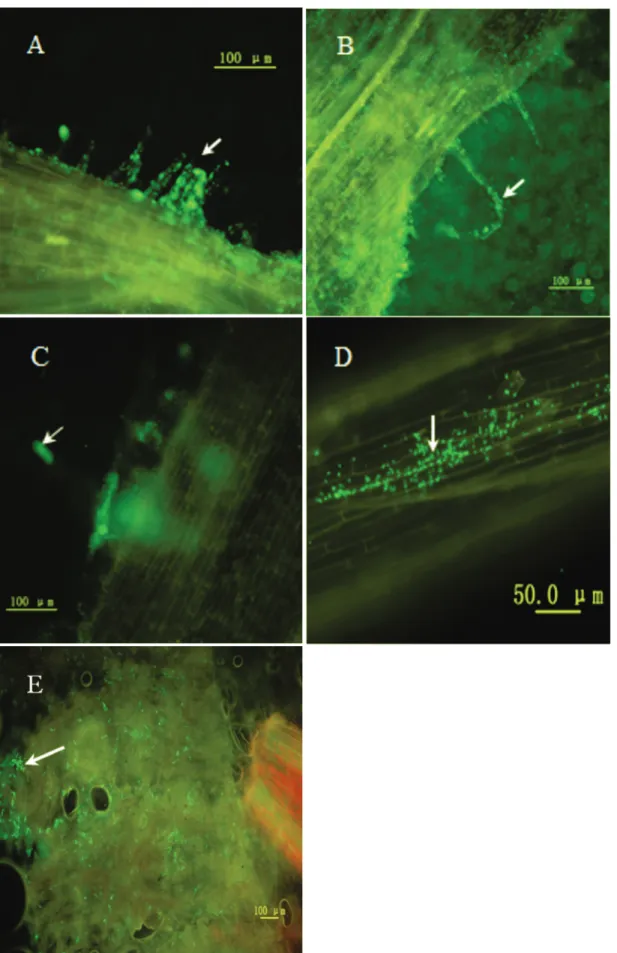
48 hours of inoculation, and developed well nodules after three weeks of inoculation could be detected, the existence ofP. chlororaphisZong1 in the root and nodules was ex-amined by observing the green fluorescence under a confo-cal laser scanning microscope using a scanning wavelength of 488 nm.
Potential plant growth promoting characteristics of isolates
Examination of siderophore production
Bacterial cultures were multiplied in Lysogeny broth (LB, 10 g NaCl/L) for 72 h and aliquots of pure bacterial culture were inoculated in plates containing agar Chrome Azurol S (CAS) and incubated at 30 °C. Each plate was ob-served daily for 7 days to detect the appearance of orange color around the colony (Schwyn and Neilands, 1987). Ex-periments were performed in triplicate.
Phosphate solubilization
Log phase LB pure bacterial cultures were spot inocu-lated on Pikovasky’s inorganic and Mongina organic cul-ture plates, incubated at 30 °C, and observed daily for 7 days for appearance of transparent halos (Katznelson and Bose, 1959). Experiments were performed in triplicate.
Antifungal activity
Spores of fungal cultures (Fusarium oxysporum, Magnaporthe grisea, Botrytis cinerea Pers., Valsa mali Miyabe et Yamada,Alternaria alternata) were grown on Potato Dextrose Agar (PDA) plates and a small block of agar with fungal growth was cut using sterile puncher (Ø = 4 mm) and placed in the centre of a fresh PDA plate. Tested strains were spot inoculated on the PDA plate’s edge about 25 mm from the centre, incubated at 30 °C for 7 days and observed for zones of inhibition. Fungal mycelia cultivated for 7 days without spot inoculation were used as control (Zhaoet al., 2011).
Organic acid production
Bacterial cultures were spot inoculated onto MM9 (Sambrooket al., 2001) agar medium, after incubation for 48 hours at 30 °C, and observed for a drop in pH using methyl red as an indicator dye which changed from yellow to pink below pH 5.0. Isolates having the ability to produce organic acid showed a pink zone around the colony.
IAA production
Indole acetic acid (IAA) production was estimated by inoculating a bacterial suspension (1 x 10⁸ cfu/mL) in 10 mL (LB) broth containing L-tryptophan (100mg/mL), and shaken incubation for 72 h. IAA concentration in the culture supernatant was estimated using Salkowskis re-agent (Gordon and Weber, 1951).
Plant inoculation experiment under greenhouse condition
S. alopecuroides seeds were treated with 98% sulphuric acid for 60 min, and subsequently rinsed 6 times with sterilized demineralized water (Zhaoet al., 2010). The seeds were then surface sterilized by immersion in absolute alcohol for 1 min, immersed in 0.1% (w/v) HgCl2for 2 min and rinsed 8 times with sterile distilled water. Surfaced ster-ile seeds were germinated axenically in Petri dishes filled with moist filter paper at 28 °C for 72 h.
Inoculum of strains was prepared by growing cells in nutrient broth at 30 °C, 120 rev/min until an exponential growth phase. Bcateria were then harvested by centrifu-gation (8000 rev/min for 10 min), washed twice in steril-ized demineralsteril-ized water and resuspended in the same demineralized water to a density of approx. 108-109cfu/mL.
Germinated seed were soaked in the bacterial suspen-sion and control seeds were soaked in sterilized water at 30 °C for 3 h. Seeds were transferred to plastic pots filled with sterilized perlite-vermiculite (1:1) moistened with ni-trogen-free plant nutrient solution as described by Vincent et al.(1970). The inoculated seedlings were cultured under greenhouse condition, that is, programmed for a 14 h/d photoperiod at a constant temperature of 28 °C during the day and 20 °C during the night with about 60% relative hu-midity. All pot experiments were performed in five repeat with five seedlings per pot, and seedlings with Mesorhizobiumsp. SQ1 alone were used as positive con-trols (PC); Seedlings without any bacteria were the nega-tive control (NC); Seedlings with isolate Zong1 and seedlings co-inoculated with Zong1 and isolate Mesorhizobiumsp. SQ1 (1:1 v/v) were used as the experi-mental systems. The plants were harvested after six weeks of inoculation when well developed nodules could be de-tected, and plant biomass such as dry and fresh weight, shoot and root length, nodule number per plant were mea-sured and compared to control plants (NC).
Sequencing and phylogenetic analysis
TREECON package (Van and Y De , 1997), and computa-tion of the similarity of each strain tested was done with the DNAMAN application (version 6.0.3.40, lynnon corpora-tion). The 16S rRNA gene sequences obtained were sub-mitted to NCBI GenBank (http://www.ncbi.nlm.nih.gov/) under the accession number HM241942.
Statistical analysis
The parameters of plant growth promoting character-istics and the parameters of growth and nodulation ofS. alopecuroideswere examined with ANOVA analysis using the SPSS 17.0 package (by the Data Theory Scaling System Group, Faculty of Social and Behavioral Sciences, Leiden University, The Netherlands).
Results
Isolation of endophytic bacteria and nodulation test
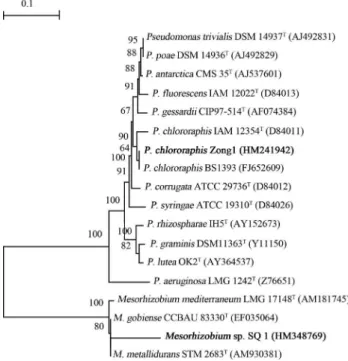
Twelve nodule bacteria were isolated from S. alopecuroidesroot nodules. Nodulation test results showed that eight nodule isolates could not form root nodules, which were defined as endophytes. Physiological and bio-chemical tests were conducted (Table S1), which included measurements such as temperature, pH values and salt tol-erance, antibiotic sensitivity, metal susceptibility, and dye resistance. On the basis of these characteristics, a selected strain was termed Zong1. Sequencing of 16S rRNA gene and phylogenetic analysis (Figure 1) indicated that strain
Zong1 is most related to Pseudomonas chlororaphis (GenBank accession number HM241942).
Construction of gfp-markedP. chlororaphisstrain Zong1 and colonization
Experiment results showed that when cells were transformed by electroporation with the pMP2444 plasmid, carrying thegfpgene, and cultured on LB medium supplied with 30mg/mL gentamycin, bacterial colonies presented green color when they were exposed to blue light (255 nm wave length, portable ultraviolet lamp). Tansformant con-taining plasmid pMP2444, was chosen for further studies and compared to the wild-type strain during growth in LB and minimal medium (data not shown), indicating that the presence of the plasmid does not interfere in the trans-formant life cycle. Results suggested that fluorescence was still observed and the growth rates of strains were identical, suggesting that insertion of the plasmid did not interfere with normal cell growth.
By inoculation and examination, results shown in Figure 2 (A-E) indicated that the process of adsorption, in-vasion, and colonization accompaniedMesorhizobiumsp. SQ1 in root hairs, root woodiness, and in the root nodule.
Potential plant growth promoting characteristics
All of three treatments Zong1+ SQ1, SQ1 and Zong1 (Table 1) gave a positive CAS assay showing that they all produced siderophores. Compared with the control, co-inoculation Zong1+SQ1 showed the strongest capability of producing siderophores, and Zong1 was second. As for the ability of phosphate solubilization (organic phosphate and inorganic phosphate), these strains were same as the case of produced siderophores, ie, co-inoculation Zong1+SQ1 showed the most significant phosphate solubilization with 3.46(D/d) and 3.68(D/d) for organic phosphate and inor-ganic phosphate, respectively. However, none of the iso-lates showed any production of organic acid. Three treat-ments all showed positive for IAA production, and co-inoculation with Zong1+SQ1 treatments was the most significant, measured at 63.07 mg/L. Another, three treat-ments showed different certain extent antifungal activity to plant pathogenic fungi, co-inoculation (Zong1+SQ1 treat-ments) was the most significant inhibition ratios, and Zong1 was second, while SQ1 has no effect to F. oxysporum,M. grisea,B. cinerePers. All inhibition ratios of three treatments were compared to Control, specific data were showed in Table 1. As a whole, co-inoculation with Zong1+SQ1 showed best effects than inoculation alonein vitro.For example, inhibition ratios show 86.21%, 67.27%, 76.25%, 82.67% forFusarium oxysporum, Magnaporthe grisea, Botrytis cinere Pers., Valsa mali Miyabe et Yamada, Alternaria alternate, respectively. Therefore, mixed inoculation (P. chlororaphi Zong1 and Mesorhizobiumsp. SQ1) was more effective on PGP traits than observed when the strains were evaluated alone. But Figure 1 - Phylogenetic tree reconstructed with neighbour-Joining
the definite mechanism of their interaction needs further study.
Plant inoculation assay
To further confirm plant growth promoting character-istics, we performed plant inoculation assays. Results in Table 2 showed that each growth parameters of inoculated Zong1 were higher than those of negative control (NC) and SQ1 (PC) on different degrees. But it is noteworthy that each growth parameters of co-inoculated Zong1+SQ1 was higher than those of single inoculation (Zong1, PC, NC) and showed significant difference (p < 0.05).
Discussion
GFP is a useful biomarker for examining biological localization because the cell can be studied nondestruc-tively and without the addition of confounding exogenous substrates or cofactors (Tombolini et al., 1997). In this study, we described the construction of new gfp-containing plasmids for use inP. chlororaphisstrain Zong1, experi-ments have demonstrated gfp-marked cells can be used to simplify the detection and locate the position of an individ-ual cell on roots or root nodules ofSophora alopecuroides with standard epifluorescence microscopes and filter sets (Figure 2 D, E). Additionally, once GFP is synthesized and properly folded, no energy source is required for its act, in contrast to theluxsystem, which requires ATP for activity (Stewart et al., 1992). As for the legume host plant S. alopecuroides, colonization of gfp-markedP. chlororaphis strain Zong1 in root tissue or root nodules were first de-tected and reported. Therefore, gfp-marking techniques will provide valuable information for a wide range ofP. chlororaphisspecies associated withSophora.
Among Gram-negative soil bacteria,Pseudomonasis the most abundant genus in the rhizosphere (Bardaset al., 2009). Root-associated Pseudomonas spp. strains have long been known to be beneficial to plants attribute to their plant-growth promotion effect (PGPE) or their potential as biological control agents. Since these endophytes may di-rectly stimulate plant growth by increasing nutrient uptake and enhancing plant biomass, producing phytohormones (IAA), siderophores, solublizating phosphorus (Lugten-berg and Kamilova, 2009), fixing nitrogen (Yan et al., 2010a) and decreasing heavy metal toxicity (Suranjana and Manas, 2009). In addition, endophyticPseudomonasspp. can also indirectly induce PGPE by controlling phyto-pathogens or pathogenic fungi using mechanisms such as producing antibiotic factors (Joussetet al., 2010; Rochatet al., 2010; Vallet-Gelyet al., 2010), enhancing competition for colonization sites (Wensinget al., 2010), and induction of systemic resistance (Matillaet al., 2010).
As for PGPC of strainP. chlororaphisZong1, results showed that tested parameters (Table 1) present beneficial actionsin vitro, such as the IAA production, siderophores and phosphorus solubilization. Another, it showed certain
antifungal activity to plant pathogenic fungi. These indi-cated that strain Zong1 may stimulate and promote plant growth. Similar reports prove this viewpoint. Choong-Minei et al. (Choong-Min et al., 2007) reported that rhizosphere colonies in tobaccoP. chlororaphis O6 can stimulate growth promotion and induce resistance against Cucumber mosaicvirus, as well as protect cucumber plants against leaf spotting caused by Corynespora cassicola; Selin et al. (2010) reported that P. chlororaphis strain PA23 initially isolated from soybean root tips can protect canola from the devastating effects of stem rot caused by the fungusSclerotinia sclerotiorum(Lib.), and antibiotic production is the primary mechanism of pathogen inhibi-tion. It was previously demonstrated that strain P. chlororaphisMA 342 was a very effective and consistent biocontrol agent against seed-borne barley net blotch caused byDrechslera teres(Riccardoet al., 2009).
Comparing with PGPC of alone inoculation (Zong1 or SQ1 or control), we found that effects of co-inoculation Zong1+SQ1 have more significant than single treatments. Previous reports have shared this observation. For exam-ple, non-pathogenic P. putida WCS358 combined with Fusarium oxysporum Fo47 provided better suppression ofFusarium flaxwilt than either alone, and also showed better PGPE (Whipps, 2001). CombinedP. chlororaphis 30-84 withP. fluorescensQ2-87 provided greater suppres-sion of take-all of wheat than either alone (Duffy et al., 1996), combination of P. chlororaphis PCL1391 and P. fluorescensWCS365 showed biocontrol ability against the tomato pathogen Fusarium oxysporum f. sp. radicis-lycopersici(Bardaset al., 2009). These cases all suggested that PGPE produced by rhizosphere bacteria co-inoculation indirectly of controls phytopathogens or pathogenic fungi, which was further supported by our experiment results.
It was noteworthy that each growth parameters of co-inoculation with Zong1+SQ1 in plant inoculation as-says was higher than those of single innoculation (Zong1, PC, NC), and showed significant effects. Interestingly, PGPC of co-inoculated Zong1+SQ1 coincide with each growth parameters of co-inoculation in growth assays un-der greenhouse conditions. Similar reports proved our
re-sults. Jayet al.(2010) reported that combinedP. stratawith Rhizobiumhave shown significantly increased dry matter, nodulation, grain yield and phosphorus uptake over the non-inoculated control in legumes. Recent results of stud-ies with PGPR and Rhizobium/Bradyrhizobium sp. have shown co-inoculation may increased root and shoot bio-mass, nodule dry matter, nitrogenase activity, N2-fixation and grain yield in chickpea and various legumes (Vermaet al., 2010). In this experiment, co-inoculation of combina-tionP. chlororaphisZong1 withMesorhizobiumsp. SQ1 performed under greenhouse conditions showed that endo-phytesP. chlororaphiszong1 play important roles either in co-inoculation or inoculation alone, and is a potential bio-logical control agent and plant-growth promoting agent. The effects brought by co-inoculation P. chlororaphis Zong1 and other rhizobial genera, both known and un-known, provide a basis for supporting future research in this area.
Acknowledgments
This work was supported by projects from the 973 Project of China (2010CB126502), National Science Foun-dation of China (U1204301, 31125007 and 31070444), Henan Provincial Department of Science and Technology Research Project (112102110177), Henan Provincial Edu-cation Department of Science and Technology Research Key Research Project(12A210019) and Foundation for University Key Teacher by the Ministry of Education of Henan Province(2012GGJS166).
References
Bai Y, Zhou X, Smith DL (2003) Crop ecology, management and quality. Enhanced soybean plant growth resulting from co-inoculation of Bacillus strains with Bradyrhizobium japonicum.Crop Sci 43:1774-1781.
Bardas GA, L Lagopodi A, Kadoglidou K, Tzavella-Klonari K (2009) Biological control of three Colletotrichum lindemuthianum races using Pseudomonas chlororaphis
PCL1391 and Pseudomonas fluorescens WCS365. Biol Control 2:139-145.
Table 2- Effect ofP. chlororaphisZong1 andMesorhizobiumsp. SQ1 on growth and nodulation ofS. alopecuroides.
Treatments Shoot length (cm)
Root length (cm)
Shoot fresh weight (g/plant)
Root fresh weight (g/plant)
Shoot dry weight (g/plant)
Root dry weight (g/plant)
Nodule number/plant
SQ1+ Zong1 11.61±0.48 a* 17.21±0.98 a 0.229±0.009 a 0.218±0.028 a 0.049±0.009 ab 0.085±0.004 a 8.67 a
Zong1 9.4±0.53 ab 12.25±0.30 b 0.092±0.004 b 0.182±0.009 ab 0.031±0.013 ab 0.057±0.006 b 0 b
SQ1(PC) 8.57±0.28 bc 11.34±0.45 bc 0.089±0. 004 b 0.116±0.018 ab 0.013±0.002 a 0.013±0.001 c 2.333±0.33 b
NC 6.42±0.61 c 9.17±0.33 c 0.058±0.002 c 0.154±0.003 b 0.004±0.001 b 0.008±0.001 c 0 b
*The letters a and b indicate different Tukey grouping. The same latter means no difference among treatments, while different letter means significant dif-ference (p < 0.05).
The value in the column are the averages±standard error (n = 3), and each set consisted of 10 plants.
Burns Jr TA, Bishop PE, Israel DW (1981) Enhanced nodulation of leguminous plant roots by mixed cultures ofAzotobacter vinelandi and damping-off of tomato by Pseudomonas aeruginosa7NSK2. Appl Environ Microbiol 62:865-871. Chandra SN, Puneet SC, Sangeeta MD, Karishma S, Ajit V,
Wil-liam JS (2010) Tripartite interactions amongPaenibacillus lentimorbusNRRL B-30488,Piriformospora indicaDSM 11827, and Cicer arietinum L. World J Microbiol Bio-technol 26:1393-1399.
Chanway CP, Hynes RK, Nelson LM (1989) Plant growth pro-moting rhizobacteria: Effects on growth and nitrogen fixa-tion of lentil (Lensesculenta Moench) and pea (Pisum sativumL.). Soil Biol Biochem 21:511-517.
Chen WM, James EK, Prescott AR, Kierans M, Sprent JI (2003) Nodulation of Mimosa spp. by the b-Proteobacterium
Ralstonia taiwanensis. Mol Plant-Microb Interact 16:1051-1061.
Choong-Min Ryu, Beom Ryong Kang, Song Hee Han, Song Mi Cho, Joseph W Kloepper, Anne J, Anderson Young Cheol Kim (2007)Tobacco cultivars vary in induction of systemic resistance against Cucumber mosaic virus and growth pro-motion byPseudomonas chlororaphisO6 and its gacS mu-tant. Eur J Plant Pathol 119:383-390.
Duffy BK, Simon A, Weller DM (1996) Combination of
Trichoderma koningii withfluorescent pseudomonads for control of take-all on wheat. Phytopathology 86:188-194. Geetha R, Sing FJ, Desai A, Archana G (2008) Enhanced growth
and nodulation of pigeon pea by co-inoculation ofBacillus
strains withRhizobiumspp. Biores Technol 99:4544-4550. Gordon AS, Weber RP (1951) Colorimetric estimation of
indoleacetic acid. Plant Physiol 26:192-195.
Jay PV, Janardan Y, Kavindra NT (2010) Impact of plant growth promoting rhizobacteria on crop production. Int J Agric Res 11:954-983.
Jousset A, Rochat L, Scheu S, Bonkowski M, Keel C (2010) Pred-ator-prey chemical warfare determines the expression of biocontrol genes by rhizosphere pseudomonads. Appl Envi-ron Microbiol 62:552-563.
Kan FL, Chen ZY, Wang ET, Tian CF, Sui XH, Chen WX (2007) Characterization of symbiotic and endophytic bacteria iso-lated from root nodules of herbaceous legumes grown in Qinghai-Tibet Plateau and in other zones of China. Arch Microbiol 188:103-115.
Katznelson H, Bose B (1959) Metabolic activity and phosphate dissolving capability of bacterial isolates from wheat root, rhizosphere and non-rhizosphere soil. Can J Microbiol 5:79-85.
Kazunori T, Tasuka S, Muhammad Z, Joyce N, Yuichi S, Masao S, Takeo Y, Kiwamu M, Shocichiro A (2006) Incorporation of a DNA sequence encoding green fluorescent protein (GFP) into endophytic diazotroph from sugarcane and sweet potato and the colonizing ability of these bacteria in Brassica oleracea. Microbes Environ 21:122-128.
Li JH, Wang ET, Chen WF, Chen WX (2008) Genetic diversity and potential for promotion of plant growth detected in nod-ule endophytic bacteria of soybean grown in Heilongjiang province of China. Soil Biol Biochem 40:238-246. Lin L, Qiao YS, Ju ZY, Ma CW, Liu YH, Zhou YJ, Dong HS
(2009) Isolation and characterization of endophyticBacillus subtilis Jaas ed1 antagonist of eggplantVerticilliumwilt. Biosci Biotechnol Biochem 73:1489-1493.
Liu J, Wang ET, Ren DW, Chen WX (2010) Mixture of endophytic Agrobacterium and Sinorhizobium meliloti
strains could induce nonspecific nodulation on some woody legumes. Arch Microbiol 192:229-234.
Lugtenberg B, Kamilova F (2009) Plant-growth-promoting rhizobacteria. Annu Rev Microbiol 63:541-556.
Matilla MA, Ramos JL, Bakker PAHM, Doornbos R, Badri DV, Vivanco JM, Ramos-González MI (2010) Pseudomonas putida KT2440 causes induced systemic resistance and changes in Arabidopsis root exudation. Environ Microbiol Rep 2:381-388.
Moulin L, G Béna, Boivin-Masson C, St Pkowski T (2004) Phylo-genetic analyses of symbiotic nodulation genes support ver-tical and lateral gene co-transfer within theBradyrhizobium
genus. Mol Phylogenet Evol 30:720-732.
Parmar N, Dadarwal KR (1999) Stimulation of nitrogen fixation and induction of flavonoid-like compounds by rhizo-bacteria. J Appl Microbiol 86:36-64.
Riccardo T, van der Gaag DJ, Gerhardson B, Jansson JK (1999) Colonization pattern of the biocontrol strainPseudomonas chlororaphisMA 342 on barley seeds visualized by using green fluorescent protein. Appl Environ Microbiol 8:3674-3680.
Rochat L, Péchy-Tarr M, Baehler E, Maurhofer M, Keel C (2010) Combination of fluorescent reporters for simultaneous mon-itoring of root colonization and antifungal gene expression by a biocontrol pseudomonad on cereals with flow cyto-metry. Mol Plant-Microbe Interact 23:949-961.
Ryan RP, Germaine K, Franks A, Ryan DJ, Dowling DN (2008) Bacterial endophytes: Recent developments and applica-tions. FEMS Microbiol Lett 278:1-9.
Saitou N, Nei M (1987) The neighbor-joining method: A new method for reconstructing phylogenetic trees. Mol Biol Evol 4:406-425.
Sambrook J, Russell DW (2001) Molecular Cloning: A Labora-tory Manual, Volume 1 Cold Spring Harbor, New York. Schwyn B, Neilands JB (1987) Universal chemical assay for the
detection and determination of siderophore. Anal Biochem 160:47-56.
Selin C, Habibian R, Poritsanos N, NP Athukorala S, Fernando D, R de Kievit T (2010) Phenazines are not essential for Pseu-domonas chlororaphis PA23 biocontrol of Sclerotinia sclerotiorum, but do playa role in biofilm formation. FEMS Microbiol Ecol 71:73-83.
Song JZ, Xu HX, Tian SJ, But PP (1999) Determination of quinolizidine alkaloids in traditional Chinese herbal drugs by nonaqueous capillary electrophoresis. J Chromatogr A 857:303-311.
Stewart G, Williams P (1992) lux genes and the applications of bacterial bioluminescence. J Gen Microbiol 138:1289-1300. Stuurman N, Bras CP, Schlaman HRM, Wijfjes AHM, Bloem-berg G, Spaink HP (2000) Use of green fluorescent protein color variants expressed on stable broad-host-range vectors to visualize rhizobia interacting with plants. Mol Plant-Microb Interact 13:1163-1169.
Suranjana AR, Manas KR (2009) Bioremediation of heavy metal toxicity-with special reference to chromium. Al Ame J Med Sci 2:57-63.
Pseu-domonas fluorescens bacteria. FEMS Microbiol Ecol 22:17-28.
Vallet-Gely I, Novikov A, Augusto L, Liehl P, Bolbach G, Péchy-Tarr M, Cosson P, Keel C, Caroff M, Lemaitre B (2010) Association of hemolytic activity ofPseudomonas entomophila, a versatile soil bacterium, with cyclic lipo-peptide production. Appl Environ Microbiol 76:910-921. Van Berkum P, Beyene D, Eardly BD (1996) Phylogenetic
rela-tionships amongRhizobiumspecies nodulating the common bean (Phaseolus vulgaris L.). Int J Syst Evol Microbiol 46:240-244.
Van de Peer Y, De Wachter R (1997) Construction of evolution-ary distance trees with TREECON for Windows: Account-ing for variation in nucleotide substitution rate among sites. Comput Appl Biosci 132:227-230.
Verma JP, Yadav J, Kavindra NT (2010) Application of
Rhizobium sp. BHURC01 and plant growth promoting
Rhizobactria on nodulation, plant biomass and yields of Chickpea (Cicer arietinumL.). Int J Agric Res 3:148-156. Vincent JM (1970) The cultivation, isolation and maintenance of
rhizobia. A Manual for the Practical Study of the Root-Nodule Bacteria. Blackwell Scientific, Oxford, pp 1-13. Wensing AD, Braun S, Büttner P, Expert D, Völksch B, S Ullrich
M, Weingart H (2010) Impact of siderophore production by
Pseudomonas syringaepv. syringae 22d/93 on epiphytic fit-ness and biocontrol activity againstPseudomonas syringae
pv. glycinea 1a/96. Appl Environ Microbiol 76:2704-2711. Whipps JM (2001) Microbial interactions and biocontrol in the rhizosphere. J Experiment Botany, Root Special issue: 487-511.
Yahalom E, Okon Y, Dovrat A (1988) .Early nodulation in le-gumes inoculated withAzospirillumandRhizobium. Symbi-osis 6:69-80.
Yan YL, Yang J, Dou YT, Chen M, Ping SZ, Peng JP, Lu W, Zhang W, Yao ZY, Li HQ, Liu W, He S, Geng LZ, Zhang XB, Yang F, Yu HY, Zhan YH, Li DH, Lin ZL, Wang YP, Elmerich C, Lin M, and Jin Q (2010a) Nitrogen fixation is-land and rhizosphere competence traits in the genome of root-associated Pseudomonas stutzeri A1501. PNAS 21:7564-7569.
Zakhia F, Jeder H, Willems A, Gillis M, Dreyfus B, De Lajudie P (2006) Diverse bacteria associated with root nodules of spontaneous legumes in Tunisia and first report fornifH-like gene within the generaMicrobacteriumandStarkeya. Mi-crobial Ecol 51:375-393.
Zhao LF, Deng ZS, Yang WQ, Cao Y, Wang ET, Wei GH (2010) Diverse rhizobia associated with Sophora alopecuroides
grown in different regions of Loess Plateau in China. Syst Appl Microbiol 33:468-477.
Zhao LF, Xu YJ, Sun R, Deng ZS, Yang WQ, Wei GH (2011) Identification and characterization of the endophytic plant growth prompterBacillus Cereusstrain mq23 isolated from
Sophora Alopecuroides root nodules. Braz J Microbiol 42:567-575.
Supplementary Material
Table S1 - Physiological and biochemical tests results of twelve isolates obtained fromS. alopecuroidesroot nodules.