Bull Pan Am He&h Organ 12(S), 1978.
THE MULTINATIONAL ANDEAN GENETIC AND HEALTH PROGRAM:
II. DISEASE AND DISABILITY AMONG THE AYMARA192’3
Biffret Dia~,~ Daniel Gallegos, 5 Federico Murillo,6 Edmund0 Covarrubias,’
Thusnelda Covarrubias, 7 Roberto Rona,’ William Weidman,8
Francisco Rothhammer,’ and William J. Schull’
The subject of altitude-related disease and disability in high Andes towns and villages has interested the medical community for many years; but aside from information on risks associated with particular age OT occupa- tional groups, data on this subject has been rather limited. To help fill the gap, a number of academic and government institutions in Bolivia, Chile, Ecuador, Peru, and the United States have been collaborating on a broad research effort known as the Multinafional Andean Genetic and Health Program. This article reports results of that program stemming from medical examination of 2,096 highland and coastal residents of the
Chilean Department of Arica.
Introduction
Andean men and women are generally presumed to have adapted effectively to the lessened oxygen, rigorous temperatures, and low humidity which go with life in the highlands where they reside (1,2,3). How- ever, some of their adaptations, which may enhance oxygen transport and utilization, may also have deleterious effects in the long run.
Thus, for example, increased hema- topoiesis can lead to a higher frequency of
‘Also appearing in Spanish in the Boletin de la Ofi- cina Sanitaria Panamericana, 1979.
2Part I of this series, by W. J. Schull and F. Roth- hammer, entitled “A Multinational Andean Genetic and Health Program: Rationale and Design of a Study of Adaptation to the Hypoxia of Altitude,” appeared in: J. S. Weiner (Ed.), Genetic and Nongenetic Com- ponents in Physiological Variability,, Vol. 18. Society for the Study of Human Biology, London. 1977. pp. 139-169.
SThe authors gratefully acknowledge the support of the U.S. National Heart and Lung Institute through Grant HL-15614.
4National Health Service, Arica, Chile. 5Central University, Quito, Ecuador. 6San Andris University, La Paz. Bolivia. ‘University of Chile, Santiago, Chile. 8Mayo Clinic. Rochester, Minnesota, U.S.A. gCenter for Demographic and Population Genetics, University of Texas Health Science Center, Houston, Texas, U.S.A.
gall bladder and liver disease, and to an elevated serum uric acid level stemming from increased red cell destruction (4,5). Elevated serum uric acid, in turn, appears to be a coronary risk factor in some popula- tions, although admittedly not a certain one (6,7,8,9); but see also, for example, Cis- wicka-Sznajderman, et al. (IO) or Allard and Goulet (II). Also, elevated hemoglobin and hematocrit, both characteristic of high- altitude dwellers, have been shown to be associated with an increased risk of coro- nary heart disease in Framingham, Massa- chusetts (IZ), an association confirmed by Heyden and colleagues (13) among white residents of Evans County, Georgia.
In addition, polycythemia is known to predispose to thrombus formation (14), and ample physiological evidence exists to suggest that increased blood viscosity, as measured by hematocrit levels, should increase the risk of coronary heart disease. A high incidence of patent ductus arte- riosus has also been observed at high altitude. In 1962 Marticorena, et al. (15) reported an incidence of 0.74 per cent among children living at 14,200 feet in Cerro de Pasco, Peru. The incidence at sea level in Lima, Peru, has been reported as 0.05 per cent (16). It is probable that chronic hypoxia and pulmonary hyperten-
220
PAHO BULLETIN l vol. XII, no.3, 1978
Diaz et al. . DISEASE AND DISABILITY AMONG THE AYMARA 221
sion are at least partly responsible for this patency at high altitude.
Pulmonary edema is also known to be a hazard for the high-altitude dweller upon his or her return to altitude after a stay at sea level (17), and the presently inexplica- ble, seemingly acute loss of adaptation known as Monge’s disease, which appears to threaten all indigenous inhabitants, must add to the hazards of highland life (2).
Similarly, pneumoconiosis, the scourge of the miner, is a disease known to cause res- piratory insufficiency at sea level, and its occurrence among miners at the higher alti- tudes would seem especially threatening. However, the functional effects of this disorder appear to be different at high altitudes than at sea level. Hurtado (18, see also Cosio (19)) reports no reduction in residual air among high-altitude miners with this disease (there is, of course, a reduction in vital capacity): this contrasts with the diminution seen at sea level. He believes a reduction in residual air would be incompatible with life at high altitude. Simple comparisons based solely upon altitude differences are hazardous, how- ever, for it is now recognized that the impact of pneumoconiosis upon the miner depends on the nature of the dust which he inhales (20,21). Indeed, the risk of pneumo- coniosis itself appears to be related to smok- ing as well as to other extraneous factors which may condition the symptomatology of the disease as well as its incidence and prevalence (20,22).
As our brief observations will indicate, most of what is known about high-altitude disease and disability involves risks asso- ciated with special occupations or age groups, and there is a paucity of informa- tion on disease and disability in the typical highland Aymara or Quechua village or town.
Some data are available, of course, from cities such as La Paz, Cuzco, and Arequipa, but these are generally based upon hospital admissions, an uncertain guide in com-
munities where the vast majority of people have limited access to such medical atten- tion. These observations, often merely clinical impressions, appear nonetheless to confirm higher morbidity and mortality from respiratory, gall bladder, and liver disease. Hellriegel (23), for example, has reported relatively high rates of lung cancer among inhabitants of a mining and indus- trial community in the central Andes of Peru; it is unclear, however, whether the increased frequency in this instance stems from altitude, exposure to industrial pollu- tants, or both.
Numerous clinical impressions of dif- ferences in the frequency of specific diseases at high and low altitudes have been re- ported (24,25); however, most are nothing more than unquantifiable opinions. It is somewhat more difficult to discount dif- ferences in age-specific mortality rates for such specific disorders as arteriosclerotic heart disease; however, even here there are non-trivial sources of bias which can color conclusions (in the case of mortality from heart disease see (26) as an example). Infec- tious disorders such as tuberculosis might seem to present a simpler problem, but this is not so (27), since the factors that affect the dissemination of disease can and do differ widely from altitude to altitude, but not necessarily as a direct and proportionate consequence of changes in ox.ygen tension.
222 PAHO BULLETIN l vol. XII, no. 3, I978
munities, three of which (Compi, San Miguel, and Penas) are in the aZti#lano.
The Present Study
Northern Chile, specifically the Depart- ment of Arica, is divisible into three sharply distinct ecological niches-the costa (sea level to a few hundred meters), the sierra (generally 3,060 to 3,500 meters), and the altifilano (above 4,000 meters). The three differ strikingly with regard to air pressure, temperature, and humidity; and these physical parameters, in turn, are associated with biotic constraints that impose differing biological burdens and limit life-styles. In 1972 a multidisciplinary investigation, termed the Multinational Andean Genetic and Health Program, was initiated in Arica. Thus far it has involved members of the University of San Andres (Bolivia), the University of Chile (Santiago), the North- ern University (Arica, Chile), the Chilean National Health Service, the Central Uni- versity of Ecuador, the University of San Marcos (Peru), the Mayo Clinic (United States), theuniversity of Michigan, and the University of Texas Health Science Center at Houston. While this program has many objectives (32), the one that pertains here is evaluation of the burden of disease and dis- ability among the indigenous Aymara people- both those living in the interior of Arica and their kinfolk along the coast.
Examinations Performed
In 1973 and 1974, during the months of October and November, 10 2,096 individ- uals ranging in age from 15 days to over 90 years, drawn from 12 coastal, sierran or altiplano communities or locales, were given a thorough medical examination. Selection of subjects was based on willing-
“These months correspond to the dry season in the sierra and aZti$dano. It hardly ever rains along the coast.
ness to participate. An open invitation was made to all village residents during town meetings, at which time a movie explaining the examination was shown. The medical examination entailed the following: (1) a physical examination and procurement of a complete medical history; (2) oral a.nd dental examinations; (3) anthropometric measurements; (4) pulmonary function tests; (5) a resting electrocardiogram; (6) an ophthalmoscopic examination of visual acuity, color vision, tensiometry, and other variables; (7) a detailed appraisal of cardio- vascular status; (8) simple performance tests, such as tapping; (9) procurement of nutritional, reproductive, and residential histories; and (10) the taking of an ACD preserved specimen of venous blood, a perchloric or trichloracetic acid precipi- tated specimen, or both.’
The standardized physical examination called for comments on (1) general appear- ance; (2) the skin; (3) the head (including the face, mouth and throat, nose, and ears-the latter including the eardrums, cerumen type, and general observations); (4) the neck (including venous engorgement and the thyroid); (5) the lymphatics; (6) the abdomen; (7) the bones and joints; (8) the spine and other parts of the musculoskeletal system; (9) the extremities; and (10) the nervous system (a neurological appraisal).
Diaz et al. l DISEASE AND DISABILITY AMONG THE AYMARA 223
measurements-made with a mercury
sphygmomanometer having an appropriate size cuff-were recorded from the right arm with the subject sitting. (Korotkoff sounds I, IV, and V were recorded. Korotkoff IV was used for diastolic blood pressure.) Finally, a resting electrocardiogram was recorded with the subject supine.
All of the evaluations of the chest, lungs, and heart were made by one cardiologist; six physicians (four in 1973, two in 1974) conducted the remainder of the examina- tions.
Elsewhere (31) we have argued that these examinations-in the various villages with- in each ecological niche-were done on a broad enough base to make systematic biases in our evaluation of the prevalence of dis- ease and disability unlikely. We accept, of course, that disorders limiting the mobility needed to participate in the examinations afford a basis for bias, insofar as such dis- orders are altitude-dependent.
Determination of Ethnic Background and Residence
Another basic consideration is the way in which the people examined were classified, first as to their Aymara or non-Aymara origins, and second as to their place of residence in the costa, sierra, or altiplano.
Racial ancestry. Aymara family names are recognizably different from Spanish ones, and this presumably makes individ- uals with such names readily classifiable. However, substantial numbers of these people have taken-or more frequently been given -Spanish surnames at baptism, and these persons pose classification prob- lems if Aymara surnames are used as the sole criterion of Aymara origin. On the other hand, historical sources, as well as the dis- tribution of certain Spanish names in this area, strongly suggest that the bearers of these particular names are actually Aymara. (In some instances it is even possible to show that the Spanish name is a translation of a
common Aymara surname.) Accordingly, through the use of known Aymara surnames and those Spanish names which most probably reflect Aymara origin, it is pos- sible to classify a person’s antecedents, and hence to classify the person as Aymara, non- Aymara, or mestizo (mixed ancestry).
Normally an individual inherits one family name from each of four grand- parents, so in theory four names should be available for purposes of classification. But in practice the individual may not know or recollect all four names. To cope with these cases, we adopted the following procedure:
l If none of a person’s known family surnames were Aymara or on the short list of Spanish names frequently encountered among the Aymara, that person was assumed to be non-Aymara.
l If all of a person’s known family surnames were Aymara (or on the select Spanish list) when only two or three sur- names were known, or if at least three names were in this category when all four names were known, the person was classi- fied as Aymara.
l All persons falling into neither of these categories were classified as mestizo.
We believe this to have been a conserva- tive procedure, in the sense that many Aymara were presumably classified as mestizo.
224
PAHO BULLETIN lVOW.
XII, no. 3, 19 78
proportion
of his or her life spent in the
costa, sierra,
or
altifilano.
A person
was
classed as a permanent
resident
of one of
these regions if he had lived all his life in
that region,
while
a peson who had spent
less than 90 per cent of his life.in
the region
of current
residence was considered
a non-
permanent
resident.
(Those who had spent
at least 90 but less than 100 per cent of their
lives in one region
constituted
only about
100 of the examinees.)
Diagnosis
of Disease and Disability
Diagnostic Standards
Given the traditional
metrics of clinical
medicine,
the capacity to recognize and.pro-
perly describe the presence of disease can
vary widely from physician
to physician.
So
it is important
in a study such as ours,
which
attempts
to examine
differences
in
the “burden”
of disease and disability
as a
function
of hypoxia,
to be able to demon-
strate that no systematic
diagnostic
biases
exist.
It will
be noted
that
this is not
equivalent
to asserting
that
diagnostic
errors do not occur, but merely that they are
not systematic.
The evidence
overwhelm-
ingly attests to “personal”
diagnoses, that is,
An Aymara mother and child
(photo: Betsy Siegel, Univer-
sity
ofTexas).
to substantial
differences
of opinion
or
diagnostic
acumen,
whichever
term hap-
pens to more accurately
describe these inter-
personal differences.
As previously
noted, seven different
phy-
sicians participated
in the clinical
evalua-
tions; so there was clearly
ample opportu-
nity
for
systematic
biases which
might
fortuitously
affect the data so as to suggest
altitude
differences.
We have
therefore
examined
the general frequencies
of disease
and
disability
encountered
at different
altitudes
(the
costa
and
sierra)
in the years
1973 and 1974. The results are set forth in
Table
1; while
individual
diagnoses
dif-
Table 1. Diseases and disabilities seen in the years 1973 utd 1974 in the coast and sierra zones of the Department of Aria, by ICDA* Classes.
Coast Sierra Total
Disease category -~ -__
1973 1974 1973 1974 1973 1974
tnfective and parasitic 7 21 19 4 26 25
Neoplasms 2 6 9 0 11 6
Endocrine, nutritional, metabolic 16 45 30 4 46 49 Blood, blood forming organs 7 13 6 0 13 13 Mental disorders 2 5 17 0 19 5 Nervous system 7 35 100 9 107 44 Circulatory system 39 113 178 23 219 136 Respwatory system 9 70 117 68 126 138 Digestive system 2 39 30 6 32 45 Genitourinary system 3 11 7 6 10 17
Skm 11 91 137 73 148 164
Musculoskeletal system 9 49 40 13 49 62 Congenital anomalies 2 16 28 3 30 19 Other 23 103 245 51 268 154 Total diseases and disabilities 179 617 963 260 1,104 877
People at nsk 116 520 671 136 787 656
Diaz et al. l DISEASE AND DISABILITY AMONG THE AYMARA 225
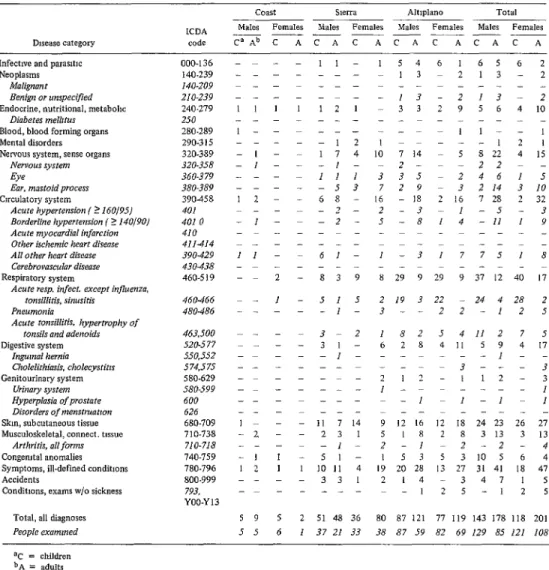
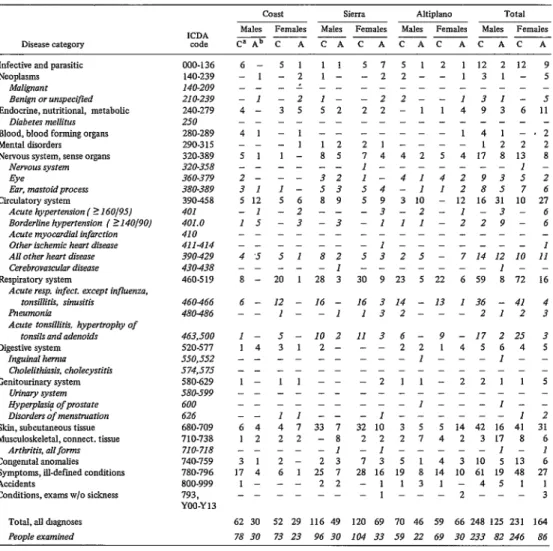
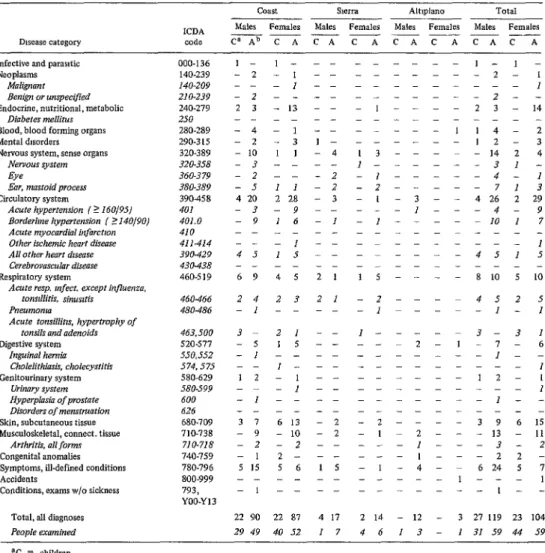
fered (but in a manner wholly explicable by chance), the overall rates in the two years were comparable. Thus in 1973 1.40 diagnoses were made for each individual examined; in 1974 this figure was 1.34. Within ecological niches, these values were 1.20 versus 1.19 for the coast, and 1.44 versus 1.92 for the sierra. It bears noting that the proportions of males seen in the years 1973 and 1974 did not differ signifi- cantly, nor did the proportions of children. Thus Tables 2a through SC, which give only the overall rates, do not confound diag- nostic differences ascribable to sex or age.
Many of the diagnoses set forth in Tables 2 and 3 are matters of clinical judgment, while others are matters of convention. Among the latter is the diagnosis of hyper- tension. In the latter connection we re- corded two events, namely, “frank” and “borderline” hypertension. By convention (3.2) we defined borderline hypertension among individuals 15 years of age or older as indicated by a systolic pressure of 140-159 mm of mercury and/or a diastolic pressure of 90-94, while defining “frank” hyper- tension in this age group as indicated by a systolic pressure of 160 or greater and/or a diastolic pressure of 95 or more. Hyper- tension, frank or borderline, is less clearly defined in children (subjects under 15 years of age) and the definition is likely age-dependent: but convention, limited as it is, suggests that systolic pressures over 140 or diastolic pressures over 90 are abnormal. Though these standards do not adequately recognize cardiovascular disease at high altitude in our view, we accepted them for purposes of comparison. Since they are defined on the basis of experiences at lower altitudes, they are not calculatedly self- serving insofar as high-altitude observers are concerned. It warrants noting, however, that for individuals less than 15 years of age, even at sea level, these standards exceed the 90th percentile for ages 6 through 15 inclusive (33).
The diagnosis of anemia presents similar problems when the condition involves inadequate nutrition. Here one of the con- ventional metrics is the amount of hemo- globin in the blood. Again, we took as our standards those values normally viewed as indicative of anemia at sea level, namely, less than 12 gms per cent of hemoglobin in males and less than 10 gms per cent in females.
Specific Diagnoses
Some 419 different ICDA (34) codable diseases or “symptoms and ill-defined con- ditions” listed in the International Classzyi- cation of Diseases (34) were encountered. Most of these involved only a few individ- uals at most, making diagnosis-specific com- parisons for different altitudes, sexes, or age groups statistically meaningless. Accord- ingly, we have grouped our findings into broader diagnostic categories, but will in the paragraphs that follow call attention to the most frequently encountered problems in each category (in addition to those other specific diagnoses indicated in the tables).
Infective and parasitic diseases. The illnesses most commonly encountered in children were diarrhea, upper respiratory infection (including otitis media), tubercu- losis, whooping cough, and bacterial infec- tions of the skin. The illness most commonly encountered in adults was tuberculosis. Stools were not routinely examined; it can be surmised from the work of others (28) that had they been, parasites, mostly worms, would undoubtedly have been encountered.
Neoplasms. Only one malignancy was seen, and all of the benign tumors were essentially inconsequential as threats to health.
226 PAHO BULLETIN l vol. XII, no. 3, 1978
Table 2a. Data for permanent Aymara residents Distribution of diseases and disorders among the permanent Aymara residents
examined in the population of the Department of Aria, by sex and ecological niche.
Disease category
ICDA code
- lnfectlve and paras,t,c
Neoplasms Malignant Benign or unspecified
Endocrine, nutritional, metabohc
Diabetes melbtus Blood, blood forming organs Mental disorders Nervous system, sense organr
Nervous system Eye
Ear, mnstoid process
Circulatory system
Acute hypertension ( ? 160/95J
Borderline hypertension ( S 140/9OJ
Acute myocardial infarction
Other ischemic heart disease AN other heart disease
Ccrebrovascular disease
Respiratory system
Acute rap. infect. except influenza, tonsillitis, sinusitis
Pneumonia
Acute tonsillitis, hype-trophy of
tonsils and adenoids Digestive system
Ingurnol hernia
Cholelithiasis, cholecystitrs
Genitourinary system
Urinary system
Hyperplasia of prostate
Disorders of menstmotron
Skm, subcutaneous tissue
Musculoskeletal, connect. tissue
Arthritis, all forms Congemtal anomalies
Symptoms, ill-defined conditmns
Accidents
Conditmns, exams w/o sickness
000.136 140.239 140-209 210.239 240.279 250 280.289 290.315 320.389 320.358 360979 380,189 390458 401 401 0 410 411.414 390.429 430-438 460.519
460466 4X0-486
1 -3 1775 I8
8 29 9 29 9 37 12 40 17
2 I9 3 22 - 24 4 28 2
3--22-125
463.500 520.577 550,552 574,575 580.629 580.599 600 626 680.709 710.738 710.718 740.759 780.796 800.999 793, YOO.Yl3
11 - 61-
2 - 839
1 - 515
1 -
3-2
3 I -
1 -
1 82 5 4 11 2 7 5
6 2 8 4 II 5 9 4 17
1 - -
3 -- - 3
2 I? - 112 - 3
I---, ImI-lml
]- - - 11 7 14
-2, - - 23 I
1 -
-1 1 -51-
12 1 I 1011 4
33 I
9 12 16 12 18 24 23 26 27
5 IS 28 3 13 3 13
2-l -2-2 - 4
1 5 3 5 3 10 5 6 4
19 20 28 13 27 31 41 I8 47
214-3471s
12 5 -12 5
Total, all diagnoses 59 5 2 51 48 36 80 87 121 77 119 143 178 118 201
People exammed 55 6 1 37 21 33 38 87 59 82 69 129 85 121 108
Coast SMra Altlplano Tots1
Males FUX&X Males FeWlIes Males Females M&&S Females
c”?--- ACACF ACAC ACAC A
I 1 - 1 54 6 I.55 6 2
--- - --- I 3 2 1 3 - 2
Ill I121
-13-213-2
3 3 2 9 5 6 4 10
I-- --- 1 l-- I
1 2 l-m---121
-I- 1 7 4 10 7 14 5 822 4 1s
-I- - -I- 2- --22 -
Ill 3 35 246 15
- -53 7 2 9 3 2 14 3 10
12 - - 68- 16 - 18 2 16 7 28 2 32
7 - 2 -3 l-5 - 3
-I- -2- 5 -8 14 -II 1 9
“C = children bA = adults
- =o
subject fell into the lowest one percentile of his or her age and sex class (based on Chilean standards.)
Diseases of the blood and blood-forming organs. Anemia, generally thought to be nutritional in origin, was found to be the most frequent disease of the blood. Detailed hematologic studies were not practicable in the field, and thus some of the “simple” anemias may have been due to causes other
than iron deficiency or a more generalized malnutrition.
Mental disorders. Neurosis in adults and mental retardation in children accounted for the bulk of mental problems.
Diaz et al. l DISEASE AND DISABILITY AMONG THE AYMARA 227
Table Zb. Data far permanent mesttzo residents. Distribution of diseases and disorders among the permanent mestizo residents
examined in the population of the Department of Arica, by sex and ecological niche.
Disease category ICDA code
Males Females M&S Females M&S Females Males Females
CBAb CA CACAC
Infective and parasitic Neoplasms
Mal~ont
Benign or unspecified
Endocrine, nutritional, metabolic
Diabetes mellitus Blood, blood forming organs Mental disorders Nervous system, sense organs
Nervous system Eye
Ear. mastoid process
Circulatory system
Acute hypertension ( ? 160/95J
Borderline hypertension ( ?140/9OJ
Acute myocardial infamion
Other ischemic heart disease All other heart disease
Cmbrovascular disease
Respiratory system
Acute msp. infect. except influenza, tonsillitis, sinusitis
Pneumonia
Acute tonsillitis, hypertrophy of
tonsils and adenoids Digestive system
Inguinal henna
Cholelithiasis. cholecystitis
eenitotiary system
urinary sys*em
flyperpkrsi? of prostate
Disorders of menstruation
Skin, subcutaneous tissue
Musculoskeletal, connect. tissue
Arthritis, 011 forms
CongenItal anomalies
Symptoms, ill-defmed conditions
Accidents
Conditions, exams w/o sickness
000-136 140.239 140-209 21 o-239 240-279 250 280.289 290-31s 320.389 320.358 360.379 380.389 390458 401 401.0 410 411414 390429 430.438 460.519
6- 51 11
-1-Z l-
-- -L --
-I -2 l-
4- 3s 52
41 -1 --
112
51 l- 85
-- -- --
2- -- 32
31 I- 53
512 5 6 a 9
-1 -2 --
15 -3 -3
s 7 s 1 2 1 12 2 12 9
-22--131-s _----_---- -22--131-j
22-11493 6 11
---141-.2
21----122 2
7 4 4 2 5 4 17 a 13 a
I---I -
l-41429352
54-11 285 7 6
5 9 3 10 - 12 16 31 10 27
-3-2-l-3-6 111-229-6 ---
-I--- 1
5 3 2 5 - 7 14 I2 IO II
---I--
30 9 23 s 22 6 59 8 72 16
460466 480486
-_ -- _-
4’5 5 I 82
-- -- -I
8 - 20 1 28 3
6 - 12 - 16 -
I- -I
16 3 14 - 13 I 36 - 41 4
132---2123 463,500 520-577 s50,552 574,575 580.629 S80-599 600 626 680.709 710.738 7IO-7I8 740-759 780.796 800.999 793, YOO-Y13
I - 5 - IO 2
14 31 2-
-- -- --
-- -- --
1- 11 --
-- -- --
-_ -- --
-- II --
6 4 4 7 33 7
12 22 -8
1
31 2- 23
17 4 6 1 25 7
I- -- 22
II 3 6- 9 -17 225 3
--22145645 I---I--
-211-2211 5
---
l---I--
-I---I 2
3210 3 S S 14 42 16 41 31
222742 317 8 6
-I---I- ]
73 514 3 10 S 13 6
28 16 19 8 14 10 61 19 48 27
-1131-4511
l---Z--- 3
Total, all dngnoses 62 30 52 29 116 49 120 69 70 46 59 66 248 125 231 164
People examined 78 30 73 23 96 30 IO4 33 59 22 69 30 233 82 246 86
Coast Sierra Altiplano Total
v! = children
bA = parents -=o
reiteration that the examinations were conducted in the spring (October and November), a season during which otitis media and respiratory diseases were pre- sumably at neither a maximum nor a minimum.
Diseases of the circulatory system. Sys-
temic hypertension in Aymara adults living permanently in the sierra or the altifdano was uncommon, but it occurred more frequently than the literature would sug-
228 PAHO BULLETIN l vol. XII, no. 3, I978
Table 2~. Data for permanent non-Aymara residents. Distribution of diseases and disorders among the permanent non-Aymara residents
examined in the population of the Department of Arica, by sex and ecological niche.
Coast Sl-Srrd Altlplano Total
ICDA Milks Females Males Females M&% Females MEikS Females
Disease category code CaAbCACACA
Infective and parasitic Neoplasms
MaIignunt Benign or unspecified
Endocrine, nutritional, metabolic
Diabetes mellitus Blood, blood forming organs Mental dxorders
Nervous system, sense organs Nervous system Eye
Ear, mastoid process
CtiCulatary system
Acute hypertension (? 16OJ95J
Borderlrne hypertension ( _> I40/9OJ
I- I--- ---l-l-
-2-1 -- ---2- 1
I -- --- 1
-2---2--
2 3 - 13 - - - 1 - - - - 2 3 - 14
-4-,-- ---I 14- 2
-2-3 l- ---12- 3
-10 11-4 13---- -14 2 4
-3---- I---31-
-2---2 -]---4-I
-5 11-2 -z---71 3
4 20 228 -3 - I - 3 - - 4 26 2 29
-3-9-- ---I---4- 9
-9 16-I -l---m -10 1 7
Acute myocardinl infarctron
Other ischemic heart disease All other heart dmme
Cerebrovmculor disease
Respiratory system
Acute rasp. mfect. except influenza.
tonsdlitis, sinusrtis Pneumonro
Acute tonsiiiihs, hypertrophy of
tonsils and adenoids Digestive system
Inguinal hernia Cholelithiasis. cholecystitis
Genltourinary system
urimry system
Hyperplasia of prostate
Disorders of mensmmtion
Skin, subcutaneous tissue
Musculoskeletal, connect. tissue
Arthritis. all forms
Congenital anomalies
Symptoms, ill-defmed conditions
Accidents
Conditions, exams w/o sickness
000-l 36 140.239 140-209 21 O-239 240.279 250 280.289 290.3 IS 320.389 320.358 360.379 380.389 390458 401 401.0 410 411414 390429 430438 460-S 19
I-- ---I
4515-- ---4515
460466 480486
69 45 21 lS---- 8 10 5 10
24 23 21 -Z----452 5
-,---1p--m-I-i
463,500 520.577 550,552 574,575 580.629 580-599 600 626 680.709 710.738 710.718 740.759 780396 800.999 793, YOO-Yl3
3- 21-- I---3-3,
-5 1*---2-l-7-6
-I---- ---I--
l--- --- 1
12-l -- ---,2- 1
I -- --- 1
-I---- ---I--
3 7 613-2 -2----39 6 15
- 9 -10 -2 - 1~ 2 - - - 13 - 11
-2-z-- ---l---3- 2
-12---l---22-
515 56 IS -1-4-m 624 S 7
l--- 1
l---l--
Total, all diagnoses 22 90 22 87 4 17 2 14 - 12 - 3 27 119 23 104
Peopk amined 29 49 40 52 I 7 4 6 1 3 - I 31 59 44 59
ac = children bA = adults
-= (J
between 140/90 and 160/95. Only 1 of 239 Aymara children living permanently in the sierra or altiplano had a blood pressure greater than 140/90, and none of the 11 living permanently along the coast had elevated blood pressure.
Among the 155 Aymara adults who were residing in the sierra or altiplano at the time of these examinations but acknow- ledged spending at least 10 per cent of their lives elsewhere, 6 had systolic blood pres- sures over 160 or diastolic pressures above
95. An additional 16 individuals had blood pressures in the range of either 140-159 (systolic) or 90-94 (diastolic) or both. These frequencies are very similar to those observed among permanent residents at these altitudes, and lower than those found among the coastal Aymara. None of the 33 Aymara children who had spent only part of their lives in the sierra or altiplano had elevated systolic or diastolic pressures.
Diaz et al. l DISEASE AND DISAEiILITY AMONG THE AYMARA 229
Table 3a. Data for non-permanent Aymara residents. Distribution of diseases and dim&s among the non-permanent Ayman
residents examined in the population of the Department of Arica, by sex and ecological niche.
coast Sierra Altlplano Total
Infective and parasitic Neoplasms
Malignant Benign or unspecrjied
Endocrine, nutritional, metabolic
Diabetes mellim Blood, blood fomdng organs Mental disorders Nervous system, sense orSam
Nervous system Eye
Ear. mastoid process
Cimlatory system
Acute hypertension (2 160/95J
Borderbne hypertension ( L 140/9OJ
Acute myocmdrol infarction
Other ischemic heart disease AN other heart disease
Cerebrovasculm disease
Respiratory system
Acute resp. mfect. except influenza, tonsillitis. sinusitis
meumonia
Acute tonsilIitis, hypertrophy of
tonsils and adenoids Digestive system
Inguinal hemti
Cholelzthiasn. chokcystitis
GmitounnaIy system
urinary system
Hyperplnsrn of prostate
Disorders of menstruation
Skin, subcutaneous tissue
Musculo&eletaI, connect. tissue
Arthritis>> all forms
Congenital anomalies
Symptoms, ill-defmed conditions
Accidents
Conditions, exams w/o sickness
Total, all diagnoses People examined
000.136 140-239 140.209 21 o-239 240.279 250 280.289 290-3 15 320-389 320-358 360-379 380.389 390458 401 401.0 410 411414 390429 430438 460.519 460466 480486 463,500 520.577 550,552 574,575 580.629 580399 600 626 680-709 710.738 710-718 740-759 780-796 800.999 793 YOO.Yl3
-2 - l-l l--212-523
l-- -2---l---4
1 --
-4 - 2 11
-_ - - --
2 - 1
2
3 112
-2---l---4 l----15-3
2 -3
-- - I19
-9 - 4 2 20
-3 - - -2
-2 - 3 -8
-l---l- 3
l---1-2- 2
15-3-1 115 1 9
-2--- 2
11-1-l-41 4
-2-z-- 111 - 3
-18 - 5 - 2 2 34 - 24
-4---J- 4
-J-3-- -13 - 8
-2 - - 24
-- - 1 1 15
I17 I
-S-2-128- 6
_----__--_
110 42 13 5 17 2 14
lSI2I12927 -3---l-3
2
-3 - 4--
-- - I--
1 --
-- - - -2
I
-- - - -1
-6 15 19
-5 - 4-5
-2 - I -I
l--
-2 - 5 3 32
-- - l--
-- - 3 --
- 31 1 37 9 100
2 26 4 22 13 55
--3--232-2 3-2-l-5-8
I
--- 1
-2---,-z-3
I - -
---I-- -I---I---2
316 19 13 2 24 5 24
7 - 2 - 2 - 12 - 13
-2-I---4- 3
112-312-5
- 1.5 115 1 9 4 49 1 29
---,---,- 1
l-2-2-2- 6
6 83 7 45 4 31 16 176 11 151
647 931 5 22 24 I?2 1.5 91
ac = children bA = adults
-= 0
Cardiac auscultatory findings were of interest and surprising. The most common finding among adults was premature con- tractions, the vast majority of which were superventricular in origin.
Rheumatic fever is a significant health problem in many Central and South American countries, and it came as a sur- prise that none of the Aymara adults or children living at altitude or sea level had murmurs of mitral insufficiency, mitral
230 PAHO BULLETIN l vol. XII, no. 3, 1978
Table 3b. Data for non-permanent mestizo residents. Distribution of diseases and disorders among the non-permanent mestizo
residents examined in the population of tbe Department of Ariw. by sex and ecological niche.
Infectwe and parasitic Neoplasms
Moligmn t Benign or unspecified
Endocrine, nutritional, metabohc
Diobctes mellitus Blood, blood forming organs Mental disorders Nervous system, sense organs
Nervous system Eye
Em, mastoid process
Circulatory system
Acute hypertensm ( ? 160195)
Border/m hypertension ( ?140/90)
Acute myocordul inforctron
Other ischemic heart disease
Ail other hurt disease
Cerebrovoscular disease
Respxatory system
Acute req. infect. except influenza, tonsillitis sinusrtis Pneumonia
Acute tonsiibtis, hypertrophy of
tonsils nnd ndenoids Digestive system
In&ml hernro
Choklithiosis, cholecystitzs
Genitourinary system
uimy system
Hyperplasio of prostote
Disorders of menstruotron
Skin, subcutaneous tissue
Musculoskeletal, connect. tissue
Arthritis, all forms
Congenital anomalies
Symptoms, ill-defined conditions
Accidents
Conditmns, exams w/o sickness
Total, all diagnoses 16 75 13 82 29 86 36 71 19 39 9 23 64 200 58 177
People examined 20 55 21 46 26 55 28 52 11 17 8 12 57 127 57 110
000.136 140.239 140.209 210.239 240.279 250 280.289 29031s 320.389 320.358 360.379 3X0-389 390458 401 401.0 410 411414 390429 430438 460-S 19
1413-l---3111824 ---,-,-2---l-3
l-]-2---1-3
12 - 8 - 4 - 3 12 - 3 2 8 - 14
l--*---2----1--4
l---l---Z--
17 14 2 8 2.4 12 2 1 417 5 9
*-I-I---*- 2
3--21-1-I--25- I
1413-6221121 211 5 6
415 2 7 4 17 5 22 7 3 8 39 7 33
6---6-J-2---14-5 3-4-5-I-3-1-11-6
1 ---I- -
42214455-2-18878
34 66 610 9 5 7 4 3 3 16 18 18 14
460466 12313563412- 8 8 11 4
4X0-486 1 ---l--
463,500 520.577 550,552 574.575 580.629 580599 600 626 680.709 710.738 710-71X 740.759 780.796 800.999 793, YOO-Y 13
11312-21311-6262
3 - 8 1 5 - 5 - 1 I 1 9 - 14
,---l-l- 1
3---3 2-2-1-3---3-s
*---I I---I--
l--- 1
12 - 18 9 312 9 3 5 I 7 12 20 13 34
1 9 - 3 - 1 - 3 1 2 - 1 212 7
3-l---2---3-3 2-lll31--2--3521
2 16 2 14 6 30 7 10 6 9 2 2 14 55 11 26
l---l---1---3-- 5---3---1---9
T - children
bA = adults
-= 0
United States showed high rates of rheu- matic fever in the Rocky Mountain area (35). The lack of crowding in the areas studied-both the villages at altitude and the two valleys at sea level -could have been at least partially responsible for the appar- ent low incidence of rheumatic fever.
Virtually all of the murmurs were insig- nificant, being either soft ejection murmurs over the upper left sternal border or vibra- tory short systolic murmurs over the lower left sternal border. The few significant
Diaz et al. l DISEASE AND DISABILITY AMONG THE AYMARA 231
Table 3~. Data for non-permanent non.Aymara residents. Distribution of diseases and disorders among the non-permanent
non-Aymam residents examined in the population of the Department of Arka. by sex and emtogical niche.
COaSt
Sierra
Altiplano TotalICDA Malei Females MZikS Females Males Females M&S Fern&s
Disease category code ~AbyyA--- CAC A CAC A
Infective and parantic Neoplasms
Malignant Benign or unspecified
Endocrine, nutritional, metabolic
Drnbetes mellihn Blood, blood forming organs Mental disorders Nervous system, sense organs
Nervous system Eye
Ear, mastoid process
Circulatory system
Acute hypertension / ? 160195)
Borderline hypertension / 2 140/901
Acute myocardtil infarction
Other ischemrc heart disease All other heart drsense
Cerebrovascular disease
Respiratory system
Acute resp. infect. except influenza. tonsillitis. sinusitis
Pneumonia
Acute tonsillitis, hypertrophy of
tonsils and adenoids Digestive system
Inguinnl hemlo Cholelithiosis. cholecystitis
ChitouruwIy system
Urihaiy sys*enl
Hyperpl& of prostate
Disorders of menstruation
Skin,subcutaneous tissue
Musculoskeletal, connect. tissue
Arthriris. all forms
Congenital anomalies
Symptoms, ill-defined conditmns
Accidents
Conditions, exams wlo sickness
000-136 140.239 140-209 21 o-239 240.279 250 280-289 290315 320.389 320-358 360-379 380-389 390458 401 401.0 410 411414 390429 430438 460-S 19
-l-1---,-,
l---l--
____ ---_---
---I---I-- 5-5-2-1---7-6
---2---z ---,-2---]---3-l
3 - 2 - 5 - - - 3 - l-11 - 3
2---1---3--
__ ---2---z- -
1 -2-4----I-6- 3
- 17 - 8 -2722-6-l 1 50 2 I1
-j-3-7---J-- -17 - 3
-5 -I - II - - - I - I -17 - 2
_____ --__---
-4---z---6-- 2-2-32---1522
-Z-1235--2112762
460466 -1-11-z---111132
480486 l---l--
463,500 520.577 550.5s2 574.575 580.629 S80.599 600 626 680.709 710.738 710.718 740.759 780.796 800-999 793, YOO-Y13
----133--- 1 3 3 -
-I-3-I---2- 3
____ ---_---
__--- ---
I-2---1-1-3
I--- 1
- 3 - 6 2 4 1 1 - 2 - 3 2 9 1 10
-3-4-3---7-4
2---2-- 2---2---4--
-3 -5 217 12 - 5 2 - 225 3 7
-, ---, *---21-
__---_---_--
Total, all diagnoses - 42 - 40 6 66 10 6 - 22 3 7 7 130 13 53
People examined 3 16 I 24 7 39 6 10 - 10 I 3 IO 65 8 37
=c = cluldren bA = adults
-=o
of patent ductus arteriosis, particularly since it was expected that the incidence would be high. It is possible, but not prob- able, that most of the infants with patent ductus arteriosis had died.
Diseases of the respiratory system. Com- mon cold, bronchitis, tonsillitis, and pneu- monia were the more common diagnoses in this disease category among both adults and children. Auscultatory findings suggesting asthma were not noted; but the older Aymara living at altitude commonly had
symptoms and auscultatory findings sug- gesting pulmonary tuberculosis.
Diseases of the digestive system. Severe dental caries and ill-defined gastrointes- tinal disorders constituted the bulk of adult problems; no single diagnosis stood out among children. Dental caries were often so severe that extraction was necessary.
232 PAHO BULLETIN l vol. XII, no. 3, 1978
Diseases of the skin and subcutaneous tissue. Cicatrix, keloids, and acquired kera- toderma were the commonest of the skin diseases observed in adults and children.
Diseases of the musculoskeletal system and connective tissue. Among children deformities of the leg, most often as a result of trauma, constituted the principal pathol- WY; among adults deformities were also common, but so too were arthritis and rheumatism.
Congenital anomalies. Ogival palate and deformities ‘of the chest (pectus excavatum and pectus carinatum) predominated among the Aymara. The diagnosis of 14 congenital heart defect cases revealed an incidence
among the Aymara similar to that found in the United States (7 per 1,000 population).
Symfitoms and ill-defined conditions. Among children, enlarged lymph nodes and hemoptysis were the most frequent findings in this category; among adults, enlarged lymph nodes, hemoptysis, abdominal and/ or joint pain, and senility were the pre- dominant findings.
Accidents. Perforated eardrums, one or both, was the most common finding nor- mally recorded in this category.
Concluding Remarks
Tables 2 and 3 indicate the numbers of male and female adults and children with observed diseases and disabilities, the nature of these diseases and disabilities, and the ecological niche and ethnic origins of those examined. Table 2 includes only people who said they had never lived outside their present area of residence (Costa, sierra, or altiplano), while Table 3 includes only those who said they had spent at least 10 per cent of their lives in other regions. (As noted earlier, approximately 100 individuals were seen whose residential status placed them between the two groups described.)
We note that findings varied significantly for different regions and ethnic groupings,
different regions. For example, taking all altitudes together, systemic hypertension was more commonly observed among adult non-Aymara (in 33 of 220 subjects) than among mestizos (28 of 405), and was more often found among mestizos than among the Aymara (17 of 396). It is also interesting to note that the frequency of hypertension in- creased with increasing altitude among adult non-Aymara, decreased among the Aymara, and remained more or less constant among the mestizos. This increase among the non-Aymara cannot be ac- counted for solely in terms of the transitory increase in blood pressure which frequently accompanies migration to high altitude during the acclimatization process.
Many of the other altitude-related diag- noses seem to directly reflect differences in the rigors of life. Thus respiratory diseases increased with altitude, presumably because of colder temperatures and ill-heated homes; the rate of skin diseases reflecting the di- minished moisture and increased cold was also elevated; and otitis media was more common. More evidence of past traumatic accidents was also seen at higher altitudes; this must reflect in part the limited health care available to people in these regions. Fractures often went unset. However, we did not see increased rates of arthritic or rheumatoid disorders, gall bladder disease, or other conditions which might be ascrib- able to differences in adaptation to altitude. We did not encounter clinically recogniz- able diabetes or obvious nutritional dis- orders. Obese as well as undernourished individuals were encountered in all groups and at all altitudes; however, obesity was rarer among the Aymara and undernour- ished individuals were somewhat more common.
Diaz et aL . DISEASE AND DISABILITY AMONG THE AYMARA 233
had entered rather than the one they had left behind. But this statement requires immediate qualification. In particular, the result is heavily influenced by infectious and parasitic disorders-respiratory diseases and the like-which undoubtedly account for the bulk of the disability prevalent in any population such as the one under dis- cussion. It is also true that the three broad ecological zones in the Department of Arica differ so markedly in temperature, humid- ity, and atmospheric pressure that diseases or conditions which relate directly to these physical parameters can and do differ-as in the case of the acquired keratoderma resulting from the chill and dessication which occur at high altitude. However, as we have pointed out in the case of hyper- tension, there are also real differences between migrants and non-migrants which suggest some more fundamental biological response to environmental stress. Unfortu- nately, rather than elucidating the nature of this stress response, our data merely serve to indicate its existence.
Viewed in terms of public health needs, some consolation may be obtained from this general observation, for it implies that public health authorities need not anti-
cipate two totally different sets of health care requirements, one for “immigrants” and the other for permanent residents. Some acute problems will differ in fre- quency, however, and provision must be made for their occurrence. Such provision must include an awareness-by both profes- sionals and the lay public-of those disorders which may be virtually unique or which may occur with elevated frequency among immigrants.
Our observations suggest a need for other more specific public health activities. Steps should be taken to promote improved dental care, particularly preventive work, and also-if needed-reconstructive work capa- ble of obviating severe tooth loss. The current school health programs are clearly beneficial, but do not reach the older indi- viduals requiring some reinforcement of earlier education. A program in the sierra and alti@lano to improve skin hygiene would have immediate rewards. Continua- tion of the use of BCG in children is clearly indicated. And, finally, the routine use of chloramphenicol, largely by the practi-
cantes, 11 should be discouraged; penicillin involves significantly less risk, is less expen- sive, and is usually more effective.
ACKNOWLEDGMENTS
Studies of this magnitude and complex- ity, carried out under circumstances very alien to most of those involved, clearly owe whatever measure of success they achieve to many individuals. This investigation was no exception. We are indebted to numerous people and many local and national institu- tions in Chile, but we are especially be- holden to the Junta de AdeEanto of Arica and its then president, Luis Beretta. With- out the unqualified endorsement of this body, as well as the enthusiastic support of all members of the Department of Com- munity Development and Andean Plan- particularly that of its chief, Carlos Solari - this study would not have been pos-
sible. We also owe much to the National Health Service of Chile, the practicantes of the Chilean Carabineros, and numerous teachers who gave selflessly of their time and energies to make our examinations a success. We are also indebted to Dr. Merry Makela, Ms. Sara Barton, Richard Allen, and Ms. Paula Carlock, without whose help the data presented would not be available for analysis. Finally, we wish to express our gratitude to the numerous Arica residents who in patience and good humor tolerated our questions, pokings, and proddings.
234 PAHO BULLETIN l vol. XII, no. 3, 1978
SUMMARY
During the Multinational Andean Genetic Health Program initiated in the Chilean Department of Arica in 1972, some 2,096 Arica residents were given thorough medical examina- tions. This article reports data obtained from these examinations, which were conducted in the months of October and November of 1973 and 1974.
All of those examined were classified in terms of their area of residence (the costa, sierra, or aZti$&zno); whether they had always resided in
the same area: their ethnic origins; and their age and sex. Differences were observed in the incidence of particular diseases and disabilities among diverse ethnic groups-those occupying similar ecological niches as well as those occupy- ing different niches. It was also found that “migrants” tended to experience the health problems of their new, as opposed to their old, places of residence. Some of the public health implications of these and other findings are discussed briefly.
REFERENCES
(1) Hurtado, A. Acclimatization to high alti- tudes. In: W.H. Weihe (ed.). Physiological Effects of High Altitude. Pergamon Press, Oxford, England, 1964.
(2) Monge M., Carlos, and Carlos Monge C. High Altitude Disease: Mechanism and Manage- ment. Charles C. Thomas, Springfield, 1966.
(3) Frisancho, A. R. Functional adaptation to high altitude hypoxia. Science 187:313-319, 1975.
(4) Lewis, J. G., and J. E. Gardner. The rela- tion of serum uric acid to haemoglobin level in patients with cardiac and respiratory disease. J Clin Pathol 13:502-505, 1960.
(5) Page, L. B., A. Damon, and R. C. Moellering. Antecedents of cardiovascular dis- ease in six Solomon Islands societies. Circulation 49:1132-1146, 1974.
(6) Hall, A. P. Correlations among hyper- uricemia, hypercholesterolemia, coronary dis- ease and hypertension. Arthritis Rheum 8:846- 852, 1965.
(7) Jacobs, D. Hyperuricaemia and myocar- dial infarction. S Afr Med J 46:367-369, 1972. (8) McEwin, R., K. McEwin, and B. Loudon. Raised serum uric acid levels with myocardial infarction. MedJ Aust 1:530-532, 1974.
(9) Klein, R., B. E. Klein, J. C. Cornoni, J. Maready, J . C. Cassel, and H. A. Tyroler. Serum uric acid: Its relationship to coronary heart dis- ease risk factors and cardiovascular disease, Evans County, Georgia. Arch Intern Med 132:401-410, 1973.
(IO) Ciswicka-Sznajderman, M., H. Igna- towska-Switalska, and M. Sznajderman. Uric acid level, coronary heart disease and serum lipids. Pal Med J. 11:233-237, 1972.
(II) Allard, C., and C. Goulet. Serum uric acid: Not a discriminator of coronary heart disease in men and women. Can Med AssocJ 109: 986-988, 1973.
(12) Dawber, T. R. Coronary heart disease. Bib2 Cardiol (Basel) 13:9-24, 1963.
(13) Heyden, S., L. Walker, C.G. Hames, and H. A. Tyroler. Decrease of serum cholesterol level and blood pressure in the community: Seven to nine years of observations in the Evans County study. Arch Intern Med 128:982-986,
1971.
(14) Erf, L.A. Radioactive phosphorus in the treatment of primary polycythemia (Vera). In: L. M. Tocantins (ed.). Progress in Hematology. Grune and Stratton, New York, 1956.
(15) Marticorena, E., D. Penaloza, J. Seve- rino, and K. Hellriegel. Frequency of patent ductus arteriosus at high altitude. Fourth World Congress of Cardiology, Mexico, 1962.
(16) Rossena, H. Unpublished observations. (17) Hurtado, A. Aspectos fisiolbgicos y patolGgicos de la vida en la altura. Imprenta
Rimac, Lima, 1937.
(18) Hurtado, A. Relation de 10s estudios de altura con la cllnica y la fisiologia en general. Gaceta Midicu (Lima) 1:57-59, 1944.
(19) Cosio, G., Z. Hematic and cardiopulmo- nary characteristics of the Andean miner. Bull Pan Am Health Organ 7(1):26-33, 1973.
(20) Morgan, W.K.C., N. L. Lapp, and A. Seaton. Respiratory impairment in simple coal workers’ pneumoconiosis. J Occup Med 14:839- 844, 1972.
(21) Marek, K., and A. Kujawska. L’in- fluence des lesions pneumaconiotiques precoces sur la fonction respiratoire. Bull Physio-Path Resp 9:1173-1187.
(22) Morgan, W.K.C., R. Reger, D. B. Burgess, and E. Shoub. A comparison of the prevalence of coal workers’ pneumoconiosis and respiratory impairment in Pennsylvania bitu- minous and anthracite miners. Ann NY Acad Sci 200:252-259, 1972.
Diaz et al. l DISEASE AND DISABILITY AMONG THE AYMARA 235
pulmonar en un centro minero-industrial de 10s Andes de1 Per-ii central. Revista Mt?dica de Yauli (Oroya, Peru) l-2:16, 1962.
(24) Hurtado, A. Pathological aspects of life at high altitudes. MiEit Med 1172.72-284, 1955. (25) Hurtado A. Some clinical aspects of life at high altitude. Ann Intern Med 53:247-258, 1960.
(26) Morton, W. E., D. J. Davids, and J. A. Lichty. Mortality from heart disease at high alti- tude. Arch Environ Health 9:21-24, 1964.
(27) Keck, C. W., R. K. St. John, T. M. Daniel, M. Pantoja, D. Danielson, and W. W. Fox. Tuberculosis in the Yungas area of Boli- via. Health Sew Re$ 88:499-507, 1973.
(28) Buck, A. A., T. T. Sasaki, and R. I. Anderson. Health and Disease in Four Peruvian
Villages: Contrasts in E@idemiology. The Johns Hopkins Press, Baltimore, 1968.
(29) Omran, A. R., W. J. McEwen, and M. H. Zaki. Epidemiological Studies in Bolivia. Research Institute for the Study of Man, New York, 1967.
(30) Cruz-Coke, R., A. P. Cristoffanini, M. Aspillaga, and F. Biancani. Evolutionary forces in human populations in an environmental gradient in Arica, Chile. Hum Biol 38:421-438, 1966.
(31) Schull, W. J., and F. Rothhammer. A multinational Andean genetic and health pro- gram: Rationale and design of a study of adapta- tion to the hypoxia of altitude. In: J. S. Weiner (ed.). Genetic and Non-Genetic Components in PhysioZogicaE Variability, Vol. 18. Society for the Study of Human Biology, London, 1977.
(32) Gordon, T., and B. Devine. Hyperten- sion and hypertensive heart disease in adults: United States, 1960-1962. In: VitaE and Health Statistics. U.S. Public Health Service, Publica- tion No. 1,000, Series 11 (No. 13), p. 62; Wash- ington, D.C., 1966.
(33) Lauer, R., and W. H. Weidman. Un- published data from SCOR, University of Iowa and Mayo Clinic, Rochester, Minnesota.
(34) U.S. Department of Health, Education, and Welfare, Public Health Service, National Center for Health Statistics. Eighth Revision, International Classification of Diseases. U.S. Government Printing Office, Washington, D. C., 1968.