A Work Project, presented as part of the requirements for the Award of a Masters Degree in Economics from the Faculdade de Economia da Universidade Nova de Lisboa.
The Echoing Phenomenon in Antidumping Cases
Ana Raquel Hip´olito Gon¸calves, Master Student Number 408
A Project carried out on the World Trade Organization course, under the supervision of: Professor Chrysostomos Tabakis
The Echoing Phenomenon in Antidumping Cases
Abstract
The practice of antidumping law has been increasing in the past decades, allowing for the rise of new trends in the world trade panorama. One of these new trends is the echoing phenomenon. This work contains an extended research of echoing between antidumping users, using identical products’ codes for identifying the echoing cases. The results show that the USA and Canada are the major players in echoing antidumping suits, with echoing cases representing 14% and 29% of the total antidumping filings, respectively. Indeed, this is a new phenomenon of great importance, as it might be defining trade patterns worldwide furtively.
1
Introduction
“Since 1980, GATT/WTO members have filed more complaints under the AD [antidump-ing] statute than under all other trade laws combined.” Blonigen and Prusa (2001).
The use of the antidumping policy started growing in the beginning of 1980. This increase coincided with the end of the Tokyo Round, which made the filing of antidumping (AD) cases easier. From that point onwards, a set of revisions were done to AD law.
Today’s definition of dumping in an AD investigation is very far away from its economic definition. For example, according to USA AD law, imports can be considered unfair even if the exporting firm charges a higher price in the USA compared to the price it charges at its home country1
.
With the proliferation of AD suits around the world and the insurgence of new users, a new phenomenon started to appear. It is a trend in the way countries file their antidumping investigations and it was named echoing. The name is given by Jean-Christophe Maur in his paper, Echoing in Antidumping Cases, of 1998, and it is based on the fact that an “antidumping procedure in one country may lead to identical procedures targeting similar products originating from the same countries under other foreign antidumping statutes.” The objective of this Work Project is to further identify and analyze the echoing phenomenon, aiming at a broader vision of its magnitude in antidumping usage worldwide. The motivation behind the study of such trends in antidumping law comes from the existence of instances that suggest that multinational firms are monitoring antidumping law. This issue was discussed by Messerlin and Reed (1995), where the authors found that similar antidumping statutes between countries allow for global firms to be experts in AD petitions in many countries, ultimately leading to an increase in similar AD filings conducted by the same multinational, in different countries. If antidumping law is now looser towards the definition of dumping, and, on the other hand, multinational firms are mastering antidumping law for their own profit2
, then the combination of these new factors makes echoing extremely relevant for trade matters.
Although for the study done by Messerlin and Reed (1995), the imitation in antidump-ing investigations theme appears to be given too little emphasis by trade authorities in
1
Please see Blonigen and Prusa (2001), page 3. 2
general. In addition, what Maur (1998) conducted during his study on echoing was proof that the echoing phenomenon is, indeed, significant. Following the context discussed in his paper, the current research entails questions on the existence of the echoing phenomenon and its extent in antidumping suits. Firstly, is there evidence that AD users are imitating each other when filing an antidumping petition? Secondly, what are the main countries conducting such practices? Moreover, what are the main exporting countries victims of this phenomenon? Are these exporting countries the same main victims of AD petitions? This paper is organized firstly with a brief overview of other studies developed in the antidumping subject and on the interdependence of AD suits. It continues with the problem’s presentation, which includes the explanation of the methodology for finding echoing cases and an extensive analysis of the data. Finally, there is the discussion and conclusion of the topic, leaving room for the study of further questions on the subject.
2
Literature Review
Antidumping law has been a topic for vast research during the past two decades, due to this fact I will focus on the work developed by Prusa and Bloningen (2001), which is basically a review on past literature under the antidumping topic, and it gives intuition on antidumping law from the past twenty years.
In this paper, the trends in AD use are discussed, starting with pre-1980 antidumping activity, and then post-1980 AD activity. 1980 is an important date for antidumping be-cause it marks the end of the Tokyo Round, where two important modifications were made to the antidumping statutes. It also marks the beginning of an increase in antidumping usage that had been never seen before. The first change in AD statutes was the definition of “less than fair value” sales, which was loose to capture also sales below cost, leading cost-based AD petitions to be the dominant cause in filing a suit. The second amend-ment relates to the end of the mandatory imposition that required “dumped imports be demonstrably the principal cause of material injury before duties could be imposed”3
. The authors also make a comparison of AD rules across countries, where it is observed that there are variations in AD statutes. This fact creates the most interesting question, how
3
come countries with such different AD laws have so similar antidumping petitions? This was discussed by Maur (1998) and it will be covered in this text latter on.
Another important aspect discussed in the paper was the importance of the filing of a case and its initiation date, even though a case ends up suspended. There is evidence supporting that a suspended case decreases imports, and increases output of the domestic country, by✩25 million4
. The initiation date of a case is used later on in the methodology to find the echoing cases between countries.
Literature regarding the echoing phenomenon is scarce, and for that reason the work developed by Maur (1998) is used as an important resource for the current research, be-cause it is the first paper to actually tackle this new phenomenon and it gives important insights from a theoretical point of view. Maur (1998) presents the causes for echoing in antidumping cases. The first cause is the monitoring done by multinational enterprises, which happens when a global firm tries to capture domestic antidumping law for its own profit, and subsequently uses AD policy in the different countries where it operates, al-lowing similar antidumping suits between these different countries and creating room for echoing.
Secondly, Maur (1998) presents a theory stating that echoing can have its origin in cascading and diverting effects, which is due to the premise that protection in one country leads other countries to look for the same kind of protection. This happens when one country seeks protection for its domestic firms and it ultimately ends up setting AD duties on the exporting firm, this firm will divert its products to another country. Now, this third country sees its imports increasing by an abnormal amount because of diversion, and therefore it might follow the first country, seeking protection. These kinds of practices lead to the creation of a domino effect and echoing between countries.
The third cause for echoing given by Maur (1998) is the phenomenon of imitation and positive externalities in antidumping suits. This reflects the fact that one country starts an AD petition after having observed the action and sometimes the outcome of other country’s investigation. Imitation is used here as a way to save costs in information gathering and it might be desirable in cases where there is imperfect information. If, for example, one does not have certain information about the exporting company, it files an
4
AD suit with existing information from another country’s AD petition, creating echoing between countries.
The methodology used to identify echoing cases is in part taken from the paper on echoing by Maur (1998). Where the author suggests the need for finding identical cases between countries, one could resort to the Harmonized System (HS) product codes that are used to identify a product’s typology in the same way, throughout countries.
3
Results
3.1 Data
The data employed in the development of this work was taken from the Global Antidump-ing Database5
, an online website that combines all AD data made available by the coun-tries’ Governments publications. The data is divided into four spreadsheets; the first one has all the information about each AD case filed in that country6
. The second spreadsheet provides information about the Harmonized System product codes (HS code) listed in the AD investigation petition; such codes are of the most importance for the development of this work project. Finally, the third and forth sheets have all the information about the domestic firms that filed the dumping complaint and the exporting firms under the AD investigation, respectively.
For this research AD data from the following eight countries is used. These countries are the USA, European Union as a whole, Canada, Australia, New Zealand, Argentina, Brazil and Colombia. The choice of these countries relies on the fact that the first five are major users of AD policy7
and the final three allow for a comparison between developed and developing countries during the analysis of the echoing phenomenon.
For a brief characterization of the AD data studied during this work we can take a look into Table 1, which shows the number of AD investigations in each country’s database, from 1990 to 2010. One can verify that the country with more AD petitions is the USA, with 745 cases, followed by the EU with 609 AD cases and by Australia with 479 AD cases
5
Bown, Chad P. (2010) ”Global Antidumping Database” available at
http://econ.worldbank.org/ttbd/gad/. 6
Take into consideration that the majority of countries did not made available AD fillings, up until the mid-eighties, hence not all AD investigation petitions are in this database.
7
during these past twenty years. One can also observe that Canada, Argentina and Brazil have a number of AD petitions between 250 and 300. And finally, Columbia and New Zealand show a smaller number of AD fillings during this period, each one with 77 and 50 AD cases, respectively. This low number of AD petitions from New Zealand is truly interesting, given that pre-1980 this country showed great antidumping activity8
.
Table 1. Number of AD Investigations by Filing Country, from 1990 to 2010
Country Number of AD Investigations
USA 745
EU 609
Canada 253
Australia 479
New Zealand 50
Argentina 259
Brazil 272
Colombia 77
Total 2744
3.2 Identifying the Echoing Cases
3.2.1 Methodology
As previously explained, echoing is the name given to the phenomenon that occurs when an antidumping suit in one country is followed by a similar suit abroad, Maur (1998). In order to have a practical way to identify the echoing cases, I developed an approach to this definition of echoing. Hereupon, some assumptions were made in a parsimonious way to what echoing should be.
First of all, this study can only consider echoing between two AD cases if those cases concern an identical product. If one were to consider close substitutes as well, looking for echoing cases would be a very difficult task, since the definition of close substitutes may be
8
subject to argument9
. Given this, the procedure used to find the identical products was based on the Harmonized System (HS) products code, the first six digits of the national tariff codes of these countries which identify the same class of products, Maur (1998). Secondly, for this study I considered a maximum time period of two years between the filings of the AD cases in one importing country and the other importing country. In order to accomplish this, it is used the initiation date of the AD petitions, because even though some petitions end up being dismissed by the AD Authority, the filing of an AD investigation alone provokes an effect in trade. One example of such an effect would be the creation of trade diversion or a settlement between the domestic firms and the exporting firms, which would end up benefiting the domestic industry without a final duty imposed10
. Thirdly, the time period for AD cases to be considered is from 1990 to 2010. Finally, the last imposition was that the AD cases would only be considered echoing if both petitions were against the same exporting country.
Given all the assumptions taken, one can define an echoing case as the phenomenon between two countries’ AD petitions, where the petitions involved have equal dumped products, are all against the same country or group of countries and were filed within a 2 year time period. The majority of the echoing cases found have only two antidumping investigations involved, for example one AD investigation in the USA with the corre-sponding AD investigation filed by the European Union, both against the same exporting country and involving an identical product, make an echoing case. Nevertheless, there are echoing cases that have more than two antidumping petitions, because sometimes several antidumping investigations are against a set of exporting countries, all dumping the same identical product11
. In these cases, the echoing is accounted as only one echoing case, but with several antidumping investigations within. One example is the echoing case between the USA and the European Union, in June of 1994. The USA filed two AD cases, one against China and the other against Thailand, because of dumped furfuryl alcohol, and then in April 1995 the European Union filed two AD cases also against China and Thai-land implicating the same dumped product12
. This is accounted as one echoing case, even
9
See Maur (1998). 10
See Staiger and Wolak (1994) for more details. 11
This is called cumulation in antidumping petitions and it appeared in US AD law in 1984, see Hansen and Prusa (1996) for the impacts of cumulation.
12
though it has two exporting countries and four AD investigations13 .
The method used in the search for echoing in AD cases was based on the match of HS product codes between one country and another14
. For this, combinations two by two, for the eight countries were considered, ending up with twenty-eight different combinations of countries. In each combination, there is a comparison between the HS product codes of country 1 and those of country 2, ending up with the set of HS codes that exist in both countries’ AD database. Afterwards all AD cases filed under each HS product are registered for both countries. With this, one has all the AD cases that are possible candidates to be in an echoing process, and therefore, it is possible to do the screening by time period between AD filings and finally the screening by exporting countries.
Another methodology used later on is based on screening out the AD cases with no final antidumping duty, for which the main goal is to have only echoing cases on AD petitions that result on a final duty. This is done holding steady all the other assumptions previously stated.
The methodology applied during this research differs from the one used by Maur (1998), in the sense that Maur did not take into account the two year time period between AD cases. One example of this difference is that in his research of 1998, the author considers an echoing case the antidumping suit on barium chloride against China, filed by the USA in November of 1983 and then a suit, with the same characteristics, filed by the European Union in December of 1988. Again, while in Maur (1998) this is considered as an echoing case, in my research it is not, given that there is a difference of five years from one antidumping filing to the other.
Another point in which this work differs from Maur’s is that his research covers AD cases from 1973 until 1997, and only searches for echoing cases between the USA and the European Union, and the USA and Canada. Now, in the current research, the number of countries has been extended to eight and also all the combinations possible between countries have been considered. In order to have an up to date database, the time period
against more exporting countries other than China and Thailand; this are the ones involved in the echoing phenomenon, because the other AD petitions on this same dumped product were not in accordance with the assumptions under what one considers echoing, that is why they are not reflect in this example.
13
Please check Table 1 of the Appendix, to see the echoing cases between the USA and the EU in more detail.
14
takes into consideration cases between 1990 and 2010.
Although the current research covers a vast amount of data, it still presents some limitations. The major one is that it is underestimating the number of echoing cases that actually exist between all these countries, as the close substitutes definition is not being used15
for the search of echoing cases. The reason for accepting this limitation lies in the difficulty to comprehend and study the echoing phenomenon with all close substitutes. The alternative adopted was to develop the research using only identical products.
3.3 Data Analysis
3.3.1 Echoing Data by Initiation Date
During the research, a total of 191 echoing cases were found between the eight countries considered, with a total of twenty-eight combinations of countries studied. One can observe this data in Table 2 below. The number of echoing cases between the USA and another country is, in total, 107, 56% of the total echoing cases. This can be explained by the fact that the USA is the highest user of AD policy, with 745 AD cases filed during the past 20 years. Therefore, one should expect the USA to be also a major player in respect of echoing.
One can also observe that the combination which showed higher echoing results was the USA and the European Union, with 32 echoing cases in the past 20 years. It is followed by the USA and Canada, a combination that presents 30 echoing cases for the same period. The reason behind the high number of echoing cases for the combination USA/European Union lies in the fact that together they are the countries that have more AD cases filed during that time period, which account for 1354 AD cases. In order to understand why the combination USA/Canada shows so many echoing cases a closer analysis has to be carried out, given that in absolute terms Canada does not file that many AD petitions. In addition, if we take into account the AD cases filed per volume of imports, one can say that Canada is not the greatest player in terms of the world’s AD policy. However, the explanation for the high number of echoing cases between Canada and the USA is related to the fact that these two countries suffer highly from the causes of echoing. For
15
example, Canada is home of many subsidiaries of American firms, which ultimately may lead to monitoring of AD law by the multinational firm in both countries. When it comes to trade diversion, it is obvious that an exporting firm facing high duties from an AD case in the US will be tempted to divert its exports to Canada given its big domestic market and its consumers, that are similar to an American typical consumer. Such trade diversion can lead to an AD filing from Canada against that exporting country, creating an echoing case.
After these two combinations of countries, the registry of echoing cases decreases dras-tically, with echoing between the USA and Brazil showing 16 echoing cases, followed by the echoing between the USA and Australia which present 13 cases, during 1990 to 2010. The number of echoing cases between the USA and Australia is interesting, given that the US and Australia are major users of AD law. These countries alone account for 1224 AD petitions, during the past 20 years. Hence, such low number of echoing cases between the two countries would not be expected. The reasoning behind such result could be the fact that when faced with an AD suit in the USA, an exporting firm does not divert its products to a market like Australia, making echoing through diversion small. One of the reasons behind this small diversion is that Australia is a great exporter of iron ore and its concentrates that are the type of products most hit by echoing. The exports of iron in Australia account for 13.8% of the country’s total exports, being the second most ex-ported product. On the side of Australian imports, iron ore and its concentrates do not even make the Australian top 25 most imported goods, which allows me to argue that the Australian market is unappealing for foreign firms exporting iron products16
.
After these combinations, the number of echoing cases goes down to one digit, with echoing between the USA and Argentina composed of 9 cases, for example. One must take into account that from all the twenty-eight country’s combinations, there are four which present no echoing cases between countries. They are the echoing combinations of Canada and New Zealand, Australia and Colombia, New Zealand and Brazil, and New Zealand and Colombia. One of the causes for this low number of echoing cases between these specific countries is the fact that New Zealand and Colombia present only 50 and
16
77 antidumping investigations during the time period studied, and therefore it is perfectly expected that when matching the HS codes for identical products one finds very few cases.
Table 2. Number of Echoing Cases found, by Country-Combination Country’s Combination Number of Echoing Cases
USA-EU 32
USA-Canada 30
USA-Australia 13
USA-New Zealand 1
USA-Argentina 9
USA-Brazil 16
USA-Colombia 6
EU-Canada 9
EU-Australia 6
EU-New Zealand 1
EU-Argentina 8
EU-Brazil 5
EU-Colombia 3
Canada-Australia 6
Canada-New Zealand 0
Canada-Argentina 7
Canada-Brazil 2
Canada-Colombia 5
Australia-New Zealand 2
Australia-Argentina 5
Australia-Brazil 7
Australia-Colombia 0
New Zealand-Argentina 1
New Zealand-Brazil 0
New Zealand-Colombia 0
Argentina-Colombia 7
Brazil-Colombia 1
Total 191
Analyzing the data further, one can see that the country which follows more other country’s antidumping policy is Canada, with 29% of its AD cases being actually identical to AD petitions filed by other country first17
.
The reasons behind Canada being the country that follows others the most have been stated earlier, as they relate to the many echoing cases between Canada and the USA. 70% of the total of Canada’s echoing cases represent petitions following cases filed by the USA first. Therefore, what this number is showing us is the echoing pattern between these two countries. A US firm files complaints against one exporting country, given this AD case, another dumping complaint is filed by that multinational which happens to operate in Canada as well. The echoing pattern might also imply the usage of imitation in the filings, that arises from imitating one AD case filed abroad, using it for the sake of saving costs on the part of the domestic firm which is filing the suit.
Right after, comes Argentina and Colombia with 24% and 22% of their AD investiga-tions echoing from other country’s AD filings, respectively. Then there is the USA and Brazil with a much lower percentage of AD cases that are following another country’s AD investigations, 14% and 13%, respectively. One can observe that the European Union does not follow others that frequently, with only 6% of the total of its AD cases being actually echoing from AD cases abroad. Finally, there is New Zealand that has no AD petitions following other country’s petitions.
producer in 2010, China being the first18
. The steel industry is one of the most affected industries by echoing cases. Therefore, when a country that exports steel faces an AD duty in one country, the European market will not be the most attractive market for that country to divert its steel exports to.
As expected, the USA are one of the most followed countries in terms of its antidumping policy, given that it has the European Union, Canada and Brazil following it, with 66%, 69% and 50%, respectively. These percentages represent the number of echoing cases that are following an USA AD suit. The USA is the country with higher number of AD cases filed, and at the same time, it is a vital country to world trade. Therefore, it was already expected that it would have a group of countries following its AD policy.
But Canada turns out to be a country popular to be followed on its antidumping policy as well, where it has the USA, Australia and Argentina following it by 37.9%, 38.1% and 34% of its echoing cases, respectively. It is important to stress that these countries are following Canada at much lower rates than the countries following the USA. Focusing now on the USA following Canada’s AD policy, one might see this data as an opposition to previous arguments. However, looking carefully into the subject, the USA is following Canada in 37.9% of its echoing cases, but Canada follows the USA in 69% of its cases. From these numbers one can see that the echoing pattern is still Canada mostly following the USA.
The reasons that might be leading the USA to follow Canada’s AD policy are related to the monitoring by multinational enterprises as well. But this time, what happens is that first a suit is filed by the firm in Canada, then after watching the effects of that suit, another one, similar to the previous case, is filed in the USA. It stands clear that the diversion effects discussed previously might be behind this echoing pattern as well.
With Canada as the country that follows the most and one of the countries that is more followed, it is safe to state that it is an interesting player in the echoing panorama. Also, it is interesting to notice that the country that Colombia follows the most in terms of AD policy is Argentina. 41% of Colombia’s echoing cases are following Argentina’s AD petitions. Here the monitoring by multinational enterprises (MNE) argument might apply
18
as well, provided it is the number of firms operating in Argentina and Colombia at the same time.
Overall, the MNE argument and the exports diversion effect are the main reasons behind the echoing patterns presented. In the first reason, usually the case is firstly filed by the mother firm in the USA or Canada and then followed by a subsidiary abroad. Then in the latter one, an exporting country faces an AD suit in the USA or Canada, forcing it to decrease its exports to that country, which leads its exports to be diverted to one of the other countries, the followers.
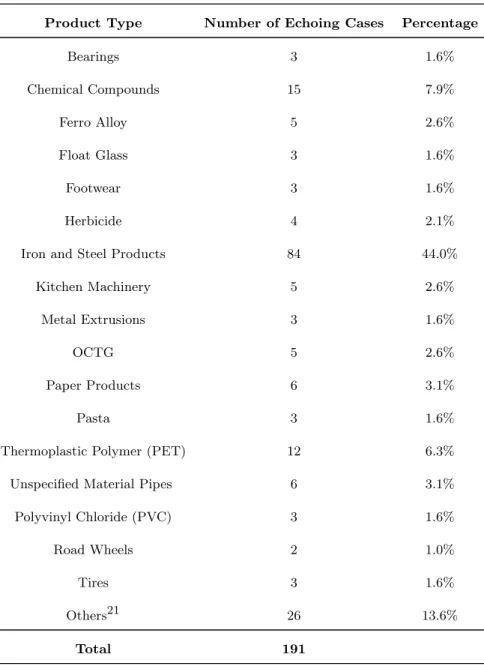
Moving to the analysis of the products implicated in an echoing case, one could look into Table 3 presented below. The products were grouped according to their typology. Having stated this, one can see that the products more implicated in an echoing case are the ones coming from the iron and steel industry, with 44% of echoing cases. After the iron and steel industry, the type of products with more echoing cases are chemical compounds, representing 7.9% of echoing cases. The reasons behind such results are not the most simple, because the trade of chemical compounds accounted for 10.9% of the world’s total merchandised trade in 2008, when the iron and steel industry accounted only for 3.7% in the same period19
. From these numbers, the first thought that comes to mind is that there is a great deal of dumping in the iron and steel industry leading to filings of AD suits and subsequently to more echoing cases in this industry compared to any other. But economical reasoning could lead us to another argument. In reality, iron and steel are amongst the more homogeneous products, which makes dumping easier to verify, since the problem that arises with identification of similarity between products disappears. Making the identification process easier might increase antidumping cases on these industries, thus leading to more echoing cases found.
Afterwards, there are the thermoplastic polymer products, the so called PETs, which account for 6.3% of the total echoing cases. These are followed by different types of papers and pipes20
, with 3.1% of the total cases each.
19
Please see http://www.wto.org/english/res e/statis e/its2009 e/its09 appendix e.htm for more infor-mation on the data.
20
Table 3. Echoing Cases by Product
Product Type Number of Echoing Cases Percentage
Bearings 3 1.6%
Chemical Compounds 15 7.9%
Ferro Alloy 5 2.6%
Float Glass 3 1.6%
Footwear 3 1.6%
Herbicide 4 2.1%
Iron and Steel Products 84 44.0%
Kitchen Machinery 5 2.6%
Metal Extrusions 3 1.6%
OCTG 5 2.6%
Paper Products 6 3.1%
Pasta 3 1.6%
Thermoplastic Polymer (PET) 12 6.3%
Unspecified Material Pipes 6 3.1%
Polyvinyl Chloride (PVC) 3 1.6%
Road Wheels 2 1.0%
Tires 3 1.6%
Others21 26 13.6%
Total 191
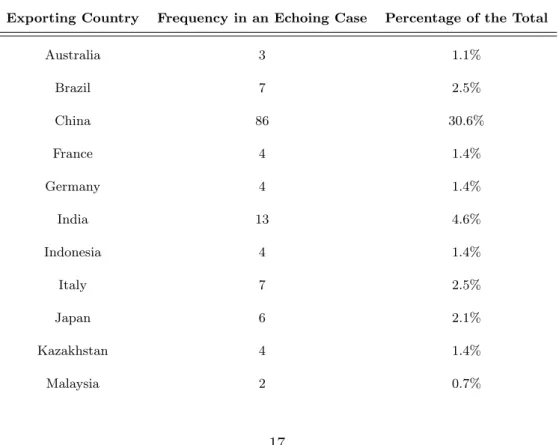
Looking further into the data, we can observe that the exporting country that is more caught under an antidumping investigation that turn out to be in an echoing case is China, with 31% of the echoing cases against this country, as can be noted in Table 4 below. This result might be expected since China is the exporting country more hit by antidumping suits. China experienced 784 AD filings from 1995 to 201022
. After China comes South
21
Autoglass products, bicycles, cement, citrates, cordage, culture media, DRAMs, fiber ropes, fuels, garlic, LCFC, lithium batteries, locks, mattress components, mineral compounds, mushrooms, optical laser, pencil cases, pesticides, saddles, slabstock, syringes, tables and chairs, washing machines, wire decking and wood flooring. All products are implicated in one echoing case each.
22
Korea with 9.3% of the echoing cases against this exporting country and then Russia with 8.5% of the echoing cases against it. In this case, the results from the echoing database do behave as those on the antidumping fillings from 1995 to 2010. For instance, South Korea is a part of 7% of the total of the world’s AD investigations and it is also the second exporting country most hit by echoing. In the case of Russia, it is within the ten countries in the world more hit by AD suits, with 3.2% of the total of AD cases.
Finally, other countries also under antidumping investigations that are part of an echoing process are Taiwan, Ukraine, South Africa and India, with 6.4%, 5%, 4.6% and 4.6%, respectively. An interesting fact is that countries like Japan and the USA that are majorly hit by antidumping suits, with 4.2% and 5.6% of the total AD petitions from 1995 to 2010, are not a preferred target to be hit by echoing, given that they only represent 2% and 3% of the total. This interesting phenomenon might be related to the argument given by Maur (1998) of monitoring by multinational enterprises. Countries like USA and Japan might be home country for those enterprises or for its subsidiaries, which will make these countries less attractive as an echoing target. This might be the case for the USA as home of such firms, given that it is a major player in the echoing process as we have seen before.
Table 4. Exporting Countries hit by Echoing
Exporting Country Frequency in an Echoing Case Percentage of the Total
Australia 3 1.1%
Brazil 7 2.5%
China 86 30.6%
France 4 1.4%
Germany 4 1.4%
India 13 4.6%
Indonesia 4 1.4%
Italy 7 2.5%
Japan 6 2.1%
Kazakhstan 4 1.4%
Mexico 2 0.7%
Romania 7 2.5%
Russia 24 8.5%
Slovakia 3 1.1%
South Africa 13 4.6%
South Korea 26 9.3%
Taiwan 18 6.4%
Thailand 5 1.8%
Turkey 6 2.1%
Ukraine 14 5.0%
United Kingdom 3 1.1%
USA 9 3.2%
Others23 11 3.9%
Total 281
3.3.2 Echoing Data by Final AD Duty
In order to get only the echoing cases that result into final antidumping duties, one more imposition was included in the echoing data by initiation date. To manage that, one has to screen out all the echoing cases which had AD suits with no final antidumping duty. The process of looking for antidumping cases with final duties is not simple given that each country has its own way of registering an antidumping duty with certain specificities. Let us look into the AD cases filed by the European Union against Ukraine and Brazil, on Ferro-Silico Manganese in August of 1993, the final duty imposed stated that: “Duty shall be the difference between the minimum import price of ECU 492 per metric tonne product and the net free-at-Community frontier price, before duty, in all cases where the net free-at-Community frontier price, before duty, per metric tonne product is less than the minimum import price.” This duty is a way to create a floor price of 492➾ for this imported product, so when the price practiced by the exporting firms at the Community
23
frontier is lower than this import price, a duty will be imposed on these imports, such that the final price will equal this floor price. The duty was imposed in this way to prevent consumers from major price increases, given the price sensitivity of ferro-silicon manganese24
.
During the analysis of echoing cases by final duties, some specific cases had to be ruled out, such as antidumping cases where there was important information missing or cases where it is found that dumping caused injury to the domestic country but the country cannot impose a duty due to the fact that it would affect negatively domestic agriculture. Furthermore, an analysis of the data will be developed considering only the AD peti-tions which are part of an echoing case and that resulted in actual antidumping duties. A total of 92 echoing cases had final antidumping duties imposed, which represent 48% of the total number of echoing cases found25
. Therefore, less than half of the echoing cases reach the ultimate purpose of an antidumping suit. However, this does not mean that those echoing cases that did not produce final AD duties did not have an effect on the trade pattern between countries. As we have seen before, a suspended case can still produce effects to the domestic country’s imports. Again, the combinations of countries that show more echoing cases are the ones that involve the USA and another country, the 7 combinations of countries where the USA is a part of account for 58.7% of the total of echoing cases with final AD duties. Moreover, the combination with more echoing cases is the USA and Canada, with 20 echoing cases, which differs from the previous analysis, where the USA and the European Union were the combination of countries with a higher number of echoing cases by initiation date.
From these results one can add that echoing cases between the USA and Canada tend to reach more final duties than echoing between the USA and the EU. One of the reasons for the imposition of a final duty is the fact that the exporting firm did not make any sort of settlement with the domestic country, or failed to decrease its exports. Still the USA is in both combinations. In consequence one might argue that the EU is more open to a settlement with the exporting company than Canada.
24
For more information on the subject please see the Proposal for a Council Regulation (EC), amending Regulation (EC) N➦2413/95 imposing a definitive anti-dumping duty on imports of ferro-silico-manganese originating in Russia, Ukraine, Brazil and South Africa, of 12-01-1996 for more information on this an-tidumping suit, http://eur-lex.europa.eu/LexUriServ/LexUriServ.do?uri=COM:1995:0748:FIN:EN:PDF.
25
As far as AD final duties are concerned, Canada is still the country that follows others’ AD policy the most, with 15% of the total of its AD cases being actually an antidumping case equivalent to a previous one, filed abroad. The developing countries are still great followers of other countries’ antidumping policy with a 6% following average of the total of AD cases. The EU and Australia are the countries that show a smaller following rate on others’ AD policy, with only 3% and 1% of following cases, respectively26
.
The countries that others follow more frequently are still the US and Canada, with the first being followed by the European Union, Canada and Brazil, and the second by the USA, Australia and Argentina. An interesting fact appears when analyzing the echoing data by final duties as the USA is now following in the same proportion both Canada and the European Union, with twelve antidumping cases filed by the USA, that are actually following other AD case in the EU or in Canada.
For the analysis of the products in an echoing case with final AD duty, one can see that iron and steel products are again the type of product with more echoing cases, representing 51.1% of the total echoing cases with final AD duty27
. These are followed by the chemical compounds’ industry which account for 10.9% of the cases. Furthermore, with 4.3% each, are the ferroalloy products and the PET products (thermoplastic polymers). As we can see, the results do not vary that much from echoing by initiation date to echoing by final duty, since the products more hit by echoing are almost the same in both cases, only changing in the fourth most hit products, that in this case are ferroalloy products, while in echoing by initiation date the place was occupied by paper products and pipes, tied at 3.1%.
When looking into the exporting countries more affected by antidumping policy in respect to echoing cases with final duties, China is again the most hit by antidumping suits, that are part of an echoing process, with 33% of the echoing cases being against this country28
. It is followed by Russia, Ukraine and Taiwan, all with 6.9% of the echoing cases against them. With 5.3% is South Africa and South Korea. Finally, India and Romania are hit by 4.6% of the echoing cases. Romania is not that much affected in echoing by initiation date, with 2.5% of the cases, which is interesting to see, given that it actually is
26
Please see Table 2 of the Appendix to observe this data in more detail. 27
One can see the data by product in more detail in Table 4 of the Appendix. 28
quite affected by echoing by final duties. This result might be due to a reasoning previously discussed, where a final AD duty is imposed because sometimes the exporting firm and the domestic country did not agree on a settlement. So what is happening with Romania might be that Romanian firms do not want to make a settlement with the importing country, or the other way around, leading to an increase in AD cases against Romania with final duty imposed.
Summing up, one can say that the results from echoing by final duty come close to those from echoing by initiation date, in the sense that the major results are verified in both analysis. Examples are China being the country most hit by echoing, Canada being the country that follows others the most, or the iron and steel industry being the most affected by echoing. Nevertheless, one must stress that the results from echoing by final duty are always smaller than those by initiation date. The reason behind this result is that in order to reach only cases with final AD duty, another screening phase to the existing echoing cases by initiation date was added, turning the echoing cases by duty in what can be called a sample of the echoing cases by initiation date.
4
Conclusion
“While political-economy factors influence all forms of trade protection, no other trade instrument has AD’s unique combination of political and economic manipulability. . . ” Blonigen and Prusa (2001). In the context of studying the antidumping topic in a general way and echoing in a more objective one, this research was conducted to gather, identify and study the echoing cases between AD users. Echoing being this phenomenon where one country files an AD suit similar to other country’s AD suit, even when it is well known that antidumping statutes differ from one country to the other29
.
Summarizing the results in the broader view of echoing by initiation date, the country that has more AD suits in an echoing case is the USA, with 56% of the total echoing cases found. Then the antidumping user which follows other countries’ AD policy the most is Canada, with 29% of its antidumping investigations being actually echoing of other country’s AD investigations. Adding to this fact, Canada is also one of the most
29
followed countries alongside with the USA. One must conclude that the major players in what concerns echoing in antidumping cases are the USA and Canada. This result differs slightly from the result of Maur’s research in 1998, where the EU also played a very important role in the echoing phenomenon, much more decisive than Canada. Now, in the current research, although the EU is still an important player in the echoing panorama, it is so, mainly due to being followed by other country’s AD policy. An interesting result was to observe that China is the exporting country most affected by echoing, being hit by 31% of the cases. Such results are in accordance with the outcomes of nowadays AD policy pattern. But in the particular case of echoing in AD cases, China shows a much bigger share of AD suits against it.
Given all the results found during the research, one can state clearly that the echoing phenomenon is a reality and it appears to be affecting more and more the world’s trade pattern, coming across as an important issue in nowadays’ trade policy worldwide.
It is clear that the work developed in this paper thesis gives a broader overview of the echoing phenomenon, but it is still missing some important aspects, which are more complex to accomplish. The problem that arises from comparing close substitutes in practical terms and that led us to use only identical products is one of those complex issues. In addition, the research should be extended to all AD users in order to have a complete database of the phenomenon. These issues are the opening line for further research in this area. Also, it would be interesting to see a trade model using this new data that echoing provides, with, for example, a probit model that infers the probability of success of an antidumping case, using echoing as a determinant for the success of a case. Nevertheless, this Work Project gives a real insight on the echoing phenomenon that is spreading each day in antidumping policy, creating the most complete and up-to-date database of echoing in AD cases.
References
[2] Blonigen, Bruce A. and Thomas J. Prusa. 2001. “Antidumping”, NBER Working Paper, No. W8398.
[3] Bown, Chad P. 2007. “Global Antidumping Database: Version 3.0”. Retrieved
Jan-uary, 2011 from http://siteresources.worldbank.org/INTTRADERESEARCH/Resources/544824-1272916036631/bown-global-ad-v3.0.pdf.
[4] Bown, Chad P. 2010. “Global Antidumping Database”. Retrieved January to April, 2011 from http://econ.worldbank.org/ttbd/gad/.
[5] European Commission. 1996. “Customs Union and Commercial Policy: Proposal for a Council Regulation (EC) Amending Regulation (EC) No. 2413/95 Imposing a Defini-tive Anti-Dumping Duty on Imports of Ferro-Silico-Manganese Originating in Russia, Ukraine, Brazil and South Africa”, The Stationery Office Books (Agencies).
[6] European Commission. (n.d.) “Industrial Goods, Steel”. Retrieved May, 2011 from the European Commission website http://ec.europa.eu/trade/creating-opportunities/economic-sectors/industrial-goods/steel/#stats.
[7] Hansen, Wendy L., and Thomas J. Prusa. 1996. “Cumulation and ITC Decision Making: The Sum of the Parts is Greater than the Whole,” Economic Inquiry, 34: 746-69.
[8] Maur, Jean-Christophe. 1998. “Echoing in Antidumping Cases: Regulatory Com-petitors, Imitation and Cascading Protection”, World Competition, Vol. 21 No. 6, 51-84.
[9] Messerlin, Patrick A. & Geoffrey Reed. 1995. “Antidumping Policies in the United States and the European Community”, Economic Journal, 105(433), 1565-1575. [10] Staiger, Robert W. and Frank A. Wolak. 1994. “Measuring Industry Specific
Protec-tion: Antidumping in the United States,” Brookings Papers on Economic Activity: Microeconomics,51-118.
The Echoing Phenomenon in Antidumping Cases
Appendix
Extra
Ana Raquel Hipólito Gonçalves
Masters Degree in Economics
List of Tables
Table 1. Antidumping Investigations under an Echoing Case, between the USA and the
European Union
Table 2. Antidumping Investigations that are Followers in an Echoing Case - Initiation
Date and Final AD Duty
Table 3. Number of Echoing Cases found, by Country-Combination - Final AD Duty
Table 4. Echoing Cases by Product - Final AD Duty
Table 5. Exporting Countries hit by Echoing - Final AD Duty
Table 1. Antidumping Investigations under an Echoing Case, between the USA and
the European Union
USA EU
HS Code
Exporting Country
Product Initiation
Date Final AD Duty Exporting Country
Product Initiation
Date
Final AD Duty 280469 Russia Silicon Metal 03-15-2002 79.42 Russia Silicon Metal 10-12-2002 23,60 282580 China Antimony Trioxide 05-03-1991 . China Refined Antimony
Trioxide
03-21-1992 . 481029 China Coated Paper 09-30-2009 MI China Coated Fine Paper 02-18-2010 MI 270400 China Foundry Coke 09-27-2000 214.89 China Coke of Coal in Pieces 09-16-1999 43,60
China Blast Furnace Coke 07-06-2001 .
291814 China Citric Acid and Certain Citrate Salts
04-22-2008 156,87 China Citric Acid 09-04-2007 42,70 293213 China Furfuryl Alcohol 06-08-1994 45,27 Thailand Furfuryl Alcohol 04-19-1995 .
Thailand Furfuryl Alcohol 06-08-1994 7,82 China Furfuryl Alcohol 04-19-1995 . 293213 China Electrolytic Manganese
Dioxide
08-11-2003 . China Furfuryl Alcohol 08-09-2002 EUR250 /ton
293221 China Coumarin 01-07-1994 160.80 China Coumarin 05-20-1994 ECU347
9/ton 293369 China Chlorinated
Isocyanurates
05-21-2004 285,63 China Trichloroisocyanuric Acid (TCCA)
07-10-2004 25,00 310230 Ukraine Ammonium Nitrate 10-20-2000 156.29 Ukraine Ammonium Nitrate 10-29-1999 33,25 392062 South Korea Polyethylene
Teraphthalate (Pet) Film
05-07-1990 21,50 South Korea
Thin Polyester Film 02-01-1990 . 392062 India Polyethylene
Terephthalate Film
05-29-2001 24.14 India Polyethylene
Terephthalate (PET) Film
05-27-2000 53,30 392321 China Polyethylene Retail
Carrier Bags
06-27-2003 77,57 China Certain Plastic Sacks and Bags
06-30-2005 28,80 Malaysia Polyethylene Retail
Carrier Bags
06-27-2003 84,94 Malaysia Certain Plastic Sacks and Bags
Carrier Bags Bags 550320 South Korea Polyester Staple Fiber 04-09-1999 11.35 South
Korea
Polyester Staple Fibres 10-07-1999 20,20 720221 China Ferrosilicon 06-02-1992 137,73 China Ferrosilicon 07-09-1992 49,70 720230 Ukraine Silicomanganese 11-23-1993 163,00 Ukraine Ferro-Silico Manganese 08-04-1993 see
notes Brazil Silicomanganese 11-23-1993 17.60 Brazil Ferro-Silico Manganese 08-04-1993 see
notes 720810 South
Africa
Hot-Rolled Carbon Steel Products
11-22-2000 9,28 South Africa
Iron or Non-Allloy Products Flat Rolled
01-07-1999 37,80 India Hot-Rolled Carbon
Steel Products
11-22-2000 33,17 India Iron or Non-Alloy Products Flat Rolled
01-07-1999 9,00 Taiwan Hot-Rolled Carbon
Steel Products
11-22-2000 20,28 Taiwan Iron or Non-Allloy Products Flat Rolled
01-07-1999 24,90 720851 India Cut-To-Length Carbon
Steel Plate
02-24-1999 72,49 India Non-Alloy Steel Hot Rolled Flat Products
05-13-1999 11,50 721190 Russia Cut To Length Carbon
Steel Plate
11-13-1996 . Russia Narrow Steel Strips 07-12-1997 . 721710 China Wire Decking 06-11-2009 . China Pre- and Post-Stressing
Wires and Wire Strands of Non-Alloy Steel
02-16-2008 46,20
722300 India Stainless Steel Round Wire
04-06-1998 . India Stainless Steel Big Wire 06-25-1998 55,60 South Korea Stainless Steel Round
Wire
04-06-1998 . South Korea
Stainless Steel Fine Wire 06-25-1998 .
South
Korea
Stainless Steel Big Wire 06-25-1998 . 730439 China Oil Country Tubular
Goods
04-15-2009 99,14 China Seamless Pipes and Tubes 07-09-2008 39,20 China Seamless Carbon and
Alloy Steel Standard and Line and Pressure Pipe
09-22-2009 MI
730422 China Drill Pipe 01-06-2010 MI China Certain Seamless Pipes and Tubes of Stainless Steel
09-30-2010 MI
730630 China Circular Welded Carbon Quality Steel Pipe
06-14-2007 85,55 China Certain Welded Tubes and Pipes of Iron or Non-Alloy Steel
09-26-2007 90,60
730660 Turkey Light-Walled Rectangular Pipe and Tube
09-16-2003 . Turkey Hollow Sections 10-16-2002 .
730661 Turkey Light-Walled Rectangular Pipe and Tube
07-03-2007 27,04 Turkey Welded Tubes/Pipes and Hollow Profiles of Square or Rectangular Cross-Section
11-13-2008 .
730793 Thailand Certain Carbon Steel Butt-Weld Pipe Fittings
03-10-1994 . Thailand Certain Tube or Pipe Fittings of Iron or Steel
02-03-1994 58,90 731210 China Steel Wire Rope 03-09-2000 . China Steel Wire Rope 05-20-1998 60,40
India Steel Wire Rope 03-09-2000 . India Steel Wire Rope 05-20-1998 30,80
India Stainless Steel Big Wire 06-25-1998 55,60
Thailand Steel Wire Rope 03-09-2000 . Thailand Certain Iron or Steel Ropes and Cables
05-05-2000 42,80 Malaysia Steel Wire Rope 03-09-2000 . Malaysia Certain Iron or Steel
Ropes and Cables
05-05-2000 . 731210 South Korea Prestressed Concrete
Steel Wire Strand
02-07-2003 35.64 South Korea
Certain Iron or Steel Ropes and Cables
11-20-2004 . 731815 China Steel Threaded Rod 03-12-2008 206,00 China Certain Iron or Steel
Fasteners
11-09-2007 85,00 China Certain Standard Steel
Fasteners
732399 China Steel Wire Garment Hangers
08-10-2007 187,25 China Ironing Boards 02-04-2006 38,10 847330 South Korea Drams 04-29-1992 3,85 South
Korea
DRAMs (Dynamic Random Access Memories)
03-06-1991 .
Table 2. AD Investigations that are Followers in an Echoing Case
Data by Initiation Date Data by Final AD Duty
USA - the follower
Frequency of AD cases that are followers in Echoing Cases Percentage of Total of AD Cases where US is the Follower Frequency of AD cases that are followers in Echoing Cases Percentage of Total of AD Cases where US is the Follower
EU-US 25 24% 12 30,0%
CAN-US 39 37,9% 12 30,0%
AUS-US 10 10% 5 12,5%
NZ-US 1 1% 1 2,5%
ARG-US 18 17% 7 17,5%
BRA-US 8 8% 3 7,5%
COL-US 2 2% 0 0,0%
Total 103 40
Total of AD Cases 745 14% 745 5,4%
EU - the follower
Frequency of AD cases that are followers in Echoing Cases Percentage of Total of AD Cases where EU is the Follower Frequency of AD cases that are followers in Echoing Cases Percentage of Total of AD Cases where EU is the Follower
US-EU 23 66% 9 23%
CAN-EU 2 6% 2 5%
AUS-EU 4 11% 3 8%
NZ-EU 1 3% 0 0%
ARG-EU 3 9% 1 3%
BRA-EU 1 3% 1 3%
COL-EU 1 3% 1 3%
Total 35 17
Canada - the follower Frequency of AD cases that are followers in Echoing Cases Percentage of Total of AD Cases where CAN is the Follower Frequency of AD cases that are followers in Echoing Cases Percentage of Total of AD Cases where CAN is the Follower
US-CAN 51 69% 26 65%
EU - CAN 9 12% 5 13%
AUS-CAN 2 3% 1 3%
NZ-CAN 0 0% 0 0%
ARG-CAN 9 12% 4 10%
BRA-CAN 1 1% 0 0%
COL-CAN 2 3% 1 3%
Total 74 37
Total of AD Cases 253 29% 253 15%
Australia - the follower
Frequency of AD cases that are followers in Echoing Cases Percentage of Total of AD Cases where Australia is the Follower Frequency of AD cases that are followers in Echoing Cases Percentage of Total of AD Cases where Australia is the Follower
US-AUS 7 33% 0 0,0%
EU - AUS 2 10% 0 0,0%
CAN - AUS 8 38,1% 2 5,0%
NZ-AUS 2 10% 1 2,5%
ARG - AUS 0 0% 0 0,0%
BRA-AUS 2 10% 2 5,0%
COL-AUS 0 0% 0 0,0%
Total 21 5
Total of AD Cases 479 4% 479 1,0%
New Zealand - the follower
Frequency of AD cases that are followers in Echoing Cases Percentage of Total of AD Cases where NZ is the Follower Frequency of AD cases that are followers in Echoing Cases Percentage of Total of AD Cases where NZ is the Follower
US-NZ 0 0% 0 0%
EU - NZ 0 0% 0 0%
CAN - NZ 0 0% 0 0%
AUS - NZ 0 0% 0 0%
ARG - NZ 0 0% 0 0%
COL-NZ 0 0% 0 0%
Total 0 0
Total of AD Cases 50 0% 50 0%
Argentina - the follower
Frequency of AD cases that are followers in Echoing Cases Percentage of Total of AD Cases where Argentina is the Follower Frequency of AD cases that are followers in Echoing Cases Percentage of Total of AD Cases where Argentina is the Follower
US-ARG 12 20% 0 0%
EU - ARG 7 11% 4 10%
CAN - ARG 21 34% 6 15%
AUS - ARG 6 10% 1 3%
NZ- ARG 1 2% 0 0%
BRA-ARG 10 16% 3 8%
COL-ARG 4 7% 3 8%
Total 61 17
Total of AD Cases 259 24% 259 7%
Brazil - the follower
Frequency of AD cases that are followers in Echoing Cases Percentage of Total of AD Cases where BRA is the Follower Frequency of AD cases that are followers in Echoing Cases Percentage of Total of AD Cases where BRA is the Follower
US-BRA 18 50% 8 20%
EU - BRA 9 25% 6 15%
CAN - BRA 2 6% 0 0%
AUS - BRA 7 19% 3 8%
NZ- BRA 0 0% 0 0%
ARG - BRA 0 0% 0 0%
COL-BRA 0 0% 0 0%
Total 36 17
Total of AD Cases 272 13% 272 6%
Colombia - the follower
Frequency of AD cases that are followers in Echoing Cases Percentage of Total of AD Cases where COL is the Follower Frequency of AD cases that are followers in Echoing Cases Percentage of Total of AD Cases where COL is the Follower
US-COL 4 24% 1 3%
EU - COL 2 12% 0 0%
AUS - COL 0 0% 0 0%
NZ- COL 0 0% 0 0%
ARG - COL 7 41% 2 5%
BRA - COL 1 6% 0 0%
Total 17 3
Total of AD Cases 77 22% 77 4%
Table 3. Number of Echoing Cases found, by Country-Combination - Final AD Duty
Country's Combination Number of Echoing Cases
USA-EU 17
USA-Canada 20
USA-Australia 4
USA-New Zealand 1
USA-Argentina 3
USA-Brazil 8
USA-Colombia 1
EU-Canada 5
EU-Australia 3
EU-New Zealand 0
EU-Argentina 4
EU-Brazil 4
EU-Colombia 1
Canada-Australia 3
Canada-New Zealand 0
Canada-Argentina 4
Canada-Brazil 0
Canada-Colombia 1
Australia-New Zealand 1
Australia-Argentina 1
Australia-Brazil 4
Australia-Colombia 0
New Zealand-Argentina 0
New Zealand-Brazil 0
New Zealand-Colombia 0
Argentina-Brazil 3
Argentina-Colombia 4
Brazil-Colombia 0
Table 4. Echoing Cases by Product - Final AD Duty
Product Type Number of Echoing Cases Percentage
Bearings 1 1,1%
Chemical Compound 10 10,9%
Ferro Alloy 4 4,3%
Float Glass 0 0,0%
Footwear 1 1,1%
Herbicide 3 3,3%
Iron and Steel Products 47 51,1%
Kitchen Appliance 1 1,1%
Metal Extrusions 1 1,1%
OCTG 1 1,1%
Paper 1 1,1%
Pasta 1 1,1%
PET 4 4,3%
Pipes 1 1,1%
PVC 1 1,1%
Road Wheels 1 1,1%
Tires 1 1,1%
Others 13 14,1%
Total 92
Table 5. Exporting Countries hit by Echoing- Final AD Duty
Exporting Country Frequency in an Echoing Case Percentage of the Total
Australia 1 1%
Brazil 3 2%
Canada 0 0%
China 43 32,8%
France 3 2%
Germany 2 2%
India 6 4,6%
Indonesia 2 2%
Italy 3 2%
Japan 3 2%
Kazakhstan 2 2%
Latvia 1 1%
Macedonia 0 0%
Mexico Moldova
1 1
1% 1%
New Zealand 0 0%
Norway 0 0%
Poland 1 1%
Portugal 0 0%
Romania 6 4,6%
Russia 9 6,9%
Slovakia 2 2%
South Africa 7 5,3%
South Korea 7 5,3%
Taiwan 9 6,9%
Thailand 1 1%
Trinidad & Tobago 0 0%
Turkey 1 1%
Ukraine 9 6,9%
United Kingdom 2 2%
USA 5 3,8%
Venezuela 1 1%