Bedbug infestation and its control practices in Gbajimba: a rural
settlement in Benue state, Nigeria
E.A. Omudu & C.N. Kuse
Department of Biological Sciences, Benue State University, Makurdi, Nigeria
Abstract
Background & objectives: The common bedbug Cimex lectularius Linnaeus 1758 (Hemiptera: Cimicidae) is a globally re-emerging pest of serious public health concern. We investigated bedbug infestation in randomly selected apartments in Gbajimba community in Guma Local Government area in Benue state, Nigeria.
Methods: Beddings and furniture (bed frames, pillows, mattresses, cushion chairs, mats, mosquito nets and bamboo beds) were thoroughly inspected for bedbug infestation using the hand-picking technique. Data were analysed using chi-square analysis for differences in the infestation levels in harbourages and sampling locations.
Results: Only 16% of the apartments investigated showed no evidence of bedbug infestation as egg cases and faecal marks were sighted in 62.2% of apartments surveyed. The highest infestation rate was observed in Angwan Jukun area and infestation here was higher compared to other study locations within the town though the difference was not statistically significant (2 = 7.92, df = 6,
p >0.05). Bamboo beds harboured the highest number of bedbugs collected, accounting for 35.8%, while other harbourages like iron bed frames and sleeping mats had 23 and 22.7% infestation rates respectively. The infestation rates in these household items were significantly higher than other items inspected (2 = 11.8, df = 4, p > 0.05).
Interpretation & conclusion: This study demonstrates the urgent need for identification of evidences of infestation and bedbug management involving community participation in inspection, detection and education, including physical removal and exclusion as well as pesticide application.
Key words Bedbugs; harbourages; infestation; Nigeria
Introduction
The common bedbug Cimex lectularius Linnaeus 1758 (Hemiptera:Cimicidae) is a globally re-emerg-ing pest of serious public health concern. They are bloodsucking ectoparasites that infest human habi-tations, and usually feed during the night when host is sleeping1. The mouthparts of bedbugs are espe-cially adapted to feed on blood of humans, bats, chicken and occasionally domesticated animals2. Bedbugs seem to posses all of the necessary prereq-uisites for being capable of transmitting human
dis-eases, but there have been no known cases of bed-bug transmitting human diseases even though about 27 known pathogens have been reported to be ca-pable of surviving inside bedbugs or its mouthparts3.
result to anxiety, stress, emotional distress and in-somnia9. Heavy infestation and feeding rates by bed-bugs have resulted in significant blood loss and even-tual anaemia, especially in malnourished children4,10.
There has been a global resurgence of bedbug infes-tation, until recently, bedbugs have been considered uncommon in the industrialized world. However, since the mid-1990s the number of reports of human bedbug infestations has increased significantly in the United Kingdom11–13, Australia9,14, Israel8, Canada15, Demark16 and Italy17. The ease of inter-national travel has been blamed for these infestations especially with immigrants and refugees from devel-oping countries where bedbug infestation has never eased18,19 and indiscriminate use of insecticides which is resulting in resistance20,21.
Bedbug infestation is common and widespread in Nigeria, it has, however, not attracted the research interest it requires. Consequently, there is a dearth of documented information on prevalence and inten-sity of infestation. Studies in Lagos, the commercial nerve centre of Nigeria, reported infestation rates of 50% and above in two out of five study sites22. Ear-lier study in Benue state reported heavy infestation in homes and school hostels19. This current study was designed to investigate bedbug infestation pro-file and dynamics in Gbajimba; a rural settlement in Benue state experiencing in a boom in commercial activities and influx of visitors from other parts of the country. In addition to these, the town recently hosted internally displaced persons resulting from the ethnic conflict in north-central Nigeria. These social and economic factors justified the selection of Gbajimba for the study. The methods for bedbug con-trol employed in the community were also investi-gated. This article provides current infestation sta-tus that will serve as baseline information to mobilize and encourage community participation in vector control.
Material & Methods
Study area: Benue state is one of the 36 states in the
Federal Republic of Nigeria, a tropical country on the west coast of Africa. Gbajimba town is the head-quarters of Guma Local Government Area (LGA) of Benue state, a state that derives its name from the second largest river in Nigeria. The state covers an area of about 34,059 km2 with a population of over 4.2 million people23. Majority of the inhabitants live in rural agricultural areas and engage in peasant ag-riculture. Benue state has two seasons, rainy and dry seasons as rainfall is the real climatic variable. The rainy season is from April–October (7 months with 800–1100 mm of rain) while the dry season runs from November–March (5 months with 200–400 mm of rain). Temperature ranges from 26–29.5°C in dry sea-son and 19.5– 24°C in rainy seasea-son with mean rela-tive humidity of 78%. The town lies between lati-tude 7°30’–8°00’N and longitude 8°30’–9°00’E and situated in the guinea savanna region, a vegetative region in Nigeria. The inhabitants of the town are predominantly peasant farmers and fishermen. The town attracts very high number of visitors and trad-ers for once in five days market because its reputa-tion as fresh fish depot. Many of the traders and visi-tors lodge in short-stay hotels within the community. The town is a rural settlement lacking basic ameni-ties like potable water, electricity and access roads. To ease sampling exercise, we divided the town into seven locations based on aggregation of residential apartments and landmark structures. Sampling was done at the end of every week during the three months duration of the study from January to end of March 2010.
of empty egg cases which remains in place long after hatching and black faecal spots (0.5–1 mm diam), on surfaces around the harbourage. The bedbugs were then transported in specimen bottles with 70% alcohol to the Entomology Laboratory of Benue State University, Makurdi for identification and sex deter-mination using dissecting microscope. Identification and sex determination was done using keys provided in Pratt and Smith24.
After the house inspection, household heads of in-fested apartments were asked about the control mea-sures they employ to kill bedbugs, their responses were documented. Data were analysed using simple percentages and chi-square was used to test for sig-nificance in infestation levels in the sampling loca-tions and harbourages.
Results
Of the 119 residential apartments and hotels surveyed during the study, 26 (21.8%) apartments had bed-bug infestation and 1056 bedbed-bugs were collected from these apartments. The mean number of bedbugs col-lected from an apartment was 40.6 (Table 1). Only 16% of the apartments investigated showed no evi-dence of bedbug infestation; and egg cases and fae-cal marks were sighted in 62.2% of apartments
sur-veyed. The highest infestation rate was observed in Angwan Jukun area and infestation here was higher compared to other study locations within the town though the difference was not statistically significant (2 = 7.92; df = 6, p >0.05).
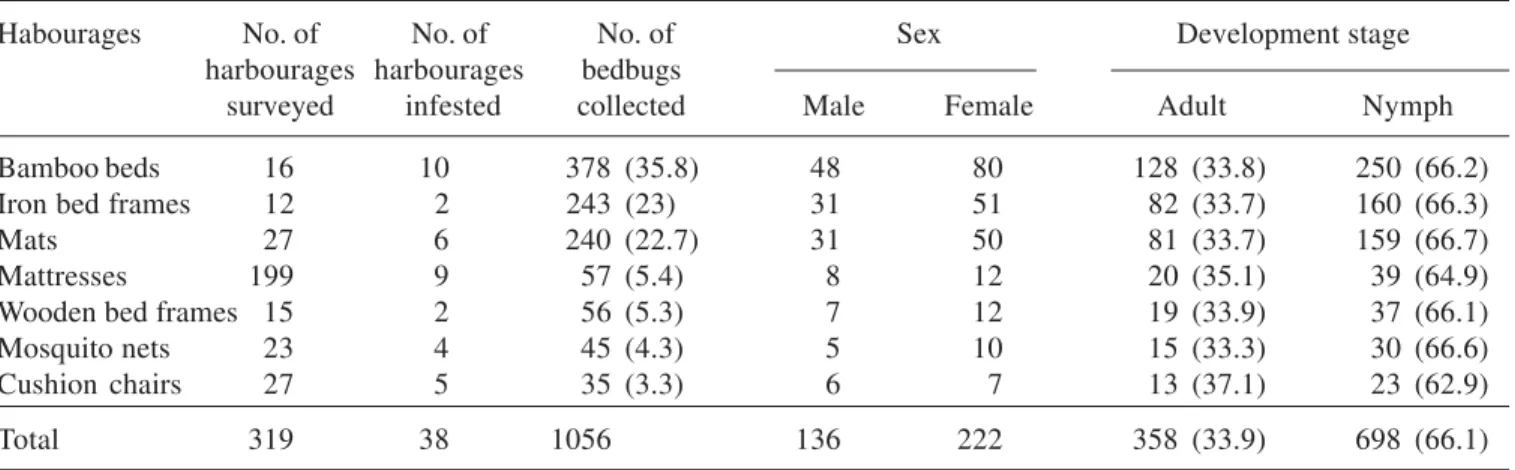
Bamboo beds harboured the highest number of bed-bugs collected, accounting for 35.8%, while other harbourages like iron bed frames and sleeping mats had 23 and 22.7% infestation rates respectively (Table 2), combined infestation rates of these three harbourages differed significantly when compared with the others (2 = 11.8; df = 4, p > 0.05). Clusters of bedbugs were usually found at joints of bamboo bed in heavy infest. Nymphs were the most predomi-nant development stages collected accounting for 66.1% and of the 358 adults 62% were females.
Bedbug control methods employed by the residents are broadly categorised into chemical insecticides and physical techniques (Table 3). The use of insecticides is widespread, however, 16.1% of the residents re-portedly did nothing to control infestation. The in-secticides of choice were insect powder (Permethrin), Snipper (2,3-dichlorovinyl dimethyl phosphate) and Nuvan: Dichlorovos (2,2-dichloro-vinyl dimethyl-phosphate). Application of insect powder is done outdoor, household furniture suspected to be infested
Table 1. Bedbugs (Cimex lectularius) collected from study locations in Gbajimba, Nigeria
Study location No. of No. of No. of Mean Apartments with Apartments
apartments apartments with bedbugs number of evidence of without surveyed bedbugs collected bedbugs infestation infestation
Logo 20 5 (25) 225 (21.3) 45 13 (65) 2 (10)
General Hospital 20 – – – 17 (85) 3 (15)
Angwan Jukun 20 9 (45) 467 (44.2) 51.2 10 (50) 1 (5)
Beach Hotel 20 4 (20) 118 (11.2) 29.5 12 (60) 4 (20)
Ishamior 20 6 (30) 207 (19.6) 34.5 10 (50) 4 (20)
Kwenev 10 2 (20) 39 (3.7) 19.5 8 (80) –
Agbaka 9 – – – 4 (44.4) 5 (55.6)
Total 119 26 (21.8) 1056 40.6 74* (62.2) 19 (16)
are carried outside and the powder applied to harbourages. Snipper and Nuvan on the other hand are applied indoors. The insecticide is drawn into used disposable syringes and sold at the open market de-pending on the quantity, the content of the syringe is then dropped on suspected harbourages and corners of the room. Dosage of insecticide application de-pends on perceived level of infestation as applica-tion is mostly done without professional advice or supervision. Though bedbugs were collected from households that reported recent use of insecticides, the numbers were significantly lower when compared
to households that have not applied insecticides (p >0.05).
Discussion
The study demonstrates that bedbug infestation in this community is high, which could be attributed to poor hygiene and housekeeping practices. Similar in-festation rates have been reported in other parts of Nigeria19 and elsewhere in Africa and the developed countries13,16,18. Though it has been said that bed-bug infestation is not necessarily a reflection of pov-erty and poor sanitation, overcrowding of residen-tial apartment and deteriorating sanitary conditions in this community may be contributing to the grow-ing problem of bedbug infestation. Housgrow-ing pattern observed within the community where most apart-ments were multi-tenanted also increase the tendency of bedbugs to disperse to other locations within some building3,19.
While increasing bedbug infestation in developed countries is being blamed on the ease of international travel and refugee mobility8,9,17, the same cannot be said of this community. The lucrative local fish in-dustry in the community may be implicated for level of infestation observed, as traders come in from other parts of the country and lodge in short stay hotels scattered in the Agwan Jukun area of the town. Stud-ies have indicated that infestations in high turnover
Table 2. Sex and development stages of bedbugs collected from harbourages in Gbajimba, Nigeria
Habourages No. of No. of No. of Sex Development stage
harbourages harbourages bedbugs
surveyed infested collected Male Female Adult Nymph
Bamboo beds 16 10 378 (35.8) 48 80 128 (33.8) 250 (66.2)
Iron bed frames 12 2 243 (23) 31 51 82 (33.7) 160 (66.3)
Mats 27 6 240 (22.7) 31 50 81 (33.7) 159 (66.7)
Mattresses 199 9 57 (5.4) 8 12 20 (35.1) 39 (64.9)
Wooden bed frames 15 2 56 (5.3) 7 12 19 (33.9) 37 (66.1)
Mosquito nets 23 4 45 (4.3) 5 10 15 (33.3) 30 (66.6)
Cushion chairs 27 5 35 (3.3) 6 7 13 (37.1) 23 (62.9)
Total 319 38 1056 136 222 358 (33.9) 698 (66.1)
2 = 7.08; df = 6, p > 0.05;Figures in parentheses indicate percentages.
Table 3. Bedbug control methods practiced by residents of Gbajimba
Control methods No. of
house holds
Chemical: Insecticides
Insect powder (Permethrin) 41 (34.4) Snipper 1000 (2,3,-dichlorovinyl 24 (20.1) dimethyl phosphate)
Nuvan: Dichlorovos (2,2- dichloro-vinyl 15 (12.6) dimethyl phosphate)
Non-chemical method
Sun drying infested item 7 (5.9)
Hand picking 10 (8.4)
Hot water treatment 3 (2.5)
Do nothing 19 (16.1)
Total 119
locations such as hotel rooms, and school hostels are particularly likely to give rise to more secondary in-festation in the community12,14,19. Trade in second hand furniture, especially beds, mattresses and chairs, in many rural markets in Nigeria has also facilitated the transfer of bedbugs locally within surrounding communities. Most of these second hand furniture come into the market from Makurdi, the state capi-tal, this town has its own share of bedbug problems19. The trade in second-hand household furniture and electronic goods has reached an all-time high in many sub-Saharan countries, this will no doubt continue to facilitate the spread of bedbugs or their eggs over longer distance9,12,13,15.
The identification of bedbug harbourages is essen-tial in guiding pest control personnel during inter-vention12, the wide range of household items harbouring bedbugs in this community and their abil-ity to spread to adjoining rooms and reinvade previ-ously freed rooms within an apartment make indi-vidual control efforts unsustainable. Settlement and housing pattern in the community may also facilitate the dispersion of bedbugs from one household to another, since most inhabitants live in congested housing units and rooms. Predominant house types are a room and parlour attachment with shared kitchen, toilet and bathroom facilities and traditional huts. This may have accounted for the re-infestation observed in households that reported recent use of insecticides and not necessarily development of re-sistance.
The common practice of moving infested household materials outside in order to expose them to sunlight has been reported to have little or no impact on bed-bugs because they are quick to hide away from sun-light into dark protected crevices11,25. The use of insecticides to control bedbugs could have severe public health consequences either by increasing hu-man exposure to indoor pesticide residue or the re-cent evidence of high levels of resistance in bedbugs to two pyrethroid insecticides in addition to ineffec-tive application techniques by untrained individu-als20,21,26,27. Both factors are likely to contribute to
increased infestation. Application of these insecticides served two purposes in this community, while it is being targeted on mosquitoes as well as other house-hold insects including bedbugs being controlled.
There has never been an organized comprehensive bedbug control effort in Nigeria and controlling in-festation has always been the responsibility of indi-viduals living in infested buildings. The widespread application of these insecticides by untrained persons and without professional supervision will no doubt result in unacceptable indoor pesticide residue and development of resistance. Without the development of new tactics for bedbug management, further es-calation of this neglected public heath problem should be expected. Changes in the dynamics of housing, sanitation and human activities may continue to cre-ate new and unexpected opportunities for the increase and dispersion of bedbugs. This study demonstrates the urgent need for members of the public to be aware of typical symptoms of bedbug bites and identifica-tion of evidences of infestaidentifica-tion. Integrated approach should be used for bedbug management involving community participation in inspection, detection and education, including physical removal and exclusion as well as pesticide application.
References
1. Thomas I, Kihiczak GG, Schwartz RA. Bedbug bites: a review. Intl J Dermatol 2004; 43: 430–3.
2. Krueger L. Don’t get bitten by the resurgence of bedbugs.
Pest Control 2000; 68: 58–64.
3. Kell SA, Hahn J. Prevention and control of bedbugs in residences. Minneapolis, U.S.A: Department of Entomol-ogy, University of Minnesota 2007.
4. Leverkus M, Jochim RC, Schad S, Brocker EB, Ander-son, JF, Valenzuela JG. Bullous allergic hypersensitivity to bedbug bites mediated by IgE against salivary nitrophorin. J Investigative Dermatol 2006; 126: 91–6. 5. Doggett SL. Bedbugs: what the general practitioner needs
to know. Australian Family Phys 2009; 20(11): 11–6. 6. Liebold K, Schliemann-Wailers S, Wollina U.
Dissemi-nated bullous eruption with systemic reaction caused by
Cimex lectularius. J European Acad Dermatol Venereol
Corresponding author: Dr Edward Omudu, Department of Biological Sciences, Benue State University, PMB 102119, Makurdi, Nigeria.
E-mail: [email protected]
Received: 16 June 2010 Accepted in revised form: 7 July 2010 7. Scarupa MD, Economides AE. Bedbug bites
masquerad-ing as urticaria. J Allerg Clin Immunol 2006; 117:
1508–9.
8. Mumcuoglu KY. A case of bedbug (Cimex lectularius) in-festation in Israel. Israeli Med Assoc J 2008; 10: 388–9. 9. Doggett SL, Geary MJ, Russell RC. The resurgence of bed-bug in Australia: with notes on their ecology and control.
Environmental Health 2004; 4(2): 30–7.
10. TerPoorten MC, Prose NS. The return of the common bedbug. Pediatr Dermatol 2005; 22: 183–7.
11. Paul J, Bates J. Is infestation with common bedbug in-creasing? British Med J 2000; 320: 1141.
12. Boase CJ. Bedbugs: reclaiming our cities. Biologists 2004;
51(1): 9–12.
13. Richards L, Boase CJ, Gezan S, Cameron MM. Are bed bug infestations on the increase within Greater London?
J Environ Health Res 2009; 51: 3–11.
14. Ryan N, Peter B, Miller P. A survey of bedbugs in short-stay lodges. New South Wales Public Health Bull 2004;
15: 215–7.
15. Hwang SW, Svoboda TJ, De Jong IJ, Kabasele KJ, Gogosis E. Bedbug infestations in urban environment.
Emerg Infect Dis 2005; 11(4): 18–24.
16. Kilpinen O, Vagen Jensen KM, Kristensen M. Bedbug problem in Denmark, with an European perspective. In: Robinson WH, Bajomi D, editors. Hungary: Proceedings of the VI International Conference on Urban Pest 2008; p. 395–400.
17. Masetti M, Bruschi F. Bedbug infestation recorded in cen-tral Italy. Parasitol International 2007; 56: 81–3. 18. Gbakima A, Terry BC, Kanja F, Kortequee S, Dukuley I,
Sahr F. High prevalence of bedbugs Cimex lectularius in camps for internally displaced person in Freetown, Sierra Leone: a pilot humanitarian investigation. West African
J Med 2002; 21: 268–71.
19. Omudu EA. A survey of bedbug (Hemiptera: Cimicidae) infestation in some homes and hostels in Makurdi and Otukpo, Benue state, Nigeria with notes on public health implications. The Nigerian J Pure Applied Sci 2008; 1:
84–91.
20. Romero A, Potter MF, Potter DA, Haynes KF. Insecticide resistance in the bedbug: a factor in the pest’s sudden re-surgence? J Med Entomol 2007; 44: 175–8.
21. Myamba J, Maxwell CA, Curtis CF. Pyrethroid resistance in tropical bedbugs (Cimex hemipterus) associated with use of treated bednets. Med Vet Entomol 2002; 16: 448– 51.
22. Okwa OO, Omoniyi AO. The prevalence of headlice (Pediculus humanus capitis) and bedbug (Cimex hemipterus) in selected human settlement areas in south-west Lagos state, Nigeria. J Parasitol Vector Biol 2008;
2(2): 8–13.
23. Report of the National Census Exercise 2005. Official Gazette. Lagos: National Population Commission 2006; p. 49.
24. Pratt HD, Smith JW. Arthropods of public health impor-tance. In: Wentworth BB, editor. Diagnostic procedure for mycotic and parasitic infections. Washington DC: American Public Health Association 2005.
25. Cleary CJ, Buchanan D. Bedbugs: an emerging United States infestation. The Nurse Practitioner 2004; 29(6): 46–8.
26. Karunaratne SH, Damayanthi BT, Fareena MH, Imbuldeniya V, Hemingway J. Insecticide resistance in the tropical bedbug Cimex hemipterus. Pesticide Biochem Physiol 2007; 88: 102–7.