University of Trás-os-Montes e Alto Douro
Carbon and nitrogen management for the sustainability of
organic horticulture
PhD thesis
Rui Manuel Machado Pinto
Supervisors:
Professor Luís Miguel Cortêz Mesquita de Brito Professor João Filipe Coutinho Mendes
University of Trás-os-Montes e Alto Douro
Carbon and nitrogen management for the sustainability of
organic horticulture
PhD thesis
Rui Manuel Machado Pinto
Supervisors:
Professor Luís Miguel Cortêz Mesquita de Brito Professor João Filipe Coutinho Mendes
Jury composition:
Professor Catedrático Victor Manuel Machado de Ribeiro dos Reis Professor Catedrático Mário Carvalho
Professora Catedrática Laura Monteiro Torres
Professor Associado com Agregação Henrique Manuel da Fonseca Trindade Professor Coordenador com Agregação Luís Miguel Cortez Mesquita de Brito Professor Adjunto João Manuel Baptista Carneiro
Investigador Auxiliar David Paulo Fangueiro
The subjects expressed in this thesis are the exclusive responsibility of the author
Acknowledgments
This work would not had been possible without the support of several people that accompanied me during these four years of research and thesis writing. To polish a rough stone requires persistence and willpower. Very often, obstacles look difficult and we would not be capable of proceeding without the hand of a friend. To everyone that reached out their hands I herein express my deepest thanks.
I want to thank Professor Miguel Brito for encouraging me to do a PhD at a time in which my professional path was uncertain and also for designing the work plan that granted me the FCT fellowship. I am also thankful to him for the time spent in the endless corrections of the thesis and related work, as well as for all the knowledge, advices and suggestions given. A special thanks for helping me overcome the difficult moments throughout this work.
To Professor João Coutinho I want to express my deepest thanks to his contribution in the experimental work and execution of the laboratory tests. His teachings, critical opinion, involvement in the practical laboratory work as well as the correction of written work related with the thesis were a decisive help for me. Also, I would like to thank his insightful observations in the correction of the written thesis that contributed immensely to a clearer discussion of the results.
To my daughter Joana I would like to thank her time spent in proofreading the thesis for English correction that greatly contributed for a better clarity of the discussed issues.
To all the members of the soil laboratory team in UTAD I thank all their support throughout the execution of the laboratory experiments. A special thanks to Ricardo Alves, Rui Lagoa and Paula Fidalgo for their precious teaching and constant availability to explain me all the required details of the laboratory work.
To the staff of the UTAD academic services I would like to thank their sympathy and readiness to help me solve all bureaucratic problems related with the thesis.
To Professor Isabel Mourão I would like to thank for her friendship during all these years since I first arrived in ESAPL back in 1997. Thank you for the sincere support and encouragement given in all moments of my life that I needed a friendly word.
To Professors Raul Rodrigues, Luísa Moura, José Pedro, Joaquim Alonzo, Isabel Valin, António Cardoso, Gabriela Dias and Marinho Cardoso I would like to thank their supportive words and friendly smile every time I visited them in ESAPL.
To my colleagues of the master degree, with whom I shared unforgettable moments, many thanks for their words of support every time we met in our memorable lunches or dinners. A special thanks to the teacher Custódia Barros, to the artist Miguel Oliveira and to the farmer Miguel Plácido.
To Paulo Raimundo and Manuela Baptista I want to thank for constantly remembering me how important friends are for life.
Thank you Maria do Pilar for the books that allowed me to enjoy pleasant relaxing moments after intense periods of concentration in the thesis.
To my family I would like to thank all their affection. To my parents a special thanks for all the love with which they raised me and for the life teachings that helped me become what I am now. A special thanks to my brother.
To my children Joana, Ruizinho, Maria, Margarida and Francisquinho for giving me the strength to enjoy life in all its fullness with the ones we love.
Grants
Previous use of results presented in the thesis
International Journals
Pinto, R., Brito, L.M., Coutinho, J. (submitted). Organic production of horticultural crops with green manure, compost of farmyard manure and organic fertilizer. Agriculture, Ecossystems and Environment.
National Journals
Pinto, R., Brito, L.M., Coutinho, J. 2013. Gestão do azoto no solo numa rotação hortícola no modo de produção biológico. Revista de Ciências Agrárias, 36: 475-486.
Books of Proceedings
Pinto, R., Brito, L.M., Coutinho, J. 2014. Evaluation of laboratory and field incubation to predict nitrogen fertilization in an organic horticultural rotation. In: Cordovil, C.M.d.S. (ed): The nitrogen challenge: Building a blueprint for nitrogen use efficiency and food security. Proceedings of the 18th Nitrogen Workshop, 30 June-3 July 2014, Lisbon, Portugal, pp. 135-136.
Pinto, R., Brito, L.M., Coutinho, J. 2014. Nitrogen management in organic horticultural rotation. In: Rahmann, G. and Aksoy, U. (eds.): Building organic bridges. Proceedings of the 4th ISOFAR Scientific Conference at the Organic World Congress Istanbul, 13-15 October 2014, Istanbul, Turkey. Thuenen Report 20, Braunschweig, Germany, pp. 933-936.
Pinto, R., Brito, L.M., Coutinho, J. (accepted). Horticultural crop yields and nitrogen uptake response to green manure, farmyard manure compost and organic commercial fertilizer. Proceedings of the the III International Symposium on Organic Matter Management and Compost Use in Horticulture, 20-24 April 2015, Murcia, Spain. Acta Horticulturae.
Fraga, I., Bajouco, R., Pinto, R., Brito, L.M., Bezerra, R., Coutinho, J., 2015. Short-term changes of soil organic carbon in organic horticultural systems in Portugal: use of the carbon pool determined by permanganate. In: Abreu, M.M., Fangueiro, D., Santos, E.S. (eds): O solo na investigação científica em Portugal, ISA press, Lisbon, pp. 53-56.
Oral communications
Pinto, R., Brito, L.M., Coutinho, J. Gestão do azoto numa rotação horticola no modo de produção biológico. Oral communition in the Encontro Anual da Sociedade Portuguesa de Ciências do solo, 26-28 June 2013, Oeiras, Portugal.
Pinto, R., Brito, L.M., Coutinho, J. Nitrogen management in organic horticultural rotation. Oral communication in the 18th IFOAM Organic World Congress, 11-13 October 2014, Istanbul Congress Center, Turkey.
Pinto, R., Brito, L.M., Coutinho, J. Crop yield and N management in an organic horticultural rotation with compost, commercial organic fertilizer and green manure. Oral communication in the III International Symposium on Organic Matter Management and Compost Use in Horticulture, 20-24 April 2015, Murcia, Spain.
Pinto, R., Brito, L.M., Coutinho, J. Produção vegetal e gestão do azoto no solo numa rotação de culturas hortícolas no modo de produção biológica. Oral communication in the Encontro Anual da Sociedade Portuguesa de Ciências do solo, 24-25 June 2015, Castelo Branco, Portugal.
Poster communications
Pinto, R., Brito, L.M., Coutinho, J. Evaluation of laboratory and field incubation to predict nitrogen fertilization in an organic horticultural rotation. Poster communication in the 18th Nitrogen Workshop, 30 June to 3 July 2014, Auditório Alto dos Moinhos, Lisboa.
Fraga, I., Bajouco, R., Pinto, R., Brito, L.M., Bezerra, R., Coutinho, J. Effect of organic residues on the enzyme activity in soils. Poster communication in the VIII Jornadas de Bioquímica, 15-16 April 2015, Universidade de Trás-os-Montes e Alto Douro, Vila Real, Portugal.
Fraga, I., Bajouco, R., Pinto, R., Brito, L.M., Bezerra, R., Coutinho, J., 2015. Short-term changes of soil organic carbon in organic horticultural systems in Portugal: use of the carbon pool determined by permanganate. Poster communication in the Simpósio o Solo na investigação científica em Portugal, 27 November, 2015, Instituto Superior de Agronomia, Lisboa, Portugal.
Abstract
Improved fertilizer recommendations based on experimental data are required to increase organic crop yields. With this aim a three year field organic crop rotation was set up in a sandy loam soil with a cover crop of rye consociated with vetch over the autumn/winter for green manure, followed by potato and lettuce (1st year), Swiss chard and turnip (2nd year), and Portuguese cabbage and carrot (3rd year). This rotation was arranged as a randomized block design with green manure (GM), GM with 20 and 40 t ha-1 farmyard compost manure (C20 and C40), GM with 1 and 2 t ha-1 of commercial organic fertilizer (CF1 and CF2) and a control treatment without fertilizers, to access crop yield and N uptake. Nitrogen (N) mineralization was determined by field incubation to ressemble the environmental conditions in the field, having been found a positive correlation between the sum of mineralized N and crop yield during the growth period of the crops, showing that field incubation maybe a good indicator to predict fertilization. N uptake and crop yields were compared to N mineralization in order to develop recommendations to adjust N mineralization to crop needs.
Lettuce, turnip and carrot yields were significantly increased 90%, 115% and 56% respectively for C40 compared to CF2, probably because of the rapid N mineralization of the commercial fertilizer during the previous crop, decreasing N availability for the 2nd crop of the season whereas compost N mineralization took place during all crop rotation decreasing the risk of N losses. Differences on potato yield were not found between the treatments C40, CF1 and CF2, probably due to the long potato growth season (124 days) which allowed a better efficiency use of the mineralized N from the compost in which N remineralization increased after 71 days N immobilization. In contrast, Swiss chard, with a much shorter growing season (54 days), presented a yield increase for CF2 compared to C40. Probably, it would be advantageous to delay S. chard plantation due to the period of 31 days N immobilization with C40 to increase synchronization between N mineralization and N uptake. Portuguese cabbage yield, unlike Swiss chard, did not increase for CF2 compared to C20 and C40 in the 3rd year crop rotation, even with the same short growth period (56 days), probably due to the effect of continuous compost and green manure application that increased N availability in the long-term.
The amount of total N and extractable P and K in soil decreased for GM, C20, CF1 and CF2 whereas these nutrient contens were similar for C40 after 3 years of organic fertilization. The pH increased from 4.9 to 6.7 after liming and decreased to 6.1 in the end of the experiment.
Total C did not increase after three years of accumulated application of organic fertilizers and there were no significant differences between treatments. However, the permanganate oxidizable carbon content increased for C40, indicating greater impact on C sequestration. Briefly, the application of 40 t ha-1farmyard manure compost and rye consociated with vetch as green manure during three years of organic horticultural crop rotation has the potential to (i) enhance crop yields; (ii) decrease the risk of N losses; and (iii) increase C sequestration. C and N mineralization were determined by laboratory incubation to assess C and N dynamics after organic fertilizers incorporation into the soil and to argue about N mineralization differences in field and laboratory incubations. Compost and green manure N mineralization rate, accumulated mineralized N and the pattern of N released were different in field and laboratory incubations. However, N mineralization rate and the accumulated mineralized N were similar with commercial fertilizer incorporation in both incubations.
Keywords: compost, field incubation, laboratory incubation, nitrogen mineralization, organic agriculture
Resumo
Os ensaios de campo no modo de produção biológico são necessários para melhorar as recomendações de fertilização e aumentar as produções neste modo de produção. Com estes objectivos realizou-se uma rotação trianual, num solo franco-arenoso, com uma cultura de cobertura outono/invernal de centeio e ervilhaca para adubação verde nos três anos de rotação, seguida de batata e alface (1º ano), acelga e nabo (2º ano), e penca e cenoura (3º ano). Esta rotação foi delineada com um arranjo de blocos casualizados com adubo verde (GM), GM com 20 e 40 t ha-1 de compostado (C20 e C40), GM com 1 e 2 t ha-1 de adubo orgânico comercial e um tratamento de controlo sem aplicação de fertilizantes para determinar a acumulação de azoto (N) e a produção das culturas. A mineralização de N foi determinada através de uma incubação de campo tendo sido encontrada uma correlação positiva entre o somatório da mineralização de N nos vários períodos de incubação e a produção das culturas durante o período de crescimento destas, prevendo que a incubação de campo pode ser um bom indicador para a fertilização das culturas.
A produção de alface, nabo e cenoura aumentou 90%, 115% e 56% respectivamente com o tratamento C40 em comparação com os tratamentos CF1 e CF2 em virtude da rápida mineralização de N do adubo comercial ocorrida na cultura anterior, diminuindo a disponibilidade de N para a 2ª cultura da estação. Pelo contrário a mineralização de N do composto ocorreu ao longo da rotação diminuindo o risco de perdas de N. A produção de batata foi semelhante nos tratamentos C40, CF1 e CF2 devido à maior disponibilidade de N do compostado na cultura de ciclo-longo da batata (124 dias) na qual a remineralização de N aumentou após 71 dias de imobilização. Pelo contrário, a produção de acelga aumentou com o tratamento CF2 em relação ao tratamento C40 devido ao curto período de crescimento da acelga (54 dias). Provavelmente seria vantajoso atrasar a plantação da acelga devido ao periodo de imobilização de N de 31 dias com C40 de modo a aumentar a sincronização entre a mineralização de N e a absorção de N pela acelga. No 3º ano de rotação as produções idênticas da couve penca nos tratamentos CF2 e C40, apesar desta ser uma cultura de ciclo-curto (56 dias), poderá dever-se à aplicação continuada de compostado e adubação verde que aumentou a disponibilidade de N.
O teor total de N, P e K disponíveis no solo foram semelhantes no início e no fim da rotação com o tratamento C40. Pelo contrário, estes teores de nutrientes diminuíram com os restantes tratamentos após 3 anos de fertilização. O pH aumentou de 4.9 para 6.7 após a aplicação da
calagem no ínicio da rotação, diminuindo para 6.1 no fim do ensaio. O C total não aumentou após 3 anos de aplicação de fertilizantes orgânicos, e não se verificaram diferenças significativas entre os vários tratamentos. No entanto, o permanganato de C oxidável aumentou com o tratamento C40 em relação aos restantes tratamentos, revelando o potencial do tratamento C40 para aumentar o sequestro de C no solo. Resumindo, a aplicação de 40 t ha-1 de composto e centeio consociado com ervilhaca durante uma rotação de 3 anos em horticultura biológica demonstrou potencial para: (i) aumentar a produção das culturas; (ii) diminuir o risco de perdas de N; and (iii) aumentar o sequestro de C no solo.
A mineralização de C e N foram determinadas numa incubação de laboratório para avaliar as dinâmicas de C e N dos fertilizantes orgânicos incorporados no solo e comparar as diferenças de mineralização de N durantes as incubações no campo e no laboratório. A taxa de mineralização de N, a acumulação de N e as curvas de mineralização de N do compostado e adubo verde foram diferentes nas incubações de campo e laboratório. No entanto, a taxa de mineralização e a acumulação de N com o adubo orgânico comercial foram idênticas em ambas as incubações.
Palavras-chave: agricultura biológica, composto, incubação de campo, incubação de laboratório, mineralização de azoto
Index
Acknowledgments ... i
Grants ... iii
Previous use of results presented in the thesis ... v
Resumo ... ix
Index ... xi
Index of figures ... xv
List of symbols ... xix
1. INTRODUCTION ... 1
1.1 A brief summary of organic agriculture history ... 1
1.2 Organic and conventional agriculture ... 3
1.3 Soil fertility in organic agriculture ... 7
1.3.1 Crop rotation ... 7
1.3.2 Soil organic matter ... 9
1.3.3 Compost ... 12
1.3.3.1 Compost characteristics ... 12
1.3.3.2 Compost maturity ... 14
1.3.3.3 Short and long term effect of compost on crop yield ... 15
1.3.3.4 Compost effects on soilborne pathogens ... 16
1.3.4 Green manure ... 17
1.3.4.1 Green manure characteristics ... 17
1.3.4.3 Effects on pathogens and weeds ... 21
1.4 Carbon mineralization ... 23
1.4.1 Organic matter mineralization and CO2 emission ... 23
1.4.2 Biotic and abiotic factors that drive carbon mineralization ... 24
1.4.2.1 Composition of organic fertilizers ... 24
1.4.2.2 Rate of application of organic fertilizers ... 25
1.4.2.3 Temperature and soil moisture ... 26
1.4.2.4 Soil properties ... 28
1.4.2.5 Tillage ... 28
1.4.3 Carbon mineralization from organic fertilizers ... 29
1.4.3.1 Compost ... 29
1.4.3.2 Green manure ... 30
1.4.4 Priming effect ... 31
1.5.1 Definition ... 32
1.5.2 Abiotic and biotic factors that drive N mineralization ... 35
1.5.2.1 Composition of organic fertilizers ... 35
1.5.2.2 Rate of organic fertilizers application ... 36
1.5.2.3 Temperature and soil moisture ... 37
1.5.2.4 Soil properties ... 38
1.5.2.5 Tillage ... 39
1.5.3 Nitrogen mineralization from organic fertilizers ... 40
1.5.3.1 Compost ... 40
1.5.3.2 Green manure ... 43
1.5.3.3 Commercial organic fertilizers ... 46
1.5.4 Synchronizing N mineralization and N uptake. ... 47
1.6 Carbon and nitrogen dynamics in soil ... 50
1.6.1 The role of C and N availability ... 50
1.6.2 Carbon and N dynamics in soil after the application of organic fertilizers ... 50
1.7 Fertilization of horticultural crops ... 52
1.7.1 Potato ... 52 1.7.2 Lettuce ... 54 1.7.3 Swiss chard ... 57 1.7.4 Turnip ... 57 1.7.5 Portuguese cabbage ... 58 1.7.6 Carrot ... 59 1.8 Objectives ... 60
2. MATERIALS AND METHODS ... 63
2.1 Study site description ... 63
2.1.1 Localization ... 63
2.1.2 Soil and climate ... 63
2.2 Field experience ... 65
2.2.1 Experimental design ... 65
2.2.2 Cultural practices ... 66
2.2.2.1 Soil amendments before the start of the field experience ... 67
2.2.2.2 Organic fertilizers ... 68
2.2.3 Sample collection ... 77
2.2.3.1 Soil samples ... 77
2.2.3.3 Green manure samples ... 77
2.2.3.4 Horticultural crop samples ... 78
2.3 Pot experiment ... 79 2.3.1 Experimental design ... 79 2.3.2 Cultural practices ... 79 2.3.3 Sample collection ... 80 2.3.3.1 Soil samples ... 80 2.3.3.2 Lettuce samples ... 80 2.4 Field incubation ... 80 2.5 Laboratory incubation ... 81 2.6 Laboratory analyses ... 82
2.6.1 pH value and electrical conductivity (EC) ... 82
2.6.2 Total carbon (C) ... 83
2.6.3 Total N, P and K ... 83
2.6.4 Total Ca, Mg, Cu, Zn, Mn, Fe and S ... 83
2.6.5 Boron (B) ... 83
2.6.6 Soluble C and N ... 84
2.6.7 Mineral N ... 84
2.6.8 P2O5 and K2O ... 84
2.7 Calculations ... 85
2.8 Statistical analysis and kinetic models ... 85
3. RESULTS ... 87
3.1 Field experience ... 87
3.1.1 Crop fresh weight ... 87
3.1.1.1 Green manure ... 87 3.1.1.2 Horticultural crops ... 88 3.1.2 Nutrient content ... 91 3.1.2.1 Green manure ... 91 3.1.2.2 Horticultural crops ... 92 3.1.3 Nutrient accumulation ... 94 3.1.3.1 Green manure ... 94 3.1.3.2 Horticultural crops ... 95 3.1.4 Nutrient recovery ... 98 3.1.5 Nitrogen mineralization ... 100 3.1.6 Soil characteristics ... 109
3.2 Pot experience ... 112
3.2.1 Soil chemical characteristics at the beginning of the pot experience ... 112
3.2.2 Lettuce fresh weight ... 112
3.2.3 Nutrient content ... 114 3.2.4 Nutrient accumulation ... 114 3.3 Laboratory incubation ... 115 3.3.1 Carbon dynamics ... 115 3.3.2 Nitrogen mineralization ... 121 4. DISCUSSION ... 127
4.1 Nutrient content of vegetable crops ... 127
4.2 Crop yields and N accumulation ... 129
4.2.1 Green manure yield and N accumulation ... 129
4.2.2 Crop vegetable yields and N accumulation ... 131
4.3 Nitrogen mineralization in field incubation ... 135
4.3.1 Nitrogen mineralization from the organic fertilizers ... 135
4.3.2 The effect of N mineralization on crop yields ... 137
4.4 Carbon mineralization in laboratory incubation ... 140
4.5 Nitrogen mineralization in laboratory incubation ... 144
4.6 Ammonia evolution in laboratory incubation ... 146
4.7 Differences in N mineralization between incubations ... 147
4.8 Differences in N accumulation and lettuce yield during the pot and field experiment .... 151
4.9 Changes in soil characteristics during the crop rotation ... 152
Index of figures
Figure 2.1 Air and soil daily mean temperature during the growth period of potato and lettuce (2012), Swiss chard and turnip (2013) and Portuguese cabbage and carrot (2014). .... 65 Figure 2.2 Diagram of the experimental plots with green manure (GM), compost (C) at the rates of 20 and 40 t ha-1 and commercial organic fertilizer (CF) at the rates of 1 and 2 t ha-1. 66 Figure 2.3 Stable with straw as bedding material (a) and pile of cow manure covered with a shed net (b). ... 68 Figure 2.4 Turning compost pile (a) and compost application in the respective plots (b). ... 69 Figure 2.5 Green manure with flowering vetch (a) and chopping green manure using a breaker hammer before incorporation (b). ... 72 Figure 2.6 Potato crop (a) ridging and (b) flowering potato 52 days after planting in the 1st year crop rotation. ... 73 Figure 2.7 Lettuce crop (a) seedlings and (b) planting lettuce in the 1st year crop rotation. .... 74 Figure 2.8 Swiss chard crop (a) after the first weeding 23 days after planting and (b) before harvest in the 2nd year crop rotation. ... 74 Figure 2.9 Turnip crop (a) Sowing and (b) after weeding of turnip 20 days after sowing in the 2nd year crop rotation. ... 75 Figure 2.10 Portuguese cabbage crop (a) Irrigation after planting and (b) before harvest in the 3rd year crop rotation. ... 76 Figure 2.11 Carrot crop (a) after the third weeding 59 days after sowing and (b) before harvest in the 3rd year crop rotation. ... 76 Figure 2.12 Pot experiment inside a green house. ... 79 Figure 2.13 PVC cores enclosed in polyethylene bags for field incubation. ... 81 Figure 3.1 Fresh weight of green manure during the 2nd year of crop rotation for the control treatment (T0) and for the treatments with green manure (GM), GM with 20 or 40 t ha-1 of compost (C20 and C40), and GM with 1 or 2 t ha-1 of commercial fertilizer (CF1 and CF2). 87 Figure 3.2 Fresh weight of green manure during the 3rd year crop rotation (2014), for the control treatment (T0) and for the treatments with green manure (GM), GM with 20 or 40 t ha-1 of compost (C20 and C40), and GM with 1 or 2 t ha-1 of commercial fertilizer (CF1 and CF2). ... 88 Figure 3.3 Fresh weight (t ha-1) from potato and lettuce during the 1st year crop rotation for the control treatment (T0) and for the treatments with green manure (GM), GM with 20 or 40 t ha-1 of compost (C20 and C40), and GM with 1 or 2 t ha-1 of commercial fertilizer (CF1 and CF2). ... 89 Figure 3.4 Fresh weight (t ha-1) from S. chard and turnip during the 2nd year crop rotation for the control treatment (T0) and for the treatments with green manure (GM), GM with 20 or 40 t ha-1 of compost (C20 and C40), and GM with 1 or 2 t ha-1 of commercial fertilizer (CF1 and CF2). ... 90 Figure 3.5 Fresh weight (t ha-1) from P. cabbage and carrot during the 3rd year crop rotation for the control treatment (T0) and for the treatments with green manure (GM), GM with 20 or 40 t ha-1 of compost (C20 and C40), and GM with 1 or 2 t ha-1 of commercial fertilizer (CF1 and CF2). ... 91 Figure 3.6 Mean temperature (ºC), soil moisture (%) and mean daily N mineralization (mg N kg-1 day-1) during the growing seasons of potato and lettuce (from 28th March to 10th
October 2012). The arrows indicate the beginning and the end of each crop growing season. ... 102 Figure 3.7 Mean temperature (ºC), soil moisture (%) and mean daily N mineralization (mg N kg-1 day-1) during the growing seasons of S. chard and turnip (from 7th May to 25th August 2013). The arrows indicate the beginning and the end of each crop growing season.103 Figure 3.8 Mean temperature (ºC), soil moisture (%) and mean daily N mineralization (mg N kg-1 day-1) during the growing seasons of P. cabbage and carrot (from 16th April to 1st October 2014). The arrows indicate the beginning and the end of each crop growing season. ... 105 Figure 3.9 Accumulated apparent mineralized N (mg kg-1) from 20 and 40 t ha-1 compost, 1 and 2 t ha-1 commercial fertilizer, and green manure during the incubation periods for the three years of crop rotation. N mineralization equations are described on table 3.13. ... 106 Figure 3.10 Soil mineral N (kg ha-1) content during horticultural crop rotation for the green manure (GM), GM with 20 or 40 t ha-1 of compost (C20 and C40), GM with 1 or 2 t ha-1 commercial organic fertilizer (CF1 and CF2), and the unfertilized control treatment (T0). The arrows represent the beggining and the end of crop growing seasons ... 106 Figure 3.11 Fresh weight (g pl-1) in organic lettuce for the control treatment (T0) and for the treatments with green manure (GM), GM with 20 or 40 t ha-1 of compost (C20 and C40), and GM with 1 or 2 t ha-1 of commercial fertilizer (CF1 and CF2). ... 113 Figure 3.12 CO2-C mineralization rates (mg CO2-C (kg soil)-1 day-1) for the control treatment (T0) and for the treatments with compost (C), commercial fertilizer (CF), green manure (GM), compost with green manure (CGM) and commercial organic fertilizer with green manure (CFGM) incorporated into the soil during the 2nd year crop rotation (2013). . 116 Figure 3.13 CO2-C mineralization rates (mg CO2-C (kg soil)-1 day-1 for the reference treatment (T0) and for the treatments with compost (C), commercial fertilizer (CF), green manure (GM), compost with green manure (CGM) and commercial organic fertilizer with green manure (CFGM) incorporated into the soil during the 3rd year crop rotation (2014). 117 Figure 3.14 The apparent accumulated CO2-C (mg (kg soil)-1) evolved from (a) compost and commercial fertilizer and evolved from (b) green manure, compost with green manure and commercial fertilizer with green manure incorporated into the soil during the 2nd year crop rotation (2013). N mineralization equations are described on table 3.18. ... 118 Figure 3.15 The apparent accumulated CO2-C (mg (kg soil)-1) evolved from (a) compost and commercial fertilizer and evolved from (b) green manure, compost with green manure and commercial fertilizer with green manure incorporated into the soil during the 3rd year crop rotation (2014). N mineralization equations are described on table 3.18. ... 119 Figure 3.16 Accumulated mineralized N (mg kg-1) from compost, commercial fertilizer, green manure, compost with green manure and commercial fertilizer with green manure incorporated into soil during the 2nd and 3rd year of crop rotation. N mineralization equations are described on table 3.20. ... 122 Figure 4.1 Correlation between N mineralization (kg ha-1) and crop yield (t ha-1) during the growth period of potato, S. chard, P.cabbage, lettuce, turnip and carrot. ... 138 Figure 4.2 Acumulated ion ammonium (NH4+) and ion nitrate (NO3-) from commercial organic fertilizer during the 2nd and 3rd year crop rotation in laboratory incubation. ... 147 Figure 4.3 Acumulated ion ammonium (NH4+) and ion nitrate (NO3-) from commercial organic fertilizer during the 2nd and 3rd year crop rotation in field incubation. ... 150
Index of tables
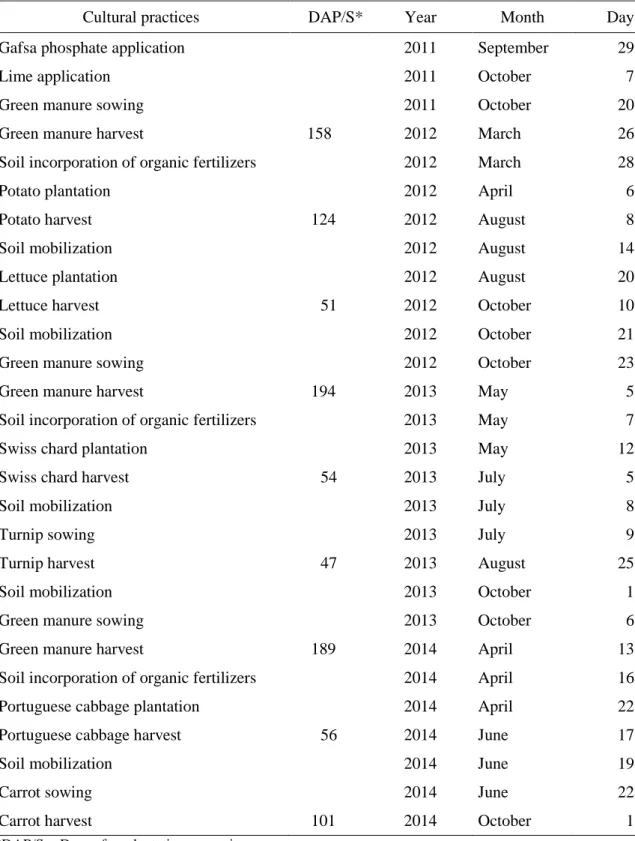
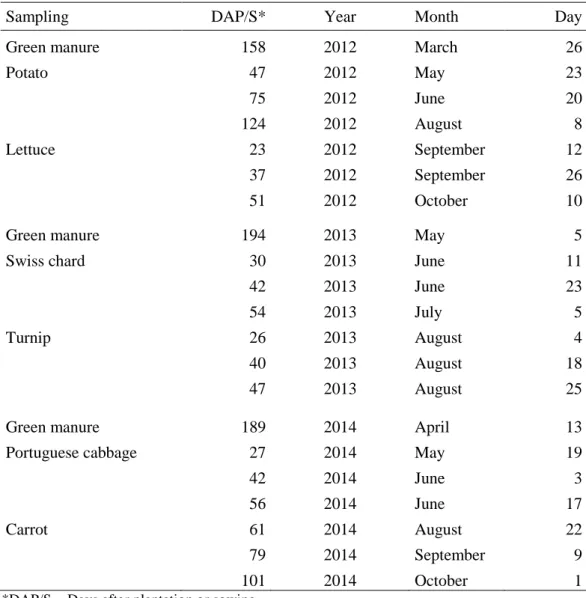
Table 2.1 Soil chemical characteristics at the beginning of the crop rotation. ... 63 Table 2.2 Schedule of cultural practices during the three years of crop organic rotation ... 67 Table 2.3 Dry matter content (DM) and chemical characteristics of compost applied before potato (1st year), Swiss chard (2nd year) and Portuguese cabbage (3rd year) (mean ± standard deviation). ... 70 Table 2.4 Dry matter content (DM) and chemical characteristics of commercial organic fertilizer applied before potato (1st year), Swiss chard (2nd year) and Portuguese cabbage (3rd year) (mean ± standard deviation). ... 71 Table 2.5 Fresh weight, dry matter content (DM) and chemical characteristics of green manure applied before potato (1st year), Swiss chard (2nd year) and Portuguese cabbage (3rd year) (mean ± standard deviation). ... 72 Table 2.6 Crop sampling during the three years of organic rotation ... 78 Table 3.1 Green manure nutrient content (g kg-1) before experimental treatments application in 2012, and in response to green manure (GM), GM with 20 or 40 t ha-1 of compost (C20 and C40), and GM with 1 or 2 t ha-1 of commercial fertilizer (CF1 and CF2) in 2013 and 2014. ... 92 Table 3.2 Crop nutrient content (g kg-1) on the 1st year of crop rotation in response to green manure (GM), GM with 20 or 40 t ha-1 of compost (C20 and C40), and GM with 1 or 2 t ha-1 of commercial fertilizer (CF1 and CF2). ... 93 Table 3.3 Crop nutrient content (g kg-1) on the 2nd year of crop rotation in response to green manure (GM), GM with 20 or 40 t ha-1 of compost (C20 and C40), and GM with 1 or 2 t ha-1 of commercial fertilizer (CF1 and CF2). ... 94 Table 3.4 Crop nutrient content (g kg-1) on the 3rd year of crop rotation in response to green manure (GM), GM with 20 or 40 t ha-1 of compost (C20 and C40), and GM with 1 or 2 t ha-1 of commercial fertilizer (CF1 and CF2). ... 94 Table 3.5 Green manure nutrient accumulation (kg ha-1) in response to green manure (GM), GM with 20 or 40 t ha-1 of compost (C20 and C40), and GM with 1 or 2 t ha-1 of commercial fertilizer (CF1 and CF2). ... 95 Table 3.6 Potato (tubers and shoots) and lettuce (shoots) nutrient accumulation (kg ha-1) on the 1st year of crop rotation in response to green manure (GM), GM with 20 or 40 t ha-1 of compost (C20 and C40), and GM with 1 or 2 t ha-1 of commercial fertilizer (CF1 and CF2). 96 Table 3.7 Swiss chard (shoots) and turnip (shoots and roots) nutrient accumulation (kg ha -1
) on the 2nd year of crop rotation in response to green manure (GM), GM with 20 or 40 t ha-1 of compost (C20 and C40), and GM with 1 or 2 t ha-1 of commercial fertilizer (CF1 and CF2). ... 97 Table 3.8 Portuguese cabbage (shoots) and carrot (roots and shoots) nutrient accumulation (kg ha-1) on the 3rd year of crop rotation in response to green manure (GM), GM with 20 or 40 t ha-1 of compost (C20 and C40), and GM with 1 or 2 t ha-1 of commercial fertilizer (CF1 and CF2). ... 97 Table 3.9 Apparent nutrient recovery (%) during the 1st year of crop rotation in potato and lettuce from green manure, 20 or 40 t ha-1 of compost and 1 or 2 t ha-1 of commercial fertilizer. ... 98
Table 3.10 Apparent nutrient recovery (%) during the 2nd year of crop rotation in S chard and turnip from green manure, 20 or 40 t ha-1 of compost and 1 or 2 t ha-1 of commercial fertilizer. ... 99 Table 3.11 Apparent nutrient recovery (%) during the 3rd year of crop rotation in P. cabbage and carrot from green manure, 20 or 40 t ha-1 of compost and 1 or 2 t ha-1 of commercial fertilizer. ... 99 Table 3.12 Accumulated mineralized N (kg ha-1) during each crop growing season for green manure (GM), GM with 20 and 40 t ha-1 compost (C20 and C40) and GM with 1 or 2 t ha-1 organic fertilizer (CF1 and CF2) and for the control without fertilization (T0). ... 100 Table 3.13 Apparent N mineralization equations during the growing seasons, for compost, commercial fertilizer and green manure. ... 107 Table 3.14 Accumulated mineralized N (mg kg-1), proportion of potentially mineralizable N that was mineralized, organic N applied (mg kg-1) and N mineralization rate (g kg-1 initial N) during the growing seasons for compost and commercial fertilizer. ... 109 Table 3.15 Soil chemical characteristics at the beginning and the end of the crop rotation for the control treatment (T0) without soil amendments and in response to green manure (GM), GM and 20 or 40 t ha-1 of compost (C20 and C40), GM and 1 or 2 t ha-1 of commercial organic fertilizer (CF1 and CF2). ... 110 Table 3.16 Soil chemical characteristics at the beginning of the pot experience for the control treatment (T0) without soil amendments and in response to green manure (GM), GM and 20 or 40 t ha-1 of compost (C20 and C40), GM and 1 or 2 t ha-1 of commercial organic fertilizer (CF1 and CF2). ... 112 Table 3.17 Dry weight (DW) and dry matter content (DM) in organic lettuce for the control treatment (T0) and for the treatments with green manure (GM), GM with 20 or 40 t ha-1 of compost (C20 and C40), and GM with 1 or 2 t ha-1 of commercial fertilizer (CF1 and CF2).113 Table 3.18 Nutrient content (g kg-1) of organic lettuce for the control treatment (T0) and for the treatments with green manure (GM), GM with 20 or 40 t ha-1 of compost (C20 and C40), and GM with 1 or 2 t ha-1 of commercial fertilizer (CF1 and CF2). ... 114 Table 3.19 Nutrientaccumulation (mg pl-1) in organic lettuce for the control treatment (T0) and for the treatments with green manure (GM), GM with 20 or 40 t ha-1 of compost (C20 and C40), and GM with 1 or 2 t ha-1 of commercial fertilizer (CF1 and CF2). ... 115 Table 3.20 Apparent CO2-C evolved equations for compost, commercial fertilizer, green manure, compost with green manure and commercial fertilizer with green manure. ... 120 Table 3.21 Accumulated CO2-C evolved (mg (kg soil)-1), C applied (mg (kg soil)-1) and C mineralization rate (g kg-1 initial C) from compost, commercial fertilizer, green manure, compost with green manure and commercial fertilizer with green manure. ... 121 Table 3.22 Apparent N mineralization equations for compost, commercial fertilizer, green manure, compost with green manure and commercial fertilizer with green manure. ... 123 Table 3.23 Accumulated N mineralized (mg kg-1), Norg applied (mg kg-1) and N mineralization rate (g kg-1 initial N) from compost, commercial fertilizer, green manure, compost with green manure and commercial fertilizer with green manure. ... 124
List of abbreviations
C/N Carbon/nitrogen ratio
C20 20 t ha-1 farmyard manure compost C40 40 t ha-1 farmyard manure compost CF1 1 t ha-1 commercial organic fertilizer CF2 2 t ha-1 commercial organic fertilizer DM Dry matter
EC Electrical conductivity FYM Farmyard manure GM Green manure OA Organic agriculture OM Organic matter SOM Soil organic matter
List of symbols
Al Aluminium Al3+ Aluminium ion C Carbon Ca Calcium CO2 Carbon dioxide K Potassium Mg Magnesium N Nitrogen NH3 Ammonia N2O Nitrous oxide NH4+ Amonium ion NO3- Nitrate ion NO2- Nitrite ion O2 Oxigen P Phosphorus
1. INTRODUCTION
1.1 A brief summary of organic agriculture history
Organic agriculture (OA) is a modern way of agricultural management that combines best environment practices, a high level of biodiversity, the preservation of natural resources and the application of high animal welfare standards in order to minimize the negative effects on the environment and to increase human health or animal health (Council regulation EC 834/2007). Organic agriculture aims to maintaining or enhancing soil fertility, feeding the crops through the soil eco-system and not through soluble fertilizers applied to the soil in accordance with the Council Regulation (EC) 834/2007 and the Commission Regulation (EC) 889/2008.
Organic farming emerged in Europe as a response to intensified farming and industrial agriculture, which uses synthetic fertilizers, chemical pesticides, monocultures into large areas and the separation of animal husbandry from plant production (Rembialkowska et al., 2012). The decade of 1960 was of great social and political upheaval worldwide and public awareness of environmental threats including those resulting from agriculture. The most dramatic threat came from the use of pesticides and was revealed by the Silent Spring book from Rachel Carson (Carson, 1962). Diclorodifeniltricloroetano (DDT) and other organochlorines were banned from the market in the early 1970s because of the harm they did to birds. Another cause for concern was the risk of methaemoglobinaemia (blue baby disease) caused by high nitrate contents found in drinking water supplies. The increased use of synthetic fertilizers caused several agricultural problems. The crop cultivars at that time were not yet adapted to higher nitrogen contents and weakened plants were easily attacked by pathogens and insects, whereas acid mineral fertilizers acidified the soil (Lockeretz, 2007).
Rudolf Steiner in German introduced the principles that lead to biodynamic agriculture in 1924. Steiner presented the farm as a living organism based on interactions between crop production and animal husbandry well adapted to environmental conditions (Steiner, 1958). From 1925 to 1930, the English Sir Albert Howard developed in India an aerobic composting technique and concluded that soil fertility based on a humus-rich soil was the precondition for healthy plant and animals. A key scientist of organic agriculture in France was Claude Aubert who wrote Lʼagriculture biologique (Aubert,
1970) which became a fundamental book for organic farming. Jerome Rodale from the United States started a movement which advocated the principle of small organic farms as cells of a sustainable society. Jerome Rodale started the magazine “Organic gardening and farming and his book “Pay dirt” was published in 1945 (Lockeretz, 2007).
Although the concept of organic farming already existed over the 1980s years, it was only since the implementation in 1993 of the Council Regulation (EEC) nº 2092/91, that it became the focus of significant attention from consumers and farmers. There was convergence of European policy goals with those of the organic movements, particularly with respect to ameliorating the impacts of intensive production on the environment and promoting higher animal welfare as well as food quality standards. Nowadays, the new emphases on climate change and global recession present new challenges for organic farming development.
Organic farming's reliance on livestock is seen by some as a weakness (Balmford et al., 2005); but by others as a way of significantly reducing emissions of green-house gases associated with manufacture and use of nitrogen fertilizers, and also providing opportunities for sequestration of soil organic carbon (Meisterling et al., 2009). On the other hand, integrated organic systems may have similar productivity to conventional production systems, while being less dependent on inputs from non-renewable resources (Stolze et al. 2009). The small and familiar organic farms almost always produce higher output levels per unit area than larger conventional farms (Chappell et al., 2011) and the improvement of biological activity and biodiversity in organic systems provide an efficient use of resources (Mäder et al., 2002). Therefore, organically manured crop rotation with organic fertilizers from the farm itself can be a realistic alternative to conventional farming systems (Sandhu et al., 2010) and in developing countries, the potential of organic farming, to directly enhance food productivity has been recognized (Ericksen et al., 2009).
The most recent survey on certified organic agriculture (FIBL IFOAM, 2014) reports that 37.5 million hectares of agricultural land were managed organically by 1.9 million producers. The countries with greatest organic agricultural land are Australia (12 million ha), Argentina (3.6 million ha) and the United States (2.2 million ha). Currently 0.9% of the agricultural land in the world is used for organic agriculture. In ten countries more than 10% of the agricultural land is managed organically (for example,
Falkland islands, 36.3%; Liechtenstein, 29.6%; Austria, 19.7%). In Europe, there are 11.2 million ha managed organically by more than 320.000 farms (2.3% of European agricultural land). The countries with the largest organic agricultural area in Europe are Spain (1.6 million ha), Italy (1.2 million ha) and Germany (1 million ha). In Portugal 6% of the agricultural land (201.054 ha) is managed organically, but the area used for organic horticulture (764 ha) is less than 0.5% of the organically managed land. Organic farming is gaining worldwide acceptance and, looking at the future of organic farming, there is clearly a need for more research and investment to explore the potential of organic farming (Gomiero et al., 2011).
1.2 Organic and conventional agriculture
Conventional farming has played a significant role in improving food and fiber productivity to meet human consumption demands, but has become excessively dependent on high-yield varieties, increased irrigation and use of pesticides and fertilizers. As a result of desertification, salinization, soil nutrient depletion and harmful residues in soil, water and food became concerning environmental issues (Baker et al., 2002; Kibblewhite et al., 2008). The practices of intensive agriculture also led to the degradation of several ecosystem services such as biological control of insect pests with natural enemies, biological control of diseases by soil microorganisms that naturally suppress of soil-borne diseases, pollination of crops, availability of nutrients by soil microbial activity and storage of carbon in soils (Sandhu et al., 2010). These last authors evaluated the role of land management practices on 14 organic and 15 conventional fields in the maintenance or enhancement of ecosystems services in agricultural land, and showed that organic agriculture was more sustainable than conventional agriculture to maintain ecosystem services. Organic farming systems also increases flora and fauna biodiversity compared to conventional systems (Krebs et al., 1999; Gomiero et al., 2011).
Organic and conventional farming systems differ in soil physical and chemical properties. For example, bulk density decreases in organically managed soils (Bulluck et al., 2002; Ge et al., 2013). The pH value usually decreases in soil managed with synthetic fertilizers because many of these are acidifying mineral fertilizers (Bulluck et al., 2002). The pH value also tends to decrease with organic management because of
soil microbial mineralization activity (Ge et al., 2011). However, the incorporation of organic matter (OM) mitigates the undesirable effects of the aluminum ion, and so the plants are less susceptible to soil acidity (Varennes, 2003).
Many authors reported that carbon (C) and nitrogen (N) contents increased in organically managed soils (Marinari et al., 2006; Evanylo et al., 2008; Nett et al., 2010). The total C increased 27.9% in organically managed soil with cattle manure application compared to 8.6% in conventionally managed soil after 22 years of crop production (Pimentel et al., 2005). Soil organic carbon content was 8% higher in the organic system compared with the conventional system after 27 years, in soils amended with equivalent amounts of organic carbon (Birkhofer et al., 2008), and labile C increased 76% under organic compared to conventional management (Marinari et al., 2007).
Drinkwater et al. (1998) reported a 15 years’ study in which they compared net balances of carbon and nitrogen in a conventional system with two different methods in organic system: one in which the crop biomass was fed to cattle and returned to the field as manure, and another that received C directly through incorporation of green manure. There was a significant increase in carbon stored in soil from manure (12 kg C ha-1) and green manure (6.6 kg C ha-1) incorporation compared to the conventional system (2.2 kg C ha-1). These authors found a significant increase in soil N content after manure incorporation and green manure incorporation, whereas in the conventional system soil N content decreased due to greater leaching. On the contrary, Marinari et al. (2006) found no differences in soil C content between organic and conventional management after 7 years. This might have been a consequence of organic management practices which might induce decomposition of native soil organic matter, the so-called priming effect (Kusyakov et al., 2000) or a high short-term decomposition of organic matter caused by mechanical weed control used more often in organic agriculture than in conventional agriculture. Therefore, the N use efficiency in organic and conventional systems may be contradictory. Mäder et al. (2002) found over a 21 year experience that the input of fertilizers (N, P and K), energy and pesticides in the organic systems was reduced by 34%, 53% and 97%, respectively, although mean crop yield was only 20% lower, indicating a more efficient use of resources of crop production. On the contrary, Aronsson et al. (2007) found that the yield of cereals in the organic systems was 15% to 50% less than in conventional systems, leading to a less efficient use of N.
Organically managed soils exhibit greater biological activity than conventionally managed soils (Mäder et al., 2002; Marinari et al., 2006). Mäder et al. (2002) reported an increase of the amount of earthworms, by a factor of 1.3 to 3.2 in the organic plots as compared to conventional ones, whereas the density of arthropods, carabids, staphlinids and spiders in organic plots was almost twice than in conventional plots. Microbial communities are also different between organic and conventional systems (Chu et al., 2007). Over a 4 year horticultural rotation, Gunapala et al. (1998) observed that bacteria were more important than fungi in organic compared to conventional soils. This was explained by the type of organic input. The major source of C for soil organisms in conventional system were soil humus and the exudates of roots, while the organic system received large inputs of manure and cover crops. Arbuscular mycorrhizal symbiosis, that is believed to ameliorate plant mineral nutrition, enhance water stress tolerance and contribute to a better soil aggregation, was also enhanced 30% to 60% in the organic farming systems compared to the conventional ones (Mäder et al., 2000), whereas root length colonized by mycorrhizae in organic farming was 40% higher than in conventional systems (Mäder et al., 2000).
High soil respiration rates were found for organically managed soils compared to conventionally managed soils, indicating higher soil microbial activity in organic farming soils (Ge et al., 2011). Indeed, Pimentel et al. (2005) found that soil respiration was 50% higher in organic system soils compared to the conventional system. In a long-term agricultural experiment (21 years) microbial biomass was 43% higher in organic systems compared to conventional systems (Fliebach et al., 2007). In this experience the metabolic quocient (qCO2) that related soil respiration to microbial C biomass was 43% lower in organic systems compared to conventional systems. This means that microorganisms in organic systems need less energy to maintain their biomass than in conventional systems. A higher microbial C biomass and lower qCO2 indicates that organic soil management better conserves soil organic carbon (Mäder et al., 2002). Pesticides may affect soil biological activity, including bacterial groups with important functions in soil nitrogen transformations (Johnsen et al., 2001). Rhizobium fixing N in symbiosis with bean (Phaseolus vulgaris L.), Azospirillum and Azotobacter free-living N fixing bacteria and the nitrifying bacteria may be severely affected by pesticide applications (Martinez-Toledo et al., 1992; Ramos and Ribeiro, 1993).
Nitrogen leaching from organic systems is usually lower than from the conventional systems (Benoit et al., 2014). Drinkwater et al. (1998) showed that N losses due to leaching during 15 years was on average 13 kg N ha-1 after application of manure and green manure, which corresponds to 35% lower than in conventional systems (20 kg N ha-1). Based on a system modeling approach, Hansen et al. (2000) showed that N leaching in organic soils varied from 19 to 30 kg ha-1 in loamy soils and 36 to 65 kg ha-1 in sandy soils. Whilst in conventional soils, N leaching varied from 32 to 48 kg ha-1 in loamy soils and 90 to 111 kg ha-1 in sandy soils. These authors further concluded that N leaching was lower in organic systems due to lower input of mineral N and the use of catch crops. The lower potential risk of N leaching in organic agriculture appears to improve agricultural sustainability while maintaining similar crop yields in comparison to conventional agriculture (Poudel et al., 2002).
Yield differences between organic and conventional farming are quite controversial. Soils on organic farming can be as productive as conventional farming after 5 years of organic production, probably due to beneficial effects on soil properties of long-term organic amendments (Bulluck et al. 2002; Pimentel et al., 2005). Maize yield in a two year rotation with soybean fertilized with hairy vetch residues before sowing maize was not significantly different from conventional management after 6 years (Drinkwater et al., 2000). However, Seufert et al. (2012) reported for 316 studies with comparisons between organic and conventional yields, with 34 different crops in 62 farms that the average organic yields were 25% lower for organic compared to conventional yields. These authors also suggested that the yields varied substantially with crop types. For example, yields of oilseeds were only 11% smaller in organic farming than in conventional farm, whereas organic cereals and vegetables yields were 26% and 33% lower, respectively, compared to conventional farming (Seufert et al., 2012). These differences were explained by the slower release of mineral N from organic sources which often do not keep up with the high crop N demand during the peak growing period (Pang and Letey, 2000). Badgley et al. (2006) examined 293 examples from all over the world to compare yields of organic and conventional systems. These authors found out that the average ratio of organic/non organic yield was slightly below 1 in the developed world and above 1 in developing countries. This same study concluded that organic agriculture has potential to fulfill food demand of a growing population at low cost, low input and locally available eco-technologies.
The large number of variables affecting mineral composition of plants makes it difficult to reach a definite conclusion about the effect of organic practices on mineral composition. However, it was observed that organic crops usually show higher phosphorus, iron, magnesium, vitamin C and dry matter contents and lower total nitrogen and nitrate content than conventional crops (Worthington, 2001; Herencia et al., 2011). Polyphenol content and antioxidant capacity tended to increase with organic farming management (Faller and Fialho, 2010), thus increasing the palatability of organic fruits and vegetables (Rembialkowska et al., 2012). Moreover, long-term addition of organic fertilizers increased soil content of vitamin B12 (Mozafar, 1994). This last author measured B12 content in the seeds of soybean, barley grains and in the leaves of spinach in plants grown in soils amended with cow manure (10 g kg-1) and found that the soil amendment did not alter B12 in soybean seeds, but increased the B12 content in barley grains by more than threefold and in spinach leaves by close to twofold. This may offer special benefits to people living on strict vegetarian diets who are known to be in danger of B12 deficiency.
A meta-analysis comparing environmental impacts of organic and conventional farming in Europe was performed using a wide range of indicators: soil organic matter, nitrogen leaching, nitrous oxide emissions, ammonia emissions, phosphorus losses, land use, energy use, greenhouse gas emissions, eutrophication potential, acidification potential and biodiversity (Tuornisto et al., 2012). This study concluded that the key goals in conventional farming should be improvement of soil quality, nutrients recycling and biodiversity protection, whereas in organic farming the main points to improve are nutrient management and increasing yields.
1.3 Soil fertility in organic agriculture
1.3.1 Crop rotation
In the early Middle Ages, crops in Europe were often organized in a three year rotation, in a system utilizing one third fallow (Duby, 1962). Later, by the 14th century, fallow rotations were replaced by rotations with forage leguminous, thus allowing production during the three consecutive years (Duby, 1962). Unfortunately, during 1950s and 1960s it was believed that synthetic fertilizers and pesticides could replace crop rotation without loss of yield, opinion that changed in the subsequent years. Nowadays, crop
rotation is one of the building blocks of organic farming systems. Careful design of crop rotation may ensure soil fertility for maintaining productivity and prevent problems with weeds, pests and diseases (Mourão, 2007). Moreover, the nutrient management under crop rotation target the needs of crops rather than focusing on individual crops because application of OM has strong residual benefits over several crop cycles (Singh et al., 2001).
The benefits of crop rotation to increase crop yields and the sustainability of agricultural systems has been reported (Yusuf et al., 2009). A 2-year crop rotation with maize and soybean increased 5% to 20% maize yields when compared with continuous maize production or maize after fallow (Bullock, 1992). A 4-year crop rotation consisting of fababean, barley and barley intercropped with pea increased mineral N and microbial N content compared to barley monoculture, indicating that leguminous contributed with N to the crop rotation through biological N fixation and addition of N enriched crop residues (Chang and Juma, 1994). Reeves et al. (1997) compaired maize yields for 50 years, between continuous cropping and 3 crop rotations: corn-oat, corn-oat-soybean and corn- oat- red-clover- alfalfa, and found that maize yields were lowest in the monoculture and highest with the corn- oat- red-clover- alfalfa rotation because of the presence of leguminous.
Long rotations with pasture or hay improve soil physical, chemical and biological properties, whereas short rotations such as maize-soybean may result in the degradation of soil properties (Bullock, 1992). For instance, a rotation including two years of pasture per each year of cereal was necessary to maintain soil structural stability (Reeves et al., 1997). Furthermore, Studdert et al. (1997) reported that rotations consisting of 7 years of short rotations require a minimum of 3 years of pasture to maintain soil properties in order to meet the goals of sustainable agriculture. Other authors indicate that short rotations with leguminous may also enhance physical and chemical properties (Liang et al., 2004; Kayser et al., 2010). A 4-year crop rotation with corn, oats and alfalfa (2 years), increased the content of soil organic matter and aggregate stability compared to a continuous corn production after 43 years (Drury et al., 2004). Furthermore, a 2-year crop rotation with oat, pea, hairy vetch and potato increased soil organic C from 23.9 to 25.9 g kg-1 (Grandy et al., 2002). In order to maintain and increase soil fertility, a crop rotation should include crops with different nutritional needs. For example, leafy crops, leguminous crops and root crops require
high levels of N, P and K, respectively (Mourão, 2007). A crop rotation should also explore the whole soil depth by using crops with different root lengths (Monfort, 1985). Crop rotation can help to reduce the amount of weeds (Marshall et al., 2003). In fact, Koocheki et al. (2009) found that weed density in continuous winter wheat (6300 seeds m-2) was higher than weed density in rotations with maize or sugar beet (5000 seeds m -2
). Total weed density was higher in continuous maize (39 plants m-2) compared with maize grown in rotation with spring barley (29 plants m-2) (Demjanova et al., 2008). Importantly, a crop rotation must take into account which crops increase weed emergence and the ones that prevent their growth in order to alternate them. For example, potato and spinach cover the soil preventing weed growth, as opposed to carrot and onion (Monfort, 1987).
Crop rotation may control diseases caused by soil pathogens (Hwang et al., 2009). This can be explained because crop rotation favors the development of antagonistic bacteria (Gorlach-Lira and Stefaniak, 2009). These authors found that a 6-year crop rotation increased the number of mycoantagonistic actinomycetes that inhibit the growth of
Fusarium oxysporum in sugar beet (Beta vulgaris) and winter rape (Brassica napus). In
addition, two year rotation of spring barley and potato and a three year rotation of barley, red clover and potato significantly reduced the levels of Rhizoctonia solani in potato (Peters et al., 2003). Crop rotation also reduced the risk of Fusarium wilt (Fusarium oxysporum) damage in lettuce (Scott et al., 2012); it has also been reported that pests are reduced with crop rotation mostly because of the interruption of food supply, being crop rotation most effective against pest species with narrow host (Mazzi and Dorn, 2011).
1.3.2 Soil organic matter
Soil organic matter (SOM) is an essential reservoir of carbon, nutrients and energy in the life cycle (Craswell and Lefroy, 2001), and the mineralization of SOM can be a major source of mineral N in agricultural soils. It has been estimated that 1% to 3% of the organic N is mineralized annually (Soltner, 1996). This can represent 30 to 90 kg N ha-1 if the OM content of the soil is approximately 3%. Furthermore, SOM is the most important indicator of soil quality and agriculture sustainability because of its impact on soil physical, chemical and biological properties (Reeves et al., 1997).
Regarding physical characteristics, the role of OM in the formation of stable aggregates has a major influence on water holding capacity, aeration and resistance to root growth (Benbi et al., 1998). Mamman et al. (2007) set up a laboratory experiment in which soil samples with three soil OM and moisture content levels were pressured with four different compactive efforts and found out that soil bulk density and penetration resistance decreased with increasing OM content. Therefore, OM addition alleviates the problems of soil compaction. Concerning chemical characteristics, OM incorporation into the soil increased total N, P and K contents (Bayu et al., 2006) and increased soil cation exchange capacity (Yilmaz and Alagoz, 2010). Besides, OM serves as a buffer in ameliorating the adverse effects of inorganic pollutants through their complexation with humidified OM. For example, organically complexed forms of Al are less harmful to plants than Al3+ (Varennes, 2003). SOM is the driving force for biological activity as the primary source of energy and nutrients for many soil organisms. A direct effect of the biological activity is seen through the formation of soil pores as a consequence of faunal activity, root and fungal growth. Other effects of the biological activity are changes in organic compounds that result from biological breakdown and mineralization and immobilization of nutrients (Craswell and Lefroy, 2001).
Organic matter is a key resource to restore fertility in depleted soils. For example, coarse-textured sandy soils with low OM content are difficult to manage as they easily lose nutrients by leaching and are easily susceptible to erosion (Burt et al., 2001). However, soil fertility can be restored by increasing OM content. Manure showed the potential to restore soil fertility of the depleted sandy soils by increasing SOM content, supplying nutrients, and increasing water-holding capacity after three years of manure application (Zingore et al., 2008). Nevertheless, addition of OM to soils may have some negative effects. From 14 field experiments studying the long-term-effect of manure application, Edmeades et al. (2003) showed that, because the ratio of nutrients in manures is different from the ratio of nutrients removed by the crops, excessive accumulation of some nutrients, particularly P and N can arise from the long-term use of manures. These authors also reported that the use of manures can result in soils becoming excessively enriched in P, K, Ca and Mg in the top soils and in nitrate, Ca and Mg in the subsoils. Moreover, applying manure on a N basis, leads to soils enriched with P because the N/P ratio in manure is lower than the crop’s requirements (Sikora and Enkiri, 2004).
Intensification of agricultural practices has increased the use of mineral fertilizers compared to the application of organic materials, with subsequent decline in soil OM content (Wells et al., 2000). To meet increasing food demand without accelerating land degradation, including the decline in organic matter, is one of the greatest challenges that the human race has to face in the 21st century (Craswell and Lefroy, 2001). A comparison, made between two different ancient agricultural sites (154 years of agricultural production) from USA and Peru, showed that agriculture in USA was based predominantly on corn as opposed to Peru that cultivated a diversity of crops, including corn, potato, small grains, faba bean and alfalfa. After 154 years, the OM content of USA farms was 46% lower in cultivated soils compared to uncultivated soils. In striking contrast, in farms from Peru, the OM content in cultivated soils was 30% higher than in uncultivated soils (Reeves et al., 1997). Nevertheless, other long term-studies have shown that most continuous cropping systems result in a decrease of OM content (Reeves et al., 1997). In their review, Reeves et al. (1997) reported that a rotation with corn, oat and leguminous crops with lime and manure fertilizer decreased 11% of the OM soil content compared to uncultivated sites after 70 years. However, the dynamics of OM are quite different depending on soil type, climate and crop management. According to Craswell and Lefroy (2001), humans are capable of maintaining and improving soil quality under continuous cultivation by wise soil management practices that include manure additions, inclusion of pasture in rotations, perennial crops and no-tillage systems.
Crop rotations and tillage practices influence the quantity of soil organic C and N. The soil C content increased 19% in a rotation with cereals and legumes in no-tillage management compared to conventional tillage management (Hungria et al., 2009). Similarly, no-tillage system (uses herbicides for fallow weed control) increased total organic C by 2 t ha-1 (6%) comparatively to conventional tillage (uses tillage for fallow weed control and heavy cultivator followed by rodweeding and packing before sowing) after 8 years in continuous wheat cultivation in a soil with approximately 4% OM. However, after 16 years of no-tillage in a wheat-fallow rotation, total organic C was only 1.6 t ha-1 higher than in conventional tillage (Larney et al., 1997). Larney et al. (1997) suggested that fallow periods stimulated decomposition by providing favorable moisture and temperature conditions, limiting the build-up of organic C. Hence, intensification of cropping practices by fallow elimination and tillage reduction may
build-up soil OM content. However, in OA the use of no-tillage system is difficult to achieve because the weeds have to be controlled and a higher number of tillage operations are required for weed control (Sartori et al., 2005). Moreover, without a significant input of C from crop residues or manures, tillage conservation can only decelerate the loss of soil organic matter.
Hungria et al. (2009) reported that C and N biomass increased in no-tillage system in comparison to a conventional system after 14-year rotation with cereals and legumes. They also reported an increased metabolic coefficient (microbial respiration/microbial biomass) in the conventional tillage system, which is indicative of a lower efficiency in the use of soil C by microbial population in this system. This is probably due to the fact that no-tillage systems favors fungi over bacteria and fungi apparently have lower maintenance energy requirement than bacteria (Haynes, 1999). Although the content of organic matter increased in no tillage systems compared to conventional systems, yields tended to decrease in minimum tillage systems because there is no disruption of soil below 20 cm leading to a reduction in soil aeration and temperature and consequently net N mineralization decreases. As an example, Jackson et al. (2004) found lower lettuce and broccoli yields when minimum tillage was used continuously for two years compared to conventional tillage. These authors suggested that, for improving soil quality and assuring profitability, farmers should utilize a combination of conventional and minimum tillage with frequent additions of organic matter.
Application of organic amendments to soil, such as animal manures (Haynes and Naidu, 1998), composts (Amlinger et al., 2003) and green manures (Thorup-Kristensen et al., 2003), is a current organic agricultural practice used to replenish C losses and improve soil biological and chemical properties (Goyal et al., 1999). However, it is not easy to manage N supply in organic farming systems, mainly because N availability depends crucially on the synchronization between N release from organic sources and crop uptake (Ranells and Wagger, 1996).
1.3.3 Compost
1.3.3.1 Compost characteristics
Animal manures have been traditionally used in soils as fresh material, because of their high N content. However, application of animal manures may cause serious