www.solid-earth.net/6/115/2015/ doi:10.5194/se-6-115-2015
© Author(s) 2015. CC Attribution 3.0 License.
Changes in soil quality after converting
Pinus
to
Eucalyptus
plantations in southern China
K. Zhang1, H. Zheng1, F. L. Chen1, Z. Y. Ouyang1, Y. Wang1, Y. F. Wu2, J. Lan2, M. Fu2, and X. W. Xiang2
1State Key Laboratory of Urban and Regional Ecology, Research Center for Eco-Environmental Sciences,
Chinese Academy of Sciences, Beijing 100085, China
2Guangxi Dongmen Forest Farm, Fusui 532108, Guangxi, China
Correspondence to:H. Zheng ([email protected])
Received: 19 August 2014 – Published in Solid Earth Discuss.: 17 September 2014 Revised: 25 December 2014 – Accepted: 7 January 2015 – Published: 2 February 2015
Abstract. Vegetation plays a key role in maintaining soil quality, but long-term changes in soil quality due to plant species change and successive planting are rarely reported. Using the space-for-time substitution method, adjacent plan-tations ofPinusand first, second, third and fourth generations ofEucalyptusin Guangxi, China were used to study changes in soil quality caused by convertingPinustoEucalyptusand successive Eucalyptus planting. Soil chemical and biologi-cal properties were measured and a soil quality index was calculated using principal component analysis. Soil organic carbon, total nitrogen, alkaline hydrolytic nitrogen, microbial biomass carbon, microbial biomass nitrogen, cellobiosidase, phenol oxidase, peroxidase and acid phosphatase activities were significantly lower in the first and second generations of Eucalyptus plantations compared with Pinusplantation, but they were significantly higher in the third and fourth gen-erations than in the first and second gengen-erations and signifi-cantly lower than inPinusplantation. Soil total and available potassium were significantly lower inEucalyptusplantations (1.8–2.5 g kg−1and 26–66 mg kg−1)compared to thePinus plantation (14.3 g kg−1and 92 mg kg−1), but total phospho-rus was significantly higher inEucalyptusplantations (0.9– 1.1 g kg−1)compared to the Pinus plantation (0.4 g kg−1). As an integrated indicator, soil quality index was highest in the Pinus plantation (0.92) and lowest in the first and sec-ond generations of Eucalyptusplantations (0.24 and 0.13). Soil quality index in the third and fourth generations (0.36 and 0.38) was between that in Pinusplantation and in first and second generations of Eucalyptus plantations. Chang-ing tree species, reclamation and fertilization may have tributed to the change observed in soil quality during
con-version of Pinus to Eucalyptus and successive Eucalyptus planting. Litter retention, keeping understorey coverage, and reducing soil disturbance during logging and subsequent es-tablishment of the next rotation should be considered to help improving soil quality.
1 Introduction
Vegetation plays a key role in soil development due to its in-fluence on nutrient cycling, hydrological processes and soil erosion (de la Paix et al., 2013; Zhao et al., 2013). Degra-dation of soil quality is a serious problem (Miao et al., 2012; Zhao et al., 2013).Eucalyptusis an important tree species for afforestation in tropical and subtropical regions and has been introduced to many countries around the world. In southern China, millions of hectares of degraded land, cropland and natural secondary forest have been converted into Eucalyp-tusplantations and successive planting has been undertaken (Wen et al., 2009). However, due to nutrient limitations in many areas (LeBauer and Treseder, 2008) and a high demand for nutrients byEucalyptus(Laclau et al., 2010), this kind of land use change may exhaust soil nutrients and decrease soil quality (Yu et al., 2000b). Inappropriate plantation manage-ment also accelerates the decline in soil quality (Yu et al., 2009). There is an urgent need to assess the effects that Eu-calyptusplanting has on soil quality since it plays a key role in sustaining forest productivity.
Figure 1.Study site and pictures of thePinusand the successiveEucalyptusplantations. MP, G1, G2, G3 and G4 refer to thePinusplantation and the first, second, third and fourth generationEucalyptusplantations, respectively.
soil physic-chemical properties (Garay et al., 2004; Muñoz-Rojas et al., 2012; Parras-Alcántara et al., 2013), microbial communities (Wu et al., 2012) or enzyme activities (Wang et al., 2008), which only reflect some aspects of soil quality. A soil quality index (SQI) was proposed for quantifying the combined biological, chemical and physical response of soil to land use and soil/crop management practices (Andrews and Carroll, 2001; Andrews et al., 2002). It provides an intel-ligible and more holistic measurement of soil quality and, in recent years, the SQI has been used to assess the impacts of land use change, forest and cropland management and eco-logical restoration (Navas et al., 2011; Morugán-Coronado et al., 2013; Tesfahunegn, 2013). Methods used to calculate SQI include expert opinion and principal component analy-sis (PCA) (Andrews et al., 2002), with the latter more widely used in recent studies (Navas et al., 2011).
The ecological consequences of Eucalyptus planting are important and have been studied in depth. For example, it was reported that soil organic carbon, nitrogen, microbial biomass and the metabolic quotient were significantly lower inEucalyptusplantations compared to natural and regener-ated forests or pastures (Behera and Sahani, 2003; Sicardi et al., 2004; Araújo et al., 2010; Chen et al., 2013). It was also found that the conversion of native savanna or sugarcane fields toEucalyptusplantations did not cause impacts on soil organic carbon, microbial biomass carbon or nitrogen con-tents (Binkley et al., 2004). Fialho and Zinn (2014) compiled paired-plot studies on how soil organic carbon stocks under native vegetation change after planting fast-growth Eucalyp-tus species in Brazil and found that Eucalyptusplantations on average had no net effect on soil organic carbon stocks. The results of these different studies were not consistent and the effect of successiveEucalyptusplanting has rarely been reported.
Here we accessed the effects of converting Pinusto Eu-calyptusand subsequent successiveEucalyptus planting on
soil quality by examining adjacent plantations of localPinus massonianaLamb. (Pinus) and first, second, third and fourth generations ofEucalyptus urophylla x grandis(Eucalyptus). The changes in soil quality were investigated by measuring the soil chemical and biological properties and by calculating a SQI using the PCA method for each plantation. Exhaustion of soil nutrients was the main problem considered in the stud-iedEucalyptus plantation; soil physical attributes were not considered in this study. The study aimed to test the effect on soil bio-chemical quality after (1) convertingPinusto Eu-calyptusplantations and (2) successiveEucalyptusplanting with rotation time of 5 years in southern China.
2 Materials and methods
2.1 Study area
This study was conducted at Fusui, Guangxi, China (22◦14′– 22◦21′N, 107◦47′–107◦56′E; Fig. 1). Elevation of study sites was between 140 and 250 m above sea level. The dom-inant aspect of slopes was southeast, with slope below 15◦. The region has a typical subtropical monsoon climate with mean annual temperature of 21.2–22.3◦C. Annual rainfall is 1100–1300 mm, concentrated during June–August. Soils in the region are mainly lateritic red earth with a profile depth of more than 80 cm. Soil pH ranged from 4 to 5 (Chen et al., 2013).
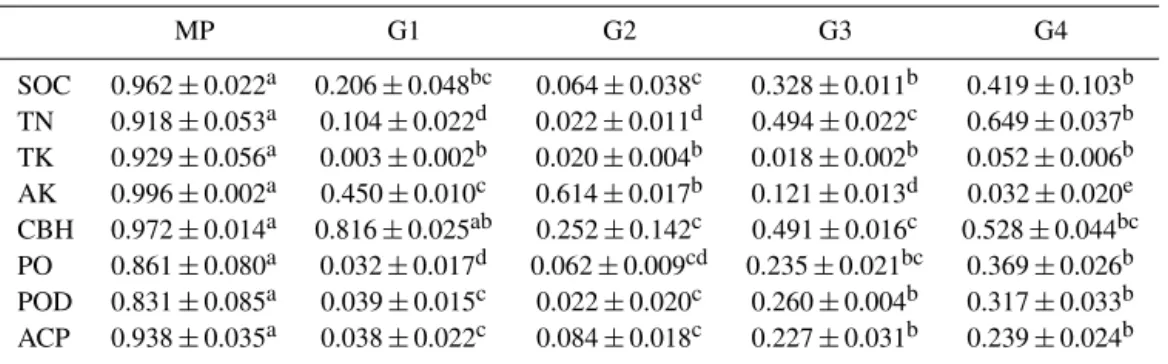
Table 1.Soil quality indicator scores (mean±standard error) for soil samples taken from thePinusandEucalyptusplantations.
MP G1 G2 G3 G4
SOC 0.962±0.022a 0.206±0.048bc 0.064±0.038c 0.328±0.011b 0.419±0.103b
TN 0.918±0.053a 0.104±0.022d 0.022±0.011d 0.494±0.022c 0.649±0.037b
TK 0.929±0.056a 0.003±0.002b 0.020±0.004b 0.018±0.002b 0.052±0.006b
AK 0.996±0.002a 0.450±0.010c 0.614±0.017b 0.121±0.013d 0.032±0.020e
CBH 0.972±0.014a 0.816±0.025ab 0.252±0.142c 0.491±0.016c 0.528±0.044bc
PO 0.861±0.080a 0.032±0.017d 0.062±0.009cd 0.235±0.021bc 0.369±0.026b
POD 0.831±0.085a 0.039±0.015c 0.022±0.020c 0.260±0.004b 0.317±0.033b
ACP 0.938±0.035a 0.038±0.022c 0.084±0.018c 0.227±0.031b 0.239±0.024b
MP, G1, G2, G3 and G4 refer to thePinusplantation and the first, second, third and fourth generationEucalyptusplantations, respectively. SOC, soil organic carbon; TN, total nitrogen; TK, total potassium; AK, available potassium; CBH, cellobiosidase; PO, phenoloxidase; POD, peroxidase and ACP, acid phosphatase. Means followed by the same letter (a–d) within a row are not significantly different atp< 0.05.
sprouts. The third generation ofEucalyptuswas planted with seedlings after strip reclamation (50 cm depth). Finally, the fourth generation was regenerated by sprouts again. Leaves, branch and bark litter were kept in the plantation during the plant growth period. However, at harvest time, most branch litter was removed and burned before the next rotation, and soil erosion happened easily due to the lack of soil protection during the crop transition periods.
Before Eucalyptus planting, base fertilizer (500 g seedling−1, N : P : K=10:15:5) was added into
a 20 cm depth soil hole under each new Eucalyptus tree and covered with soil. Then, 6, 12 and 24 months after planting, 250, 500 and 500 g, respectively, of fertilizer (N : P : K=15:10:8) per tree was separately added in
soil holes that were 30 cm away from each tree. Herbicide (glyphosate) was applied once a year during the first 3 years after Eucalyptus planting and consequently the coverage of understory plants was less than 50 %. However, the understory coverage increased gradually during the fourth and fifth years after Eucalyptus planting. During sampling time, tree, shrub and grass cover in thePinusplantation was about 60, 25 and 70 %, respectively. Tree, shrub and grass cover in the Eucalyptus plantations was similar, about 40, 10 and 45 %, respectively. The litter layer was about 3 cm in the Pinus plantation and 1 cm deep in the Eucalyptus plantations.
2.2 Experimental design and sampling
The adjacent plantations of local Pinus and first, second, third and fourth generations of Eucalyptusat the Dongmen Forestry Farm were selected (Fig. 1) to representPinus plant-ing and first, second, third and fourth generations of succes-siveEucalyptusplanting. Three 20 m×20 m plots were
ran-domly selected and marked out at each plantation site, with an average distance of 20 m between plots. During soil sam-pling, the ages ofPinusandEucalyptuswas 20 and 3 years, respectively.
In October 2010, soil from the top 0–10 cm layer was col-lected from the study sites. Ten soil cores were colcol-lected at randomly selected points at each plot using a 3.6 cm diameter soil auger and mixed together as a composite sample. Three composite samples were collected at each point. Stones and roots were removed from the soil samples by hand and soil samples were sieved through 2 mm sieves. Soil samples were stored at 4◦C for soil microbial biomass and enzyme activity analyses, or air dried for chemical analyses.
2.3 Soil chemical and biological analyses
Soil water content was determined gravimetrically after oven-drying at 105◦
C for 24 h in order to correct sam-ple weights in biochemical property measurements. Soil pH was measured in deionized water (1:2.5w/v) using a Delta 320 pH-meter (Mettler-Toledo Instruments (Shanghai) Co., Ltd.). Soil organic carbon (SOC) was measured using the Walkley and Black wet oxidation method as outlined in Bao (2000). Soil total nitrogen (TN) was determined by com-bustion in a Vario EL III Elemental Analyser (Elementar Analysensysteme GmbH, Germany). Soil alkaline hydrolytic nitrogen (AN) was measured according to Bao (2000). For the assessment of AN, 1 g of air-dried soil was incubated in 5 mL sodium hydroxide solution (1.2 M) in the outside ring of an airtight Conway diffusion cell; 3 mL boric acid (0.3 M) were added to the inner well at 40◦C for 24 h. With methyl red-bromocresol green as indicator, 0.01 M hy-drochloric acid was used to titrate ammonia absorbed in the boric acid. For total phosphorus (TP) and total potassium (TK), air-dried soil samples were digested using 18.4 M sul-furic acid (1:10w/v) and 12.7 M perchloric acid at 275◦C
for 6 h, TP and TK were measured using a Prodigy High Dispersion ICP-OES (Teledyne Technologies Incorporated, USA). Available phosphorus (AP) was measured after ex-traction with 0.05 N sulfuric and 0.025 N hydrochloric acids (1:5w/v), with shaking during 5 min. Available potassium
acetate solution (1:10w/v), shaken for 30 min (Bao, 2000).
AP and AK were measured using the Prodigy High Disper-sion ICP-OES.
Soil microbial biomass carbon and nitrogen (MBC and MBN, respectively) were estimated using the chloroform fumigation extraction method (Vance et al., 1987). Soil β -glucosidase (BG), phenol oxidase (PO), peroxidase (POD) and acid phosphatase (ACP) activities were measured ac-cording to Waldrop et al. (2000). Soil protease (PRO) activity was estimated according to Ladd and Butler (1972). Soil ure-ase (URE) activity was assessed according to Kandeler and Gerber (1988). Soil cellobiosidase (CBH) activity was mea-sured using the fluorimetric method according to Saiya-Cork et al. (2002).
2.4 Calculation of the soil quality index
The SQI was calculated according to Andrews and Car-roll (2001). Three steps were involved in the elaboration of this quality index: (i) definition of a minimum data set (MDS), (ii) assignment of a score to each indicator by linear scoring functions and (iii) data integration into an index.
Three steps were used to identify the MDS in our study. (1) Data screening: one-way analysis of variance was performed for soil chemical and biological properties; only variables with significant differences between treatments (p< 0.05) were chosen for the next step. (2) Selection of represen-tative variables: PCA was performed on the variables cho-sen from step (1); only principal components (PCs) that ex-plained at least 5 % of the variation in the data up to 85 % of the cumulative variation were examined, within each PC, only weighted factors with absolute values within 10 % of the highest weight were retained for the MDS. (3) Redundancy reduction: multivariate correlation coefficients were used to determine the strength of the relationships among variables. Highly correlated variables (correlation coefficient > 0.70) were considered redundant and candidates for elimination from the data set. In order to choose variables within well-correlated groups, we summed the absolute values of the cor-relation coefficients for these variables and assumed that the variable with the highest correlation sum best represented the group. The choice among well-correlated variables was also based on the published references and expert opinion about the soils and sites (Xu, 2000; Wang et al., 2008; Yu et al., 2009). Any uncorrelated, highly weighted variables were considered important and retained in the MDS.
Linear scoring was used in our study. Indicators were ranked in ascending or descending order depending on whether a higher value was considered “good” or “bad” in terms of soil function. In our study, all variables were “more is better”. The linear scoring function used for converting measured values to scored values is as follows (Zheng et al., 2005):
Sij =
Vij−Vimin Vimax−Vimin
whereSij is the score of soil variablei of samplej,Vij is
the observed variable value of samplej,Vimax is the highest value of variablei, andViminis the lowest value of variablei. The scores of the indicators (Table 1) were integrated into a SQI according to Andrews et al. (2002) as follows:
SQI= n X
i=1 Si
n,
whereSi is the score assigned to indicatori, and n is the
number of indicators included in the MDS.
2.5 Statistical analyses
One-way variance analyses were used to test the significant differences in soil chemical and biological properties and SQIs among these treatments. Normality of the data was tested using the Kolmogorov–Smirnov test and the soil indi-cators obeyed standard normal distribution. Tukey’s test was used for multiple comparison analysis. All statistical analy-ses were performed using SPSS 10.0 (SPSS Inc., Chicago, IL, USA) and SigmaPlot for Windows version 11.0 (Systa Software Inc.). The three plots established per site do not constitute true replicates, because they are located within the same area of the five plantations (Pinus, first, second, third and fourth generations Eucalyptus plantations). However, these plantation stands occur in similar topographic condi-tions and soil parent material, and were similar in planting history (Pinus plantation before the 1980s), which allowed us to consider them as different treatments.
3 Results
3.1 Soil chemical properties
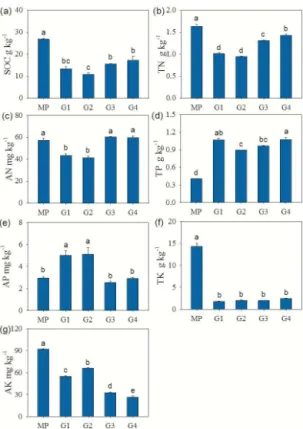
SOC, TN and AN ranges at our study sites were 10.8– 26.9 g kg−1, 0.9–1.6 g kg−1and 41.4–60.3 mg kg−1, respec-tively. They were high in thePinusplantation, low in the first and second generations ofEucalyptusplantations, and mod-erate in the third and fourth generations (Fig. 2a–c). SOC and TN in the fourth generation ofEucalyptus plantations were significantly lower than in thePinusplantation, but signif-icantly higher than in the second generation ofEucalyptus plantations. Soil AN in the fourth generation ofEucalyptus was significantly higher than in the second generation, but not different from that in thePinusplantation.
Figure 2.Soil chemical properties in thePinusand the successive Eucalyptusplantations. MP, G1, G2, G3 and G4 refer to thePinus plantation and the first, second, third and fourth generation Euca-lyptusplantations, respectively. SOC, soil organic carbon; TN, total nitrogen; TP, total phosphorus; TK, total potassium; AN, alkaline hydrolytic nitrogen; AP, available phosphorus and AK, available potassium. Soil chemical properties with the same letter are not sig-nificantly different atp< 0.05.
and 2.93 mg kg−1in the third and fourth generations, respec-tively (Fig. 2e).
Soil TK and AK ranged from 1.8 to 6.3 g kg−1 and from 24 to 92 mg kg−1, respectively. TK content was significantly lower in theEucalyptusplantations than in thePinus planta-tion, without significant differences betweenEucalyptus gen-erations (Fig. 2f). AK content was significantly higher in the Pinus plantation compared with in Eucalyptus plantations (Fig. 2g).
3.2 Soil microbial biomass carbon and nitrogen
Soil MBC and MBN contents ranged from 278 to 673 mg kg−1 and from 7 to 35 mg kg−1, respectively. Soil
MBC content was significantly lower in the first and sec-ond generation of Eucalyptus plantations than in the third and fourth generations (Fig. 3a). Soil MBN content was significantly lower in the second generation (Fig. 3b). The MBC/MBN ratio was significantly higher in the second generation Eucalyptus plantation than in other plantations (Fig. 3c).
Figure 3.Soil microbial biomass carbon and nitrogen in the Pi-nusand the successive Eucalyptus plantations. MP, G1, G2, G3 and G4 refer to thePinusplantation and the first, second, third and fourth generationEucalyptusplantations, respectively. MBC, mi-crobial biomass carbon and MBN, mimi-crobial biomass nitrogen. Mi-crobial indicators with the same letter are not significantly different atp< 0.05.
3.3 Soil enzyme activities
BG activity was significantly higher in the Pinus planta-tion compared with inEucalyptusplantations (Fig. 4a). Soil CBH, PO, POD, PRO and ACP activities were highest in the Pinusplantation, lowest in the first or second generations of Eucalyptusplantations and between the middle in the third or fourth generations ofEucalyptusplantations (Fig. 4b–f). Soil URE activity was significantly higher in thePinus plan-tation than in theEucalyptusplantations, with no significant differences amongEucalyptusplantations (Fig. 4g).
3.4 Changes in soil quality index
SQI was highest in thePinusplantation (0.92) and lowest in the second generation of theEucalyptusplantations (0.13). In the third and fourthEucalyptusgenerations, SQI was signifi-cantly higher than in the secondEucalyptusgeneration (0.36 and 0.38, respectively, compared to 0.13), but still lower than in thePinusplantation (0.92, Fig. 5).
4 Discussion
4.1 Decrease in soil quality in the first and second generations of Eucalyptus planting
Figure 4. Soil enzyme activities in the Pinusand the successive Eucalyptusplantations. MP, G1, G2, G3 and G4 refer to thePinus plantation and the first, second, third and fourth generation Eucalyp-tusplantations, respectively. BG,β-glucosidase; CBH, cellobiosi-dase; PO, phenoloxicellobiosi-dase; POD, peroxicellobiosi-dase; PRO, protease; URE, urease and ACP, acid phosphatase. Enzyme activities with the same letter are not significantly different atp< 0.05.
et al., 2004; Chen et al., 2013). However, in our study, soil TP was significantly higher inEucalyptusplantation, which might be caused by fertilization in Eucalyptus plantations and the low mobility of phosphorus. The decreased soil qual-ity in the first and second generations of Eucalyptus plan-tations after convertingPinustoEucalyptus plantation may have been caused by tree species change, full reclamation, herbicide application, clear-cutting and short rotation.
Eucalyptushas a fast growth rate and a strong nutrient ab-sorption capacity, which means that they absorb soil nutrients and store them in the biomass efficiently (Laclau et al., 2005), resulting in lower nutrient contents in the soil (Fig. 2). Tes-faye et al. (2014) evaluated seven tree species for fuelwood and soil restoration and found thatEucalyptuspresented the highest growth rates and biomass, but depleted soil nitrogen. The depletion of nitrogen in soils underEucalyptus planta-tions was also found by Wen et al. (2009). The lower soil nutrient contents in the second generationEucalyptus plan-tation may lead to lower soil microbial biomass and enzyme activities and a higher MBC/MBN ratio (Figs. 3, 4).
Full reclamation normally impacts the soil structure, ex-poses more aggregates and accelerates organic matter
de-Figure 5.Soil quality index in thePinusand the successive Eu-calyptusplantations. MP, G1, G2, G3 and G4 refer to thePinus plantation and the first, second, third and fourth generation Euca-lyptusplantations, respectively. SQI, soil quality index. SQIs with the same letter are not significantly different atp< 0.05.
composition (Zinn et al., 2002), which would lead to lower soil organic matter contents in theEucalyptus plantations. Understorey vegetation may provide a better microcosm for microorganisms and alleviate rainfall-induced erosion and nutrient leaching (Yu et al., 2000a). In our study, herbaceous vegetation was treated with herbicide during the first 3 years of theEucalyptus planting exposing the uncovered soils to erosion.
At harvest, clear-cutting totally destroyed plant coverage and the subsequent fire clearance burned all the residues and the litter layer, which resulted in bare ground prior to Euca-lyptusplanting. Soil erosion and nutrient leaching can occur during heavy rainfall if there is no protection from plant and litter layers (Yu et al., 2000a). Fire also removes significant amounts of organic matter (Certini, 2005) and nutrients are lost through volatilization (Fisher and Binkley, 2000). Soil microbial biomass decreases during fire because of increased decay and death of heat-sensitive microbes or through alter-ations of soil physic-chemical properties (De Marco et al., 2005). These could have been the causes for the bio-chemical depletion observed in soils that underwentPinusto Eucalyp-tusconversion.
4.2 Increase in soil quality in the third and fourth generations of Eucalyptus planting
Our results showed that after the sudden decline following convertingPinustoEucalyptus, SOC, TN, MBC, CBH, PO, POD and ACP activities recovered in the third and fourth generations, albeit lower than that in the nativePinus planta-tion (Figs. 2–4). This is inconsistent with Yu et al. (2000b), who recorded that soil physical and chemical properties decreased during successive Eucalyptusplanting. However, Lima et al. (2006) recorded an increasing soil organic matter trend as the plantation aged afterEucalyptusafforestation of degraded pastures. The inconsistency between these studies might be caused by different climate, soil properties, Euca-lyptusspecies and management practices amongst the study sites. The recovery of soil quality in the third and fourth gen-eration Eucalyptusplantations may be attributed to reduced soil disturbance and fertilizer application.
Soil disturbance caused by strip reclamation in the third generationEucalyptusplantation was much smaller than that due to full reclamation during the conversion fromPinusto Eucalyptus, which may have led to a reduction in soil or-ganic matter decomposition, soil erosion and nutrient leach-ing. The decreased soil erosion risk, nutrient leaching and organic matter decomposition rate helped in improving soil organic matter accumulation and nutrient levels (Yu et al., 2000a).
Fertilization could increase plant growth and litter input (Madeira et al., 1995), so improving soil quality. If soil nutri-ent inputs through fertilization and litter fall equal the output caused by erosion, plant absorption and leaching, then soil quality would reach a steady status (Xu, 2000). Our results suggest a recovery in soil quality after the third and fourth generations ofEucalyptusplanting (Fig. 5). To better under-stand the impacts of successive Eucalyptusplanting on soil quality, evaluation of more generations ofEucalyptus planta-tions is needed.
5 Conclusions
Findings from our study suggest that soil quality decreased significantly in the first and second generation Eucalyptus plantations after convertingPinustoEucalyptusplantations, partially recovering in the following third and fourth gener-ations. Changes in tree species, reclamation, herbicide ap-plication and long-term fertilization might have contributed to the changes observed in the soil quality during successive Eucalyptus planting. Our results emphasize the importance of long-term soil quality monitoring. Improving management practices, such as maintenance of litter and herbaceous cover and reduction of soil disturbance during logging and subse-quent establishment of the next planting rotation, should be considered to maintain soil quality.
Author contributions. H. Zheng and Z. Y. Ouyang designed the ex-periment and K. Zhang, F. L. Chen, and Y. Wang carried it out. Y. F. Wu, J. Lan, M. Fu and X. W. Xiang helped collecting soil samples and gave suggestion about the experiment. K. Zhang and H. Zheng prepared the paper.
Acknowledgements. We thank Y. F. Li, X. G. Pan and Q. B. Wu for helping us with the experimental investigation and soil sampling. We thank Guangxi Dongmen Forest Farm for permitting us to con-duct the study in their plantations and for helping us collect data. This research was funded by the Knowledge Innovation Program of the Chinese Academy of Science (grant no. KZCX2-EW-QN406) and the National Natural Science Foundation of China (grant no. 31170425, 40871130).
Edited by: A. Jordán
References
Andrews, S. S. and Carroll, C. R.: Designing a soil quality as-sessment tool for sustainable agroecosystem management, Ecol. Appl., 11, 1573–1585, 2001.
Andrews, S. S., Karlen, D. L., and Mitchell, J. P.: A comparison of soil quality indexing methods for vegetable production systems in Northern California, Agr. Ecosyst. Environ., 90, 25–45, 2002. Araújo, A. S. F., Silva, E. F. L., Nunes, L. A. P. L., and Carneiro, R.F.V.: The effect of converting tropical native savanna to Eu-calyptus grandis forest on soil microbial biomass, Land Degrad. Dev., 21, 540–545, 2010.
Bao, S. D.: Soil Agro-chemical Analysis, China Agriculture Press, Beijing, 2000 (in Chinese).
Behera, N. and Sahani, U.: Soil microbial biomass and activity in re-sponse to Eucalyptus plantation and natural regeneration on trop-ical soil, Forest Ecol. Manag., 174, 1–11, 2003.
Binkley, D., Kaye, J., Barry, M., and Ryan, M. G.: First-rotation changes in soil carbon and nitrogen in a Eucalyptus plantation in Hawaii, Soil Sci. Soc. Am. J., 68, 1713–1719, 2004.
Certini, G.: Effects of fire on properties of forest soils: a review, Oecologia, 143, 1–10, 2005.
Chen, F. L., Zheng, H., Zhang, K., Ouyang, Z. Y., Lan, J., Li, H. L., and Shi, Q.: Changes in soil microbial community structure and metabolic activity following conversion from native Pinus massoniana plantations to exotic Eucalyptus plantations, Forest Ecol. Manag., 291, 65–72, 2013.
de la Paix, M. J., Lanhai, L., Xi, C., Ahmed, S., and Varenyam, A.: Soil degradation and altered flood risk as a consequence of deforestation, Land Degrad. Dev., 24, 478–485, 2013.
De Marco, A., Gentile, A. E., Arena, C., and De Santo, A. V.: Or-ganic matter, nutrient content and biological activity in burned and unburned soils of a Mediterranean maquis area of southern Italy, Int. J. Wildland Fire, 14, 365–377, 2005.
Fisher, R. F. and Binkley, D.: Fire effects, 241–261, edited by: Fisher, R. F. and Binkley, D., in : Ecology and management of forest soils, 3rd edition, John Wiley & Sons Inc, New York, 2000. Garay, I., Pellens, R., Kindel, A., Barros, E., and Franco, A. A.: Evaluation of soil conditions in fast-growing plantations of Eu-calyptus grandis and Acacia mangium in Brazil: a contribution to the study of sustainable land use, Appl. Soil Ecol., 27, 177–187, 2004.
Kandeler, E. and Gerber, H.: Short-term assay of soil urease activity using colorimetric determination of ammonium, Biol. Fert. Soils, 6, 68–72, 1988.
Laclau, J. P., Ranger, J., Deleporte, P., Nouvellon, Y., Saint-Andre, L., Marlet, S., and Bouillet, J. P.: Nutrient cycling in a clonal stand of Eucalyptus and an adjacent savanna ecosystem in Congo 3, Input-output budgets and consequences for the sustainability of the plantations, Forest Ecol. Manag., 210, 375–391, 2005. Laclau, J. P., Ranger, J., Goncalves, J. L. D., Maquere, V., Krusche,
A. V., M’Bou, A. T., Nouvellon, Y., Saint-Andre, L., Bouillet, J. P., Piccolo, M. D., and Deleporte, P.: Biogeochemical cycles of nutrients in tropical Eucalyptus plantations: Main features shown by intensive monitoring in Congo and Brazil, Forest Ecol. Manag., 259, 1771–1785, 2010.
Ladd, J. N. and Butler, J. H. A.: Short-term assays of soil prote-olytic enzyme activities using proteins and dipeptide derivatives as substrates, Soil Biol. Biochem., 4, 19–30, 1972.
LeBauer, D. S. and Treseder, K. K.: Nitrogen limitation of net primary productivity in terrestrial ecosystems is globally dis-tributed, Ecology, 89, 371–379, 2008.
Lima, A. M. N., Silva, I. R., Neves, J. C. L., Novais, R. F., Barros, N. F., Mendonca, E. S., Smyth, T. J., Moreira, M. S., and Leite, F. P.: Soil organic carbon dynamics following afforestation of degraded pastures with Eucalyptus in southeastern Brazil, Forest Ecol. Manag., 235, 219–231, 2006.
Madeira, M., Araújo, M. C., and Pereira, J. S.: Effects of water and nutrient supply on amount and on nutrient concentration of lit-terfall and forest floor litter in Eucalyptus globulus plantations, Plant Soil, 168, 287–295, 1995.
Miao, C., Yang, L., Chen, X., and Gao, Y.: The vegetation cover dynamics (1982–2006) in different erosion regions of the Yellow River basin, China, Land Degrad. Dev., 23, 62–71, 2012. Morugán-Coronado, A., Arcenegui, V., García-Orenes, F.,
Mataix-Solera, J., and Mataix-Beneyto, J.: Application of soil quality indices to assess the status of agricultural soils irrigated with treated wastewaters, Solid Earth, 4, 119–127, doi:10.5194/se-4-119-2013, 2013.
Muñoz-Rojas, M., Jordán, A., Zavala, L. M., De la Rosa, D., Abd-Elmabod, S. K., and Anaya-Romero, M.: Organic carbon stocks in Mediterranean soil types under different land uses (South-ern Spain), Solid Earth, 3, 375–386, doi:10.5194/se-3-375-2012, 2012.
Navas, M., Benito, M., Rodríguez, I., and Masaguer, A.: Effect of five forage legume covers on soil quality at the Eastern plains of Venezuela, Appl. Soil Ecol., 49, 242–249, 2011.
Parras-Alcántara, L., Martín-Carrillo, M., and Lozano-García, B.: Impacts of land use change in soil carbon and nitrogen in a Mediterranean agricultural area (Southern Spain), Solid Earth, 4, 167–177, doi:10.5194/se-4-167-2013, 2013.
Saiya-Cork, K. R., Sinsabaugh, R. L., and Zak, D. R.: The effects of long term nitrogen deposition on extracellular enzyme activity
in an Acer saccharum forest soil, Soil Biol. Biochem., 34, 1309– 1315, 2002.
Sicardi, M., García-Préchacb, F., and Frionic, L.: Soil microbial indicators sensitive to land use conversion from pastures to commercial Eucalyptus grandis (Hill ex Maiden) plantations in Uruguay, Appl. Soil Ecol., 27, 125–133, 2004.
Tesfahunegn, G. B.: Soil quality indicators response to land use and soil management systems in Northern Ethiopia’s catchment, Land Degrad. Dev., doi:10.1002/ldr.2245, 2013
Tesfaye, M. A., Bravo-Oviedo, A., Bravo, F., Kidane, B., Bekele, K., and Sertse, D.: Selection of tree species and soil manage-ment for simultaneous fuelwood production and soil rehabili-tation in the Ethiopian central highlands, Land Degrad. Dev., doi:10.1002/ldr.2268, 2014.
Vance, E. D., Brookes, P. C., and Jenkinson, D. S.: An extrac-tion method for measuring soil microbial biomass C, Soil Biol. Biochem., 19, 703–707, 1987.
Waldrop, M. P., Balser, T. C., and Firestone, M. K.: Linking micro-bial community composition to function in a tropical soil, Soil Biol. Biochem., 32, 1837–1846, 2000.
Wang, Q. K., Wang, S. L., and Liu, Y.: Responses to N and P fertil-ization in a young Eucalyptus dunnii plantation: Microbial prop-erties, enzyme activities and dissolved organic matter, Appl. Soil Ecol., 40, 484–490, 2008.
Wen, Y. G., Zheng, X., Li, M. C., Xu, H. G., Liang, H. W., Huang, C. B., Zhu, H. G., and He, B.: Effects of eucalypt plantation re-placing Masson pine forest on soil physiochemical properties in Guangxi, southern China, Journal of Beijing Forestry University, 31, 145–148, 2009 (in Chinese).
Wu, J. P., Liu, Z. F., Sun, Y. X., Zhou, L. X., Lin, Y. B., and Fu, S.L.: Introduced Eucalyptus urophylla plantations change the compo-sition of the soil microbial community in subtropical China, Land Degrad. Dev., 24, 400–406, 2012.
Xu, D. P.: An approach to nutrient balance in tropical and south sub-tropical short rotation plantations, 27–35, edited by: Yu, X. B., in: Studies on long-term productivity management of Eucalyptus plantation, China Forestry Publishing House, Beijing, 2000 (in Chinese).
Yu, F. K., Huang, X. H., Wang, K. Q., and Duang, C. Q.: An overview of ecological degradation and restoration of Eucalyptus plantations, Chinese Journal of Eco-Agriculture, 17, 393–398, 2009 (in Chinese).
Yu, X. B., Chen, Q. B., Wang, S. M., and Mo, X. Y.: Research on land degradation in forest plantation and preventive strategies, 1–7, edited by: Yu, X. B., in: Studies on long-term productivity management of Eucalyptus plantation, China Forestry Publish-ing House, BeijPublish-ing, 2000a (in Chinese).
Yu, X. B., Yang, G. Q., and Li, S. K.: Study on the changes of soil properties in Eucalyptus plantation under continuous-planting practices, 94–103, edited by: Yu, X. B., in: Studies on long-term productivity management of Eucalyptus plantation, China Forestry Publishing House, Beijing, 2000b (in Chinese). Zhao, G., Mu, X., Wen, Z., Wang, F., and Gao, P.: Soil erosion,
Zheng, H., Ouyang, Z. Y., Wang, X. K., Miao, H., Zhao, T. Q., and Peng, T. B.: How different reforestation approaches affect red soil properties in Southern China, Land Degrad. Dev., 16, 387– 396, 2005.