University of Trás-os-Montes e Alto Douro
Ontology-based Procedural Modelling
of Traversable Buildings Composed
by Arbitrary Shapes
Doctoral Thesis in Computer Science By
Telmo Miguel Oliveira Adão
Supervisors:
Professor Luís Gonzaga Mendes Magalhães
Professor Emanuel Soares Peres Correia
Ontology-based Procedural Modelling of
Traversable Buildings Composed by
Arbitrary Shapes
By
Telmo Miguel Oliveira Ad˜ao
Supervisor: Professor Lu´ıs Gonzaga Mendes Magalh˜aes
Co-supervisor: Professor Emanuel Soares Peres Correia
Thesis submitted to
UNIVERSITY OF TR ´AS-OS-MONTES E ALTO DOURO in partial fulfillment of the requirements
for the degree of DOCTOR PHILOSOPHY in Computer Science, accordingly with the provisions of DR – I A–series, n.◦ 74/2006, March 24th and accordingly with the
Regulation of the Postgraduate Studies of UTAD DR, 2nd series – Deliberation n.◦ 2391/2007
Ontology-based Procedural Modelling of
Traversable Buildings Composed by
Arbitrary Shapes
By
Telmo Miguel Oliveira Ad˜ao
Supervisor: Professor Lu´ıs Gonzaga Mendes Magalh˜aes
Co-supervisor: Professor Emanuel Soares Peres Correia
Thesis submitted to
UNIVERSITY OF TR ´AS-OS-MONTES E ALTO DOURO in partial fulfillment of the requirements
for the degree of DOCTOR PHILOSOPHY in Computer Science, accordingly with the provisions of DR – I A–series, n.◦ 74/2006, March 24th and accordingly with the
Regulation of the Postgraduate Studies of UTAD DR, 2nd series – Deliberation n.◦ 2391/2007
Supervisors:
Professor Lu´ıs Gonzaga Mendes Magalh˜aes
Assistant Professor with Habilitation Department of Information Systems
University of Minho
Professor Emanuel Soares Peres Correia
Assistant Professor
Engineering Department, Science and Technology School University of Tr´as-os-Montes e Alto Douro
Learn from yesterday, live for today, hope for tomorrow. The important thing is not to stop questioning.
Albert Einstein
To my family and friends To my soulmate D´ercia
UNIVERSITY OF TR ´AS-OS-MONTES E ALTO DOURO PhD in Computer Science
The members of the jury recommend to the University of Tr´as-os-Montes e Alto Douro the acceptance of the thesis entitled “Ontology-based Procedural Modelling of Traversable Buildings Composed by Arbitrary Shapes” accomplished by Telmo Miguel Oliveira Ad˜ao in partial fulfillment of the requirements for the degree of Doctor Philosophy.
December 2015
Jury President: Professor Vitor Manuel de Jesus Filipe,
Associate Professor with Habilitation of the University of Tr´as-os-Montes e Alto Douro
Jury Members: Professor Ad´erito Fernandes Marcos,
Full Professor of the Aberta University
Professor Ant´onio Augusto de Sousa,
Associate Professor of the Engineering Faculty of the University of Porto
Professor Lu´ıs Paulo Peixoto dos Santos,
Assistant Professor of the Engineering School of the University of Minho
Professor Nuno Carlos Sousa Rodrigues,
Adjunct Professor of the School of Technology and Management of the Polytechnic Institute of Leiria
Information Systems of the University of Minho
Professor Emanuel Soares Peres Correia,
Assistant Professor of the Engineering Department, Science and Technology School of the University of Tr´as-os-Montes e Alto Douro
Ontology-based Procedural Modelling of Traversable Buildings
Composed by Arbitrary Shapes
Telmo Miguel Oliveira Ad˜ao
Submitted to the University of Tr´as-os-Montes e Alto Douro in partial fulfillment of the requirements
for the degree of Doctor of Philosophy
Abstract – 3D virtual models of buildings are commonly used in areas such as architecture and video games to preview a house project and to populate a virtual scenario, respectively. Traditionally, the production of these models requires highly skilled manpower and a considerable amount of time. To address this issue, many researchers have developed semi-automatic techniques to produce virtual models expeditiously. These procedural techniques provide different ways of generating buildings, including interiors and outer facades, to serve several purposes (e.g., content generation for video games or archaeological reconstruction). However, the existing techniques focusing on building interiors usually only support the generation of floor plans constrained by regular shapes or contour polygons obtained from rectangles sets. At the same time, the possibility of modelling interior rooms through the specification of its constraint walls remains poorly explored. Moreover, most of the existing procedural generation solutions are guided by complex grammars concerned with geometrical aspects or semantic structures that fit specific project requirements, apparently disregarding the established standards for virtual urban environments, specifically, CityGML.
To overcome the noted issues, a novel procedural modelling methodology is proposed in this thesis, one that produces virtual models of buildings, including exteriors outlined by arbitrary shapes and interiors formed by convex polygons. Methodology’s regulation is provided by a building ontology - a CityGML-based knowledge structure, planned to be extensible to specific architecture styles - through several guiding data structures such as structured XML and ontology-based grammar. Regarding the supporting process, a treemap approach is used to subdivide the building layout into floor plan areas. During the development of this work, several improvements were progressively made to the treemap in order to enable the subdivision of different constraint polygon types which range from rectangles to arbitrary shapes. Moreover, in the most mature work stage, a method concerning inner room walls adaptation is addressed. Next, a set of operations is performed, from the marking transitions step to the extrusion process that provides the 3D aspect. In addition, an experimental stochastic approach is proposed to automate the production of random buildings using this procedural modelling methodology.
A set of tests was made to demonstrate the capabilities of the proposed methodology xi
the effectiveness of the treemap approach in subdividing random layouts is shown, along with a generic stochastic process for automatic building generation and also some computational performance measurements.
Keywords: Procedural Modelling, Procedural Generation, Building Ontology, Building modelling, Ontological Grammar, Arbitrary Convex Shapes, Fake-concave, Computer-Aided Design.
Modela¸c˜ao Procedimental Baseada em Ontologia de Edif´ıcios
Atravess´aveis Compostos por Formas Arbitr´arias
Telmo Miguel Oliveira Ad˜ao
Tese submetida `a Universidade de Tr´as-os-Montes e Alto Douro em cumprimento parcial de requisitos
para a obten¸c˜ao do grau de Doutor
Resumo – Modelos virtuais 3D de edif´ıcios s˜ao usualmente utilizados em ´areas como a arquitetura e videojogos para fins de visualiza¸c˜ao de projetos de casas e povoamento de cen´arios virtuais, respetivamente. Tradicionalmente, a produ¸c˜ao destes modelos requer m˜ao-de-obra altamente especializada e consider´aveis quantidades de tempo. Para abordar esta quest˜ao, muitos investigadores desenvolveram t´ecnicas semiautom´aticas para produzir modelos virtuais de forma expedita. Estas t´ecnicas procedimentais providenciam diferentes formas de gera¸c˜ao de edif´ıcios, incluindo interiores e fachadas exteriores, que servem v´arios prop´ositos (por exemplo, gera¸c˜ao de conte´udo para videojogos ou reconstru¸c˜oes arqueol´ogicas). No entanto, as t´ecnicas existentes com foco na constru¸c˜ao de interiores normalmente s´o suportam a gera¸c˜ao de plantas restritas por formas regulares ou pol´ıgonos de contorno obtidos a partir de conjuntos de retˆangulos. Ao mesmo tempo, a possibilidade de modelar quartos interiores atrav´es da especifica¸c˜ao das suas paredes de restri¸c˜ao permanece pouco explorada. Al´em disso, a maioria das solu¸c˜oes de gera¸c˜ao procedimental existentes recorrem a gram´aticas complexas referentes aos aspetos geom´etricos, ou ent˜ao,
estruturas semˆanticas desenvolvidas para projetos com requisitos espec´ıficos, desconsiderando os standards desenvolvidos para ambientes urbanos virtuais, concretamente, CityGML. No sentido de abordar as quest˜oes indicadas, uma nova metodologia de modela¸c˜ao procedimental ´e proposta nesta tese, tendo como foco a produ¸c˜ao de modelos virtuais de edif´ıcios, incluindo exteriores circunscritos por formas arbitr´arias e interiores formados por pol´ıgonos convexos. A regula¸c˜ao da metodologia ´e fornecida por uma ontologia para edif´ıcios - que pode ser vista como um conjunto relacional de entidades baseadas em CityGML, extens´ıveis a estilos arquitet´onicos espec´ıficos - atrav´es de v´arias estruturas de dados, tais como XML estruturado e gram´atica baseada na ontologia. Relativamente ao processo de suporte da reparti¸c˜ao de espa¸co, uma abordagem treemap ´e usada para subdividir o layout representativo de uma dada base de edif´ıcio em sub´areas inerentes a contentores e quartos interiores. Durante o desenvolvimento deste trabalho, diversas melhorias foram feitas ao treemap de forma progressiva, com o objetivo de permitir a subdivis˜ao de diferentes tipos de pol´ıgonos de restri¸c˜ao que variam entre retˆangulos a formas arbitr´arias. Al´em disso, na fase final deste trabalho, foi incorporado um m´etodo para a adapta¸c˜ao de paredes de quartos. Na sequˆencia da subdivis˜ao, vem um conjunto de opera¸c˜oes que vai desde
Um conjunto de testes foi feito para demonstrar as capacidades da metodologia proposta na produ¸c˜ao de edif´ıcios com formatos distintos (edif´ıcios limitados por formas convexas e n˜ao-convexas e quartos com um n´umero espec´ıfico de paredes de restri¸c˜ao) e diferentes estruturas arquitet´onicas (casas de prop´osito geral, domus romanas) em curtos per´ıodos de tempo. Al´em disso, a efic´acia da abordagem treemap na subdivis˜ao de layouts ´e mostrada, juntamente com um processo estoc´astico experimental para a gera¸c˜ao autom´atica de edif´ıcios e tamb´em algumas medi¸c˜oes de desempenho computacional.
Palavras-chave: Modela¸c˜ao Procedimental, Gera¸c˜ao Procedimental, Ontologia para Edif´ıcios, Modela¸c˜ao de Edif´ıcios, Gram´atica Baseada na Ontologia, Formas Convexas Arbitr´arias, Falso-cˆoncavo, Design Assistido por Computador.
Acknowledgments
I want to use this opportunity to express my sincere gratitude to everyone that directly or indirectly participated on this important journey of my life, which is ending now.
Institutionally, I would like to thank to the Magnificent Rector of the University of Tr´as-os-Montes e Alto Douro, Professor Ant´onio Augusto Fontainhas Fernandes and to his predecessor, Professor Carlos Alberto Sequeira, to the President of the School of Science and Technology, Jos´e Boaventura Cunha and to his predecessor Professor Jos´e Afonso Bulas Cruz by the facilities and means provided for the realization of this work.
A special thanks to my supervisors, Professor Lu´ıs Magalh˜aes and Professor Emanuel Peres, by all of the support provided and useful interventions along this work. I am also very thankful to them by the vote of confidence and their friendship, which were crucial to the conclusion of this journey.
To all of my friends and colleagues, specially to Miguel Melo, my battle partner and loyal friend and also to his girlfriend, Indal´ecia Melim, for the good moments of leisure that we have spent together. To Sim˜ao Cardeal, Davide Borges, Ant´onio
Moreira, Carina Jerusa and Filipa Moura for the companionship and also to Martinho Gon¸calves who partially shared this journey with me: my heartfelt thanks.
Another manifestation of gratitude must be addressed to the officials of the Engineering Department for their sympathy and availability to assist and support in situations related with documentation and classrooms: thank you for the laughs and thank you for your patience every time I lost the key of the research lab.
Thank you to INESC-Tec for supporting me in the beginning of this research process, specially to Ricardo Batista and Pedro Brand˜ao, who provided me valuable tips during the development of this work.
I want to express my gratitude to my parents, brother and my family in general, for all the love, trust and support.
A very special thanks to my soulmate D´ercia, for being such a good partner. Thank you for your love, friendship, support and remarkable patience, summarily, thank you for being the woman that I want to keep for life and beyond.
Finally, I would like to thank to those who have believed, for the vote of confidence and, to those who have doubted, for the challenge.
Thanks very much to all of you!
UTAD, Vila Real Telmo Ad˜ao
3rd
of December, 2015
General Index
Abstract xi
Acknowledgments xv
Table Index xxi
Figure Index xxiii
Glossary, acronyms and abbreviations xxvii
1 Introduction 1
1.1 Content Production for Virtual Environments . . . 2
1.2 Main Concepts . . . 4
1.2.1 Production of buildings through procedural generation . . . . 4
1.2.2 Regulation through ontologies . . . 5
1.2.3 Ontology-based procedural modelling vs. Building Information Modelling . . . 5
1.3 Motivation and Goals . . . 6
1.4 Main Contributions . . . 9
1.5 Assumptions . . . 10
1.6 Document Organization . . . 11
2 Ontologies and Procedural Modelling 13 2.1 Ontologies on Virtual Environments . . . 14
2.2.1 L-systems for procedural modelling . . . 22
2.2.2 Detailing facades through split grammars. . . 23
2.2.3 Semi-automatic digital reconstruction of old buildings considering GIS data-based topology . . . 25
2.2.4 Random extrusion of floors. . . 25
2.2.5 Feature-based decomposition of facades . . . 26
2.2.6 Computer generated architecture for buildings production . . 27
2.2.7 Building generation based on facade view acquisition . . . 30
2.2.8 Digital map-based generation of 3D buildings with multiple roofs . . . 31
2.2.9 City Modelling Procedural Engine (CMPE) . . . 31
2.2.10 Procedural generation 3D (PG3D) solution . . . 32
2.2.11 Ontology-based generation of urban environments and building exteriors . . . 33
2.3 Procedural Modelling of Virtual Traversable Buildings . . . 35
2.3.1 LaHave House: an automated architectural design service . . . 35
2.3.2 Procedural generation of buildings using graphs and expansion algorithms . . . 35
2.3.3 Building indoors generation using constructive solid geometry algorithms . . . 37
2.3.4 Lazy production of virtual building interiors . . . 37
2.3.5 Interior rooms generated through Voronoi diagrams and constrained by convex layouts . . . 38
2.3.6 Rule-based generation/reconstruction of buildings . . . 39
2.3.7 Squarified treemaps for virtual buildings generation . . . 40
2.3.8 Residential buildings generation based on bayesian networks . 41
2.3.9 Grid approach focusing floor plan generation . . . 42
2.3.10 Generative Modelling Language (GML) for the production on virtual buildings . . . 43
2.3.11 Component-based modelling of virtual buildings . . . 44
2.3.12 Producing virtual 3D buildings from pre-designed floor plans . 44
2.3.13 Ontology-based generation of traversable buildings . . . 46
2.4 Summary . . . 48
3 Proposed Procedural Generation Methodology Overview 55
3.1 Problem Definition and General Proposed Framework . . . 55
3.2 Ontology for Buildings . . . 59 xviii
3.2.1 Generic ontology . . . 59
3.2.2 Generic ontology elements . . . 60
3.2.3 Extending the generic ontology to the roman architecture . . . 62
3.2.4 Roman ontology elements . . . 63
3.3 Procedural Modelling Methodology Overview . . . 65
3.3.1 Building Floor plan definition . . . 65
3.3.2 Extrusion, roofing and completions . . . 66
3.4 Summary . . . 66
4 Generation of Virtual Buildings Formed by Rectangles 69 4.1 Preliminary Procedural Modelling Methodology Proposal . . . 70
4.1.1 Ontology integration . . . 71
4.1.2 Methodology regulation: definition rules . . . 72
4.1.3 Methodology regulation: restriction rules . . . 76
4.1.4 Procedural modelling approach . . . 77
4.2 Implementation Prototype . . . 83
4.3 Preliminary Tests and Results . . . 85
4.4 Summary . . . 86
5 Generation of Virtual Buildings Constrained by Convex Shapes 89 5.1 Enhanced Procedural Modelling Methodology Proposal . . . 90
5.1.1 Ontology-based data model to guide definition rules . . . 91
5.1.2 Definition rules . . . 95
5.1.3 Restriction rules . . . 96
5.1.4 Moderation process for definition rules . . . 98
5.1.5 Procedural modelling generation process . . . 99
5.2 Enhanced Methodology System Implementation . . . 106
5.2.1 An ontology-based XML for virtual buildings definition (XML4BD)107 5.2.2 Rules moderator module . . . 110
5.2.3 Procedural modelling module . . . 112
5.3 Preliminary Tests and Results . . . 113
5.4 Summary . . . 116
6 Generation of Virtual Buildings Composed by Arbitrary Shapes 119 6.1 Final Procedural Modelling Methodology Proposal. . . 121
6.1.1 Ontology-based Grammar . . . 123
6.1.2 Moderating ontology-based grammar rules . . . 126
6.1.3 Procedural modelling generation process . . . 127
6.1.4 Stochastic rules selection for the automatic generation of virtual buildings . . . 134
6.3 Preliminary Tests and Results . . . 144
6.4 Summary . . . 146
7 Procedural Modelling Methodology Evaluation 149
7.1 Virtual Buildings Constrained by Arbitrary Shapes . . . 150
7.1.1 Simple building model . . . 151
7.1.2 U-shaped building model . . . 152
7.1.3 L-shaped building model . . . 153
7.1.4 Arbitrary building model with three connected corridors . . . 153
7.2 Interior Divisions’ Walls Adaptation . . . 155
7.2.1 L-shaped building model (six divisions) . . . 155
7.2.2 L-shaped building model (nine divisions) . . . 155
7.2.3 T-shaped building model . . . 157
7.2.4 Building model with a complex layout . . . 157
7.3 Subdivision Provided by the Treemap Approach . . . 158
7.4 Generating Structures Stochastically . . . 159
7.5 Ontology-based Architectural Derivation . . . 160
7.5.1 Generic building and roman domus overview . . . 162
7.5.2 Structural extensions and differences . . . 163
7.6 Performance Results . . . 163
7.7 Summary . . . 168
8 Conclusions 171
8.1 Thesis Summary . . . 171
8.1.1 Building Ontology . . . 172
8.1.2 Procedural Modelling Methodology . . . 172
8.2 Discussion and Future Work . . . 174
8.3 Final Remarks. . . 177
References 179
Table Index
2.1 Summary of the procedural modelling works, regarding buildings with interiors. . . 49
4.1 Roman domus divisions classified by functional zones. . . . 73
5.1 Reconstructed roman buildings of Conimbriga (Portugal) . . . 113
5.2 Ficticious virtual building models representing ancient structures and produced by the system that implements the methodology for generating buildings constrained by convex shapes.. . . 115
Figure Index
1.1 Examples of real-world buildings floor plans composed by inner and outer non-rectangular shapes. . . 8
2.1 A UML diagram representing the top classes of the CityGML standard (Kolbe, 2009). . . 20
2.2 UML diagram showing a simplified excerpt from the CityGML building model (Kolbe, 2009). . . 21
2.3 L-System operation: an iterative replacement system using alphabets. 23
2.4 Set of operations performed by a split grammar (Wonka et al., 2003). 24
2.5 Process of floor extrusion proposed by Greuter et al. (2003). . . 26
2.6 Merging of volumetric shapes resulting from CGA grammar rules. . . 28
2.7 Virtual Rome produced by the system of Dylla et al. (2009), using manual and procedural models. . . 29
2.8 Boavista roundabout produced by PG3D (Silva and Coelho, 2011). . 33
2.9 An house with interiors produced by Martin’s approach (Martin, 2006). 36
2.10 Building with floors produced in real-time through the lazy approach proposed by Hahn et al. (2006). . . 38
2.11 Example of a building structure generated by Rinde (2008). . . 39
2.12 Virtual environment depicting roman houses from Rodrigues (2010). . 40 xxiii
with real data (Merrell et al., 2010).. . . 42
2.15 Virtual environments produced using the tool developed by Santos et al. (2011).. . . 46
2.16 Virtual World generator process proposed by Trescak et al. (2010) and exemplified through an auction system. . . 48
3.1 Generic buildings’ ontology: a semantic abstract schema that defines the connections between the elements that can be part of a building. 61
3.2 The WorldObject parent and the inheritance mechanism . . . 61
3.3 The specialization of the generic building ontology into roman architectural objects. . . 63
4.1 Representative schema of the connections possibilities between functional zones. . . 76
4.2 Floor plan generation, using a treemap approach for dividing a roman
domus into rectangular divisions. . . . 78
4.3 Procedural modelling approach main stages, from the treemap-based floor plan division to the wall extrusion. . . 79
4.4 Generic work-flow diagram depicting the behaviour of the treemap subdivision process. . . 81
4.5 Generic work-flow diagram depicting the behaviour of the transition placement process. . . 82
4.6 Generic workflow diagram depicting the behaviour of the extrusion process, for a single AbstractBuildingElement. . . . 84
4.7 Final layout of a generated domus including interiors and a exterior. . 87
5.1 Simplified ontology-based data model. . . 93
5.2 Workflow depicting the process of balancing division weights through space borrowing. . . 100
5.3 General workflow depicting the adjustments made to a given building element during the floor plan division process of a virtual building constrained by a convex shape (valid for building parts, divisions and temporary containers). . . 104
5.4 Example of a treemap structure defining a floor plan arrangement, and respective floor plan subdivision process. . . 105
5.5 Architecture of the system that implements the methodology for generating virtual buildings constrained by arbitrary shapes, considering XML4BD specifications as input rules. . . 106
5.6 Example of a XML4BD node system and resulting 3D virtual model . 108
6.1 Example of the fake-concave technique behaviour. . . 128
6.2 Workflow depicting the addition of division wall segments. . . 130
6.3 Workflow depicting the operations regarding the deletion of a division’s wall segments. . . 131
6.4 Geometric operations to add or remove wall segments for division’s shape adaptation. . . 132
6.5 Stochastic process regarding the generation of random virtual buildings.135
6.6 Simplified scheme of the stochastic process, depicting the main steps regarding the random selection and arrangement of both priority-one and priority-two divisions. . . 137
6.7 Screenshot of the procedural modelling system implementing the stochastic and parametric tools. . . 139
6.8 Software toolkit backoffice screenshots excerpts regarding texture and restriction parameters. . . 140
6.9 Set of operations that a user can perform in the deterministic tool GUI.142
6.10 Preliminary results depicting the traversable buildings generated with the final methodology. . . 145
6.11 Preliminary results of the stochastic approach. . . 145
7.1 Simple general purpose building (based on the generic ontology). . . . 152
7.2 U-shaped general purpose building (based on the generic ontology). . 153
7.3 L-shaped general purpose building (based on the generic ontology). . 154 xxv
7.5 L-shaped building demonstrating inner walls adaptation . . . 156
7.6 Second L-shaped building that demonstrates inner walls adaptation . 156
7.7 T-shaped building to demonstrate inner walls adaptation. . . 157
7.8 Fourth virtual building model for the demonstration of inner walls adaptation. . . 158
7.9 Floor plan subdivision examples with four distinct structures . . . 159
7.10 Stochastic production of virtual buildings obtained from three fixed sets of divisions and a fourth set with randomly selected divisions. . . 161
7.11 Ontology-based generation of a generic building and a roman domus . 162
7.12 Structural differences between the domus and the generic building . . 164
7.13 Chart depicting the performance tests made to five groups of virtual buildings with a gradual increment of building parts per group and divisions per generation. . . 165
7.14 Results of the performance tests made to measure the computational resources spent by the application of the procedural modelling methodology in the generation of virtual buildings characterized by internal walls adaptation, presented in section 7.2.. . . 166
7.15 Results of the performance tests made to the structures subdivision process presented in section 7.3 . . . 167
7.16 Results of the performance tests made to the generation of ontological structures presented in section 7.5. . . 168
Glossary, acronyms and
abbreviations
Acronyms list
Acronym Expansion 2D Two Dimensional 3D Three DimensionalASCII American Standard Code for Information Interchange
BAW Building with Adapted Walls
BIM Building Information Modeling
BMG Building Model Generator
BSP Binary Space Partitioning
CAD Computer-Aided Design
CD Cyber Devices
CGA Computer Generated Architecture
CityGML City Geography Markup Language
CMPE City Modeling Procedural Engine
CPU Central Processing Unit
CSG Constructive Solid Geometry
ERAS Expedite virtual Reconstruction of Cultural HeritAge Sites
Fpms Floor planned modules
GB Gigabyte
GHz Gigahertz
GIS Geographic Information System
GML Generative Modeling Language
GTA Grand Theft Auto
GUI Graphical User Interface
HarvANA Harvesting and Aggregating Networked Annotations
IFC Industry Foundation Classes
LRU Last Recent Use
L-System Lindenmayer System
MRF Markov Random Field
MB Megabyte
MMORPG Massive Multiplayer Online Role-Playing Game
ms millisecond
NFS Need For Speed
OCG Open Geospatial Consortium
OCR Optical Character Recognition
PC Personal Computer
PG3D Procedural Generation 3D
RAM Random Access Memory
r/w read/write
SEMIC Semantic Modeling of Interactive 3D Content
UML Unified Modeling Language
VFDM Virtual Factory Data Model
Acronym Expansion
VFM Virtual Factory Manager
VirCA Virtual Collaboration Arena
VRML Virtual Reality Modeling Language
VW Virtual World
X3D Extensible Three-Dimensional
XML Extensible Markup Language
XML4BD Extensible Markup Language for Building Definition
Abbreviations List
Abbreviation Meaning(s)e.g. from latin exempli gratia; for example et al. from latin et alii ; and others (co-authors) i.e. from latin id est; that is
1
Introduction
Research and business areas like architecture, archaeology or videogames require the use of virtual structures, specifically buildings, to satisfy different requirements such as: the presentation of building projects, testing of hypothesis based on vir-tual models that enable theory formulations about missing or severely damaged ancient buildings or, on the other hand, the population of urban environments in an extensive way. Commonly, the production of these models requires highly skilled manpower and a considerable amount of time. Alternatively, procedural modelling proposes a semi-automatic, cost-effective and faster way of providing accurate vir-tual buildings representations.
During the last two decades, the scientific community researching procedural mod-elling has explored different methodologies to solve the generation of urban environ-ments and building interiors with interesting results. However, some issues remain unexplored. For example, methodologies for producing 3D buildings constrained by arbitrary shapes are still scarce, as until now, most of the existing solutions focus the generation of floor plans composed by squared or regular shapes. On the other hand, the semi-automatic modelling of interior rooms with non-regular formats is rarely addressed.
To overcome these issues, a new procedural modelling methodology capable of pro-ducing 3D building models externally constrained by arbitrary shapes and having internal divisions delimited by convex shapes is proposed. It is regulated through a building ontology that was created considering CityGML (Gr¨oger et al.,2008,2012) as basis: a standard proposed by Open Geospatial Consortium that details virtual urban environments. A set of instructions provided by ontology-based rules guides the proposed methodology in the following sequence: a constraint polygon is split into inner rooms; the transitions are placed between the resulting rooms; the walls extrusions are applied; finally, the placement of the roofs, rooms ceilings and floors takes place.
This introductory chapter will expatiate around the production of contents for vir-tual environments, procedural modelling and also ontologies. Motivation and goals for this work are then presented along with some assumptions. This chapter ends with the main contributions and orientations regarding document organization.
1.1
Content Production for Virtual Environments
Content production for virtual environments is an important subject as it is directly related with parameters such as production cost and development time, which have a significant impact in how well a business or research performs. The conventional production of these models - specifically, using manual modelling - requires highly skilled manpower and a considerable amount of time to achieve the desired virtual contents, in a process composed by many stages that are typically repeated over time.
As technology continues to evolve at a faster rate - more processing power, faster and larger memory, increased disk space at better r/w rates and more powerful graphic boards - new paradigms are emerging to provide more efficient and cost-effective solutions for business that depend on virtual contents. Among them is procedural modelling which can be seen as an assortment of techniques that aim to autom-atize the production of virtual models through the assimilation of patterns and
1.1. CONTENT PRODUCTION FOR VIRTUAL ENVIRONMENTS 3
algorithmic approaches that assume the role of content production engines. From the perspective of some business and research areas (e.g. architecture, archaeology, videogames producers), the overwhelming use of resources can now be drastically re-duced, leading to the increase of competitiveness. Moreover, man-skilled labour can now be concentrated in the validation and improvement of the automatically pro-duced models by adding or altering particularities and details that might make them closer to the expected results, considering the requirements of a given modelling task in a certain context.
The application fields are numerous. Videogames industry is perhaps one of the most obvious cases, due to the use of complex road networks and rich urban environments, pretty noticeable in games such as Grand Theft Auto1 or Need For Speed2. Actually,
NFS was a case study forWatson et al. (2008) who had underlined the applicability and importance of procedural modelling in the production of certain game contents such as buildings and road networks, due to its cost-effective and dynamic nature. Moreover, they suggest that designers who demand for automatic ways of generating game contents to avoid tedious and repetitive hand-made tasks, can be supported by procedural modelling tools to generate the first set of urban objects, that afterwards can be customized to make them look like what they have projected.
The same modelling style can be used in the archaeological research area, even in damaged structures - as it is pointed out by M¨uller et al. (2006a), Rodrigues et al.
(2008b) orDylla et al.(2010) - to aid, for example, in the proposal of hypothesis that can be valuable for the formulation of theories among that scientific community. Another application field is 3D cinema. Enterprises like Pixar3 or Dreamworks
An-imation4 are specialized in producing 3D movies that include human and animal
1
Grand Theft Auto, also known as GTA, is a well-know role playing game series, devel-oped by Rockstar. For more information, check the link http://www.rockstargames.com/
grandtheftauto/.
2
Need For Speed or NFS, is a racing game series developed by Electronic Arts. For more information, check the linkhttp://www.needforspeed.com/.
3
Pixar is a digital animation enterprise that belongs to the Walt Disney Company. For more information, check the linkhttp://www.pixar.com/.
4
Dreamworks Animation is a north-american studio specialized in animation movies. For more information, check the linkhttp://www.dreamworksanimation.com/.
characters, cities, villages and forests. Some of their productions already take ad-vantage from procedural modelling techniques. For example, in the Monters Inc. (Pixar) movie, the hair of Sulley character is procedurally animated (Cohen, 2001). Another example is the fracturing and debris procedural technique that was de-veloped for Kung-Fu Panda (Dreamworks) in order to be applied in several scenes involving massive destruction of structures (Lee et al., 2008b).
These were just a few examples intending to show procedural modelling versatility. However, others will be provided in the next chapters, to demonstrate the wide range of applicability of this modelling style in the generation of structures - specifically, buildings - expeditiously and demanding low user interaction.
1.2
Main Concepts
The concepts inherent to the development of this work will be presented, namely, ontologies and procedural modelling. Building Information Modelling (BIM) disam-biguation closes the section.
1.2.1
Production of buildings through procedural
genera-tion
The production of buildings and urban environments are major concerns for the procedural modelling area. Many works (Parish and M¨uller, 2001; M¨uller et al.,
2006b; Dylla et al., 2010; Silva and Coelho, 2011) present different approaches for the procedural generation of extensive urban environments, considering the exterior facades. These solutions have demonstrated to be a reliable alternative to manual approaches, since they are also capable of producing representations endowed with high levels of detail and visual accuracy. Regarding time consumption, the pro-cedural solutions are incomparably faster. The same conclusions are valid for the generation of buildings considering their interiors (Rodrigues et al., 2008b; Marson and Musse, 2010;Tutenel et al., 2011;Merrell et al.,2010) which proposes the fully
1.2. MAIN CONCEPTS 5
production of such structures including exterior facades, inner rooms and also the transitions that ensure transitivity among them.
1.2.2
Regulation through ontologies
Ontologies are knowledge structures capable of describing a system, namely the relations between its parts. They have been successfully applied in different solutions that require the use of virtual models/environments (Lee et al.,2008a;Attene et al.,
2009;Hunter and Gerber,2010) to achieve a wide variety of purposes that range from the planning of neurosurgery operation to the cataloguing of museum artefacts. A few procedural modelling solutions also used them to guide the process of generating virtual models (Liu et al.,2008;Trescak et al.,2010;Tutenel et al.,2011). The results are interesting. However, most of these procedural modelling solutions seem confined to the context for which they were developed, disregarding standards oriented for virtual environments.
1.2.3
Ontology-based procedural modelling vs. Building
In-formation Modelling
This subsection intends to clarify the main differences between ontology-based pro-cedural modelling approach and Building Information Modelling (BIM) which, due to the common use of semantics and similar goals, are liable to cause confusion. BIM supports the development and use of a computer generated model to simu-late the different stages of a facility such as planning design and construction. Its preciseness, flexibility and huge range of possibilities make it suitable for construc-tion professionals (Azhar, 2011). It is a complex standard that mixes semantic and geometry and contains a complete set of information - including, for example, the air conditioning system, the building structure or even the materials of its walls -and which requires expertise -and labor when dealing with it, in order to meet client requirements and also legal and physical rules.
On the other hand, ontology-based procedural modelling is concerned with the rapidly and faithful visualization of virtual structures, disregarding imperceptible details - such as the skeleton structure of a building - which can be harmful to the fluidity that is required, for example, in a video-game. During the exploration of a virtual scenario, these details are usually not needed for observation. Thereby, the performance issues are avoided at two levels: in the structures generation for further visualization; and in the virtual environment navigation itself that is only provided with required contents for visualization, possibly using a level-of-detail (LOD) load-ing strategy for computational resources management purposes.
Regarding the requirements of this procedural modelling work, a CityGML-based ontology was adopted and consists in a semantic structure simpler than BIM seman-tics, as it will be detailed in later sections. This option does not reject the possibility of having the resulting models integrated in BIM-based projects, since one of the CityGML (Gr¨oger et al.,2008,2012) concerns is to improve the interoperability be-tween the referred construction standard and urban virtual environments (Kolbe,
2012).
1.3
Motivation and Goals
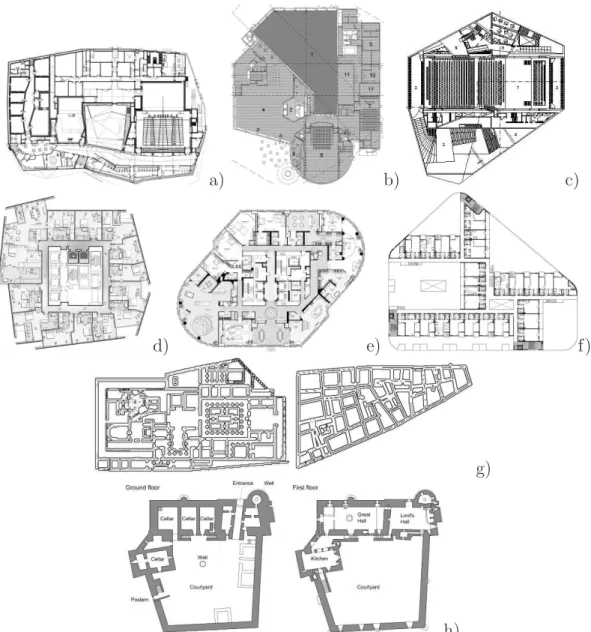
Real-world buildings are made up of very diverse geometries. Probably, the most commonly found sustaining floor plans are based on rectangular shapes. However, other contemporaneous and historical buildings are composed by wider sets of ge-ometries. Some examples are provided on Figure1.1. They include the floor plans of the following randomly selected buildings: Centre Pompidou-Metz5, Metz, France;
5
Centre Pompidou-Metz, situated in Metz, France;
1.3. MOTIVATION AND GOALS 7
Nantes’ Paloma music complex6, France; Casa da M´usica7 situated in Porto,
Portu-gal; the 39th floor of the Shard London Bridge8, London, United Kingdom; the 89th
floor penthouse belonging to a Trump Tower9 located in Illinois, United States; SZA
residential and business center10 located in Zagreb, Croatia; also historic buildings
such as Cantaber and Insula of the Phallus Vase11, located in Conimbriga, Portugal;
and finally, Doune Castle12 from Doune Village, Scotland.
Currently, procedural modelling methodologies that deal with traversable buildings, composed by non-square based polygons - as the ones that were presented in Figure
1.1 - including interiors (i.e. delimiting room walls) and exteriors (i.e. constraint building limits) are scarce. Moreover, notwithstanding the available and complete procedural modelling methodologies, some issues were identified:
• currently, the generation of virtual buildings with interior divisions composed by a customized number of constraint walls is poorly explored;
• most of the approaches generating virtual buildings only operate with con-straint polygons based on rectangles;
• the absence of a semantic organization into a comprehensive and extensive ontology (or similar) based on standards - which is noticed in most of the procedural modelling solutions - might difficult the derivation of new archi-tectonic styles and the exchange of information among heterogeneous systems regarding virtual environments, in general.
6
Paloma music complex, situated in Nantes, France; retrieved fromhttp://www.behance.net, in 2014.
7
Casa da M´usica, situated in Porto, Portugal;
retrieved fromhttp://estelalopezrocha.blogspot.com, in 2014.
8
39th floor of the Shard London Bridge, situated in London, England; retrieved fromhttp://www.theplan.it, in 2014.
9
89th floor penthouse of the Trump Tower, situated in Illinois, United States; retrieved fromhttp://chicago.curbed.com, in 2014.
10
SZA residential and business center, situated in Zagreb, Croatia; retrieved fromhttp://www.designboom.com, in 2014.
11
House of Cantaber and Insula of the Phallus vase ruins, situated in Conimbriga, Portugal; retrieved fromhttp://www.conimbriga.pt, in 2014.
12
Doune Castle, situated in Doune Village, Scotland;
a) b) c)
d) e) f)
g)
h)
Figure 1.1– Examples of real-world buildings floor plans composed by inner and outer nonrectangular shapes: a) Paloma music complex Nantes, France; b) Centre PompidouMetz -Metz, France; c) Casa da M´usica - Porto, Portugal; d) 39th floor of the Shard London Bridge - London, England; e) 89th floor penthouse of the Trump Tower - Illinois, United States; f) SZA residential and business center - Zagreb, Croatia; g) House of Cantaber (left) and Insula of the Phallus vase (right) ruins - Conimbriga, Portugal; h) Doune Castle - Doune Village, Scotland;
Thus, considering the aforementioned issues, the main goal of this thesis is to propose a methodology capable of producing traversable buildings internally and externally
1.4. MAIN CONTRIBUTIONS 9
described by more shapes than the rectangular-based ones. Moreover, in order to guide the referred methodology through the modelling of multiple structures belonging to different architectonic styles (e.g. ancient roman style, neoclassic, post-modern), a flexible and extensible ontology is also proposed. It relies in CityGML (Gr¨oger et al., 2008, 2012) which is an extensive and mature standard for virtual urban environments that documents a set of data models, including the generic composition and organization of the building entity.
Summing up, to fulfill the requirements of this work, the following list of specific goals need to be achieved:
• Identify the limitations that currently affect the procedural modelling research area;
• Propose of a novel methodology, capable of overcoming the identified issues; • Develop a prototype to demonstrate and evaluate the proposed methodology; • Carry out a performance evaluation;
• Discuss and compare the obtained results to other relevant works.
1.4
Main Contributions
This thesis main contributions focus on the proposal of a novel procedural modelling methodology supported by an extensible ontology. The following topics intend to identify the contributions:
• Development of a new procedural modelling methodology capable of producing traversable buildings constrained by arbitrary convex shapes, based on a pure treemap approach;
• Establishment of a process to change the format of the interior rooms, through wall number modification;
• Adaptation of a “fake-concave” technique to support non-convex buildings layouts;
• Proposal of an extensible building ontology to guide the methodology process and support the generation of other architectural style buildings (e.g. roman houses);
• Presentation of some ontology-based structures - eXtensible Markup Lan-guage (XML) and ontological grammar - to provide the procedural modelling methodology with production rules;
• Suggestion of computer-managed processes for the stochastic generation of buildings;
• Development of a toolkit implementing the above-mentioned procedural mod-elling methodology and computer-managed processes for automating building production.
1.5
Assumptions
This section will present a set of topics that the reader must take into consideration, when consulting this thesis. They will help to clarify which aspects are addressed and which are not:
• The proposed methodology will only focus on the generation of buildings with one floor, despite the support of the ontology to achieve more than that; • The proposal aims the generation of individual buildings that can possibly be
integrated in more extensive urban environments;
• The proposed procedural modelling approach intends to be an alternative for the existing ones and aims to produce a wider range of structures described by an extensive range of geometries, rather than to be concerned with faithful architectonic representations;
1.6. DOCUMENT ORGANIZATION 11
• Most of the generated models follow a deterministic approach. However, a stochastic alternative for the fully automated productions of buildings is pro-posed, constituting a preliminary approach devoid of real architectonic regu-lation;
• The proposed work does not address slanted walls;
• When discussing the proposed procedural modelling methodology, the term “room” is sometimes applied as having the same meaning as “division”, which is formally characterized in the proposed ontology (addressed on chapter 3); • All of the implementation versions regarding the proposed procedural
mod-elling methodology were made under Microsoft’s .NET framework13, using C#
programming language14 and also the XNA framework15;
• This thesis focus the procedural modelling of buildings, not the rendering as-pects. To visualize the created models, a XNA-based previewer was developed and a Blender software16 was used.
1.6
Document Organization
Besides the introduction, this thesis is constituted by seven other chapters.
Chapter 2 addresses ontologies and its effective applications on several fields re-quiring virtual models and environments. Also, an extensive revision targeting the state-of-art on procedural modelling is presented and its main contents include ur-ban environments, traversable buildings and ontological approaches.
13
Microsoft .NET framework refers to a collection of programming libraries that enables the use of .NET platform functionalities (link: http://www.microsoft.com/net).
14
C# is a powerful and flexible object-oriented programming language developed by Microsoft. More informations are available at the link https://msdn.microsoft.com/en-us/library/
kx37x362.aspx.
15
Microsoft XNA (not acronymed) framework is a software development kit for game production dedicated to Microsoft compatible devices (PC, Xbox). For more information, consult the following link: http://msdn.microsoft.com/xna.
16
Blender is a free and professional computer aided design (CAD) software developed, maintained and distributed by Blender Foundation. It is used for 3D modelling, UV wrapping, texturing, raster graphics editing and others (link: http://www.blender.org).
The third chapter (3) presents an overview of the proposed procedural modelling methodology for generating building’s outlined and internally composed by arbi-trary shapes. It includes the generic ontology, the derivation to the roman ontology and also the procedural modelling process, which succinctly explains the involved generation steps, from the floor plan subdivision to the walls extrusions.
Chapters 4, 5 and 6 will expose in detail each development and implementation stage of the proposed methodology. Chapter 4 addresses a first approach, which joins ontology and treemaps to achieve the creation of roman houses - uniquely composed by square shapes.
Chapter 5presents the first traversable buildings constrained by convex shapes. A set of descriptions of historic roman buildings are converted to XML definitions -based on ontology - and then, the reconstructions takes place using the procedural modelling methodology. The adaptation of this XML to a more adequate format, XML for buildings definition (XML4BD), is also documented along with the ficti-tious buildings that were produced as demonstration, in this development stage. A substantial part of this work is revealed on chapter 6. The proposed methodol-ogy, which allows the generation of buildings apparently constrained by non-convex shapes using the false-concave technique is explained. Here, the adaptations made to this approach that enable the modelling of the internal rooms through wall number definition are presented. Also, the new input rule set, which evolved to an ontology-based grammar and a stochastic approach, are addressed. This chapter ends with the presentation of a toolkit composed by a deterministic parametric tool and also a stochastic tool, that implements the complete procedural modelling methodology. The methodology evaluation is addressed in the seventh chapter (7), using the afore-mentioned toolkit. A set of tests is exposed to evaluate the methodology in the fol-lowing aspects: generation of simple structures, adaptation of inner walls to define the room shapes, treemap subdivision and architectural derivation capabilities. The stochastic approach is also evaluated. Finally, some performance tests are presented. The final chapter - chapter 8 - ends this document by exposing the conclusions, a brief discussion and some final remarks.
2
Ontologies and Procedural
Modelling
Procedural modelling consists in a collection of semi-automatic processes and tech-niques applied to generate virtual environments and structures with a reduced de-mand for user interaction. These techniques have been studied, developed and ap-plied by several researchers who recognize the potential of procedural modelling in reducing development time in projects requiring massive production of virtual struc-tures such as traversable buildings or extensive urban environments. During the last few decades, several works were developed, addressing the generation of building ex-teriors uniquely composed by outer facades (e.g. Parish and M¨uller (2001), Wonka et al.(2003),M¨uller et al.(2006b),Carrozzino et al.(2009),Silva and Coelho(2011)) and traversable buildings with interior divisions (e.g. Hahn et al.(2006);Marson and Musse (2010); Merrell et al.(2010)). A subset of these works also relies on ontolo-gies and semantics (e.g. Trescak et al. (2010), Liu et al. (2006), Liu et al. (2008)), which are knowledge organization based approaches that contributed, along with procedural modelling, to the methodology proposed in this document. Thus, the following subsections will expose a literature review regarding both matters.
2.1
Ontologies on Virtual Environments
Over the years, several authors have defined and characterized “ontology” (e.g.
Borgo et al. (1997), Noy and Hafner (1997), Benjamins and Fensel (1998)), while others were concerned with its applications in fields such as information systems and engineering (Wand and Weber (1990), Weber and Lybrand(1997),van Heijst et al.
(1997)). All of them inspiredGuarino(1998) andChandrasekaran et al.(1999) in the formulation of their own concepts about these knowledge organization structures. According to Guarino(1998), an ontology aims to describe a certain entity using a particular system of categories. In some areas like engineering - such as Artificial Intelligence - an ontology is established through a set of concepts and respective meanings (i.e. vocabulary) with a relation structure that intends to characterize a certain reality. The author also refers the increasing importance of ontologies for computer science, focusing in the information systems area, in which ontologies can play an important role due to their straight relation with components such as databases and program objects and application programs.
Chandrasekaran et al. (1999), shares a similar vision. The author states that this kind of structures intends to represent a set of facts related with a particular domain through the organization of the integrating knowledge concepts. This organization arises from the analysis over the domain fields, in which the following authors’ assumption should be considered:
“Weak analyses lead to incoherent knowledge bases.” —Chandrasekaran et al. (1999)
One of the most interesting features of ontologies is the possibility of sharing knowl-edge. This promotes a re-usability and standardization. For example, a building can share characteristics common in several architectonic styles. Despite their appear-ance on the different styles, a window, a door and a wall are transversal elements
2.1. ONTOLOGIES ON VIRTUAL ENVIRONMENTS 15
to the majority of the existing architectonic styles. The representation of particu-lar cases (eg. Manueline window, mesquite entrance, skylight) are extensions of the generic ones.
“Shared ontologies let us build specific knowledge bases that describe specific situations.” —Chandrasekaran et al. (1999)
Besides re-usability, ontologies are considered, byChandrasekaran et al.(1999), ab-stract structures. The combination of these two features are completely compatible with the design of data models and object oriented programming classes (towards the considerations made by Guarino (1998)). Thus, the ontological analysis of a certain domain field can be suitable for integration in areas such as computer sci-ence and software engineering, for both project stages: requirement analysis and algorithmic development.
Considering the notions left by Guarino(1998) andChandrasekaran et al.(1999) at an abstract level, one can infer that the use of ontologies can be extended to other areas - besides information systems or software engineering - namely the ones in-volving virtual representations, as some authors have already shown (e.g. Jannin and Morandi (2007), Attene et al. (2009) and B´eh´e et al. (2014)). The following subsections will expose some of the works that successfully applied ontologies to reg-ulate virtual representations in different scenarios and contexts. CityGML standard will also be discussed, due to its relevance in the context of virtual environments representation.
2.1.1
Virtual representations based on ontologies
The integration of ontologies in some of the works developed around virtual repre-sentations will be presented in this subsection. Although the concept of ontology has been explored for a while, this way of structuring knowledge is still largely used by several authors today.
Pittarello and De Faveri(2006) were concerned with the lack of semantic description across the considerable amount of virtual environments available on the Internet, which prevented a proper interaction with them. To get around this issue by enhanc-ing the models with semantics, the authors proposed a solution capable of relatenhanc-ing geometric primitives - X3D and VRML - with semantic class objects through the so called MetadataSet nodes. An independent scene ontology was also incorporated to establish a set of relations used for the description of a certain domain (for example, a wall can be contained inside the room).
One year later, an approach involving surgical models for computer-assisted neuro-surgery was proposed by Jannin and Morandi (2007). The aim of this work is to provide a visual framework for planning surgeries, improving human-computer in-terfaces - specifically, for the computer-assisted surgery systems - thus formalizing the surgical knowledge and practice. The presented framework relies in a surgical ontology which establishes the concepts and relationships belonging to the surgi-cal work domain - extensible to other areas of medicine - and a supporting software that describes the surgical procedures.
For setting up urban environments, a work that employs ontologies was proposed by Garc´ıa-Rojas et al.(2008). Their parametric system allows common users - non-experts in the virtual reality field - to prepare 3D scenes through an on-demand configuration. To achieve this, a visual programming paradigm, supported by a proper ontology, allows the organization of a 3D scene components.
A pervasive system, proposed byLee et al.(2008a), combines ontology-based context-awareness with adaptable augmented reality. In short, the framework considers sev-eral aspects such as user preferences, device profiles and security to augment per-sonalized virtual models, which must in accordance with a given acquired context. Context-awareness is provided by three ontologies. The first ontology holds the gen-eral concepts related with the pervasive environment. A second ontology organizes knowledge about users’ device profile (related with the mobile device capabilities) and preferences (a set of user options). At last, a social ontology maps users activities related with information shared in the web, for further re-utilization. The authors exposed three system applications as examples: ubiquitous home visualization and
2.1. ONTOLOGIES ON VIRTUAL ENVIRONMENTS 17
simulation, ubiquitous car services and ubiquitous engineering collaboration. The strength of ontologies was once again highlighted by ShapeAnnotator: a system developed by Attene et al.(2009) that allows the classification of 3D virtual model meshes in a certain knowledge domain. The system provides a set of tools for model segmentation that can be manipulated by a user in order to easy and properly link the model parts to the domain knowledge, formalized by an ontology. The usefulness of ShapeAnnotator framework was discussed in two scenarios. The first one explains the potentialities of the tool in supporting the creation of human models (avatars) for Multi-massive online role playing games (MMORPGs) and virtual worlds, such as Second-Life. The second scenario focuses the collaborative e-manufacturing of 3D products taking advantage from the abstractness and re-usability provided by the ontology.
In the museums context, another system assisted by ontologies that aims the collabo-rative annotations of 3D museum artifacts through web-based services, was proposed (Hunter and Gerber,2010). This system - entitled Harvesting and Aggregating Net-worked Annotations (HarvANA) - promotes the participation of communities in the cultural enrichment and improves museum objects indexation. One of the most rel-evant features of this system is the flexible ontology-based categorization - called of folksonomy - which optimizes tagging proceedings among the communities.
In the context of urban planning and management, Martins (2011) proposed an urban ontology to overcome the issue of data heterogeneity among municipalities that use different geographic information data sources. The main idea is to establish a common data model and provide an unified platform for data sharing between municipal technicians. Thereby, the author supported a significant part of his work in the CityGML standard - addressed in the next subsection - to develop a set of data models, which intend to reflect the different urban elements. For example, the proposed building model establishes a structure which includes a building, building parts, rooms, openings such as doors and windows and several boundary surfaces like walls, grounds, ceilings and furniture.
A couple of years later,Colledani et al.(2013) proposed the integration of several het-erogeneous software tools for manufacturing activity design over the same platform, using ontologies for uniformization purposes. This is implemented through the so-called Virtual Factory Framework, which is composed by several components: data and knowledge, Semantic Virtual Factory Data Model (VFDM), Semantic Virtual Factory Manager (VFM), decoupled virtual factory modules and the real factory interface. In this case, the VFDM is the abstraction layer holding the ontology that can extend products and define manufacturing processes. The rest of the com-ponents complete the system by ensuring the connection of the framework to the external applications, through special framework connectors designed for integra-tion.
Recently,Flotynski(2014) developed the Semantic Modelling of Interactive 3D Con-tent (SEMIC), which employs a method for the modelling of knowledge, rather than the modelling of virtual content itself. SEMIC employs a method that consists in the mapping of 3D content into semantic classes, which are related with each other, in order to establish object relations for a given domain. The creation of 3D content consists in a set of well defined steps that includes the design of the concrete seman-tic representation containing properties related with the 3D content, the mapping of specific domain concepts and the design of a conceptual semantic representation of 3D content, for arbitrary 3D creation purposes. These steps, as the author refers, require the intervention of different skilled professionals such as content developers, domain experts and content consumers. This aspect might suggest that this system is somewhat complex regarding 3D virtual models creation process.
Another recent approach addressing simulations in virtual environments was pro-posed by B´eh´e et al. (2014). The authors presented a framework for interactive multiagent-based simulations in virtual environments, adapting ontologies as a core notion to ease the simulation design and re-usability. Thereby, simulations are con-figurable through semantic modelling. This is used to describe the different aspects of the simulation, namely agent behaviours, surrounding environments with physi-cal objects, scheduling for operation progress and the results of agent actions and interactions.
2.1. ONTOLOGIES ON VIRTUAL ENVIRONMENTS 19
The differences between Geographical Information Systems (GIS) and BIM were addressed by Mignard and Nicolle(2014), who developed a system called SIGA3D. This system takes advantage of ontologies, to provide interoperability between con-struction and urban management. So, information about buildings and geographic data can be managed together, in the same structure. The system also promotes col-laboration between facility managers, aiming the enrichment of knowledge models since the designing stage to buildings’ recycling .
The last work reviewed in this subsection is Virtual Collaboration Arena (VirCA): a collaborative virtual/augmented reality framework that enables testing and training events in the context of manufacturing systems, through several practical scenarios (Galambos et al., 2014). Such scenarios are mounted through web-based applica-tions and interfaces that provide mechanisms for using and extending virtual reality content. Interaction with the referred scenarios is provided by cyber devices, also known as CDs, that enable the manipulation of their objects. The ontology con-cept acts here: a semantic manager layer ensures the bidirectional communication between CDs and virtual scenes, factoring on the available capabilities and requests - in terms of allowed actions/functionalities - supplied by the scenes’ ontologies. Summing up, one might conclude that ontologies have made a significant contribu-tion to the success of several works, some of them referred in this subseccontribu-tion. This way of organizing knowledge to regulate processes has revealed robustness and flex-ibility in several works that require data representation through virtual models in a wide variety of contexts such as simulation, industrial manufacturing, collaboration, urban planning and others. However, in the specific context of 3D urban modelling, there is a well-defined urban knowledge structuring standard named CityGML. The next subsection will address some of the most relevant features of this standard.
2.1.2
CityGML: a 3D urban environment standard
CityGML is, perhaps, the most important effort for the standardization of 3D urban representations (Gr¨oger et al.,2008,2012). These guidelines, proposed by the Open Geospatial Consortium (OCG), intend to provide a widespread XML-based format
for the geometric and semantic representations of city components. Kolbe (2009), one of the co-founders of CityGML, explains this standard, starting by describing the scheme of thematic classes (Figure 2.1) that is composed by an abstract base class - CityObject - from which all of the other thematic classes inherit, for example,
CityModel, Site, WaterBody, Vegetation, AbstractBuilding. It is noteworthy that
these classes are conceptual structures isolated from the geometric aspects, which are addressed by the Geometry structure associated to each conceptual class. Geometry extends a set of primitives for representational purposes which intend to describe geometrically the objects spawned from concept classes.
Figure 2.1– A UML diagram representing the top classes of the CityGML standard (Kolbe,
2009) in which objects are considered features and their classes are derived from CityObject.
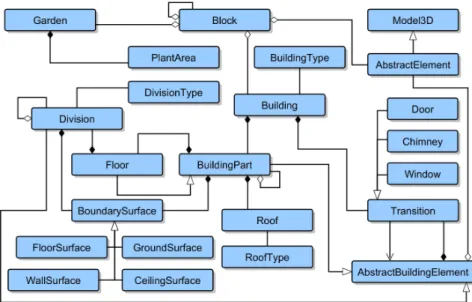
The term “3D urban environment” can lead to the idea that only the exterior as-pects of a city are addressed. However, the standard also covers the building element and both its inner and outer components. Kolbe(2009) explains the CityGML sup-port to this crucial city element, by presenting also an abstract class named of
AbstractBuilding. This is the mother class that derives to Building and Building-Part. Building holds sets of BuildingPart which can be seen as groups of structures
that take advantage of the recursive relation with the AbstractBuilding in order to support a wider range of structural rearrangements. For example, a given building
2.1. ONTOLOGIES ON VIRTUAL ENVIRONMENTS 21
may hold a stack of floors and a castle might be constituted by a set of horizon-tal distinguishable parts such as towers, curtain walls or gatehouses. Buildings and building parts can be represented in terms of constraints by another important class which is the BoundarySurface. This one can derive to specific boundaries such as
WallSurface or RoofSurface. Furthermore, this boundaries may hold a set of
ob-jects spawned from Opening class, as for example, doors and windows. Finally,
Room class is intended to support the inner compartments inside the building and
building parts. The diagram that describes the building knowledge organization is depicted on Figure 2.2.
Figure 2.2– UML diagram showing a simplified excerpt from the CityGML building model (Kolbe,2009).
.
The specification of buildings is also extensively addressed by Industry Founda-tion Classes (IFC): a data model standard widely used by the construcFounda-tion indus-try for project purposes, in the context of BIM process (Liebich, 2013). However,
the quantity of addressed civil construction and architectural domains ( BuildingS-MART,2013) is excessive and technically complex to describe an urban environment oriented for areas such as videogames, 3D cinema or archaeology. The overload of dispensable information - not perceptible to the eye during representation - can even, in some cases, harm the objective of the virtual building representation, depending on usage context (unnecessary heavy and time consuming renderings, graphical lag, heavy processing, etc.). To conclude and considering such aspects, CityGML seems to be more suitable for designing general urban environments that target virtual content creation for areas as the ones that were aforementioned.
Besides the various applications of ontologies on virtual environments, some proce-dural modelling works also use them to regulate structures’ generation (e.g.: Trescak et al. (2010); Liu et al. (2008); Yong et al. (2012); Liu et al. (2014); Bellotti et al.
(2011)). The aforementioned works will be presented during the following pair of sections, which are reserved for an extensive analysis to procedural modelling, in-cluding the generation/reconstruction of virtual extensive urban environments and traversable buildings.
2.2
Procedural Modelling of Virtual Urban
Envi-ronments
In this section, the production of virtual environments concerning the generation/re-construction of exteriors will be presented. These environments are mainly composed by street networks and buildings, exclusively represented by outer facades.
2.2.1
L-systems for procedural modelling
L-System was introduced byLindenmayer(1968) and adopted byParish and M¨uller
(2001) to generate an extensive virtual environment considering its exterior layout. This technique - depicted on Figure 2.3 - uses an alphabet of symbols combined with a set of production rules. The process starts with an initial set of symbols
2.2. PROCEDURAL MODELLING OF VIRTUAL URBAN ENVIRONMENTS 23
that are iteratively replaced by other symbols until the final string is obtained. This final string is then used to generate shapes through a transformation mechanism.
Parish and M¨uller (2001) used this technique in two steps: one for generating a street network and other for producing buildings that can be described by several formats, provided by extrusion operations.
Figure 2.3 – L-System operation: an axiom is the trigger element which is then replaced accordingly with re-writing rules. The resulting symbols are once again replaced accordingly with the referred rules and this process is repeated until the final string is obtained (pyramid bottom).
XL3D modelling system (Coelho et al., 2007) also incorporates a geospatial L-System. Streets and blocks coordinates provided by a database populated with real data were used in combination with the L-System production rules, to generate the virtual downtown of Porto, Portugal.
2.2.2
Detailing facades through split grammars
Split grammar was introduced by Wonka et al. (2003). This technique relies on a grammar that operates in the context of a shape in order to produce 3D layouts. There are two types of rules in this grammar: splitting rules to replace geome-tries and conversion rules to produce transformations upon geomegeome-tries. Shapes marked to be splitted or converted can be categorized in two classes: terminal and non-terminal. The process starts with an initial shape. A split grammar operates iteratively to force the shape to undergo several non-terminal states, until its final form. This process is considered finalized when all shapes in a pool reach their final