
Miguel Gomes Rosa
Master of ScienceVirtual HSM: Building a Hardware-backed
Dependable Cryptographic Store
Dissertation submitted in partial fulfillment of the requirements for the degree of
Master of Science in
Computer Science and Informatics Engineering
Adviser: Bernardo Luís da Silva Ferreira, Researcher,
Faculdade de Ciências e Tecnologia, Universidade Nova de Lisboa
Examination Committee Chairperson: Vítor Manuel Alves Duarte
Virtual HSM: Building a Hardware-backed Dependable Cryptographic Store
Copyright © Miguel Gomes Rosa, Faculty of Sciences and Technology, NOVA University Lisbon.
The Faculty of Sciences and Technology and the NOVA University Lisbon have the right, perpetual and without geographical boundaries, to file and publish this dissertation through printed copies reproduced on paper or on digital form, or by any other means known or that may be invented, and to disseminate through scientific repositories and admit its copying and distribution for non-commercial, educational or research purposes, as long as credit is given to the author and editor.
This document was created using the (pdf)LATEX processor, based in the “novathesis” template[1], developed at the Dep. Informática of FCT-NOVA [2].
Ac k n o w l e d g e m e n t s
First and foremost, I would like to thank my advisor, Bernardo Ferreira, for his valuable guidance. His knowledge, availability, and support were fundamental throughout the whole process of this thesis.
I would like to thank my closest friends and colleagues who helped me throughout this Master in Computer Science with study sessions, course assignments, and many other wonderful moments.
I am also thankful for the financial support from FCT/MCTES, through the strategic
project NOVA LINCS (UID/CEC/04516/2013) and project HADES (PTDC/CCI-INF/31698/2017). Finally, I must express my very profound gratitude to my parents, my sister and
my girlfriend for providing me with unfailing support and continuous encouragement throughout my years of study and through the process of researching and writing this thesis. This accomplishment would not have been possible without them. Thank you.
A b s t r a c t
Cloud computing is being used by almost everyone, from regular consumer to IT specialists, as it is a way to have high availability, geo-replication, and resource elasticity with pay-as-you-go charging models. Another benefit is the minimal management effort and maintenance expenses for its users.
However, security is still pointed out as the main reason hindering the full adoption of cloud services. Consumers lose ownership of their data as soon as it goes to the cloud; therefore, they have to rely on cloud provider’s security assumptions and Service Level Agreements regarding privacy and integrity guarantees for their data.
Hardware Security Modules (HSMs) are dedicated cryptographic processors, typically used in secure cloud applications, that are designed specifically for the protection of cryptographic keys in all steps of their life cycles. They are physical devices with tamper-proof resistance, but rather expensive. There have been some attempts to virtualize HSMs. Virtual solutions can reduce its costs but without much success as performance is incomparable and security guarantees are hard to achieve in software implementations.
In this dissertation, we aim at developing a virtualized HSM supported by modern attestation-based trusted hardware in commodity CPUs to ensure privacy and reliability, which are the main requirements of an HSM. High availability will also be achieved through techniques such as cloud-of-clouds replication on top of those nodes. Therefore virtual HSMs, on the cloud, backed with trusted hardware, seem increasingly promising as security, attestation, and high availability will be guaranteed by our solution, and it would be much cheaper and as reliable as having physical HSMs.
Keywords: Hardware Security Module; Trusted Hardware; Intel SGX; Cloud Computing; Cloud-of-Clouds
R e s u m o
A computação na nuvem é hoje utilizada por quase todos, desde utilizadores comuns a especialistas na área da Informática, pois é uma maneira de garantir alta disponibilidade, geo-replicação e elasticidade dos recursos com o modelo em que se paga consoante a utilização desses mesmos recursos. Tem ainda outro benefício relativo à facilidade de gestão e manutenção da infra-estrutura, passando estas tarefas a ser responsabilidade do provedor da nuvem.
Contudo, preocupações de segurança continuam a ser apontadas como a razão prin-cipal que impede uma adoção completa da nuvem. Ao enviarem os seus dados para a nuvem, os utilizadores perdem o controlo sobre os mesmos e são obrigados a confiar nas políticas de segurança dos provedores de serviços na nuvem sobre a privacidade e integridade dos seus dados.
Módulos de Hardware Seguros (HSMs) são processadores criptográficos dedicados, tipicamente utilizados em aplicações seguras na cloud, que foram desenhados de modo a manterem seguras as chaves criptográficas em todo o seu ciclo de utilização. Estes HSMs são dispositivos físicos, resistentes a atacantes que possam adulterar os dados, mas são bastante caros. Houve algumas tentativas de virtualizar HSMs de modo a reduzir os seus custos financeiros mas sem grande sucesso porque a performance é incomparável e é difícil alcançar as garantias de segurança necessárias apenas em implementações de software.
Nesta tese temos como objetivo desenvolver um HSM virtual suportado por hardware confiável presente em CPUs normais que consiga garantir privacidade e confiabilidade, que são os principais requisitos de um HSM. Adicionalmente vamos também oferecer alta disponibilidade através de técnicas como replicação de nuvem de nuvens. Assim os HSMs virtuais na cloud, suportados por hardware confiável parecem ser cada vez mais interessantes e promissores pois a segurança, a atestação e a alta disponibilidade estão garantidos e serão muito mais baratos e tão confiáveis como HSMs físicos.
Palavras-chave: Módulo de Hardware Seguro; Hardware Confiável; Intel SGX; Compu-tação na Nuvem; Nuvem de Nuvens
C o n t e n t s
List of Figures xvii
List of Tables xix
Listings xxi
1 Introduction 1
1.1 Context and Motivation. . . 1
1.2 Problem. . . 2
1.3 Objectives . . . 3
1.4 Main Contributions . . . 3
1.5 Document Structure. . . 4
2 Background 5 2.1 Hardware Security Module . . . 5
2.1.1 Public-Key Cryptographic Standards . . . 6
2.1.2 Virtual HSM . . . 7
2.1.3 Discussion . . . 9
2.2 Hardware-backed Trusted Computing . . . 10
2.2.1 Isolated Execution Environment . . . 11
2.2.2 Technologies . . . 11
2.2.3 Discussion . . . 17
2.3 Dependable Cloud Storage . . . 18
2.3.1 Cryptographic Cloud Storage . . . 18
2.3.2 DepSky . . . 20
2.3.3 CryptDB . . . 23
2.3.4 Cipherbase . . . 24
2.3.5 Discussion . . . 24
3 Virtual HSM 27 3.1 System Model and Architecture . . . 27
3.2 Adversary Model . . . 29
C O N T E N T S
3.3.1 Hash Functions . . . 30
3.3.2 Hash Message Authentication Codes . . . 31
3.3.3 Block-ciphers . . . 31
3.3.4 Asymmetric-key Ciphers . . . 33
3.3.5 Elliptic Curve Ciphers . . . 33
3.4 HSM API . . . 34
3.4.1 Digest. . . 34
3.4.2 Key Generation . . . 34
3.4.3 Sign and Verify . . . 35
3.4.4 Encrypt and Decrypt . . . 35
3.4.5 Other Functions . . . 36 3.4.6 Critical Analysis. . . 36 3.5 Implementation Details . . . 37 3.5.1 Setup . . . 37 3.5.2 Secure Channel . . . 38 3.5.3 HSM Internal State . . . 39 3.5.4 External Storage . . . 40 3.5.5 Client Requests . . . 40 3.5.6 Enclave Configurations . . . 41 3.6 Security Analysis . . . 41 3.7 Summary . . . 43 4 Distributed VirtualHSM 45 4.1 System Model and Architecture . . . 45
4.1.1 Certificate Authority . . . 46 4.2 Adversary Model . . . 47 4.3 Use Cases . . . 48 4.4 Implementation Details . . . 48 4.4.1 Setup . . . 48 4.4.2 Secure Channel . . . 49 4.4.3 Replication . . . 49 4.5 Security Analysis . . . 50 4.6 Discussion . . . 51 5 Experimental Evaluation 53 5.1 Experimental Test Bench . . . 53
5.2 VirtualHSM Evaluation . . . 54
5.2.1 HASH. . . 54
5.2.2 HMAC . . . 55
5.2.3 AES . . . 55
C O N T E N T S
5.2.5 EC. . . 58
5.2.6 Impact of Distributed Version . . . 59
5.2.7 Comparison with Related Work . . . 60
5.3 Discussion . . . 61
6 Conclusion 63 6.1 Future Work . . . 64
L i s t o f F i g u r e s
2.1 Poor Man’s HSM architecture (taken from [16]). . . 9
2.2 Time (in milliseconds) used by SoftHSM and pmHSM in the signing procedure (taken from [16]). . . 10
2.3 Components of a Trusted Platform Module (taken from [7]).. . . 12
2.4 Intel SGX mechanisms for local and remote attestations (taken from [2]). . . 15
2.5 ARM TrustZone architecture (taken from [12]). . . 16
2.6 Cryptographic Cloud Storage architecture (taken from [29]). . . 20
2.7 DepSky architecture (taken from [10]). . . 21
2.8 DepSky-CA (taken from [10]). . . 23
2.9 CryptDB architecture (taken from [40]). . . 23
2.10 Cipherbase architecture (taken from [3]).. . . 24
3.1 System architecture. Server acts as a proxy to securely connect Client with IEE. Persistent Storage is loaded by the Server and sent to IEE, still encrypted. 28 4.1 Distributed system architecture. Clients communicate with HSMs using a secure channel. Each HSM is connect to every other HSM using another secure channel. Certificate Authority is apart from the system and issues certificates for every trustworthy Client and HSM. . . 46
4.2 CA structure. Each intermediate CA only issues certificates to Clients or to Enclaves. . . 47
5.1 Digest. . . 54
5.2 HMAC key generation. . . 55
5.3 HMAC sign and verify. . . 55
5.4 AES key generation. . . 56
5.5 AES mode comparison. . . 56
5.6 AES encrypt. . . 56
5.7 AES decrypt. . . 56
5.8 RSA key generation. . . 57
5.9 RSA sign. . . 57
5.10 RSA verify. . . 57
L i s t o f F i g u r e s
5.12 RSA unseal.. . . 58
5.13 EC key generation. . . 58
5.14 Adapted from: NIST Recommendations(2016) [23]. . . 58
5.15 EC sign. . . 59
5.16 EC verify. . . 59
L i s t o f Ta b l e s
2.1 Subset of PKCS#11 functions (taken and adapted from [24]). . . 7
2.2 Subset of Intel SGX instructions (taken from [12, 34]) . . . 14
5.1 Comparison between VirtualHSM and SoftHSM, in Ops/s. . . 61
L i s t i n g s
3.1 Virtual HSM API: digest. . . 34
3.2 Virtual HSM API: key generation. . . 35
3.3 Virtual HSM API: sign and verify. . . 35
3.4 Virtual HSM API: encrypt and decrypt.. . . 36
3.5 Virtual HSM API: utils. . . 36
3.6 Keys structure. . . 39
C
h
a
p
t
e
r
1
I n t r o d u c t i o n
1.1
Context and Motivation
Cloud computing is a hot topic nowadays. Almost two billion people were using the cloud at the end of 2018 [39], and it has become so widely popular that, already in 2009, 95% of IT professionals assume using it dail.
The pay-as-you-go model is not the only advantage that cloud computing offers. One of the main advantages is resource elasticity, where the user begins with few resources and increase them as demand increases. When using the cloud, there are no concerns related to maintenance: the cloud provider is now maintaining everything. The user gets higher availability and geo-replication for a reasonable price (we could opt for the same availability on a private cloud, but the costs would increase drastically, and for geo-replication, we would need to have data warehouses around the globe).
Despite the increase in its popularity, there are some concerns regarding security and privacy that come with cloud computing. From the consumer’s point of view, they give away the ownership of their data to the cloud providers and rely on their assumptions of data privacy and security, having no longer control over their data and the infrastructure involved. Despite the rapid growth of cloud computing, many users and companies still do not rely on it to store sensitive data. We are talking about private information, health records, and many others that if leaked, can cause severe issues (not only financial but also judicial).
One of the most used techniques to overcome these security concerns is to encrypt data before sending it to the cloud, ensuring that no one but the owner can decrypt the data. As everything is encrypted, it is impossible to perform computations and queries over data. Thus, whenever it is needed, the owner has to download the data, decrypt it, make all the necessary computations, encrypt it again, and upload it back in the cloud.
C H A P T E R 1 . I N T R O D U C T I O N
This approach is called encryption at rest and not only increases client-side overhead but also wastes cloud resources. It is necessary to find a better solution that allows us to store data securely in the cloud and to provide a cryptographic key management solution.
1.2
Problem
Hardware Security Modules (HSMs) [25,53] are dedicated cryptographic processors that safeguard and manage cryptographic keys for operations such as authentication, encryp-tion, and signing. They are widely used by security companies and other companies who value security because they have internationally recognized certifications that can vouch for their security guarantees. Tampering resistance and responsiveness are also another of their features as the first makes it very hard for attackers to tamper physically with an HSM without making it inoperable and the second that could, for example, erase all keys if tampering is detected.
Highly dedicated hardware with such specific components and certifications imposes high financial costs, making it impracticable for the average user or company. As an example, a well known physical HSM like Sun Crypto Acelerator costs nearly 1.300$. That is why there have been some attempts to virtualize HSMs [16,37]. The objective was to provide the same guarantees and performance as physical HSMs. The problem is that performance is incomparable as one is a highly dedicated hardware explicitly designed for that purpose, and the other is just a software running on commodity hardware. Strong security guarantees were also not provided by existing solutions because it is challenging to assure that neither hardware or software can be compromised.
The appearance of hardware-backed trusted computing, i.e., safe hardware (CPUs) that can provide strong security guarantees, such as confidentiality, integrity, and attesta-tion of their computaattesta-tions seemed very promising. In some cases they can even vouch for some hardware increasing the trust base, thus allowing to provide those strong guaran-tees to software running on this kind of hardware. Therefore virtual HSMs backed with trusted hardware seem increasingly promising because security and attestation are now guaranteed, and it would be much cheaper than purchasing physical HSMs.
In cloud computing, availability is one of the most important features offered [35]. However, some times, even 99% availability is not enough. Critical services or infras-tructures, e.g., hospitals, banks, stock exchange, and many more, can not go down for a few seconds with the risk of losing lives and money [17]. Models such as the cloud-of-clouds [10] have been proposed to counter this issue, improving the availability of cloud services even higher. This model gathers multiple independent public cloud providers to replicate our data and perform computations. This model’s primary goal is to increase availability; however, it can also be leveraged to improve reliability as individual clouds can be tampered or corrupted.
1 . 3 . O B J E C T I V E S
1.3
Objectives
In this dissertation, we aim to explore new hardware technologies for trusted computation and to develop a secure distributed cryptographic store. More specifically, we intended to create a virtualized and distributed HSM on the cloud, using Intel SGX-enabled nodes, for private key management in which availability, privacy, and reliability are crucial re-quirements. Regarding availability, we explored the cloud-of-clouds model, leveraging nodes equipped with trusted hardware. Secure and attested communication between those trusted components and data replication protocols were studied to ensure the de-sired behavior of such a system. HSMs store sensitive information, such as private keys that must always have the latest version available. That is why consistency management protocols were analyzed and, afterward, decided that we should implement a strong con-sistency protocol so that our solution can give guarantees that an outdated key will never be used.
Our objective was to develop a virtual HSM that could provide the same security guar-antees as physical ones, that could be validated experimentally, with increased availability. We evaluated other contributions and made comparisons regarding the performance and security of our solution. Our final objective was that our virtual HSM could be used in testing and production environments.
Furthermore, with this dissertation, we aim at answering the following scientific question:
How can we provide the security guarantees of a physical HSM through commodity hard-ware while increasing availability and reducing financial costs?
1.4
Main Contributions
Our main contribution consists of a fully developed virtualized HSM supported by mod-ern attestation-based trusted hardware in commodity CPUs to ensure privacy and reliabil-ity. We then extended this implementation to a distributed cloud version whereas every node has trusted hardware, and together, they form a trusted cloud-of-clouds. Finally, we executed performance benchmarks as well as extensive security evaluations comparing our solutions with previous virtualized solutions and a cloud-based HSM.
Our contributions can be summarized as follows:
1. A virtualized HSM supported by a node with Intel SGX. We use an encrypted persistent data storage outside the Enclave to preserve the HSM state even if it shuts down.
2. A distributed version of the virtualized HSM so that high availability requirements can be met with the support of multiple nodes with Intel SGX.
C H A P T E R 1 . I N T R O D U C T I O N
3. Extensive evaluation of the developed contributions. We analyzed performance and scalability benchmarks of both solutions as well as ensuring the security require-ments of an HSM.
1.5
Document Structure
This document is divided into six chapters. Chapter2discusses the background related to this dissertation, including hardware security modules, hardware-backed trusted comput-ing, and dependable cloud storage. At the end of each section, we will have a subsection dedicated to discussing its relevance for our work.
In Chapter3, we talk about our first solution, a single Virtual HSM. We explain the system model and its architecture, the adversary model, the supported algorithms in our HSM and how to use it, i.e., its API. Then we get into implementation details, further explaining the most important parts and components, followed by an informal security analysis ending with a discussion. Chapter4describes the distributed version of Virtual HSM: differences in the system model, architecture, adversary model, and implementation. Ending with another informal security analysis and a final discussion.
Chapter5contains the test bench and the measurements done to evaluate our system performance. The chapter ends with a comparison against the related work and highlights the most important conclusions regarding our system performance. This thesis concludes in Chapter6with a conclusion and future work indications.
C
h
a
p
t
e
r
2
Ba c k g r o u n d
This chapter is organized as follows: the first section explains what is a Hardware Security Module and what it does (2.1), presents the standardized API for interacting with one (2.1.1) and analyses a couple examples of Virtual HSMs (2.1.2). On Section (2.2) we will explain what is Hardware-backed Trusted Computing, the differences between TEE and IEE (2.2.1) and what kind of technologies make use of them (2.2.2). Section (2.3) will explore the concept of Dependable Cloud Storage and discuss some approaches that have been made on that field: Cryptographic Cloud Storage (2.3.1), DepSky (2.3.2), CryptDB (2.3.3) and Cipherbase (2.3.4).
2.1
Hardware Security Module
A hardware security module (HSM)[25,53] is a dedicated cryptographic processor that is designed specifically for the protection of cryptographic keys in all steps of their life cycles. Hardware security modules excel at securing cryptographic keys and provisioning encryption, decryption, authentication, and digital signing services for a wide range of applications. As this kind of hardware manages highly sensitive data, it is heavily regulated and certified to internationally recognized standards such as Common Criteria [18] or FIPS 140-2 [36]. It also has mechanisms to prevent, detect, and react against possible intrusions or tampering (e.g., it can wipe its storage when it detects tampering). There are four levels of certifications that an HSM can achieve, according to FIPS 140-2:
• Level 1: It is the lowest security level; it only needs to use an externally tested algorithm or security function. It does not need to provide any physical security mechanism to prevent tampering.
C H A P T E R 2 . BAC KG R O U N D
• Level 2: In this level, there are physical security mechanisms that ensure physical tamper-evidence (e.g., coatings or seals that must be broken to attain physical access to the cryptographic keys) and role-based authentication.
• Level 3: There is now a requirement for tamper-resistance (e.g., it can destroy its content if tampering is detected) and identity-based authentication. There is also the need to separate between physical and logical interfaces by which critical se-curity parameters enter and leave the module (e.g., private keys can only enter or leave it in an encrypted way).
• Level 4: The highest security level requires the module to be tamper-active. It means that it has even more extensive physical security guarantees with the intent of detecting and responding to all unauthorized attempts at physical access and any sign of tampering attempt has a very high probability of being detected. This level is the most relevant in situations the modules are in physically unprotected environments.
2.1.1 Public-Key Cryptographic Standards
PKCS comes from Public-Key Cryptography Standards [43] that gathers a group of cryp-tographic standards that provide guidelines and application programming interfaces (APIs) for the usage of cryptographic methods, emphasizing the usage of public-key cryptography. Specifically, PKCS#11 is a cryptographic token interface called Cryptoki [28] in which applications can address cryptographic devices as tokens, and it is used to communicate or access the cryptographic devices such as HSMs.
In PKCS#11 terminology, a token is a device that stores objects (e.g., Keys, Data and Certificates) and performs cryptographic operations. A device may have more than one tokens as they are just logical components, not physical ones.
Every object has its properties; for example, a key object has a "Key Type"property that differentiates from public, private, or secret key.
2.1.1.1 Functions
PKCS#11 has a wide range of functions [24] to allow applications to manage and enforce cryptographic operations. Some functions are related to Cryptoki in general, like ini-tializing Cryptoki, get a list of slots and tokens available, get information related to a specific token, initialize or modify the regular user’s PIN, open or close session and login or logout from a token.
Specific cryptographic functions are also available divided into some useful categories. Encryption and decryption functions (regardless if it is a single-part or multiple-part data), message digesting functions, signing functions (with signatures or Message Au-thentication Codes) and functions to verify those digests, signs, and MACs.
2 . 1 . H A R D WA R E S E C U R I T Y M O D U L E
Table 2.1: Subset of PKCS#11 functions (taken and adapted from [24]).
Category Function Description
General Purpose
Initialize Initializes Cryptoki
Finalize Clean up Cryptoki-associated resources GetFunctionList Obtains Cryptoki functions
Slot and Token Management
GetSlotList Obtains a list of existing slots
GetSlotInfo Obtains information about a particular slot GetTokenInfo Obtains information about a particular token InitToken Initializes a token
InitPIN Initializes the normal user’s PIN
Session Management
OpenSession Opens a connection between an application and a particular token
CloseSession Closes a session
Login Logs into a token
Logout Logs out from a token
Encryption and Decryption
Encrypt Encrypts data
Decrypt Decrypts encrypted data Message
Digesting
Digest Digests data
DigestKey Digests a key
Signing and MAC
Sign Sign data
Verify Verifies a signature on data
Dual-purpose Cryptographic
DigestEncryptUpdate Continues simultaneous digesting and encryption operations
SignEncryptUpdate Continues simultaneous signature and encryption operations
Key
Management
GenerateKey Generates a secret key
GenerateKeyPair Generates a public-key/private-key pair
WrapKey Encrypts a key
UnwrapKey Decrypts a key
DeriveKey Derives a key from a base key
There are also key management functions that allow us to generate a secret key, create a public/private key pair, encrypt and decrypt those generated keys, and to derive a key from a base key.
Cryptoki function calls are, in general, "atomic"operations (i.e., a function call accom-plishes either its entire goal or nothing at all). If it executes successfully it returns an OK and if it does not execute successfully, it returns an error related value.
In Table2.1, we have some of the essential functions of PKCS#11 API.
2.1.2 Virtual HSM
Physical Hardware Security Modules are costly solutions. Depending on the certification and security levels required, they can cost up to fifty thousand dollars [16]. That is why
C H A P T E R 2 . BAC KG R O U N D
there have been some attempts to create virtualized HSMs to drastically reduce those costs while maintaining performance and security guarantees as high as possible. Virtual HSMs can not be used to meet the requirements of services in production level, but are nonetheless typically used for testing purposes.
2.1.2.1 SoftHSM
SoftHSM [37] is an open-source project developed by DNSSEC (DNS Security Extensions) in which they emulate an HSM for their clients who were incapable of buying such an ex-pensive and specific hardware, resulting in a software implementation of a cryptographic store accessible through a PKCS#11 interface.
This project is important because it was one of the first attempts to virtualize an HSM, and it is still used today in testing environments.
2.1.2.2 Poor Man’s HSM
Afterward, DNSSEC created Poor Man’s Hardware Security Module (pmHSM) [16] to provide the same functionalities as SoftHSM (2.1.2.1) without being so expensive and prone to hardware fails as a physical one. pmHSM is based on threshold cryptography which improves security and availability of the system as it is a distributed solution.
pmHSM is extremely easy to adopt by already in use software as it presents the standard PKCS#11 interface to the outside, which is the API used to access the majority of physical HSMs.
Threshold cryptography [20] means that we need to gather a number of shares/parties to be able to use/sign something. For instance: K out of N threshold signature scheme is a protocol that allows any subset of K players out of N to generate a signature, but disallows the creation of a valid signature if fewer than K players participate in the protocol. This scheme means that we need to divide the secret key into K shares, and each share can be attributed to a different party to request to sign a document. Thus, we need to merge at least K signature shares to sign the document. There is also a public key associated with the N key shares that allows end-users to verify the document signature regardless of the set of signatures used.
This kind of cryptographic scheme improves security as the secret key has many shares, and each one of them is stored in a different node. It also enhances availability because it does not need all N shares of the key, having some margin for nodes that can fail in a byzantine way.
pmHSM is divided in three layers: application, manager and node (Figure2.1). The application layer translates the signing function calls to the PKCS#11 API into messages sent to the manager. The manager is the one that deals with the requests that have been done by the application (e.g., signing, generate key-pair and a few more) and the one who waits until K of N nodes reply with their signature share (when it is a signing request).
2 . 1 . H A R D WA R E S E C U R I T Y M O D U L E
Nodes are different parties that are subscribed to the manager to receive the documents to be signed; thus, having multiple nodes ensures reliability.
Figure 2.1: Poor Man’s HSM architecture (taken from [16]).
2.1.2.3 AWS CloudHSM
AWS CloudHSM [6] is a cloud-based HSM that allows users to easily add secure key storage and high-performance cryptographic operations to their AWS applications. It uses the Amazon Virtual Private Cloud (VPC) which provides a logically isolated section where users can launch AWS resources in a virtual network defined by the end-user.
Amazon offers a scalable HSM solution where users can add and remove HSM nodes, on-demand, depending on their needs. It uses industry-standard APIs as PKCS#11 and JCE, and it is a FIPS 140-2 level 3 compliant HSM.
2.1.3 Discussion
Hardware Security Modules, as said above, are specialized cryptographic processors ca-pable of performing thousands of signatures and cryptographic operations per second with a very high financial cost. For instance, Sun Crypto Accelerator 6000 [44,47] is a well known HSM that cost around 1 300 dollars with a certification of FIPS 140-2 level 3 and can perform 13.000 signatures per second with 1024-bits keys. We are paying for performance and security certifications from single hardware prone to fails as it has been already documented with some incidents resulting in a 2-day lockdown and unreachable HSMs caused by some hardware fault [33,51].
There are virtual HSMs like SoftHSM [37] and pmHSM [16] that try to face those giants but fail in some aspects. SoftHSM is faster at signing 1024-bits keys than pmHSM
C H A P T E R 2 . BAC KG R O U N D
(Figure2.2) but it lacks availability. It runs on a single computer, without taking into account the availability and integrity of the hardware, software and every cryptographic material it produces and stores. pmHSM, as reported by the authors, can sign fifteen 1024-bits keys per second and, has a bit more robustness as it has multiple nodes that improve both availability and integrity. pmHSM ensures availability by working with threshold signatures, i.e., only K out of N nodes have to be available, and integrity is ensured because at least K nodes have to sign so that the process can go on.
Figure 2.2: Time (in milliseconds) used by SoftHSM and pmHSM in the signing procedure (taken from [16]).
At the moment, there are no better virtual solutions for HSMs (as far as we know). Software implementations can not compete with the performance of highly dedicated processors, and there is still the need to have HSMs certified to internationally recognized standards (to use them in production environments) or at least to provide guarantees regarding security aspects ensured by those certifications.
Amazon offers a cloud-based HSM with auspicious features: tamper-resistant hard-ware with FIPS 140-2 level 3 certification (same used by physical HSMs); possibility to add and remove nodes when needed; uses industry-standard APIs like PKCS#11. Even though performance does not match that of physical HSMs, it is much higher than soft-ware implementations. Regarding financial costs, there are no upfront costs; users only pay an hourly fee for each HSM they launch. Although their solution seems very promis-ing we have to ask ourselves a question: do we trust AWS? They have full control of the infrastructure and the HSM platform, which could be a problem because we have no way of knowing what happens inside their infrastructure and who has access to our sensitive information.
DNSSEC already discovered the key to success on pmHSM’s article [16], the objective is not to beat the performance, but to achieve the same security guarantees given by phys-ical HSMs using commodity hardware (or another type) lowering substantially the costs. Nonetheless, with this dissertation, we aim at providing the best performance and secu-rity guarantees possible, by leveraging trusted hardware and cryptographic acceleration implemented on commodity CPUs.
2.2
Hardware-backed Trusted Computing
Trusted computing refers to technologies and proposals for resolving computer security problems through hardware enhancements and associated software modifications. Those
2 . 2 . H A R D WA R E - BAC K E D T R U S T E D C O M P U T I N G
hardware enhancements, thus called Trusted Hardware [50], is hardware that is certified to meet a given set of security properties, according to Radu Sion [26]. Trusted hardware can ensure privacy, integrity, or attestation guarantees over the instructions it executes. Trusted computing had the objective of offering a way to outsource computations to the cloud with confidential guarantees [45].
Trusted Execution Environment (TEE) [21] is an isolated area on the processor of a device that is separated from the operating system. It ensures that data is stored, pro-cessed, and protected in a trusted environment. TEE gives confidentiality and integrity guarantees for code and data loaded inside it. This alongside-system is intended to be more secure than the classic system (called REE or Rich Execution Environment [27]) by using both hardware and software to protect data and code. TEEs are based on dedicated security chips and processor modes (e.g., TPM [52] and ARM TrustZone [4]) or emerging processor architectures, like Intel SGX [19], that allow the normal execution environment to create or activate a TEE instance when needed.
2.2.1 Isolated Execution Environment
Isolated Execution Environment (IEE) is an abstraction of a TEE provided by the authors [8]. Execution of a program in such an isolated way that its initial state and a set of fully known and well-defined inputs given into that isolated environment determine the program’s output. IEE ensures full isolation from other applications running on the same machine, i.e., provides privacy against untrusted programs on that machine, protecting both data and computations.
Attested computing is needed and introduced to allow outsourcing of programs run-ning on IEEs to assure that a program is runrun-ning without being tampered on a remote IEE. The authors [8] define attestation as a set of three algorithms: Compile, Attest, and Verify. Compile is the first verification and attestation of the program; Attest runs on the remote machine and interacts with the program on IEE; Verify is run by the user to check the validity of the output from Attest.
Every communication between the user and the program running on the remote IEE is done by a secure communication channel to guarantee integrity and confidentiality.
2.2.2 Technologies
In the subsections below, we will explore and discuss the core model of trusted hardware (Trusted Platform Module (TPM)) and the most relevant solutions for TEE (Intel SGX and ARM TrustZone).
2.2.2.1 Trusted Platform Module
A TPM [52] is a specification for a hardware module incorporated and deployed in a motherboard aimed at providing a Trusted Computing Base (TCB). These chips can
C H A P T E R 2 . BAC KG R O U N D
provide boot authentication, software attestation, and encryption. TPMs are considered to be trustworthy and tamper-proof, thus extending the trust base into software attested by them.
An authenticated boot service allows verifying that a machine’s operating system has not been tampered with, i.e., that the boot of the system is made in well known and defined stages. It produces hashes of the software modules being loaded, storing those, and comparing them with predetermined ones. If hashes do not match, it will abort the boot process.
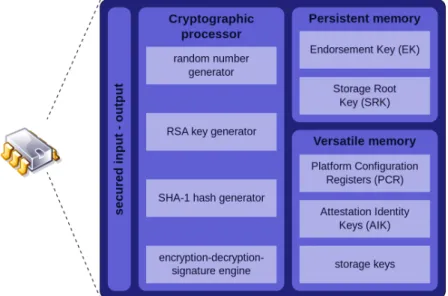
Figure 2.3 shows us the different components of a TPM: cryptographic processor,
persistent memory, and versatile memory. Persistent memory is used to store encryption keys, predetermined hashes, and other records that need to be maintained and untouch-able. Versatile memory is used to store information that keeps changing, e.g., those hashes calculated at boot authentication service, stored into internal registers - Platform Configuration Registers (PCRs).
Figure 2.3: Components of a Trusted Platform Module (taken from [7]).
A software attestation service allows to verify that the contents and interaction of some software, executed by trusted hardware, is as expected, i.e., TPM can verify the loading sequence of a program by producing a hash of the program’s code (before execution) and storing it in a PCR. The user has the expected PCR values and, when needed, can request attestation from the TPM by sending a nonce and required PCR values. Then the TPM produces signed attestation proof that the user can verify against the expected values. If they do not match, it means that something has changed in the code or the software behavior and it will abort all computations.
Encryption service is ensured by a secure co-processor (cryptographic processor) that can perform cryptographic operations (e.g., random number generation, key generation, hash generation, encryption, decryption and signing [Figure 2.3]). Every key is stored inside the TPM, which guarantees that they can not be stolen or exported to the outside
2 . 2 . H A R D WA R E - BAC K E D T R U S T E D C O M P U T I N G
and that data can only be unsealed (decrypted) on that machine.
As TPMs are capable of boot authentication and attestation of the software stack that runs on the TPM enabled machine, they can ensure that a TEE with processing, memory, and storage capabilities is secure.
2.2.2.2 Intel SGX
Intel Software Guard Extension (SGX) is a new set of instructions available on recent Intel CPUs. These instructions allow the programmer to define enclaves (IEEs) that are like containers where code is secured and can run with confidentiality and integrity guar-antees provided by the hardware. Those enclaves are physical memory regions isolated from the rest of the system, including the operating system and hypervisor.
A programmer that is designing an application under the SGX software model must know that there are two different components: an untrusted and a trusted one, the latter being the enclave. Whenever the untrusted part requests the creation of an enclave, the CPU allocates a region of the memory that is only accessible to that enclave. That region is completely inaccessible from any other application or component in that machine as memory is kept encrypted and it is only decrypted by the CPU when requested by the enclave. Those enclaves have a limitation of 128 MB of memory.
Intel SGX has some special instructions:
• ECALL: a call from an untrusted component or application into an enclave
• OCALL: a call from inside an enclave to an untrusted function
The second call is needed because ECALLs have no access to the exterior of the enclave, e.g., system libraries, networking, disk I/O and many more. Whenever OCALLs are performed the enclave is temporarily exited, the untrusted function is performed, and execution goes back to the enclave. These calls are defined through a specification file (Enclave Definition Language (EDL)) where it is clear what functions can be issued from trusted components (OCALLs) and untrusted components (ECALLs).
Processor Reserved Memory (PRM) is an isolated region of memory where all enclaves’ data structures, code, and data are and can not be accessed by other software [34]. It also contains the Enclave Protected Cache (EPC) where some protected memory pages can be assigned to enclaves. In Table2.2we present thirteen of the eighteen most relevant SGX’s instructions.
Data integrity checks, attestation, sealing, debugging, and initialization can be done with those enclave operations. For example, to create an enclave, we start by issuing EECREATE instruction, which allocates the needed EPC pages and initializes SGX’s en-clave data structures. Then, if we need to add pages to the enen-clave, we can call the EADD instruction. When everything is ready, we can call EINIT instruction to end the initializa-tion process and start the enclave. Afterward calls into an enclave funcinitializa-tion (ECALLs) are performed by the EENTER instruction, exiting enclave with EEXIT instruction.
C H A P T E R 2 . BAC KG R O U N D
Table 2.2: Subset of Intel SGX instructions (taken from [12,34])
Category Instruction Description
Initialization
EECREATE Declare an enclave, its size and initialize data structures
EADD Add a 4KB EPC page to the enclave EREMOVE Remove an EPC page from the enclave
EINIT Finalize the enclave initialization, enabling its execution
Entry and Exit
EENTER Enter an enclave via an ECALL EEXIT Exit the enclave
AEX Asynchronous enclave exit, saving the CPU state
ERESUME Resume enclave execution, restoring previous CPU state
Paging Management
EBLOCK Block an enclave page, prepare for eviction from protected memory
EWB Evict a page from protected memory
ELDB/U Reload an evicted page into protected memory
Enclave Security EREPORT
Produce a report with information about the en-clave and the hardware it is running on
EGETKEY Generate a unique key
As we have seen, memory inside PRM is limited, so it has a mechanism to swap pages from PRM to untrusted memory and back. Those mechanisms consist of "Entry and Exit"category of Table2.2: EBLOCK, EWB, and ELDB/U instructions. The first prepares an enclave page for eviction, i.e., blocking writes and encrypting the page. EWB evicts the page, now encrypted, from PRM to untrusted memory. Lastly, to reload a page, an ELDB/U call copies the evicted page content into the PRM, decrypts it and runs security checks. Evicted pages are stored with integrity proofs (MACs and version number) to guarantee it was not tampered and ensuring page’s version is the last one, thus preventing replaying-like attacks.
Local attestation(Figure2.4a):
1. Enclave B requests attestation to enclave A.
2. Enclave A produces a report (calling EREPORT instruction) containing its identity, attributes and information about the hardware it is running on. Then it calculates a MAC for that report using a symmetric key (owned by the CPU and given to the enclave by the EGETKEY instruction). Finally sends the report to B.
3. Enclave B can use the same symmetric key (local attestation, thus both enclaves share the CPU) to generate a report of A and calculate its MAC comparing with the
2 . 2 . H A R D WA R E - BAC K E D T R U S T E D C O M P U T I N G
a Local attestation
b Remote attestation (e.g. enclave running on the cloud)
Figure 2.4: Intel SGX mechanisms for local and remote attestations (taken from [2]).
one received. If they are running on the same machine, MACs should check, and B reciprocates the attestation process and sends it to A its report.
Remote attestation(Figure2.4b):
1. A challenger requests attestation to the untrusted application A.
2,3. Application A requests a report from its enclave, which creates it with the same information and the same way as in the local attestation. Sending it back to the application.
4. The application now sends the report to a special enclave (Quoting Enclave).
5. This special enclave signs the report with an EPID key (asymmetric key) producing aQuote and returning it to the application.
6. The application acts as an intermediary for communication and sends theQuote to
the challenger.
7. The remote user (challenger) must have a public key certificate of that EPID that he can use to verify theQuote from SGX.
As the enclave size is limited, it has another feature called data sealing, i.e., the enclave encrypts data (with all the security guarantees it provides) and then stores it outside the
C H A P T E R 2 . BAC KG R O U N D
enclave boundaries. This key (sealing key) is requested via the EGETKEY instruction and is unique to that enclave, meaning that no one else could ever use that key.
2.2.2.3 ARM TrustZone
ARM TrustZone is the security extension made to their System-on-Chip (SoC) that pro-vide a hardware-level isolation between two execution domains defined by ARM:Normal World and Secure World [4, 46]. As these domains are isolated they have independent memory addresses and privileges: from theNormal World it is impossible to access the Secure World, while programs running in Secure World can access Normal World.
Transitions between these two worlds are assured using the secure-monitor call (SMC) instruction (Figure 2.5) that saves all registers and protects sensitive memory before switching from one world to another. Both worlds exist in the same physical core, but they are seen as independent virtual cores. As in Intel SGX, ARM TrustZoneSecure World
provides a full IEE for untrusted applications.
Figure 2.5: ARM TrustZone architecture (taken from [12]).
This new CPU privileged mode supports SMC, called monitor mode, and can be compared to the SGX’s instructions EEXIT and AEX. Contrary to Intel’s SGX there is no programming model imposed by ARM, and there are a few ways to handle Secure World software stack. The simplest one is, like Intel’s enclaves, that applications running
fromNormal World that need to isolate some computations to make synchronous calls
into theSecure World returning to Normal World after completing them. Another, more
complex, way is to run the whole OS Kernel inside theSecure World relying on multiple
applications running in parallel inside it.
As Figure2.5shows, TrustZone’s architecture is divided into two virtual cores, one for each world, and several duplicated hardware modules to ensure physical isolation. Regarding memory management, there are two physical Memory Management Units (MMUs) that allow a completely independent memory mapping and management. On the other hand, cache shares the same physical housing, but an additional bit is indicating the security state (whether it is being used in a secure or normal world). TrustZone also has
2 . 2 . H A R D WA R E - BAC K E D T R U S T E D C O M P U T I N G
a separate bus to secure peripheral access, i.e., to I/O and network devices, guaranteeing that a secure peripheral can not be accessed from theNormal World.
ARM’s TrustZone is being more used and exploited in mobile devices than for cloud applications because it has been present in mobile architectures for over a decade, and it is providing trusted execution of applications and preventing mobile OS security breaches [21,46].
2.2.3 Discussion
These technologies are neither perfect nor bulletproof. TPM’s, for instance, can suffer from a few well-known attacks. One of them is called "software attack"and targets the attestation service, i.e., given an application already configured in the TPM adversaries, it can exploit the difference between the instant when an application is loaded and when it is used to introduce run time vulnerabilities. This attack is called Time Of Check to Time Of Use (TOCTUO), and a solution was proposed [14]: dynamically updating PCR values when the memory it measures is changed.
TPMs have some additional vulnerabilities that are worth mentioning. It is possible to conduct a passive attack where we analyze the unencrypted data bus between the TPM and the CPU [30], and an active attack which saves the record of the trusted boot process forces the reset of the TPM and utilize a previous trusted record in the malicious system. The last is called TPM reset attack [49].
As authenticated boot service attests to the integrity of the operating system, it means that no update can be done to that operating system after its initialization without reset-ting all boot attestation records. Also, cryptographic keys are heavily secured inside the TPM, but there is no solution to recover sealed documents if something happens to the TPM and those keys become inaccessible.
Intel SGX considers, aside from the CPU, both software and hardware to be untrusted, which eliminates many attacks from its threat model but it remains vulnerable to some attacks: privileged software and side-channel attacks. The first is related to the ability to support hyper-threading by the CPU, i.e., logical processors (LP) share the same physical processor and its resources. It means that a malicious system can execute code in a thread running on an enclave and execute, in another thread that shares the same physical pro-cessor, some snooping program that allows this thread to learn the instructions executed by the enclave and its memory access patterns.
Side-channel is another type of attack that SGX does not provide any protection. It is related to SGX’s handling mechanism and page faults that allow the malicious operating system to take full control of the enclave’s execution by stopping the program, unmapping the target’s memory pages and resuming execution [13]. There is already a Transaction Synchronization Extension (TSX) provided by Intel to mitigate this attack [48]. Intel SGX is also vulnerable to speculative execution like spectre and meltdown, and specific for SGX, foreshadow [54], where the processor predicts computations to achieve better
C H A P T E R 2 . BAC KG R O U N D
performance, but attackers can explore this and get enclave’s secrets.
ARM’s TrustZone is a more general notion to the programmer and can be configured to provide countermeasures for different threats. Regardless of those configurations it is vulnerable to an attack resulting from the unauthenticated access to resources in TrustZone, which makes the communication channel betweenSecure World and Normal World susceptible to anyone who has kernel privileges in the Normal World mode. This
specific attack is made by continuously sending requests with specific arguments to try to find vulnerabilities on the resources in TrustZone. Like this, a man-in-the-middle attack is also possible by exploring the communication channel. Some authors proposed the creation of a secure channel for cross-world communication [27].
TrustZone increases the broader utilization of an IEE and secure communication be-tween TrustZone’s components with the cost of programming complexity and the avail-ability of trusted firmware. With the inclusion of hardware other than CPU into Trust-Zone’s trust base, we are putting at risk every other component if a vulnerability is found in one of them. Contrary to what happens with SGX’s policy that is much more restrictive but offers a more secure trust base.
2.3
Dependable Cloud Storage
Cloud Storage is a cloud computing model in which data is stored on remote servers accessed from the internet. It is maintained, operated, and managed by a cloud storage provider. The benefits of using such storage are well known: high availability and reli-ability at a relatively low cost. The problem is that there are many security and privacy concerns as data stored on those cloud providers go out of our control which inevitably poses new security risks toward the correctness of our data in the cloud.
To address this new problem and further achieve secure and dependable cloud stor-age, we need to understand how existing solutions try to solve those concerns over the confidentiality and integrity of data.
2.3.1 Cryptographic Cloud Storage
Cryptographic Cloud Storage [29] tries to leverage the benefits of public cloud services while introducing both confidentiality and integrity, resulting in a virtual private storage service.
The architecture described is divided into four main components:
• Data Processor (DP) which is responsible for processing data before it is sent to the cloud, i.e., it creates metadata to that specific data, joins it with the original data and finally encrypts both data and metadata.
• Data Verifier (DV) which can be used at any moment and verifies the integrity of the data stored in the cloud.
2 . 3 . D E P E N DA B L E C L O U D S T O R AG E
• Token Generator (TG) which is responsible for the creation of temporary tokens that are related to the segment of customer data we want to retrieve from cloud.
• Credential Generator (CG) that implements an access control policy issuing creden-tials to other parties to be able to decrypt encrypted data.
If it is needed, DP can add a decrypt policy that only allows certain data to be de-crypted by an authorized party or team.
There are concerns related to public cloud services that can be avoided when using this kind of virtual private storage service as it is the client who controls data and has certain security properties (e.g., confidentiality). Those concerns can be:
• Regulatory compliance[41]: certain public cloud providers can be forced to deliver data to law enforcement agencies, which is not a problem as all data is encrypted.
• The same applies if the public cloud provider must follow certain rules against the data it stores and its geographical location [56]. As all data is encrypted, it is impossible to distinguish it.
• Clients must be notified and cooperate if data has to be analyzed (again, if law enforcement agencies force it, they need the client to decrypt data) [57].
• In a public provider it is nearly impossible to guarantee that data has been fully eliminated but, in this case, it is only needed to eliminate the key and then it is impossible to access that data again.
Whenever DP prepares data to sent to the cloud, it starts by indexing and encrypting it with a symmetric encryption scheme, like AES, with a unique key. Then it will encrypt again but with a searchable encryption scheme [9] and encrypt that unique key with an attribute-based encryption scheme [11]. At last, it encodes the encrypted data and indexes it in such a way that the DV can, at any moment, verify the data integrity with proof of storage scheme [5].
The searchable encryption scheme provides a way to encrypt a search index so that contents are hidden except to a party that has the appropriate tokens and can search without the need to decrypt the data. This technique has two important properties: first is that given a token for a keyword it can only retrieve pointers to the encrypted files that contain the keyword; second is that without a token the contents of the index are hidden.
An attribute-based encryption scheme allows associating a decrypt policy with the ciphertext. All decrypt keys existing in the system have a set of attributes, and so, it is only possible to decrypt specific files if the key used has some attributes that match the decryption policy of that file.
Proofs of storage protocols are executed by the client to request the server to prove that it did not tamper the files it is storing. They can be used an arbitrary number of
C H A P T E R 2 . BAC KG R O U N D
times and data resulting from that proof is extremely small and independent from the size of the data.
Whenever Alice wants to upload data to the cloud her DP attaches some metadata and encrypts data and metadata as previously explained (Figure2.6[1]). If Bob wants to access data from the cloud he has to ask Alice for permission to search for a keyword (Figure 2.6 [2]) and Alice’s token and credential generators send back a token for the keyword and a credential to Bob (Figure2.6[3]). Now Bob can send the token he received to the cloud (Figure 2.6[4]) and the cloud provider can use the token to find the right encrypted documents and return them to Bob (Figure2.6[5]). At any time Alice’s DV can be invoked and ascertain the integrity of the data (Figure2.6[?]).
Figure 2.6: Cryptographic Cloud Storage architecture (taken from [29]).
2.3.2 DepSky
DepSky [10] is a system that improves the availability, integrity and confidentiality [38] of information stored in the cloud through the encryption, encoding, and replication of data on several clouds that form a cloud-of-clouds.
There are four important limitations of using a single, commercial cloud computing for data storage:
• Loss of availability is an inevitable problem that a user or company can suffer when moving to cloud storage. DepSky solves this problem by replicating data and storing it on different cloud providers, thus the above name: cloud-of-clouds. All the data will be available if a subset of them are reachable [1].
• DepSky addresses loss and corruption of data by using Byzantine fault-tolerant replication protocols [32] for storing data on those different cloud providers, being possible to get the data correctly even if some of the clouds corrupt or lose data.
• Loss of privacy is another massive concern as the cloud provider has access to all the stored data, even if the provider is 100% trustworthy, it can be infected by
2 . 3 . D E P E N DA B L E C L O U D S T O R AG E
some malicious software that exposes everything we stored. One of the possibilities is to encrypt everything before storing it in the cloud, which involves protocols for key distribution as different distributed applications may need access. DepSky uses a secret sharing scheme [15] to ensure that all the data is stored after being encrypted and that it can be decrypted with one or a set of keys from that secret sharing scheme.
• As it uses several cloud providers, we will not be "locked-in"with a particular cloud provider. Also, as DepSky uses erasure codes [42] to store only a fraction (usually half) of the data in each cloud, it would only cost half to exchange from a cloud provider to another.
As pointed by the authors, DepSky would be very beneficial to services like critical data storage as the cloud-of-clouds would guarantee very high availability and integrity, besides, DepSky-CA protocol ensures the confidentiality of stored data. Those guarantees are some of the most important to build, e.g., a cryptographic cloud store.
To deal with the heterogeneity of using different clouds, DepSky assumes there is a generic Data Unit or container that contains metadata and files (real data). Metadata files contain a version number, a verification number and some information that may be application dependent. The files are named as "value-<version>".
Figure 2.7: DepSky architecture (taken from [10]).
The system proposed by DepSky (Figure2.7) models three parties: writers, readers, and cloud storage providers. All writers of a Data Unit have a shared private key used to sign some of the data written on the data unit, while readers of a Data Unit know the corresponding public key to verify these signatures.
C H A P T E R 2 . BAC KG R O U N D
Cloud storage providers only support five operations: list, get, create, put, and remove. DepSky assumes that it is a cloud provider’s job only to allow readers to invoke list and get operations (i.e., access control). As clouds can fail in a Byzantine way, DepSky requires a set of N=3F+1 storage clouds where at most F clouds can fail. Thus, we need any subset of N-F storage clouds to gather a quorum. DepSky has implemented a single-writer multi-reader register to overcome the problem of having multiple writers and the inability to verify different version numbers being written concurrently.
DepSky protocols always need at least two round-trips: to read or write from metadata and to read or write the actual files, having to acknowledge whenever one of those reads or writes are done correctly. It is also consistency-proportional, i.e., its consistency is as strong as the underlying clouds allow, from eventual [55] to regular consistency [31].
As pointed early, to ensure confidentiality, data is encrypted using symmetric cryp-tography with a secret sharing scheme for that symmetric key. In this case, the writer splits the symmetric key into N (number of clouds) different shares of that key and give one share to each of the clouds. The main advantage of this scheme is that at least F+1 <= N-F, which means that even if F shares are corrupted, the secret can never be disclosed. It also means that a client that is authorized to access data needs at least F+1 shares of the key to be able to rebuild it and decrypt the data.
DepSky also uses a protocol named informational-optimal erasure code to avoid the monetary costs of replicating all the data on every cloud provider, which would increase by a factor of N.
How does DepSky-A work? DepSky-A only ensures availability and integrity by repli-cating data on several clouds using specific quorum protocols. The idea is that whenever a write must occur, it writes the value on a quorum of clouds and then writes its cor-responding metadata to ensure that when a read operation is issued, it can only read metadata from data already existing on that cloud. If it is the first write of that Data Unit, the writer must first contact a quorum of clouds to obtain the metadata with the highest version number. Whenever a read is issued it starts by gathering metadata from a quorum of clouds and choosing the one with the highest version number, then it searches for a value file containing the value matching the digest on the metadata.
Availability is guaranteed because the read operation has to retrieve the value from only one of the clouds, which is always available because of (N-F)-F > 1. Integrity is also guaranteed because metadata contains a cryptographic hash being easily verifiable if data was corrupted or tampered.
As DepSky-A only ensures availability and integrity, so the authors also developed DepSky-CA (Figure2.8) that joins confidentiality to the previous protocol. The di ffer-ences between these two protocols are that whenever DepSky-CA requests a write, it encrypts the data, generates the key shares, divides information, and those key shares for each cloud. On reading requests, it is the reverse process: joins data and shares of the key, rebuild the key and decrypt data. As this protocol uses a key share scheme, it needs that at least F+1 clouds reply with their key share whenever a read request is made to read
2 . 3 . D E P E N DA B L E C L O U D S T O R AG E
the Data Unit’s current value properly.
Figure 2.8: DepSky-CA (taken from [10]).
2.3.3 CryptDB
CryptDB [40] ensures confidentiality for applications that use database management sys-tems (DBMS) by exploring its intermediate design point as middleware and by enabling the execution of SQL queries over encrypted data.
There are two threats solved by CryptDB:
1. A curious database administrator (DBA) who tries to learn private data;
2. An adversary who gains complete control of application and DBMS servers.
CryptDB acts like a proxy, where all the queries go through, and encrypts, decrypts and rewrite queries so they can be executed on encrypted data. Therefore, the DBMS server never receives decryption keys, and so DBAs could never see private data.
Regarding threat number two CryptDB divides SQL schema between different prin-cipals (users) whose keys allow decrypting different parts of the database. This process makes it impossible for attackers that compromise the whole system (application or proxy or DBMS) to be able to decrypt or read data from users that are not logged-in, without providing the same guarantees for those who are.
C H A P T E R 2 . BAC KG R O U N D
2.3.4 Cipherbase
Cipherbase [3] is a full-fledged SQL database system that achieves high performance on cloud computations nevertheless ensures confidentiality by storing and processing strongly encrypted data on specially designated secure nodes. Those nodes can be some secure co-processors (SCPs) available at the server-side, instead of creating some mid-dleware between client and server, to manage computations between a Trusted Machine (TM) and an Untrusted Machine (UM) that are side by side.
On the original paper, the authors leveraged a Field Programmable Gate Array (FPGA) and placed it inside the UM connected to the TM, to reproduce that fully-fledged database system.
Whenever Cipherbase receives a query plan, it sends the encrypted tuples from the UM to the TM where they are decrypted, processed, and re-encrypted before sending the results back from the TM to the UM.
Figure 2.10: Cipherbase architecture (taken from [3]).
2.3.5 Discussion
CryptDB and Cipherbase are compelling solutions that achieve high performance on encrypted computations, ensuring confidentiality. However, we are aiming at storage solutions that do not need to perform computations nor searches over encrypted data.
Cryptographic Cloud Storage is a solution that offers a virtual private storage service, i.e., providing the security of private clouds and the functionality and costs of public clouds. It means that all the perks of using a public cloud provider are maintained: availability, reliability, and data sharing, and also, there are confidentiality and integrity guarantees.
To ensure confidentiality, it encrypts data with symmetric encryption, encrypts it again with searchable symmetric encryption and finally encrypts the key with attribute-based encryption. Even though it is a highly confidential and secure storage solution, it introduces a considerable overhead in the system, and we do not need to search over encrypted data or to have a decrypt policy associated with the ciphertext stored.
DepSky puts in practice the notion of cloud-of-clouds: using multiple independent public cloud providers in the same storage system to increase availability. It uses byzan-tine fault-tolerant replication protocols on those different cloud providers to allow them to get data correctly even if there is some corrupted cloud or data. DepSky-CA protocol
2 . 3 . D E P E N DA B L E C L O U D S T O R AG E
ensures the confidentiality of stored data by encrypting data and divide encrypted data and symmetric key into N shares (being N the number of clouds in use). Then each cloud provider receives their share of the data and the key itself. As it uses quorum protocols, it means that when a read is issued, DepSky does not need to get data or key shares from every cloud, just from F+1 clouds (being F the number of faulty clouds) to be able to rebuild the key and decrypt data.
With the cloud-of-clouds concept, a new concern arises regarding consistency. DepSky offers a consistency-proportional solution where the system provides the client with the same level of consistency of the underlying clouds. Integrity guarantees are provided by metadata which is stored together with the data and contains a cryptographic hash that can be verified to guarantee that data has not been tampered with.
A critical aspect that could be raised is related to costs that this system can add to cloud storage. Therefore, DepSky employs erasure codes that allow storing only a fraction of the data in each cloud. It also optimized read and write quorums achieving an impressive increase cost of only 23% compared with the average cost of storing data on a single cloud (experimental evaluation performed by DepSky authors with four different clouds [29]). Despite all the advantages that each one of these solutions has, no solution has all the security guarantees with high availability required. Regarding security guarantees, the isolation and remote attestation required is only possible by using trusted hardware (IEE) that, apart from Cipherbase, none of the solutions use it. However, Cipherbase does not provide other necessary guarantees such as high availability given by the replication in multiple clouds.
C
h
a
p
t
e
r
3
Vi rt ua l H S M
In this chapter, we introduce our Virtual HSM that combines traditional cryptographic schemes and key generation with trusted hardware, particularly an Isolated Execution Environment (IEE) component. This component allows us to securely execute computa-tions on untrusted machines, like a Cloud environment, thus leveraging its advantages, such as high computational power and large persistent storage.
State-of-the-art Virtual HSMs usually find a trade-off between compromising some security guarantees, or even not having any security guarantees, (e.g., SoftHSM) to ensure a better performance, or choose to implement some security guarantees (e.g., pmHSM) incurring on a significant decrease of performance while not being as secure as a physical HSM should be. Using an IEE allows us to efficiently outsource computations to otherwise untrusted Cloud servers, while still preserving strong security guarantees.
This chapter is organized as following: firstly we introduce the system model, it’s architecture (Section 3.1) and the adversary model (Section 3.2), we go through every algorithm implemented (Section3.3), then we explain our API and how to use it (Section
3.4) and discuss the implementation details (Section 3.5). Finally we provide a secu-rity analysis about our solution (Section 3.6) and finish this chapter with conclusions regarding our Virtual HSM (Section3.7).
3.1
System Model and Architecture
In this chapter, we consider a system with a single client interacting with a single IEE-enabled cloud server. Inside of this cloud server, there are both trusted and untrusted components that, combined, are what we called our Virtual HSM:
• Client is a simple application where it creates the requests made by the end-user and pre-processes them so that they can be sent to Server.
![Table 2.1: Subset of PKCS#11 functions (taken and adapted from [24]).](https://thumb-eu.123doks.com/thumbv2/123dok_br/15902981.1091722/29.892.130.768.185.852/table-subset-pkcs-functions-taken-adapted.webp)
![Figure 2.1: Poor Man’s HSM architecture (taken from [16]).](https://thumb-eu.123doks.com/thumbv2/123dok_br/15902981.1091722/31.892.318.576.232.549/figure-poor-man-s-hsm-architecture-taken.webp)
![Table 2.2: Subset of Intel SGX instructions (taken from [12, 34]) Category Instruction Description](https://thumb-eu.123doks.com/thumbv2/123dok_br/15902981.1091722/36.892.141.755.184.639/table-subset-intel-instructions-taken-category-instruction-description.webp)
![Figure 2.4: Intel SGX mechanisms for local and remote attestations (taken from [2]).](https://thumb-eu.123doks.com/thumbv2/123dok_br/15902981.1091722/37.892.235.661.159.320/figure-intel-sgx-mechanisms-local-remote-attestations-taken.webp)
![Figure 2.5: ARM TrustZone architecture (taken from [12]).](https://thumb-eu.123doks.com/thumbv2/123dok_br/15902981.1091722/38.892.289.605.543.747/figure-arm-trustzone-architecture-taken-from.webp)
![Figure 2.6: Cryptographic Cloud Storage architecture (taken from [29]).](https://thumb-eu.123doks.com/thumbv2/123dok_br/15902981.1091722/42.892.232.652.424.661/figure-cryptographic-cloud-storage-architecture-taken.webp)
![Figure 2.7: DepSky architecture (taken from [10]).](https://thumb-eu.123doks.com/thumbv2/123dok_br/15902981.1091722/43.892.235.659.655.998/figure-depsky-architecture-taken-from.webp)
![Figure 2.8: DepSky-CA (taken from [10]).](https://thumb-eu.123doks.com/thumbv2/123dok_br/15902981.1091722/45.892.231.655.202.416/figure-depsky-ca-taken-from.webp)
![Figure 2.10: Cipherbase architecture (taken from [3]).](https://thumb-eu.123doks.com/thumbv2/123dok_br/15902981.1091722/46.892.137.761.491.618/figure-cipherbase-architecture-taken-from.webp)
