ISSN - 2182-8407
Sociedade Portuguesa de Psicologia da Saúde - SPPS - www.sp-ps.pt
DOI: http://dx.doi.org/10.15309/19psd200315
VALIDATION OF THE PARENTAL FEEDING STYLE QUESTIONNAIRE IN
A PORTUGUESE SAMPLE
Filipa Pimenta 2, Inês Queiroz Garcia2, Sofia Cristina1, Diana Galvão1, João Marôco2, & Isabel Leal2 1ISPA – Instituto Universitário, Lisboa, Portugal, [email protected], [email protected] 2William James Center for Research, ISPA – Instituto Universitário, Lisboa, Portugal, [email protected],
[email protected], [email protected], [email protected]
______________________________________________________________________
ABSTRACT: Portugal is among the European countries with higher rates of
overweight children, and parental feeding practices may affect children weight and
eating patterns. A community sample of 252 Portuguese parents was used to study the
psychometric properties of the Portuguese version of the Parental Feeding Style
Questionnaire. (i.e., structural, convergent and discriminant validity, external and
criterion validity, as well as reliability and sensitivity). Regarding construct validity, the
measurement model supported a five-factor structure (Emotional, Instrumental,
Encouragement, Permissiveness, and Control) with an acceptable fit; Item 24 was
excluded since it showed a very low factor weight and was not significantly associated
with its subscale (λ=0.274; p=0.065); also, this item’s explained variance was below the
recommended (r
2=0.018). Discriminant validity was verified in eight of the ten paired
factors. Only the emotional eating subscale had a good value of VME (convergent
validity; VME = .62). External validity was confirmed, as was internal consistency,
where four of the five subscales, with the exception of the emotional eating subscale,
had good Cronbach's alphas (.67 <α <.88). The Portuguese sample reported the
predominant use of permissiveness and control practices, similar to that reported by
previous studies. The Portuguese Parental Feeding Style Questionnaire appears valid
and reliable for assessing Portuguese parents feeding styles and can be used in further
studies. The existence of culturally adapted and validated instruments is fundamental for
an accurate understanding of parental practices, in order to develop strategies to manage
children’s dietary intake and prevent health-related problems, subsequent to overweight.
Keywords: feeding, parental practices, children, validation, Portuguese.
______________________________________________________________________
VALIDAÇÃO DO PARENTAL FEEDING STYLE QUESTIONNAIRE NUMA
AMOSTRA PORTUGUESA
RESUMO: Portugal é um dos países europeus com elevada prevalência de excesso de
peso infantil, com implicações na saúde e bem-estar das crianças. As práticas
alimentares parentais, como controlo, promoção/encorajamento, alimentação emocional
William James Center for Research, ISPA – Instituto Universitário, Rua Jardim do Tabaco, 34,
1149-041, Lisboa, Portugal. Tel.: (+351) 21 881 1700; Email: [email protected]e instrumental têm demonstrado influência no peso e nos padrões alimentares das
crianças. O objetivo deste estudo foi avaliar as propriedades psicométricas da versão
portuguesa do Parental Feeding Style Questionnaire. Uma amostra comunitária de 252
pais portugueses foi utilizada para estudar o constructo do instrumento (i.e., validade
estrutural, convergente e discriminante), validade externa e de critério, bem como
confiabilidade e sensibilidade. Os resultados suportam uma estrutura de 5 fatores
(Emocional, Instrumental, Encorajamento, Permissividade e Controlo); o item 24 foi
excluído (λ=0,274; p=0,065; r
2=0,018) e os itens do Controlo foram distribuídos em
duas subescalas. A validade discriminante foi verificada em oito dos dez pares de
fatores; apenas a subescala de alimentação emocional apresentou um bom valor de
VME (validade convergente; VME=0,62). A validade externa foi confirmada, assim
como a consistência interna, onde quatro das cinco subescalas, com exceção da
subescala de alimentação emocional, apresentaram bons alfas de Cronbach
(0,67<α<0,88). A amostra portuguesa reportou o uso predominante de práticas de
permissividade e controlo, similarmente ao reportado pelos estudos anteriores. O
Parental Feeding Style Questionnaire evidencia ser válido para avaliar os estilos
alimentares de pais portugueses semelhantes aos desta amostra. A existência de
instrumentos culturalmente adaptados e validados é indispensável para o
desenvolvimento de estratégias para gerir a ingestão alimentar das crianças e a
prevenção de problemas relacionados com a saúde.
Palavras-chave: alimentação, práticas parentais, crianças, validação, Português.
________________________________________________________________________
Recebido em 08 de Agosto de 2019/ Aceite em 31 de Agosto de 2019The Childhood Obesity Surveillance Initiative (COSI) has identified Portugal as one of the five
European countries with a higher prevalence of overweight and childhood obesity (Rito, Sousa,
Mendes, & Graça, 2017). Although throughout the four phases of the COSI there had been a
decrease in the prevalence of obesity, Portugal remained among the countries with the highest
estimates. In 2016, Portugal had a prevalence of overweight of 30.7%, less 7.2% than in 2008.
Likewise, the prevalence of obesity showed a decrease from 15.3% in 2008 to 11.7% in 2016 (Rito
et al., 2017). Additionally, Portugal is in second place regarding overweight’s prevalence among 11
years old, when compared with other countries of the WHO European Region (World Health
Organization, 2014).
Identifying the predictors of childhood obesity is crucial, not only because of their link with
obesity risk in subsequent years (Faienza, Wang, Frühbeck, Garruti, & Portincasa, 2016), but
mostly due to its negative effects during childhood and adolescence, such as type 2 diabetes
mellitus, hypertension, early puberty, menstrual irregularities and polycystic ovary syndrome,
steatohepatitis, sleep apnea, asthma, benign intracranial hypertension, musculoskeletal disorders,
and psychological problems (Gozal et al., 2017; Muc, Mota-Pinto, & Padez, 2016); adults with
obesity are also at risk of developing most of these conditions (Bassuk & Manson, 2017).
Obesity-inducing behaviours include the consumption of sugar-rich and energy-dense snacks
(Jebb, 2005), sugar-sweetened drinks (Vartanian, Schwartz, & Brownell, 2007); also, health-risk
behaviours such as skipping breakfast (Wijnhoven et al., 2015) and frequent takeaway meal
consumption (Donin et al., 2017) appear to be associated with unhealthy dietary intake and long
term consequences for obesity. On the contrary, fruit consumption (Lock, Pomerleau, Causer,
Altmann, & McKee, 2005) and daily breakfast consumption (Dubois, Girard, Potvin Kent, Farmer,
& Tatone-Tokuda, 2008) have been found to be associated with having a healthy body weight.
Several biological maternal-related factors (e.g., genetic, endocrine) are already identified as
being associated with obesity (Pan et al., 2019); however, contextual factors, such as family, seem
also to be determinant in childhood obesity (Kaufman & Karpati, 2007). The family has been
identified as the early and most fundamental context in which eating behaviours are established, by
selecting, modelling and giving directions on when, what and how much to eat (Arcan et al., 2007).
Parental feeding style has been associated with intergenerational transmission of obesity and
children’s eating behaviours (Ventura & Birch, 2008; Wardle, Sanderson, Guthrie, Rapoport, &
Plomin, 2002), including not only the exposure to food (quantity, quality, frequency), but also the
social context of the meals (e.g., eating while watching television) and reactions to children’s eating
behaviours (Daniels et al., 2009). More specifically, two areas of parenting have been considered:
parental styles (how parents interact with their children) and parental practices (behavioral
strategies that parents use to socialize their children) (Darling & Steinberg, 1993; Ventura & Birch,
2008).
Baumrind’s theory of parenting styles (Baumrind, 1971, 1989) considered three types of parental
control (authoritarian, authoritative, permissive) and was later extended by Maccoby and Martin
(1983) by establishing four parenting styles according to a two-dimensional framework: 1)
authoritarian – high demandingness and low responsiveness; 2) authoritative – high demandingness
and high responsiveness; 3) permissive – low demandingness and high responsiveness; and 4)
uninvolved – low demandingness
and low
responsiveness.
Parenting styles have been applied to the feeding subject, often considering an equivalent
typology of four feeding styles. Parental feeding practices refer to specific actions used to enable or
limit specific food consumption, being the most present in literature: pressure to eat – pressuring a
child to consume more healthy foods or increase overall food consumption (Birch et al., 2001); and
restriction – decreasing a child’s intake of unhealthy foods (Faith, Scanlon, Birch, Francis, &
Sherry, 2004). Other feeding practices are referred, namely, instrumental and emotional feeding –
using food as a reward or to help children in regulating emotions (Rodenburg, Kremers, Oenema, &
van de Mheen, 2014; Wardle et al., 2002); parental food modelling – children learning by
observation and vicarious reinforcement (Dickens & Ogden, 2014; Ventura & Birch, 2008);
monitoring – keeping track of a child's eating (Birch et al., 2001); and prompting/encouragement to
eat – which might derive from the parents’ keenness to get the child to eat carefully prepared food
or the belief that a heavier child is healthier (Wardle et al., 2002). Encouragement is also shown in a
positive form, as encouraging specifically eating healthy foods (Cullen et al., 2001) and providing
appropriate guidance (Grolnick & Pomerantz, 2009).
Several authors associate parenting styles and parental feeding practices (Hubbs-Tait, Kennedy,
Page, Topham, & Harrist, 2008; Hughes, Power, Fisher, Mueller, & Nicklas, 2005; Vereecken,
Rovner, & Maes, 2010) with children’s both negative and positive health-related outcomes (such as
body weight, eating patterns or self-control).
Controlling feeding styles, such as restriction and pressure to eat, have been related to several
negative outcomes: increase in the preference for forbidden foods (Jansen, Mulkens, & Jansen,
2007), higher consumption of unhealthy food (Vereecken, Legiest, De Bourdeaudhuij, & Maes,
2009), decrease in children’s ability to respond to their internal cues of hunger (Ventura & Birch,
2008) and satiety (Carper, Fisher, & Birch, 2000), eating in response to emotions such as boredom
or sadness (Carper et al., 2000), loss of control over eating (Neumark-Sztainer, Wall, Haines, Story,
& Eisenberg, 2007) and overweight (Hurley, Cross, & Hughes, 2011). A lower child consumption
of fruit (Gregory, Paxton, & Brozovic, 2011) and vegetables (Fisher, Mitchell, Smiciklas-Wright, &
Birch, 2002) has also been observed as associated with pressure to eat; it is suggested that this is a
consequence of the children’s perception of being forced to consume certain foods (e.g., soup),
developing a “cognitive aversion” for those foods by associating them with the negative feeding
experience and consuming them less (Galloway, Fiorito, Francis, & Birch, 2006).
Feeding practices based on the use of food for reward had a positive association with
energy-dense snack intake (Rodenburg et al., 2014). Benton (2004) suggested that instrumental feeding
could reinforce the preference for the reward, frequently, a high-calorie food. Emotional feeding
was positively associated with weight status and obesogenic eating behaviours, as it encourages
children to eat in the absence of hunger (Sleddens, Kremers, De Vries, & Thijs, 2010). Vereecken et
al. (2009) showed that parental encouragement through negotiation had a positive impact on dietary
habits among sixth graders, and maternal encouragement promoted the intake of varied and healthy
foods, which was found to be related to lower child body mass index (BMI) (Musher-Eizenman, de
Lauzon-Guillain, Holub, Leporc, & Charles, 2009).
Given the increase in childhood overweight and obesity, and considering the impact that parental
feeding behaviours might have on children’s former development, several measures have been
developed to assess parental styles and practices. The development of culturally appropriate
instruments to identify factors that may be related to childhood overweight is essential to
understand the mechanisms involved in such process and establish adequate prevention and
intervention measures for children’s eating problems and overweight. Thus, the purpose of this
study is to validate a Portuguese version of the Parental Feeding Style Questionnaire.
METHODS
Participants
The present community sample was collected mainly through schools in Lisbon (Portugal).
Inclusion criteria were having at least one child aged between 2 and 18 years. In total, 252 parents
filled in all measuring instruments. Participants’ characteristics are shown in Table 1.
Table 1. Characterisation of the Participants. Mean (SD) n (%) Age 37.7 (6.31) — Sex Female — 224 (88.9) Male — 28 (11.1) Parity 1 or 2 children — 231 (91.7)
More than 2 children — 21 (8.3)
Relationship status
With an affective-sexual relationship — 229 (90.9)
Without an affective-sexual relationship — 23 (9.1)
Education level Primary school — 4 (1.6) Middle school — 39 (15.5) High school — 50 (19.8) College degree — 159 (63.1) Professional status Active — 224 (88.9) Inactive — 25 (9.9) Other — 3 (1.2) Parent’s BMI Below normal — 4 (1.6) Normal weight — 139 (55.2) Overweight — 71 (28.2) Obesity — 38 (15.1) Recent disease Yes — 29 (11.5) No — 223 (88.5)
Recent psychological problem
Yes — 17 (6.7)
No — 235 (93.3)
BMI, body mass index; SD, standard deviation.
Material
Sociodemographic Questionnaire. A questionnaire was applied to collect self-reported
socio-demographic (e.g., sex, age, schooling), health status (e.g., the presence of a disease) and weight
status.
Parental Feeding Style Questionnaire (PFSQ). PFSQ was originally developed in the United
Kingdom by Wardle et al. (2002). The questionnaire consists of 27 items organized into four scales,
including
emotional
feeding
(five
items),
instrumental
feeding
(four
items),
prompting/encouragement to eat (eight items), and control over eating (ten items). Five items in
control over eating are reversed. It is answered on a 5-point rating scale ranging from 1 (never) to 5
(always), meaning that a higher score corresponds to a higher tendency for the adoption of a
specific style. Evidence supporting the reliability and validity of this instrument has been previously
reported in Turkey, China, and Russia (Özçetin, Yilmaz, Erkorkmaz, & Esmeray, 2010; Surkov,
Pavlovskaya, Caroli, & Kaganov, 2012; Tam, Keung, Lee, Lo, & Cheung, 2014).
Generalized Expectations of Control Scale (GECS). GECS was developed by Palenzuela,
Gerardo, Barros, and Almeida (1997) and adapted to the Portuguese language by Silva (2010). This
20-item four-factor instrument [self-efficacy/expectancy for success (eight items), luck (four items),
contingency (four items), and non-contingency (four items)] is answered using a Likert-type scale
ranging from 1 (totally disagree) to 9 (totally agree). Previous findings support the validity and
reliability of the GECS (Silva, 2010).
Dutch Eating Behavior Questionnaire (DEBQ). DEBQ was originally developed by Van Strien,
Frijters, Bergers, and Defares (1986) and adapted to Portuguese by Viana and Sinde (2003). It
comprises 33 items, answered on a 5-point rating scale ranging from 1 (never) to 5 (very
frequently), and organized in three subscales: restrain (10 items), emotional eating (10 items), and
external eating (13 items). Evidence supporting the reliability and validity of this instrument has
been previously reported (Viana & Sinde, 2003).
Translation of the Parental Feeding Style Questionnaire (PFSQ)
In order to achieve semantic and conceptual similarity between the Portuguese and the original
English version of the PFSQ, a translation and back translation were done independently by two
bilingual health professionals. During the process, replication of the original sentences’ structure
and meaning, and sensitivity to cultural adjustment were also considered in the process (Behlin &
Law, 2000). At last, there was no need to make any language adjustments, so the items of the
Portuguese version of the PFSQ remained the same as the ones in the English version (cf.
Appendix).
Procedure
Several schools in the area of Lisbon were contacted, and permission to distribute the
questionnaire to parents, teachers and school staff was acquired. Permission to use the Portuguese
version of the DEBQ was obtained (license agreement ref: 14b1422jr). After confirming the
inclusion criteria, written informed consent was obtained, and the questionnaires were distributed to
the participants. This research followed the standards of the Portuguese Psychologist Association
(2011) and the American Psychological Association (2003) regarding the ethical treatment of
participants, and ethical validation of the project was given by the Health Group Coordination of the
William James Center for Research.
Data analysis
Missing values were imputed for variables where its frequency was lower than 10% of the
sample. This was done using the mean interpolation method.
The construct validity of the PFSQ was asserted by confirmatory factor analysis, convergent and
discriminant validity. The goodness of fit of the measurement model was given by chi-square
statistics (χ
2/df), comparative fit index (CFI), goodness of fit index (GFI), root mean square error of
approximation (RMSEA), and standardized root mean square residual (SRMR). Reference values
indicative of good model fit were those currently applied in structural equation modeling (Byrne,
2016; Hu & Bentler, 1995; Schermelleh-Engel, Moosbrugger, & Müller, 2003).
Convergent validity was analysed through the average variance extracted (AVE), considering
adequate if AVE was higher than .5 (Hair, Black, Babin, & Anderson, 2009). The discriminant
validity was explored comparing the inter-factors’ squared correlation with the AVE of each factor.
To demonstrate the factors’ discriminant validity, the squared correlation between factors should be
smaller than the individual factors’ AVE (Marôco, 2014).
In addition, to demonstrate the stability of the original structure of the instrument and assert
external validity of the measurement model, initial confirmatory factor analysis was carried out in
50% of the sample, randomly selected, and the factor weights and correlations stability were
confirmed in the remaining 50% of the sample through a multi-group analysis of invariance CFA
(Marôco, 2014).
Criterion validity was explored through concurrent-oriented validity of scales, using Pearson’s
correlation with similar constructs (Cohen, 1988).
Cronbach’s alpha and composite reliability (CR) were also computed, values higher .6 and .7
were considered acceptable and good, respectively (P. Kline, 2000).
Sensitivity was explored through the analysis of minimum and maximum values, skewness, and
kurtosis. Values are expected to range through the overall Likert-type scales (from the minimum to
the maximum scores) and skewness and kurtosis are expected to have absolute values below three
and seven respectively (R. B. Kline, 2015; Marôco, 2014).
Finally, to explore whether there are significant differences between parents with normal weight,
overweight, and obesity (excluding the parents with a weight below normal, given that this group
was very small: n=4), regarding the five parental feeding styles, a one-way analysis of variance
(ANOVA) was applied.
Levene’s test was used to assess the homogeneity of variances. In the case
of heterogeneity of variances, Games-Howell post-hoc test was applied for multiple comparisons.
All statistical analysis was performed using software IBM SPSS Statistics and SPSS AMOS (v.
25, IBM Corp., Armonk, NY).
RESULTS
Construct validity
Confirmatory factor analysis. A baseline model was tested with the PFSQ-27 individual items.
Based on the analysis of the statistical significance of parameter and of the standardized regression
weight, item 24 (“I insist my child eats meals at the table”) showed a very low standardized factor
weight and was not significantly associated with its subscale (λ=.274; p=.07); also, the value of the
squared multiple correlations was below the recommended .250 (r
2=.018). In addition, this item
displayed an absolute kurtosis above the recommended values (i.e., 7; |ku|=8.50). Therefore, item 24
was excluded.
The modification indices pointed to a correlation of the errors between the items 17-20, 26,
5-17, 17-26, 4-27, and 10-12. After inserting the correlations, the fitness of the four-factor model
proved to be acceptable (χ
2/df=1.845; CFI=.883; GFI=.862; RMSEA=.058; p<.001; C.I.
90%=].050; .066[; SRMR=.087). Figure 1 presents the standardized factorial weights and individual
items reliability.
Figure 1. Baseline model for the confirmatory factor analysis.
The model without item 24 presents a good fit, and most factorial weights are adequate.
However, subscale Control points to four items (5, 17, 20 and 26) with very low factorial weights.
A second model was tested, dividing the subscale Control into two distinct constructs. Indeed, a
better model fit for the five-factor model was achieved (χ
2/df=1.536; CFI=.926; GFI=.884;
RMSEA=.046; p<.001; C.I. 90%=].037; .055[; SRMR=.061). The standardized factorial weights
and individual items’ reliability for the PFSQ are presented in Figure 2.
Figure 2. Final model for the confirmatory factor analysis.
Convergent validity. Convergent validity for PFSQ was assessed through AVE. Only emotional
feeding subscale presented a good AVE score. The AVE for encouragement, instrumental feeding,
permissiveness, control, and emotional feeding were .28, .35, .42, .43, and .62, respectively.
Discriminant validity. Discriminant validity for PFSQ subscales is listed in Table 2. Of the ten
paired-factors possible comparisons, only eight presented discriminant validity.
Table 2. PFSQ Factors’ Discriminant Validity (N=252).
Association between different factors Squared correlations Discriminant validity
Emotional feeding ↔ Instrumental feeding .589 No
Emotional feeding ↔ Encouragement .009 Yes
Emotional feeding ↔ Permissiveness .078 Yes
Emotional feeding ↔ Control .021 Yes
Instrumental feeding ↔ Encouragement .005 Yes
Instrumental feeding ↔ Permissiveness .04 Yes
Instrumental feeding ↔ Control .018 Yes
Permissiveness ↔ Encouragement .001 Yes
Permissiveness ↔ Control .042 Yes
Control ↔ Encouragement .294 No
External validity
The model presents a good fit (χ
2/df=1.386; CFI=.900; GFI=.810; RMSEA=.039; p=.99; C.I.
90%=].032; .046[) in both groups (test group versus validation sample, obtained by random
splitting the total sample in two).
The constrained measurement model with factorial weights (l), intercepts (i), and fixed
variances/covariances (cov) in both groups did not present a significantly worse adjustment than the
unconstrained measurement model (∆χ
2λ(21)=30.475, p=.08; ∆χ
2i(26)=30.203, p=.26;
∆χ
2cov(15)=24.281, p=.06). Therefore, the external validity of the measurement model was
confirmed through a strong invariance of the model across groups. Hence, there weren’t significant
differences in the factorial measurement weights between the two groups and the stability of the
parental feeding’s construct, as measured by the PFSQ, was confirmed.
Criterion validity
Criterion validity was explored through concurrent-oriented validity of scales, using Pearson’s
correlation with similar/divergent constructs. With that purpose, the Portuguese adaptation of the
GECS (entailing four scales: luck, self-efficacy/expectancy for success, contingency,
non-contingency) and the DEBQ (measuring emotional, external eating and restrain) were used.
Emotional and instrumental feeding showed positive weakly significant correlations with GECS
luck and non-contingency, and DEBQ external eating (.18<r<.27); and negative weakly significant
correlations with GECS self-efficacy/expectancy for success and contingency (-.15<r<-.27). Only
emotional feeding revealed a positive weakly significative correlation with DEBQ emotional eating
(r=.20). Encouragement showed positive weakly significant correlations (.21<r<.25) with GECS
self-efficacy/expectancy for success and contingency; and, negative weakly correlation with GECS
non-contingency (r=-.13). Permissiveness showed negative weakly significant correlations
(.19<r<.25) with GECS luck and non-contingency, and with DEBQ emotional and external eating.
Control revealed a positive weakly significant correlation with GECS contingency (r=.15), and
negative weakly associated with GECS non-contingency (r=-.14).
Reliability: internal consistency and composite reliability
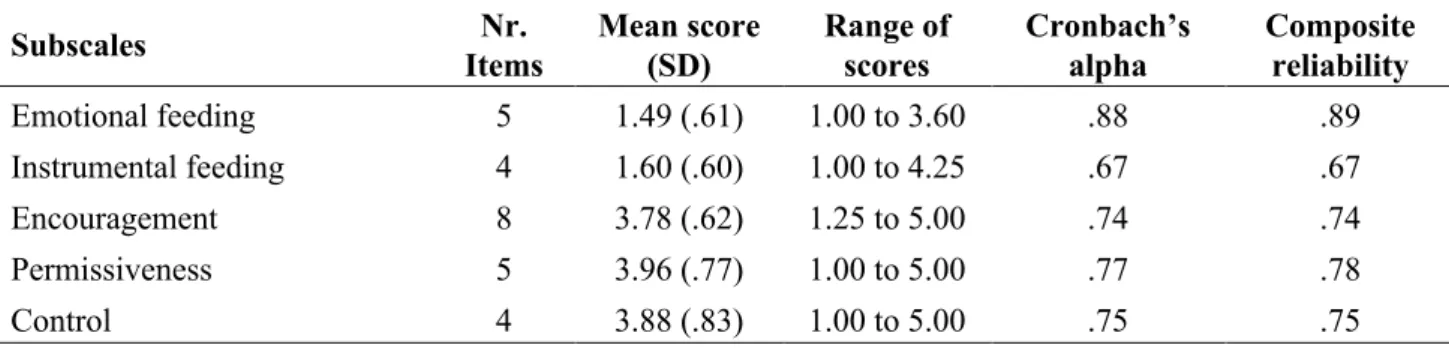
The internal consistency and CR for the PFSQ subscales were also explored. As shown in Table
3, all the subscales evidenced acceptable to good reliability (.67<α<.88, and .67<CR<.89).
Table 3. Descriptive Statistics and Reliability Analysis for PFSQ (N=252). Subscales Nr. Items Mean score (SD) Range of scores Cronbach’s alpha Composite reliability Emotional feeding 5 1.49 (.61) 1.00 to 3.60 .88 .89 Instrumental feeding 4 1.60 (.60) 1.00 to 4.25 .67 .67 Encouragement 8 3.78 (.62) 1.25 to 5.00 .74 .74 Permissiveness 5 3.96 (.77) 1.00 to 5.00 .77 .78 Control 4 3.88 (.83) 1.00 to 5.00 .75 .75 SD, standard deviation.
Distributional properties
To address eventual problems with the items’ responses distributions, the range of the five-point
Likert-type scale was explored, as well as skewness and kurtosis values of the PFSQ individual
items. Except for item 24 (which showed an unacceptable kurtosis), all items presented acceptable
skewness (-2.85<Sk<2.37) and kurtosis (-.91<Ku<6.71) values; with answers ranging from one to
five. These results attest no distributional properties problems that would recommend against
further factor analysis with maximum likelihood estimation.
Parent’s BMI classes and parental feeding styles differences
An ANOVA was conducted to explore the impact of the parents’ BMI classes on parental
feeding styles as measured by the PFSQ. There were no differences between parents with normal
weight, overweight, and obesity concerning, emotional feeding, instrumental feeding,
encouragement, and control. Nonetheless, there was a statistically significant difference at the
p<.001 level in permissiveness subscale for the parents’ BMI classes: F(2, 83)=12.31, p<.001.
Despite reaching statistical significance, the actual difference in mean scores between groups was
medium. The effect size, calculated using eta squared, was .13. Post-hoc comparisons using the
Games-Howell test indicated that parents with normal weight (M=4.15, SD=.58) manifested a
significantly higher permissiveness when compared with their counterparts with overweight
[M=3.83, SD=.75; d=.50 (medium effect size)] and obesity [M=3.40, SD=1.06; d=1.07 (large effect
size)].
DISCUSSION
Parental feeding practices have been an issue of interest that has increased in recent years due to
their potential to affect food consumption behaviors, child obesity (Birch et al., 2001), and food
preferences (Northstone & Emmett, 2008; Unusan, 2006). Enhancing scientific insight into these
problems and the use of valid and reliable measures seems necessary given the high prevalence of
disturbed eating, since early ages and continuing through adolescence (Matton, Goossens, Braet, &
Van Durme, 2013).
A systematic review carried out by Vaughn, Tabak, Bryant, and Ward (2013) identified 71
instruments assessing parental feeding practices, including the PFSQ, and concluded about the
substantial variation in the items across different scales and constructs, making a comparison
between instruments demanding, and suggesting the development and validation of instruments.
The present study had the purpose of validating the PFSQ to Portuguese. In this sample,
participants appeared to practice more frequently permissiveness, control, and encouragement, with
less frequent instrumental and emotional feeding. This was similar to the original study (Wardle et
al., 2002) whose mothers reported higher levels of control and prompting and lower levels of
instrumental and emotional feeding.
These results have also been confirmed in a Chinese sample (Tam et al., 2014), where the most
reported feeding practice was control over eating – two-factor structure, followed by
prompting/encouragement, instrumental feeding, and emotional feeding. In the Turkish sample
(Özçetin et al., 2010), the preferred feeding practices were encouragement and restrictive control –
considering a two-factor structure, followed by emotional, permissive control and instrumental.
Despite the existence of Russian validation of the questionnaire (Surkov et al., 2012), it has not
been possible to access it to compare validation results.
Similarly, from previous validation of the PFSQ (Özçetin et al., 2010; Tam et al., 2014), in this
study, the control subscale was confirmed as a two-factor construct. However, item 24 was not
associated with this construct and was removed, improving the fit of the acceptable measurement
model. The low factor regression weight for Item 3 suggest the need to review the formulation of
the item in the Portuguese version of the PFSQ.
Instrumental and emotional feeding practices share the concept of reward; probably due to their
proximity, the two subscales showed no discriminant validity. External and criterion validity were
confirmed. Concerning convergent validity, only emotional feeding presented a good AVE score,
indicating that the questionnaire assesses five close constructs, however, not associated enough to
compose a second order (broader) factor.
To correct the correlations between the items’ errors (assessed through modification indices -
Lagrange Multipliers), six correlations were assumed to improve the model fit. Correlated errors
between the items 17-20 (“I decide when it is time for my child to have a snack”; “I decide the
times when my child eats his/her meals”), 5-26 (“I decide how many snacks my child should have”;
“I decide what my child eats between meals”), 5-17 (“I decide how many snacks my child should
have”; “I decide when it is time for my child to have a snack”), and 17-26 (“I decide when it is time
for my child to have a snack”; “I decide what my child eats between meals”), from the control over
eating subscale; and items 4-27 (“I praise my child if s/he eats what I give him/her; “I praise my
child if s/he eats a new food”) and 10-12 (“I encourage my child to taste each of the foods I serve at
mealtimes”; “I encourage my child to try foods that s/he hasn’t tasted before”) from prompting and
encouragement to eat subscale were inserted, improving the measurement model fit. These assume
correlations represent that each pair shares an underlying communality. For example, the first pair
refers to a restrictive control regarding snacks; the fourth pair involves prompting through praising.
In what refers to reliability, except for the instrumental feeding subscale (α=.67), all the other
subscales presented a good Cronbach’s alpha, ranging from .74 (encouragement) to .88 (emotional
feeding), supporting the instrument’s reliability. The original study obtained a Cronbach’s alpha
ranging from .67 (instrumental) to .83 (emotional), while in validation studies the following were
obtained: Tam et al. (2014) – from .63 (control over eating and instrumental feeding) to .83
(prompting/encouragement); Özçetin et al. (2010) – from .54 (permissive control) to .74
(encouragement).
This study, as Wardle et al. (2002) found that normal-weight parents didn’t differ from their
counterparts with obesity in terms of control, encouragement, emotional and instrumental practices;
however, they did regarding permissiveness, which might suggest the importance of overlooking
the relation between low parental control and children’s eating and weight-related outcomes.
Some limitations should be accounted concerning the present findings, particularly the fact that
this research had a cross-sectional design, and uses a convenience sample, where 63.1% of the
sample has a college degree, limiting the generalization of the results. The sample size used for the
structural equation modelling corresponded to a rule of thumb of nearly ten participants per
manifest variable found adequate for this type of statistical analysis (R. B. Kline, 2015).
Our study addresses the insufficiency of validated instruments in this domain, considering the
Portuguese reality. Moreover, it is important to note that Portugal is among the European countries
with a higher prevalence of overweight children, calling attention to the pertinence of reliable
assessment and ground-based intervention with children and their parents.
In conclusion, the inconsistent findings in the literature and the limited number of longitudinal
studies about feeding styles/practices and weight and health-related outcomes have highlighted the
need for additional research in this area. Although multiple studies have found associations between
parental feeding behaviors and children’s weight (Birch & Fisher, 2000; Golan & Crow, 2004), the
literature is not consensual and some authors (Ventura & Birch, 2008) state that other mechanisms
may be present in the relationship between parental feeding behaviors and children’s weight,
specifically children’s eating behaviors and the family contexts of feeding behaviors. The PFSQ
appears as a potentially valid and reliable measure to include in further research; however, results
should be interpreted in light of study limitations.
Implications for Research and Practice
The objective of this study was to validate a Portuguese version of the Parental Feeding Style
Questionnaire in Portuguese parents. This validated instrument enables the evaluation of a variable
that can predict eating and weight disorders and has the potential to precociously detect
dysfunctional parental practices. Also, the validation of this widely used instrument to a specific
culture allows the comparison of results among different cultural contexts.
FINANCIAL SUPPORT
This work was supported by a research grant of FCT – Portuguese Foundation for Science and
Technology (grant SFRH/BPD/77799/2011). William James Center for Research, ISPA - Instituto
Universitário, is funded by FCT (grant UID/PSI/04810/2019).
ETHICS OF HUMAN SUBJECT PARTICIPATION.
This study was conducted according to the guidelines laid down in the Declaration of Helsinki.
REFERENCES
American Psychological Association. (2003). Ethical principles of psychologists and code of
conduct. Washington: APA.
Arcan, C., Neumark-Sztainer, D., Hannan, P., van den Berg, P., Story, M., & Larson, N. (2007).
Parental eating behaviours, home food environment and adolescent intakes of fruits, vegetables
and dairy foods: longitudinal findings from Project EAT. Public Health Nutrition, 10(11), 1257–
1265. doi:10.1017/s1368980007687151
Bassuk, S. S., & Manson, J. E. (2017). Obesity/overweight: health consequences. International
Encyclopedia of Public Health, 277–294. doi:10.1016/b978-0-12-803678-5.00308-8
Baumrind, D. (1971). Current patterns of parental authority. Developmental Psychology, 4(2), 1–
103. doi:10.1037/h0030372
Baumrind, D. (1989). Rearing competent children. In W. Damon (Ed.), Child development today
and tomorrow (pp. 349–378). San Francisco, CA: Jossey-Bass Publishers.
Behlin, O., & Law, K. S. (2000). Translating questionnaires and other research instruments:
problems and solutions. London, UK: Sage Publications.
Benton, D. (2004). Role of parents in the determination of the food preferences of children and the
development
of
obesity.
International
Journal
of
Obesity,
28(7),
858–869.
doi:10.1038/sj.ijo.0802532
Birch, L. L., & Fisher, J. O. (2000). Mothers' child-feeding practices influence daughters' eating and
weight. American Journal of Clinical Nutrition, 71(5), 1054–1061. doi:10.1093/ajcn/71.5.1054
Birch, L. L., Fisher, J. O., Grimm-Thomas, K., Markey, C. N., Sawyer, R., & Johnson, S. L. (2001).
Confirmatory factor analysis of the Child Feeding Questionnaire: a measure of parental attitudes,
beliefs and practices about child feeding and obesity proneness. Appetite, 36(3), 201–210.
doi:10.1006/appe.2001.0398
Byrne, B. M. (2016). Structural equation modeling with Amos: basic concepts, applications, and
programming (3rd ed.). New York, NY: Routledge.
Carper, J. L., Fisher, J. O., & Birch, L. L. (2000). Young girls' emerging dietary restraint and
disinhibition are related to parental control in child feeding. Appetite, 35(2), 121–129.
doi:10.1006/appe.2000.0343
Cohen, J. (1988). Statistical power analysis for the behavioral sciences (2nd ed.). Hillsdale, NJ:
Lawrence Erlbaum Associates.
Cullen, K. W., Baranowski, T., Rittenberry, L., Cosart, C., Hebert, D., & de Moor, C. (2001).
Child-reported family and peer influences on fruit, juice and vegetable consumption: reliability
and validity of measures. Health Education Research, 16(2), 187–200. doi:10.1093/her/16.2.187
Daniels, L. A., Magarey, A., Battistutta, D., Nicholson, J. M., Farrell, A., Davidson, G., &
Cleghorn, G. (2009). The NOURISH randomised control trial: positive feeding practices and
food preferences in early childhood - a primary prevention program for childhood obesity. BMC
Public Health, 9(1), 387. doi:10.1186/1471-2458-9-387
Darling, N., & Steinberg, L. (1993). Parenting style as context: an integrative model. Psychological
Bulletin, 113(3), 487–496. doi:10.1037/0033-2909.113.3.487
Dickens, E., & Ogden, J. (2014). The role of parental control and modelling in predicting a child's
diet and relationship with food after they leave home. A prospective study. Appetite, 76, 23–29.
doi:10.1016/j.appet.2014.01.013
Donin, A. S., Nightingale, C. M., Owen, C. G., Rudnicka, A. R., Cook, D. G., & Whincup, P. H.
(2017). Takeaway meal consumption and risk markers for coronary heart disease, type 2 diabetes
and obesity in children aged 9-10 years: a cross-sectional study. Archives of Disease in
Childhood, 103(5), 431–436. doi:10.1136/archdischild-2017-312981
Dubois, L., Girard, M., Potvin Kent, M., Farmer, A., & Tatone-Tokuda, F. (2008). Breakfast
skipping is associated with differences in meal patterns, macronutrient intakes and overweight
among
pre-school
children.
Public
Health
Nutrition,
12(1),
19–28.
doi:10.1017/s1368980008001894
Faienza, M. F., Wang, D. Q., Frühbeck, G., Garruti, G., & Portincasa, P. (2016). The dangerous link
between childhood and adulthood predictors of obesity and metabolic syndrome. Internal and
Emergency Medicine, 11(2), 175–182. doi:10.1007/s11739-015-1382-6
Faith, M. S., Scanlon, K. S., Birch, L. L., Francis, L. A., & Sherry, B. (2004). Parent-child feeding
strategies and their relationships to child eating and weight status. Obesity Research, 12(11),
1711–1722. doi:10.1038/oby.2004.212
Fisher, J. O., Mitchell, D. C., Smiciklas-Wright, H., & Birch, L. L. (2002). Parental influences on
young girls' fruit and vegetable, micronutrient, and fat intakes. Journal of the American Dietetic
Association, 102(1), 58–64. doi:10.1016/s0002-8223(02)90017-9
Galloway, A. T., Fiorito, L. M., Francis, L. A., & Birch, L. L. (2006). 'Finish your soup':
counterproductive effects of pressuring children to eat on intake and affect. Appetite, 46(3), 318–
323. doi:10.1016/j.appet.2006.01.019
Golan, M., & Crow, S. (2004). Targeting parents exclusively in the treatment of childhood obesity:
long-term results. Obesity Research, 12(2), 357–361. doi:10.1038/oby.2004.45
Gozal, D., Khalyfa, A., Qiao, Z., Smith, D. L., Philby, M. F., Koren, D., & Kheirandish-Gozal, L.
(2017). Angiopoietin-2 and soluble Tie-2 receptor plasma levels in children with obstructive
sleep apnea and obesity. Obesity, 25(6), 1083–1090. doi:10.1002/oby.21859
Gregory, J. E., Paxton, S. J., & Brozovic, A. M. (2011). Maternal feeding practices predict fruit and
vegetable consumption in young children. Results of a 12-month longitudinal study. Appetite,
57(1), 167–172. doi:10.1016/j.appet.2011.04.012
Grolnick, W. S., & Pomerantz, E. M. (2009). Issues and challenges in studying parental control:
toward a new conceptualization. Child Development Perspectives, 3(3), 165–170.
doi:10.1111/j.1750-8606.2009.00099.x
Hair, J. F., Black, W. C., Babin, B. J., & Anderson, R. E. (2009). Multivariate data analysis (7th
ed.). Upper Saddle River, NJ: Prentice Hall.
Hu, L., & Bentler, P. M. (1995). Evaluating model fit. In R. H. Hoyle (Ed.), Structural equation
modeling: concepts, issues, and applications (1st ed.). London: Sage Publications, Inc.
Hubbs-Tait, L., Kennedy, T. S., Page, M. C., Topham, G. L., & Harrist, A. W. (2008). Parental
feeding practices predict authoritative, authoritarian, and permissive parenting styles. Journal of
the American Dietetic Association, 108(7), 1154–1161. doi:10.1016/j.jada.2008.04.008
Hughes, S. O., Power, T. G., Fisher, J. O., Mueller, S., & Nicklas, T. A. (2005). Revisiting a
neglected construct: parenting styles in a child-feeding context. Appetite, 44(1), 83–92.
doi:10.1016/j.appet.2004.08.007
Hurley, K. M., Cross, M. B., & Hughes, S. O. (2011). A systematic review of responsive feeding
and child obesity in high-income countries. Journal of Nutrition, 141(3), 495–501.
doi:10.3945/jn.110.130047
Jansen, E., Mulkens, S., & Jansen, A. (2007). Do not eat the red food!: prohibition of snacks leads
to their relatively higher consumption in children. Appetite, 49(3), 572–577.
doi:10.1016/j.appet.2007.03.229
Jebb, S. A. (2005). Dietary strategies for the prevention of obesity. Proceedings of the Nutrition
Society, 64(2), 217–227. doi:10.1079/PNS2005429
Kaufman, L., & Karpati, A. (2007). Understanding the sociocultural roots of childhood obesity:
food practices among Latino families of Bushwick, Brooklyn. Social Science & Medicine,
64(11), 2177–2188. doi:10.1016/j.socscimed.2007.02.019
Kline, P. (2000). The handbook of psychological testing (2nd ed.). London: Routledge.
Kline, R. B. (2015). Principles and practice of structural equation modeling. (4th ed.). New York,
NY: Guilford Press.
Lock, K., Pomerleau, J., Causer, L., Altmann, D. R., & McKee, M. (2005). The global burden of
disease attributable to low consumption of fruit and vegetables: implications for the global
strategy on diet. Bulletin of the World Health Organization, 83(2), 100–108.
doi:/s0042-96862005000200010
Maccoby, E. E., & Martin, J. A. (1983). Socialization in the context of the family: Parent–child
interaction. In P. H. Mussen & E. M. Hetherington (Eds.), Handbook of child psychology: Vol. 4.
Socialization, personality, and social development (pp. 1–101). New York, NY: John Wiley &
Sons.
Marôco, J. (2014). Análise de equações estruturais: fundamentos teóricos, software e aplicações.
Pêro Pinheiro, Portugal: Report Number.
Matton, A., Goossens, L., Braet, C., & Van Durme, K. (2013). Continuity in primary school
children's eating problems and the influence of parental feeding strategies. Journal of Youth and
Adolescence, 42(1), 52–66. doi:10.1007/s10964-012-9794-3
Muc, M., Mota-Pinto, A., & Padez, C. (2016). Association between obesity and asthma -
epidemiology, pathophysiology and clinical profile. Nutrition Research Reviews, 29(2), 194–
201. doi:10.1017/s0954422416000111
Musher-Eizenman, D., de Lauzon-Guillain, B., Holub, S. C., Leporc, E., & Charles, M. A. (2009).
Child and parent characteristics related to parental feeding practices. A cross-cultural
examination in the US and France. Appetite, 52(1), 89–95. doi:10.1016/j.appet.2008.08.007
Neumark-Sztainer, D., Wall, M., Haines, J., Story, M., & Eisenberg, M. E. (2007). Why does
dieting predict weight gain in adolescents? Findings from project EAT-II: a 5-year longitudinal
study.
Journal
of
the
American
Dietetic
Association,
107(3),
448–455.
doi:10.1016/j.jada.2006.12.013
Northstone, K., & Emmett, P. M. (2008). Are dietary patterns stable throughout early and
mid-childhood? A birth cohort study. British Journal of Nutrition, 100(5), 1069–1076.
doi:10.1017/s0007114508968264
Özçetin, M., Yilmaz, R., Erkorkmaz, U., & Esmeray, H. (2010). Reliability and validity study of
parental
feeding
style
questionnaire.
Turk
Pediatri
Arsivi,
45(2),
124–131.
doi:10.4274/tpa.45.124
Palenzuela, D. L., Gerardo, P., Barros, A. M., & Almeida, L. S. (1997). Una versión española de
una batería de escalas de expectativas generalizadas de control (BEEGC). Revista Portuguesa de
Educação, 10(1), 75–96.
Pan, X.-F., Tang, L., Lee, A. H., Binns, C., Yang, C.-X., Xu, Z.-P., . . . Sun, X. (2019). Association
between fetal macrosomia and risk of obesity in children under 3 years in Western China: a
cohort study. World Journal of Pediatrics. doi:10.1007/s12519-018-0218-7
Portuguese Psychologist Association. (2011). Código deontológico. Lisboa: OPP.
Rito, A. I., Sousa, R. C., Mendes, S., & Graça, P. (2017). Childhood Obesity Surveillance Initiative
- COSI Portugal 2016. Lisboa, Portugal: Ministério da Saúde. Instituto Nacional de Saúde Dr.
Ricardo Jorge.
Rodenburg, G., Kremers, S. P., Oenema, A., & van de Mheen, D. (2014). Associations of parental
feeding styles with child snacking behaviour and weight in the context of general parenting.
Public Health Nutrition, 17(5), 960–969. doi:10.1017/s1368980013000712
Schermelleh-Engel, K., Moosbrugger, H., & Müller, H. (2003). Evaluating the fit of structural
equation models: tests of significance and descriptive goodness-of-fit measures. Methods of
Psychological Research, 8(2), 23–74.
Silva, D. M. (2010). Expectativas generalizadas de controlo: tradução e adaptação da escala
BEEGC-20., Centro de Estudos em Educação, Tecnologias e Saúde. Instituto Politécnico de
Viseu.
Sleddens, E. F., Kremers, S. P., De Vries, N. K., & Thijs, C. (2010). Relationship between parental
feeding styles and eating behaviours of Dutch children aged 6-7. Appetite, 54(1), 30–36.
doi:10.1016/j.appet.2009.09.002
Surkov, A., Pavlovskaya, E., Caroli, M., & Kaganov, B. (2012). Validation of the Russian version
of Parental Feeding Style Questionnaire and its applicability. Public Health Nutrition, 15(8A),
1590–1590. doi:10.1017/S1368980012002522
Tam, W., Keung, V., Lee, A., Lo, K., & Cheung, C. (2014). Chinese translation and validation of a
Parental Feeding Style Questionnaire for parents of Hong Kong preschoolers. BMC Public
Health, 14(1), 1194–1200. doi:10.1186/1471-2458-14-1194
Unusan, N. (2006). How university students evaluate the grammatical style of nutrition messages?
Nutrition Bulletin, 31(2), 100–103. doi:10.1111/j.1467-3010.2006.00557.x
Van Strien, T., Frijters, J., Bergers, G., & Defares, P. (1986). Nederlandse Vragenlijst Voor
Eetgedrag. Handleiding [Dutch Eating Behaviour Questionnaire. Manual]. Swets & Zeitlinger
B.V. Lisse.
Vartanian, L. R., Schwartz, M. B., & Brownell, K. D. (2007). Effects of soft drink consumption on
nutrition and health: a systematic review and meta-analysis. American Journal of Public Health,
97(4), 667–675. doi:10.2105/AJPH.2005.083782
Vaughn, A. E., Tabak, R. G., Bryant, M. J., & Ward, D. S. (2013). Measuring parent food practices:
a systematic review of existing measures and examination of instruments. International Journal
of Behavioral Nutrition and Physical Activity, 10(1), 61–87. doi:10.1186/1479-5868-10-61
Ventura, A. K., & Birch, L. L. (2008). Does parenting affect children's eating and weight status?
International Journal of Behavioral Nutrition and Physical Activity, 5(1), 15–26.
doi:10.1186/1479-5868-5-15
Vereecken, C., Legiest, E., De Bourdeaudhuij, I., & Maes, L. (2009). Associations between general
parenting styles and specific food-related parenting practices and children's food consumption.
American Journal of Health Promotion, 23(4), 233–240. doi:10.4278/ajhp.07061355
Vereecken, C., Rovner, A., & Maes, L. (2010). Associations of parenting styles, parental feeding
practices and child characteristics with young children's fruit and vegetable consumption.
Appetite, 55(3), 589–596. doi:10.1016/j.appet.2010.09.009
Viana, V., & Sinde, S. (2003). Estilo alimentar: adaptação e validação do Questionário Holandês do
Comportamento Alimentar. Psicologia: Teoria, Investigação e Prática, 8, 59–71.
Wardle, J., Sanderson, S., Guthrie, C. A., Rapoport, L., & Plomin, R. (2002). Parental feeding style
and the inter-generational transmission of obesity risk. Obesity Research, 10(6), 453–462.
doi:10.1038/oby.2002.63
Wijnhoven, T. M., van Raaij, J. M., Yngve, A., Sjöberg, A., Kunešová, M., Duleva, V., . . . Breda,
J. (2015). WHO European Childhood Obesity Surveillance Initiative: health-risk behaviours on
nutrition and physical activity in 6-9-year-old schoolchildren. Public Health Nutrition, 18(17),
3108–3124. doi:10.1017/s1368980015001937
World Health Organization. (2014). New WHO analysis shows alarming rates of overweight
children. Retrieved from
http://www.euro.who.int/__data/assets/pdf_file/0013/243400/New-WHO-analysis-shows-alarming-rates-of-overweight-children.pdf
APPENDIX
Parental Feeding Style Questionnaire (Versão Portuguesa)
Por favor, leia as seguintes instruções e assinale com uma cruz a resposta que mostra a maneira
como lida com a alimentação do seu filho. É importante ter em mente que não existem respostas
certas ou erradas; estamos apenas interessados no que os pais sentem e fazem.
Nu nc a fa ço Fa ço raram en te Fa ço à s vezes Fa ço m ui ta s vezes Fa ço s em pr e
1. Permito que o(a) meu(minha) filho(a) escolha o que quer comer às refeições 1 2 3 4 5 2. Eu dou ao(à) meu(minha) filho(a) alguma coisa para comer, para o(a) fazer
sentir-se melhor, quando se sente aborrecido(a) 1 2 3 4 5 3. Eu encorajo o(a) meu(minha) filho(a) a esperar com antecipado prazer pela
refeição 1 2 3 4 5
4. Eu elogio o(a) meu(minha) filho(a) se ele(a) comer o que eu lhe der 1 2 3 4 5 5. Eu decido quantos lanches é que o(a) meu(minha) filho(filha) deve ter 1 2 3 4 5 6. Eu encorajo o(a) meu(minha) filho(a) a comer uma grande variedade de comida 1 2 3 4 5 7. De modo a conseguir que o(a) meu(minha) filho(a) se porte bem, eu prometo-lhe
algo para comer 1 2 3 4 5
8. Eu apresento a comida de uma forma atrativa ao(à) meu(minha) filho(a) 1 2 3 4 5 9. Se o(a) meu(minha) filho(a) se portar mal, eu retenho a sua comida preferida 1 2 3 4 5 10. Eu encorajo o(a) meu(minha) filho(a) a provar cada uma das comidas que sirvo
às horas de refeição
1 2 3 4 5
11. Eu permito que o(a) meu(minha) filho(a) ande de um lado para o outro durante
uma refeição 1 2 3 4 5
12. Eu encorajo o(a) meu(minha) filho(a) a experimentar comida que nunca provou antes
1 2 3 4 5
13. Eu dou ao(à) meu(minha) filho(a) algo para comer para o(a) fazer sentir-se
melhor, quando ele(a) se magoa 1 2 3 4 5
14. Eu deixo o(a) meu(minha) filho(a) decidir quando quer fazer a sua refeição 1 2 3 4 5 15. Eu dou ao(à) meu(minha) filho(a) alguma coisa para comer se ele(a) se sentir
aborrecido(a) 1 2 3 4 5
16. Eu permito que o(a) meu(minha) filho(a) decida quando é que já comeu lanches
suficientes 1 2 3 4 5
17. Eu decido quando é a hora de o(a) meu(minha) filho(a) lanchar 1 2 3 4 5 18. Eu uso sobremesas como um suborno para conseguir que o(a) meu(minha)
19. Eu encorajo o(a) meu(minha) filho(a) a apreciar a sua comida 1 2 3 4 5 20. Eu decido as horas a que o(a) meu(minha) filho(a) faz as suas refeições 1 2 3 4 5 21. Eu dou ao(à) meu(minha) filho(a) algo para comer para o(a) fazer sentir-se
melhor, quando ele(a) está preocupado(a) 1 2 3 4 5
22. Eu recompenso o(a) meu(minha) filho(a) com algo para comer quando ele(a) se
porta bem 1 2 3 4 5
23. Eu deixo o(a) meu(minha) filho(a) comer entre as refeições sempre que quer 1 2 3 4 5 24. Eu insisto que o(a) meu(minha) filho(a) coma as refeições na mesa 1 2 3 4 5 25. Eu dou ao(à) meu(minha) filho(a) algo para comer para o(a) fazer sentir-se
melhor, quando ele(a) está zangado(a) 1 2 3 4 5
26. Eu decido o que o(a) meu(minha) filho(a) come entre as refeições 1 2 3 4 5 27. Eu elogio o(a) meu(minha) filho(a) se ele(a) comer uma comida nova 1 2 3 4 5