Composition, anti-quorum sensing and antimicrobial activity of essential oils from
Lippia alba
Jesus Olivero-Verbel
1, Ana Barreto-Maya
1, Angela Bertel-Sevilla
1, Elena E. Stashenko
2 1Environmental and Computational Chemistry Group, College of Pharmaceutical Sciences, University of Cartagena, Cartagena, Colombia.
2
Chromatography Laboratory, Research Centre for Biomolecules, Industrial University of Santander, Bucaramanga, Colombia.
Submitted: October 4, 2012; Approved: March 14, 2014.
Abstract
Many Gram-negative pathogens have the ability to produce N-acylhomoserine lactones (AHLs) as signal molecules for quorum sensing (QS). This cell-cell communication system allows them to co-ordinate gene expression and regulate virulence. Strategies to inhibit QS are promising for the control of infectious diseases or antibiotic resistant bacterial pathogens. The aim of the present study was to evaluate the anti-quorum sensing (anti-QS) and antibacterial potential of five essential oils isolated fromLippia albaon the Tn-5 mutant ofChromobacterium violaceumCV026, and on the growth of the gram-positive bacteriaS. aureusATCC 25923. The anti-QS activity was detected through the in-hibition of the QS-controlled violacein pigment production by the sensor bacteria. Results showed that two essential oils fromL. alba, one containing the greatest geranial:neral and the other the high-est limonene:carvone concentrations, were the most effective QS inhibitors. Both oils also had small effects on cell growth. Moreover, the geranial/neral chemotype oil also produced the maximum zone of growth inhibition againstS. aureusATCC 25923. These data suggest essential oils fromL. alba have promising properties as QS modulators, and present antibacterial activity onS. aureus.
Key words:violacein,Chromobacterium violaceum, limonene, carvone, geranial, neral.
Introduction
The increasing rate of multi-drug-resistant patho-genic bacteria drastically reduced the efficiency of conven-tional antibiotics. This multi-drug resistance is now recog-nized as a global health problem (Sipahi, 2008; Köhleret al., 2010; Chonget al., 2011), as many pathogens have the ability to develop antimicrobial resistance through different mechanisms, including random mutations, and the dissemi-nation and interchange of antibiotic resistance genes be-tween diverse pathogenic bacteria (Issac Abrahamet al., 2011; Kaufman, 2011). Thus, there is a pressing need for the development of novel therapeutic measures to prevent infection among drug-resistant bacterial pathogens (Musthafaet al., 2010).
A promising approach is to target bacterial cell-to-cell communication, commonly known as quorum sensing
(QS). This is a process that bacteria use to sense informa-tion from other cells. The “language” utilized for this intercellular communication is mediated by extracellular signaling molecules called autoinducers (AIs), which accu-mulate in the environment in proportion to cell density (Kabiret al., 2010; Yanget al., 2010; Deepet al., 2011; Mayet al., 2011; Krishnanet al., 2012). Many physiologi-cal processes in the bacteria including luminescence, viru-lence, motility, sporulation, biofilm formation, develop-ment of genetic competence, production of secreted proteolytic enzymes, synthesis of peptide antibiotics and fluorescence are coordinated by QS (Singhet al., 2009; Truchadoet al., 2009; Rocha-Estradaet al., 2010).
In general, each bacteria species produces and re-sponds to a unique autoinducer signal. Gram-negative and Gram-positive bacteria use acylated homoserine lactones (AHLs) and oligopeptides as autoinducers, respectively
Send correspondence to J. Olivero-Verbel. Environmental and Computational Chemistry Group, College of Pharmaceutical Sciences, University of Cartagena, Zaragocilla Campus, Cartagena, Colombia. E-mail: [email protected], [email protected].
(Xavier and Bassler, 2003). Modulation of the physiologi-cal processes controlled by AHLs occurs according to cell density and growth phase; this situation induces expression of QS genes (Whiteheadet al., 2001). The central compo-nents of AHL-driven QS systems are typically members of the LuxI and LuxR protein families. The first one generates homoserine lactones (AHLs), and the second protein fam-ily activates or represses the transcription of specific genes, e.g.the expression of virulent genes (Xavier and Bassler, 2003; Williamset al., 2007; Morohoshiet al., 2008) in bac-terial pathogens such as Pseudomonas aeruginosa, Burkholderia cepacia,Salmonella typhimurium,Yersinia enterocolitica, among others; helping these cells to succeed during host infection (Khanet al., 2009; Musthafaet al., 2010). The interruption of this communication system can attenuate microbial virulence because many important hu-man pathogens depend on QS signaling systems to coordi-nate expression of virulence genes (Zhang and Dong, 2004; Vattemet al., 2007; Jaramillo-Coloradoet al., 2011; Sid-diqui et al., 2012). Strategies designed to interfere with these signaling systems will likely have broad applicability in the biological control of QS-dependent bacterial infec-tions (Truchadoet al., 2009; Dituet al., 2011).
The importance of QS during bacterial pathogenesis has motivated research of inhibition of this mechanism through the use of anti-QS compounds (Chooet al., 2006). These approaches provide the advantage of interfere with this communication system and control the infectious bac-teria without halting their growth, thus avoiding the devel-opment of bacterial resistance to antibiotics (Debleret al., 2007; Truchadoet al., 2009; Christiaenet al., 2011). The process of inactivation or degradation of QS signal mole-cules (AHL) is called QS inhibition or quorum quenching (QQ). QQ can be achieved in several ways such as through the enzymatic destruction of QS signal molecules, the de-velopment of antibodies to QS signal molecules or via agents which block QS (Chanet al., 2011).
Halogenated furanones produced by the benthic ma-rine macroalgaDelisea pulchrawere the first identified anti-QS compounds, for their role in inhibiting biofilm (Teplitskiet al., 2000; Chooet al., 2006). Subsequently, other plant-derived anti-QS compounds such as oroidin, ursolic acid, naringenin, cinnamaldehyde, salicylic acid, methyl eugenol, and extracts from garlic and edible fruits, have shown antibiofilm properties against several patho-gens (Issac Abrahamet al., 2011). In this group, essential oils derived from medicinal and food plants have attracted widespread interest in the search of microbial control al-ternatives. However, these oils, a rich source of diverse bioactive compounds, have been little studied to ascertain their anti-QS activity (Khanet al., 2009). In this context, the present study was carried out to evaluate the anti-QS activity and cytotoxicity of essential oils from Lippia alba, using the bacteria Chromobacterium violaceum CV026.
Materials and Methods
Bacterial strains and culture conditions
Bacterial strains used in this study,Chromobacterium violaceum CV026 and Chromobacterium violaceum ATCC 31532 (McCleanet al., 1997), were kindly provided by Professor Robert J.C. McLean, Texas State University, USA. N-Acyl-homoserine lactone (C6-HSL) was pur-chased from Sigma (Buchs, Switzerland), aliquoted and used at 15mM inC. violaceumCV026 cultures to induce violacein production. The bacterium was cultivated aerobi-cally and maintained in Luria Bertani (LB) medium at 30 °C; the turbidity was measured at 620 nm and adjusted to match a 0.5 Mc-Farland density standard, which produces approximately 1 x 10⁸cfu/mL according to the Clinical and Laboratory Standards Institute (CLSI) (Chooet al., 2006; CLSI, 2009).
Bacterial strains were reactivated and plated onto LB agar, and then incubated during 18 to 24 h at 30 °C. Col-onies were checked by macroscopic (morphology, color and consistency) and microscopic characteristics (Gram staining), and also phenotipically identified. BBL CRYSTAL Enteric/Nonfermenter (E/NF) Identification (ID) kit, from Becton & Dickinson, was used to identify nonfermenting Gram-negative bacteria (Holmes et al., 1994). Strains were stored at -70 °C with 80% glycerol and subcultured twice on Sabouraud agar (Difco) prior to test-ing anti-QS to confirm its purity and viability.
Plant material and essential oils isolation
Plant specimens were collected from several loca-tions of Colombia. Samples were stored in the dark, trans-ported to the laboratory, washed and used fresh with mini-mal light exposure. Plant material was identified by an expert botanist from the Institute of Natural Sciences at the National University of Colombia (Bogotá). A voucher of each species was deposited at the Institute’s Herbarium. Es-sential oils were extracted by steam distillation (SD) or mi-crowave assisted hydrodistillation (MWHD) and character-ized by GC-MS using a previously reported method (Stashenko et al., 2004). Sampling sites and extraction methods for essential oils are shown in Table 1.
Preparation of essential oil dilutions
Essential oils were initially dissolved in DMSO and then added to the culture medium to obtain concentrations of 0.01, 0.1, 10, 100, 200, 300mg/mL. The maximum con-centration of DMSO used in the assays was 0.5% (Olivero et al., 2011).
Measurement of cell growth
2006) to test their effect on cell growth. After the incuba-tion period, the cell density was read at 620 nm and the absorbance data were normalized to vehicle-control, for which it was assumed 100% of cell growth.C. violaceum ATCC 31532 was used as control to ensure reproducible re-sults.
Anti-quorum sensing activity
The assays were done as described in the methodol-ogy proposed by Choo et al. (2006) and McLean et al. (2004). Production of violacein by the mutant CV026 was possible upon external addition of C6-HSL. To investigate the inhibitory effects ofL. alba essential oils on this pro-cess, cells were treated simultaneously with diverse con-centrations of the oils and the violacein production was measured.
An overnight culture ofC. violaceumCV026 (in LB broth, 30 °C) was adjusted to an OD620of 0.1, and then 100 mL of bacterial suspension was added to sterile Eppendorf tubes containing 890mL of LB media supple-mented with 5mL of C6-HSL (15mM), and 5mL of essen-tial oil to achieve final concentrations of 0.01, 0.1, 10, 100, 200 and 300mg/mL. Control tubes received 5mL of 0.5% DMSO. Tubes were covered with aluminum foil and incu-bated aerobically for 24 h. The experiments were per-formed by triplicates.
Quantification of violacein production
The extent of violacein production byC. violaceum CV026 in the presence of control (DMSO) or essential oils fromLippia alba was carried out in the presence of C6-HSL at a working concentration of 15 M. First, 300mL of cultures were placed in Eppendorf tubes and lysed by add-ing 300mL of 10% SDS, mixing for 5 seconds with vortex, and incubating at room temperature during 5 min (Blosser and Gray, 2000; Khanet al., 2009). This solution was then mixed with 800mL of 1-butanol/water (1:1), vortexed for 5 seconds and centrifuged at 13 000 rpm for 5 min. The pre-cipitate was discarded, the upper (butanol) phase contain-ing the violacein was collected, and the absorbance was read at 585 nm (McLeanet al., 2004; Chooet al., 2006). The violacein concentration generated in the absence of es-sential oil was used as positive control and all other
mea-surements were normalized to this value. Each experiment was performed in triplicate.
Antibacterial activity assay
The antibacterial potential of essential oils from Lippia albaagainstS. aureusATCC 25923 was performed through disk diffusion method in Mueller-Hinton agar (MHA; Difco) by following the method specified by the Clinical and Laboratory Standards Institute (CLSI, 2009). The bacterial strainS. aureusATCC 25923 was cultivated in LB for reactivation. Wells (diameter of 6 mm) were made on solidified agar plates. Each pure essential oil (5 and 10mL) was loaded into the wells, and then the bacteria was inoculated over the whole surface of the agar plate (Krishnanet al., 2012). The plates were incubated during 18 h at 4 °C for the diffusion of the essential oils on the cul-ture medium, and subsequently incubated under aerobic conditions at 37 °C for additional 24 h, followed by mea-suring the zone of growth inhibition (Issac Abrahamet al., 2011).
Gas chromatography-mass spectrometry (GC-MS) analysis
The composition of the essential oil was obtained as previously described (Jaramillo-Coloradoet al., 2011) with minor modifications. In short, 20mL of the oils were dis-solved in CHCl2to 1 mL. OnemL of the solution was in-jected into an Agilent Technologies 6890 Plus (Palo Alto, CA) GC coupled to an Agilent Technologies MSD 5975 se-lective detector mass equipped with a split/splitless injector port (1:50 split ratio), an injector Agilent 7863, and a data system HP ChemStation. The column had the following characteristics: 30 m, 0.25 mm i.d., and 0.25mm stationary phase with 5% phenyl poly(methylsiloxane). The oven temperature was set at 45 °C for 5 min, then increased 4 °C/min up to 150 °C during 2 min, then to 5 °C/min up to 250 °C for 5 min, and finally at 10 °C/min up to 275 °C. He-lium was used as a carrier gas at 1 mL/min. Identification of compounds was based on Kováts indices (Ik) and by com-parison of the mass spectra with those present in available databases.
Table 1- Essential oils fromLippia albaused in this study.
Codea Sampling site Sample type Extraction type Voucher Number
VEsrW01E Sacabeña, Arauca Whole plant MWHD 512084
VEmcT02E Anolaima, Cundinamarca Whole plant SD 484650
VEboW02E Colorado, Bolívar Whole plants MWHD 512272
VEbgW03H Bucaramanga, Santander Leaves MWHD 512077
VEbgW01E Bucaramanga, Santander Whole plant MWHD 480750
Notes:aCode assigned by CENIVAM toLippia albaessential oils isolated in different locations or extracted using a specific method.
Data analysis
Results are presented as mean ±standard deviation. Probit analysis was used to calculate the half maximal in-hibitory concentration (IC50), for both cell growth and QS, defined as the concentration of essential oil that leads to a 50% reduction of cell growth as compared to vehicle-control, and the concentration of essential oil that leads to a 50% reduction of violacein production as compared to the amount produced byC. violaceumwhen fully induced by C6-HSL, respectively (Olivero et al., 2011). The differ-ences between the means of the responses obtained for each tested concentration were evaluated by analysis of variance (ANOVA), after logarithmic data transformation. Compar-isons against the control group were performed if signifi-cant differences between means there were found, using Dunn’s test. In all cases, the normal distribution and equal-ity of standard deviations of the means were checked using the Kolmogorov-Smirnov and Bartlett tests, respectively. In the absence of normality, mean comparisons between more than two groups were performed by Kruskal Wallys test. For all cases, the level of significance was set at p < 0.01.
Results
Cell growth inhibition
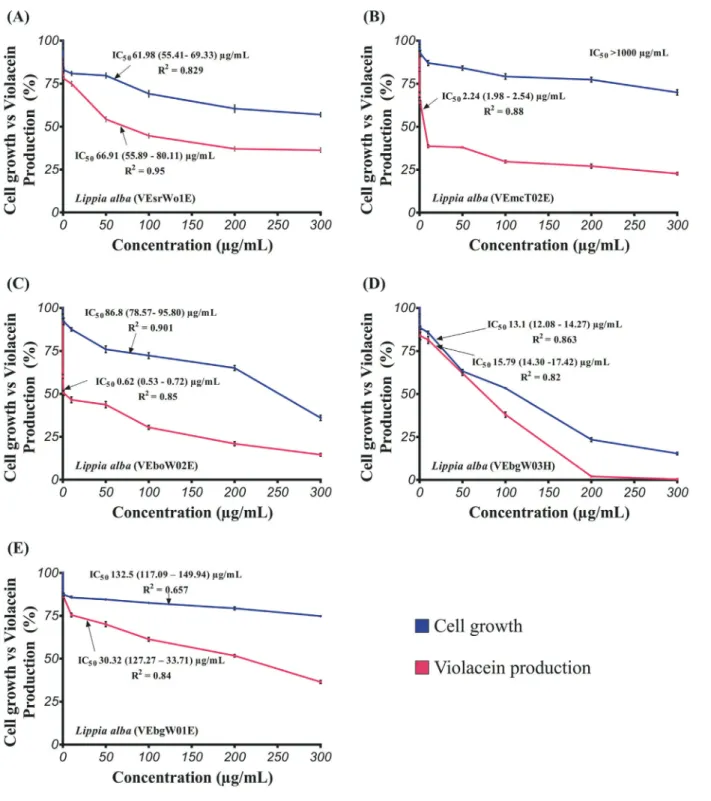
The antimicrobial activity of theLippia albaessential oils was analyzed usingC. violaceumCV026 as indicator microorganism, in order to evaluate whether the inhibition of violacein production owed to the microbial growth reduction or AHL inhibition. The results of the cell growth inhibition of CV026 induced by essential oils fromL. albaare shown in Figure 1. In all cases, there is a clear concentration-response relationship. At 100mg/mL, the growth of CV026 varied be-tween 53.4 and 82.6% compared to vehicle control. Greater oil concentrations produced proportional impact in cell growth, except for the essential oil containing the highest geraniol content (9.5%) (VebgW03H), which allowed 23.5% cell growth at 200mg/mL, and only 15.4 ± 0.8% at 300 mg/mL (Figure 1D).
Quorum sensing inhibition
The inhibitory activity of essential oils fromLippia alba against bacterial QS was evaluated by testing the violacein production byC. violaceumCV026 (Figure 1). Pigment production data normalized against cell growth (OD620) are depicted in Figure 2. Two out of five tested es-sential oils presented promising QS-inhibition capabilities. The greatest QS inhibition was observed for theL. alba with the highest geranial and neral concentration (VEboW02E) (Figure 1C), followed by that with the great-est limonene and carvone contents (VEmcT02E) (Figu-re 1B), with IC50 values of 0.62 (0.53-0.72) and 2.24 (1.98-2.54)mg/mL. These oils were followed in activity by
VEsrW01E (Figure 1A) and VEbgW01E (Figure 1E), which had similar QS inhibitory action, but greater than that observed for VEbgW03H, for which the QS data al-most matched that for cell growth (Figure 1D). These re-sults revealed the ability of essential oils fromLippia alba to inhibit QS. Moreover, as presented before, the anti-QS activity for these essential oils is independent from their ef-fect on cell growth.
Antibacterial activity assay
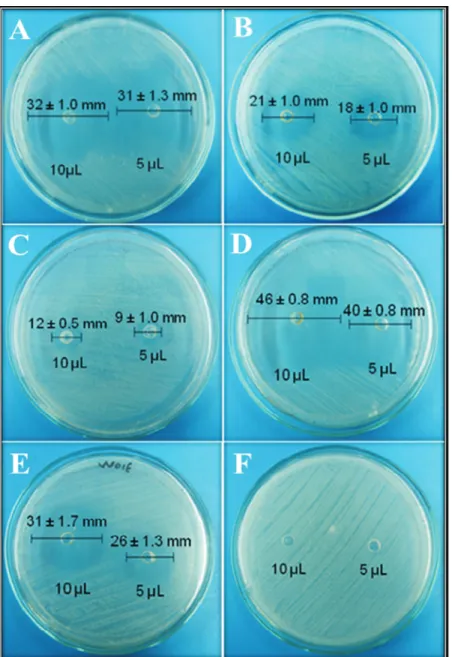
To validate some aspects of the traditional uses of the tested bioactive products as antimicrobial agents, essential oils were tested against the bacterial human pathogenS. aureus. Regarding the disk diffusion assays, most of the es-sential oils showed broad zones of growth inhibition againstS. aureusATCC 25923 at 10 and 5mL of each pure essential oil (Figure 3). VEboW02E produced the maxi-mum zone of growth inhibition (46± 0.8mm)(Figure 3D), followed by VEbgW03H with 32 ± 1.0 mm, and VEsrW01E with 31 ± 1.7mm(Figures 3A and 3E).These findings show that essential oils fromL. albado possess an-tibacterial activity at tested concentrations against Gram-positive bacteria such asS. aureusATCC 25923.
Lippia albaoil composition
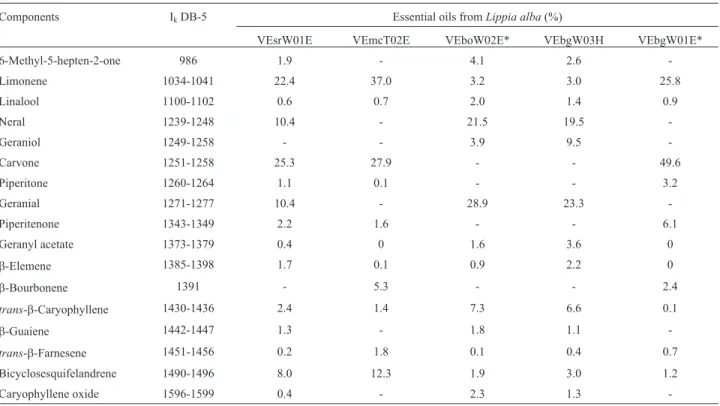
The GC-MS analysis of evaluatedL. albasamples are presented in Table 2. The main constituents were identified as limonene, neral, carvone, geraniol, bicyclosesquite-landrene, geranial, piperitenone,b-bourbonene, and trans-b-caryophyllene.
Discussion
In many Gram-negative bacteria, a number of bacte-rial traits, including virulence and pathogenicity, are regu-lated by acyl homoserine lactone (AHL)-mediated QS system (Khan et al., 2009). The quenching of bacterial cell-cell communication could be a promising strategy to attenuate the expression of virulence genes, and thus for the control of pathogenic infections (Issac Abraham et al., 2011). Although several medicinal properties of Lippia alba such as antiviral, antibacterial, antifungal and antiparasitic have been investigated so far (Stashenkoet al., 2004; Hennebelleet al., 2008; Araet al., 2009; Lópezet al., 2011), its ability to prevent QS has been partially studied.
These anti-QS properties have also been found for natural plant extracts such as that of Lotus corniculatus (Choo et al., 2006). Similarly, anti-QS compounds have also been reported forPseudomonas aeruginosa, including molecules isolated fromPisum sativum,Conocarpus erec-tus, Chamaesyce hypericifolia, Callistemon viminalis,
Bucida bucerasandAcalypha alopecuroidea(Musthafaet al., 2010). Szabóet al.(2010) evaluated the effect of sev-eral essential oils on bacterial growth and QS, using the sensor strainC. violaceumCV026, showing that rose, gera-nium, lavender and rosemary oils were the most potent QS inhibitors. Eucalyptus and citrus oils moderately reduced
Figure 1- Effect of essential oils fromLippia albaon cell growth and violacein production inC. violaceumCV026 exposed to essential oils. (A) VEsrWo1E; (B) VEmcTo2E; (C) VEboW02E; (D) VEbgW03H and (E) VEbgW01E. IC50values are presented as the mean value (95% confidence
pigment production by CV026, whereas the chamomile, or-ange and juniper oils were ineffective. Chooet al.(2006) conducted studies about inhibition of QS signals with va-nilla extract, being violacein production reduced by up to 87.73 and 98.41% in 1 and 2% extract, respectively; fur-thermore, the main chemical components of these extracts had structural similarity to the natural autoinducers or furanone derivatives.
The composition of the essential oil varies greatly, suggesting the existence of a high number of chemotypes. According to Hennebelleet al.(2008), there are at least seven chemotypes on the basis of composition and possible common biosynthetic pathways between different oils. Chemotype I had citral, linalool andb-caryophyllene, as the main constituents; chemotype II, tagetenone; the most
Figure 2- Violacein production normalized against bacterial concentra-tion (OD620) inC. violaceumexposed to essential oils fromLippia alba.
common case for chemotype III were limonene and car-vone or related monoterpenic ketones; chemotype IV, myr-cene; chemotype V,g-terpinene; chemotype VI camphor-1, 8-cineole and chemotype VII, estragole. Therefore, the es-sential oils ofL. albastudied here were classified as citral (geranial-neral) and carvone/limonene chemotypes, thus corresponding to chemotypes I and III, respectively.
L. albaspecies is characterized by the variability in the chemical composition of its essential oils, which vary, as it has been presented here, according to the part of the plant employed in the distillation, the state of development, the geographic location, the characteristics of the soil, cli-mate, and other local conditions (Stashenkoet al., 2004). Most of the essential oils have one or a few major constitu-ents and a variety of other minor componconstitu-ents. Thus, mode of action of these mixtures on the QS system is uncertain (Khanet al., 2009), although it may be speculated that it probably involves a synergistic action of the majority and minority compounds identified in the essential oils.
To date, known mechanisms of QS inhibition in-clude: competitive binding of signal-like molecules to cognate receptors, as in the case of furanones; enzymatic signal degradation, as seem with acyl homoserine lactone (AHL) acylases, and inhibition of reception signal mole-cules (Sioet al., 2006; Tagannaet al., 2011). Our results have shown that essential oils are a diverse and suitable source of QS inhibitor compounds. The presence of mole-cules with different structures in the oils, allows a wider
spectrum of bioactivity. Several studies on the essential oils fromL. albabioactivities have revealed their antivi-ral, antibacterial, antifungal and antiparasitic activities, thus sustaining their use in the treatment of diseases of mi-crobial origin (Escobaret al., 2010; Lópezet al., 2011). A recent report by our group has revealed the anti-QS activ-ity of essential oils isolated fromL. albaand other species. In this case, although an approach with different sensor plasmids (Jaramillo-Coloradoet al., 2011) was used, sim-ilar findings were obtained, reinforcing the idea that ex-amined essential oils do have promising action as anti-QS inhibitors.
Antiseptic activity has been a promising issue for Lippia alba. Several studies have reported the antimicro-bial and antifungal activities of this essential oil extracted from two chemotypes. The carvone chemotype has been re-ported to be active against several microorganisms, particu-larly against Gram-positives strains from human clinical isolates. On the other hand, the linalool chemotype has been successfully proven againstCandida albicans (Hen-nebelleet al., 2008; Jaramillo-Coloradoet al., 2011).
Due to the high antimicrobial activity of monoter-penes and sesquitermonoter-penes from essential oils (Oliveira et al., 2006), it can be suggested that the antimicrobial activity of VEboW02E and VEbgW03H is probably related to the high content of oxygen-containing monoterpenes, repre-sented mainly by aldehydes and alcohols, such as neral/ge-ranial (Oliveiraet al., 2006).
Table 2- Major components of essential oils fromLippia albaas identified by Gas chromatography- mass spectrometry.
Components IkDB-5 Essential oils fromLippia alba(%)
VEsrW01E VEmcT02E VEboW02E* VEbgW03H VEbgW01E*
6-Methyl-5-hepten-2-one 986 1.9 - 4.1 2.6
-Limonene 1034-1041 22.4 37.0 3.2 3.0 25.8
Linalool 1100-1102 0.6 0.7 2.0 1.4 0.9
Neral 1239-1248 10.4 - 21.5 19.5
-Geraniol 1249-1258 - - 3.9 9.5
-Carvone 1251-1258 25.3 27.9 - - 49.6
Piperitone 1260-1264 1.1 0.1 - - 3.2
Geranial 1271-1277 10.4 - 28.9 23.3
-Piperitenone 1343-1349 2.2 1.6 - - 6.1
Geranyl acetate 1373-1379 0.4 0 1.6 3.6 0
b-Elemene 1385-1398 1.7 0.1 0.9 2.2 0
b-Bourbonene 1391 - 5.3 - - 2.4
trans-b-Caryophyllene 1430-1436 2.4 1.4 7.3 6.6 0.1
b-Guaiene 1442-1447 1.3 - 1.8 1.1
-trans-b-Farnesene 1451-1456 0.2 1.8 0.1 0.4 0.7
Bicyclosesquifelandrene 1490-1496 8.0 12.3 1.9 3.0 1.2
Caryophyllene oxide 1596-1599 0.4 - 2.3 1.3
-IkDB-5: Kovats retention index for DB-5.
In short, these results suggest the essential oils from Lippia albahave interesting anti-QS and antiseptic activi-ties. Therefore, new researches must be undertaken in order to elucidate the possible mechanisms involved.
Conclusion
Essential oils from Colombian flora, specifically Lippia albahave noticeable anti-QS and antimicrobial ac-tivities, which may make them targets for the development of drugs to fight bacterial infections.
Acknowledgments
The authors thank Professor Robert J.C. McLean for providing the biosensor strains for the QS tests. This work was sponsored by the Support Program to Research Groups, Vice-presidency for Research, University of Car-tagena (2012-2013).
References
Ara N, Nur MH, Amran MS, Wahid MI, Ahmed M (2009) In vitro antimicrobial and cytotoxic activities of leaves and flowers extracts fromLippia alba. Pak J Biol Sci 12:87-90. Blosser RS, Gray KM (2000) Extraction of violacein from
Chromobacterium violaceum provides a new quantitative bioassay for N-acyl homoserine lactone autoinducers. J Microbiol Methods 40:47-55.
Chan KG, Atkinson S, Mathee K, Sam CK, Chhabra S, Camara M, Koh CL, Williams P (2011) Characterization of N-acyl-homoserine lactone-degrading bacteria associated with the
Zingiber officinale (ginger) rhizosphere: Co-existence of quorum quenching and quorum sensing in Acinetobacter
andBurkholderia. BMC Microbiol 11:51.
Chong YM, Yin WF, Ho CY, Mustafa MR, Hadi AHA, Awang K, Narrima P, Koh CL, Appleton DR, Chan KG (2011) Malabaricone C fromMyristica cinnamomeaexhibits anti-quorum sensing activity. J Nat Prod 74:2261-2264. Choo JH, Rukayadi Y, Hwang JK (2006) Inhibition of bacterial
quorum sensing by vanilla extract. Lett Appl Microbiol 42:637-641.
Christiaen SEA, Brackman G, Nelis HJ, Coenye T (2011) Isola-tion and identificaIsola-tion of quorum quenching bacteria from environmental samples. J Microbiol Methods 87:213-219. CLSI (2009) Métodos para Pruebas de Sensibilidad a los
anti-microbianas por dilución para bacterias que crecen en condi-ciones aeróbicas. Eighth edition ed, Pennsylvania.
Debler EW, Kaufmann GF, Kirchdoerfer RN, Mee JM, Janda KD, Wilson IA (2007) Crystal Structures of a Quorum-quenching Antibody. J Mol Biol 368:1392-1402.
Deep A, Chaudhary U, Gupta V (2011) Quorum sensing and Bac-terial Pathogenicity: From Molecules to Disease. J Lab Phy-sicians 3:4-11.
Ditu LM, Chifiriuc MC, Bezirtzoglou E, Voltsi C, Bleotu C, Pelinescu D, Mihaescu G, Lazar V (2011) Modulation of virulence and antibiotic susceptibility of enteropathogenic
Escherichia colistrains byEnterococcus faeciumprobiotic strain culture fractions. Anaerobe 17:448-451.
Escobar P, Milena Leal S, Herrera LV, Martinez JR, Stashenko E (2010) Chemical composition and antiprotozoal activities of
ColombianLippiaspp essential oils and their major compo-nents. Mem Inst Oswaldo Cruz 105:184-190.
Hennebelle T, Sahpaz S, Joseph H, Bailleul F (2008) Ethno-pharmacology ofLippia alba. J Ethnopharmacol 116:211-222.
Holmes B, Costas M, Thaker T, Stevens M (1994) Evaluation of two BBL Crystal systems for identification of some clini-cally important gram-negative bacteria. J Clin Microbiol 32:2221-2224.
Issac Abraham SV, Palani A, Ramaswamy BR, Shunmugiah KP, Arumugam VR (2011) Antiquorum sensing and antibiofilm potential ofCapparis spinosa. Arch Med Res 42:658-668. Jaramillo-Colorado B, Olivero-Verbel J, Stashenko EE,
Wag-ner-Döbler I, Kunze B (2011) Anti-quorum sensing activity of essential oils from Colombian plants. Nat Prod Res 26:1075-1086.
Kabir AH, Roy AG, Alam MF, Islam R (2010) Detection of Quo-rum Sensing Signals in Gram-Negative Bacteria by Using Reporter Strain CV026. Not Sci Biol 2:72-75.
Kaufman G (2011) Antibiotics: mode of action and mechanisms of resistance. Nurs Stand 25:49-55.
Khan MSA, Zahin M, Hasan S, Husain FM, Ahmad I (2009) Inhi-bition of quorum sensing regulated bacterial functions by plant essential oils with special reference to clove oil. Lett Appl Microbiol 49:354-360.
Köhler T, Perron GG, Buckling A, van Delden C (2010) Quorum sensing inhibition selects for virulence and cooperation in
Pseudomonas aeruginosa. PLoS Pathog 6:1-6.
Krishnan T, Yin WF, Chan KG (2012) Inhibition of Quorum Sensing-Controlled Virulence Factor Production in Pseudo-monas aeruginosa PAO1 by Ayurveda Spice Clove (Syzygium Aromaticum) Bud Extract. Sensors 12:4016-4030.
López MA, Stashenko EE, Fuentes JL (2011) Chemical composi-tion and antigenotoxic properties ofLippia alba essential oils. Genet Mol Biol 34:479-488.
May AL, Eisenhauer ME, Coulston KS, Campagna SR (2011) Detection and Quantitation of Bacterial Acylhomoserine Lactone Quorum Sensing Molecules via Liquid Chromatog-raphy-Isotope Dilution Tandem Mass Spectrometry. Anal Chem 84:1243-1252.
McClean KH, Winson MK, Fish L, Taylor A, Chhabra SR, Ca-mara M, Daykin M, Lamb JH, Swift S, Bycroft BW, Stewart GSAB, Williams P (1997) Quorum sensing and
Chromobacterium violaceum: exploitation of violacein pro-duction and inhibition for the detection of N-acyl-homoserine lactones. Microbiology 143:3703-3711. McLean RJC, Pierson Iii LS, Fuqua C (2004) A simple screening
protocol for the identification of quorum signal antagonists. J Microbiol Methods 58:351-360.
Morohoshi T, Kato M, Fukamachi K, Kato N, Ikeda T (2008) N-Acylhomoserine lactone regulates violacein production inChromobacterium violaceumtype strain ATCC 12472. FEMS Microbiol Lett 279:124-130.
Musthafa KS, Ravi AV, Annapoorani A, Packiavathy ISV, Pan-dian SK (2010) Evaluation of anti-quorum-sensing activity of edible plants and fruits through inhibition of the N-acyl-homoserine lactone system inChromobacterium violaceum
andPseudomonas aeruginosa. Chemotherapy 56:333-339. Oliveira DR, Leitão GG, Santos SS, Bizzo HR, Lopes D, Alviano
study of twoLippiaspecies from Oriximiná, Brazil. J Ethno-pharmacol 108:103-108.
Olivero JT, Pájaro NP, Stashenko EE (2011) Antiquorum Sensing activity of essential oils isolated from different species of the genuspiper. Vitae 18:77-82.
Rocha-Estrada J, Aceves-Diez A, Guarneros G, de la Torre M (2010) The RNPP family of quorum-sensing proteins in Gram-positive bacteria. Appl Microbiol Biotechnol 87:913-923.
Siddiqui MF, Sakinah M, Singh L, Zularisam AW (2012) Tar-geting N-acyl-homoserine-lactones to mitigate membrane biofouling based on quorum sensing using a biofouling re-ducer. J Biotechnol 161:190-197.
Singh BN, Singh BR, Singh RL, Prakash D, Sarma BK, Singh HB (2009) Antioxidant and anti-quorum sensing activities of green pod of Acacia nilotica L. Food Chem Toxicol 47:778-786.
Sio CF, Otten LG, Cool RH, Diggle SP, Braun PG, Bos R, Daykin M, Cámara M, Williams P, Quax WJ (2006) Quorum Quen-ching by an N-Acyl-Homoserine Lactone Acylase from
Pseudomonas aeruginosa PAO1. Infect Immun 74:1673-1682.
Sipahi OR (2008) Economics of antibiotic resistance. Expert Rev Anti-Infect Ther 6:523-539.
Stashenko EE, Jaramillo BE, Martínez JR (2004) Comparison of different extraction methods for the analysis of volatile sec-ondary metabolites of Lippia alba (Mill.) N.E. Brown, grown in Colombia, and evaluation of its in vitro antioxidant activity. J Chromatogr A 1025:93-103.
Szabó MA, Varga GZ, Hohmann J, Schelz Z, Szegedi E, Amaral L, Molnár J (2010) Inhibition of quorum-sensing signals by essential oils. Phytother Res 24:782-786.
Taganna JC, Quanico JP, Perono RMG, Amor EC, Rivera WL (2011) Tannin-rich fraction from Terminalia catappa
inhib-its quorum sensing (QS) in Chromobacterium violaceum
and the QS-controlled biofilm maturation and LasA sta-phylolytic activity in Pseudomonas aeruginosa. J Ethnopharmacol 134:865-871.
Teplitski M, Robinson JB, Bauer WD (2000) Plants Secrete Sub-stances That Mimic Bacterial N-Acyl Homoserine Lactone Signal Activities and Affect Population Density-Dependent Behaviors in Associated Bacteria. Mol Plant Microbe Inter-act 13:637-648.
Truchado P, López-Gálvez F, Gil MI, Tomás-Barberán FA, Allende A (2009) Quorum sensing inhibitory and antimi-crobial activities of honeys and the relationship with indi-vidual phenolics. Food Chem 115:1337-1344.
Vattem DA, Mihalik K, Crixell SH, McLean RJC (2007) Dietary phytochemicals as quorum sensing inhibitors. Fitoterapia 78:302-310.
Whitehead NA, Barnard AML, Slater H, Simpson NJL Salmond GPC (2001) Quorum-sensing in Gram-negative bacteria. FEMS Microbiol Rev 25:365-404.
Williams P, Winzer K, Chan WC, Cámara M (2007) Look who’s talking: communication and quorum sensing in the bacterial world. Philos Trans R Soc Lond B Biol Sci 362:1119-1134. Xavier KB, Bassler BL (2003) LuxS quorum sensing: more than
just a numbers game. Curr Opin Microbiol 6:191-197. Yang L, Liu Y, Sternberg C, Molin S (2010) Evaluation of
Enoyl-Acyl Carrier Protein Reductase Inhibitors as Pseudo-monas aeruginosa Quorum-Quenching Reagents. Mole-cules 15:780-792.
Zhang LH, Dong YH (2004) Quorum sensing and signal interfer-ence: diverse implications. Mol Microbiol 53:1563-1571.