online | memorias.ioc.fiocruz.br
Trypanosoma cruzi is a kinetoplastid flagellate proto-zoan that causes Chagas disease in Latin America, where 75-90 million are exposed to the infection. Studies have estimated that currently 15-16 million people are infected with this parasite (Coura & Dias 2009). T. cruzi has a life cycle that includes invertebrate (triatomine bugs) and vertebrate (mammals) hosts. During its cycle, the parasite undergoes drastic morphological alterations in cell shape, which result in at least three major evolutive forms. Each form has adapted for living in specific environments in-side the hosts. Although epimastigote forms are exclu-sive to the insect vector, trypomastigotes (bloodstream forms) and amastigotes (intracellular forms) are associ-ated with vertebrate hosts (de Souza 1984).
T. cruzi differentiation from the epimastigote to the trypomastigote stage in the insect rectum (metacyclo-genesis process) is critical for the generation of infective metacyclic trypomastigotes. Furthermore, intracellular differentiation from trypomastigotes to amastigotes (and then back to trypomastigotes) is essential for evading the host’s immune response and maintaining the infection in the mammalian host. Therefore, studies on these processes may help to elucidate their function-ing and indicate potential targets for the development of trypanocidal drugs. This is relevant because the cur-rently available drugs (nifurtimox and benznidazole) are not fully effective and present serious, toxic side effects (Coura & de Castro 2002, Urbina 2009).
Essential oils are sources of phytotherapeutic agents that have traditionally been used by native cultures to treat infectious diseases. Their use as antimicrobial and antifungal agents has been firmly established for de-cades (Burt 2004). More recently, studies have shown that essential oils may also be used as anti-protozoal drugs. Indeed, essential oils have inhibitory actions against diverse parasitic protozoa, such as Plasmodium falciparum (Valentin et al. 1995), Trypanosoma bru-cei, Leishmania major (Mikus et al. 2000), Leishmania amazonensis (Monzote et al. 2006, Santin et al. 2009) and T. cruzi (Santoro et al. 2007a, b, c).
Interestingly, the essential oil of Cymbopogon citra-tus (DC) Stapf (Gramineae) has fungal and anti-bacterial activities (Onawunmi et al. 1984, Onawunmi 1989, Ibrahim 1992, Mishra & Dubey 1994, Viollon & Chaumont 1994, Wannissorn et al. 1996, Cimanga et al. 2002). This essential oil has been shown to be effective against protozoa and significantly reduced the growth of Plasmodium berghei (Tchoumbougnang et al. 2005), the insect trypanosomatid Crithidia deanei (Pedroso et al. 2006), L. amazonensis (Santin et al. 2009) and all three evolutive forms of T. cruzi (Santoro et al. 2007a).
Because the T. cruzi differentiation process plays a major role in the life cycle of the parasite, understand-ing and inf luencunderstand-ing this process is a primary research interest. Citral, the main constituent of C. citratus
(lemongrass) essential oil, showed a high activity against T. cruzi bloodstream trypomastigotes (San-toro et al. 2007a), with a concentration that induced 50% cell lysis (IC50) of about 15 μg/mL. Therefore, the present study investigated the effect of citral on the epimastigote-to-trypomastigote metacyclogenesis process of T. cruzi in vitro by growing the parasites in triatomine artificial urine (TAU)3AAG, which is a chemically defined medium that induces parasite dif-ferentiation (Contreras et al. 1985).
Financial support: CAPES, CNPq, FIOCRUZ + Corresponding author: [email protected] Received 24 June 2010
Accepted 29 September 2010
In vitro effects of citral on Trypanosoma cruzi metacyclogenesis
Josiane Cardoso, Maurilio José Soares/+
Instituto Carlos Chagas-Fiocruz, Rua Prof. Algacyr Munhoz Mader 3775, 81350-010 Curitiba, PR, Brasil
Citral, the main constituent of lemongrass (Cymbopogon citratus) essential oil, was added to Trypanosoma cruzi
cultures grown in TAU3AAG medium to observe the effect on the epimastigote-to-trypomastigote differentiation
pro-cess (metacyclogenesis). Our results showed that citral (20 μg/mL) did not affect epimastigote viability or inhibit the differentiation process. Concentrations higher than 60 μg/mL, however, led to 100% cell death (both epimastigote and trypomastigote forms). Although epimastigotes incubated with 30 μg/mL citral were viable and able to adhere to the substrate, we observed around 50% inhibition in metacyclogenesis, with a calculated concentration that inhib
-ited metacyclogenesis by 50% after 24 h (IC50/24 h) of about 31 µg/mL. Treatment with 30 μg/mL citral did not hinder
epimastigote multiplication because epimastigote growth resumed when treated cells were transferred to a
drug-free liver infusion tryptose culture medium. Metacyclogenesis was almost totally abolished at 40 μg/mL after 24 h of
incubation. Furthermore, the metacyclic trypomastigotes obtained in vitro were similarly susceptible to citral, with
an IC50/24 h, concentration that killed 50% of the cells after 24 h, of about 24.5 µg/mL. Therefore, citral appears to
be a good candidate as an inhibitory drug for further studies analyzing the T. cruzi metacyclogenesis process.
MATERIALS AND METHODS
Drugs - Citral, an isomeric mixture of geranial and neral (Fig. 1), was purchased from Sigma (Sigma-Al-drich, St. Louis, MO, USA) and initially diluted in
dim-ethyl sulphoxide (DMSO) at a concentration of 100 mg/
mL. This solution was then diluted in TAU or TAU3AAG
culture media to obtain a second stock solution at 1 mg/
mL (the DMSO was diluted to 1%). Stock solutions were stored at 4ºC and used within one month. Stock solutions prepared in culture media were diluted at different
con-centrations for the experiments (20, 40, 60, 80 or 100 µg/
mL). Under this setting, the final DMSO concentration in the assays never exceeded 0.1%. Thus, the potentially toxic effects of DMSO did not affect protozoa.
Parasite - T. cruzi strain Dm28c (Contreras et al. 1988) was used in the experiments. Culture epimastigote forms were kept at 28ºC in liver infusion tryptose (LIT) medium (Camargo 1964) supplemented with 10% foetal bovine serum. The epimastigotes were passaged weekly.
Epimastigote-to-trypomastigote differentiation -For in vitro metacyclogenesis, 5-day-old culture epi-mastigotes were harvested by centrifugation at 7000 g
for 10 min at 10ºC. The parasites were then incubated for 2 h at 28ºC at a density of 5 x 10⁸ cells/mL in TAU
medium (190 mM NaCl, 17 mM KCl, 2 mM MgCl2, 2 mM CaCl2, 8 mM phosphate buffer, pH 6.0). Thereaf-ter, the parasites were incubated at a 1:100 dilution (fi-nal epimastigotes concentration: 5 x 10⁶ cells/mL) for
96 h at 28ºC in TAU3AAG medium (TAU supplemented with 10 mM L-proline, 50 mM L-sodium glutamate, 2 mM L-sodium aspartate and 10 mM D-glucose) in 25 mL culture flasks with a layer of culture medium that was not more than 1 cm in depth (Contreras et al. 1985). All experiments were performed with a final parasite concentration of 5 x 10⁶ epimastigotes/mL, which was
a condition that allowed the best differentiation rates. Thus, after 72 h of cultivation, about 80% of the cells in the supernatant were in the trypomastigote form.
Culture supernatants were collected after 24, 48 and 72 h of incubation in TAU3AAG medium and the num-ber of living epimastigotes and metacyclic trypomas-tigotes was determined by light microscopy and cell counting using a Neubauer chamber. These evolutive forms could be easily differentiated on morphological grounds because epimastigotes are broad and have a rigid body, whereas trypomastigotes are slim and pres-ent a wavy movempres-ent of the whole body.
Inhibition of epimastigote-to-trypomastigote differen -tiation with citral -In the first set of experiments, we only added citral to the stress medium, TAU, and tested wheth-er citral would affect the diffwheth-erentiation process of stressed epimastigotes, which occurs in the TAU3AAG medium.
We added 50 μg/mL citral to the TAU medium. This con -centration was chosen because a previous study showed that the IC50/24 h for citral against T. cruzi epimastigotes
was about 40 μg/mL (Santoro et al. 2007a). After incuba -tion for 2 h at 28ºC in this medium, the parasites in the supernatant were observed by light microscopy, collected by centrifugation and transferred to citral-free TAU3AAG medium kept at 28ºC. Culture supernatants were collected after 24, 48 and 72 h of incubation and the number of liv-ing epimastigotes and metacyclic trypomastigotes was de-termined by light microscopy as described above.
In another experiment, epimastigotes were main-tained for 2 h at 28ºC in citral-free TAU medium and the stressed parasites were transferred to TAU3AAG medium (kept at 28ºC) containing different citral
concentrations (20, 40, 60, 80 or 100 μg/mL). Culture
supernatants were collected after 24, 48 and 72 h of incubation and the number of living epimastigotes and metacyclic trypomastigotes was determined by light microscopy as described above.
To examine whether fully differentiated metacyclic trypomastigotes were susceptible to citral, trypomastig-otes were obtained after a normal differentiation process in TAU3AAG medium. After 72 h, the resulting trypo-mastigotes (8 x 10⁵ cells/mL) were resuspended in
24-well plates at 4 x 10⁵ cells/500 µL TAU3AAG medium per well. Each well contained 0, 20, 40, 60 or 80 μg/mL
citral. After a 24 h incubation, the number of living try-pomastigotes was assessed by cell counting in a Neubau-er chambNeubau-er to detNeubau-ermine the pNeubau-ercent of parasite lysis.
To determine whether the effect of citral was re-versible, parasites (epimastigotes plus trypomastig-otes) were obtained by differentiation in TAU3AAG
medium containing 40 μg/mL citral. After 48 h of
incubation in this medium, the parasites were resus-pended in 24-well plates at 1 x 10⁵ cells/mL in
citral-free LIT medium (1 mL per well) The number of liv-ing epimastigotes in the cultures was assessed daily by cell counting in a Neubauer chamber.
All of these tests were performed in triplicate in three independent experiments.
Electron microscopy - Culture flasks with differen-tiating epimastigotes in TAU3AAG medium containing
30 μg/mL citral were incubated for 24 h. After incubation,
the supernatant was collected and the free-swimming parasites were obtained by centrifugation at 5,500 g for Fig. 1: citral (C10H16O, molecular mass 152.24 g/mol) exhibits geo
5 min. To collect the remaining adhered parasites, about 5 mL of TAU3AAG medium was added to the empty flasks, which were vigorously shaken in a vortex for about 2 min. This medium was collected and the procedure was repeated twice. These three aliquots were pooled and cen-trifuged at 5,500 g for 5 min, which resulted in a pellet of adhered epimastigotes. Free-swimming and adhered parasites were then processed for electron microscopy. Control cultures without citral were also analyzed.
For scanning electron microscopy (SEM), adhered and free-swimming parasites were fixed for 30 min with 2.5% glutaraldehyde in 0.1 M phosphate buffer and then adhered for 10 min to glass coverslips coated with 0.1% poly-L-lysine. The samples were washed in buffer and post-fixed for 15 min with 1% osmium tetroxide in 0.1 M cacodylate buffer (pH 7.2). Thereafter, the samples were dehydrated in graded acetone, critical-point dried and mounted on SEM stubs. The samples were coated with a 20-nm thick gold layer and examined in a Jeol JSM-6360LV scanning electron microscope.
For transmission electron microscopy, adhered and free-swimming parasites were washed in 0.1 M phosphate buffer (pH 7.2) and fixed for 30 min with 2.5% glutaralde-hyde in 0.1 M phosphate buffer. The cells were then washed once with 0.1 M phosphate buffer, once with 0.1 M caco-dylate buffer and post-fixed for 15 min with 1% osmium tetroxide, 0.8% potassium ferricyanide and 5 mM CaCl2 in 0.1 M cacodylate buffer (pH 7.2). Cells were rinsed in buffer, dehydrated in graded acetone, infiltrated overnight
in a 100% acetone/PolyBed 812 mixture (1:1) and embed -ded for 72 h at 60ºC in PolyBed 812 (PolySciences, War-rington, PA, USA) resin. Ultrathin sections were stained with 5% uranyl acetate and lead citrate and observed in a Jeol 1200EXII transmission electron microscope.
RESULTS
Citral added to TAU medium does not influence metacyclogenesis -First, we analyzed whether 50 μg/ mL citral added to epimastigotes maintained in the stress medium, TAU, would influence the metacyclo-genesis process. The results showed that this concen-tration of citral did not have an effect on the differen-tiation rate. Indeed, about 80% of the cells were in the trypomastigote form 48-72 h after being transferred to citral-free TAU3AAG (differentiation) medium. This differentiation rate was similar to the rate in the con-trols. Light microscopy showed that most cells from control and citral-treated culture supernatants ap-peared as long epimastigotes, which confirmed that ci-tral treatment for 2 h in TAU medium had no effect on parasite morphology and differentiation potential.
Citral added to TAU3AAG medium inhibits metacyclo-genesis in a concentration-dependent manner - A differ-ent result was obtained when citral was added only to the differentiation medium, TAU3AAG. Although no effect
was observed at 20 μg/mL, metacyclogenesis was almost totally abolished at 40 μg/mL after 24, 48 or 72 h of in
-cubation. Higher concentrations (60, 80 or 100 μg/mL)
induced 100% cell lysis. We determined that the IC50/24
h of citral was 30.8 μg/mL (Fig. 2A). An additional experi
-ment, which was performed with 30 μg/mL citral added
to the TAU3AAG medium, confirmed the estimated cal-culation. Indeed, metacyclogenesis was inhibited by about 54% and 45% after 24 h and 48 h, respectively.
Fig. 2A: estimative of the IC50/24 h (concentration that inhibited metacy -clogenesis in 50% after incubation for 24 h) of citral in triatomine artifi-cial urine (TAU)3AAG medium. The value obtained was about 30.8 μg/
mL. Each point represents the mean and standard deviation (SD) values; B: estimative of IC50/24 h for metacyclic trypomastigotes incubated for 24 h in TAU3AAG medium containing different citral concentrations. The IC50/24 h was estimated as about 24.5 µg/mL; C: reversibility assay.
Parasites were pre-treated for 48 h with 40 µg/mL citral in TAU3AAG
medium and then transferred to citral-free liver infusion tryptose medi-um. Epimastigote growth in the cultures was then estimated by daily cell counting in Neubauer chamber. Each point represents the mean and SD
Treatment with citral blocks cell differentiation but
does not affect epimastigote adhesion - We used light microscopy to examine living, free-swimming para-sites from cultures maintained for 24 h in TAU3AAG
medium with 40 µg/mL citral. Although most cells in
the supernatant of the control medium displayed the characteristic morphology of metacyclic trypomastig-otes, most cells in the supernatant of cultures treated
with 40 µg/mL citral kept the epimastigote form. The
adhesion process, however, was not affected and simi-lar numbers of adhered parasites were observed in treated and untreated culture flasks (data not shown). Nevertheless, parasites from treated cultures presented morphological alterations and showed rounded bodies or signs of cell extraction when compared with the con-trols. Although citral treatment did not block adhesion, these results indicate that citral treatment affected fac-tors that trigger the T. cruzi differentiation process.
Metacyclic trypomastigotes are more susceptible to citral than epimastigotes -To determine whether meta-cyclic trypomastigotes were more susceptible to citral than epimastigotes, trypomastigotes were obtained after
a normal differentiation process for 72 h in TAU3AAG medium and incubated for 24 h in TAU3AAG medium
containing 0, 20, 40, 60 or 80 μg/mL citral. There was a concentration-dependent effect and 60 μg/mL citral
killed almost all of the parasites. The IC50/24 h was esti
-mated to be 24.5 μg/mL (Fig. 2B).
Effect of citral on epimastigotes is reversible - Al-though citral effectively inhibited the epimastigote to trypomastigote differentiation, its effect on epimas-tigote growth was reversible. Epimasepimas-tigote growth
re-sumed when parasites treated with 40 μg/mL citral in
TAU3AAG medium were washed in LIT medium and incubated in citral-free LIT medium (Fig. 2C).
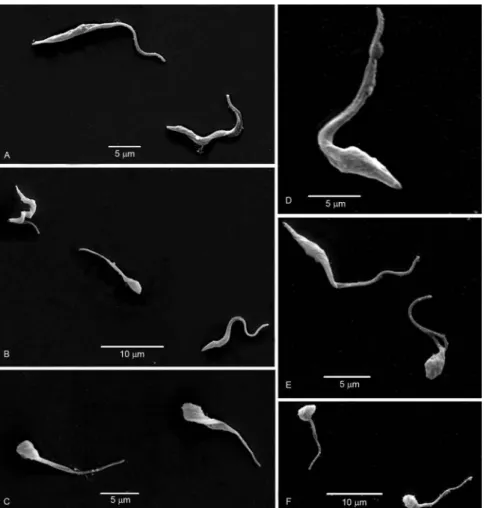
Citral induces morphological alterations during T. cruzi differentiation - SEM of differentiating parasites
treated with 30 μg/mL citral (corresponding to the IC50/24
h value) confirmed the results obtained by light micros-copy. Most treated epimastigotes, whether they were in the supernatant (Fig. 3B, C) or adhered to the walls of the flasks (Fig. 3E, F), presented a rounded body, whereas the control cells had an elongated body (Fig. 3A, D).
Fig. 3: scanning electron microscopy of parasites from the supernatant (A-C) or adhered to the flask walls (D-F) from cultures kept in triatomine artificial urine (TAU)3AAG medium for 24 h (A, D) controls. A: both epimastigote and trypomastigote forms can be seen; D: is a higher
magni-fication of an epimastigote form; B-D, F: epimastigotes from cultures with 30 μg/mL citral. Note that treated cells (both in the supernatant and
Transmission electron microscopy (Fig. 4A-D) showed that incubation for 24 h in medium containing
30 µg/mL citral caused the parasites in the supernatant
to have a rounded form with swelling of the mitochon-drion and a loose arrangement of the kDNA network (Fig. 4C). Adhered parasites that retained the epimas-tigote form showed few morphological alterations, ex-cept for the presence of a higher number of cytoplasmic vacuoles (Fig. 4D).
DISCUSSION
C. citratus, popularly known as citronella grass or lemongrass, is a perennial grass that is widespread throughout the world. The anti-microbial and anti-fungal activities of lemongrass essential oil, which are primarily due to its main constituent citral (Onawunmi et al. 1984), have been known for a long time (Kurita et al. 1981, Mishra & Dubey 1994). The present study was the first to show the inhibitory effects of citral on the differentia-tion process (metacyclogenesis) of T. cruzi in vitro. Our data demonstrated that incubation with citral decreased epimastigote differentiation efficiency in vitro, which re-sulted in cultures with low numbers of trypomastigotes. Furthermore, epimastigote adhesion was not blocked with the citral treatment, which suggested that citral affects factors that trigger the T. cruzi differentiation process. Therefore, citral may be useful in experiments analyzing the molecules involved in T. cruzi differentiation. During in vivo metacyclogenesis, adhesion of epimastigotes to a substrate was thought to be a prerequisite for differ-entiation into metacyclic trypomastigotes (Bonaldo et al. 1988). The role of adhesion in stimulating differentiation remains unknown, but both adhesion and cell differen-tiation have been shown to be initiated by a nutritional stress stimulus (Figueiredo et al. 2000).
Addition of 50 μg/mL citral to TAU stress medium
containing epimastigotes did not influence the meta-cyclogenesis process when the treated parasites were transferred to citral-free TAU3AAG medium. Because
the TAU medium with epimastigotes/citral was diluted
at 1:100 in TAU3AAG, there was a final concentration of
0.5 μg/mL citral in TAU3AAG, which apparently had no
influence on the differentiation process. Our morpholog-ical data showed that incubation for 2 h in citral-TAU me-dium did not result in any morphological alteration of the parasites. The incubation time, however, may not have
been long enough to cause any metabolic disturbance in
the cells. When citral (20-100 µg/mL) was added directly
to the TAU3AAG medium, we observed a strong concen-tration-dependent influence on the parasites.
Interestingly, a previous study on the incubation of
T. cruzi epimastigotes and bloodstream trypomastigotes with lemongrass essential oil and citral also showed a concentration-dependent effect (Santoro et al. 2007a). For epimastigotes, the IC50/24 h value was 126.5 µg/mL
for the oil and 42 µg/mL for citral (Santoro et al. 2007a).
For bloodstream trypomastigotes, IC50/24 h values were
15.5 µg/mL for the oil and 14.2 µg/mL for citral. Almost 100% trypomastigote lysis was obtained with 50 µg/mL
citral (Santoro et al. 2007a). The present study observed about 90% cell lysis for metacyclic trypomastigotes
af-ter treatment with 60 µg/mL citral and the IC50/24 h was estimated to be 24.5 μg/mL, which confirmed the results
of the Santoro et al. (2007a). Trypomastigotes were more susceptible to citral than epimastigotes and bloodstream trypomastigotes were more susceptible to citral than in vitro-derived metacyclic trypomastigotes. Because epi-mastigotes, bloodstream trypomastigotes and metacyclic trypomastigotes have different metabolisms and differ-ent glycoconjugate compositions at the cell membrane (de Andrade et al. 1991, de Souza 2008), these different susceptibilities could be due to different cell permeabil-ity rates for citral or different cellular targets.
Our data showed that treatment with citral induced ultrastructural alterations in the parasites, such as rounding of the body and cell vacuolization. An im-portant characteristic of essential oils and their com-ponents is their hydrophobicity (Burt 2004). Indeed, hydrophobicity allows the essential oils to permeate the cell membrane and kill T. cruzi parasites by affecting cytoplasmic metabolic pathways or organelles (Santoro et al. 2007a). Essential oils permeate the cell mem-branes and disrupt the structure of the different layers of membrane polysaccharides, fatty acids and phospho-lipids, which permeabilizes the membranes (Bakkali et al. 2008). Essential oil cytotoxicity appears to include membrane damage, which leads to the leakage of mac-romolecules and lysis (Juven et al. 1994, Gustafson et al. 1998, Cox et al. 2000, Lambert et al. 2001, Ous-salah et al. 2006). Because our microscopy findings indicated that citral treatment resulted in rounding of the parasite body with cell vacuolization, the T. cruzi
Fig. 4: transmission electron microscopy of epimastigotes from the supernatant (A, C) or adhered to the flask walls (B, D) from cultures kept in triatomine artificial urine (TAU)3AAG medium for 24 h. A-B: control epimastigotes, showing the elongated body and the presence of
reservo-somes (R). C-D: parasites from cultures treated with 30 μg/mL citral. Note that treated epimastigotes (both in the supernatant and adhered to the
cell membranes may have been permeabilized by citral, which would lead to organelle toxicities, cytoplasmic leakage and cell lysis.
In eukaryotic cells, studies have shown that essential oils can provoke depolarization of the mitochondrial mem-branes and permeabilization of the outer and inner mito-chondrial membranes, which leads to cell death by apopto-sis and necroapopto-sis (Yoon et al. 2000, Armstrong 2006). The damaged mitochondria result in changes in electron flow through the electron transport chain, which can produce free radicals that oxidise and damage lipids, proteins and DNA (Bakkali et al. 2008). Because we observed mito-chondrial swelling in citral-treated T. cruzi parasites, it is possible that such events may be occurring in this parasite. Similar growth inhibition results have been described with C. citratus essential oil assays of other trypanosoma-tids. Indeed, studies have demonstrated the in vitro activity of this essential oil against C. deanei, with mean IC50 values for symbiont-bearing and symbiont-free strains of 120 and
60 μg/mL, respectively (Pedroso et al. 2006). Interestingly, L. amazonensis promastigotes were more sensitive to the essential oil and citral, with IC50 of about 1.7 and 8.0 μg/mL, respectively, after 72 h of incubation(Santin et al. 2009). One study showed that 3.1 µM concentrations of neral or geranial (isomers of citral) were effective against epimas-tigotes of T. cruzi (Saeidnia et al. 2004). Another study showed that citral presented high activity against T. cruzi
bloodstream trypomastigotes (Santoro et al. 2007a). In ad-dition, recent data demonstrated a concentration-dependent anti-proliferative activity of citral-rich essential oil from C. citratus on promastigotes, axenic amastigotes and intracel-lular amastigotes of L. amazonensis (Santin et al. 2009).
Studies of T. cruzi in mouse peritoneal macrophages demonstrated that the use of C. citratus essential oil re-sulted in a selectivity index (the ratio of the IC50 value in the host cell divided by the IC50 value of the parasite) close to two (Santoro et al. 2007a). The expected value for a good drug candidate, however, is greater than 50 (Romanha et al. 2010). Despite the toxicity to mouse macrophages, the testing of citral derivatives appears to be an alternative in the search for new chemotherapeutic drugs.
Data from the literature have shown that the metacy-clogenesis process of T. cruzi could be inhibited by the topoisomerase II inhibitor ofloxacin (Gonzales-Perdomo et al. 1990), the antitubulin drug trifluralin (Bogitsh et al. 1999), the proteasome inhibitor lactacystin (Cardoso et al. 2008), metallo and cysteine-protease inhibitors (Bonaldo et al. 1991) or mannose (Barbieri et al. 1992). The data from the present paper showed that citral ef-fectively blocked the metacyclogenesis of T. cruzi in vitro. In addition, citral killed the resulting metacyclic trypomastigote form, which may have occurred through alterations of membrane permeability. Therefore, citral appears to be a good inhibitory drug candidate for stud-ies on the T. cruzi metacyclogenesis process.
ACKNOWLEDGEMENTS
To the Centro de Microscopia Eletrônica at the Univer-sidade Federal do Paraná, for the use of the scanning and transmission electron microscopes. All experiments comply with the current laws of Brazil.
REFERENCES
Armstrong JS 2006. Mitochondrial membrane permeabilization: the sine qua non for cell death. Bioessays28: 253-260.
Bakkali F, Averbeck S, Averbeck D, Idaomar M 2008. Biological ef-fects of essential oils - a review. Food Chem Toxicol 46: 446-475.
Barbieri MA, Lammel EM, Isola EL, Bertini F 1992. Trypanosoma cruzi: inhibition of metacyclogenesis by mannose. Biochem
Bio-phys Res Commun 187: 108-113.
Bogitsh BJ, Middleton OL, Ribeiro-Rodrigues R 1999. Effects of the an-titubulin drug trifluralin on the proliferation and metacyclogenesis of Trypanosoma cruzi epimastigotes. Parasitol Res 85: 475-480.
Bonaldo MC, d’Escoffier LN, Salles JM, Goldenberg S 1991. Charac-terization and expression of proteases during Trypanosoma cruzi metacyclogenesis. Exp Parasitol 73: 44-51.
Bonaldo MC, Souto-Padron T, de Souza W, Goldenberg S 1988. Cell-substrate adhesion during Trypanosoma cruzi differentiation.
J Cell Biol 106: 1349-1358.
Burt S 2004. Essential oils: their antibacterial properties and potential applications in foods - a review. Int J Food Microbiol94: 223-253.
Camargo EP 1964. Growth and differentiation of Trypanosoma cruzi. I. Origin of metacyclic trypanosomes in liquid media. Rev Inst Med Trop Sao Paulo 6: 93-100.
Cardoso J, Soares MJ, Menna-Barreto RF, Le Bloas R, Sotomaior V, Goldenberg S, Krieger MA 2008. Inhibition of proteasome ac-tivity blocks Trypanosoma cruzi growth and metacyclogenesis.
Parasitol Res 103: 941-951.
Cimanga K, Kambu K, Tona L, Apers S, De Bruyne T, Hermans N, Totté J, Pieters L, Vlietinck AJ 2002. Correlation between chemi-cal composition and antibacterial activity of essential oils of some aromatic medicinal plants growing in the Democratic Republic of Congo. J Ethnopharmacol79: 213-220.
Contreras VT, Araujo-Jorge TC, Bonaldo MC, Thomaz N, Barbosa HS, Meirelles MN, Goldenberg S 1988. Biological aspects of the Dm 28c clone of Trypanosoma cruzi after metacyclogenesis in chemically defined media. Mem Inst Oswaldo Cruz 83: 123-133.
Contreras VT, Salles JM, Thomas N, Morel CM, Goldenberg S 1985.
In vitro differentiation of Trypanosoma cruzi under chemically defined conditions. Mol Biochem Parasitol 16: 315-327.
Coura JR, de Castro SL 2002. A critical review on Chagas disease chemotherapy. Mem Inst Oswaldo Cruz 97: 3-24.
Coura JR, Dias JC 2009. Epidemiology, control and surveillance of Chagas disease - 100 years after its discovery. Mem Inst Oswaldo Cruz104 (Suppl. I): 31-40.
Cox SD, Mann CM, Markham JL, Bell HC, Gustafson JE, Warm-ington JR, Wyllie SG 2000. The mode of antimicrobial action of the essential oil of Melaleuca alternifolia (tea tree oil). J Appl Microbiol 88: 170-175.
de Andrade AF, Esteves MJ, Angluster J, Gonzales-Perdomo M, Goldenberg S 1991. Changes in cell-surface carbohydrates of Trypanosoma cruzi during metacyclogenesis under chemically defined conditions. J Gen Microbiol 137: 2845-2849.
de Souza W 1984. Cell biology of Trypanosoma cruzi. Int Rev Citol 86: 197-283.
De Souza W 2008. Electron microscopy of trypanosomes - A histori-cal view. Mem Inst Oswaldo Cruz 103: 313-325.
Gonzales-Perdomo M, de Castro SL, Meirelles MN, Goldenberg S 1990. Trypanosoma cruzi proliferation and differentiation are blocked by topoisomerase II inhibitors. Antimicrob Agents
Chemother 34: 1707-1714.
Gustafson JE, Liew YC, Chew S, Markham J, Bell HC, Wyllie SG, Warmington JR 1998. Effects of tea tree oil on Escherichia coli. Lett Appl Microbiol 26: 194-198.
Ibrahim D 1992. Antimicrobial activity of the essential oil of the local serai, Cymbopogon citratus. J Bioscience 3: 87-90.
Juven BJ, Kanner J, Schved F, Weisslowicz H 1994. Factors that in-teract with the antibacterial action of thyme essential oil and its active constituents. J Appl Bacteriol 76: 626-631.
Kurita N, Makoto M, Kurane R, Takahara Y, Ichimura K 1981. Anti-fungal activity of components of essential oils. Agric Biol Chem
45: 945-952.
Lambert RJ, Skandamis PN, Coote PJ, Nychas GJ 2001. A study of the minimum inhibitory concentration and mode of action of oregano essential oil, thymol and carvacrol. J Appl Microbiol 91: 453-462.
Mikus J, Harkenthal M, Steverding D, Reichling J 2000. In vitro effect of essential oils and isolated mono- and sesquiterpenes on Leish-mania major and Trypanosoma brucei. Planta Med 66: 366-368.
Mishra AK, Dubey NK 1994. Evaluation of some essential oils for their toxicity against fungi causing deterioration of stored food commodities. Appl Environ Microbiol 60: 1101-1105.
Monzote L, Montalvo AM, Almanonni S, Scull R, Miranda M, Abreu J 2006. Activity of the essential oil from Chenopodium ambro-sioides grown in Cuba against Leishmania amazonensis. Chemo-therapy 52: 130-136.
Onawunmi GO 1989. Evaluation of the antimicrobial activity of ci-tral. Let Appl Microbiol9: 105-108.
Onawunmi GO, Yisak WA, Ogunlana EO 1984. Antibacterial con-stituents in the essential oil of Cymbopogon citratus (DC.) Stapf.
J Ethnopharmacol 12: 279-286.
Oussalah M, Caillet S, Lacroix M 2006. Mechanism of action of Spanish oregano, Chinese cinnamon, and savory essential oils against cell membranes and walls of Escherichia coli O157:H7 and Listeria monocytogenes. J Food Prot 69: 1046-1055.
Pedroso RB, Ueda-Nakamura T, Dias Filho BP, Cortez DAG, Cor-tez LER, Morgado-Diaz JA, Nakamura CV 2006. Biological ac-tivities of essential oil obtained from Cymbopogon citratus on Crithidia deanei. Acta Protozool 45: 231-240.
Romanha AJ, de Castro SL, Soeiro MNC, Lannes-Vieira J, Ribeiro I, Talvani A, Bourdin B, Blum B, Olivieri B, Zani C, Spadafora C, Chiari E, Chatelain E, Chaves G, Calzada JE, Bustamante JM,
Freitas-Junior LH, Romero LI, Bahia MT, Lotrowska M, Soares M, Andrade SG, Armstrong T, Degrave W, Andrade ZA 2010.In vitro and in vivo experimental models for drug screening and develop-ment for Chagas disease. Mem Inst Oswaldo Cruz 105: 233-238.
Saeidnia S, Gohari AR, Uchiyama N, Ito M, Honda G, Kiuchi F 2004. Two new monoterpene glycosides and trypanocidal terpe-noids from Dracocephalum kotschyi. Chem Pharm Bull (Tokyo) 52: 1249-1250.
Santin MR, dos Santos AO, Nakamura CV, Dias Filho BP, Ferreira IC, Ueda-Nakamura T 2009. In vitro activity of the essential oil of Cymbopogon citratus and its major component (citral) on Leish-mania amazonensis. Parasitol Res 105: 1489-1496.
Santoro GF, Cardoso MG, Guimarães LG, Freire JM, Soares MJ 2007a. Anti-proliferative effect of the essential oil of Cymbopogon citra-tus (DC) Stapf (lemongrass) on intracellular amastigotes, blood-stream trypomastigotes and culture epimastigotes of Trypanosoma cruzi (Protozoa: Kinetoplastida). Parasitology 134: 1649-1656.
Santoro GF, Cardoso MG, Guimarães LG, Mendonça LZ, Soares MJ 2007b. Trypanosoma cruzi: activity of essential oils from Achillea millefolium L., Syzygium aromaticum L. and Ocimum basilicum L. on epimastigotes and trypomastigotes. Exp Parasitol 116: 283-290.
Santoro GF, das Graças Cardoso M, Guimarães LG, Salgado AP, Menna-Barreto RF, Soares MJ 2007c. Effect of oregano ( Origa-num vulgare L.) and thyme (Thymus vulgaris L.) essential oils on Trypanosoma cruzi (Protozoa: Kinetoplastida) growth and ultra-structure. Parasitol Res 100: 783-790.
Tchoumbougnang F, Zollo PH, Dagne E, Mekonnen Y 2005. In vivo antimalarial activity of essential oils from Cymbopogon citratus and Ocimum gratissimum on mice infected with Plasmodium berghei. Planta Med 71: 20-23.
Urbina JA 2009. New advances in the management of a long-neglect-ed disease. Clin Infect Dis 49: 1685-1687.
Valentin A, Pélissier Y, Benoit F, Marion C, Kone D, Mallie M, Bas-tide JM, Bessière JM 1995. Composition and antimalarial activity in vitro of volatile components of Lippia multiflora.
Phytochem-istry 40: 1439-1442.
Viollon C, Chaumont JP 1994. Antifungal properties of essential oils and their main components upon Cryptococcus neoformans.
Mycopathologia 128: 151-153.
Wannissorn B, Jarikasem S, Soontorntanasart T 1996. Antifungal activity of lemon grass oil and lemon grass oil cream. Phytother
Res 10: 551-554.