Activity from Permeabilized
Kluyveromyces lactis
Cells
JOSE G E R A L D O S A B I O N I , ~ AD~.O JOSI~ R E Z E N D E P I N H E i R O , ~ DAISON O L Z A N Y S I L V A , JOSI~ BENICIO PAES CHAVES, 2 and A R N A L D O CHAER BORGES Departamento de Biologia Geral Universidade Federal de Vi~osa 36570 Vi§osa, MG, Brazil
ABSTRACT
Feasibility of controlling lactose crys- tallization in "dulce de leche" by per- meabilized
Kluyveromyces lactis
cells was studied. Optimum temperature for lactase activity was 45°C. Stability of the enzyme system remained practically unaltered during storage at room temperature or below for up to 7 mo. Degree of lactose hydrolysis in milk was determined as a function of the content of permeabilized cells. Addition of 400 or 800 rag/liter of permeabilized cells to milk used to make " d u l c e " , followed b y 2.5 or 3.5 h in- cubation at 35°C, resulted in hydrolysis of 45.02 and 69.13% of the lactose. There was no lactose crystallization after 120 days storage in products treated by permeabilized cells. The sensory qualities of the "dulces" were similar to those of the control.I N T R O D U C T I O N
Lactose crystals in concentrated dairy products such as condensed milk and "dulce de leche" may cause a sandy texture and reduce consumer acceptability. Crystals tend to aggregate and alter the physical character of the p r o d u c t (2, 4). Under normal conditions for dairy products, alpha-lactose is the major determinant of the nature and degree of crystal- lization (11).
Various studies have been directed toward controlling lactose crystallization in "dulce de leche" (1, 4, 9, 13, 14, 15, 18). Vargas (18) tested different concentrations of milk fat,
Received September 2, 1983.
1Departamento de Nutri~:~'o, UFOP, 35400, Ouro Preto,
MG,
Brazil.Departamento de Tecnologia de Alimentos, U FV, 36570, Viffosa, MG, Brazil.
glucose, and starch in formulations o f "dulce de leche". She found that 1.28% fat and added starch reduced crystallization but did not alter normal characteristics of the product. Addition of glucose increased its brightness.
Hosken (4), however, tested seven " d u l c e " formulations and obtained best results with addition of 2% glucose; addition of starch reduced crystallization but altered other characteristics of the product. Velasco, cited by Silva (14), reduced net lactose in "dulce de leche" with addition of casein (sodium salt). The product was similar to the traditional one, even though it had less lactose. Studies b y Souza (15) on the effect of acidity and heat treatment of the milk indicated that acidity alone was not sufficient to prevent crystal- lization, whereas heat treatment reduced the problem.
Partial hydrolysis of lactose with beta- D-galactosidase will prevent crystallization in concentrated dairy products (1, 9, 14). The galactose and glucose produced b y hydrolysis are soluble in water at concentrations of 32 and 50% wt/vol, at 25°C (8). Together they have higher reducing power than lactose and cause accelerated nonenzymatic browning during the manufacture of " d u l c e " (8, 9).
Castelo et al., cited b y Silva (14), used the enzyme lactase in the manufacture o f "dulce de leche" and observed that about 20% lactose hydrolysis guaranteed physical stability of the product for more than 120 days at room temperature. The product had a darker color than the control. Coelho (1), in a similar experiment, using lactase at 20 to 2000 mg/liter of milk, observed best results with addition of 40 mg/liter followed by incubation at 34°C for 4 h. Except for color changes, alteration of normal characteristics of the " d u l c e " were not observed. Silva (14), by addition of 40 mg/liter enzyme to milk at 8°C, followed by incubation and continuous agitation, obtained a homog- enized "dulce de leche". This product was
LACTOSE HYDROLYSIS 2211 similar to the traditional Brazilian "dulce de
leche" in color, texture, and flavor and showed no sandiness after 90 days storage.
Luuvrema (9) described the advantages of lactose hydrolysis and how enzymatically to treat milk for its potential use in manufacture of "dulce de leche".
Beta-D-galactosidase is marketed under the trade name "Maxilact R", (Gist Brocades, Holland). The enzyme is obtained from a special strain of the yeast
Kluyveromyces lactis
(3). Its high cost and Brazilian importing restrictions make utilization by dairy industries difficult (4, 14).
Van-Dam et al. (17), treated cells of
Sac-
cbaromyces fragilis
with ethyl alcohol andobtained a product with beta-D-galactosidase activity that was denoted as "permeabilized cells".
The objective of this experiment was to investigate control of lactose crystallization in "dulce de leche" with beta-D-galactosidase activity in permeabilized
Kluyveromyces lactis
cells.
M A T E R I A L S A N D M E T H O D S
Preparation of
Kluyveromyces lactis
Permeabilized Cells
Yeast stock culture (1.0% peptone; 2.0% lactose; .5% yeast extract; 1.5% of agar; pH 7.0), was used to inoculate .5 liter sterilized skim milk in a 1000 ml Erlenmeyer flask, followed by 24-h aerobic incubation at 30°C. This mother culture was inoculated into a fermentor containing 7.5 liters sterilized skim milk. The fermentor, constructed by Biasinox Industria e Com~rcio Ltda, Lambari, MG-Brazil, was equipped with aeration and agitation systems. The skim milk was incubated for 12 h at 30°C with the agitator running at 170 rpm and aeration rate corresponding to one volume of air per volume of media per minute (1 vol/vol/min). After incubation the 8 liters of culture was transferred to a 200-1iter stainless steel tank containing 92 liters of skim milk, previously heated to 90°C, then cooled to 30°C. The tank was equipped with an agitation system and an aeration system connected to an air com- pressor (Douat type - 40 liters) for injection of filtered air. To minimize bacterial growth 5 btg/ml each of streptomycin and chloram- phenicol were added. After 12-h incubation,
cells had acquired high growth and elevated beta-D-galactosidase activity. The medium was cooled to 2°C and maintained at that tem- perature until cells were harvested. Yeast cells were separated from the milk by centrifugation at 2800 x g for 5 min and maintained under refrigeration for further permeabilization. Cell- ular permeabilization was achieved by 96% ethyl alcohol added to attain a final concen- tration of 80% in the mixture (17). The resulting }'east cell suspension was passed through a Buchner funnel. The precipitate was dried at 40°C for 1 h in an oven and then stored in a refrigerator at 4°C. In this way the yeast cellular membrane became permeabilized to lactose.
Enzymatic properties of the permeabilized cells were studied with respect to o p t i m u m temperature for hydrolytic activity, temper- ature stability during storage, and degree of lactose hydrolysis as a function of various concentrations of permeabilized cells.
Optimum temperature for hydrolytic activity was determined by our suspending 1 mg/ml of permeabilized cells in distilled water. Incubation temperatures were 2, 10, 22, 28, 35, 40, 45, 50, and 60°C. Three test tubes containing 4.4 ml of a Z buffer (10), .1 ml of the cell suspension, and .5 ml of 2.5 mM ortho-nitrophenyl-beta- D-galactoside (ONPG), were used for each temperature. Tubes were incubated for 15 rain at the chosen temperature, and the reaction was stopped by addition of 1.0 ml of 1 M Na2CO3 to each tube. Color intensity was determined at 420 nm with a Spectronic 20. spectrophotometer with 4.9 ml of a Z buffer solution and .1 ml cell suspension as control. By concentration of orthonitrophenol (/lmoles/ml) plotted versus incubation temperature, o p t i m u m temperature of hydrolytic activity was estimated.
Enzyme stability was determined as a function of storage temperature and time. Three sealed test tubes, each containing about 3 g of permeabilized cells, were stored at 25°C (environmental), 5°C (refrigerator), and at - 2 0 ° C (freezer). Weekly, and later monthly, the hydrolytic activity at 30°C was determined as described.
of 20 ml, one for each incubation period, transferred to 50-ml Erlenmeyer flasks con- taining the substrate and incubated for .5, 1.0, 1.5, 2.0, 2.5, 3.0, and 4.0 h at 35°C in a water bath with slight agitation. After incubation, .3 ml of acetic acid (1 + 9) was added. Each mixture was agitated and then left in a steam bath at 80°C for 5 min to precipitate milk proteins and inactivate the enzyme. Precipitated proteins were separated by centrifugation at 2500 × g for 2 rain. One milliliter of the supernatant fraction was transferred to a 50-ml volumetric flask and the volume brought to 50 ml with distilled water. The sample was stored at 4°C until analyzed. Lactose hydrolysis was determined according to a method described by Potter (12). Lactose content before hydrolysis was determined as described by Teles et al. (16).
Lactose Hydrolysis and Production of "Dulce"
Permeabilized cells were used to hydrolyze lactose in milk used for production of "dulce de leche". Three hundred and fifty liters of milk were skimmed by centrifugal separation, and the resulting skim milk and cream warmed to 90°C, cooled, and maintained at 2°C. Permeabilized cells at 400 to 800 rag/liter were added to the milk. For each concentration, hydrolysis was observed at the end of 2.5 and 3.5 h at 35°C with a slight and continuous agitation to avoid ceil sedimentation. After hydrolysis, the treated milk (50 liters each) was heated to 80°C to inactivate the enzyme. Lactose hydrolysis was determined as described by Potter (12).
Milk for the production of "dulce" was standardized to 2.5% fat (5) and acidity neu- tralized to .13% lactic acid ( 5 ) b y addition of sodium bicarbonate. "Dulce" was made by adding 8 kg sucrose (commercial grade) to 50 liters of milk and the mixture concentrated in an open concentrator to 65 to 70 ° Brix as determined by a densitometer. The product was placed in 250-g glass cups, sealed with metal lids, heated in live steam for 20 min, cooled by water spray to about 50°C, and stored at room temperature.
Sensory Evaluation for Flavor and Crystallization
"Dulce de leche's" flavor acceptability was evaluated by a 10-member sensory panel using a
9-point hedonic scale as follows: 1 - horrible, 2 - bad, 3 - objectionable, 4 - less than ac- ceptable, 5 - acceptable, 6 - more than acceptable, 7 - good, 8 - very good, and 9 - excellent, according to the ASTM (American Society for Testing and Materials), cited by Silva (14).
Evaluation of degree of crystallization was after 30, 60, 90, and 120 days storage by five trained, experienced panelists, according to the following scale: 1 - without perceptible crystallization, 2 - minor fine crystallization, 3 - sandy, 4 - very sandy, 5 - excessively sandy. Statistical Analysis
Permeabilized cells and time of hydrolysis were studied in a fractional factorial scheme in randomized blocks. The transformed square roots of the panelist scores were used for analysis of variance.
R E S U L T S A N D D I S C U S S I O N
Beta-D-glactosidase activity of permeabilized K. lactis cells was determined as a function of incubation temperature (Figure 1). The greatest enzyme activity was at 40 to 45°C, and m i n i m u m at 2°C or 60°C. Results by Wierzbicki and Kosikowski (19) were similar. Van-Dam et al. (17) showed that the optimum temperature for
i
o o E . 2
o
O
r , o .I
° a
z
!
O
o ' ~ b " 2"o ' ~ o ' 4o " ~;o ' T e r n p e r o t u r e ( * C )
Figure 1. Beta-D-galactosidase activity as measured by ortho-nitrophenyl-beta-D-galactoside (ONPG) hy- drolysis by Ktuyveromyces lactis permeabilized cells as function of temperature.
LACTOSE HYDROLYSIS 2213
U)
q)
" ~ 1.3'
. 2
q}
.i • ,e,-
Z
I
o
~
-20"C
5"C
25"C
Storage time (Months)
Figure 2. Beta-D-galactosidase activity of Kluy- veromyces lactis permeabilized ceils as a function of temperature and time of storage before use as mea- sured by ortho-nitrophenyl-beta-D-galactoside (ONPG) hydrolysis.
beta-D-galactosidase activity in permeabilized cells of Saccharomyces fragilis was 35°C, although the ideal temperature for growth was 28°C. Even though o p t i m u m growth temper- atures for both K. lactis and S. fragilis were identical (7), the same did not apply to the beta-D-galactosidase hydrolytic activity, that was near 45°C for K. lactis. This is of micro- biological significance, because it allows utiliza- tion of permeabilized cells at temperatures detrimental for growth of pathogenic micro- organisms.
Enzyme activity essentially was unchanged after storage for 7 mo at - 2 0 , 5, or 25°C (Figure 2).
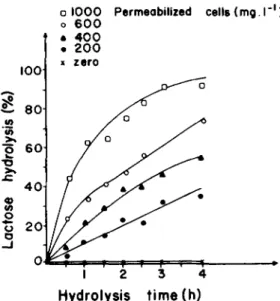
A higher concentration of permeabilized cells (up to 1000 rag/liter) resulted in increased hydrolysis rate with behavior similar to a first order reaction (Figure 3). According to Leh- ninger (6), it is necessary not only to select the proper enzyme concentration but also to provide other factors such as substrate con- centration, temperature, and pH to reach the region of direct proportionality• These results also indicated that hydrolysis does not increase in direct proportion to permeabilized cell concentrations, because substrate is the limiting factor. One of the objectives in this experiment was to provide 40 to 70% lactose hydrolysis in milk for use in "dulce" production. Such a product would have a final lactose concentration below the maximum limit of solubility and
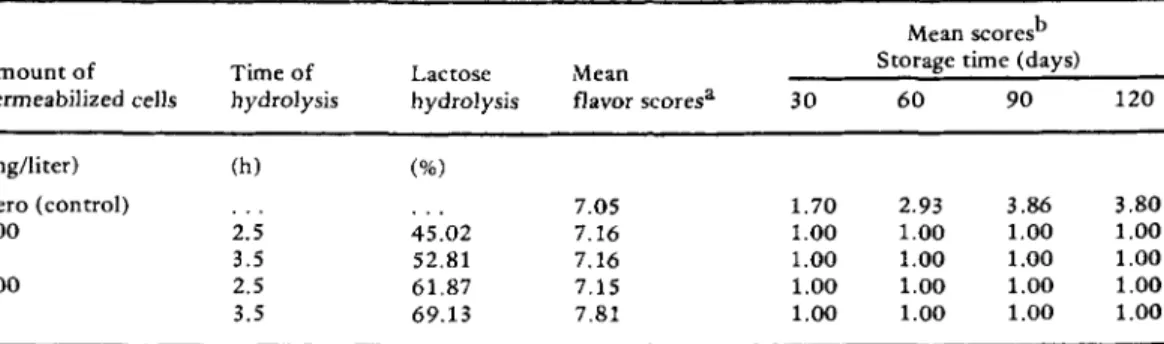
would not crystallize. Addition of 400 or 800 mg/liter of permeabilized cells to milk followed by 2.5 or 3.5-h incubation at 35°C resulted in 45 to 69% lactose hydrolysis (Table 1). This was obtained without any risk of contamination and with reasonable permeabilized cell cost.
Analysis of variance of sensory evaluation scores on effect of permeabilized cells on the properties of "dulce de leche" indicated that panelists did not detect significant differences (P< .05) among cell addition rates and hydrolysis times (Table 1). The "dulce's" flavor was not altered by 400 or 800 mg/liter of permeabilized cells added to milk as compared with the control (Table 1).
"Dulce de Ieche" produced without addition of permeabilized cells (control), was the only product that developed lactose crystals (Table 1). Crystallization increased in the control during storage as indicated by panelist scores, which ranged from 1.7 at 30 days to 3.8 after 120 days. Addition of permeabilized cells prevented crystal formation for 120 days at lactose hydrolysis rates that varied from 45.02 to 69.13% (Table 1).
Luursema (8) showed that hydrolysis increased the reducing power of milk carbo- hydrates because of the probable effect of
Permeobilized cells (mg.l")
o I 0 0 0
o 600
• 400
• 200
= zero
t O 0
• 0
i
80'
o
0
6 0
L-- 4 0
•
•
~ 20 +
_Ji 2 3 4
Hydrolysis
time (h)
Figure 3. Percent hydrolysis of lactose in milk at 35°C as a function of time and permeahilized Kluyveromyces lactis cells addition•
TABLE 1. Extent of lactose hydrolysis and mean sensory scores for flavor and crystallization in "dulce" with
various concentrations of permeabilized Kluyveromyces lactis cells and reaction times.
Mean scores b
Amount of Time of Lactose Mean Storage time (days)
permeabilized cells hydrolysis hydrolysis flavor scores a 30 60 90 120
(mg/liter)
Zero (control) 400
800
(h) (%)
7.05 1.70 2.93 3.86 3.80
215 4;102 7.16 1.00 1.00 1.00 1.00
3.5 52.81 7.16 1.00 1.00 1.00 1.00
2.5 61.87 7.15 1.00 1.00 1.00 1.00
3.5 69.13 7.81 1.00 1.00 1.00 1.00
al, Horrible, 2, bad, 3, objectionable, 4, less than acceptable, 5, acceptable, 6, more than acceptable, 7, good, 8, very good, and 9, excellent.
b l , Without perceptible crystallization, 2, minor or fine crystallization, 3, sandy, 4, very sandy, and 5, excessively sandy.
galactose. T h e same was o b s e r v e d in a m o r e
rapid n o n e n z y m a t i c d a r k e n i n g d u r i n g con-
c e n t r a t i o n o f m i l k t r e a t e d w i t h p e r m e a b i l i z e d cells. Similar results w e r e o b t a i n e d b y H o s k e n (4), L u u v r e m a (9), C o e l h o (1), and Silva (14).
CONCLUSION
L a c t o s e h y d r o l y s i s b y p e r m e a b i l i z e d K.
lactis ceils t o c o n t r o l c r y s t a l l i z a t i o n in " d u l c e d e l e c h e " o f f e r s a s i m p l e e c o n o m i c a l t e r n a - tive t o t h e use o f p u r i f i e d e n z y m e s . Because e n z y m e a c t i v i t y in d r i e d , p e r m e a b i l i z e d cells r e m a i n e d stable f o r u p t o 7 m o at r o o m t e m - p e r a t u r e , s t o r a g e a n d h a n d l i n g p r o c e d u r e s are n o t critical.
A C K N O W L E D G M E N T
T h e a u t h o r s are i n d e b t e d t o J. Warren Stull,
N u t r i t i o n a n d F o o d S c i e n c e D e p a r t m e n t ,
U n i v e r s i t y o f A r i z o n a , f o r his k i n d n e s s in carefully reviewing t h i s p a p e r and f o r his m o s t h e l p f u l r e m a r k s .
REFERENCES
1 Coelho, E.B.B. 1980. Utiliza(ffo da beta-D-galac- tosidase no controle da cristalizaq~o do doce de leite. M.S. Thesis, U.F.V., Imprensa Universit~ria, Viqosa, MG, Brazil.
2 Doan, F.J. 1958. Problems of lactose crystallization in concentrated milk products. J. Dairy Sci. 41:325.
3 Gist Brocades. 1978. Industrial Products Division. Maxilact a dairy yeast lactase. Technical data sheet. MIL 01-01-78. O5EMO3, Delft Holland.
4 Hosken, F. S. 1969. Doce de leite - Durabilidade e cristalizag~'o. Rev. Inst. Lat. Cand. Tostes. Brazil 24:10.
5 Lara, A.B.W.H.; G. Nazi.rio; M.E.W. Almeida, and
W. Pregnolato. 1976. Pages 151--178 in Normas
analiticas do Instituto Adolfo Lutz. 2nd ed. Vol. 1. Sec. Est. Saude, S~b Paulo, Brazil.
6 Lehninger, A. L. 1970. Pages 183-212 in Bio-
chemistry. 2nd ed. Worth Publ. Inc. New York, NV.
7 Lodder, J. 1974. Pages 349-351 in The yeasts, a
taxonomic study. 2nd ed. North-Holland Publ. Co., Amsterdam, Holland.
8 Luursema, J. O. 1973. Dulce de leche non cristal- izable. Ind. Lechera 57:2.
9 Luuvrema, I. J. 1978. Aplicaciones de lactase para el dulce de leche. Ind. Lacteas 27:25.
10 Miller, J. H. 1974. Experiments in molecular genetics. Cold Spring Harbor Laboratory. New York, NY.
11 Nickerson, T. A., and E. E. Moore. 1974. Alpha- lactose and crystallization rate. J. Dairy Sci. 57: 160.
12 Potter, F. E. 1950. A colorimetric method for quantitative determination of degree of lactose hydrolysis. J. Dairy Sci. 33:803.
13 Santos, D. M. 1976. Arenosidade no doce de leite. Rev. Inst. Lat. Canal. Tostes. 31:3.
14 Silva, T.J.P. 1980. Utiliza~'o dabeta-D-glactosidase no processO continuo de fabrica~'o do doce de leite homogeneizado. (M.S. Thesis), UFV, Imprensa Univ., Vi~osa, MG, Brazil.
15 Souza, L.R.P. 1979. Efeito da acidifica(~o e do tratamento t~rmico do leite na qualidade do doce de leite. M.S. Thesis, UFV, Imprensa Univ., Viqosa, MG, Brazil.
16 Teles, F.F.F., C. K. Young, and J. W. Stull. 1978. A method for rapid determination of lactose. J. Dairy Sci. 61:506.
17 Van-Dam, B., J. G. Revallier-Warffemius, and L. C.
LACTOSE HYDROLYSIS 2215
Van-Darn Schermerhorn. 1950. Preparation of
lactase from
Saccbaromyces fragilis.
Neth. MilkDairy J. 4:96.
18 Vargas, M. M. 1979. InfluOncia da gordura, da glucose e do amido na cristaliza~'o do doce de
leite. M.S. Thesis, U.F.V., Imprensa Universit~ria. Viqosa, MG, Brazil.
19 Wierzbicki, L. E., and F. V. Kosikowski. 1973. Lactase potential of various microorganisms grown in whey. J. Dairy Sci. 56:26.