Analysis of 16S rRNA and
mxa
F genes revealing insights into
Methylobacterium
niche-specific plant association
Manuella Nóbrega Dourado
1, Fernando Dini Andreote
2, Francisco Dini-Andreote
1, Raphael Conti
3,
Janete Magali Araújo
4and Welington Luiz Araújo
5,61
Departamento de Genética, Escola Superior de Agricultura “Luiz de Queiroz”,
Universidade de São Paulo, Piracicaba, SP, Brazil.
2
Departamento de Solos e Nutrição de Planta, Escola Superior de Agricultura “Luiz de Queiroz”,
Universidade de São Paulo, Piracicaba, SP, Brazil.
3Faculdade de Ciências Farmacêuticas de Ribeirão Preto, Universidade de São Paulo,
Ribeirão Preto, SP, Brazil.
4
Centro de Ciências Biológicas, Universidade Federal de Pernambuco, Recife, PE, Brazil.
5Laboratório de Biologia Molecular e Ecologia Microbiana, Universidade de Mogi das Cruzes,
Mogi das Cruzes, SP, Brazil.
6
Departamento de Microbiologia, Instituto de Ciências Biomédicas,
Universidade de São Paulo, São Paulo, SP, Brazil.
Abstract
The genusMethylobacterium comprises pink-pigmented facultative methylotrophic (PPFM) bacteria, known to be an important plant-associated bacterial group. Species of this group, described as plant-nodulating, have the dual ca-pacity of producing cytokinin and enzymes, such as pectinase and cellulase, involved in systemic resistance induc-tion and nitrogen fixainduc-tion under specific plant environmental condiinduc-tions. The aim hereby was to evaluate the phylogenetic distribution ofMethylobacterium spp. isolates from different host plants. Thus, a comparative analysis between sequences from structural (16SrRNA) and functional mxaF (which codifies for a subunit of the enzyme methanol dehydrogenase) ubiquitous genes, was undertaken. Notably, someMethylobacterium spp. isolates are generalists through colonizing more than one host plant, whereas others are exclusively found in certain specific plant-species. Congruency between phylogeny and specific host inhabitance was higher in themxaF gene than in the 16S rRNA, a possible indication of function-based selection in this niche. Therefore, in a first stage, plant coloni-zation byMethylobacterium spp. could represent generalist behavior, possibly related to microbial competition and adaptation to a plant environment. Otherwise, niche-specific colonization is apparently impelled by the host plant.
Key words:phylogenetic diversity, methylotrofics, PPFM, plant-bacteria interaction.
Received: April 15, 2011; Accepted: December 9, 2011.
Introduction
TheMethylobacteriumgenus, which belongs to the classAlphaproteobacteria, is described as pink-pigmented facultative methylotrophic (PPFM). Interestingly, this bac-terial group presents the ability to metabolize one-carbon compounds as carbon sources (Toyama et al., 1998; Skovranet al., 2010).
A wide variety of Methylobacterium species have been isolated from plants (Pirttiläet al., 2000; Syet al.,
2001; Araújoet al., 2002; Yateset al., 2007; Ferreiraet al., 2008; Andreoteet al., 2009; Madhaiyanet al., 2011), the soil (Cao et al., 2011), cold lands, such as Antarctica (Moosviet al., 2005), and the bottom of the Kuroshima Knoll sea in Japan (Inagakiet al., 2004). On considering bacteria-plant association, it has been shown that this genus can establish a beneficial interaction with the hosts, by fix-ing nitrogen (Syet al., 2001; Yateset al., 2007), producing cellulase (Jayashreeet al., 2011), or interacting with other plant pathogens (Araújoet al., 2002, Lacavaet al., 2004, Madhaiyanet al., 2006a, 2006b). Curiously, in spite of the specific capacity for synthesizing hydrolytic enzymes (i.e. pectinase and cellulose), as yet, PPFMs have not been de-scribed as plant-pathogens, thereby indicating their addi-tional capacity of offering host plant protection by inducing
Send correspondence to Welington Luiz Araújo. Departamento de Microbiologia, Instituto de Ciências Biomédicas, Universidade de São Paulo, Av. Prof. Lineu Prestes 1374, Ed. Biomédicas II, Cidade Universitária, 05508-900 São Paulo, SP, Brazil. E-mail: [email protected].
systemic resistance during the colonization process (Madhaiyanet al., 2006a, b). Additionally, a high level of PPFM inoculation can modulate the composition of the bacterial community associated with the host plant (An-dreoteet al., 2006), thereby implying that some competi-tion may occur during this phase.
According to the most recent analysis, 34 species of the genus have been described to date (Katoet al., 2008; Weonet al., 2008; Madhaiyanet al., 2009), half of which (17) within the last five years, a clear indication that only a minor part of the diversity of this genushas been described so far. Thus, further studies of plant-associated members of theMethylobacteriumgenus will furnish additional knowl-edge on their distribution and ecology, thereby leading to research towards developing strains capable of enhancing plant fitness.
Since methylotrophic metabolism conferred by the mxaF gene is advantageous for Methylobacterium extorquensduring plant colonization (Syet al., 2005), it is plausible that the evolution ofMethylobacterium-plant in-teraction has led to the selection of methylotrophic spe-cies/genotypes. Thus, in the present study, the genetic di-versity of 60Methylobacteriumspp. strains obtained from eight different host plants was assessed by sequence analy-sis of 16SrRNAandmxaF genes, to so facilitate compre-hension of the distribution of theMethylobacteriumspecies in various host plants.
Material and Methods
Strains ofMethylobacteriumspp. and plant-species origins
Endophytic bacterial isolates (Table 1), obtained from the culture collection of the Laboratory of Microbial Genetics (ESALQ/USP, Piracicaba, Brazil), were isolated from previous studies of surface-disinfestedCitrusspp. (18 isolates) (Araújo et al., 2002), eucalyptus (Eucalyptus grandisxEucalyptus urophyla) (7 isolates) (Ferreiraet al., 2008),Saccharumspp. (8 isolates) (Rossetto, 2008, Doc-toral thesis, Universidade de São Paulo, Piracicaba),Coffea arabica(8 isolates),Borreria verticillata(12 isolates) and Capsicum annuum(7 isolates).
DNA extraction and sequencing methodology
After cultivation, bacterial DNA was extracted ac-cording to previously described methodology (Araújo et al., 2002). A partial sequence of the 16S rRNA gene (27-1401, according toE. coliposition) was amplified with the primers R1378 (Heueret al., 1997) and P027F (Laneet al., 1985). PCRs were performed in 50 mL of a reaction
containing 1 X enzyme buffer, 3.75 mM of MgCl2, 0.2 mM of each dNTP, 0.2mM of each primer and 0.1U/mL ofTaq
DNA Polymerase (Invitrogen, Brazil). Initial denaturation was carried out at 94 °C for 4 min, followed by 35 thermal cycles of 30 s at 94 °C, 1 min at 62.5 °C and 1 min at 72 °C,
with a final extension at 72 °C for 7 min. Partial amplifica-tion of themxaF gene was obtained with mxa1003f and mxa1561r primers (McDonaldet al., 1995). All PCR am-plification was checked through electrophoresis on agarose gel (1.5%w/vagarose) and UV visualization of the ethi-dium bromide stained gels, after which, PCR products were purified (PureLink, Invitrogen). The 16S rDNA fragments were sequenced using internal primers for both strains in an automated sequencer (MegaBACE 1000), whereasmxaF gene fragments were sequenced with two primers (mxa1003f and mxa1561r).
Sequence analysis
All the cromatograms were first trimmed for high quality bases (80% of bases with quality > 20) by means of Phred software and the trimmed sequences used for com-parison in the Ribosomal Data Project (for 16SrRNAgene) and the GenBank database (nr/nt) (for themxaF gene). The best hits of well-characterized strains of the Methylobacterium genus were retrieved from the data-bases, and subsequently used for alignment and phylogeny analysis with MEGA 4.0 version software (Tamuraet al., 2007). Evolutionary history was inferred through the Neighbor-Joining method (Saitou and Nei, 1987) and evo-lutionary distances were computed by the Kimura 2-para-meter method (Kimura, 1980). All the sequences obtained here were assigned to operational taxonomic units (OTUs) using MOTHUR (Schlosset al., 2009), at the frequency of 97% sequence similarity. Furthermore, Venn diagrams were constructed for 16SrRNAandmxaFgene analysis to cross-compare and visualize the distribution of these OTUs in plant species.
Nucleotide sequence accession numbers
120 DNA sequences of partial 16SrRNAandmxaF genes were deposited in the GenBank database under ac-cession numbers EU789466 to EU789518 and EU789406 to EU789465, respectively.
Results
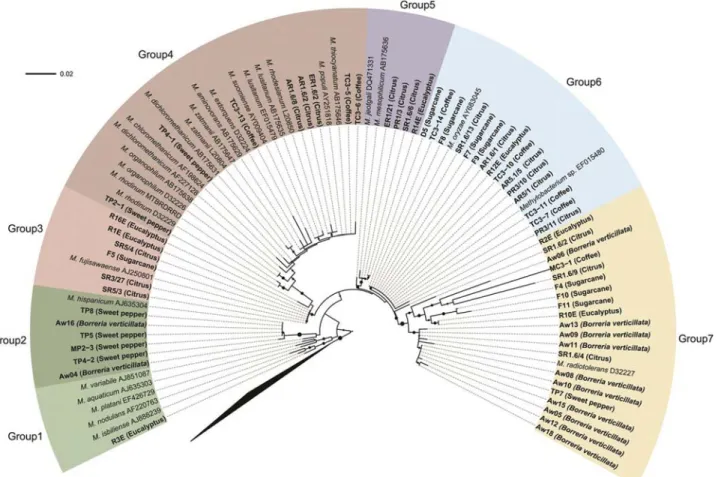
indicating the occurrence of species, as yet not described for this genus.
Congruency between the 16S rRNA and mxaF phylogenetical trees was incomplete. Comparative analysis of mxaF partial gene sequences by BLASTn against the nr/nt database at GenBank, classified most isolates as “ un-cultured methylotrophic bacterium or Methylobacterium sp.” (Table 1 and Figure 2). This was a possible outcome of the limited number ofmxaFsequences available in the da-tabase. In addition, phylogenetic analysis with themxaF gene sequences also revealed the formation of seven groups
(Figure 2). Groups I, II, III and IV presented isolates from two or three hosts, groups IV and V only from citrus and group VI mainly fromB. verticillata(except for TP7 and MC3-1). On the other hand, group VII contained isolates from all the hosts, with the exception ofB. verticillata.
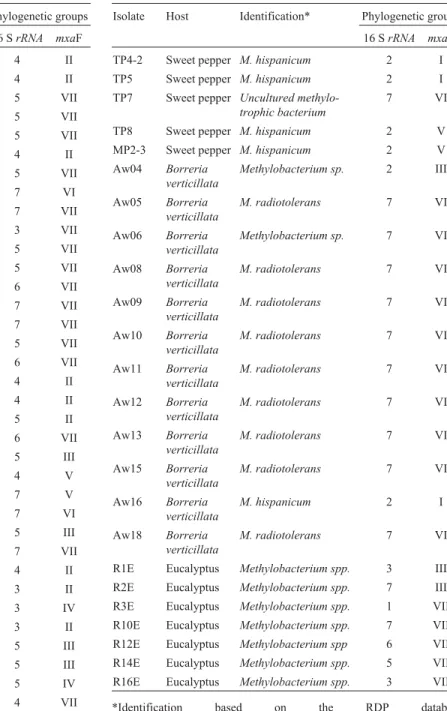
We observed that the clusters obtained bymxaFgene sequence analysis, revealed a certain association with host plants, since isolates fromB. verticillatawere located in group VII, those from sugarcane mainly in group VI (only two belonged to groups I and III), those from eucalyptus mainly in group VII (only two in group III), and those from Table 1- Identification ofMethylobacteriumspp. isolated from different hosts by the partial sequence of the 16SrRNAandmxaFgenes.
Isolate Host Identification* Phylogenetic groups
16 SrRNA mxaF
TC3-5 Coffee M. populi 4 II
TC3-6 Coffee Methylobacterium sp. 4 II
TC3-7 Coffee Methylobacterium sp. 5 VII
TC3-10 Coffee Methylobacterium sp.. 5 VII
TC3-11 Coffee Methylobacterium sp. 5 VII
TC3-13 Coffee M. extorquens 4 II
TC3-14 Coffee Methylobacterium sp. 5 VII
MC3-1 Coffee Methylobacterium sp. 7 VI
F4 Sugarcane Methylobacterium sp. 7 VII
F5 Sugarcane M. fujisawaense 3 VII
F7 Sugarcane Methylobacterium sp. 5 VII
F8 Sugarcane Methylobacterium sp. 5 VII
F9 Sugarcane Methylobacterium sp. 6 VII
F10 Sugarcane Methylobacterium sp. 7 VII
F11 Sugarcane Methylobacterium sp. 7 VII
D5 Sugarcane Methylobacterium sp. 5 VII
AR1.6/1 Citrus Methylobacterium sp. 6 VII
AR1.6/2 Citrus Methylobacterium sp. 4 II
AR1.6/8 Citrus Methylobacterium sp. 4 II
AR5/1 Citrus Methylobacterium sp. 5 II
AR5.1/5 Citrus Methylobacterium sp. 6 VII
ER1/21 Citrus M. mesophilicum 5 III
ER1.6/2 Citrus Methylobacterium sp. 4 V
SR1.6/2 Citrus Methylobacterium sp. 7 V
SR1.6/4 Citrus M. radiotolerans 7 VI
SR1.6/6 Citrus Methylobacterium sp. 5 III
SR1.6/9 Citrus Methylobacterium sp. 7 VII
SR1.6/13 Citrus Methylobacterium sp. 4 II
SR3/27 Citrus Methylobacterium sp. 3 II
SR5/3 Citrus M. fujisawaense 3 IV
SR5/4 Citrus M. fujisawaense 3 II
PR1/3 Citrus M. mesophilicum 5 III
PR3/10 Citrus Methylobacterium sp. 5 III
PR3/11 Citrus Methylobacterium sp. 5 IV
TP2-1 Sweet pepper M. fujisawaense 4 VII
TP4-1 Sweet pepper Methylobacterium sp. 4 II
Isolate Host Identification* Phylogenetic groups
16 SrRNA mxaF
TP4-2 Sweet pepper M. hispanicum 2 I
TP5 Sweet pepper M. hispanicum 2 I
TP7 Sweet pepper Uncultured methylo-trophic bacterium
7 VI
TP8 Sweet pepper M. hispanicum 2 V
MP2-3 Sweet pepper M. hispanicum 2 V
Aw04 Borreria verticillata
Methylobacterium sp. 2 III
Aw05 Borreria verticillata
M. radiotolerans 7 VI
Aw06 Borreria verticillata
Methylobacterium sp. 7 VI
Aw08 Borreria verticillata
M. radiotolerans 7 VI
Aw09 Borreria verticillata
M. radiotolerans 7 VI
Aw10 Borreria verticillata
M. radiotolerans 7 VI
Aw11 Borreria verticillata
M. radiotolerans 7 VI
Aw12 Borreria verticillata
M. radiotolerans 7 VI
Aw13 Borreria verticillata
M. radiotolerans 7 VI
Aw15 Borreria verticillata
M. radiotolerans 7 VI
Aw16 Borreria verticillata
M. hispanicum 2 I
Aw18 Borreria verticillata
M. radiotolerans 7 VI
R1E Eucalyptus Methylobacterium spp. 3 III
R2E Eucalyptus Methylobacterium spp. 7 III
R3E Eucalyptus Methylobacterium spp. 1 VII
R10E Eucalyptus Methylobacterium spp. 7 VII
R12E Eucalyptus Methylobacterium spp 6 VII
R14E Eucalyptus Methylobacterium spp. 5 VII
R16E Eucalyptus Methylobacterium spp. 3 VII
*Identification based on the RDP database
sweet pepper mainly in group I (three in groups II, VI and VII). However, the bacterial population isolated from citrus plants was found in four of the seven groups (II, IV, V, VII). This was confirmed by a Venn diagram , obtained us-ing 97% similarity in 16S rRNA gene sequences (Figure 3a). The analysis showed that 74% (20) of OTUs were found to be exclusive to one host plant (six toB. verticilata, four to citrus, three to sweet pepper, three to coffee, two to eucalyptus, and two to sugarcane). Additionally, only 26% (7) of OTUs were found in two host plants, and only one in four. A similar analysis, usingmxaFgene sequences (Fig-ure 3b), revealed 13 OTUs, of which, 61.5% (eight) were exclusive to only one host plant, and 38.5% (5) to two.
Discussion
The genusMethylobacteriumis commonly found in natural environments, such as soil, air, dust, ocean and lake waters, and sediments, as well as urban environments (Van Akenet al., 2004). A remarkable niche of this group is its association with plants, where it is capable of colonizing leaf surfaces (Chanprameet al., 1996; Madhaiyan et al., 2011), inner tissues (Pirttilä et al., 2000; Araújo et al., 2001, 2002; Andreoteet al., 2006; Yateset al., 2007), and
nodules (Syet al., 2001, Yateset al., 2007). These features could possibly have arisen from an intimate co-evolution process betweenMethylobacterium spp. and host plants. An example of this co-evolutive process is the bacterial ca-pacity to mediate high photosynthetic activity in the host, by the induction of a higher number of stomata, increased chlorophyll concentration and greater amount of malic acid (Cervantes-Martinezet al., 2004). Moreover, mxaFgene associated with methylotrophic metabolism is responsible for increasingM. extorquensfitness during plant epiphytic colonization under competitive conditions (Syet al., 2005). All together, it is assumed that plants are the main niche for assessing the diversity of the genusMethylobacterium.
As diversity in the genusMethylobacteriumhas not been fully explored, e.g. 17 new species of Methylobacteriumwere only described quite recently (Gal-legoet al., 2005a, b, 2006; Aslamet al., 2007; Kanget al., 2007; Madhaiyanet al., 2007; Wanget al., 2007; Katoet al., 2008; Weonet al., 2008), the present study constitutes a significant contribution to the description of diversity in this ubiquitous bacterial group.
scribed, epiphytic colonization is the first stage towards de-veloping such an association (Andreoteet al., 2006). Under like circumstances, the methylotrophic metabolism state is advantageous forM. extorquensunder competitive condi-tions (Syet al., 2005). This advantage is associated to the ability to use, as a carbon source, methanol produced during plant-growth. However, some isolates affiliated by 16S
rRNA genes to theMethylobacterium genus, through not havingmxaFgenes, were incapable of colonizing or nodu-latingLotononisspp. (Ardleyet al., 2009), thereby implying that the capacity to use methanol produced by the plant itself is an important characteristic determining selection.
All the groups containing isolates from two or more different hosts (except group 1, with only one isolate) show
Figure 3- Venn diagrams of operational taxonomic units (OTUs) assigned at 97% sequence similarity. (a) Venn diagram for 16SrRNAgene analysis with 27 OTUs, and (b) Venn diagram formxaFgene analysis with 13 OTUs.
species ability in colonizing various hosts. Thus, the host plant is not able to completely select the bacterial geno-types. Controversially,Borreria verticillata isolates were found mainly in group 7 (except for two isolates in group 2), thus indicating that part ofMethylobacteriumspp. di-versity inside the host plant could be determined by specific association, although random events may occur.
Notably, all the isolates observed in group I (from mxaFphylogeny) are present in group 2 (16SrRNA phy-logeny), whereas isolates in group VI (mxaFphylogeny) are so in group 7 (16SrRNAphylogeny). However, excep-tions occurred, such as eventual changes in positioning. On comparing the two phylogenetic trees, this variable alloca-tion could be attributed to (i) ecological differentiaalloca-tion of the isolate in the environment where it develops (Konstan-tinidiset al., 2006), or (ii) the occurrence of horizontal gene transfer (HGT) (Heyeret al., 2002).
The results obtained in the present work show the ge-netic diversity of the Methylobacterium spp. community associated with plants, with the inference that this specific diversity inside the host plant could be impelled not only by the host plant itself, but also by the generalist behavior of some strains for using certain plant compounds, such as al-cohols produced during plant metabolism. If so, B. verticillata is the strongest plant species when selecting Methylobacterium spp. endophytes. It can also be con-cluded that it is possible to acquire additional knowledge on Methylobacterium spp. phylogeny through studies using distinct plant species. In summary, it is assumed that, al-though, in a first step of plant colonization, the generalist behavior ofMethylobacteriumspecies plays a pivotal role in niche occupation, afterwards, niche-specific-association may be driven by the host plant.
Acknowledgments
This work was supported by a grant from the Founda-tion for Research Assistance, São Paulo State, Brazil (Proc. 2010/07594-5). We thank FAPESP (Proc. 04/15414-6) and CNPq for Fellowships to M.N.D. and F.D.A., respectively.
References
Andreote FD, Lacava PT, Gai CS, Araújo WL, Maccheroni Jr. W, van Overbeek LS, van Elsas JD and Azevedo JL (2006) Model plants for studying the interaction between Methylobacterium mesophilicum and Xylella fastidiosa. Can J Microbiol 52:419-426.
Andreote FD, Carneiro RT, Salles JF, Marcon J, Labate CA, Azevedo JL and Araújo WL (2009) Culture-independent as-sessment of Rhizobiales-related Alphaproteobacteria and the diversity ofMethylobacterium in the rhizosphere and rhizoplane of transgenic eucalyptus. Microbial Ecol 57:82-93.
Araújo WL, Saridakis HO, Barroso PAV, Aguilar-Vildoso CI and Azevedo JL (2001) Variability and interactions between endophytic bacteria and fungi isolated from leaf tissues of citrus rootstocks. Can J Microbiol 47:229-236.
Araújo WL, Marcon J, Maccheroni Jr. W, van Elsas JD and Azevedo JL (2002) Diversity of endophytic bacterial popu-lations and their interaction withXylella fastidiosain citrus plant. Appl Environ Microbiol 68:4906-4914.
Ardley JK, O’Hara GW, Reeve WG, Yates RJ, Dilworth MJ, Tiwari RP and Howieson JG (2009) Root nodule bacteria isolated from South AfricanLotononis bainesii,L. listiiand L. solitudinisare species ofMethylobacteriumthat are un-able to utilize methanol. Arch Microbiol 191:311-318. Aslam Z, Lee CS, Kim KH, Im WT, Ten LN and Lee ST (2007)
Methylobacterium jeotgalisp. nov., a non-pigmented, facul-tatively methylotrophic bacterium isolated from jeotgal, a traditional Korean fermented seafood. Int J Syst Evol Mi-crobiol 57:566-571.
Cao YR, Wang Q, Jin RX, Tang SK, Jiang Y, He WX, Lai HX, Xu LH and Jiang CL (2011)Methylobacterium solisp. nov. a methanol-utilizing bacterium isolated from the forest soil. Antonie Van Leeuwenhoek 99:629-634.
Cervantes-Martinez J, Lopez-Diaz S and Rodriguez-Garay B (2004) Detection of the effects of Methylobacterium in Agave tequilanaWeber var. azul by laser-induced fluores-cence. Plant Sci 166:889-892.
Chanprame S, Todd JJ and Widholm JM (1996) Prevention of
pink-pigmented methylotrophic bacteria
(Methylobacterium mesophilicum) contamination of plant tissues cultures. Plant Cell Rep 16:222-225.
Ferreira A, Quecine MC, Lacava PT, Oda S, Azevedo JL and Araújo WL (2008) Diversity of endophytic bacteria from Eucalyptusspecies seeds and colonization of seedlings by Pantoea agglomerans.FEMS Microbiol Lett 287:8-14. Gallego V, Garcia MT and Ventosa A (2005a)Methylobacterium
hispanicumsp. nov. andMethylobacterium aquaticumsp. nov., isolated from drinking water. Int J Syst Evol Microbiol 55:281-287.
Gallego V, Garcia MT and Ventosa A (2005b)Methylobacterium isbiliensesp. nov., isolated from the drinking water system of Sevilla, Spain. Int J Syst Evol Microbiol 55:2333-2337. Gallego V, Garcia MT and Ventosa A (2006)Methylobacterium
adhaesivum sp. nov., a methylotrophic bacterium isolated from drinking water. Int J Syst Evol Microbiol 56:339-342. Heuer H, Krsek M, Baker P, Smalla K and Wellington EMH (1997) Analysis of actinomycete communities by specific amplification of genes encoding 16SrRNAand gel-electro-phoretic separation in denaturing gradients. Appl Environ Microbiol 63:3233-3241.
Heyer J, Galchenko VF and Dunfield PF (2002) Molecular phy-logeny of type II methane-oxidizing bacteria isolated from various environments. Microbiology 148:2831-2846. Inagaki F, Tsunogai U, Suzuki M, Kosaka A, Machiyama H,
Takai K, Nunoura T, Nealson KH and Horikoshi K (2004) Characterization of C1-metabolizing prokaryotic communi-ties in methane seep habitats at the Kuroshima Knoll, South-ern Ryukyu Arc, by analyzingpmoA,mmoX,mxaF,mcrA
and 16S rRNA genes. Appl Environ Microbiol
70:7445-7455.
Jayashree S, Lalitha R, Vadivukkarasi P, Kato Y and Seshadri S (2011) Cellulase production by pink pigmented facultative methylotrophic strains (PPFMs). Appl Biochem Biotechnol 164:666-680.
a leaf of the treePlatanus orientalis. Int J Syst Evol Micro-biol 57:2849-2853.
Kato Y, Asahara M, Goto K, Kasai H and Yokota A (2008) Methylobacterium persicinum sp. nov.,Methylobacterium komagataesp. nov.,Methylobacterium brachiatumsp. nov., Methylobacterium tardum sp. nov. andMethylobacterium greganssp. nov., isolated from freshwater. Int J Syst Evol Microbiol 58:1134-1141.
Kimura M (1980) A simple method for estimating evolutionary rates of base substitutions through comparative studies of nucleotide sequences. J Mol Evol 16:111-120.
Konstantinidis KT, Ramette A and Tiedje JM (2006) Toward a more robust assessment of intraspecific diversity, using fewer genetic markers. Appl Environ Microbiol 72:7286-7293.
Lacava PT, Araújo WL, Marcon J, Maccheroni Jr W and Azevedo JL (2004) Interaction between endophytic bacteria from
cit-rus plants and the phytopathogenic bacteria Xylella
fastidiosa, casual agent of Citrus Variegated Chlorosis. Lett Appl Microbiol 39:55-59.
Lane DJ, Pace B, Olsen GJ, Stahl DA, Sogin ML and Pace NR (1985) Rapid-determination of 16S ribosomal RNA se-quences for phylogenetic analyses. Proc Natl Acad Sci USA 82:6955-6959.
Liu Z, Lozupone C, Hamady M, Bushman FD and Knight R (2007) Short pyrosequencing reads suffice for accurate mi-crobial community analysis. Nucleic Acids Res 35:120-130. Madhaiyan M, Poonguzhali S, Sundaram SP and Sa TM (2006a)
A new insight into foliar applied methanol influencing phyl-loplane methylotrophic dynamics and growth promotion of cotton (Gossypium hirsutumL.) and sugarcane (Saccharum officinarumL.). Environ Exp Bot 57:168-176.
Madhaiyan M, Reddy BVS, Anandham R, Senthilkumar M, Poonguzhali S, Sundaram SP and Sa TM (2006b) Plant growth-promoting Methylobacterium induces defense re-sponses in groundnut (Arachis hypogaeaL.) compared with rot pathogens. Curr Microbiol 53:270-276.
Madhaiyan M, Kim BY, Poonguzhali S, Kwon SW, Song MH,
Ryu JH, Go SJ, Koo BS and Sa TM (2007)
Methylobacterium oryzae sp. nov., an aerobic, pink-pigmented, facultatively methylotrophic, 1-aminocyclopro-pane-1-carboxylate deaminase-producing bacterium iso-lated from rice. Int J Syst Evol Microbiol 57:326-331. Madhaiyan M, Poonguzhali S, Kwon SW and Sa TM (2009)
Methylobacterium phyllosphaerae sp. nov., a pink-pigmented, facultative methylotroph from the phyllosphere of rice. Int J Syst Evol Microbiol 59:22-27.
Madhaiyan M, Poonguzhali S, Senthilkumar M, Lee JS and Lee KC (2011)Methylobacterium gossipiicolasp. nov., a pink-pigmented facultative methylotrophic bacteria isolated from cotton phyllosphere. Int J Syst Evol Microbiol (Epub). McDonald IR, Kenna EM and Murrell JC (1995) Detection of
methanotrofic bacteria in environmental samples with the PCR. Appl Environ Microbiol 61:116-121.
Moosvi SA, Mcdonald IR, Pearce DA, Kelly DP and Wood AP (2005) Molecular detection and isolation from Antarctica of methylotrophic bacteria able to grow with methylated sulfur compounds. Syst Appl Microbiol 28:541-554.
Pirttilä AM, Laukkane H, Pospiech H, Myllylã R and Hohtola A (2000) Detection of intracellular bacteria in buds of scoth pine (Pinus sylvestrisL.) byin situhybridization. Appl En-viron Microbiol 66:3037-3077.
Saitou N and Nei M (1987) The neighbor-joining method: A new method for reconstructing phylogenetic trees. Mol Biol Evol 4:406-425.
Schloss PD, Westcott SL, Ryabin T, Hall JR, Hartmann M, Hol-lister EB, Lesniewski RA, Oakley BB, Parks DH, Robinson CJ, et al. (2009) Introducing mothur: Open-source, plat-form-independent, community-supported software for de-scribing and comparing microbial communities. Appl Envi-ron Microbiol 75:7537-7541.
Skovran E, Crowther GJ, Guo X, Yang S and Lidstrom ME (2010) A systems biology approach uncovers cellular strategies
used by Methylobacterium extorquens AM1 during the
switch from multi-to single-carbon growth. PLoS One 24:e14091.
Sy A, Giraud E, Jourand P, Garcia N, Willems A, de Lajudie P, Prin Y, Neyra M, Gillis M, Bivin-Masson C,et al.(2001) MethylotrophicMethylobacteriumbacteria nodulate and fix
nitrogen in symbiosis with legumes. J Bacteriol
183:214-220.
Sy A, Timmers ACJ, Knief C and Vorholt JA (2005) Methylo-trophic metabolism is advantageous forMethylobacterium extorquensduring colonization ofMedicago truncatula un-der competitive conditions. Appl Environ Microbiol 71:7245-7252.
Tamura K, Dudley J, Nei M and Kumar S (2007) MEGA4: Molec-ular Evolutionary Genetics Analysis (MEGA) software ver. 4.0. Mol Biol Evol 24:1596-1599.
Toyama H, Anthony C and Lidstrom ME (1998) Construction of insertion and deletion mxa mutants ofMethylobacterium extorquensAM1 by electroporation. FEMS Microbiol Lett 166:1-7.
Wang X, Sahr F, Xue T and Sun B (2007)Methylobacterium
salsuginissp. nov., isolated from seawater. Int J Syst Evol Microbiol 57:1699-1703.
Weon HY, Kim BY, Joa JH, Son JA, Song MH, Kwon SW, Go SJ and Yoon SH (2008)Methylobacterium inerssp. nov. and Methylobacterium aerolatum sp. nov., isolated from air samples in Korea. Int J Syst Evol Microbiol 58:93-96. Yates RJ, Howieson JG, Reeve WG, Nandasena KG, Law IJ, Bra
UL, Ardley JK, Nistelberger HM, Real D and O’Hara GW (2007)Lotononis angolensisforms nitrogen fixing, lupinoid nodules with phylogenetically unique, fast-growing, pink-pigmented bacteria, which do not nodulateL. bainesiiorL. listii. Soil Biol Biochem 39:1680-1688.
Van Aken B, Peres CM, Doty SL, Yoon JM and Schnoor JL (2004)Methylobacterium populisp. nov., a novel aerobic, pink-pigmented, facultatively methylotrophic, metane-uti-lizing bacterium isolated from poplar trees (Populus deltoids xnigraDN34). Microbiology 54:1191-1196.
Associate Editor: Luís Carlos de Souza Ferreira