A novel multiplex PCR for the simultaneous detection of
Salmonella enterica
and
Shigella
species
M. Radhika, Majumder Saugata, H.S. Murali, H.V. Batra
Microbiology Division, Defence Food Research Laboratory, Siddharthanagar, Mysore, Karnataka, India
Submitted: January 9, 2013; Approved: September 9, 2013.
Abstract
Salmonella entericaandShigellaspecies are commonly associated with food and water borne infec-tions leading to gastrointestinal diseases. The present work was undertaken to develop a sensitive and reliable PCR based detection system for simultaneous detection ofSalmonella entericaandShigella at species level. For this the conserved regions of specific genes namelyipaH1, ipaH, wbgZ, wzyand invAwere targeted for detection ofShigellagenus,S. flexneri, S. sonnei, S. boydii and Salmonella enterica respectively along with an internal amplification control (IAC). The results showed that twentySalmonellaand elevenShigellaspp., were accurately identified by the assay without showing non-specificity against closely related other Enterobacteriaceae organisms and also against other pathogens. Further evaluation of multiplex PCR was undertaken on 50 natural samples of chicken, eggs and poultry litter and results compared with conventional culture isolation and identification procedure. The multiplex PCR identified the presence ofSalmonellaandShigellastrains with a short pre-enrichment step of 5 h in peptone water and the same samples were processed by conventional procedures for comparison. Therefore, this reported multiplex PCR can serve as an alternative to the tedious time-consuming procedure of culture and identification in food safety laboratories.
Key words:Salmonella,Shigella, multiplex PCR, spiking.
Introduction
Diarrhoeal disease is an important public health prob-lem in developing countries and also is an important cause of morbidity and mortality throughout the world. Globally Salmonella enterica and Shigella species remain major contributors to acute enteric infections (Jousilahtiet al., 1997). They are closely related enteric pathogens belong-ing to the family Enterobacteriaceae and are found natu-rally in the environment, humans and food (Jun et al., 2004). Bacillary dysentery or Shigellosis caused by Shigella spp., is endemic throughout the world and it is among the most common causes of bacterial diarrhoeal dis-eases. It is responsible for approximately 165 million cases annually, of which 163 million are in developing countries and 1.5 million in industrialized ones (Kumaret al., 2010). Shigella spp., are subdivided into four serogroups - S. sonnei,S. boydii,S. flexneriandS. dysenteriaeand humans are the principal reservoir of infection. The infectious dose
of Shigella is as low as 10 bacterial cells (Germani and Sansonetti, 2006) and the transmission occurs person to person through the faecal-oral pathway, and this feature of shigellosis gives the pathogen epidemic outbreak potential and can rapidly be disseminated through contaminated food and water (Niyogi, 2005). The symptoms ofShigella infection range from mild watery diarrhoea normally in case ofS. sonneito severe bacillary dysentery with fever, abdominal pain, blood and mucus in stool samples caused mainly by strains ofS. dysenteriae1 (Kumaret al., 2006). S. flexneriandS. boydiican cause either mild or severe ill-nesses.
Salmonella entericaare a major cause of foodborne illness leading to acute gastroenteritis throughout the world.Salmonellainfections (Salmonellosis) are transmit-ted from animals to humans through food and occasionally from person to person through the fecal-oral route (D’Aoust, 1989). Although gastroenteritis often occurs in large epidemics among individuals who have eaten con-Brazilian Journal of Microbiology 45, 2, 667-676 (2014) Copyright © 2014, Sociedade Brasileira de Microbiologia
ISSN 1678-4405 www.sbmicrobiologia.org.br
Send correspondence to M. Radhika. Microbiology Division, Defence Food Research Laboratory, Siddharthanagar, 570011 Mysore, Karnataka, India. E-mail: [email protected].
taminated food, family outbreaks and sporadic cases are even more common (Moffatet al., 2012). Salmonellosis in the human occurs in a variety of forms, presenting a broad clinical spectrum.Salmonellainfections of humans and an-imals continue to remain a major public health hazard worldwide. This also has a large negative economic impact on food production.
With the continuing impact of these pathogens on hu-man and animal health, the need for rapid and accurate de-tection methods for these organisms both in environmental and clinical samples remains high. Moreover, identification ofSalmonella entericaandShigellaspecies is important for surveillance, prevention and control of food-borne diseases (Liet al., 2005). An accurate and rapid procedure for identi-fication would help identify the sources, reservoirs and or their transfer through food chain. Conventional methods recommended for the detection of these pathogens are gen-erally cumbersome, inefficient, labor intensive and time consuming (Miescieret al., 1992; D’Aoust, 1989). DNA-based methods are better for identification of food-borne pathogens because these methods rely on the nucleic acid composition of the bacterium instead of their phenotypic expressions that may be variable under culture conditions (Hillet al., 1985; Olsenet al., 1995; Batt, 1997). The PCR represents a rapid procedure with both high sensitivity and specificity for the immediate detection, identification of specific pathogenic bacteria from various food matrices (Lantz et al., 1994; Hill, 1996) and multiplex PCR; has been used to detect several pathogens in a single reaction (Way et al., 1993; Brasher et al., 1998; Soumet et al., 1999).
Multiplex PCRs have been reported where both Sal-monella entericaandShigellagenus could be identified to-gether but not with the individual species (Vantarakiset al., 2000; Konget al., 2002; Li and Mustafa, 2004).In few mul-tiplex PCR reports the targeted genes such asVir A and invA(Vantarakiset al., 2000; Villalobo and Torres, 1998), ipaH (Kong et al., 2002), phoP/phoQ (Li and Mustafa, 2004), were not totally specific as someE.coligenes were also getting amplified. Therefore, it was planned to work out on a multiplex PCR that can conclusively differentiate all fourShigellaspp., along withSalmonella entericaand that could be directly applied for the food samples. The new multiplex PCR system standardized in this study could de-tect target organisms directly from food and environmental samples with 5 h preenrichment step and without exhibiting non specific amplification even among closely related or-ganisms. The genomic DNA could be extracted by boiling method in order to save time and also to reduce the cost. The sensitivity of the newly developed multiplex PCR is better when compared with the reported (Vantarakiset al., 2000) multiplex PCR.
For this multiplex PCR two genus specific genes invA (Invasion protein gene ‘A’) ofSalmonella enterica(Rahn et al., 1992) andipaH1(invasion plasmid antigen H) gene
ofShigella(Brigittleet al., 1998) were selected. For species differentiation ofShigella, species specific geneswzy (O-antigen polymerase), wbgZ (putative epime-rase/dehydratase) andipaH1(invasion plasmid antigen H) ofS. boydii(Taoet al., 2004),S. sonnei(Jameset al., 2000) andS. flexneri(Keniaet al., 2010), respectively were se-lected.
Moreover, an IAC, which has now become almost mandatory for diagnostic PCR’s, was also incorporated to account for the false negative results during the PCR reac-tion. Following standardization, the multiplex PCR was evaluated withSalmonella entericaandShigellastrains in-dividually and in combination to assess the sensitivity and the specificity. Spiking studies were also conducted in food samples to evaluate the efficacy of the system. The detec-tion of all these pathogenic bacteria simultaneously from food samples could be completed within 8-10 h.
Materials and Methods
Bacterial strains and cultural methods
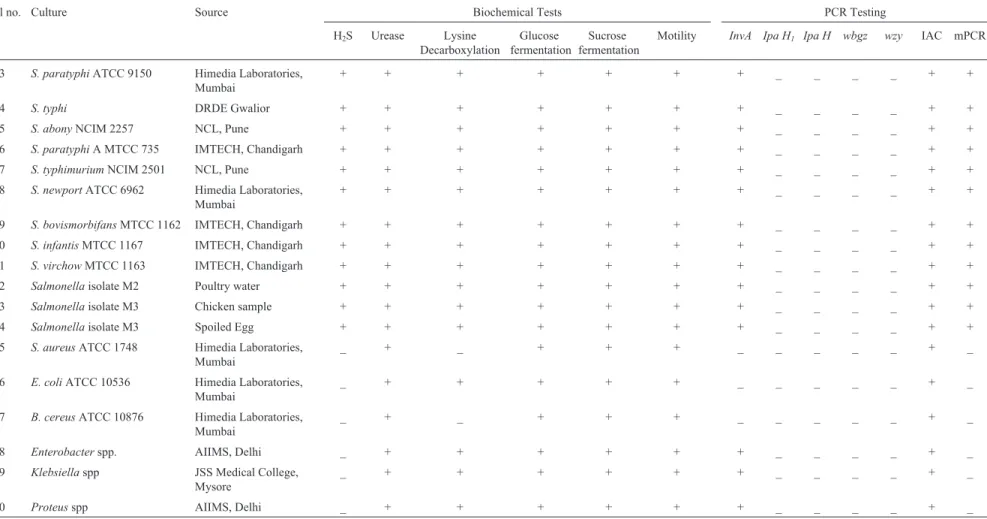
The bacterial strains selected to test the diagnostic specificity of PCR are listed in Table 1. These included ref-erence strains, human clinical isolates and food and envi-ronmental isolates. Standard strains and isolates were grown in Nutrient broth and then streaked on selective agars procured from Himedia (Mumbai, India). Presump-tive colonies selected on Deoxycholate Citrate Agar (DCA), Salmonella Shigella Agar (SSA) and Xylose Lysine Deoxycholate Agar (XLD) were further subjected to biochemical tests viz., Lysine Decarboxylation, Hydro-gen di sulphide (H2S) production, carbohydrate fermenta-tion and Urease producfermenta-tion and motility test (Food and Drug Administration, 1995). The bacterial strains were pe-riodically subcultured and were used for DNA extraction. DNA Extraction
Each tube containing 5 mL of Luria Bertani broth (LB) was inoculated with each culture and incubated (37 °C, 24 h) in shaking conditions. Template DNA from each bacterial strain was extracted by boiling lysis method (Theronet al., 2001) or by commercial DNA extraction kit (Qiagen, Germany). One milliliter of cells was removed and centrifuged at 10,000 rpm for 3 min. The pellet was resupended in 50 mL of distilled water, boiled for 12 min, and centrifuged again for 3 min at 12,000 rpm. The super-natant was transferred to a new microfuge tube and the DNA concentration was estimated by NanoDrop-ND-1000 spectrophotometer (Thermo scientific, India) and the DNA was stored at -20 °C until further use.
Primers and Internal amplification control
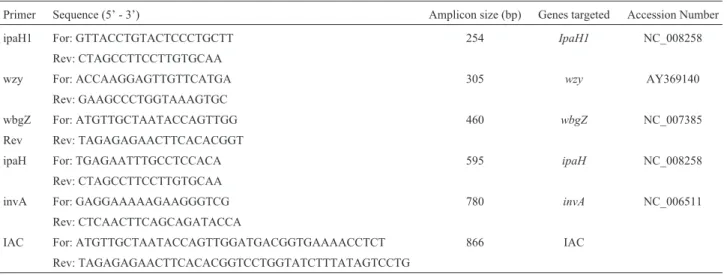
Five sets of primers were designed to detectinvA, ipaH, ipaH1andwbgZandwzygenes using Gene Bank da-tabase sequences. Conserved regions were selected and
mPCR
to
detect
Salmonella
and
Shigella
669
Table 1- List of bacterial cultures, source, biochemical and PCR results.
Sl no. Culture Source Biochemical Tests PCR Testing
H2S Urease Lysine
Decarboxylation
Glucose fermentation
Sucrose fermentation
Motility InvA Ipa H1 Ipa H wbgz wzy IAC mPCR
1 S. flexneriATCC 9199 Himedia Laboratories, Mumbai
_ _ _ + + _ _ + + _ _ + +
2 S. flexneriD1 SDM Medical college,
Dharwad
_ _ _ + + _ _ + + _ _ + +
3 S. flexneriATCC 5160 Himedia Laboratories, Mumbai
_ _ _ + + _ _ + + _ _ + +
4 S. flexneriATCC 12022 Himedia Laboratories, Mumbai
_ _ _ + + _ _ + + _ _ + +
5 S. flexneriJ -1 JSS Medical College, Mysore
_ _ _ + + _ _ + + _ _ + +
6 Shigellaisolate M1 Poultry litter _ _ _ + + _ _ + + _ _ + +
7 S. sonneiCMC CMC Medical College,
Vellore
_ _ _ + + _ _ + _ + _ + +
8 S. sonneiATCC 9290 Himedia Labora-tories, Mumbai
_ _ _ + + _ _ + _ + _ + +
9 S. boydiiD3A SDM Medical
col-lege, Dharwad
_ _ _ + + _ _ + _ _ + + +
10 S. boydiiD3B SDM Medical
col-lege, Dharwad
_ _ _ + + _ _ + _ _ + + +
11 S. boydiiATCC 9207 Himedia Laboratories, Mumbai
_ _ _ + + _ _ + _ _ + + +
12 S. enteritidis DRDE, Gwalior + + + + + + + _ _ _ _ + +
13 S. typhimuriumKMC - 2 KMC, Manipal + + + + + + + _ _ _ _ + +
14 S. typhimurium10259 NICED, Kolkata + + + + + + + _ _ _ _ + +
15 S. typhimuriumATCC 14028 Himedia Laboratories, Mumbai
+ + + + + + + _ _ _ _ + +
16 S. typhimuriumMTCC 98 IMTECH, Chandigarh + + + + + + + _ _ _ _ + +
17 S. typhimuriumMTCC 1251 IMTECH, Chandigarh + + + + + + + _ _ _ _ + +
18 S. typhimuriumMTCC 1253 IMTECH, Chandigarh + + + + + + + _ _ _ _ + +
19 S. typhimuriumKMC 1 KMC, Manipal + + + + + + + _ _ _ _ + +
20 S. typhimuriumBCH 703 NICED, Calcutta + + + + + + + _ _ _ _ + +
21 S. bruneiMTCC 1168 IMTECH, Chandigarh + + + + + + + _ _ _ _ + +
22 S. arizonaeATCC 13314 Himedia Laboratories, Mumbai
670
Radhika
et
al.
Sl no. Culture Source Biochemical Tests PCR Testing
H2S Urease Lysine
Decarboxylation
Glucose fermentation
Sucrose fermentation
Motility InvA Ipa H1 Ipa H wbgz wzy IAC mPCR
23 S. paratyphiATCC 9150 Himedia Laboratories, Mumbai
+ + + + + + + _ _ _ _ + +
24 S. typhi DRDE Gwalior + + + + + + + _ _ _ _ + +
25 S. abonyNCIM 2257 NCL, Pune + + + + + + + _ _ _ _ + +
26 S. paratyphiA MTCC 735 IMTECH, Chandigarh + + + + + + + _ _ _ _ + +
27 S. typhimuriumNCIM 2501 NCL, Pune + + + + + + + _ _ _ _ + +
28 S. newportATCC 6962 Himedia Laboratories, Mumbai
+ + + + + + + _ _ _ _ + +
29 S. bovismorbifansMTCC 1162 IMTECH, Chandigarh + + + + + + + _ _ _ _ + +
30 S. infantisMTCC 1167 IMTECH, Chandigarh + + + + + + + _ _ _ _ + +
31 S. virchowMTCC 1163 IMTECH, Chandigarh + + + + + + + _ _ _ _ + +
32 Salmonellaisolate M2 Poultry water + + + + + + + _ _ _ _ + +
33 Salmonellaisolate M3 Chicken sample + + + + + + + _ _ _ _ + +
34 Salmonellaisolate M3 Spoiled Egg + + + + + + + _ _ _ _ + +
35 S. aureusATCC 1748 Himedia Laboratories, Mumbai
_ + _ + + + _ _ _ _ _ + _
36 E. coliATCC 10536 Himedia Laboratories, Mumbai
_ + + + + + _ _ _ _ _ + _
37 B. cereusATCC 10876 Himedia Laboratories, Mumbai
_ + _ + + + _ _ _ _ _ + _
38 Enterobacterspp. AIIMS, Delhi _ + + + + + + _ _ _ _ + _
39 Klebsiellaspp JSS Medical College, Mysore
_ + + + + + + _ _ _ _ + _
40 Proteusspp AIIMS, Delhi _ + + + + + + _ _ _ _ + _
primers were designed with Gene runner software (http://www.generunner.com). The gene bank accession numbers of the gene sequences used to design the primers are given in the Table 2. Sequences of all primers (Table 2) were evaluated using the Primer-BLAST and BLASTn tools (http://www.ncbi.nlm.nih.gov/tools/primer-blast/) to identify any non-specific targets and to anticipate the speci-ficity of the PCR assay. PCR products ranged from 254 bp to 866 bp in length. Appropriate care was taken to ensure that the primer pairs had similar annealing temperature and the resulting amplicons had a minimum 50 bp difference among themselves (Table 2). The primer pairs were custom synthesized from Eurofins Pvt Ltd., Bangalore (Table 2).
To check the presence of inhibitors within PCR mix-ture, an IAC was constructed. The primers used in this reac-tion had 5’ overhanging ends, which were identical to the primer wbgZ (factor essential for putative epimerase/dehy-dratase protein) whereas 3’ ends were complementary to a DNA sequence of pUC 19 (Table 2). The PCR reaction mix-ture for generation of IAC DNA contained 6 picomolar of each primer, 100mM each dNTPs (Sigma), 0.5 units ofTaq polymerase, 2.0 millimolar MgCl2in 1x PCR buffer (MBI Fermentas, Canada) with 175 ng pUC 19 plasmid DNA was used as template. The reaction procedure consisted of 30 cy-cles of denaturation at 94 °C for 1 min, primer annealing at 57 °C for 1 min and extension at 72 °C for 1 min. The DNA was denatured for 4 min in the beginning and finally ex-tended for 10 min at 72 °C (Eppendorf master cycler gradi-ent, Hamburg Germany). PCR product was purified using commercially available kit (Qiagen, Hilden, Germany). The concentration of IAC DNA was determined spectrophoto-metrically at 260 nm and was stored in DDW at -20 °C. The following equation was used to calculate the copy number of the PCR product concentration: weight of PCR fragment (in gmL-1) x (6.023 x 1023) / (660 g mol L-1x number of base
pairs of PCR fragment) = the number of genomic copy per microlitre (Maheshet al., 2009).
Standardization of multiplex PCR
Initially, presence of all genes in the standard strains was confirmed by performing monoplex PCRs. Multiplex PCR was standardized by empirically varying critical fac-tors that affect multiplexing, primer concentrations, amount of MgCl2, annealing time and temperature. Multi-plex PCR was optimized in an Eppendorf master thermal cycler (Hamburg, Germany) with a reaction volume of 30mL reaction containing 2.5 picomolar each of IpaH1 F and IpaH1 R primers, 4.0 picomolar each of wzy F and wzy R primers, 5.0 picomolar each of IpaH F and IpaH R prim-ers and 6.0 picomolar each of wbgZ and invA F and wbgZ and invA R primers, 200mM of each dNTP, 7000 copies of IAC DNA, 1 unit ofTaqpolymerase, 2 mM MgCl2in 1x PCR buffer with 1.2mL of mixed template DNA from bac-terial samples. Amplification consisted of initial denatur-ation at 94 °C for 4 min followed by 30 cycles of denaturation at 94 °C for 1 min, primer annealing at 57 °C for 1 min and extension at 72 °C for 1 min and followed by a final extension at 72 °C for 10 min. The PCR products were electrophoresed on 2% agarose gel stained with ethidium bromide and visualized under UV transillumi-nator (G-Box, syngene, India).
Determination of specificity and sensitivity of multiplex PCR
The specificity of the multiplex PCR primers was de-termined against different organisms as shown in Table 1 by taking 1.5mL of template DNA from each of the organ-ism (approx. 107cfu). The procedure for PCR was essen-tially the same as described earlier. To assess sensitivity, minimum amount of DNA detectable by multiplex PCR,
mPCR to detectSalmonellaandShigella 671
Table 2- List of targeted genes, primer sequences and expected product size.
Primer Sequence (5’ - 3’) Amplicon size (bp) Genes targeted Accession Number
ipaH1 For: GTTACCTGTACTCCCTGCTT 254 IpaH1 NC_008258
Rev: CTAGCCTTCCTTGTGCAA
wzy For: ACCAAGGAGTTGTTCATGA 305 wzy AY369140
Rev: GAAGCCCTGGTAAAGTGC
wbgZ For: ATGTTGCTAATACCAGTTGG 460 wbgZ NC_007385
Rev Rev: TAGAGAGAACTTCACACGGT
ipaH For: TGAGAATTTGCCTCCACA 595 ipaH NC_008258
Rev: CTAGCCTTCCTTGTGCAA
invA For: GAGGAAAAAGAAGGGTCG 780 invA NC_006511
Rev: CTCAACTTCAGCAGATACCA
IAC For: ATGTTGCTAATACCAGTTGGATGACGGTGAAAACCTCT 866 IAC
10-fold serial dilutions of overnight growth ofS. flexneri ATCC 9199,S. sonneiATCC 9290,S. boydiiATCC 9207 andS. typhimuriumMTCC 98 were serially diluted in ster-ile saline (0.8%) to achieve concentrations of 108-100cfu/mL. DNA was prepared by boiling method and multiplex PCR assay was performed on the boiled lysates of each diluted culture in order to detect the minimum num-ber of cells.Escherichia coligenomic DNA was used as a negative control.
Analysis of experimentally spiked food sample
In order to estimate the interference of food matrices on the sensitivity, detectable concentration of target organ-isms (108cfu/mL) were ten-fold serially diluted in 10 mL saline. Retort processedchicken pulavrinse was prepared by macerating 10 g of sample in 90 mL of peptone water us-ing stomacher. The rinse was centrifuged at 1,500gto get rid of the particulate debris and supernatant was stored in aliquots of 10 mL at -20 °C for further use. Ten milliliter each ofchicken pulavrinse were spiked with S. flexneri ATCC 9199,S sonneiATCC 9290,S. boydiiATCC 9207 andS. typhimuriumMTCC 98 culture with cell concentra-tion ranging from 108to 101cfu mL-1and incubated over-night (18 h) at 37 °C. One milliliter was taken at the end of the incubation period from all the samples and processed for DNA extraction by boiling method. The DNA (1.5mL) was used as template in PCR assay. Simultaneously 100mL sample from each dilution was plated to assess the cfu’s. Similar sampling and analysis were done after 5 h incuba-tion also.
Investigation ofSalmonella entericaandShigella
spp., from food and environmental sources
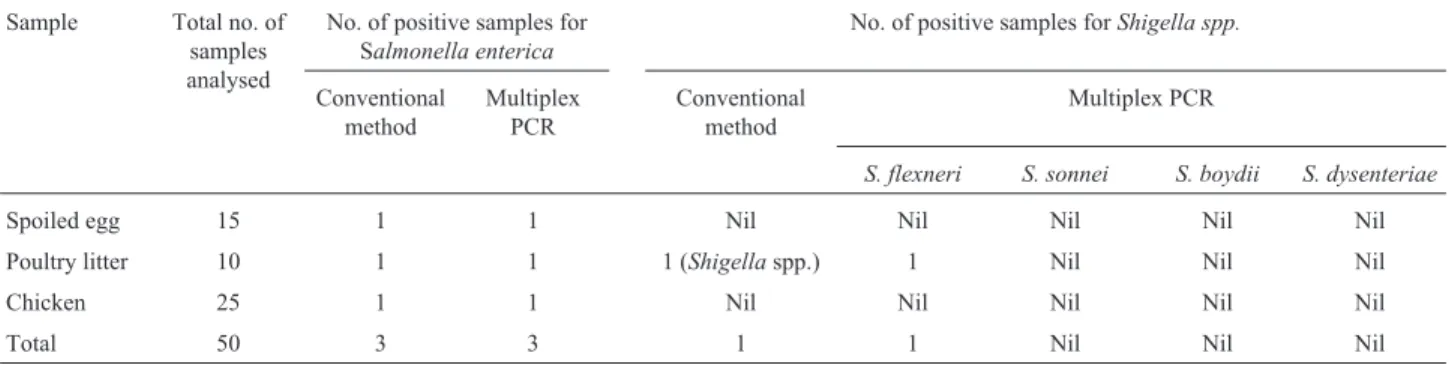
Fifty food and environmental samples obtained from various localities in Mysore region were assessed for the presence ofSalmonella entericaandShigellaspecies fol-lowing standard enrichment and isolation procedures and also by multiplex PCR method (Table 3). For this 25 g of sample was aseptically cultured in 225 mL of Lactose broth and incubated at 37 °C for 24 h. About 1 mL of sample was transferred to 9 mL of tetrathionate broth (Himedia, India) and incubated at 37 °C for 24 h. Subsequently, a loopful of
broth was streaked on surface of SDA, SSA and XLD agar (Himedia, India) and incubated at 37 °C for 24 h. Further, biochemical tests were carried out by conventional meth-ods for suspected isolates (Wallace and Thomas, 1998). Genomic DNA (1.5mL) prepared from 1 mL enrichment broth (short enrichment incubation step of 5 h in peptone water) by boiling lysis method was used in multiplex PCR.
Results
Bacterial strains and cultural methods
All the cultures as listed in Table 1 were characterized by conventional method and colonies selected on DCA, SSA and XLD agar were further confirmed by biochemical tests.Salmonellacultures were found to be positive for fer-mentation of Mannitol, Dextrose, Lysine decarboxylation, H2S production, and negative for fermentation of Lactose, Sucrose and urease whereasShigellacultures were nonmo-tile, positive for glucose fermentation, negative for H2S, gas production, lysine decarboxylation and urease as shown in (Table 1).
Standardization of Multiplex PCR for the detection of selected genes:
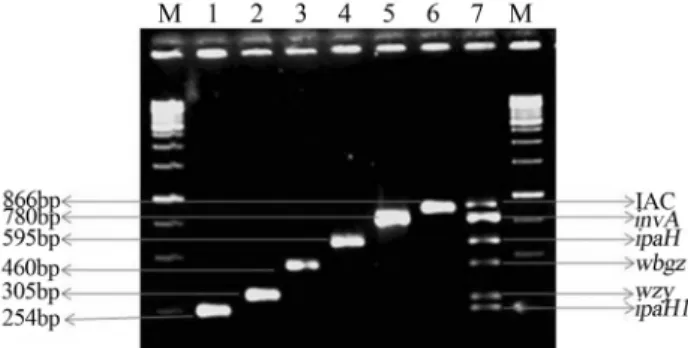
The reaction conditions for the multiplex PCR assay were optimized to ensure that all of the target gene se-quences were satisfactorily amplified. Care was taken to avoid areas of homology with other organisms. The con-centration of primers was optimized after standardizing in-dividual monoplex PCRs (Figure 1) with their respective genes and had almost equal annealing temperature, which reduced the non-specific amplification The annealing tem-perature of 57 °C was selected because at this temtem-perature adequate resolution of all the amplified products could be seen. Serial dilution of IAC incorporated in the multiplex assay revealed that 3000 copies of the same resulted in un-hindered amplification of wbgZ gene for which the IAC primer pair was competitive besides meticulously amplify-ing other multiplex genes (Figure 2) and the detection limit of the assay was found to be 5 pg. The ability of the multi-plex PCR to identifySalmonella entericaandShigellaspp.,
672 Radhikaet al.
Table 3- Comparison of biochemical and mPCR testing on field samples. Sample Total no. of
samples analysed
No. of positive samples for Salmonella enterica
No. of positive samples forShigella spp.
Conventional method
Multiplex PCR
Conventional method
Multiplex PCR
S. flexneri S. sonnei S. boydii S. dysenteriae
Spoiled egg 15 1 1 Nil Nil Nil Nil Nil
Poultry litter 10 1 1 1 (Shigellaspp.) 1 Nil Nil Nil
Chicken 25 1 1 Nil Nil Nil Nil Nil
was validated using Salmonella and Shigella spp., and other strains listed in Table 1.
All the cultures were identified correctly by the dardized multiplex PCR (Figure 1 and Table 1). The stan-dardized multiplex PCR revealed the presence of five bands after agarose gel electrophoresis. On amplification, multiplex PCR yielded a band of 780 bpinvAgene for Sal-monella enterica, 254 bp ipaH1gene forShigella genus, 305 bpwzy gene for S. boydii, 460 bp wbgzgene for S. sonneiand 595 bpipaHgene forS. flexnerion agarose gel electrophoresis. IAC, was coamplified withwbgzprimers and had the amplicon size of 866 bp. As a negative control multiplex PCR was tested with water, no amplicons were observed except IAC. This internal control is highly recom-mended when PCR-based methods are used to detect bacte-rial pathogens (Hoorfaret al., 2004). All these results were compared with the conventional culture, isolation and bio-chemical identification procedures. In the multiplex PCR described here, 1.2 x 10³copies of IAC DNA appeared suit-able in avoiding competition between target DNA and IAC DNA for wbgz primers particularly at low concentration of target DNA. In PCR with an IAC, a control signal will be produced even when there is no target sequence present. This helps in revealing failures of PCR reactions (Hoorfar et al., 2004).
Robustness
There was no significant loss in the visibility of bands at less (10%, 20%) or more (10%, 20%) concentrations of
PCR reagent and IAC DNA. Temperature variation of
±2 °C also did not make any appreciable change in the pro-file.
Specificity and sensitivity of multiplex PCR
There was no amplified product obtained except that of IAC with nonSalmonellaandShigellastrains (Table 1). All the genes specific forShigellaspp., were detected until 10-8dilution which was equivalent to 4 x 10²cfu/mL. In case ofSalmonella enterica, inv Agene was detected until 10-7dilution which was equivalent to 2 x 10³cfu/mL.
Analysis of artificially contaminated chicken samples:
The detection limit was found to be 200 cfu/g, 10 cfu/g, and 30 cfu/g and 20 cfu/g ofS. typhimurium, S. flexneri, S. sonnei andS. boydii respectively in chicken pulavrinse after 5 h of enrichment (Table 3).
Analysis of field samples
Further evaluation of multiplex PCR was undertaken on 50 natural samples (chicken, eggs and poultry litter) and the comparison done with conventional culture isolation and identification procedure. The multiplex PCR could identify the presence ofSalmonella andShigella in three and one samples respectively and the same samples also yielded target organisms by the conventional method.
Discussion
Salmonella andShigella spp.are frequently encoun-tered as food borne outbreaks or occurring as sporadic cases (Alejandroet al., 2012). The conventional methods of isolation and identification of these pathogens primarily depends on selective media followed by a battery of bio-chemical tests that are laborious, costly and time consum-ing (Radjiet al., 2010). Generally, other molecular-based methods like PCRs in monoplex and multiplex formats (Liu et al., 2008), PCR non radioactive labelling, PCR -RFLP PCR -ELISA (Ojhaet al., 2013) and DNA micro-array have a well grounded potential to overcome certain insufficiencies of the conventional methods and is found to be sensitive and reproducible but its application in diagnos-tic field is difficult due to its high cost and the requirement of skilled person (Rahnet al., 1992). Several reported PCR do not discriminate betweenShigellaat the genus and spe-cies levels, nor did they differentiateShigellafrom closely related pathogens such as Salmonella, Citrobacter and enteroinvasiveE. coli(Germani and Sansonetti, 2006; Liu et al., 2008, Vantarakiset al., 2000).
In some multiplex PCR reports, the targeted genes such asVir AandinvA(Vantarakiset al., 2000; Villalobo and Torres, 1998),ipaH (Konget al., 2002),phoP/phoQ (Li and Mustafa, 2004), were not totally specific as some E.coligenes were also getting amplified. According to the ohjaet al.(2013) the primers invC, rfc, wbgz and rfpB de-signed for the identification ofShigellaspp.,S. flexneri, S.
mPCR to detectSalmonellaandShigella 673
Figure 1- Agarose gel showing monoplex and multiplex PCR format.
sonneiandS. dysenteriaewere specific however according to NCBI blast analysis the primers showed cross reactivity with other members of enterobacteriaceae family. Most of the reported multiplex PCRs lack the inclusion of an IAC, to rule out false negative reactions (Liuet al., 2008; Van-tarakiset al., 2000). The false negative PCR reaction might occur due to variation in performance of PCR thermal cyclers, incorrect PCR mixture, inefficiency in Taq poly-merase, personnel and the presence of PCR inhibitors in the sample matrices, therefore inclusion of an IAC in the multi-plex PCR becomes necessary (Malornyet al., 2003).
In the current study, we developed a novel multiplex PCR by combining genus specific and species specific genes and also the conserved genes of respective organisms which has enabled the system to identify Salmonella entericaand differentiateShigellaspecies. In addition, to make the multiplex PCR assay acceptable to the present norms of a diagnostic PCR, IAC was also included. The proficiency of individual primers to yield specific amplifi-cation for the target bacterial species was confirmed ini-tially by monoplex PCR’s and then adapted into multiplex format. Primers designed for this multiplex PCR were cho-sen to maintain a near uniform annealing temperature and also care was taken to maintain 50 bp differences among different PCR products for clear resolution. The selected primers were tested to examine the possible cross-reactions of primers by homology searches using the basic local alignment searching tool (BLAST) program. The IAC was incorporated in pUC 19 plasmid DNA flanked by wbgz primers. Optimum number of copies of IAC DNA was se-lected to give a good visible band in order to avoid competi-tion between target DNA and IAC DNA for wbgz primers. Another important criterion for a diagnostic PCR is robust-ness. No significant loss in the visibility of bands could be observed even with the variation of PCR reagents as well as IAC and DNA concentration.
TheinvA gene ofSalmonella entericaselected in the study has already been proven to be an important diagnostic tool for detection as it contains sequence unique to this ge-nus (Rahnet al., 1992; Shanmugasamyet al., 2011). Simi-larlyipaHgene which is present in multiple copies on both the plasmid and chromosome ofShigella sppis considered to be a good and specific diagnostic tool for the detection of Shigellafrom clinical and food samples (Keniaet al., 2010; Thong et al., 2005). James et al. (2000) sequenced and compared the O antigen gene cluster with other Gram nega-tive bacteria and it showed that thewbgZ gene was con-served forS. sonnei. WbgZgene was used for the molecular cloning ofS. sonnei(Zouet al., 2001) and there was no re-port where this gene is used for PCR based detection. Gene wzyencoding for O-antigen polymerase is highly specific for identification of individual O antigens in case of S. boydii(Jianget al., 2004). All the fourShigellaspecies (S. flexneri, S. sonnei, S. boydii and S. dysenteriae) could be identified correctly with this standardized multiplex PCR
using species specific primers in case ofS. flexneri(ipaH), S. boydii(wzy) andS. sonnei(wbgz). S. dysenteriaewas not included in our study. The standardized multiplex PCR has Shigellagenus specific primer (ipaH1) which was helpful in identifying S. dysenteriae where amplification of the ipaH1gene and IAC and absence of other amplicons con-firmed the presence ofS. dysenteriae. The selectivity and specificity ofinv Agene forSalmonella entericaandipaH1 gene forShigella genus,as observed in our study confirms the earlier observation of Jasmidet al.(2008).
The multiplex PCR had a reasonably high level of sensitivity in experimentally spiked chicken samples. De-tection of very low levels of bacterial contamination in food necessitates that these samples to be cultured for a few hours in peptone water for providing conditions for growth and multiplication of bacterial pathogens to a detectable level, dilution of inhibitory substances present in food and dilution of dead target cells, which provides some assur-ance that the detected DNA belongs from viable target cells. The multiplex PCR reported in our study had a rea-sonably high level of sensitivity in experimentally spiked chicken pulavsamples and able to detect as low as 101and 102organisms per ml ofShigellaandSalmonella enterica respectively following 5 h enrichment in peptone water thus the sensitivity was much better when compared to other reports (Babuet al., 2013; Ojhaet al., 2013). Accord-ing to Ohja et al. (2013) detection limit of mpcr after preincubation in GNB (Gram Negative Broth) was 5 x 10⁴ cells and according to Babuet al. (2013) mpcr detection limit was 10 cfu /PCR after 10 h of incubation in BHI broth. Epidemiological studies onShigellahave established that 10 cells are sufficient to be an infective dose (Wachsmuth and Morris, 1989). The results presented in this work showed that PCR with ipaH1 primers could be a useful tool for the detection as its sensitivity is better when compared with the reported multiplex PCR (Vantarakiset al., 2000). This detection sensitivity was adequate enough to precisely pickup the presence of these pathogens from among the natural food samples. However, the detection sensitivity of spiked food samples is higher when compared with pure reference culture which may be due to the over-night enrichment of spiked food samples. When evaluated on a few naturally occurring food and environmental sam-ples, the multiplex PCR detected three samples positive for Salmonella, one sample positive forS. flexneriwith identi-cal results obtained following the conventional culture, iso-lation and biochemical identification procedures. This strengthens the claim of the developed multiplex PCR as a viable and reliable alternative for simultaneous detection of these organisms within 5-8 h when compared to the weeklong cumbersome isolation and identification proce-dures. Considering the low cost involved and relatively much shorter time needed to detect these important organ-isms this tool is useful for investigation of food borne out-breaks where these organisms are involved. Both multiplex
PCR and conventional isolation and identification method showed good analytical and diagnostic accuracy. This means that non-target microorganisms tested were negative both by PCR and culture while allSalmonellaandShigella strains were positive by both methods. The multiplex PCR assay established in our study highlights the usefulness of the multiplex PCR for concurrent and rapid detection of Salmonella enterica and differentiation of Shigella spp from food and environmental samples.
Conclusion
The major contribution of this study was to develop a multiplex PCR to differentiate Salmonella enterica and Shigella spp.from other closely related members of Entero-bacteriaceae family. The standardized multiplex PCR re-sulted in appropriate PCR amplicons while IAC alone amplified from nonSalmonella and nonShigellaspecies and in negative control where no template DNA was added. This protocol would help in detectingSalmonella enterica andShigella genus and also differentiatingShigellaspp., during routine investigations of food and clinical samples and also during the biological emergencies. The reported multiplex PCR in our study is simple, inexpensive and sen-sitive and enables the quick and precise detection of Salmo-nellaandShigellastrains and could be used in the routine diagnostic laboratory.
Acknowledgments
Authors are thankful for DRDO for providing neces-sary facilities to carry out this work.
References
Alejandro G, Maria-Jose C, Belen R, Martina F, Jorge L, Juan MV, Ana GC (2012) Development of a multiplex real-time PCR method for simultaneous detection of Salmonella enterica,Shigella flexneri and Listeria monocytogenesin processed food samples. Eur Food Res Technol 234:571-580.
Babu L, Reddy P, Murali HS, Batra HV (2013) Optimization and evaluation of a multiplex PCR for simultaneous detection of prominent food borne pathogens of Enterobacteriaceae.
Ann Microbiol 63 (1). DOI 10.1007/s13213-013-0622-0. Batt CA (1997) Molecular diagnostic for diary based pathogens.J.
Dairy Sci.80:220-229.
Brasher CW, De - Paola A, Jones DD, Bej AK (1998) Detection of microbial pathogens in shellfish with multiplex PCR. Curr Microbiol 37:101-107.
Brigittle D, Phillppe JS, Parsof C (1998) Induction of Type 111 secretion inS. flexneriis associated with differential control of transcription of gene encoding secreted proteins. The EMB Journals 17:2894-2901.
D’Aoust JY, (1989)Salmonella. In: Doyle, M.P.(ed). Food borne bacterial pathogens.Marcel Dekker, Inc., New York, Bacel, pp 327-445.
Farfan MJ, Garay TA, Prado CA, Filliol I, Ullao MT, Toro CS (2010) A new multiplex PCR for differential identification
of Shigella flexneri and Shigella sonnei and detection of
Shigella virulence determinants. Epidemiology and Infec 138:525-533.
Food and Drug Administration. 1995. Bacteriological Analytical Manual. 8th ed. Association of Analytical Chemists. Arlington, VA, USA. Available at: http://www.fda.gov/Food/Food Science Re-search/ucm70149.htm Accessed 12 December 2012. Germani Y, Sansonetti PJ, (2006) The genusShigella. In:
Dwor-kin M, Falkow S, Rosenberg E, Schleifer KH, Stackebrandt, E (eds) The Prokaryotes. A hand Book of the Biology of Bacteria. New York, pp 99-116.
Hill WE (1996) The polymerase chain reaction for the detection of food borne pathogens. Crit.Rev.Food 36:123-173.
Hill WE, Ferreira JL, Jones VM (1985) Probability of recovering pathogenic Escherichia coli from foods. Appl Environ Microbiol 49:1374-1378.
Hoorfar J, Malorny B, Abdulmawjood A, Cook N, Wagner M, Fach P (2004) Practical considerations in design of internal amplification controls for diagnostic PCR assays. J Clin Microbiol 5:1863-1868.
James GS, Wang L, Reeves PR (2000) Comparison of O-Antigen Gene Clusters of Escherichia coli (Shigella) Sonnei and
Plesiomonas shigelloides O17: Sonnei gained its current plasmid-borne O-antigen genes fromP. shigelloidesin a re-cent event. Infect Immun. 68:6056-6061.
Jashmid A, Bassami MR, Afshari NS (2008) Identification of Sal-monellaspp., andSalmonella typhimuriumby a multiplex PCR- based assay from poultry carracases in Marshad - Iran. Int J Vet Res 3:43-48.
Jiang T, Feng Lu, Senchekova S, Yang J, Sashkov AS, Guo H, Zhao G, Knirel YA, Reeves P, Wang L (2004) Structural and genetic characterization ofS.boydiiType 13 O antigen. J Bacteriol 186:383-392.
Jousilahti P, Madkour SM, Ambrechts T, Sherwin E (1997) Diarrheal disease morbidity and home practices in Egypt. Public Health 111:5-10.
Jun W Li, Xiu Q Shi, Fu H Chao, Xin W Wang, Jin L Zheng, Nong S (2004) A study on detecting and identifying enteric patho-gens with PCR. Biomedical and Environ Sc 17:109-120. Kenia BJ, Clyde BM, Rosario A (2010) Detection ofShigellain
lettuce by the use of rapid molecular assay with rapid sensi-tivity. Braz J Microbiol 41:993-1000.
Kong RYC, Lee SKY, Law TWF, Law SHW, Wu RSS (2002) Rapid detection of six types of bacterial pathogens in marine waters by multiplex PCR. Water Res 36:2802-2812. Kumar A, Singh SK, Bajpai D (2010) Phenotypic and genotypic
characterization of Shigella spp. with reference to its viru-lence genes and antibiogram analysis from river Narmada. Microbiol. Res 165:33-42.
Kumar S, Balakrishna K, Batra HV (2006) Detection of Salmo-nella entericaserovar Typhi (S. typhi) by selective amplifi-cation of invA, viaB, fliC-dandprtgenes by polymerase chain reaction in multiplex format. Lett Appl Microbiol 42:149-154.
Lantz PG, Hahnhagerdal B, Radstorm P (1994) Sample prepara-tion methods in PCR based detecprepara-tion of food pathogens. Trends in Food Sc. Technol 5:384-389.
Li Y, Mustafa A (2004) Simultaneous Detection ofEscherichia coliO157:H7,SalmonellaandShigellain Apple Cider and Produce by a Multiplex PCR. J Food Protection 67:27-33.
Li Y, Zhuang S, Mustaffa A (2005) Application of a multiplex PCR for the simultaneous detection of Escherichia coli
O157:H7,SalmonellaandShigellain raw and ready-to-eat meat products. J Meat Sc 71:402-406.
Liu B, Knirel YA, Feng L, Perepelov AV (2008) Structure and ge-netics of Shigella O antigens. FEMS Microbiol Rev 32:627-653.
Mahesh S, Radhika M, Murali HS, Batra HV (2009) Detection of
Salmonella entericaserovarTyphimuriumby selective am-plification offliC, fliB, iroB, invA, rfbJ, STM 2755, STM 4497genes by polymerase chain reaction in monoplex and multiplex format. World J Microbiol Biotechnol 25:1385-1394.
Malorny B, Hoorfar J, Bunge C, Helmunth R (2003) Multicenter validation of the analytical accuracy ofSalmonellaPCR: to-wards an international standard. Appl Environ Microbiol 69:290-296.
Miescier JJH, Redman DA, Salinger JA, Lucas JP, (1992) Mollus-can shellfish: oyster, mussels and clams. In. Vanderzant, C., Splittstoesser. (eds). Compendium of Methods for the Mi-crobiology Examination of Goods. Washington DC, Ameri-can Public Health Association, pp 897-918.
Moffat RMC, Appulamy R, Koye A, Carswell A, Denohy D (2012) An outbreak ofSalmonella typhimuriumPhage 135a gastroenteritis’s linked to eggs served at an Australian Capi-tal Territory cafe. Communicable Disease Intelligence 36:212-218.
Niyogi SK (2005) Shigellosis. J Microbiol 43:133-143.
Ojha SS, Yean CY, Ismail A, Singh KKB (2013) A pentaplex as-say for the detection and differentiation of Shigella spp. Biomed Res International. Article ID 412370, 9 pages, 2013. doi:10.1155/2013/412370
Olsen JE, Aabo S, Hill W (1995) Probes and polymerase chain re-action for detection of food borne pathogens. Int J Food Microbiol 28:1-78.
Radji M, Malik A, Widyasmara A (2010) Rapid detection of Sal-monellain food and beverage samples by polymerase chain reaction. Malayasian J Microbiol 6:166-170.
Rahn K, Grandis SA-De, Clarke RC, Mcewen SA, Galan JE, Ginocchio C, Curtiss R, Gyles CL (1992) Amplification of aninvAgene sequence ofSalmonella typhimuriumby poly-merase chain reaction as a specific method of detection of
Salmonella.Mol Cellular Probes 6:271-279.
Shanmugasamy M, Velayutham T, Rajeswar J (2011)InvAgene specific PCR for detection ofSalmonellafrom boilers. Vet World 4:562-564.
Soumet C, Ermel G, Rose N, Drovin P, Salvat G, Colin P (1999) Evaluation of multiplex PCR for simultaneous identification ofSalmonella spp.,Salmonella enteritidis,andSalmonella typhimurium from environment swabs of poultry houses. Appl Environ Microbiol 28:113-117.
Tao J, Feng Lu, Sennchekova SN, Shaskov AS (2004) Structural and genetic characterization ofS.boydiiType 13 O Antigen. J Bacteriol 186:383-392.
Theron J, Morar D, Preez DU, Brozel MVS, Venter SN (2001) A sensitive seminested PCR method for the detection of
Shigellain spiked environmental water samples. Water Res 35:869-874.
Thong KL, Hoe SLL, Puthucheary SD, Yasin RM (2005) Detec-tion of virulence genes in Malaysian Shigellaspecies by multiplex PCR assay. BMC 5. Available at http://www.biomedcentral.com/1471-2334/5/8
Vantarakis G, Komninou DV, Papapetropoulou M (2000) Devel-opment of a multiplex PCR detection ofSalmonellaspp., andShigellaspp., in mussels. Lett App Microbiol 31:105-109.
Villalobo E, Torres A (1998) PCR for detection ofShigella spp.in mayonisse. Appl Environ Microbiol 64:1242-1245. Wachsmuth K, Morris GK (1989)Shigella.In: Doyle, M.P. (ed)
Food Borne Bacterial Pathogens. Marcel Dekker Inc., New York, pp 448-660.
Wallace HA, Thomas SH (1998) Bacteriological Analytical Man-ual. 8th edition, Revision A, Chapter 5, www.cfsan.fda.gov/nebam/bam-5.
Way JS, Josephson KL, Pillai SD, Abbaszadegan M, Gerba CP, Pepper IL (1993) Specific detection ofSalmonellaspp.by multiplex polymerase chain reaction. Appl Environ Microbiol 59:1473-1479.
Zou DQ, John OC, Ambulos N, Burr DH, Kopecko DJ (2001) Molecular cloning and characterization of genes from S. sonnei from I O-polysaccharide: proposed biosynthetic pathway and stable expression in a LiveSalmonellavaccine vector. Inf Immun 70:4414-4423.
All the content of the journal, except where otherwise noted, is licensed under a Creative Commons License CC BY-NC.