Bronchial provocation tests in clinical practice
Teste de broncoprovocação na prática clínica
Marcos de Carvalho Borges
I, Erica Ferraz
II, Elcio Oliveira Vianna
IIIDepartment of Medicine, Faculdade de Medicina de Ribeirão Preto (FMRP), Ribeirão Preto, São Paulo, and Universidade de São Carlos
(UFSCar), São Carlos, São Paulo, Brazil
ABSTRACT
Bronchial hyperresponsiveness, which consists of an exaggerated response of the airways to bronchoc-onstrictor stimuli, is one of the main characteristics of asthma, presented in nearly all asthmatic patients. Bronchial hyperresponsiveness may also be present in other diseases, such as allergic rhinitis, chronic ob-structive pulmonary disease, cystic fibrosis, heart failure and respiratory infection, and with some medica-tions, such as β-blockers. Bronchial provocation tests (also known as bronchial challenges) are used to evaluate bronchial responsiveness. These tests have become increasingly used over the last 20 years, with the development and validation of accurate, safe and reproducible tests, and with the publication of well-detailed protocols. Several stimuli can be used in a bronchial challenge, and they are classified as direct and indirect stimuli. There are many indications for a bronchial challenge. In this review, we discuss the main differences between direct and indirect stimuli, and the use of bronchial challenges in clinical prac-tice, especially for confirming diagnoses of asthma, exercise-induced bronchoconstriction and cough-variant asthma, and for use among elite-level athletes.
RESUMO
Hiperresponsividade brônquica, caracterizada por uma resposta exagerada das vias aéreas a um estímulo broncoconstritor, é uma das principais características da asma, presente em praticamente todos pacientes asmáticos. A hiperresponsividade brônquica pode estar presente também em outras doenças, como rinite alérgica, doença pulmonar obstrutiva crônica, fibrose cística, insuficiência cardíaca, infecção respiratória e com o uso de algumas medicações, como β-bloqueadores. Os testes de broncoprovocação são utilizados para determinação da responsividade brônquica, e têm sido cada vez mais utilizados nos últimos 20 anos com o desenvolvimento e validação de testes acurados, seguros e reprodutíveis e com a publicação de protocolos bem detalhados. Diversos estímulos podem ser utilizados em um teste de broncoprovocação, sendo classificados em estímulos diretos e indiretos. Existem inúmeras indicações para um teste de bron-coprovocação. Nesta revisão, nós discutimos as principais diferenças dos estímulos diretos e indiretos e o uso desses testes na prática clínica, especialmente para a confirmação de asma, broncoconstrição induzi-da por exercício, tosse variante de asma e em atletas de elite.
IMD, PhD. Visiting Professor, Department of
Medicine, Faculdade de Medicina de Ribeirão Preto (FMRP), Ribeirão Preto, São Paulo, and Adjunct Professor, Department of Medicine, Universidade de São Carlos (UFSCar), São Carlos, São Paulo, Brazil.
IIPhD. Research Collaborator, Department of
Medicine, Faculdade de Medicina de Ribeirão Preto (FMRP), Ribeirão Preto, São Paulo, Brazil.
IIIMD, PhD. Associate Professor, Department of
Medicine, Faculdade de Medicina de Ribeirão Preto (FMRP), Ribeirão Preto, São Paulo, Brazil.
Key words:
Bronchial provocation test. Asthma.
Bronchoconstriction. Diagnosis.
Respiratory hypersensitivity.
Palavras-chave:
Testes de provocação brônquica. Asma.
Broncoconstrição. Diagnóstico.
Hipersensibilidade respiratória.
IntroductIon
Bronchial responsiveness is characterized by a change in airway caliber in response to broncho-constrictor and/or bronchodilator stimuli. Bronchial hyperresponsiveness (BHR) is deined as increased responsiveness in comparison with an expected response. his increased response of the airways can be measured by inhalation of speciic or non-speciic stimuli, and it should not be expected to be observed in normal subjects.
Bronchial hyperresponsiveness is measured in laboratories by a bronchial provocation test (also known as a bronchial challenge), and is considered present when the dose-response curve for a bronchoconstrictor stimulus displays: a letward shit (hypersensitivity), an increased slope (hyperreactivity) and an enhanced maximal response compared with the response for a non-asthmatic subject.1-3 In other words, BHR is detected by an abnormal response to a bronchoc-onstrictor stimulus.
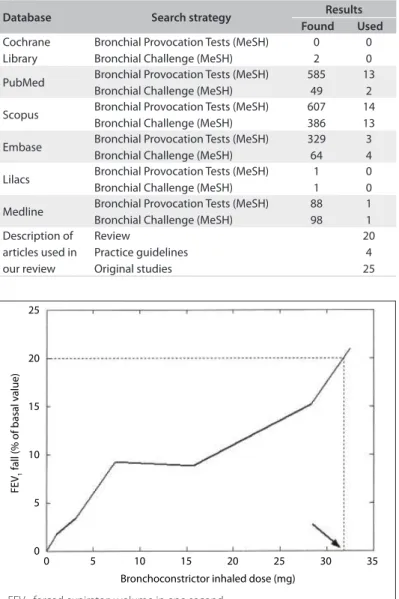
database search strategy results Found used
Cochrane Library
Bronchial Provocation Tests (MeSH) Bronchial Challenge (MeSH)
0 2
0 0
PubMed Bronchial Provocation Tests (MeSH) Bronchial Challenge (MeSH)
585 49
13 2
Scopus Bronchial Provocation Tests (MeSH) Bronchial Challenge (MeSH)
607 386
14 13
Embase Bronchial Provocation Tests (MeSH) Bronchial Challenge (MeSH)
329 64
3 4
Lilacs Bronchial Provocation Tests (MeSH) Bronchial Challenge (MeSH)
1 1
0 0
Medline Bronchial Provocation Tests (MeSH) Bronchial Challenge (MeSH)
88 98
1 1 Description of
articles used in our review
Review
Practice guidelines Original studies
20 4 25
table 1. Reviews and practice guidelines were searched in the Cochrane Library, PubMed, Scopus, Embase, Lilacs and Medline databases, using the keywords Bronchial Provocation Tests and Bronchial Challenge. Additionally, relevant original articles were included
Figure 1. Example of PD20 calculation for hypertonic saline bronchial challenge obtained by interpolation between the last two points (second-to-last and final concentration) of the dose-response curve.
25
20
15
FE
V1
fall (% of basal v
alue)
Bronchoconstrictor inhaled dose (mg) 10
5
0
0 5 10 15 20 25 30 35
FEV1: forced expiratory volume in one second
PD20: provocative dose required to produce a 20% reduction in FEV1
or occupational exposure, physical activity, respiratory infections or medications.3,4
Although bronchial hyperresponsiveness is incom-pletely understood, it is the ultimate result from an interaction between complex and multiple mechanisms, such as inlam-mation, alterations in airway smooth muscle, airway remodel-ing, reduced airway caliber and interaction between airway and lung parenchyma.5-8 In this review, we discuss the main difer-ences between direct and indirect stimuli, and the use of bron-chial challenges in clinical practice, especially for conirming the diagnoses of asthma, exercise induced bronchoconstriction and
cough-variant asthma, and for evaluating dyspnea among elite-level athletes. Systematic reviews and practice guidelines were searched in the Cochrane Library, PubMed, Scopus, Embase, Lilacs, and Medline using the keywords Bronchial Provocation Tests and Bronchial Challenge. Additionally, we included some relevant original studies (Table 1).
Bronchial provocation tests
Generally, bronchial responsiveness is measured in the labora-tory as the change in airway caliber occurring ater inhalation of a bronchoconstrictor stimulus.2 hese tests have become increas-ingly used over the last 20 years, with the development of accu-rate, safe and reproducible bronchial challenges, and with the publication of well-detailed protocols. Bronchial challenge tests are easily performed in adults and children more than seven years of age.3,6,9
Bronchial challenges are performed by the inhalation of a bronchoconstrictor stimulus followed by assessment of its response in terms of lung function, especially forced expi-ratory volume in one second (FEV1). When a fall in FEV1 is achieved, usually between 10 and 20% from the baseline mea-surement, the test is stopped and a concentration or dose is calculated and named provocative concentration (PC) or pro-vocative dose (PD), respectively (Figure 1).3,6,9,10
he absolute contraindications for bronchial challenges are severe airlow limitation (FEV1 < 50% predicted or < 1.0 l), heart attack or stroke within the last three months, uncontrolled hyper-tension, systolic BP > 200 mmHg, or diastolic BP > 100 mmHg, and known aortic aneurysm. he relative contraindications are moderate airlow limitation (FEV1 < 60% predicted or < 1.5 l), inability to perform acceptable-quality spirometry, pregnancy, nursing mothers, current use of cholinesterase inhibitor medi-cation (for myasthenia gravis) and epilepsy requiring medical treatment.3,6,9,10
direct stimuli
Methacholine Histamine Acetylcholine Carbachol Prostaglandin D2 Leukotriene C4/D4/E4
Indirect stimuli
Hypertonic aerosols (hypertonic saline, mannitol) Hypotonic aerosols
Exercise
Eucapnic voluntary hyperpnea Bradykinin
Adenosine Propranolol Metabisulphite Tachykinins
chart 1. Direct and indirect stimuli used to measure bronchial responsiveness. Direct stimuli cause bronchoconstriction through action on effector cells and indirect stimuli cause bronchoconstriction through action on another cells, which interact secondarily with the effector cells. Some stimuli are able to cause bronchoconstriction through both direct and indirect action. The stimuli are classified according their main/dominant mechanism
Bronchial challenges should be performed in the presence of staf with appropriate training for treating acute bronchocon-striction, including appropriate use of resuscitation equipment, which must be close enough to respond quickly to an emergency. Medications to treat severe bronchoconstriction must be pres-ent in the room where the test takes place. hey include epineph-rine and atropine for subcutaneous injection, and salbutamol/ albuterol and ipratropium in metered-dose inhalers or premixed solutions for inhalation. Oxygen must be readily available. A small-volume nebulizer should be readily available for adminis-tration of bronchodilators. A stethoscope, sphygmomanometer and pulse oximeter should be available. Patients should not be let unattended during the procedure. Usually, the bronchocon-striction is transitory and easily managed with bronchodilators. he roomneeds to be eicientlyventilated, and staf with active asthma should not performthe test or be present in the room where it takes place.3,6,9,10
direct and indirect stimuli
Several stimuli are in use for bronchial challenges, and each may constitute a piece of the jigsaw puzzle on the pathophysi-ology of BHR and respiratory diseases.11 he bronchial stimuli can be classiied into direct and indirect stimuli, according to the main/dominant mechanism through which they cause the bron-choconstriction.12 his classiication highlights the heterogene-ity of the airway response to the diferent stimuli, and helps in understanding the diferences in sensitivity and speciicity of the stimuli and the efect of treatment on hyperresponsiveness.5,10,12 herefore, the results from diferent bronchial challenges should be interpreted according to the stimulus used and the disease phase and treatment.
Direct stimuli cause bronchoconstriction acting on the efector cells, such as airway smooth muscle cells, bronchial vascular endothe-lial cells and mucus-producing cells.5 he main direct stimulus used in clinical practice is methacholine. Indirect stimuli cause broncho-constriction through action on another cells, such as inlammatory cells, epithelial cells and/or neuronal cells, which interact secondarily with these efector cells.5,11 he main indirect stimuli used in clini-cal practice are hypertonic saline, mannitol, bradykinin, exercise and eucapnic voluntary hyperpnea. Some stimuli are able to cause bron-choconstriction through both direct and indirect action. Several stimuli used for bronchial challenge are listed in Chart 1.
Both direct and indirect stimuli can be used as complementary information in diagnosing respiratory diseases, such as asthma, cough and exercise-induced bronchoconstriction (EIB). Although there are diferences in the airway response to the diferent stimuli, our experience shows that it is more important, in general practice, to get used to one bronchoconstrictor stimulus and protocol (thus knowing its advantages and limitations), than to use several stimuli only few times each (thus knowing several stimuli supericially).
he major diference between direct and indirect stimuli, in general practice, is the sensitivity and speciicity of each stimulus in diagnosing respiratory diseases, especially asthma. Bronchial challenge with direct stimuli, such as histamine and methacho-line, is extremely sensitive for diagnosing asthma patients. How-ever, these stimuli lack speciicity, both in diferentiating asthma from normal and asthma from chronic airlow limitation.4 here-fore, while a positive challenge in a symptomatic patient, espe-cially with direct stimuli, does not conirm asthma, a negative test has a highly negative predictive value and rules out asthma.
Indirect stimuli are used in bronchial challenges because of their higher speciicity for identifying people with active asthma, and to evaluate treatments with anti-inlammatory drugs.5,10,12 he major advantage of indirect stimuli is their capacity to act on many diferent cells, so that a wide variety of substances con-tribute towards the airway narrowing (e.g., histamine, leukot-rienes, prostaglandins and neuropeptides), which makes the response more similar to bronchoconstriction developed dur-ing daily activities.10,13,14 Since indirect stimuli have higher speci-icity, another advantage is the lack of false-positive tests; hence the interest in these stimuli in epidemiological studies on asthma prevalence.10,15 It has been suggested that indirect stimuli would better relect the degree of airway inlammation than would direct stimuli, with greater usefulness for evaluating and moni-toring the response to anti-inlammatory drugs.5,16,17
the use of bronchial provocation tests in general practice
cough-To confirm the diagnosis of asthma
To confirm the diagnosis of exercise-induced bronchoconstriction To investigate cough-variant asthma
To identify and evaluate the response and efficacy of drugs, like anti-inflammatory drugs
To collect sputum
To identify those who may experience airway narrowing while diving with self-contained underwater breathing apparatus (SCUBA)
To clear unwanted secretions
To differentiate asthma from chronic airflow limitation To evaluate elite-level athletes
chart 2. Indications for a bronchial challenge
variant asthma; to investigate occupational asthma; to identify and evaluate the response and eicacy of drugs, like anti-in-lammatory drugs; to collect sputum; to identify those who may experience airway narrowing while diving with self-contained underwater breathing apparatus (SCUBA); to clear unwanted secretions; to diferentiate asthma from chronic airlow limita-tion; and to evaluate elite-level athletes.4,10 (Chart 2).
Despite the numerous indications, in general practice, bron-chial challenges are mostly used for conirming the diagnoses of asthma, EIB and cough-variant asthma, and for assessing elite-level athletes, as will be discussed subsequently.4,10
the use of bronchial provocation tests in diagnosing asthma
A correct diagnosis for asthma is essential for adequate therapy. Asthma generally manifests with symptoms of episodic breath-lessness, wheezing, coughing and chest tightness and is conirmed through airlow limitation and reversibility, as detected through lung function tests (spirometry or peak expiratory low).18 Other tests, such as measurements of allergic status, airway responsive-ness and inlammation, can be used in atypical presentations.18
Among patients with symptoms consistent with asthma who present normal lung function, an objective measurement such as a bronchial challenge, with direct or indirect stimuli, may help establish a diagnosis of asthma.10,19,20 In these patients, detection of BHR suggests the diagnosis of asthma. he level of BHR in the bronchial challenge can also be used. Although there is no thresh-old that diferentiates asthma from other diseases that present BHR, the BHR of asthma patients is usually more severe. here-fore, there is a correlationbetween the degree of airway respon-siveness and asthma symptoms,21,22 e.g. a histamine or methacho-line PC20 greater than 8 (or 16) mg/ml rules out current asthma in most instances, whereas a PC20 less than 1 mg/ml is almost diagnostic of current asthma. Values between 1 and 8 mg/ml are intermediate in this regard.23 Since bronchial challenges have high sensitivity and limited speciicity, a negative result can be useful for ruling out a diagnosis of persistent asthma, but a pos-itive result does not always conirm the diagnosis.18,21,23 If the diagnosis ater the bronchial challenge results remains uncertain,
other tests, such as prick test, IgE measurement or induced spu-tum can be used as measurements of allergic status and airway inlammation, and/or a therapeutic test could be initiated.
It is important to evaluate the patient’s clinical status and the medications used, given that the BHR is a dynamicprocess that can vary over time. It can increase ater exposure to vari-ous environmental sensitizers and drugs (e.g. airborne allergens, substances foundat the workplace, respiratory infections or pro-pranolol), and itcan decrease spontaneously or ater anti-inlam-matory therapy.21,24,25
the use of bronchial provocation tests in diagnosing cough-variant asthma
Asthma is one of the most common etiologies among patients with a chronic cough. Other common diagnoses are postnasal drip syn-drome and gastroesophageal relux.26,27 Some patients with asthma have coughing as the sole symptom, and this is termed cough-variant asthma.28 herefore, among patients with a chronic cough, asthma should always be considered as a potential etiology.26
Among patients with a chronic cough associated with revers-ible airway low obstruction, the diagnosis of asthma should be considered and treatment for asthma should be initiated. How-ever, among patients with a chronic cough and normal spirom-etry, additional tests should be done, including bronchial chal-lenge. In these patients, the presence of BHR documented in a bronchial challenge suggests the diagnosis of asthma, and treat-ment should be initiated in order to conirm the diagnosis. Eval-uation of treatment response is essential, since the diagnosis of asthma is conirmed only when a positive bronchial challenge is followed by a favorable response to asthma therapy, usually with the use of inhaled corticosteroids for one week.29 On the other hand, given the high speciicity of bronchial challenges, a neg-ative result rules out asthma from the diferential diagnosis of chronic cough.1 Methacholine has been the stimulus most fre-quently indicated and used in cough-variant asthma investi-gations. Some studies have demonstrated that indirect stimuli could also be used, but more studies are needed before that can be used in routine practice.30,31
Bronchial provocation tests in exercise-induced bronchoconstriction
among athletes is higher, and notiications by athletes have been increasing in recent Olympic Games.32,36 Because athletes with-out asthma may have been using inhaled β2-agonists in order to improve performance, it has been recommended that athletes should demonstrate current asthma, EIB or BHR in order to be approved to inhale β2-agonists at the Olympic Games.36
Among patients with a diagnosis of asthma, a complete his-tory associated with therapeutic test is enough for a diagnosis of EIB. Among patients with symptoms of EIB and normal spirom-etry, and among elite athletes, bronchial challenges are necessary. he most accurate tests for assessing EIB are exercise, eucapnic voluntary hyperpnea, hyperosmolar aerosols such as 4.5% saline, mannitol and methacholine.32,36 Because the airway response depends on the intensity of exertion and on environmental vari-ables such as temperature, air humidity and time of the day,37,38 it is crucial to know the conditions under which the bronchial challenge was done, in order to make an appropriate interpreta-tion of its results.39
For elite athletes, the bronchial challenges accepted are exer-cise, eucapnic voluntary hyperpnea, hyperosmolar aerosols such as 4.5% saline, mannitol and methacholine. For exercise and eucapnic voluntary hyperpnea, a fall in FEV1 of 10% is consis-tent with EIB; for hypertonic saline and mannitol, a fall in FEV1 of 15% is considered to be BHR; and, for methacholine, a fall in FEV1 of 20% conirms EIB diagnosis. Bronchial challenges with other stimuli, such as carbachol, histamine or adenosine mono-phosphate, have not been accepted by the International Olympic Committee’s Medical Commission.36 Although laboratory-based challenges can be used for identifying EIB, ield-based bronchial challenge has been found to be more sensitive.40 Moreover, the sensitivity of methacholine for identifying EIB in elite athletes has been reported to be low and less than 40%. herefore, among elite athletes, a negative methacholine challenge does not com-pletely rule out EIB, and an indirect stimulus can be used for fur-ther evaluation.36,41,42 Since many other conditions can mimic EIB, a detailed clinical history and physical examination should precede the bronchial challenge.
Perspectives
Bronchial challenges are useful in studying pathophysiologi-cal characteristics of respiratory diseases, such as the relation-ship between bronchial responsiveness and airway inlammation and remodeling. hey could also be used as an index for asthma severity and clinical control. Moreover, bronchial challenges are an essential step in the development of new anti-asthma treat-ments and can provide key information on the therapeutic potential of these new agents and their anti-inlammatory efects on the airways.43-45
Because of the lack of a reference diagnostic test (gold standard), it is diicult to determine the exact sensitivity and
speciicity of each diferent stimulus and for each disease. Some studies rely on physician diagnosis as the gold standard, but such assessments are highly subjective.41
Several studies have aimed to use bronchial challenge as an additional therapeutic choice. In cystic ibrosis, inhaled mannitol treatment signiicantly improved lung function.46 We have dem-onstrated that performing two hypertonic saline challenges in the evening attenuated the nocturnal fall in FEV1 among asth-matic patients.47
Epidemiological studies on asthma have been hampered by lack of consistency in the results between reports. Most dei-nitions of asthma have emphasized variable airlow obstruc-tion and highlighted inlammaobstruc-tion as essential elements of the condition. However, a positive BHR has been used as a relative standard criterion of validity. he association between positive BHR and symptoms has been seen as a gold standard deinition of asthma and is a matter discussed in recent studies on asthma detection in large populations.48,49
reFerences
1. Crapo RO, Casaburi R, Coates AL, et al. Guidelines for methacholine
and exercise challenge testing-1999. This official statement of
the American Thoracic Society was adopted by the ATS Board of
Directors, July 1999. Am J Respir Crit Care Med. 2000;161(1):309-29.
2. Joos GF. Bronchial hyperresponsiveness: too complex to be useful?
Curr Opin Pharmacol. 2003;3(3):233-8.
3. Sterk PJ, Fabbri LM, Quanjer PH, et al. Airway responsiveness.
Standardized challenge testing with pharmacological, physical and
sensitizing stimuli in adults. Report Working Party Standardization of
Lung Function Tests, European Community for Steel and Coal. Official
Statement of the European Respiratory Society. Eur Respir J Suppl.
1993;16:53-83.
4. Joos GF, O’Connor B, Anderson SD, et al. Indirect airway challenges.
Eur Respir J. 2003;21(6):1050-68.
5. Van Schoor J, Joos GF, Pauwels RA. Indirect bronchial
hyperresponsiveness in asthma: mechanisms, pharmacology and
implications for clinical research. Eur Respir J. 2000;16(3):514-33.
6. Boulet LP, Laviolette M, Turcotte H, et al. Bronchial subepithelial
fibrosis correlates with airway responsiveness to methacholine.
Chest. 1997;112(1):45-52.
7. Cockcroft DW, Davis BE. Mechanisms of airway hyperresponsiveness.
J Allergy Clin Immunol. 2006;118(3):551-9; quiz 560-1.
8. Martin JG, Duguet A, Eidelman DH. The contribution of
airway smooth muscle to airway narrowing and airway
hyperresponsiveness in disease. Eur Respir J. 2000;16(2):
349-54.
9. Beydon N, Davis SD, Lombardi E, et al. An official American Thoracic
Society/European Respiratory Society statement: pulmonary
function testing in preschool children. Am J Respir Crit Care Med.
10. Anderson SD, Brannan JD. Methods for «indirect» challenge tests
including exercise, eucapnic voluntary hyperpnea, and hypertonic
aerosols. Clin Rev Allergy Immunol. 2003;24(1):27-54.
11. de Meer G, Marks GB, Postma DS. Direct or indirect stimuli for bronchial
challenge testing: what is the relevance for asthma epidemiology?
Clin Exp Allergy. 2004;34(1):9-16.
12. Joos GF, Kips JC, Pauwels RA. Direct and indirect bronchial
responsiveness. Respir Med. 1993;87 Suppl B:31-6.
13. Brannan JD, Gulliksson M, Anderson SD, Chew N, Kumlin M. Evidence
of mast cell activation and leukotriene release after mannitol
inhalation. Eur Respir J. 2003;22(3):491-6.
14. O’Sullivan S, Roquet A, Dahlén B, et al. Evidence for mast cell
activation during exercise-induced bronchoconstriction. Eur Respir
J. 1998;12(2):345-50.
15. Worldwide variation in prevalence of symptoms of asthma, allergic
rhinoconjunctivitis, and atopic eczema: ISAAC. The International
Study of Asthma and Allergies in Childhood (ISAAC) Steering
Committee. Lancet. 1998;351(9111):1225-32.
16. Rodwell LT, Anderson SD, Seale JP. Inhaled steroids modify bronchial
responses to hyperosmolar saline. Eur Respir J. 1992;5(8):953-62.
17. Pauwels R, Joos G, Van der Straeten M. Bronchial hyperresponsiveness
is not bronchial hyperresponsiveness is not bronchial asthma. Clin
Allergy. 1988;18(4):317-21.
18. Global Strategy for Asthma Management and Prevention. South
Africa: University of Cape Town Lung Institute; 2008. Available from:
http://www.medicinainterna.org.uy/Articulos/Neumologia/GINA_
Report_08.pdf. Accessed in 2011 (Jan 28).
19. Adelroth E, Hargreave FE, Ramsdale EH. Do physicians need
objective measurements to diagnose asthma? Am Rev Respir Dis.
1986;134(4):704-7.
20. Cockcroft DW. Bronchoprovocation methods: direct challenges. Clin
Rev Allergy Immunol. 2003;24(1):19-26.
21. Boulet LP. Asymptomatic airway hyperresponsiveness: a curiosity
or an opportunity to prevent asthma? Am J Respir Crit Care Med.
2003;167(3):371-8.
22. Cockcroft DW, Killian DN, Mellon JJ, Hargreave FE. Bronchial reactivity
to inhaled histamine: a method and clinical survey. Clin Allergy.
1977;7(3):235-43.
23. Cockcroft DW, Murdock KY, Berscheid BA, Gore BP. Sensitivity and
specificity of histamine PC20 determination in a random selection of
young college students. J Allergy Clin Immunol. 1992;89(1 Pt 1):23-30.
24. Rijcken B, Schouten JP, Weiss ST, et al. Long-term variability of
bronchial responsiveness to histamine in a random population
sample of adults. Am Rev Respir Dis. 1993;148(4 Pt 1):944-9.
25. Carpentiere G, Castello F, Marino S. Increased responsiveness to
histamine after propranolol in subjects with asthma nonresponsive
to the bronchoconstrictive effect of propranolol. J Allergy Clin
Immunol. 1988;82(4):595-8.
26. Dicpinigaitis PV. Chronic cough due to asthma: ACCP
evidence-based clinical practice guidelines. Chest. 2006;129(1 Suppl):75S-9S.
27. Irwin RS, Curley FJ, French CL. Chronic cough. The spectrum and
frequency of causes, key components of the diagnostic evaluation, and
outcome of specific therapy. Am Rev Respir Dis. 1990;141(3):640-7.
28. Corrao WM, Braman SS, Irwin RS. Chronic cough as the sole
presenting manifestation of bronchial asthma. N Engl J Med.
1979;300(12):633-7.
29. Irwin RS, French CT, Smyrnios NA, Curley FJ. Interpretation of positive
results of a methacholine inhalation challenge and 1 week of inhaled
bronchodilator use in diagnosing and treating cough-variant asthma.
Arch Intern Med. 1997;157(17):1981-7.
30. Ribeiro M, Pereira CA, Nery LE, Beppu OS, Silva CO. Methacholine vs
adenosine on intra and extrathoracic airway hyperresponsiveness in
patients with cough variant asthma. Allergy. 2008;63(5):527-32.
31. Singapuri A, McKenna S, Brightling CE. The utility of the mannitol
challenge in the assessment of chronic cough: a pilot study. Cough.
2008;4:10.
32. Parsons JP, Mastronarde JG. Exercise-induced bronchoconstriction in
athletes. Chest. 2005;128(6):3966-74.
33. Brudno DS, Wagner JM, Rupp NT. Length of postexercise assessment
in the determination of exercise-induced bronchospasm. Ann
Allergy. 1994;73(3):227-31.
34. Gotshall RW. Exercise-induced bronchoconstriction. Drugs.
2002;62(12):1725-39.
35. Rundell KW, Jenkinson DM. Exercise-induced bronchospasm in the
elite athlete. Sports Med. 2002;32(9):583-600.
36. Fitch KD, Sue-Chu M, Anderson SD, et al. Asthma and the elite athlete:
summary of the International Olympic Committee’s consensus
conference, Lausanne, Switzerland, January 22-24, 2008. J Allergy Clin
Immunol. 2008;122(2):254-60, 260.e1-7.
37. Ferraz E, Borges MC, Terra-Filho J, Martinez JA, Vianna EO. Comparison
of 4 AM and 4 PM bronchial responsiveness to hypertonic saline in
asthma. Lung. 2006;184(6):341-6.
38. Vianna EO, Boaventura LC, Terra-Filho J, et al. Morning-to-evening
variation in exercise-induced bronchospasm. J Allergy Clin Immunol.
2002;110(2):236-40.
39. McFadden ER Jr, Gilbert IA. Exercise-induced asthma. N Engl J Med.
1994;330(19):1362-7.
40. Rundell KW, Wilber RL, Szmedra L, et al. Exercise-induced asthma
screening of elite athletes: field versus laboratory exercise challenge.
Med Sci Sports Exerc. 2000;32(2):309-16.
41. Cockcroft DW, Davis BE. Diagnostic and therapeutic value of airway
challenges in asthma. Curr Allergy Asthma Rep. 2009;9(3):247-53.
42. Holzer K, Anderson SD, Douglass J. Exercise in elite summer athletes:
Challenges for diagnosis. J Allergy Clin Immunol. 2002;110(3):374-80.
43. Boulet LP, Gauvreau G, Boulay ME, et al. The allergen bronchoprovocation
model: an important tool for the investigation of new asthma
anti-inflammatory therapies. Allergy. 2007;62(10):1101-10.
44. Pogson ZE, Antoniak MD, Pacey SJ, et al. Does a low sodium diet
improve asthma control? A randomized controlled trial. Am J Respir
45. Wenzel S, Wilbraham D, Fuller R, Getz EB, Longphre M. Effect of an
interleukin-4 variant on late phase asthmatic response to allergen
challenge in asthmatic patients: results of two phase 2a studies.
Lancet. 2007;370(9596):1422-31.
46. Jaques A, Daviskas E, Turton JA, et al. Inhaled mannitol improves lung
function in cystic fibrosis. Chest. 2008;133(6):1388-96.
47. Borges MC, Ferraz E, Terra-Filho J, Vianna EO. Protective effect of
bronchial challenge with hypertonic saline on nocturnal asthma.
Braz J Med Biol Res. 2008;41(3):209-14.
48. Caldeira RD, Bettiol H, Barbieri MA, et al. Prevalence and risk factors
for work related asthma in young adults. Occup Environ Med.
2006;63(10):694-9.
49. Vianna EO, Garcia CA, Bettiol H, Barbieri MA, Rona RJ. Asthma
definitions, relative validity and impact on known risk factors in
young Brazilians. Allergy. 2007;62(10):1146-51.
Conflict of interest: None
Sources of funding: Not declared
Date of first submission: February 26, 2009
Last received: September 13, 2010
Accepted: February 24, 2011
Address for correspondence:
Elcio Oliveira Vianna
Divisão Pulmonar — Departamento de Medicina
Universidade de São Paulo, Faculdade de Medicina de Ribeirão Preto
Av. Bandeirantes, 3.900
Ribeirão Preto (SP) — Brasil
CEP 14048-900
Tel. (+55 16) 3602-2706
Fax. (+55 16) 3633-6695