ABSTRACT
RESEARCH LETTER
Dear Editor,
Failure to respond to medication is a common problem in psychiatry. Around 30% of the patients with schizophrenia will fail to improve on antipsychotic treatment.1 There are three broad reasons for treat-ment failure: lack of compliance, adverse drug reaction, and simple lack of effi cacy. Individual genetic differences clearly play a role in determining both clinical responses to medications, as well as the adverse side effects experienced. However, few genetic factors have been identifi ed and the reasons why some patients fail to respond clinically, despite taking therapeutic doses of medica-tion, remain largely unknown.2 Treatment failure may be pharmacokinetic in origin, where the drug concentration is outside the therapeutic window, or pharmacodynamic, where the effect of the drugs on the receptor and downstream signaling system pathway is impaired.
Many pharmacogenetic studies have been performed on atypical antipsychotics, in particular clozapine, but there is less data on responses to typical antipsychotics.3 However, the study of typical antipsychotics should not be neglected as they have similar effi cacy to atypical drugs and continue to be important in developing countries, for economic reasons.
In the present study, we investigated the hypothesis that Ser9Gly polymorphism of the D3 dopaminergic receptor (DRD3) gene may play a role in the inter-individual difference in response to typical antipsy-chotic drugs, using schizophrenic patients who have undergone long-term treatment with these drugs.
We analyzed 112 subjects, who met the Diagnostic and Statistical Manual of Men-tal Disorders, Fourth Edition (DSM-IV) criteria for schizophrenia and were under
Quirino Cordeiro
Karen Miguita
Elisabete Miracca
Hélio Elkis
Homero Vallada
Investigation of possible association
between Ser9Gly polymorphism of
the D3 dopaminergic receptor gene
and response to typical antipsychotics
in patients with schizophrenia
Institute of Psychiatry, Hospital das Clínicas, Faculdade de Medicina da
Universidade de São Paulo, São Paulo, Brazil
Typical antipsychotics have a high affi nity for dopamine receptors. It is therefore of interest to investigate such loci in pharmacogenetic studies on psychosis. We investigated the hypothesis that Ser9Gly polymorphism of the DRD3 gene may play a role in the differences in individual response to typical antipsychotics between schizophrenic patients. The sample was com-posed of 53 good responders and 59 poor ones. No signifi cant differences between the good and poor responders were found in the allelic distribution (good responders: Ser9 61.32%, Gly9 38.67%; poor responders: Ser9 64.40%, Gly9 35.59%; odds ratio, OR = 0.88, 0.49 < OR < 1.56; χ2 = 0.23, 1 degree of freedom,
df, p = 0.63) and genotype distribution (good responders: Ser9/Ser9 37.73%, Ser9/Gly9 47.16%, Gly9/Gly9 15.09%; poor responders: Ser9/Ser9 42.37%, Ser9/Gly9 44.06%, Gly9/ Gly9 13.55%; χ2 = 0.25, 2 df, p = 0.88). Nor
was there any association with homozygosity (good responders: homozygous: 52.82%, hetero-zygous: 47.16%; poor responders: homohetero-zygous: 55.92%, heterozygous: 44.06%; odds ratio, OR = 0.88, 0.39 < OR < 1.99; χ2 = 0.11, 1 df, p =
0.74). The results did not support the hypothesis that Ser9Gly polymorphism of the DRD3 gene infl uences the response to typical antipsychotics in our sample of schizophrenics.
KEY WORDS: Pharmacogenetics. Dopamine. Association. Genetic polymorphism. Schizo-phrenia.
treatment at the Institute of Psychiatry, Hos-pital das Clínicas, Faculdade de Medicina da Universidade de São Paulo. Clinical response was retrospectively assessed after medical notes had been evaluated.
Response to antipsychotics was defi ned according to Kane’s criteria for treatment resistance,4 i.e. patients who had failed to respond clinically to at least three differ-ent typical antipsychotics in two differdiffer-ent classes over the last fi ve years were consid-ered to be poor responders. There were 53 good responders and 59 poor responders. Clinical response criteria were based on the presence or absence of hallucinations and/or delusions and the commonest typical antipsychotics used were chlorpromazine, thioridazine and haloperidol. There were no signifi cant differences relating to ethnic, demographic and clinical characteristics between the groups. Ethnic background was assessed based on phenotypic characteristics (Caucasian, African, African-Brazilian, or Asian). The investigators who evaluated the patients’ clinical responses were blind to the genotyping results. Patients who discontin-ued the antipsychotics because of side effects were excluded from the study.
Genomic DNA was extracted from ve-nous blood and used as a template for poly-merase chain reaction (PCR) amplifi cation. Ser9Gly polymorphism was examined using primers and PCR conditions described pre-viously by Lannfelt et al.5 Statistical differ-ences between the groups of good and poor responders were tested by using the standard chi-squared test. The level of statistical signifi cance was set at p < 0.05.
No signifi cant differences between the good and poor responders were found in the allelic distribution (good responders: Ser9 61.32%, Gly9 38.67%; poor respond-ers: Ser9 64.40%, Gly9 35.59%; odds ratio,
166
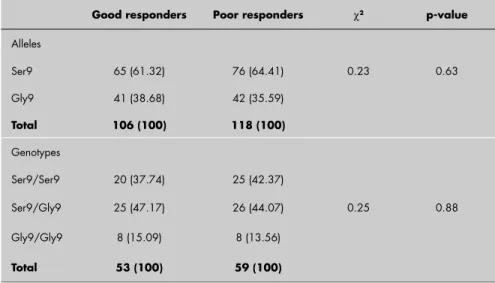
OR = 0.88, 0.49 < OR < 1.56; χ2 = 0.23, 1 degree of freedom, df, p = 0.63) and genotype distribution (good responders: Ser9/Ser9 37.73%, Ser9/Gly9 47.16%, Gly9/Gly9 15.09%; poor responders: Ser9/Ser9 42.37%, Ser9/Gly9 44.06%, Gly9/Gly9 13.55%; χ2 = 0.25, 2 df, p = 0.88) (Table 1). Nor was there any association with homozygosity (good responders: homozygous: 52.82%, heterozygous: 47.16%; poor responders: ho-mozygous: 55.92%, heterozygous: 44.06%; odds ratio, OR = 0.88, 0.39 < OR < 1.99; χ2 = 0.11, 1 df, p = 0.74).
Thus, using a Brazilian sample of long-term treated schizophrenic outpatients, we have described a lack of association between the response to typical antipsychotics and Ser9Gly polymorphism of the DRD3 gene.
Although this polymorphism has been intensively studied, the results still remain inconclusive today. In a review paper,
Scharfet-ter6 indicated a trend of association between the Gly9 allele and better response to anti-psychotic treatment in general. However, a meta-analysis performed by Jönsson et al.7 found an interesting pattern of association, showing that in studies involving patients who were treated with atypical antipsychotics, the Gly9 allele was more frequently reported to be associated with good response and, in studies that included patients receiving typi-cal antipsychotics, the Ser9 allele seemed to be correlated with better treatment response. These results were confirmed recently by Szekeres et al.,8 who found that the Ser9 allele and Ser9/Ser9 genotype were more frequent in non-responding schizophrenic patients using atypical antipsychotics (clozapine, olanzapine, quetiapine and risperidone). However these results may be due to the fact that the patients treated, especially those using clozapine (an atypical antipsychotic), were mainly recruited
Table 1. Distribution of Ser9Gly gene polymorphism genotypes in good and poor responders to typical antipsychotics
Good responders Poor responders χ2 p-value
Alleles
Ser9 65 (61.32) 76 (64.41) 0.23 0.63 Gly9 41 (38.68) 42 (35.59)
Total 106 (100) 118 (100)
Genotypes
Ser9/Ser9 20 (37.74) 25 (42.37)
Ser9/Gly9 25 (47.17) 26 (44.07) 0.25 0.88 Gly9/Gly9 8 (15.09) 8 (13.56)
Total 53 (100) 59 (100)
from among former non-responders to typical antipsychotics. Therefore, in this selected sub-group, the Gly9 allele favored better response. This situation may be a source of bias in the hypothesized pattern of association between the different types of antipsychotics and
Ser9Gly polymorphism of the DRD3 gene.9
The fact is that the Gly9 allele of the DRD3 gene may be associated with the response to clozapine but, in studies in which the choice of antipsychotics is not restricted, the role of this polymorphism is unclear.10
We are aware of methodological weak-nesses in our investigation: specifi cally, the retrospective defi nition of drug response, the use of more than one typical antipsychotic in the patients and the possibility of popu-lation stratifi cation. However, even though retrospective, we believe that the analysis of response based on Kane’s criteria4 is robust because of the long period of treatment on typical drugs (at least fi ve years). The fact that patients were given a variety of typical drugs is unlikely to be a confounding factor, since their primary mechanism of action is similar. The blood levels of the antipsychotic drugs used by the patients were not assessed, but the fact that the patients had undergone long-term treatment with these drugs in our outpatient units diminishes the chance of noncompliance detection.
In conclusion, the results from our work do not support the hypothesis that Ser9Gly polymorphism of the DRD3 gene infl uences the response to typical antipsychotics, in our Brazilian sample of patients with schizophre-nia. However, further studies will be needed in order to elucidate this issue, especially studies involving large samples, such as meta-analysis investigations, with the aim of providing psychiatrists with a biological rationale for targeted antipsychotic treatment.11
1. Meltzer HY. Treatment-resistant schizophrenia-the role of clozapine. Curr Med Res Opin. 1997;14(1):1-20. 2. Collier DA. Pharmacogenetics in psychosis. Drug News
Per-spect. 2003;16(3):159-65.
3. Gupta S, Jain S, Brahmachari SK, Kukreti R. Pharmacogenom-ics: a path to predictive medicine for schizophrenia. Pharma-cogenomics. 2006;7(1):31-47.
4. Kane J, Honigfeld G, Singer J, Meltzer H. Clozapine for the treat-ment-resistant schizophrenic. A double-blind comparison with chlorpromazine. Arch Gen Psychiatry. 1988;45(9):789-96. 5. Lannfelt L, Sokoloff P, Martres MP, et al. Amino acid substitution
in the dopamine D3 receptor as a useful polymorphism for inves-tigating psychiatric disorders. Psychiatr Genet. 1992;2:249-56.
6. Scharfetter J. Dopamine receptor polymorphisms and drug response in schizophrenia. Pharmacogenomics. 2001;2(3):251-61. 7. Jönsson EG, Flyckt L, Burgert E, et al. Dopamine D3 receptor
gene Ser9Gly variant and schizophrenia: association study and meta-analysis. Psychiatr Genet. 2003;13(1):1-12. 8. Szekeres G, Keri S, Juhasz A, et al. Role of dopamine D3
recep-tor (DRD3) and dopamine transporter (DAT) polymorphism in cognitive dysfunctions and therapeutic response to atypical antipsychotics in patients with schizophrenia. Am J Med Genet B Neuropsychiatr Genet. 2004;124(1):1-5.
9. Scharfetter J. Pharmacogenetics of dopamine receptors and response to antipsychotic drugs in schizophrenia-an update. Pharmacogenomics. 2004;5(6):691-8.
10. Wilffert B, Zaal R, Brouwers JR. Pharmacogenetics as a tool in the therapy of schizophrenia. Pharm World Sci. 2005;27(1):20-30. 11. Masellis M, Basile VS, Ozdemir V, Meltzer HY, Macciardi FM,
Kennedy JL. Pharmacogenetics of antipsychotic treatment: lessons learned from clozapine. Biol Psychiatry. 2000;47(3):252-66.
Sources of funding: Not declared
Confl ict of interest: None
Date of fi rst submission: July 12, 2005
Last received: May 22, 2006
Accepted: May 23, 2006
REFERENCES
167
AUTHOR INFORMATION Quirino Cordeiro, MD. Postgraduate student, Department of
Psychiatry, Faculdade de Medicina da Universidade de São Paulo; Researcher in the Genetics and Pharmacogenetics Project (Progene – LIM 23), Institute of Psychiatry, Hospital das Clínicas, Faculdade de Medicina da Universidade de São Paulo, São Paulo, Brazil.
Karen Miguita. Postgraduate student, Department of Psychia-try, Faculdade de Medicina da Universidade de São Paulo; Researcher in Progene – LIM 23, Institute of Psychiatry, Hospital das Clínicas, Faculdade de Medicina da Univer-sidade de São Paulo, São Paulo, Brazil.
Elisabete Miracca, PhD.Researcher in Progene – LIM 23, Institute of Psychiatry, Hospital das Clínicas, Faculdade de Medicina da Universidade de São Paulo, São Paulo, Brazil.
Hélio Elkis, MD, PhD.Associate professor, Department of Psychiatry, Faculdade de Medicina da Universidade de São Paulo; Coordinator of the Schizophrenia Program (Projesq) and Treatment-Resistant Schizophrenia Project (Proerta), Hospital das Clínicas, Faculdade de Medicina da Universidade de São Paulo, São Paulo, Brazil.
Homero Vallada, MD, PhD. Associate professor, Department of Psychiatry, Faculdade de Medicina da Universidade de São Paulo; Coordinator of Progene – LIM 23, Institute of Psychiatry, Hospital das Clínicas, Faculdade de Medicina da Universidade de São Paulo, São Paulo, Brazil.
Address for correspondence:
Homero Vallada
Progene – LIM 23, Instituto de Psiquiatria do Hos-pital das Clínicas da Faculdade de Medicina da Universidade de São Paulo (FMUSP)
Rua Dr. Ovídio Pires de Campos, 785, Sala 08 São Paulo (SP) — Brasil – CEP 01060-970 Tel. (+55 11) 3069-7534
E-mail: [email protected]
Copyright © 2006, Associação Paulista de Medicina
RESUMO
Investigação da possível associação entre o polimorfi smo Ser9Gly do gene do receptor de dopamina D3 e resposta a antipsicóticos típicos em pacientes com esquizofrenia
Antipsicóticos típicos apresentam alta afi nidade pelos receptores dopaminérgicos, que são, portanto, regiões de interesse para os estudos de farmacogenética das psicoses. No presente estudo, investigamos a hipótese de que o polimorfi smo Ser9Gly do gene do DRD3 possa exercer um papel na diferença de resposta inter-individual ao uso de antipsicóticos típicos em pacientes com esquizofrenia. Nossa amostra foi composta por 53 pacientes bons respondedores e 59 maus respondedores. Não houve diferenças nas distribuições alélicas (bons respondedores: Ser9 61,32%, Gly9 38,67%; maus respondedores: Ser9 64,40%, Gly9 35,59%; odds ratio, OR = 0,88, 0,49 < OR < 1,56; χ2 = 0,23, 1 degree of freedom,
d.f., p = 0,63) e genotípica (bons respondedores: Ser9/Ser9 37,73%, Ser9/Gly9 47,16%, Gly9/Gly9 15,09%; maus repondedores: Ser9/Ser9 42,37%, Ser9/Gly9 44,06%, Gly9/Gly9 13,55%; χ2 = 0,25, 2
d.f., p = 0,88) entre os grupos. Não houve também associação com homozigosidade (bons respondedores: homozigotos: 52,82%, heterozigotos: 47,16%; maus repondedores: homozigotos: 55,92%, heterozigotos: 44,06%; odds ratio, OR = 0,88, 0,39 < OR < 1,99); χ2 = 0,11, 1 d.f., p = 0,74). Os resultados não
dão suporte à hipótese de que o polimorfi smo Ser9Gly do gene do DRD3 possa infl uenciar a resposta terapêutica aos antipsicóticos típicos na nossa amostra de pacientes com esquizofrenia.
PALAVRAS-CHAVE: Farmacogenética. Dopamina. Associação. Polimorfi smo genético. Esquizofrenia.