Fernando Pessoa de AlbuquerqueI
Claudia Renata dos Santos BarrosII
Lilia Blima SchraiberII
I Programa de Pós-Graduação em Medicina Preventiva. Departamento de Medicina Preventiva. Faculdade de Medicina. Universidade de São Paulo. São Paulo, SP, Brasil
II Departamento de Medicina Preventiva. Faculdade de Medicina. Universidade de São Paulo. São Paulo, SP, Brasil Correspondence:
Lilia Blima Schraiber
Departamento de Medicina Preventiva Faculdade de Medicina da Universidade de São Paulo
Av. Dr. Arnaldo, 455
01246-903 São Paulo, SP, Brasil E-mail: [email protected] Received: 4/24/2012 Approved: 1/19/2013
Article available from: www.scielo.br/rsp
Violence and mental suffering
among men in primary health
care
ABSTRACT
OBJECTIVE: To analyze the association between male mental health problems and violence experienced.
METHODS: Cross sectional study with 477 males aged between 18 and 60, users of two primary healthcare centers in São Paulo, Southeastern Brazil. The selection for the sample was based on a sequentiality criterion, according to the order of arrival of the users. Sociodemographic and health characteristics and reports of having experienced violence at any time and/or having witnessed violence in childhood were collected. Information was also collected on the use of mental health services and/or psychological complaints/diagnoses during consultation at medical clinics by reading medical records, to categorize the dependent variable “mental suffering”. The variables were described as absolute
and relative frequencies. The association was tested using a conirmatory
Poisson model with robust variance adjusted for age, marital status, education, violence witnessed in childhood and psychoactive substance use.
RESULTS: The prevalence of mental suffering was 29.4%. Mental suffering was associated with experiencing repeated physical and/or sexual violence (RP 1.75, 95%CI 1.13;2.72). The association with a single episode of violence lost
signiicance after the inclusion of psychoactive substance use in the model.
Analysis of the fraction attributable to repetitive physical and/or sexual violence
for the mental suffering of the men, veriied it as 30.4%.
CONCLUSIONS: The relationship between violence and mental suffering, already highlighted in studies with women, is also relevant to men’s health,
drawing attention to the similar need of identiication, in the health services,
of situations of violence experienced by the male population. For men, this
relationship was shown to be inluenced by the presence of psychoactive
substance use; a situation which must be dealt with, more and in a better way, by the health care service.
Various studies have approached the triad of men, violence and health, in the sense of recognizing health problems associated with involvement in violent situations.7,17,a The same would apply to mental health.
Violent acts are regarded as elements in the male socialization process and in the exercise of masculinity, affecting how men look after their health and their bodies.17 Violent episodes are problems closely related to the health care needs of the male population.4,7 They have, however, been neglected.
Studies on the impact of experiencing violence on the male population’s health problems show that episodes of aggression are associated with symptoms of mental suffering of various forms and intensities for common
and more serious mental illness.11,14 In terms of
assaults, episodes of domestic and urban violence are dealt with.3,11 Rhodes et al16 show that men involved in situations of intimate partner violence (IPV), seen in hospitals in the USA, presented higher rates of psychiatric problems; 18.4% showed symptoms of severe or moderate depression, while 3.3% of those not involved showed the same symptoms (p = 0.001). Those involved had a 10.3% prevalence of post-traumatic stress disorder, 1.1% for those not involved (p < 0.001).
Findings by Coker et al3 corroborate the theory that experiencing IPV has negative consequences for mental health. Men who suffer IPV are more prone to show symptoms of depression, to take psychiatric medication and to develop some form of chronic mental illness, as well as perceiving their own health as fragile.
Acierno et al,1 in a revision of health problems triggered by various forms of violence, stated that psychiatric
problems are identiied as a risk factor for experienced
physical aggression.
The greater part of the literature studied approached exposure to IPV. However, recent studies such as that by Kaminer et al11 also show a link with urban violence. These authors indicated that 42.9% of men in the study population, in South Africa, reported having experienced at least one form of domestic, criminal or political violence, whether in the form of moral, physical or sexual violence. For men who had experienced any of these types of violence, there was a prevalence rate of 2.2 (95%CI 1.1;4.57) diagnoses of post- traumatic stress disorder. Physical abuse during childhood, criminal violence and multiple forms of violence together were the most pathogenic forms of trauma.
INTRODUCTION
Alcohol abuse is a common trait in men involved in violent situations.5,20 Freitas et al8 highlighted that 57.1% of victims of physical aggression seen at an emergency room in Sao Paulo had consumed alcohol and 93.3% of these victims were male.
Little is known about mental health problems in Brazilian men, and less about the link between them and experience of violence. This study aims to analyze the link between male mental illness and experiencing episodes of violence.
METHODS
This was a transversal study using data from a larger
studyb on intimate partner violence against women.
There were 789 men interviewed, users of two primary health care services; each man to arrive at the service was asked to take part until the stipulated sample size was reached. The two health care units were selected
as they had signiicant demand from male users, they
had mental health care services and the perception, on the part of the management or administration, of the problem of violence as a health care need. These services were located in the center-west region of the city of Sao Paulo, in urbanized neighborhoods, and did not constitute a context of high levels of urban violence. That larger study aimed to estimate the prevalence of intimate partner violence against women from the male perspective, but it also produced data which could be used in other studies of the male population. A descrip-tive study on the prevalence and type of violence expe-rienced by men, as well as details of the methodology used in the abovementioned research, were published by Schraiber et al.19
There were 477 records of data collected using three instruments: a questionnaire carried out by a male interviewer and two standardized forms for gathering information from medical records.
The questionnaire included questions on sociodemogra-phics; questions on general health; alcohol and/or illegal drug use; frequency of occurrence and reoccurrence of violent episodes experienced by the men, specifying the aggressor and the age at which the episode occurred.
In order to collect data on violence experiences, questions adapted from a validated questionnaire,18 used with women, were used, and this showed a god level of internal consistency for male respondents.19 The questions were: for psychological violence: “Has
a Nascimento MAF. Desaprendendo o silêncio: uma experiência de trabalho com grupos de homens autores de violência contra a mulher [dissertação de mestrado]. Rio de Janeiro: Universidade do Estado do Rio de Janeiro; 2001.
anyone ever (in the street, in a bar, at work or at home) insulted or belittled you or made you feel worthless?”; for physical violence: “Has anyone ever (in the street, in a bar, at work or at home) physical assaulted you (slaps, pushes, punches, kicks etc.)? If yes, how many times? (Once, a few times, many times)”; for sexual violence: “Has anyone ever forced you to have sexual intercourse against your will? If yes, how many times? (Once, a few times, many times)”. The men were also asked if they had witnessed domestic violence during
childhood (seen ights between parents and/or seen the
mother assaulted by the father or partner).
Using the two types of standardized forms, the medical records of the interviewees who had been registered as users for more than one month preceding the data of the interview were examined. One reading characterized the life of the service user in terms of how often they
were seen and the proile of the type of care used. In
this study data on mental health appointments, available in 461 database records are used. A second reading collected complaints/diagnoses noted in the medical records of men who had used the service in the prece-ding 12 months, discriminating accorprece-ding to the kind of care provided. Psychological complaints/diagnoses available in 410 database records were used.
The 477 records were selected bearing in mind wither the use of at least one of the types of care on offer in the mental health service (individual or group psycho-therapy, or psychiatric consultation), or the presence of at least one of the following complaints/diagnoses on the form: depression, anxiety/nervousness, insomnia, anger/irritability, suicide attempt or confusion/memory problems. This set of conditions was considered posi-tive case for mental suffering, the outcome variable.
This variable was used due to the abovementioned larger piece of research not having data on common mental health disorders (CMHD), which include: somatoform disorders, depression and anxiety and symptoms of insomnia, fatigue, irritability,
forgetful-ness, dificulty concentrating and complaints such as
headaches, tremors or poor digestion,9 this being a cate-gory often used in studies of psychiatric epidemiology.
The deinition of outcome is based on Dejours et al,6 to whom mental suffering is a general sense of malaise expressed as nervousness, worry, anxiety, tension and/ or apathy. It is not necessarily a mental illness in the strictest sense of medical nosography and may be viewed more as a psychic imbalance. Mental suffering is a subjective experience which leads to the individual having complaints and requiring health care services, such as outlined in this study. Mental suffering, there-fore, includes CMHDs.
The following were considered to be independent variables; socio-demographic characteristics, age group, marital status, schooling and socioeconomic
status (level A and level B were grouped together, due to the lack of subjects in these levels); psychoactive substance use (alcohol and/or illicit drug use at any point in their life); witnessing domestic violence during childhood and reporting having experienced domestic violence at any point on their life (“no report of violence”; “reported only psychological violence”; “reported physical and/or sexual violence on the same occasion” (it only occurred once); “reported repeated physical and/or sexual violence” (occurred a few or many times). Experiencing sexual violence was analyzed together with physical violence as there was no case of exclusively sexual violence.
The variable “psychoactive substance use” was charac-terized as “no psychoactive substance”, “only alcohol” and “alcohol and illegal drug consumption” (the use of an illegal drug at any point in their life). Those who only took illegal drugs were included in the “alcohol and illegal drug consumption” category as they represented only 0.7% of the sample.
The variables were described using proportions and Pearson’s Chi-square test was used to identify the differences between them. In order to better understand the link between mental suffering and violence, the various types of mental suffering in relation to each type of violence were examined. Poisson’s model, with
robust conirmatory variance, was used to test the link
between them.10 The multiple analysis was adjusted
for those variables which presented p < 0.20 in the uni-variate analysis (Chi-squared), as well as those of
theoretical signiicance. Attributed risk was examined
in the data analysis as being an indicator if interest to public policy intervention programs.
Variables related to sociodemographic questions (age group, marital status and schooling) were included
in the irst multiple model. The variable referring to
witnessing violence during childhood was added to the second multiple model. The inclusion of psychoactive
substance use in the inal model was justiied by the
literature consulted.2 The analyses were carried out
using the Stata10.0 program.
This study was approved by the Ethical Committee of
the Faculty of Medicine of the Universidade de São
Paulo, Process 348/10, 12/15/2010, as well as following
ethical guidelines for studies about violence.19
RESULTS
Of the 477 subjects, 29.4% were cases of mental suffe-ring. The prevalence was higher among single men and those who used psychoactive substances (alcohol and/ or illegal drugs) (Table 1).
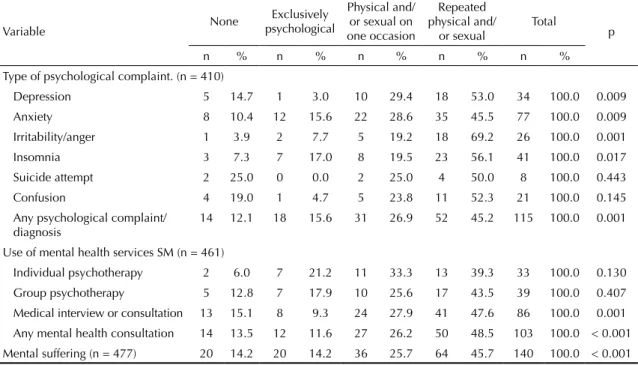
experiencing violence (p < 0.001); 87.9% of the medical records with this complaint were men who reported having experienced some form of violence, primarily recurring physical and/or sexual violence (45.2%) (Table 2).
The types of complaints/diagnoses associated with experiencing violence were: depression, nervousness/ anxiety, anger/being highly irritable and insomnia/ sleep disturbances. The majority of the men with records reporting depression and anger/irritability had experienced at least two of the three types of violence in question; 89.6% of the men with the most prevalent recorded (anxiety/nervousness) reported having expe-rienced violent situations, especially of the repeated physical and/or sexual kind (Table 2).
Of the 103 medical records with a record of some kind of mental health care, 13.5% belonged to men who reported having never experienced an episode of violence. Men who used mental health care services had higher rates of prevalence of experiencing violence and almost half of them had experienced repeated physical and/or sexual violence. The most commonly used type of care was an interview or appointment with a doctor and was that which showed the strongest link with having experienced violence (p = 0.001); 6% of the men who had individual psycho-therapy reported never having experienced any form of violence (Table 2).
Almost half of the men who presented mental suffering (psychology complaint/diagnosis and/or use of mental
Table 1. Frequencies of the variables related to mental suffering recorded in medical records, by socio-demographic variables,
associated violence and use of psychoactive substances. Sao Paulo, Southeastern Brazil, 2003.
Adjusts
Mental Suffering
No Yes
p
n % n %
Age (years) 0.085
18 a 24 74 80.4 18 19.6
25 a 34 91 72.2 35 27.8
35 a 44 81 69.8 35 30.2
45 a 54 72 64.9 39 35.1
55 a 60 19 59.4 13 46.4
Marital status < 0.001
Cohabiting with sexual partner 222 77.3 65 22.7
Not living with sexual partner 53 70.7 22 29.3
Single 62 53.9 53 46.1
Socioeconomic status (Abipeme)a 0.21
B 38 61.2 24 38.7
C 174 74.7 59 25.3
D 97 69.3 43 30.7
E 27 65.8 14 34.1
Schooling (years) 0.442
0 a 4 94 70.7 39 29.3
5 a 8 112 70.9 46 29.1
9 a 11 109 73.1 40 26.9
12 or more 22 59.5 15 40.5
Witnessed violence in childhood 0.236
No 140 73.7 50 26.3
Yes 197 68.6 90 31.4
Use of psychoactive substance (illegal drugs or alcohol) 0.04
No psychoactive substance 5 62.4 3 37.5
Just alcohol 240 74.3 83 25.7
Use of alcohol or illegal drugs 92 63.0 54 37.0
Total 337 70.6 140 29.4
health care services) (45.7%) had experienced situations of physical and/or sexual violence once, followed by 25.7% who had experienced it on only one occasion (Table 2). Violence which was exclusively psycholo-gical did not show any link with mental suffering (Raw PR) in the uni-variate analysis (Table 3).
Except in the case of exclusively psychological violence, there was an increase in the strength of the link for the other types of violence after adjusting for sociodemographic characteristics (age group, marital status and schooling) in model 1 (Table 3).
In model 2, there was an association of the same types of violence as in the previous model, with the inclusion of the variable “witnessing violence in childhood”, as well as adjusting the magnitude of the prevalence ratio (Table 3).
Repeated physical and/or sexual violence was linked to mental suffering after adjusting for psychoactive substance use, with the prevalence ratio diminishing in
the inal model. Use of psychoactive substances means
the link with mental suffering becomes borderline when this type of violence is experienced on only one occasion (Table 3).
The fraction of mental suffering in men attributable to repeated physical and/or sexual violence was 30.4% in this model.
DISCUSSION
The prevalence of mental suffering in males in this study (29.4%) may represent a higher level than that found in other studies on mental health in men using health care services because of the wider formulation
Table 2. Frequencies of variables related to mental distress recorded in medical records, according to forms of violence
experienced. Sao Paulo, Southeastern Brazil, 2003.
Variable None
Exclusively psychological
Physical and/ or sexual on one occasion
Repeated physical and/
or sexual
Total
p
n % n % n % n % n %
Type of psychological complaint. (n = 410)
Depression 5 14.7 1 3.0 10 29.4 18 53.0 34 100.0 0.009
Anxiety 8 10.4 12 15.6 22 28.6 35 45.5 77 100.0 0.009
Irritability/anger 1 3.9 2 7.7 5 19.2 18 69.2 26 100.0 0.001
Insomnia 3 7.3 7 17.0 8 19.5 23 56.1 41 100.0 0.017
Suicide attempt 2 25.0 0 0.0 2 25.0 4 50.0 8 100.0 0.443
Confusion 4 19.0 1 4.7 5 23.8 11 52.3 21 100.0 0.145
Any psychological complaint/
diagnosis 14 12.1 18 15.6 31 26.9 52 45.2 115 100.0 0.001
Use of mental health services SM (n = 461)
Individual psychotherapy 2 6.0 7 21.2 11 33.3 13 39.3 33 100.0 0.130
Group psychotherapy 5 12.8 7 17.9 10 25.6 17 43.5 39 100.0 0.407
Medical interview or consultation 13 15.1 8 9.3 24 27.9 41 47.6 86 100.0 0.001
Any mental health consultation 14 13.5 12 11.6 27 26.2 50 48.5 103 100.0 < 0.001
Mental suffering (n = 477) 20 14.2 20 14.2 36 25.7 64 45.7 140 100.0 < 0.001
Table 3. Confirmatory Poisson statistical regression model with robust variance calculation for mental distress. Sao Paulo,
Southeastern Brazil, 2003.
Mental suffering (n = 477) Raw RP 95%CI Mod. 1 95%CI Mod. 2 95%CI Final model 95%CI
None 1 1 1 1
Exclusively psychological
violence 0.84 0.48;1.48 0.95 0.55;1.66 0.94 0.54;1.64 0.92 0.53;1.62
Physical and/or sexual on
one occasion violence 1.59 1.00;2.56 1.62 1.02;2.58 1.59 1.00;2.54 1.53 0.96;2.44
Repeated physical and/or sexual violence
1.86 1.20;2.87 1.94 1.26;2.98 1.87 1.21;2.90 1.75 1.13;2.72
of the variable of mental suffering not being limited to CMHDs. Moreover, it may be a higher rate than that found in population studies as it is a study of health care service users. However, the rate was lower than that found in the study by Fortes et al,c in which 714 patients aged 18 to 65 were interviewed in Family Health units and a prevalence of 39.2% was found in men. That study is important for the purposes of comparison with the results of this study as it has a similar population, the same age range, it is the same type of study and the sample is of health care service users. The lower propor-tion found may be due to the fact that, in this study, the data were from medical records and not from a ques-tionnaire being directly applied to the sample subjects. Three different situations may have affected the data: 1)
service users may have had dificulty in spontaneously
presenting this type of assault as a clinical complaint, as indicated in the literature,4,7 whereas the interview actively sought cases; 2) the service users may do this, but it may not have been included in the records
with the spontaneous complaint; 3) dificulties or less
attention paid to diagnosing mental health problems on the part of the health care professionals.7 The indi-cator of mental health constructed here, compared to national and international studies was within the range of observations observed in those studies.
Experiencing repeated physical and/or sexual violence is associated with mental suffering, which is not the case when the violence experienced is exclusively psycholo-gical. The lack of a link between purely psychological abuse may be explained by the low prevalence of any of the types of violence studied (psychological, physical and/or sexual) occurring in isolation). Schraiber et al19 indicate that the types of violence occur simultaneously in men, with high proportions of overlap, especially of psychological and physical types of violence.
International studies have found consistent links between experiencing some kind of violence and mental health problems.1,11,16 The majority of them focus on one particular type of violence: IPV (intimate partner
violence). There is little scientiic output on urban and
community violence. Therefore, this study includes violence at the hands of a partner, by a family member within the home and that experienced from friends, acquaintances and strangers in public spaces.
Kaminer et al,11 in South Africa, found a prevalence ratio of 2.2 (95%CI 1.1;4.57) for the diagnosis of post-traumatic stress disorder at some point in their life for men who had experienced at least one type of violence, be it domestic, criminal or political. Experiencing multiple types of violence proved to be more pathogenic.
The South African study converges with our results in relation to the magnitude of PR found (PR of repeated physical and/or sexual violence in subjects with mental suffering was 1.75; 95%CI 1.13;2.72). Moreover, the strength of the link between the recurring nature of the episodes of any type of violence and mental health problems was reinforced.
Brazilian studies which looked at the relation between mental suffering and violence did not categorize by sex, which makes the discussion of how violence
affects men’s mental health dificult, especially when
dealing with CMHDs, which have a lower prevalence in males. Lopes et al,14 in a sample of 3,253 employees at a university, observed that experiencing physical violence on more than one occasion is linked to a greater relative risk (RR: 1.19) of developing CMHDs; 26.5% of subjects with CMHDs had been exposed to physical violence in at least one of the two stages of the research. The cumulative effect was also highlighted: the more often violent episodes are experienced the greater the probability of developing a CMHD.
The factor of the cumulative effect of violent episodes on mental health is highlighted by Lima et al,13 which states that there is a higher prevalence of mental disorders (around 60%) in those who have expe-rienced stressful life events, the increasing number of these events proportionally increases the probability of metal disorders. According to Onocko-Campos & Gama,15 “[...] the accumulation of many negative factors occurring simultaneously contributes more to the appearance of mental problems than isolated stress factors, irrespective of their magnitude”.
In spite of no studies dealing only with men being found, we can use the vast output on the repercussions of violence on women’s health as a counterpoint. These studies show that repeatedly experiencing IPV is linked to psycho-emotional diagnoses and/or complaints, and this effect is cumulative.18 This study reiterates that, as in women, experiencing physical and/or sexual violence on one occasion is less related to mental suffering than experiencing physical and/or sexual violence more than once.
Use of psychoactive substances has been shown to be an important adjustment variable. Our results reinforce
the indings of the bibliography which indicate an
interaction between mental suffering and the use of psychoactive substances. Abuse of alcohol or other drugs would be a comorbidity associated with some kind of psychiatric disorder at some point in the lives of at least 56.8% of the men in the population study in the USA,12 which would explain the lessened strength of the link in the statistical model developed.
Repetition of violent episodes overrides the effect caused by the use of psychoactive substances on mental health and remains linked to mental health problems in men as a cause or as a consequence, as in this study there is no information related to the temporality of the events. Even so, 30.4% of cases of mental suffering were attributed to repeated physical and/or sexual violence, according to the calculation of the attribu-table fraction.
These statements gain further importance when we
relect on the symbolic signiicance of acts of violence
in the social constitution of masculinity. Committing violence is reinforced in men’s socialization process. It may be considered as a fundamental element in forming their identity17 and it requires daily afirmation throughout their lives. Fights in the street, as well as various forms of domination over partners constitute situations which legitimize masculinity. Aggressive
behavior patterns in men are naturalized, often justiied
by biological or physiological reasons.
The naturalization of these acts makes it difficult for their repercussions to be viewed as health care needs, especially when these acts are valued by the socio-cultural demands made on masculinity, which turn them into generators of “[...] behavior which is harmful to health, encouraging the emergence of
signiicant risk factors for falling ill”,17 especially in relation to mental health. The same process takes place with the use of psychoactive substances, considered an adjustment variable in this study and encouraging mental suffering in the male population, and valued
as an element of afirmation of masculine hegemony.
This study had several limitations due to being designed primarily to assess violence perpetrated by men against their partner. Data on mental suffering and violence experienced were complementary data not mentioned in the larger study. Therefore, the data on the principal outcome were limited to data from medical records, as they were not collected through medical interviews. The category of mental suffering included any sign and/ or symptom related to mental health as positive, there being no diagnostic scale.
The links shown, although signiicant, may represent
reverse associations as the design of the study
(trans-versal) makes it dificult to infer causality due to the
lack of control over the temporal sequence of the events. Experiencing violence could just as well be a cause of mental suffering14 as a consequence of it.5
However, the indings are valid, making this study
relevant to understanding the relationship between mental health problems in males and experience of violent episodes.
Thus, it can be concluded that the link between experien-cing violence and the situation of mental suffering, so well highlighted in studies with women, also proves to be relevant to men’s health, and should be a target of future research to deepen understanding. On the other hand, the existence of this link indicates the need for health care services to identify situations of violence experienced by the male population. Moreover, for men, this relationship between mental suffering and experiencing violent
situ-ations has been shown to be inluenced by the presence
1. Acierno R, Resnick HS, Kilpatrick DG. Health impact of interpersonal violence 1: Prevalence rates, case identification, and risk factors for sexual assault, physical assault, and domestic violence in men and women. Behav Medicine. 1997;23(2):53-64. DOI: 10.1080/08964289709596729
2. Almeida RMM, Pasa GG, Scheffer M. Álcool e violência em homens e mulheres.
Psicol Reflex Crit. 2009;22(2):252-60. DOI: 10.1590/S0102-79722009000200012
3. Coker AL, Davis KE, Arias I, Desai S, Sanderson M, Brandt HM, et al. Physical and mental health effects of intimate partner violence for men and women. Am J Prev Med. 2002;23(4):260-8. DOI: 10.1016/S0749-3797(02)00514-7
4. Couto MT, Pinheiro TF, Valença O, Machin R, Silva GSN, Gomes R, et al. O homem na atenção primária à saúde: discutindo (in) visibilidade a partir da perspectiva de gênero.
Interface (Botucatu). 2010;14(33):257-70. DOI: 10.1590/S1414-32832010000200003
5. Cronholm PF. Intimate partner violence and men’s health. Prim Care. 2006;33(1):199-209,x. DOI: 10.1016/j.pop.2005.11.005
6. Dejours C, Abdouchelli E, Jayet C. Psicodinâmica do trabalho: contribuições da escola dejouriana à análise da relação prazer, sofrimento e trabalho. São Paulo: Atlas; 1994.
7. Figueiredo W. Assistência à saúde dos homens: um desafio para os serviços de atenção primária.
Cienc Saude Coletiva. 2005;10(1):105-9. DOI: 10.1590/S1413-81232005000100017
8. Freitas, EAM, Mendes ID, Oliveira LCM. Ingestão alcoólica em vítimas de causas externas atendidas em um hospital geral universitário.
Rev Saude Publica. 2008;42(5):813-21. DOI: 10.1590/S0034-89102008000500005
9. Goldberg D, Huxley P. Common mental disorders: A biosocial model. London: Tavistock; 1992.
10. Hair JF, Anderson RE, Tatham RL, Black WC, Babin BJ. Análise multivariada de dados. 6. ed. Porto Alegre: Bookman; 2009.
11. Kaminer D, Grimsrud A, Myer L, Stein DJ, Williams DR. Risk for post-traumatic stress disorder associated with different forms of interpersonal violence in South Africa. Soc Sci Med. 2008;67(10):1589-95. DOI: 10.1016/j.socscimed.2008.07.023
12. Kessler RC, Crum RM, Warner LA, Nelson CB, Schulenbeg J, Anthony JC. Lifetime co-occurrence of DSM-III-R alcohol abuse and dependence with other psychiatric disorders in the National Comorbidity Survey. Arch Gen Psychiatry. 1997;54(4):313-21. DOI: 10.1001/archpsyc.1997.01830160031005
13. Lima MS, Soares BGO, Mari JJ. Saúde e doença mental em Pelotas, RS: dados de um estudo populacional. Rev Psiquiatr Clin (Säo Paulo). 1999;26(5):225-35. 14. Lopes CS, Faerstein E, Chor D, Werneck GL. Higher
risk of commom mental disorders after experiencing physical violence in Rio de Janeiro, Brazil: the Pro-Saude Study. Int J Soc Psychiatry. 2008:54(2):112-7. DOI: 10.1177/0020764007083876
15. Onocko-Campos RT, Gama CA. Saúde mental na Atenção básica. In: Campos GWS, Guerrero AVP, organizadores. Manual de práticas em atenção básica: saúde ampliada e compartilhada. São Paulo: Hucitec; 2008. p.209-35.
16. Rhodes, KV, Houry D, Cerulli C, Strauss H, Kaslow NJ, McNutt LA. Intimate partner violence and comorbid mental health condition among urban male patients. Ann Fam Med. 2009;7(1):47-55. DOI: 10.1370/afm.936
17. Schraiber LB, Gomes R, Couto MT. Homens e saúde na pauta da Saúde Coletiva. Cienc Saude Coletiva. 2005;10(1):7-17. DOI: 10.1590/S1413-81232005000100002
18. Schraiber LB, Barros CRS, Castilho EA. Violência contra as mulheres por parceiros íntimos: usos se serviços de saúde. Rev Bras Epidemiol. 2010;13(2):237-45. DOI: 10.1590/S1415-790X2010000200006
19. Schraiber LB, Barros CRS, Couto MT, Figueiredo WS, Albuquerque FP. Homens, masculinidade e violência: estudo em serviços de atenção primária à saúde. Rev Bras Epidemiol. 2012;15(4):790-803. DOI: 10.1590/ S1415-790X2012000400011
20. Stringham P. Violence and men’s health. Prim Care.
2006;33(1):187-97,x. DOI:10.1016/j.pop.2005.11.006 REFERENCES