Back pain in adults living
in quilombola territories of
Bahia, Northeastern Brazil
Dor nas costas em adultos residentes
em territórios quilombolas, Bahia
I Faculdade de Enfermagem. Universidade
Federal da Bahia. Vitória da Conquista, BA, Brasil
II Departamento de Medicina Preventiva
e Social. Faculdade de Medicina. Universidade Federal de Minas Gerais. Belo Horizonte, MG, Brasil
III Núcleo de Estudos em Saúde e Trabalho.
Faculdade de Medicina. Universidade Federal de Minas Gerais. Belo Horizonte, MG, Brasil
Correspondence:
Luis Rogério Cosme Silva Santos Universidade Federal da Bahia Campus Anísio Teixeira
Instituto Multidisciplinar em Saúde Rua Rio de Contas, 58 Quadra 17 Gabinete 05 Candeias
45029-094 Vitória da Conquista, BA, Brasil E-mail: [email protected] Received: 1/9/2014
Approved: 4/8/2014
Article available from: www.scielo.br/rsp
ABSTRACT
OBJECTIVE: To analyze the factors associated with back pain in adults who live in quilombola territories.
METHODS: A population-based survey was performed on quilombola communities of Vitória da Conquista, state of Bahia, Northeastern Brazil.
The sample (n = 750) was established via a rafle of residences.
Semi-structured interviews were conducted to investigate sociodemographics and employment characteristics, lifestyle, and health conditions. The outcome was analyzed as a dichotomous variable (Poisson regression).
RESULTS: The prevalence of back pain was of 39.3%. Age ≥ 30 years and being a smoker were associated with the outcome. The employment status was not related to back pain.
CONCLUSIONS: The survey identiied a high prevalence of back pain in
adults. It is suggested to support the restructuring of the local public service in order to outline programs and access to healthy practices, assistance, diagnosis, and treatment of spine problems.
DESCRIPTORS: Back Pain, epidemiology. Risk Factors. Rural Population. Health Surveys.
Luis Rogério Cosme Silva SantosI
Ada Ávila AssunçãoII
Back pain (BP) is a musculoskeletal disorder that affects the main regions of the spine (cervical, thoracic, and lumbar), and it is a public health problem.11 Approximately 70.0% to 85.0% of the world’s popula-tion is susceptible to acute or subacute clinical presen-tations of BP throughout life, with repercussions on the routine of affected individuals, including temporary or permanent work-related disability.7 In this manner, it becomes the main cause of absenteeism from work and of social welfare and health costs.11,14
BP is a multicausal phenomenon. Factors such as sociodemographic, occupational, and lifestyle charac-teristics are frequently associated with this disorder. The impairment of life quality is well described in litera-ture.5 However, there is neither a single deinition nor standard methods that could facilitate comparisons of results obtained in research.7
Pain is felt in a peculiar manner, and its expression is related to subjective experience, involving sensory, cognitive, and sociocultural aspects.12 It interferes with how people understand, react, and communicate, with or without externalizing the pain process. Ethnic and
RESUMO
OBJETIVO: Analisar os fatores associados à dor nas costas em adultos residentes em territórios quilombolas.
MÉTODOS: Inquérito de base populacional foi realizado em 2011 em comunidades quilombolas de Vitória da Conquista, estado da Bahia, Brasil. A amostra (n = 750) foi estabelecida por meio de sorteio de domicílios. Entrevistas semiestruturadas foram realizadas para investigar características
sociodemográicas e de emprego, hábitos de vida e estado de saúde. O desfecho
foi analisado como variável dicotômica (regressão de Poisson).
RESULTADOS: A prevalência de dor nas costas foi 39,3%. Idade ≥ 30 anos e ser fumante foram associados ao desfecho. A situação de emprego não se associou à dor nas costas.
CONCLUSÕES: O inquérito identiicou alta prevalência de dor nas costas em adultos. Sugere-se apoiar a (re)estruturação dos serviços públicos locais, a im
de delinear programas e acesso dos adultos quilombolas às práticas saudáveis, à assistência, ao diagnóstico e ao tratamento dos problemas da coluna vertebral.
DESCRITORES: Dor nas Costas, epidemiologia. Fatores de Risco. População Rural. Inquéritos Epidemiológicos.
INTRODUCTION
behavioral characteristics also modulate individual manifestation of the painful sensation in the back.6
Although most studies focus only on the lumbar region, this is not the case for the Pesquisa Nacional de Amostra de Domicílios (PNAD – National
Residence Sample Survey)a and other national surveys.7,b The Delphi consensus performed in 2006, involving 28 specialists from 12 countries, supports the notion of incorporating more spine regions in the BP definition.4 In their final document, they consider low BP (lumbar pain) to be a synonym of BP, emphasizing the relevance of including lumbar, cervical, and thoracic pain as adopted by specific surveys. Based on this knowledge, a broader defi-nition of BP was adopted, and it includes the entire structure of the spine.
Regarding living and working conditions at the coun-tryside, the iniquities are apparent when analyzing the
social and health indicators. Of note is the predomi -nance of risk factors for musculoskeletal disorders,
related to speciic agricultural activity.10 Similarly, in rural quilombola populations, the socioeconomic
and racial asymmetries strongly inluence the health
a Instituto Brasileiro de Geografia e Estatística. Pesquisa nacional por amostra de domicílios, 2008. Um panorama da saúde no Brasil: acesso
e utilização dos serviços, condições de saúde e fatores de risco e proteção à saúde. Brasília (DF);2010 [cited 2012 Aug 12]. Available from: http://www.ibge.gov.br/home/estatistica/populacao/panorama_saude_brasil_2003_2008/
b Lima-Costa MF, Turci M, Macinko J. Saúde dos adultos em Belo Horizonte. Belo Horizonte: Núcleo de Estudos em Saúde Pública e
inequalities.c Regarding the quilombola population, there is a lack of epidemiological studies assessing health problems,3 including BP.
The term “quilombola” refers to remaining ethnic-racial quilombo groups, and their cultural and material heritage confer them a sense of being and belonging to quilombola national territories, according to the criteria of auto-attribution and presumption of black ancestry.3 In the scope of the health survey conducted in quilombola communities of Vitória da Conquista, BA, Northeastern Brazil, designated as “Projeto
COMQUISTA”,3 which guided this present study, this web of sociocultural relations substantiated the hypoth-eses regarding social inequalities in health.
The present study aimed to analyze the factors associated with back pain in adults who live in quilombola territories.
METHODS
The epidemiological characteristics of quilombola communities was investigated in 2011 using a
cross-sectional population-based study with ive quilombola communities located in ive districts of the Vitória da Conquista Municipality, Bahia. All ive communities are certiied by the Palmares Foundation for self-recog -nition of belonging to ancient quilombos.3
The estimated universe sample consisted of 2,935 adults residing in selected quilombola areas. The sample plan included the following assumptions: a) randomly selec-tion of one community per district; b) include only communities with at least 50 registered families; c)
select via a rafle the residences to be visited; and d)
invite all adults (≥ 18 years of age) living in a rafled residence to participate in the survey.
Of the rafled residences (422), 393 were included in
the study (93.1%). In total, 797 individuals were inter-viewed, and 750 adults were chosen after excluding pregnant women (11) and secondary informants (36). The pregnant women were excluded because of tran-sitory muscular changes that occur in the spine region during pregnancy. Regarding the informants, the nature of the auto-referred event (BP) is of individual and subjective character; therefore, it is inappropriate to consider the description of a third party.
For the interviews, we used the semi-structured ques-tionnaire called Inquérito Região Integrada do Distrito Federal (Integrated Region of the Federal District
Survey) of the Pesquisa Nacional de Saúde (PNS –
National Health Survey), tailored for the quilombola
population. The questionnaire was formatted in two
speciic modules (individual and residence), and it
allowed collecting demographic, socioeconomic, occu-pational, lifestyle, health status, and morbidity data.
For tbody mass index (BMI), the weight was checked with a portable electronic scale (Marte®, model LC200PP), with a maximum capacity of 200 kg and sensitivity of 50 g. The height was obtained using a portable stadiometer
(CauMaq®, model EST-22), with a capacity of 300 mm
to 2,000 mm. In the construction of the BMI variable, we considered the national standard values for the deinition
of normal and altered (overweight/obesity) indexes that interfere with the monitoring of BP.
The question asked to assess BP was: “Do you suffer from a chronic spine problem such as chronic pain in the back or neck, low BP, sciatica pain, or problems in the vertebrae or discs?”, with yes or no as l answer options.
The following explanatory variables were considered in data analysis: a) occupational characteristic (employ-ment status); b) individual characteristics (gender, age, marital status, education level, skin color, individual income); c) health status and lifestyle (practice of
physical activity, BMI, and smoking).
The variable “employment status” consisted of eight optional answers divided into three categories: unem-ployed, permanent contract, and temporary contract.
The variable “skin color” was self-declared with the following options: white, black, brown, and other
(indig-enous, yellow). The deinition of skin color followed the
national standard, according to the conceptual parame-ters adopted by PNAD, relating it with the self-declared physical characteristics of the interviewees.
The variable “educational level” included: incomplete elementary schooling; complete elementary schooling; and basic and secondary schooling. The variable “income” referred to the existence of monthly indi-vidual income, with yes or no as answer options.
“Physical activity” was evaluated according to the following question: “How many days per week do you do a physical activity or practice a sport?”. Two catego-ries were created: “yes”, for positive answers, regard-less of the number of days per week, and “no” when the individual answered “never”. Thus, we can gener-ally assess whether the interviewee performs a physical activity or not. The variable “smoking” was based on a single question about current smoking habits, with yes or no as answer options.
We consulted the local leaders to obtain their consent for this study. Data collection was performed between
September and October 2011 and was preceded by
mapping and sensitization of communities.
c Universidade Federal do Rio de Janeiro. Laboratório de Análises Econômicas, Históricas, Sociais e Estatísticas das Relações Raciais. Relatório
With the assistance of a GPS and photographic records,
we constructed a map to characterize the universe of
residences. The data generated by GPS were edited with the identiication of each point (waypoint: number and geographic coordinates) in speciic spreadsheets, gener -ating the spatial representation of the area and residences.
This representation enabled the random rafle of resi -dences in each community using the technique of an elec-tronic random number generator, without repetition, with
the assistance of the tool Random Integer Set Generator.d For the suitability of the instrument, besides two pre-tests (33 interviews), a pilot study was performed within the quilombola community not selected for research (55 families), equivalent to 8.0% of the main sample. The researchers themselves applied a paper version of the questionnaire.
The interviews of the main study were conducted
by 24 academics belonging to the health ield, who were trained and supervised by the ield coordina -tors (researchers). The questionnaires were adapted to be used on portable computers (HP pocket Rx5710)
and to be transported and stored in the Questionnaire Development System program (QDSTM; NOVA Research Company, version 2.6.1).
For reliability analysis, we re-interviewed 42 partici-pants (4.5% of sample). We used the observed concor-dance and kappa statistics for the categorical variables
and the Pearson correlation coeficient for continuous variables, obtaining satisfactory indexes and coefi -cients. Estimates were performed using EpiInfo, version 3.5.3, and R software, version 2.11.1.3
For general data analysis, we used the statistical software
Stata 11.0. Initially, we performed descriptive analysis,
estimating raw and relative frequencies according to
the categories of the study variables. Univariable anal -ysis was used to verify the presence of associations of BP with explanatory variable categories. The associa-tion between explanatory variables and the outcome
(Prevalence ratio ‒ PR) was calculated using the Poisson
regression, with estimation of the robust variable.
The explanatory variables that were statistically signii -cant (p ≤ 0.20) were selected for intermediate multivari-able analysis in blocks: sociodemographic and employ-ment; health status and lifestyle.
We opted a hierarchized entry of variables, considering the hypothesis test and the existence of two levels in the following order: on level 1, the sociodemographic and employment variables (gender, age, marital status, educa-tion level, skin color, individual income, and employment status); on level 2, the variables related to health status
and lifestyle (BMI, smoking, and physical activity).
For the inal model, we considered the variables with statistical signiicance (p ≤ 0.05) found on levels 1 and 2. This research project was approved by the Research Ethics Committee of Faculdade São Francisco de Barreiras (CAAE 0118.0.066.000-10) and by the Committee of Universidade Federal de Minas Gerais
(CAAE 0118.0.066.203-10).
RESULTS
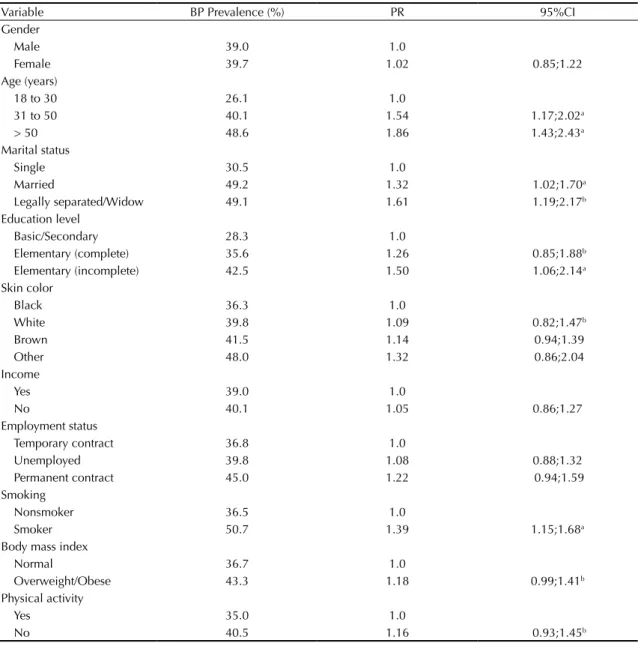
The prevalence of BP was of 39.3%, without signii -cant differences between men and women. Among the youngest age group surveyed (between 18 and 30 years), there was a lower prevalence of BP (26.1%).
Most residents of the quilombo territories were married
(63.7%). The highest prevalence of DC was found among individuals who were legally separated or widows (49.1%), and the lowest prevalence was found among single individuals (30.5%). Regarding educa-tion level, 67.3% of the interviewees had incomplete elementary schooling. The prevalence was higher among these interviewees than among those with a higher level of education (Table 1).
Most interviewees had brown skin color (44.6%). A
higher prevalence of BP was observed among the group of individuals with white skin color than among those with black skin color.
The habit of smoking was reported by 19.7% of inter-viewees, and the prevalence of BP was greater among smokers than among nonsmokers (Table 2).
Among the interviewees, 24.1% practiced physical activities at least once a week. The prevalence of BP was lower (35.0%) in this group than in the group that did not practice physical activities (40.5%).
Regarding employment status, 40.0% of the workers had a temporary contract. The prevalence of BP (36.8%) was lower in this group than in the unem-ployed group and the group that had a permanent
contract. However, the differences were not signii -cant in univariable analyses (p > 0.20).
In intermediate multivariable analyses, we observed that in the level 1 (sociodemographic and employment), only age was associated with BP. Among variables of
level 2 (state of health and lifestyle), BMI, smoking,
and physical activity remained in the model.
In the inal multivariable analysis, the BP outcome was
explained by two factors: age and smoking. Regarding age groups, there was a linear and statistical relation-ship associated with BP (Table 3).
d Haahr M. Random Integer Set Generator. School of Computer Science and Statistics. Dublin: Trinity College; 1998 [cited 2013 Aug 15].
DISCUSSION
The prevalence of BP was 39.3%, which was lower than
that registered in the Pelotas survey, RS, Southern Brazil
(63.1%)7 and higher than that found in a national survey (13.5%).c On the regional level, a lower prevalence
was recorded in Salvador, BA, Northeastern Brazil
(14.7%)1 and in Belo Horizonte, MG, Southeastern Brazil (7.3%).b According to worldwide literature, the
lowest prevalence was recorded in Japan and United States at 25.2% and 31.0%, respectively.15,17
However, the interpretation of these comparisons requires caution because the inconsistencies on the manifestation and magnitude of PB prevalence may be
due to the demographic size investigated and the type of question that led to the variable outcome in each study.7 Despite the investigators’ effort in standardizing
a BP deinition using the Delphi method, there are still
weaknesses in terms of necessary consensus for proper data comparison.4
We consistently observed16 a higher prevalence of BP and positive association in advanced age brackets.
Spinal diseases are expected and are distributed
according to the age bracket because of mechano-degenerative, metabolic, or systemic changes in the musculoskeletal system.7
Among the residents of quilombo territories, there was a higher prevalence of BP among the smokers. The smoking effect is explained by the changes that nico-tine causes in the tissue of invertebrate discs.14
The practice of physical activity was not associated
with BP. This inding is not consistent with those of
previous studies. In general, there is a negative asso-ciation between proper physical activity and BP.2,14
Surprisingly, there was no association between BP
and the employment status. We expected employed interviewees to be more vulnerable because of a higher chance of exposure to physical activi-ties at work, characterized by anomalous posture and weight lifting.8 However, unemployment also favors exposure to risk factors for the musculo-skeletal system.14
The lack of association with employment can be attrib-uted to rural livelihood. It is known that the living and health conditions of the rural groups are not exclu-sively structured according to job,10 and this can inter-fere with BP reports.
Skin color was not associated with BP in any analysis
stage, although this characteristic is associated with the reports of worst life and health conditions.10 A similar result was previously observed by Almeida et al.1
The differences in illness experiences can derive from racism and not necessarily from skin color of individ-uals. Accordingly, an association between perceived discrimination and BP has recently been shown;6 however, our study did not have the strength to examine this attribute.
Gender and education level were not signiicantly associated with BP, conirming the results obtained in the Salvador population, city next to quilombola
communities.1 However, these results are not consis-tent. In Germany14 and China,9 there was an association between gender, education level, and BP.
In the group of legally separated persons or widows and unmarried couples, there was a higher prevalence Table 1. Relative frequency of sociodemographic
characteristics, health condition, lifestyle, and occupational variables of the quilombola population. Vitória da Conquista, BA, Northeastern Brazil, 2011. (N = 750)
Variable %
Gender
Male 46.5
Female 53.5
Age (years)
18 to 30 26.5
31 to 50 39.2
> 50 34.3
Marital status
Single 21.9
Married 63.7
Legally separated/Widow 14.4 Education level
Basic/Secondary 11.3
Elementary (complete) 21.4 Elementary (incomplete) 67.3 Skin color
Black 39.5
White 12.6
Brown 44.6
Other 3.4
Income
Yes 71.7
No 28.3
Employment status
Temporary contract 40.0
Unemployed 46.7
Permanent contract 13.3 Smoking
Nonsmoker 80.3
Smoker 19.7
Body mass index
Normal 57.5
Overweight/Obese 42.5 Physical activity
Yes 24.1
of BP; however, marital status was not included in
the inal analyses. In general, single individuals are
younger, and the latter is a protection factor for BP. A similar result to this study was found in an American survey13 and a Brazilian survey.1
This study shows the general prevalence of BP in a predominantly rural, poor, less educated, underem-ployed, and socially unprotected population. Due to the cross-sectional approach, it was not possible to estab-lish the cause and effect. However, the results reinforce the relation between individual factors (age), lifestyle habits (smoking), and BP.
Table 3. Final multivariate model (Poisson regression) for back pain in quilombola population. Vitória da Conquista, BA, Northeastern Brazil, 2011. (N = 750)
Variable PR 95%CI
Age (years)
18 to 30 1.0
31 to 50 1.47 1.12;1.94a
> 50 1.80 1.38;2.35a
Smoking
Nonsmoker 1.0
Smoker 1.31 1.08;1.59a
a p ≤ 0.01
Table 2. Prevalence and prevalence ratio of back pain in quilombola population, according to sociodemographic characteristics, health condition, lifestyle, and occupational variables. Vitória da Conquista, BA, Northeastern Brazil, 2011. (N = 750)
Variable BP Prevalence (%) PR 95%CI
Gender
Male 39.0 1.0
Female 39.7 1.02 0.85;1.22
Age (years)
18 to 30 26.1 1.0
31 to 50 40.1 1.54 1.17;2.02a
> 50 48.6 1.86 1.43;2.43a
Marital status
Single 30.5 1.0
Married 49.2 1.32 1.02;1.70a
Legally separated/Widow 49.1 1.61 1.19;2.17b
Education level
Basic/Secondary 28.3 1.0
Elementary (complete) 35.6 1.26 0.85;1.88b
Elementary (incomplete) 42.5 1.50 1.06;2.14a
Skin color
Black 36.3 1.0
White 39.8 1.09 0.82;1.47b
Brown 41.5 1.14 0.94;1.39
Other 48.0 1.32 0.86;2.04
Income
Yes 39.0 1.0
No 40.1 1.05 0.86;1.27
Employment status
Temporary contract 36.8 1.0
Unemployed 39.8 1.08 0.88;1.32
Permanent contract 45.0 1.22 0.94;1.59
Smoking
Nonsmoker 36.5 1.0
Smoker 50.7 1.39 1.15;1.68a
Body mass index
Normal 36.7 1.0
Overweight/Obese 43.3 1.18 0.99;1.41b
Physical activity
Yes 35.0 1.0
No 40.5 1.16 0.93;1.45b
1. Almeida ICGB, Sá KN, Silva M, Baptista A, Matos MA, Lessa I. Prevalência de dor lombar crônica na população da cidade de Salvador. Rev Bras Ortop. 2008;43(3):96-102. DOI:10.1590/S0102-36162008000200002
2. Barros SS, Ângelo RCO, Uchôa PBL. Lombalgia ocupacional e a postura sentada. Rev Dor. 2011;12(3):226-30.
DOI:10.1590/S1806-00132011000300006 3. Bezerra VM, Medeiros DS, Gomes KO, Souzas R,
Giatti R, Guimarães MDC. Inquérito de Saúde em Comunidades Quilombolas de Vitória da Conquista/BA (Projeto COMQUISTA): aspectos metodológicos e análise descritiva. Cienc Saude Coletiva. 2013 [citado 2013 ago 15]. Disponível em: http://www.cienciaesaudecoletiva. com.br/artigos/artigo_int.php?id_artigo=12327
4. Dionne CE, Dunn KM, Croft PR, Nachemson AL, Buchbinder R, Walker BF, et al. A consensus approach toward the standardization of back pain definitions for use in prevalence studies.
Spine (Phila Pa 1976). 2008;33(1):95-103.
DOI:10.1097/BRS.0b013e31815e3a10
5. Dureja GP, Jain PN, Shetty N, Mandal SP, Prabhoo R, Joshi M, et al. Prevalence of Chronic Pain, Impact on Daily Life, and Treatment Practices in India. Pain Pract. 2014;14(2):E51-62. DOI:10.1111/papr.12132 6. Edwards RR. The association of perceived
discrimination with low back pain. J Behav Med. 2008;31(5):379-89. DOI:10.1007/s10865-008-9160-9
7. Ferreira GD, Silva MC, Rombaldi AJ, Wrege ED, Siqueira FV, Hallal PC. Prevalência de dor nas costas e fatores associados em adultos do Sul do Brasil: estudo de base populacional. Rev Bras Fisioter. 2011;5(1):31-6. DOI:10.1590/S1413-35552011005000001
8. Kwon BK, Roffey DM, Bispo PB, Dagenais S, Wai EK. Systematic review: occupational physical activity and low back pain. Occup Med (London). 2011;61(8):541-8. DOI:http://dx.doi.org/10.1093/occmed/kqr092
9. Liao CC, Chou YC. Low back pain associated with sociodemographic factors, lifestyle and osteoporosis: a population-based study.
Osteoporos Int. 2013;24(Suppl 4):539-647.
DOI:10.1007/s00198-013-2537-9
10. Maia AG, Rodrigues, CG. Saúde e mercado de trabalho no Brasil: diferenciais entre ocupados agrícolas e não agrícolas. Rev Econ Sociol Rural. 2010;48(4):737-65. DOI:10.1590/S0103-20032010000400010 11. Meziat Filho N, Silva GA. Invalidez por dor nas
costas entre segurados da Previdência Social do Brasil. Rev Saude Publica. 2011;45(3):494-502. DOI:10.1590/S0034-89102011000300007
12. Sardá Jr JJ, Nicholas MK, Pimenta CAdeM, Asghari A. Psychosocial predictors of pain, incapacity and depression in Brazilian chronic pain patients.
Rev Dor. 2012[citado 2014 mar 12];13(2):111-8.
DOI:10.1590/S1806-00132012000200003 REFERENCES
The methodology used in the study was appropriate to achieve the objectives. A partial adaptation of the
PNS questionnaire to quilombola reality ensured
representativeness for comparisons in relation to the studied object. The following can be considered adequate: performance of pilot project, training of interviewees for data collection using portable computers, precedence by sensitization of local leaders, and mapping the territories for correct local-ization of residences. Reliability analysis showed the coherence of strategies used in this study.
The question that led to the outcome, formulated in present time, avoided the possibility of recall bias and, consequently, the underestimation of BP prevalence. Despite the use of medical terms in the structure of questions, interviewees did not seem to have interpretation problems because the reliability of answers (kappa index) was equal to 1, meaning 100% agreement in repeated interviews. However, the lack of a reference to BP periodicity is a limi-tation for proper comparisons.
A more detailed approach is required to clarify the absence of connection between the employment status and spinal manifestations of pain. Considering the homogeneity of the quilombola population in terms of general life conditions, it is probable that the work
conditions were not suficiently signiicant to explain
BP. However, in future, it would be appropriate to
design studies that can differentiate exposures specii -cally related to lifestyle, work, and job.
The results of this study indicate the need of devel-oping prevention strategies to control and reduce the prevalence of BP in investigated quilombola communities. Local seminars, which took place in 2014, disclosed the results to members of the
Brazilian Unified Health System (SUS) and to
members from social movements and from the university. We expect to strengthen the institu-tional debate to support restructuring of local public services in order to develop programs and access of quilombola adults to healthy practices, assistance, diagnosis, and treatment of spine problems.
ACKNOWLEDGMENTS
We thank all researchers of the COMQUISTA Project
for participating in its elaboration and planning and
supervision of data collection; Professor Mark Drew Guimarães (UFMG) for his skills and thoroughness
during the coordination of this research; and Professor
Orlando Sílvio Caires Neves (IMS/CAT/UFBA) for
his dedication towards managing DINTER and the
13. Schiller JS, Lucas JW, Ward BW, Peregoy JA. Summary health statistics for U.S. adults: National Health Interview Survey, 2010. National Center for Health Statistics. Vital Health Stat. 2012;(252):1-207. 14. Schneider S, Schiltenwolf M, Zoller SM, Schmitt H. The
association between social factors, employment status and self-reported back pain-a representative prevalence study on the German general population. J Public Health. 2005;13(1):30-9. DOI:10.1007/s10389-004-0085-7 15. Strine TW, Hootman JM. US National Prevalence
and Correlates of Low Back and Neck Pain Among
Adults. Arthritis Rheum. 2007;57(4):656-65. DOI:10.1002/art.22684
16. Xu G, Pang D, Liu F, Pei D, Wang S, Li L. Prevalence of low back pain and associated occupational factors among chinese coal miners. BMC Public Health. 2012;12:149. DOI:10.1186/1471-244X-12-149
17. Yamada K. Matsudaira K, Hara N, Nakamura K, Takeshita K. The prevalence and characteristics of low back pain as the most disabling pain in Japan. Eur
Spine J. 2011;20(Suppl 4):S502-47.
Article based on the doctoral thesis of Santos LRCS, titled: “Dor nas costas: prevalência e fatores associados em comunidades quilombolas da Bahia”, presented during the Graduate Program in Public Health of the Faculdade de
Medicina,Universidade Federal de Minas Gerais, in 2014.
This study was presented at the 1st Meeting on the health of the quilombola population of Vitória da Conquista, BA, in 2013. This study was supported by the Fundação de Amparo à Pesquisa do Estado da Bahia (Process 020/2010 PPSUS) and by
Coordenação de Aperfeiçoamento de Pessoal de Nível Superior (CAPES – Decree 05/2009 – DINTER – Interinstitutional