RESUmo
Objeivando conhecer a percepção do sofri
-mento moral vivenciado, relacionando fre
-quência e intensidade, realizou-se pesquisa Survey, uilizando escala Likert variando de 0 a 6 pontos, com 124 enfermeiras em hos
-pitais do sul do Brasil, no ano de 2008. Me
-diante quesionário autoaplicável e análise fatorial, foram ideniicados e validados qua
-tro constructos. Os resultados inais foram obidos através de três diferentes análises: 1) estaísica descriiva; 2) análises de va
-riância 3) regressão múlipla. O constructo que apresentou maior intensidade de per
-cepção de vivência do sofrimento moral foi a falta de competência na equipe de trabalho (4,55), seguido pela negação do papel da en
-fermeira como advogada do paciente (4,30), obsinação terapêuica (3,60) e desrespeito à autonomia do paciente (3,57). Em relação à percepção da frequência do sofrimento mo
-ral, destacou-se, novamente, o constructo falta de competência na equipe de trabalho (2,42), seguido da obsinação terapêuica (2,26), negação do papel da enfermeira como advogada do paciente (1,71) e desrespeito à autonomia do paciente (1,42).
dEScRiToRES
Enfermagem Éica em enfermagem Competência proissional Esgotamento proissional Estresse psicológico
The experience of moral distress in nursing:
the nurses’ perception
*O
riginal
a
r
ticle
AbSTRAcT
With the objecive to understand the nurs
-es’ percepion of moral distress, as well as its frequency and intensity, this study used a survey uilizing a six-point Likert scale, with 124 nurses working in hospitals in southern Brazil in 2008. Using a self-admin
-istered quesionnaire and factorial analysis, four constructs were ideniied and validat
-ed. The inal results were obtained through three diferent analyses: 1) descripive sta
-isical analysis; 2) analysis of variance; and 3) muliple regression. The construct that showed the highest intensity of percepion regarding moral distress was the lack of competency in the work team (4.55), fol
-lowed by the nurse’s denial of their role as paient advocate (4.30), therapeuic obsi
-nacy (3.60) and disrespecing the paient’s autonomy (3.57). Regarding the percepion of the frequency of moral distress, once again, the highlighted construct was the lack of competency within the work team (2.42), followed by therapeuic obsinacy (2.26), the nurse’s denial of their role as paient advocate (1.71) and disrespecing the paient’s autonomy (1.42).
dEScRiPToRS
Nursing Ethics, nursing
Professional competence Professional burnout Stress psychological
RESUmEn
Objeivándose conocer la percepción del sufrimiento moral experimentado, rela
-cionando frecuencia e intensidad, se efec
-tuó invesigación Survey, uilizando escala Likert variando de 0 a 6 puntos, con 124 enfermeras en hospitales del Sur de Brasil, en 2008. Se ideniicaron cuatro construc
-tos mediante cuesionario autoaplicable y análisis factorial. Resultados obtenidos mediante tres análisis: 1) estadísica des
-cripiva, 2) análisis de varianza, 3) regre
-sión múliple. El constructo con percepción de sufrimiento moral más intenso fue la falta de competencia del equipo de traba
-jo (4,55), siguiendo negación del papel de la enfermera como abogada del paciente (4,30), obsinación terapéuica (3,60) y fal
-ta de respeto a la autonomía del paciente (3,57). Respecto a percepción de frecuen
-cia de sufrimiento moral, nuevamente pre
-dominó la falta de competencia del equipo de trabajo (2,42), siguiéndolo la obsina
-ción terapéuica (2,26), nega-ción del papel de la enfermera como abogada del pacien
-te (1,71) e falta de respeto a la autonomía del paciente (1,42).
dEScRiPToRES
Enfermería Éica en enfermería Competencia profesional Agotamiento profesional Estrés psicológico Edison Luiz devos barlem1, Valéria Lerch Lunardi2, Guilherme Lerch Lunardi3,
Graziele de Lima dalmolin4, Jamila Geri Tomaschewski5
ViVência do sofrimento moral na enfermagem: percepção da enfermeira
experiencia del sufrimiento moral en enfermería: percepción de la enfermera
inTRodUcTion
Moral distress (MD) was irst described in the 1980s(1)
and was expressed as sufering that arises from incoher
-ence between one’s acions and convicions. In other words, one knows what is the right thing to do but recog
-nizes herself/himself as unable to pursue such an acion either due to errors of judgment, personal failure, weak
-ness of character, or even due to circumstances beyond personal control(2).
Speciically in nursing, moral distress is deined as a psychological imbalance caused by painful feelings that result when nurses cannot perform morally appropriate acions according to their conscience or knowledge(1). It
can be also deined as a response, when ater an ethical conlict, personal acion is impeded by individual, insitu
-ional or social barriers(3).
Anger and sorrow are the feelings most menioned in the literature as biopsychosocial efects arising from moral distress. Introspecion is also manifested by nursing work
-ers receiving litle or no support while coping with moral conlict(4). Such feelings, which result in moral
distress, can cause emoional responses in individuals, such as dissaisfacion with work, reluctance to work, or even abandoning one’s profession(5).
Qualitaive studies show that nursing workers can experience moral distress ac
-cruing from situaions already considered to be part of their professional pracice, such as a lack of informed consent on the part of paients before diagnosic and therapeuic procedures, prolonging life without a con
-cern with its quality, quesionable profes
-sional pracices, fragmented decisions, and the unequal distribuion of resources, especially those desined for nursing(6).
The Moral Distress Scale (MDS)(7) was used to deepen
knowledge concerning the experiences of nurses with moral distress in the Brazilian context. The instrument was validated for Portuguese ater its author’s consent.
obJEcTiVE
To analyze the percepion of nurses concerning moral distress in relaion to its frequency and intensity.
mETHod
This is a survey(8) and its paricipants included nurses
from four hospitals located in the South of Brazil: one public, two philanthropic and one private hospital. Data were collected from May to September 2008 by a team of eight professionals previously trained in data collec
-ion. Each nurse received in their workplace a self-applied form along with instrucions on how to ill it out and in
-formaion on moral distress. One part of the instrument addressed the paricipants’ proile (hospital facility, years working in the facility, years since graduaion, academic degree, age and others), which was followed by 38 state
-ments addressing dilemmas potenially experienced in professional pracice, in addiion to a inal quesion con
-cerning their percepion of the experience of moral dis
-tress in their workplaces. A due date to collect the com
-pleted form was established ater it was delivered and the researchers would return ive imes, at most, to collect the completed forms.
Data collecion was simultaneously conducted in all the studied hospitals. The forms were delivered in sealed manila envelopes along with two copies of free and in
-formed consent forms to be signed. Clariicaion concern
-ing the study, moral distress and how to complete in the instrument was provided at the ime the envelope was delivered to each paricipant. Each data collector became responsible for a number of units and to distribute and collect the highest possible number of forms.
A total of 193 envelopes containing the forms were delivered to the nurses in the hospitals and 164 were returned. Forty of these were excluded: 12 due to a dichoto
-mous scale that presented values 0 or 6, and another 28 forms that were returned blank. The remaining 124 were considered valid and represented 60.4% of the target popu
-laion. The researcher responsible for the study in the Nursing and Health Studies and Research Group at the Federal University of Rio Grande do Sul (FURG) was respon
-sible for keeping the forms. Two previously trained individuals tabulated the data.
Study background –An instrument already recognized and validated in other contexts(7) was validated and ap
-plied to the Brazilian context to invesigate moral distress. The instrument, originally writen in English, has a seven-point Likert scale, ranging from 0 – never occurred or no frequency to 6 – very intense sufering or very frequent sufering.
Back translaion was performed in order to obtain a version as close as possible to the original version and re
-duce the risk of potenial bias. One group of experts in the English language translated the original version to Portu
-guese and the Portu-guese version was back translated by another group of translators. The new English version was then compared to the original one to check for potenial diferences and verify its equivalence.
Instrument validaion– The instrument was validated in three diferent respects: a) face validaion: in which we veriied whether the instruments had the proper form and a vocabulary appropriate to what it was intended to
Qualitative studies show that nursing
workers can experience moral distress accruing from
situations already considered to be part
measure. Two professors at FURG, College of Nursing per
-formed this process; b) Content validaion: in which we veriied whether the items of the instrument translated and adapted to Portuguese represented the content we intended to evaluate. This process was conducted through the applicaion and analysis of 30 pretests among Mas
-ter’s students atending the graduate program in Nursing, FURG, which conirmed the items were suiciently clear and easy to understand; c) Construct validaion: in which we delimit the characterisics of the constructs of interest to the study, tesing the internal consistency of each item (that is, the reliability of scales), their consistency under diferent statements (convergent validity) and the difer
-ence in relaion to the other items of diferent constructs (discriminant validity), in order to make a connecion be
-tween the theory and the construct (conceptual level) and the evaluated items (operaional level). In other words, the conceptual level permited specifying the nature of the studied construct and the operaional level dealt with the list of statements (items or quesions) that allowed measuring the constructs. This last validaion was per
-formed with the aid of staisical tests, while the irst two were subjecive, though essenial in order to ensure the applicability and precision of the instrument.
Ater the forms were applied in the selected sample, two staisical tests were performed to ensure the validity of the construct: factorial analysis and Cronbach’s alpha. Factorial analysis consists of a mulivariate technique that is applied to idenify factors in a set of measurements. Cronbach’s alpha in turn tests the reliability of the instru
-ment verifying whether diferent characterisics of each group, measures via the instrument’s statements, or of in
-dicators arranged within the instrument, were consistent.
Data analysis – The results concerning the studied sample were obtained through three diferent analyses: 1) descripive staisics through averages and distribuion frequency of constructs and their indicators, to idenify the intensity and frequency these individuals experience moral distress; 2) variance analysis (ANOVA) among the diferent groups of respondents according to the sample’s characterisics, to verify potenially signiicant diferences among the group of respondents (hospital, age, years since graduaion, years working in the hospital, among others); and 3) muliple regression analysis, seeking to evaluate which factors had a greater efect on moral dis
-tress, from the perspecive of nurses.
The Staisical Package for Social Sciences (SPSS) ver
-sion 13.0 was used to analyze the data, facilitaing the process of organizing the data in tables, which permited a beter visualizaion and interpretaion of results.
The study complied with ethical principles in all stages and was approved by the Ethics Research Commitee (pro
-tocol No. 012/2008 – Minutes 65/2008).
RESULTS
Table 1 presents the demographic data of the studied sample. In regard to the paricipants’ characterisics, it is important to note that 48.4% of the nurses were old
-er than 30 years of age, approaching maturity. Of these, 37.9% had a specializaion and 10.5% had a Master’s de
-gree, the highest academic degree achieved, showing a concern for professional qualiicaion. Time in the profes
-sion was nine years on average (8.6), which is considered a reasonable and already very meaningful period of pro
-fessional pracice. The average ime working in the hospi
-tal facility was approximately ive years (4.94 years).
The factorial analysis allowed grouping the statements concerning the percepion of moral distress experienced in the profession, represening diferent facets perceived by the studied nurses. To maintain conceptual coherence, 21 out of the iniial 38 statements were grouped into four dimensions and 17 were excluded due to low facto
-rial load (below 0.50), high facto-rial load (above 0.40) in more than one factor, lack of conceptual coherence ob
-served in relaion to the bloc, or the formaion of isolated blocs. The four proposed dimensions explain 66.71% of the variaions of the original statements, which repre
-sents a good degree of data synthesis, facilitaing handling and interpretaion. Table 2 presents the factorial loads of each construct according to the formaion of the factors, which correspond to the four dimensions discussed in the results.
The reliability of the four dimensions ideniied was tested through Cronbach’s alpha. Values between 0.60 and 0.80 are recommended for exploratory studies to en
-sure reliability of the scales used in the instrument. It is worth noing that the higher the alpha, which varies from 0 to 1, the higher the scale’s reliability. The instrument obtained a Cronbach’s alpha equal to 0.93, while the co
-eicients of the four dimensions were between 0.68 and 0.91, which conirms the reliability of the four ideniied
Table 1- Characteristics of the study’s participants - 2011
Characterístics N %
Bachelor’s degree 64 51.6
Specialization 47 37.9
Master’s degree 13 10.5
Age
21-30 64 51.6
31-40 31 25.0
41-50 24 19.4
51+ 5 4.0
Time working in the profession (years) (M = 8.60)
Time working in the facility (years) (M = 4.94)
Type of hospital
Public 37 29.8
Philanthropic 63 50.8
dimensions (Table 2). Hence, the four proposed constructs were deined as: denial of the nurses’ role as paient ad -vocate, which refers to the unuilized potenial of nurses to claim the rights of paients(9); the staf’s lack of
com-petence, related to a lack of skills or technical experise, which the staf should have, to perform acions speciic
to each profession(10); disregards paient autonomy, that
is, disregarding a paients’ self-government, freedom, pri
-vacy, individual choice, and free will(11); therapeuic
obsi-nacy refers to treatments that no longer beneit paients facing irreversible death and are considered to be fuile, useless(12).
Table 2 – Exploratory Factorial Analysis (Varimax rotation) – 2011
Indicators Bloc F1 F2 F3 F4
Denial of the nurses’ role as patient advocate
s-09. Avoid taking action when veriies that a member of the nursing staff administered wrong
medication and failed to report it
7.55 .566
s-10. Let medical students perform painful procedures on patients solely to increase their skills .833 .704
s-11. Assist physicians who are practicing procedures on a patient after CPR has been unsuccessful .782 .774
s-13. Work with unsafe levels of nursing stafing .813 .632
s-16. Observe without intervening when the nursing staff do not respect a patient’s privacy .808 .709
s-17. Carry out the physician’s order of not telling patients the truth when they ask for it .805 .684
s-18. Assist a physician who in your opinion is providing incompetent care .766 .677
s-30. Comply with the request of the physician not to talk about death with a dying patient who asks about it
.761 .614
Staff’s lack of competence
s-32. Work with nurses who do not have the competence required by the patient’s condition .865 .726
s-33. Work with technicians/auxiliaries who do have the competence required by the patient’s condition .849 .735
s-34. Work with medical or nursing students who do not have the competence required by the patient’s condition
.815 .846
s-35. Work with physicians who do not have the competence required by the patient’s condition. .858 .790
s-36. Work with support services that do not have the competence required by the patient’s condition .796 .615
s-38. Be required to care for patients and not feeling prepared to provide such care .674 .581
Disregards patient autonomy
s-04. Assist the physician who performs a test or procedure without the patient’s or family’s informed consent
.739 .661
s-07. Ignore situations in which patients were not given adequate information to ensure their informed consent
.744 .622
s-25. Comply with the physician’s request not to discuss with the patient his/her resuscitation in the event of cardiac arrest
.869 .832
s-26. Comply with the physician’s request not to discuss resuscitation of the patient in the event of cardiac arrest with the family, when the patient is devoid of discernment.
.877 .818
Therapeutic obstinacy
s-02. Follow the family’s wishes for maintaining the patient’s life even if it is not the best for him/her. .793 .716
s-05. Initiate extensive life-saving actions when I think it will only prolong death .793 .863
s-12. Carry out the physician’s orders for unnecessary tests and treatments for terminally ill patients .759 .545
Initial Eigenvalue 9.57 1.70 1.45 1.28
% explained variance – rotated (66.71%) 45.57 8.13 6.91 6.11
Cronbach’s alpha (instrument 0.93) 0.91 0.89 0.82 0.68
KMO measure of sampling adequacy (KMO = 0.92)
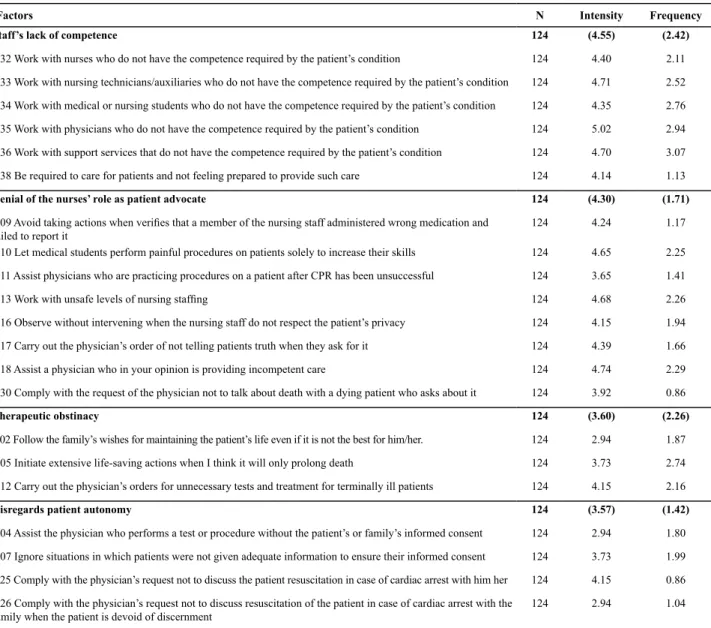
The descripive analysis revealed the percepions of nurses in the face of moral distress. Each of the four con
-structs ideniied in the study (denial of the nurses’ role as paient advocate, staf’s lack of competence, disregard paient autonomy, and therapeuic obsinacy) was repre
-sented by a numerical value, which refers to the arithme
-ic average of the statements that composed each percep
-ion individually, previously grouped by factorial analysis. The averages of the constructs and their respecive indica
-tors are presented in Table 3.
Table 3 – Indexes of intensity and frequency of moral distress experienced through situations represented in the statements of the validated instrument – 2001
Factors N Intensity Frequency
Staff’s lack of competence 124 (4.55) (2.42)
s-32 Work with nurses who do not have the competence required by the patient’s condition 124 4.40 2.11
s-33 Work with nursing technicians/auxiliaries who do not have the competence required by the patient’s condition 124 4.71 2.52
s-34 Work with medical or nursing students who do not have the competence required by the patient’s condition 124 4.35 2.76
s-35 Work with physicians who do not have the competence required by the patient’s condition 124 5.02 2.94
s-36 Work with support services that do not have the competence required by the patient’s condition 124 4.70 3.07
s-38 Be required to care for patients and not feeling prepared to provide such care 124 4.14 1.13
Denial of the nurses’ role as patient advocate 124 (4.30) (1.71)
s-09 Avoid taking actions when veriies that a member of the nursing staff administered wrong medication and
failed to report it
124 4.24 1.17
s-10 Let medical students perform painful procedures on patients solely to increase their skills 124 4.65 2.25
s-11 Assist physicians who are practicing procedures on a patient after CPR has been unsuccessful 124 3.65 1.41
s-13 Work with unsafe levels of nursing stafing 124 4.68 2.26
s-16 Observe without intervening when the nursing staff do not respect the patient’s privacy 124 4.15 1.94
s-17 Carry out the physician’s order of not telling patients truth when they ask for it 124 4.39 1.66
s-18 Assist a physician who in your opinion is providing incompetent care 124 4.74 2.29
s-30 Comply with the request of the physician not to talk about death with a dying patient who asks about it 124 3.92 0.86
Therapeutic obstinacy 124 (3.60) (2.26)
s-02 Follow the family’s wishes for maintaining the patient’s life even if it is not the best for him/her. 124 2.94 1.87
s-05 Initiate extensive life-saving actions when I think it will only prolong death 124 3.73 2.74
s-12 Carry out the physician’s orders for unnecessary tests and treatment for terminally ill patients 124 4.15 2.16
Disregards patient autonomy 124 (3.57) (1.42)
s-04 Assist the physician who performs a test or procedure without the patient’s or family’s informed consent 124 2.94 1.80
s-07 Ignore situations in which patients were not given adequate information to ensure their informed consent 124 3.73 1.99
s-25 Comply with the physician’s request not to discuss the patient resuscitation in case of cardiac arrest with him her 124 4.15 0.86
s-26 Comply with the physician’s request not to discuss resuscitation of the patient in case of cardiac arrest with the family when the patient is devoid of discernment
124 2.94 1.04
Diferent analyses of variance were performed to ver
-ify the existence of potenial diferences in the percep
-ions of nurses concerning their experience with moral distress, considering the uniqueness of each individual, such as in regard to age, year of graduaion, compleion of graduate program, hospital where employed, ime working in the hospital, unit of work, ime working in the unit, type of unit, presence/lack of meeings with the nursing staf, frequency of meeings with the nursing staf, meeings in the unit of work, frequency of meet
-ings in the unit of work.
In inding diferences, we performed the Duncan test among subgroups to idenify homogeneous groups in each of the variables, whose averages did not present signiicant staisical diferences. Only one important cor
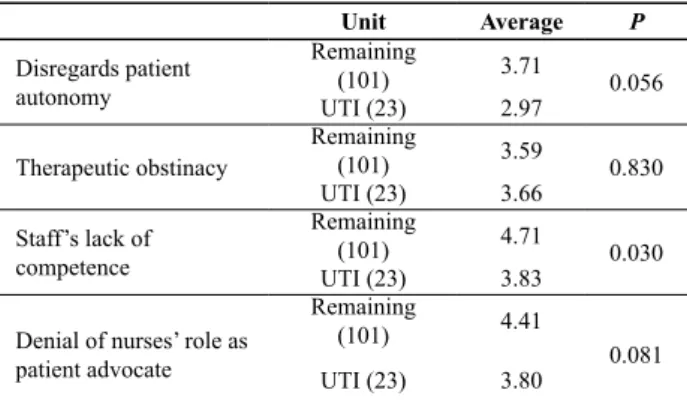
-relaion was found in the analyses of variance with a level of signiicance of 5%, that is, nurses working in Intensive Care Units (ICU) experience moral distress when facing the staf’s lack of competence.
Table 4 presents the correlaion of moral distress ex
Table 4 shows that sufering manifested by the 23 professionals working in the ICU is less intense than that experienced by the remaining workers in the categories disregards paient autonomy (2.7 and 3.71 respecively); staf’s lack of competence (3.83 and 4.71); and lack of ad-vocacy (3.80 and 4.41).
The nurses working in the ICU obtained a higher av
-erage only in the category ‘therapeuic obsinacy’ (3.66) when compared to the average of professionals from the remaining units (3.59). Such an outcome is probably explained by the greater occurrence of therapeuic ob
-sinacy observed in ICUs. Addiionally, the competence required from professionals working in ICUs is extremely relevant, a fact demonstrated by the level of signiicance of 5% obtained in this study, given the constant risk of death to which paients are exposed, which may require urgent and immediate acion.
The last test evaluated the efect of the four variables obtained in relaion to moral distress. A muliple regres
-sion model was used. It involved the studied variables; statement s-39 was established as a dependent variable: In general, situaions experienced at work cause me moral distress. The results indicate there is a signiicant relaion -ship among the variables at a level of 5%. The adjusted coeicient of determinaion (R2) obtained in the test was
40%. Table 5 shows moral distress in the four categories obtained in the four hospitals.
Table 5 shows once more that staf’s competence stands out as related to moral distress. A great power is culturally atributed to physicians in the decision-making process and among such decisions are those related to the life and death of paients. Hence, much conlict may result, since nursing professionals perform most of the procedures.
diScUSSion
The percepion of the intensity of distress experienced by nurses ranged from 2.94 to 5.02, with an average of 4.06, while frequency varied from 0.86 to 3.07, with an average of 1.72. Such values are very similar to those ideniied in another study replicaing the moral distress scale with 106 American nurses(13). This study reports that
the percepion of intensity of moral distress ranged from 2.61 to 4.79, with an average of 3.64, and the frequency ranged from 0.08 to 3.05, with an average of 1.45. Even though the values in both studies are very close, a greater intensity and frequency of moral distress is observed in the Brazilian context.
Statement s-35 working with physicians who do not have the competence required by the paient’s condiion in the variable staf’s lack of competence was the one that most caused perceived moral distress in the invesigated nurses (5.02), as opposed to the study previously menioned per
-formed with American nurses, in which statement s-13 Work with unsafe levels of nursing staing was the one that presented the highest average of perceived distress(13).
Moral distress among nurses in the Brazilian context is more associated with coping with situaions directly related to the modus operandi of some physicians, which may be linked to the percepion of an apparent disregard and indiference on the part of physicians, in relaion to the complaints and manifestaions of paients, delay in addressing the requests of nurses, absences and lack of commitment to integrality of care, incomplete medical prescripions, prescripions with errors and/or delays, which are part of the percepion of medical neglect, as an act of omission, lack of atenion to and observaion of professional duty (14).
In regard to the ideniied correlaion of the lower per
-cepion of moral distress among ICU nurses in relaion to staf’s lack of competence, this outcome may be related to characterisics speciic to ICU stafs, usually endowed with great professional competence. The complexity of equip
-ment and medicaion used in ICUs requires difereniated technical knowledge, in addiion to professional experise appropriate to everyday situaions, which include risk of death, terminality, and ethical conlicts(12), which also
seem to be associated with the high incidence of studies in ICUs addressing ethical issues(6).
The second statement in the variable denial of the nurses’ role as paient advocate was ideniied as the per
-cepion with the greatest intensity of moral distress in the enire instrument, s-18: Assist a physician who in your opinion is providing incompetent care (4.74). There are other situaions in this variable that deserve to be noted in relaion to the medical staf, such as that evidenced in statement s-10 Let medical students perform painful pro-cedures on paients solely to increase their skills (4.65); its average stood out as the sixth highest value.
Unit Average P
Disregards patient autonomy
Remaining
(101) 3.71 0.056
UTI (23) 2.97
Therapeutic obstinacy
Remaining
(101) 3.59 0.830
UTI (23) 3.66
Staff’s lack of competence
Remaining
(101) 4.71 0.030
UTI (23) 3.83
Denial of nurses’ role as patient advocate
Remaining
(101) 4.41
0.081
UTI (23) 3.80
Table 4 – Analysis of variance among the different units – 2011
Table 5 – Analysis of variance among the constructs – 2011
Constant Β P
Staff’s lack of competence 0.40 0.00
Disregards patient autonomy 0.33 0.00
Denial of the nurses’ role as patient advocate 0.30 0.00
It has been argued that nurses’ moral distress primar
-ily accrues from the fact that nursing work is performed in a social space of health care that puts workers very close to paients for long periods of ime(15).
Issues related to the medical hegemony within the health staf can contribute to nurse distress, since ac
-knowledging the power of physicians in the work environ
-ment may discourage them from implemening acions that resist this power, especially advocaing in favor of paients’ rights. Addiionally, 11 (52.38) out of the 21 inal statements in the validated instrument refer to the rou
-ine of these nurses in relaion to the medical staf, show
-ing the diiculies and sufer-ing they experience regard
-less of the moral issues and professional values involved. It is important to note that even though these state
-ments compose the variable denial of the nurses’ role as paient advocate, they are also related to the staf’s com
-petence and to the way physicians and future physicians act, which may require nurses to take acion to defend paients. Relecing on nurses’ failure to exercise power raises potenial ethical implicaions associated with the submission of nurses. In addiion to quesioning this ap
-parent lack of power, it has been argued that nurses un
-deresimate or do not acknowledge their power. On the other hand, when nurses and other nursing professionals refuse, during their professional pracice, to resist the ac
-ions of others, they may be refusing delivery of the best possible care to their paients(16).
Health workers, especially nurses, constantly need to commit themselves to the care of paients, providing technical-scieniic knowledge and becoming responsible for their decisions and acions. Therefore, diiculies in assuming such a responsibility may cause them moral dis
-tress since, in the role of paient advocate, nurses have the moral and professional responsibility to quesion, re
-lect, defend paients and, if necessary, report the pracic
-es of other prof-essionals and/or future prof-essionals that may negaively afect paient care.
As shown in this study in diferent statements, the in
-terests of paients do not seem to be fully met, leading to moral problems that may cause moral distress to nurses, with a diversiied percepion of both its intensity and fre
-quency. All these statements bring, at their core, respect for the rights of paients and their physical, emoional, so
-cial and moral integrity, oten negaively afected by situa
-ions described in the instrument.
For advocacy in health, the presence of sound ethi
-cal values becomes hugely important, since this inluence the decision-making process and individuals’ personali
-ies. Hence, the very human acion is a way of express -ing values(17), which can always sufer constraints, whether through insituional imposiion or through its members, resuling in inconsistent pracices from an ethical point of view.
Insituional constraints consitute an important and major component for the occurrence of moral distress and increased sufering since nurses may also experience educaional deiciencies; their formal educaion may have been deicient in terms of ethical reasoning and confron
-taion of ethical dilemmas that require advocacy(18).
The categories Therapeuic obsinacy (3.6) and Disre-gards paient autonomy (3.57), with very similar values and with a lower average of sufering, also present state
-ments with the lowest averages of intensity of percepion of sufering. That is, the statements s-02 Follow the fam -ily’s wishes to maintain the paient’s life even if it is not the best for him/her, s-04 Assist the physician who per-forms a test or procedure without the paient’s or family’s informed consent and s-26 Comply with the physician’s request not to discuss resuscitaion of the paient in the event of cardiac arrest with the family when the paient is devoid of discernment present an average of 2.94.
These lower values may result from a culture sill pres
-ent in the health ield, which seems not to recognize the paient, or his/her family members, when the paient is unable to manifest him/herself as subject, as owner of his/her own body and, therefore, the one who has the inal decision of what will or will not be admited in his/ her treatment based on clariicaion and guidance pro
-vided by health workers. The autonomy of paients or the autonomy and will of family members, when paients are unable to exercise such autonomy, may not be acknowl
-edged by professionals, which is associated with the fact that the consent of paients is not asked, an essenial re
-quirement to perform any procedure(19).
concLUSion
The study shows that nurses in the selected hospitals presented the highest percepion of intensity of moral distress associated with the staf’s lack of competence fol
-lowed by denial of the nurses’ role as paient advocate, while the greatest frequency of moral distress was also re
-lated to staf’s lack of competence followed by therapeuic obsinacy.
The percepion of moral distress experienced by nurs
-es reinforc-es the need to qu-esion, relect on, and discuss, constantly, with the staf, focusing on moral problems and moral distress faced by the diferent workers, especially considering its potenial relaion to the care provided to paients and respect for their rights.
When the professionals ground their acions on ethi
-cal values, they seem to be more certain in their resolu
-ions, beneiing themselves and their paients. From this perspecive, it seems to be an alternaive to reinforce pro
Among the limitaions of this study, we note it was conducted with a small populaion of nurses working in four hospitals in two ciies in the extreme South of Brazil and generalizaion of the results is not possible. Addiion
-ally, there are no previous Brazilian studies addressing the intensity and frequency with which moral distress is expe
-rienced among nurses. Hence, comparison of results with other regions in the country was not possible.
The study shows the need for further research ad
-dressing ethics, moral problems and, especially, moral distress in the nursing and health ields, to contribute to the transformaion of the current context, through beter coping with situaions in the workplace that are acknowl
-edged as acceptable by professionals despite being char
-acterized as morally inappropriate.
REFEREncES
1. Jameton A. Nursing pracice: the ethical issues. Englewood Clifs: Prenice-Hall; 1984.
2. Hardingham LB. Integrity and moral residue: nurses as parici -pants in a moral community. Nurs Philos. 2004;5(1):127-34.
3. Kopala B, Burkhart L. Ethical dilemma and moral distress: proposed new NANDA diagnoses. Int J Nurs Terminol Classif. 2005;16(1):3-13.
4. Guierrez KM. Criical care nurses’ percepions of and responses to moral distress. Dimens Crit Care Nurs. 2005;24(5):229-41.
5. Corley MC. Nurse moral distress: a proposed theory and re -search agenda. Nurs Ethics. 2002;9(6):636-50.
6. Lunardi VL, Barlem ELD, Bulhosa MS, Santos SSC, Lunardi Filho WD, Silveira RS, et al. Moral distress and the ethical dimen -sion in nursing work . Rev Bras Enferm. 2009; 62(4):599-603.
7. Corley MC, Elswick RK, Gorman M, Clor T. Development and evaluaion of moral distress scale. J Adv Nurs. 2001;33(2):250-6.
8. Babbie E. Métodos de pesquisas de Survey. Belo Horizonte: UFMG; 2003.
9. Grace PJ. Professional advocacy: widening the scope of ac -countability. Nurs Philos. 2001;2(2):151-62.
10. Oguisso T. Responsabilidade éica e legal do proissional de enfermagem. In: Oguisso T, Zoboli E, organizadores. Éica e bioéica: desaios para a enfermagem e a saúde. São Paulo: Manole; 2006. p. 68- 90.
11. Beauchamp TL, Childress JF. Princípios de éica biomédica. São Paulo: Loyola; 2002.
12. Pessini L. Distanásia: até quando prolongar a vida? São Pau -lo: Loyola; 2001.
13. Corley MC, Ptlene M, Elswick RK, Jacob M. Nurse mor -al distress and ethic-al work environment. Nurs Ethics. 2005;12(4):381-90.
14. Selli L. Bioéica na enfermagem. São Leopoldo: Ed. UNISI -NOS; 2005.
15. Peter E, Liaschenko J. Perils of proximity: a spaiotemporal analysis of moral distress and moral ambiguity. Nurs Inq. 2001;11(4):218-25.
16. Lunardi VL, Peter E, Gastaldo D. Are submissive nurses? Relect -ing on power anorexia. Rev Bras Enferm. 2002;55(2):83-8.
17. Fernandes MFP, Freitas GF. Fundamentos da éica. In: Ogu -isso T, Zoboli E, organizadores. Éica e bioéica: desaios para a enfermagem e a saúde. São Paulo: Manole; 2006. p. 27-44.
18. Zuzelo PR. Exploring the moral distress of registered nurses. Nurs Ethics. 2007;14(3):343-59.