RESUmEn
Objeivo: Analizar el efecto de la inconi -nencia urinaria como pronosicadora de la incidencia de caídas entre ancianos hos-pitalizados. Método: Estudio de cohorte concurrente en el que se acompañaron a 221 personas mayores en estancia hos-pitalaria, desde la fecha del ingreso hasta el alta, defunción o caída. El análisis de supervivencia y la veriicación de la aso -ciación entre la variable de exposición y las demás variables se llevaron a cabo por los métodos de Kaplan-Meier, densidad de in-cidencia y el modelo de regresión de Cox. Resultados: La inconinencia urinaria fue un fuerte pronosicador de caídas en los añosos invesigados y estuvo asociada con el menor iempo de ocurrencia del even -to. La inconinencia urinaria, concomitante con la disfunción de equilibrio y marcha y el uso de anipsicóicos, estuvieron asocia -das con las caí-das. Conclusión: Son nece-sarias medidas de prevención de riesgo de caídas especíicas a los pacientes añosos hospitalizados que presentan inconinen -cia urinaria.
dEScRiPtoRES Anciano
Pacientes internos Inconinencia urinaria Accidentes por caídas Análisis de supervivencia Enfermería geriátrica RESUmo
Objeivo: Analisar o efeito da inconinência urinária como preditora da incidência de quedas entre idosos hospitalizados. Méto -do: Estudo de coorte concorrente onde fo-ram acompanhados 221 idosos internados, desde a data da admissão hospitalar até a alta, óbito ou queda. A análise de sobrevi-vência e a veriicação da associação entre a variável de exposição e as demais vari -áveis foram realizadas pelos métodos de Kaplan-Meier, densidade de incidência e o modelo de regressão de Cox. Resultados: A inconinência urinária foi um forte preditor de quedas nos idosos pesquisados e esteve associada ao menor tempo de ocorrência do evento. A inconinência urinária, conco -mitante à disfunção de equilíbrio e marcha e uso de anipsicóicos foram associadas às quedas. Conclusão: São necessárias medi-das de prevenção de risco de quemedi-das espe -cíicas aos pacientes idosos hospitalizados que apresentam inconinência urinária.
dEScRitoRES Idoso
Pacientes internados Inconinência urinária Acidentes por quedas Análise de sobrevida Enfermagem geriátrica AbStRAct
Objecive: Analyzing the efect of urinary inconinence as a predictor of the inciden -ce of falls among hospitalized elderly. Me-thod: Concurrent cohort study where 221 elderly inpaients were followed from the date of admission unil discharge, death or fall. The Kaplan-Meier methods, the inci-dence density and the Cox regression mo-del were used for the survival analysis and the assessment of the associaion between the exposure variable and the other va-riables. Results: Urinary inconinence was a strong predictor of falls in the surveyed elderly, and was associated with shorter ime unil the occurrence of event. Urinary inconinence, concomitant with gait and balance dysfuncion and use of anipsycho -ics was associated with falls. Conclusion: Measures to prevent the risk of falls spe-ciic to hospitalized elderly paients who have urinary inconinence are necessary.
dEScRiPtoRS Aged
Inpaients
Urinary inconinence Accidental falls Survival analysis Geriatric nursing
Urinary incontinence in the prediction
of falls in hospitalized elderly
*Hellen cristina de Almeida Abreu1, Annelita Almeida oliveira Reiners2, Rosemeiry capriata de
Souza Azevedo2, Ageo mário cândido da Silva3, débora Regina de oliveira moura Abreu4 IncontInêncIa urInárIa na predIção de quedas em Idosos hospItalIzados
IncontInencIa urInarIa en la predIccIÓn de caÍdas en ancIanos hospItalIzados
* extracted from the dissertation “Incidência e fatores associados a quedas em idosos hospitalizados”, Faculty of nursing, Federal university of mato Grosso, 2014. 1 msc student, post-Graduate program in nursing, Faculty of nursing, Federal university of mato Grosso, cuiabá, mt, Brazil. 2 associate professor,
doI: 10.1590/s0080-623420140000500011
O
riginal
a
intRodUction
Urinary incontinence (UI) and the accident by falls are considered two of the most important and recur-rent geriatric syndromes due to the magnitude of its occurrence and its consequences(1-2). They can affect
the elderly in all age groups, especially those of ad-vanced age(3-5).
It is esimated that one-third of the elderly living in the
community and about half of hospitalized or living in
long-stay insituions present UI(5). Between 30% and 50% of
hospitalized elderly and residing in long-stay insituions sufered falls once in a lifeime(6-7).
Both syndromes are related to the need for insitu
-ional care, increased hospitalizaion ime and also, the
prevalence of anxiety and depression(5,8-9).
Studies have reported associaions between UI and
falls(9-11). Most of them were carried out with elderly
re-siding in the community, with cross-secional epidemio
-logical designs and showed that this condiion is oten associated with the occurrence of falls in this populaion, especially the urge inconinency(5,9). However, to date,
lon-gitudinal studies with hospitalized elderly idenifying UI as
a risk factor associated with falls are scarce(12-13).
The prevenion of falls among the elderly in hospitals is an imperaive acion in these insituions. In addiion to sufering more falls, the elderly with UI have longer hos -pital stays and higher use of health resources(12-14).
How-ever, addiional studies on the inluence of UI on the oc
-currence of falls among the elderly with inconinence are necessary in order that speciic prevenion strategies are adopted for these paients.
Thus, this study aimed at analyzing the efect of uri
-nary inconinence as a predictor of the incidence of falls among elderly paients in hospitals.
mEtHod
This is a concurrent, prospecive cohort study, which followed 221 elderly paients admited to medical wards in three large general hospitals, under the Uniied Health
System (SUS) of Cuiabá, Mato Grosso, in the period from March to August 2013.
This study included people of both genders, aged 60 years or older, hospitalized in the internal medicine
divi-sion of the aforemenioned hospitals. Three elderly pa
-ients with compromised mental capacity, evaluated with the Mini-Mental State Examinaion (MMSE)(10) and
with-out companions able to respond to the survey quesion -naire were excluded.
The exposure variable, urinary incontinence (UI), was obtained by questioning the involuntary loss of
urine. The following sociodemographic variables were included in the analysis: gender (female and male), age (categorized in years, subsequently re-categorized into
three age groups [60 − 69 years, 70 – 79 years and 80
years or older]), education (< 3 years and 4 years or more), income of the elderly in minimum wages (SM) (less than 1 and 2 or more SM). The presence of some comorbidities in the medical records were considered as variables on the health of the elderly, namely: hy-pertension, diabetes, osteoporosis and stroke. The presence of gait disturbance assessed by applying the Tinetti gait and balance examination was also includ-ed(15), as well as the use of antihypertensive drugs,
hy-poglycemic agents, anxiolytics, antipsychotics and anti-convulsants.
The analysis of the time until the occurrence of falls and the identification of the association between the exposure variable and the other predictive variables was done using the Kaplan-Meier method, which es-timates the function and survival curve(16). The date of
admission to hospital was used as time zero. Initially, were assessed the ratios of incidence rate (Hazard Ratio - HR) of exposed and unexposed, having as ex-planatory variables the presence or absence of UI and other variables, and as the response variable, the oc-currence of falls or not. The method used was the in-cidence density, in which the number of people / time is calculated by estimating the time of observation of each individual from the date of admission until the date of occurrence of the event (fall) or discharge / death (censoring). For the final analysis was used the Cox regression model, in which the p-value of 0.20 was considered for entry of predictive variables in the ini-tial model, and for the variable remaining in the final model was considered the 0.05 level of significance. Analyses were done using the Statistical Package for
Social Sciences 18.0 (SPSS).
The study was approved by the Ethics Committee in Research of the Hospital Universitário Julio Muller
- under protocol number 206.880/2013 of the Plata-forma Brasil.
RESUltS
Among the 221 surveyed seniors, the majority were male (n = 117, 52.9%), aged 70-79 years (n = 85, 38.5%), mean age of 73.9 years (± 8.6 years), with less than three years of study (n = 156, 70.6%) and income of less than one minimum wage (n = 191, 86.5%).
The results of the survival analysis (life table) are
shown in table 1 and igure 1. The overall survival ob -tained by the Kaplan-Meier method was 42.0% at the end of the study period, while between 20 and 39 days the
Table 1 – Life table for the time until occurrence of falls in hospitalized elderly – Cuiabá, MT, 2013
Time (in days)
Individuals Censored events Exposure to risk Occurrence of event Occurrence of event (proportion)
Survival (proportion)
Cumulative survival
Standard error of survival
n n n N
0 to 19 221 158 142 32 0.23 0.77 0.77 0.04
20 to 39 31 20 21 2 0.10 0.90 0.70 0.06
40 to 59 9 6 6 0 0.00 1.00 0.70 0.06
60 to 79 3 1 2 1 0.50 0.50 0.42 0.22
80 and more 1 1 1 0 0.00 1.00 0.42 0.22
note: (n = 221)
Figure 1 – Survival function of hospitalized elderly until the occurrence of falls obtained by the method of Kaplan-Meier – Cuiabá, MT, 2013.
The variables associated with falls were the following:
pres-ence of urinary inconinpres-ence (RR= 6.80; CI 95%: 3.38–13.64), presence of gait and balance dysfuncion (RR= 5.30; CI 95%:
2.32–12.09), use of hypoglycemic agents (RR= 2.22 CI 95%: 1.12–4.40), use of anxiolyics (RR= 4.36 CI 95% 1.84–10.30) and use of anipsychoics (RR= 3.51 CI 95%: 1.38–8.89) (Table 2).
Variables Fall People-time Incidence(*) RR (CI 95%) p value
Urinary incontinence
No 24 2609 9.20 1.00
Yes 11 176 62.50 6.80 (3.38–13.64) <0.001
Age range (years)
≤ 69 16 82 19.5 1.00
≥ 70 19 139 13.7 1.42 (0.78–2.62) 0.251
Hypertension
No 2 441 4.53 1.00
Yes 33 2339 14.11 3.11 (0.75–12.92) 0.066*
Diabetes
No 19 1914 9.95 1.00
Yes 16 866 18.47 1.86 (0.96–3.60) 0.061
Balance/gait
No dysfunction 7 1584 4.42 1.00
With dysfunction 28 1196 23.41 5.30 (2.32–12.09) <0.001
Antihypertensive
No 2 397 5.04 1.00
Yes 33 2383 13.85 2.74 (0.66–11.41) 0.067*
Table 2 – Distribution of hospitalized elderly patients who suffered falls by incidence density of hospital stay, according to the variables
continuation...
Variables Fall People-time Incidence(*) RR (CI 95%) p value
Hypoglycemic agents
No 13 1579 8.23 1.00
Yes 22 1201 18.32 2.22 (1.12–4.40) 0.018
Anxiolytics
No 29 2654 10.93 1.00
Yes 6 126 47.62 4.36 (1.84–10.30) <0.001
Antipsychotics
No 30 2654 11.30 1.00
Yes 5 126 39.68 3.51 (1.38–8.89) 0.019*
Anticonvulsants
No 32 2700 11.85 1.00
Yes 2 80 37.50 3.16 (0.99–10.12) 0.077*
RR: relative risk; CI 95%: conidence interval for the proportion of 95%.
(*): per 1000 people-time * Fisher’s test
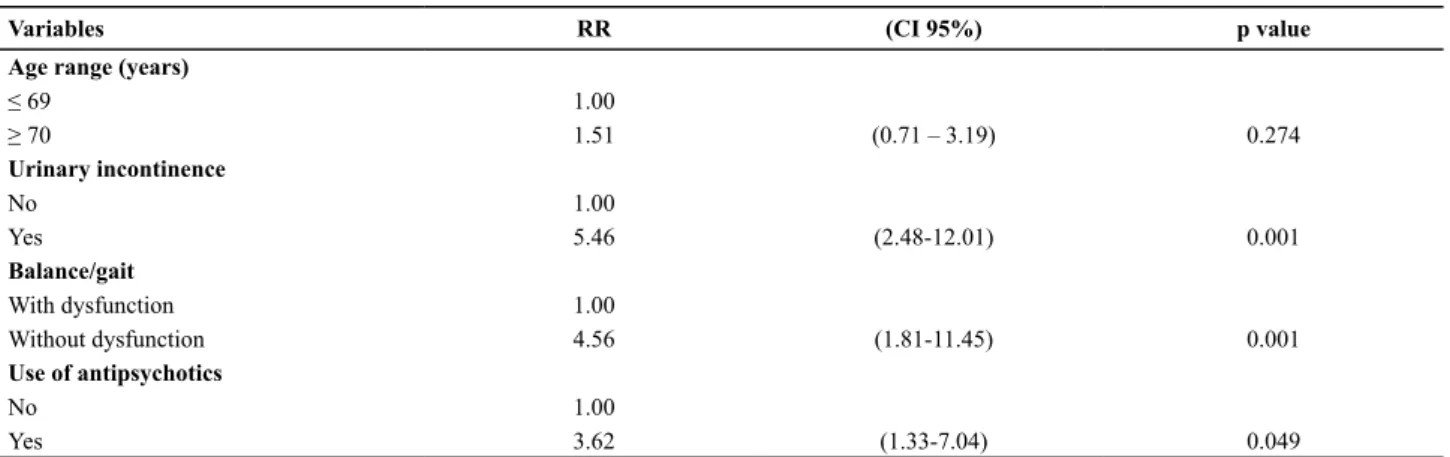
Table 3 – Regression of proportional risks of Cox for incidence of falls in hospitalized elderly – Cuiabá, MT, 2013
Variables RR (CI 95%) p value
Age range (years)
≤ 69 1.00
≥ 70 1.51 (0.71 – 3.19) 0.274
Urinary incontinence
No 1.00
Yes 5.46 (2.48-12.01) 0.001
Balance/gait
With dysfunction 1.00
Without dysfunction 4.56 (1.81-11.45) 0.001
Use of antipsychotics
No 1.00
Yes 3.62 (1.33-7.04) 0.049
RR: relative risk; CI 95%: conidence interval for the proportion of 95%.
Figure 2 – Survival function (Kaplan-Meier) of hospitalized elderly patients with urinary incontinence – Cuiabá, MT, 2013.
The variables that remained in the inal model of Cox were
the presence of urinary inconinence (RR= 5.46; (2.48-12.01)), presence of gait and balance dysfuncion (RR= 4.56; (1.81-11.45)) and use of anipsychoics (RR= 3.62; (1.33-7.04)) (Table 3).
In Figure 2, the Kaplan-Meier curve indicates the in-fluence of urinary incontinence on the survival of hos-pitalized elderly. Compared with individuals without
diScUSSion
In this study, the UI was a strong predictor of falls in
the studied populaion, similar to that found in exising
longitudinal studies(12-13). Another relevant inding was
that inconinent paients sufered falls with shorter hospi
-tal stay than those without UI, reinforcing the assumpion that this condiion inluences the occurrence of falls in hospitalized elderly. One explanaion is the more frequent
need to urinate of the elderly, as well as their inability to
postpone urinaion, forcing them to go to the bathroom more oten than expected hence, exposing them to in -creased risk of falls(17). In a study with 77 hospitalized
adults with UI, it was found that 85.2% of them woke up to go to the bathroom(18). This task can be even more
dif-icult by the concomitant presence of other risk factors such as comorbidiies and poor ambient lighing(19). Allied
to this, it must be considered that especially at nighime,
the elderly tend not to call the nurse to help them with
aciviies they believe to be able to perform(20-21).
In this study, the UI and the gait and balance
dysfunc-ion were independently associated with falls, and re
-mained in the inal model. Similar results were found in one of the exising longitudinal studies(12), in which the
balance deicit was one of the predictor factors for falls in
hospitalized elderly.
The deiciencies in the visual, vesibular and somato
-sensory systems occur with aging and can lead to diicul
-ies in gait and balance. In the elderly, this dysfuncion
concomitantly with UI may result in falls due to the
com-binaion of postural instability, the urgent need to go to the bathroom and the concern about not urinaing on the
clothes(20).
The use of anipsychoics was associated with the risk of falls. Previous studies demonstrated the use of anipsy
-choics as a risk factor for falls in hospitalized elderly(22-23).
A possible explanaion is that these drugs lead to higher rates of adverse efects, among them, inconinence and / or urinary tract infecions, and possible changes in gait
and balance, which, combined, can lead to greater inci-dence of falls(24-25).
In this study, survival was not afected by the age of the elderly. This inding is diferent from that found in
other studies(12-13). However, it was chosen to maintain the
age variable in the Cox regression, which allowed a beter it in the inal model.
Concurrent prospecive cohort studies, such as the
present research have greater validity than other
observa-ional studies, because they allow the assessment of the outcome at the ime it occurred, not being suscepible to bias of memory and informaion, among other common limitaions of nonconcurrent studies. Moreover, taking into account the proposed objecive, the survival analysis has greater advantage than other methods of staisical analy
-sis, since it uses the esimaion of the incidence density and comparison rates through people-ime, and not prevalence data. However, because this is an observaional method,
the presence of other possible biases cannot be excluded.
Finally, the results of this study deepen the knowledge
about two of the major syndromes that afect the elderly, urinary inconinence and falls, and future studies should consider them. The clinical implicaion of these indings lies in the need to implement mulidisciplinary and intersec
-toral intervenions that help to reduce the risk of falls in el
-derly inconinent paients. There are nursing intervenions
based on evidence that have contributed to this
reduc-ion(26-27). These measures include ideniicaion of paients
with UI, speciic treatment and care, as well as protecive measures to increase the safety of these paients (bars on beds, protecion bars and adequate lighing in bedrooms
and bathrooms, bedpans and urinals next to the bed).
There is also the need for implemening educaional measures with paients and caregivers on the risk of falls and the ways of prevening them. Generally, paients and
caregivers have no knowledge about the factors that lead to greater incidence of falls in hospitals. People with more
knowledge about their health situaion and the ways of
dealing with it are more likely to adopt appropriate health
behaviors and prevent problems. Studies on educaional intervenions for prevening falls in hospitals have been
carried out and show evidence that, to some extent, such
intervenions contribute to the reducion of the event(28-29).
conclUSion
The UI was a strong predictor of falls in the surveyed
elderly and associated with shorter ime unil occurrence
of the event. This study also demonstrated that UI,
con-comitant with gait and balance dysfuncion and anipsy
-choics were associated with falls. These results suggest that measures for prevening risk of speciic falls should be adopted with hospitalized elderly paients who have urinary inconinence.
REFEREncES
1. Santos CRSS, Santos VLCGS. Epidemiologia das
incon-inências urinária e anal combinadas. Acta Paul Enferm. 2009;22(3):328-30.
2. Edwards R, Marin FC, Grant R, Lowe D, Poter J, Husk J, et al.
Is urinary coninence considered in the assessment of older
people ater a fall in England and Wales? Cross-secional clini
3. Du Moulin MF, Hamers JP, Ambergen AW, Janssen MA, Halfens RJ.
Prevalence of urinary inconinence among community-dwelling adults receiving home care. Res Nurs Health. 2008;31(6):604-12.
4. Liapis A, Bakas P, Liapi S, Siouis D, Creatsas G. Epidemiology
of female urinary inconinence in the Greek populaion: EU
-RIG study. Int Urogynecol J. 2010;21(2):217-22.
5. Haylen BT, Ridder D, Freeman RM, Swit SE, Berghmans B, Lee
J, et al. An Internaional Urogynecological Associaion (IUGA)/
Internaional Coninence Society (ICS) joint report on the ter
-minology for female pelvic loor dysfuncion. Neurourol Uro
-dyn. 2010;29(1):4-20.
6. Stevens JA, Corso PS, Finkelstein EA, Miller TR. The costs of fatal and non-fatal falls among older adults. Inj Prev.
2006;12(5):290-5.
7. Ferreira DCO, Yoshitome AY. Prevalência e caracterísicas
das quedas de idosos insitucionalizados. Rev Bras Enferm. 2010;63(6):991-7.
8. Ofermans MPW, Du Moulin MFMT, Hamers JPH, Dassen T,
Halfens RJ. Prevalence of urinary inconinence and associated risk factors in nursing home residents: a systemaic review. Neurourol Urodyn. 2009;28(4):288-94.
9. Foley AL, Loharuka S, Barret JA, Mathews R, Williams K, Mc
-Grother CW, et al. Associaion between the geriatric giants of urinary inconinence and falls in older people using data from the Leicestershire MRC Inconinence Study. Age Ageing. 2012;41(1):35-40.
10. Dellaroza MSG, Pimenta CAM, Lebrão ML, Duarte YAO, Braga
PE. Associação entre dor crônica e autorrelato de quedas: estu
-do populacional - SABE. Cad Saúde Pública. 2014;30(3):522-32.
11. Hunter KF, Voaklander D, Hsu ZY, Hsu ZY. Lower urinary tract
symptoms and falls risk among older women receiving home
support: a prospecive cohort study. BMC Geriatr. 2013;13:46.
12. Corsinovi L, Bo M, Ricauda Aimonino N, Marinello R, Gariglio
F, Marcheto C, et al. Predictors of falls and hospitalizaion out comes in elderly paients admited to an acute geriatric unit. Arch Gerontol Geriatr. 2009;49(1):142-5.
13. Tanaka B, Sakuma M, Ohtani M, Toshiro J, Matsumura T, Morimoto T, et al. Incidence and risk factors of hospital falls on long-term care wards in Japan. J Eval Clin Pract.
2012;18(3):572-7.
14. Härlein J, Halfens RJ, Dassen T, Lahmann NA. Falls in older
hospital inpaients and the efect of cogniive impairment:
a secondary analysis of prevalence studies. J Clin Nurs.
2011;20(1-2):175-83.
15. Tinei ME. Performace- oriented assessment of mo
-bility problems in elderly paients. J Am Geriatr Soc. 1986;34(2):119-26.
16. Klein JP, Moeschberger ML. Survival analysis: techniques for
censored and truncated data. New York: Springer-Verlag; 1997.
17. Chiarelli PE, Mackenzie LA, Osmotherly PG. Urinary
incon-inence is associated with an increase in falls: a systemaic review. Aust J Physiother. 2009;55(2):89-95.
18. Silva APM, Santos VLCG. Prevalência da inconinência
urinária em adultos e idosos hospitalizados. Rev Esc
En-ferm USP [Internet]. 2005[citado 2014 fev. 04];39(1):36-45. Disponível em: htp://www.scielo.br/pdf/reeusp/v39n1/
a05v39n1.pdf
19. World Health Organizaion. Injuries and violence: the facts.
Geneva: WHO; 2010.
20. Morris V, Hunter KF, Wagg A. Urinary inconinence and falls:
a link ripe for intervenions. Geriatr Med. 2011;41(6):333-6.
21. Paiva MC, Paiva SA, Beri HW, Campana AO. Characterizaion
of paient falls according to the noiicaion in adverse event
reports. Rev Esc Enferm USP [Internet]. 2010 [cited 2014 Feb
04]; 44(1):134-8. Available from: htp://www.scielo.br/pdf/
reeusp/v44n1/en_a19v44n1.pdf
22. Rhalimi M, Helou R, Jaecker P. Medicaion use and increased
risk of falls in hospitalized elderly paients: a retrospecive case-control study. Drugs Aging. 2009; 26(10):847-52.
23. Shuto H, Imakyure O, Matsumoto J, Egawa T, Jiang Y, Hiraka
-wa M, et al. Medicaion use as a risk factor for inpaient falls
in an acute care hospital: a case-crossover study. Br J Clin
Pharmacol. 2010;69(5):535-42.
24. Ramos MG, Rocha FL. Eicácia e segurança dos anipsicói
-cos aípi-cos nas demências: uma revisão sistemáica. J Bras Psiquiatr. 2006;55(3):218-24.
25. Messinger-Rapport B, Dumas L. Falls in the nursing
home: a collaboraive approach. Nurs Clin North Am. 2009;44(2):187-95.
26. Wenger NS, Roth CP, Shekelle PG, Young RT, Solomon DH,
Kamberg CJ, et al. A pracice-based intervenion to improve primary care for falls, urinary inconinence, and demenia. J Am Geriatr Soc. 2009;57(3):547-55.
27. Klay M, Marfyak K. Use of a coninence nurse specialist in an
extended care facility. Urol Nurs. 2005;25(2):101-2, 107-8.
28. Haines TP, Hill AM, Hill KD, McPhail S, Oliver D, Brauer S, et
al. Paient educaion to prevent falls among older hospital inpaients: a randomized controlled trial. Arch Intern Med. 2011;171(6):516-24.
29. Hill AM, Etherton-Beer C, Haines TP. Tailored educaion for
older paients to facilitate engagement in falls prevenion
strategies ater hospital discharge: a pilot randomized con