RESUmEN
Objeivo: Evaluar los factores asociados con la mortalidad neonatal en niños na-cidos con bajo peso. Método: Estudio transversal que analizó datos de 771 na-cidos vivos con bajo peso (<2.500g) en el municipio de Cuiabá, Estado de Mato Grosso, en 2010, de los que 54 fallecieron en el período neonatal. Se obtuvieron los datos del Sistema de Información de Na-cidos Vivos y de Mortalidad, integrados por linkage. Resultados: En la regresión logísica múliple, la mortalidad neonatal se asoció con: número de consultas pre natal menor de 7 (OR=3,80;IC:1,66-8,70); edad gestacional menor de 37 semanas (OR=4,77;IC:1,48-15,38), Apgar menor de 7 en el 1er minuto (OR=4,25;IC:1,84-9,81) y 5º mi-nuto (OR=5,72;IC:2,24-14,60); y presencia de anomalía congénita (OR=14,39;IC:2,72-76,09). Conclusión: La mortalidad neonatal en re-cién nacidos con bajo peso se asocia con factores que se pueden prevenir mediante una adecuada atención en el prenatal, par-to y al mismo recién nacido.
dEScRiPtoRES Mortalidad infanil Factores de riesgo Recién nacido de bajo peso Sistemas de información Enfermería neonatal RESUmo
Objeivo: Avaliar os fatores associados à mortalidade neonatal em crianças nascidas com baixo peso. Método: Estudo transver-sal que analisou dados de 771 nascidos vi-vos com baixo peso (<2.500g) no município de Cuiabá, MT, em 2010, dos quais 54 foram a óbito no período neonatal. Obiveram-se os dados do Sistema de Informação de Nascidos Vivos e de Mortalidade, integra-dos por linkage. Resultados: Na regressão logísica múlipla, mortalidade neonatal associou-se com: número de consultas pré-natal menor que 7 (OR=3,80;IC:1,66-8,70); idade gestacional menor que 37 semanas (OR=4,77;IC:1,48-15,38), Apgar menor que 7 no 1º minuto (OR=4,25;IC:1,84-9,81) e 5º minuto (OR=5,72;IC:2,24-14,60) e presença de anomalia congênita (OR=14,39;IC:2,72-76,09). Conclusão: A mortalidade neonatal em re-cém-nascidos com baixo peso associa-se a fatores evitáveis por adequada atenção no pré-natal, parto e ao recém-nascido.
dEScRitoRES Mortalidade infanil Fatores de risco
Recém-nascido de baixo peso Sistemas de informação Enfermagem neonatal AbStRAct
Objecive: To evaluate the factors associa-ted with neonatal mortality in infant born with low birth weight. Method: Cross-sec-ional study that analyzed data from 771 live births with low birth weight (<2500 g) in the city of Cuiabá, MT, in 2010, of whom 54 died in the neonatal period. We obtai-ned data from the Informaion System on Live Births and Mortality, by integrated linkage. Results: In muliple logisic regres -sion, neonatal mortality was associated with: number of prenatal visits less than 7 (OR=3.80;CI:1,66-8,70); gestaional age less than 37 weeks (OR=4.77;CI:1.48-15.38), Apgar score less than 7 at the 1st minute (OR=4.25;CI:1.84-9.81) and the 5th minute (OR=5.72,CI:2.24-14.60) and presence of con-genital anomaly (OR=14.39;IC:2.72-76.09). Conclusion: Neonatal mortality in infants with low birth weight is associated with avoidable factors through adequate aten -ion to prenatal care, childbirth and infants.
dEScRiPtoRS Infant mortality Risk factors
Infant low birth weight Informaion systems Neonatal nursing
Neonatal mortality in infants
with low birth weigh
maria Aparecida munhoz Gaiva1, Elizabeth Fujimori2, Ana Paula Sayuri Sato3
Mortalidade neonatal eM crianças coM baixo peso ao nascer
Mortalidad neonatal en niÑos con baJo peso al nacer
1 associate professor, school of nursing, Federal University of Mato Grosso, cuiabá, Mt, brazil.. 2 associate professor, department of nursing in public
Health, school of nursing, University of são paulo, são paulo, sp, brazil. 3 phd, professor, school of public Health, University of são paulo, são paulo,
doi: 10.1590/s0080-623420140000500002
O
r
i
g
i
n
a
l
a
r
ti
c
iNtRodUctioN
For the World Health Organizaion, a low birth weight newborn is an infant who is born weighing less than 2,500 grams. Birth weight is an indicator of greater inluence on in -fant health and survival, as epidemiological data show that an infant born with a weight below this limit have a higher risk of dying, compared to those born with normal weight(1).
The associaion between mortality and birth weight is inversely proporional, that is, the probability of death de -creases as the weight in-creases. The risk of death among newborns of very low birth weight (less than 1500g) is 30 imes higher when compared with those born at 2,500 grams or more(2). In turn, the risk of death among infants
with extremely low birth weight (less than 1000g weight) is 4.8 imes greater than those who are born weighing 1.000g to 1.499g(3).
In Brazil, about 8% of total live births have low birth weight(4-5). This group represents more than half of
neona-tal deaths, especially those who are born with extremely low birth weight(3), conirmed by numerous studies that
addresses low birth weight as one of the main factors as-sociated with increased likelihood of death in the neona-tal period(2,6-10).
Among the causes for low birth weight, we highlight prematurity and intrauterine growth restricion. More -over, it is considered that low birth weight is a condiion that relects the quality of maternal care during pregnan -cy and childbirth(1,4).
There is evidence that neonatal mortality is associated with maternal age, with the highest risks for the extremes of age (adolescents or women who are equal or more than 35 years old), low maternal educaion, reproducive char -acterisics and factors related to pregnancy and prenatal assistance as type of labor and perinatal condiions(2,9-10).
Although many studies address the determinants of neonatal mortality in the country, there are only a few which have as populaion the low birth weight infant, which jusiies the design of this study. The aim of this research is to evaluate factors associated with neonatal mortality in infants with low birth weight. The purpose is to contribute to the decrease in neonatal mortality, espe-cially among infants born with this characterisic.
mEtHod
Cross-secional study using secondary data on births and deaths. The studied populaion comprised all live births with low birth weight (500-2499 grams) during the period from January 1st to December 31st of the year 2010
and those who died in the neonatal period, that is, in the irst 27 days of life. Live birth infants of mothers who are residents in the city of Cuiaba, capital of Mato Grosso State, were included.
Data were obtained from the Live Birth Informaion System (SINASC) and the Mortality Informaion System (SIM), provided by the Management of Surveillance of Births and Deaths of the Municipal Health Secretary of Cuiabá, MT, integrated by linkage technique. The choice variable for the juncion of the databases was the number of Live Birth Ceriicates (LBC), for being unique and exclu -sive for each live birth and be present in LBC and Death Ceriicate (DC). Three deaths were not located in their respecive LBC database (SINASC), so they were excluded from the study. Thus, the successful integraion of data -bases resulted in 96.2% linking. Ater that, the matching records from SIM and SINASC were grouped, consituing a single database, used in the present study.
In 2010, from a total of 9.349 births, 771 were of in-fants with low birth weight (8.3%). Out of this total, 54 (7.0%) died in the neonatal period.
Importantly, in 2010, a new model of LB was imple-mented in the country, which in Cuiabá occurred from September on. The new ields included were Father (Name and Age) and Congenital anomaly, which in ad-diion to keeping the ield to record the presence or ab -sence of the anomaly was added a ield for describing the type of anomaly. The race/color variable was deleted from the newborn Ideniicaion ield. The ield Mother had the greatest changes being added data on Race/Color and
Date of birth; Educaion changed from years of educaion
completed [none; 1 to 3; 4 to 7; 8 to 11; 12 and over; ig-nored] to complete last grade [no educaion; Elementary school (1st to 4th grade); Middle school (5th to 8th grade);
High school (former 2nd degree); incomplete college;
com-plete college; ignored]; Conjugal status was replaced by
Marital Status, including the variable stable relaionship.
The ield Pregnancy and childbirth now includes the vari-able Previous pregnancies, and in the Current pregnancy ield, the main change was in relaion to gestaional age
and number of prenatal visits no longer grouped by range
(none, 1 to 3, 4 to 6, 7 or more, ignored). In relaion to
Childbirth, besides the Type of labor, data on
Presenta-ion, Was labor induced?, Did the Cesarean occur before
labor had started? and Birth assisted by were added up.
The new LB no longer includes the papiloscopy ideniica -ion of the mother and newborn. Thus, due to the validity of two models of LB in the year studied (2010), there was a high percentage of unknown informaion/unregistered.
and 5th minutes (<7 or ≥7); presence of congenital anoma
-ly (yes or no); and race/color (white or nonwhite).
The iniial analysis of the independent variables asso -ciated with neonatal death was calculated by comparison with survivors in univariated analysis. The adjustment of possible confounding variables was performed using mul-iple logisic regression. To avoid exclusion of potenially important variables, the variables with p<0.20 in the uni-variate analysis were included. The strength of associaion between the dependent and independent variables was analyzed by odds raio (OR), both in the univariate analy -sis (crude OR), and in muliple analy-sis (adjusted OR). The Hosmer & Lemeshow (H&L) test was proposed to check the validity of the model. We used the Staisical Package for Social Sciences (SPSS) for staisical analysis. The sig -niicance level for all tests was 5%.
An authorizaion from the Municipal Health Depart -ment was obtained for using the databases and the study was approved by the Research Ethics Commitee, under
the number 968/CEPHUJM/2010.
RESUltS
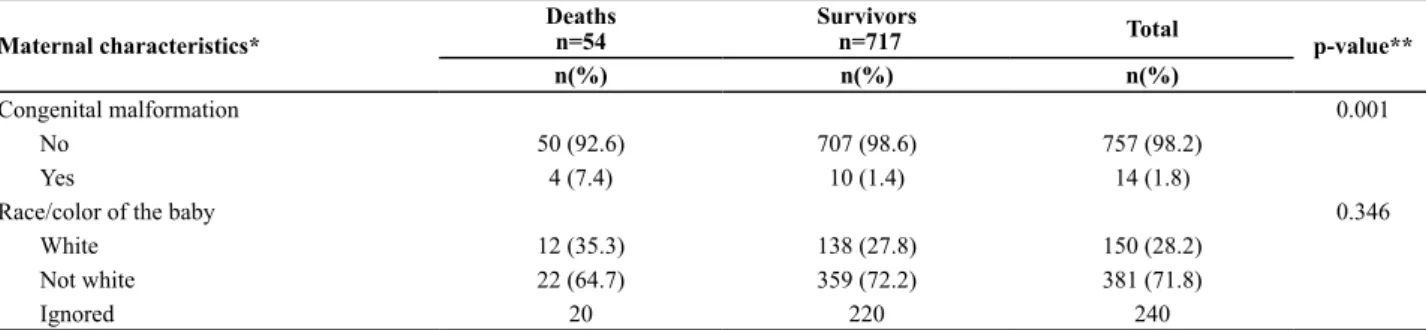
Characterizaion of low weight infant who died and who survived are presented in Table 1. Among the infants who died, nearly a third were teenage mothers, the vast majority of mothers (79.6%) of these infants had less than seven prenatal consultaions and more than half (55.6%) had vaginal delivery, maternal characterisics that difered from the observed among survivors (p <0.05).
With regard to infant characterisics, we also found a staisically signiicant diference (p <0.05) among infants who died and the survivors, with a higher proporion of deaths in males infant born with a gestaional age lower than 37 weeks, infant with Apgar score at 1st and 5th min-ute less than 7 and with presence of congenital malforma-ion (Table 1).
Table 1 - Characteristics of infant with low birth weight with neonatal death and surviving – Cuiabá, MT, 2010
Maternal characteristics*
Deaths n=54
Survivors
n=717 Total p-value**
n(%) n(%) n(%)
Maternal age 0.035
<20 16 (29.6) 129 (18.0) 145 (18.8)
≥20 38 (70.4) 588 (82.0) 626 (81.2)
Maternal education 0.697
Elementary school (<8 year of study) 11 (20.4) 179 (25.0) 190 (24.6)
High school (8-12 years of study) 12 (22.2) 136 (19.0) 148 (19.2)
College (≥ 12 years of study) 31 (57.4) 402 (56.0) 433 (56.2)
Number of infant alive 0.939
<2 35 (77.8) 500 (77.3) 535 (77.3)
≥2 10 (22.2) 147 (22.7) 157 (22.7)
Ignored 9 70 79
Number of prenatal visits <0.001
<7 43 (82.7) 298 (42.0) 341 (44.8)
≥7 9 (17.3) 411 (58.0) 420 (55.2)
Ignored 2 8 10
Type of labor 0.002
Vaginal 30 (55.6) 248 (34.6) 278 (36.1)
Cesarean 24 (44.4) 469 (65.4) 493 (63.9)
Infant’s characteristics *
Gender 0.034
Male 34 (63.0) 344 (48.0) 378 (49.0)
Female 20 (37.0) 373 (52.0) 393 (51.0)
Gestational age at birth <0.001
<37 49 (90.7) 433 (60.7) 482 (62.8)
≥37 5 (9.3) 280 (39.3) 285 (37.2)
Ignored 0 6 4
1st minute Apgar <0.001
<7 35 (67.3) 80 (11.2) 115 (15.0)
≥7 17 (32.7) 635 (88.8) 652 (85.0)
Ignored 2 2 4
5th minute Apgar <0.001
<7 23 (43.4) 17 (2.4) 40 (5.2)
≥7 30 (56.6) 698 (97.6) 728 (94.8)
Univariate analysis showed that neonatal death in in -fants of low birth weight was associated (p <0.05) with maternal age, number of prenatal visits, delivery type,
male gender, Apgar at the 1st and 5th minute <7 and the presence of congenital anomalies, variables that were brought to the muliple regression model (Table 2).
Maternal characteristics*
Deaths n=54
Survivors
n=717 Total p-value**
n(%) n(%) n(%)
Congenital malformation 0.001
No 50 (92.6) 707 (98.6) 757 (98.2)
Yes 4 (7.4) 10 (1.4) 14 (1.8)
Race/color of the baby 0.346
White 12 (35.3) 138 (27.8) 150 (28.2)
Not white 22 (64.7) 359 (72.2) 381 (71.8)
Ignored 20 220 240
* information was not obtained for all infant and mothers. ** p-value refers to the chi-square test. note: n=771 continuation...
Table 2 - Univariate analysis of neonatal deaths among newborns with low birth weight and maternal and infant characteristics – Cuiabá, MT, 2010
Maternal characteristics* N Deaths
n(%)
Univariate analysis
OR Crude 95% IC
Age
<20 145 16 (11.0) 1.92 1.04-3.55
≥20 626 38 (6.1) 1.00
Education
Elementary school (<8 year of study) 190 11 (5.8) 0.80 0.39-1.62
High school (8-12 years of study) 148 12 (8.1) 1.44 0.57-2.29
College (≥ 12 years of study) 433 31 (7.1) 1.00
Number of infant alive
<2 535 35 (6.5) 1.00
≥2 157 10 (6.3) 0.97 0.47-2.01
Number of prenatal visits
<7 341 43 (12.6) 6.60 3.16-13.72
≥7 420 9 (2.1) 1.00
Type of labor
Vaginal 278 30 (10.7) 1.00
Cesarean 493 24 (4.8) 2.36 1.35-4.13
Infant’s characteristics *
Gender
Male 378 34 (9.0) 1.84 1.04-3.26
Female 393 20 (5.0) 1.00
Gestational age at birth
<37 482 49 (10.2) 6.34 2.49-16.01
≥37 285 5 (1.7) 1.00
1st minute Apgar
<7 115 35 (30.4) 16.34 8.75-30.51
≥7 652 17 (2.6) 1.00
5th minute Apgar
<7 40 23 (57.5) 31.48 15.24-65.04
≥7 728 30 (4.1) 1.00
Presence of congenital anomaly
No 757 50(6.6) 1.00
Yes 14 4 (28.5) 5.66 1.71-18.67
* information was not obtained for all infant and mothers. note: n=771
In multiple logistic regression, neonatal mortal-ity was associated with: number of prenatal visits less than 7 (OR=3.80); gestational age less than 37 weeks (OR=4.77); Apgar score less than 7 at the 1st minute
5th minutes of life had 44 imes higher chance of death
than those who did not have hypoxia at birth(8). This
re-sult was also observed in a study conducted in Londrina-PR, where most of those who died in the neonatal period (78.2%) had been born with low birth weight and asphyxia was presented in the 1st minute of life(12).
Low Apgar score in the 5th minute is considered the
most accurate index for the prognosis of neurological health of the child and death. Research that evaluate perinatal factors associated with early death in preterm infants born in eight public university hospitals ailiated with the Brazilian Neonatal Research Network found that the Apgar score between 0 and 6 at the 5th minute was
strongly associated with early neonatal death(16). This ind
-ing is conirmed by other studies, highligh-ing a study conducted in the USA, which showed higher correlaion between low Apgar score at the 5th minute (0 to 6) and
neonatal mortality in preterm infants with gestaional age of 24 to 28 weeks(17), associaion also observed in this
study (OR=5.72).
The Apgar score, besides presening the state of vi -tality of the newborn, is directly associated to quality of care at delivery. Thus, considering that the lower the Ap-gar score at the 1st and 5th minute of life, the smaller the
chances of survival, it is essenial to monitor the adequacy of assistance in childbirth and ater birth. In this context, an organized obstetric and neonatal network of quality minimizes the risk factors that can lead to hypoxia and neonatal deaths(8).
In this context, we highlight the importance of training the team of health care in cardiopulmonary resuscitaion in the delivery room, pracice used to prevent asphyxia -ion and/or perinatal anoxia with irreversible brain impair -ment, and considered an important tool for reducing neo-natal mortality.
Although this study has not analyzed the causes of deaths among low birth weight newborns, we note that these deaths mostly occur due to preventable causes, especially through adequate care to women during preg-nancy(18), which reinforces the need to invest in the
train-ing of pre-natal care services available in the Brazilian Uni -ied Health System.
Another variable associated with neonatal death in infants of low birth weight was the number of prenatal visits. In fact, absent or inadequate monitoring of preg-nancy has been showing to be a risk factor for neonatal mortality(2-3). Associaion between number of prenatal
consultaions and neonatal mortality was also observed in a study with a populaion of live births, nonexclusive of low weight, which we observe a 3.78 imes greater risk of death in newborns of mothers with less than seven con-sultaions during pregnancy. The probability of death in newborns of these mothers was 16.8 per thousand, while for those of mothers with more than seven consultaions Table 3 - Multiple analysis of neonatal mortality in infant with low
birth weight in the logistic regression model in Cuiabá, MT, 2010
Variables Multiple Model p-valor OR Adjusted 95%IC
Number of prenatal visits
<7 3.80 1.66-8.70 0.002
≥7 1.00
Gestational age at birth
<37 4.77 1.48-15.38 0.010
≥37 1.00
1st minute Apgar
<7 4.25 1.84-9.81 <0.001
≥7 1.00
5th minute Apgar
<7 5.72 2. 24-14.60 <0.001
≥7 1.00
Presence of congenital anomaly
Yes 14.39 2.72-76-09 0.002
No 1.00
Hosmer & lemeshow test: p=0.764. note: n=771
diScUSSioN
Among infant with low birth weight, prematurity is an important risk factor for neonatal mortality(8,11-13),
con-irmed in the present study, since the newborns with less than 37 weeks of gestaional age were more likely to neo -natal death compared to those at term. This value, how-ever, was signiicantly lower than that observed in the state of Rio Grande do Sul, in a study analyzing the deter-minants of neonatal mortality in a cohort of 138,407 liv-ing newborns and 1,134 neonatal deaths in 2003, where it was found that the chance of death between living new-borns with less than 37 weeks of gestaional age was 28.9 imes higher, compared with newborn term infants(9). It is
noteworthy, however, that our study populaion is small compared to the cited research.
Also in a cohort study of live births weighing between 500 and 2.499g developed in the city of Recife, PE, gesta -ional age was associated with neonatal death in the same way that birth weight(8).
Birth weight, besides being an efecive prognosic in -dicator of death is important to explain the efect of social and biological variables in neonatal mortality(14).
Among the biological variables, the low Apgar score has been described in the literature as a predicive variable that is more closely associated with neonatal death(8- 9,15),
recurrent in the present study, since Apgar score <7, both in the 1st and 5th minutes was associated with neonatal
A similar result was found in a study conducted in the city of Recife-PE with live births of low birth weight, in which the largest number of consultaions during pregnan -cy was associated with decreased neonatal mortality(8).
The associaion between low birth weight and the number of prenatal consultaions was not conirmed in re -search that examined the social, economic, demographic and epidemiological factors associated with underweight and low birth weight infant under two years old, from the data of the Naional Demographic and Health Research 2006/2007(19). On the other hand, research that ideniied
the risk factors associated with the birth of newborn of low birth weight in a countryside city in the state of Sao Paulo showed a strong associaion between the number of prenatal consultaions and low birth weight(20).
In the monitoring of pregnancy, the concern should not be limited only to the quanity of consultaions, but also the quality of prenatal care, since appropriate care during pregnancy allows early ideniicaion of high-risk pregnancies, prevening births of infant with low weight and contribuing to the reducion of neonatal mortality(3).
Although congenital anomalies are signiicantly con -sidered on the staisics of morbidity and infant mortality, represening the second leading cause of neonatal death in Brazil(21), they have been litle explored in mortality
studies, most likely because they are not classiied as pre -ventable deaths, mostly unknown eiology and therefore, diicult to reduce(18). In the present study, the presence
of congenital anomaly was associated with death, with a greater chance of neonatal death compared to those born without malfuncion. This associaion was also observed in a study of newborns with low birth weight(8). But, we
emphasize that the congenital anomalies that are regis-tered in LB are diagnosed in the delivery room, some re-quire evaluaion and subsequent diagnosis such as heart disease, for example, that are underreported.
Low birth weight is the most important indicator for neonatal mortality(1,5) and this fact has been reairmed in
many studies conducted in Brazil, an example of research conducted in the south of Brazil, where it was found that those born alive, but with low birth weight were at risk of death 44 imes higher than the normal weight births, besides the probability of death of 69.2 per thousand(7).
It is noteworthy that, in the present study, we chose to deine as low birth weight all infants born with less than 2500g, without straiicaion by weight range, despite the likelihood of neonatal death increase with the decrease of birth weight(1,3), a fact that should be considered when
interpreing the results.
Thus, as it has occurred in other countries, Brazil has also presented the paradox of low birth weight, that is, higher rates of low birth weight in the geographic areas of greatest socioeconomic development, when reasonably would expect a lower prevalence(4,22-23). The explanaions
for this paradox sill needs to be beter invesigated, but
some causes have been described in the literature, among them, the high use of assisted reproducion techniques in more developed regions and the excessive number of cae-sarean secions, among others(23).
The inequality in the spaial distribuion of low birth weight infants in the country reinforces the need for greater investment in improving health care network and its use throughout the populaion, to reduce the number of infant deaths and low birth weight(22). In this sense, it
is expected that the implementaion of Stork Network by the Brazilian Ministry of Health in 2011, which aims to en-sure access and problem solving during the prenatal care, childbirth and the neonatal period contribute to reducing newborn deaths in the city of Cuiabá.
Since a considerable porion of low birth weight infants occurs among the newborn preterm, discusses the need to reduce the percentage of premature births to reduce the number of newborns with low weight and thus reduce the neonatal mortality rate(3). Among the intervenions found in
the literature for prevening premature births and low birth weight, prenatal care quality is highlighted, with monitor-ing of maternal weight and correcion of potenial failures in weight gain, in addiion to combat smoking and tracking infecions of urinary tract during the prenatal(10,24,25). In
ad-diion to these measures, rates of prematurity can be re -duced with beter access to family planning, especially for adolescents, increased empowerment, as well as improving care before and during pregnancy(1).
However, it is essenial to consider the social determi -nants that afect the occurrence of prematurity and low birth weight, and therefore, afecing greater risks for neonatal death. Among these determinants, we highlight maternal age and adverse living condiions, and the low educaional level of the mother, among others(1,6,22).
Re-search that assessed infant mortality in newborn of very low birth weight in a public hospital in the city of Rio de Janeiro showed that infant of mothers with less than four years of study had a 2.5 imes increased risk of neonatal death in comparison to those whose mothers that had more than eight years of study(14).
Socioeconomic inequaliies have an important role in the occurrence of low birth weight and premature birth(6).
Maternal social status has close relaionship with their edu -caion. Thus, low birth weight may be related to the low socioeconomic status of the mothers, which leads to less weight gain in pregnancy, delayed iniiaion of prenatal care and the number of consultaions lower than standard(26).
Despite this evidence, in the present study, mater-nal sociodemographic characteristics such as age and education were not associated with neonatal death among low birth weight newborns, a situation also found in other studies conducted in the country(12,27). It
socio-economic conditions are impacting more directly in post-neonatal mortality.
In this study, no associaion was found between type of birth and death in low birth weight infants, but it is known that elecive caesarean secions and inducion of labor has signiicantly contributed to the increase in the number of premature births and occurrence of low birth weight(19),
characterisics also found in other countries in Lain Ameri -ca(28). In Chile, analysis of all living births from 1991 to 2008
showed that, although the rate of 5.3% of low birth weight, speciic trends in low birth weight should be considered, as -sociated with the signiicant increase in the rate of prema -ture birth (less than 32 weeks of gestaional age), and also associated with an increased rate of very low birth weight linked to increased muliple births(28).
One limitaion of this study relates to the fact that it is the analysis of secondary data, which depends on the reliability and completeness of illing the records. It is also noteworthy, the introducion of a new model of LB in the year studied, which may explain in part the high percent-age of ields without registraion. Moreover, it was only possible to evaluate predicive factors that were present in the SINASC database. Thus, important determinants of neonatal mortality and low birth weight, as the quality of prenatal care and maternal social characterisics, such as family income, were not analyzed, since the only variable representaive of the socioeconomic level available in SINASC is educaion.
Informaion systems play an important role as a source of data, but despite the obvious improvement in coverage
and quality of SINASC records, failures when illing the LB sill occur(29). Thus, for this system to be used as a source
of research and evaluaion in health, it is necessary to in -vest in coverage and quality of compleion of all variables of the instruments which feeds their bases. The use of the linkage technique between databases, however, proved to be extremely useful and revealed important informa-ion that can be used by local managers to face neonatal mortality in infant with low birth weight. Nevertheless, the results indicate that investments should be targeted to improve the completeness and quality of compleion of LB, so that informaion systems can actually be used in the preparaion of reliable indicators of maternal and child health in municipaliies.
coNclUSioN
Number of prenatal visits less than 7, gestaional age less than 37 weeks, Apgar score less than 7 at the 1st and
5th minute and presence of congenital anomalies are
fac-tors associated with neonatal mortality in newborns with low birth weight in Cuiabá corroboraing the results of other naional researches.
Several of these factors are preventable by appropri-ate intervenion within the health services, which high -lights the need for managers and professionals to review the quality of care providing both investments in prena-tal care, aiming at the reducion of infant with low birth weight, as in childbirth and in the care for these new-borns, fundamental to ight infant and newborn mortality in the city.
REFERENcES
1. World Health Organizaion (WHO). Born too soon: the global acion report on preterm birth [Internet]. Geneva; 2012 [cited 2014 June 20]. Available from: htp://www.who.int/mater -nal_child_adolescent/documents/born_too_soon/en/
2. Soares ES, Menezes GMS. Fatores associados à mortalidade neonatal precoce: análise de situação no nível local. Epide-miol Serv Saúde. 2010;19(1):51-60.
3. Almeida MF, Alencar GP, Schoeps D, Novaes HMD, Campbell O, Rodrigues LC. Sobrevida e fatores de risco para mortalidade neonatal em uma coorte de nascidos vivos de muito baixo pe-so ao nascer, na Região Sul do Município de São Paulo, Brasil. Cad Saúde Pública. 2011;27(6):1088-98.
4. Silva AAM, Silva LM, Barbieri MA, Beiol H, Carvalho LM, Ri -beiro VS, et al. The epidemiologic paradox of low birth weight in Brazil. Rev Saúde Pública. 2010;44(5):767-75.
5. Victora CG, Aquino EML, Leal MC, Monteiro CA, Barros FC, Sz-warcwald CL. Maternal and child health in Brazil: progress and challenges. Lancet. 2011;377(9780):1863-76.
6. Glinianaia SV, Ghosh R, Rankin J, Pearce MS, Parker L, Pless-Mullioli T. No improvement in socioeconomic inequaliies in birth weight and preterm birth over four decades: a popula-ion-based cohort study. BMC Public Health [Internet]. 2013 [cited 2014 June 22];13:345. Available from: htp://www. biomedcentral.com/1471-2458/13/345
7. Maran E, Uchimura TT. Mortalidade neonatal: fatores de risco em um município no sul do Brasil. Rev Eletr Enferm [Internet]. 2008 [citado 2010 set. 29];10(1). Disponível em: htp://www. fen.ufg.br/revista/v10/n1/v10n1a03.htm
8. Ribeiro AM, Guimarães MJ, Lima MC, Sarinho SW, Couin -ho SB. Fatores de risco para mortalidade neonatal em crianças com baixo peso ao nascer. Rev Saúde Pública. 2009;43(2):246-55.
785
Rev Esc Enferm USPNeonatal mortality in infants
10. Borba GG, Neves ET, Arrué AM, Silveira A, Zamberlan KC. Fa-tores associados à morbimortalidade neonatal: um estudo de revisão. Saúde (Santa Maria). 2014;40(1):9-16.
11. Nascimento RM, Leite AJM Almeida NMGS, Almeida PC, Silva CF. Determinantes da mortalidade neonatal: estudo caso-controle em Fortaleza, Ceará, Brasil. Cad Saúde Públi -ca. 2012;28(3):559-72.
12. Ferrari RAP, Bertolozzi MR, Dalmas JC, Giroto E. De -termining factors for neonatal mortality in a city in the Southern Region of Brazil. Rev Esc Enferm USP [Internet]. 2013 [cited 2014 June 22];47(3):531-8. Available from: htp://www.scielo.br/pdf/reeusp/v47n3/en_0080-6234-reeusp-47-3-00531.pdf
13. Barros FC, Maijasevich A, Requejo JH, Giugliani E, Ma -ranhão AG, Monteiro, et al. Recent trends in maternal, newborn, and child health in Brazil: progress toward Mil-lennium Development Goals 4 and 5. Am J Public Health. 2010;100(10):1877-89.
14. Cardoso RCAC, Flores PVG, Vieira CL, Bloch KV, Pinheiro RJ, Fonseca SC, et al. Infant mortality in a very low birth weight cohort from a public hospital in Rio de Janeiro, RJ, Brazil. Rev Bras Saúde Mater Infant. 2013;13(3):237-46.
15. Lima EFA, Sousa AI, Griep RH, Primo CC. Fatores de risco pa -ra a mortalidadae neonatal no município de Ser-ra, Espírito Santo. Rev Bras Enferm. 2012;65(4):578-85.
16. Almeida MFB, Guinsburg R, Marinez FE, Procianoy RS, Le -one CR, Marba STM, et al. Fatores perinatais associados ao óbito precoce em prematuros nascidos nos centros da Rede Brasileira de Pesquisas Neonatais. J Pediatr (Rio J). 2008;84(4):300-7.
17. Lee HC, Subeh M, Gould JB. Low Apgar score and mortality in extremely preterm neonates born in the United States. Acta Paediatr. 2010;99(12):1785-9.
18. Santos HG, Andrade SM, Silva AMR, Mathias TAF, Ferrari LL, Mesas AE. Mortes infanis evitáveis por intervenções do Sistema Único de Saúde: comparação de duas cortes de nas -cimentos. Ciênc Saúde Coleiva. 2014;19(3):907-16.
19. Viana KJ, Taddei JAAC, Cocei M, Warkenin S. Peso ao nasc -er de crianças brasileiras menores de dois anos. Cad Saúde Pública. 2013;29(2):349-56.
20. Souto da Silva S, Santos FDD, Coca Leventhal L. Nascimento de recém-nascidos de baixo peso em insituição ilantrópica terciária do município de Piracicaba. Enferm Global [Inter -net]. 2011 [citado 2014 jun. 22];10(23):76-88. Disponível em: htp://scielo.isciii.es/pdf/eg/v10n23/pt_clinica6.pdf
21. Brasil. Ministério da Saúde. Painel de Monitoramento da Mortalidade Infanil e Fetal. [Internet]. Brasília; 2013 [citado 2013 dez. 10]. Disponível em: htp://svs.aids.gov.br/dash -board/mortalidade/infanil.show.mtw
22. Lima MCBN, Oliveira GS, Lyra CO, Ronccalli AG, Ferreira MAF. A desigualdade espacial do baixo peso ao nascer no Brasil. Ciênc Saúde Coleiva. 2013;18(8):2443-52.
23. Maijasevich A, Silveira MF, Matos ACG, Rabello Neto D, Fernandes RM, Maranhão AG, et al. Esimaivas corrigidas da prevalência de nascimentos pré-termo no Brasil, 2000 a 2011. Epidemiol Serv Saúde. 2013;22(4):557-64.
24. Sato APS, Fujimori E. Nutriional status and weight gain in pregnant women. Rev Laino Am Enfermagem. 2012;20(3):462-68.
25. Kusuda S, Fujimura M, Uchiyama A, Totsu S, Matsunami K; Neonatal Research Network, Japan. Trends in morbidity and mortality among very-low-birth-weight infants from 2003 to 2008 in Japan. Pediatr Res. 2012;72(5):531-8.
26. Silvestrin S, Silva CH, Hirakata VN, Goldani AAS, Silveira PP, Goldani MZ. Maternal educaion level and low birth weight: a meta-analysis. J Pediatr (Rio J). 2013;89(4):339-45.
27. Kassar SB, Melo ANC, Couinho SB, Lima MC, Lira PIC. De -terminants of neonatal death with emphasis on health care during pregnancy, childbirth and reproducive history. J Pe -diatr (Rio J). 2013;89(3):269-77.
28. Lopez P O, Bréart G. Trends in gestaional age and birth weight in Chile, 1991-2008. A descripive epidemiological study. BMC Pregnancy Childbirth [Internet]. 2012 [cited 2014 June 22];12:121. Available from: htp://www.ncbi.nlm. nih.gov/pmc/aricles/PMC3573962/
29. Silva RS, Oliveira CM, Ferreira DKS, Bonim CV. Avaliação da compleitude das variáveis do Sistema de Informações sobre Nascidos Vivos- SINASC- nos Estados da região Nor-deste do Brasil, 2000 e 2009. Epidemiol Serv Saúde. 2013; 22(2):347-52
correspondence addressed to: Maria aparecida Munhoz Gaiva
Financial support: