RESUMEn
Objeivo: Diseñar un protocolo de seguri-dad para el manejo de la sede en el poso-peratorio inmediato Método: Invesigación metodológica y aplicada, cuanitaiva, de -sarrollada en los meses de abril a agosto de 2012. Para la confección del protocolo y su manual operacional, se llevó a cabo una ex -tensa búsqueda en la literatura y consulta a expertos. El análisis teórico y el semánico los realizaron los jueces. Resultados: Los criterios de seguridad enlistados fueron: evaluación del nivel de conciencia y de los relejos de protección de las vías aéreas (tos y deglución) y ausencia de náuseas y vómitos. Dichos criterios fueron agrupa -dos y formata-dos en un algoritmo gráico que conduce a la interrupción del procedi -miento en caso de que un criterio de se-guridad no alcance la evaluación esperada.
Conclusión: La construcción del protocolo tuvo el in de suplir la falta de un modelo especíico en la literatura para estandarizar las acciones de enfermería en el manejo de la sede en el posoperatorio inmediato con seguridad.
DESCRIPTORES Sed
Protocolos clínicos Cuidados postoperatorios Enfermería perioperatoria RESUMO
Objeivo: Elaborar um protocolo de se -gurança para o manejo da sede no pós-operatório imediato. Método: Pesquisa metodológica e aplicada, quanitaiva, desenvolvida nos meses de abril a agosto de 2012. Para a elaboração do protocolo e seu manual operacional, efetuou-se uma extensa busca na literatura e consulta a especialistas. As análises teórica e semân -ica foram realizadas por juízes.
Resulta-dos: Os critérios de segurança elencados foram: avaliação do nível de consciência e dos relexos de proteção de vias aéreas (tosse e degluição) e ausência de náuseas e vômitos. Esses critérios foram agrupados e formatados num algoritmo gráico, que conduz à interrupção do procedimento caso um critério de segurança não alcance avaliação esperada. Conclusão: A constru-ção do protocolo visou suprir a falta de um modelo especíico na literatura para padro -nizar as ações de enfermagem no manejo da sede no pós-operatório imediato com segurança.
DESCRITORES Sede
Protocolos clínicos Cuidados pós-operatórios Enfermagem perioperatória AbSTRACT
Objecive: To develop a safety protocol for the management of thirst in the immediate postoperaive period. Method: Quanitai -ve, methodological, and applied study con -ducted in April-August 2012. An extensive literature search and expert consultaion was carried out to develop the protocol and its operaing manual. Theoreical and semanic analyzes were carried out by experts. Results: Assessment of level of consciousness, relexes of protecion of the airways (cough and swallowing), and absence of nausea and vomiing were se -lected as safety criteria. These criteria were grouped and formated in a graph algori -thm, which indicates the need to interrupt the procedure if a security criterion does not reach the expected standard. Conclu
-sion: The protocol was elaborated to ill in the gap in the literature of a speciic model concerning nursing acions in the safe ma -nagement of thirst in the immediate posto -peraive period.
DESCRIPTORS Thirst
Clinical protocols Perioperaive care Perioperaive nursing
Development of a Safety protocol for
Management Thirst in the Immediate
Postoperative Period
*O
riginal
a
rticle
Leonel Alves do nascimento1 Lígia Fahl Fonseca2 Edilaine Giovanini Rosseto2 Claudia benedita dos Santos3
ELABORAÇÃO DO PROTOCOLO DE SEGURANÇA PARA O MANEJO DA SEDE NO PÓS-OPERATÓRIO IMEDIATO
DISEÑO DEL PROTOCOLO DE SEGURIDAD PARA EL MANEJO DE LA SEDE EN EL POSOPERATORIO INMEDIATO
* Extracted from a dissertation entitled “Elaboração, validação e idedignidade de um Protocolo de Segurança para o Manejo da sede no Pós-Operatório
Imediato”; Londrina State University, 2013. 1 MSc student, Graduate program in Nursing, State University of Londrina, Londrina, PR, Brazil. 2 Adjunct
Professor, Department of Nursing, State University of Londrina, Londrina, PR, Brazil. 3 Associate Professor, School of Nursing of Ribeirão Preto, University
InTRODUCTIOn
Thirst is a high-incidence discomfort in the immedia
-te postoperaive period (IPO),which causes sufering to paients during their recovery from anesthesia. Thirst is deined as a conscious desire to drink water and is a com
-pensaion mechanism, so that the organism has its water balance restored. Thirst is condiioned by both physiologi
-cal signs and symptoms and cultural, emoional, habitual, and food condiions(1).
Surgical paients present condiions that promote and enhance the appearance of thirst, including preoperaive fasing, medicaion in the anestheic-surgical process, en
-dotracheal intubaion and intraoperaive blood loss(2). Paients have reported that they nearly died of thirst
during the postoperaive period of cardiac surgery when asked about their memory of anestheic recovery(3). In a study (n=160) during IPO, many paients (43.8%) indica
-ted that thirst was the discomfort with the highest inci -dence(4). In other studies, occurrences ranging from 42.9%
(n=91)(5) to 75.0% (n=128)(6) were menioned. During this period, intensity of thirst is also high. When a numeric
analog scale(1-10) was uilized to evaluate thirst, paients
indicated a mean intensity of 6.1 (SD=2.2)(6) 6.6 (SD=2.0)(5) and 8.2 (SD=1.5)(7).
In the evaluaion of strategies to alleviate the dis
-comfort of thirst during recovery from anesthesia, admi
-nistraion of ice chips proved to be more efecive in the
relief(6-8). Thirst in paients in the perioperaive period is a
sign and symptom of imbalance and intense discomfort, which should be valued and assisted by the staf.
Despite the magnitude of thirst, it has however been considered a minor complicaion in the perioperaive pe
-riod and its impact on paients is poorly studied. Too of
-ten, health professionals allow paients to remain thirsty for extended periods in both pre and postoperaive perio
-ds. When intervenions are performed, they are sporadic and occasional, assistemaic and empirical.
The approach in the management of thirst, especially in IPO, has paricular challenges due to the contraindicaion to oral intake of large liquid volumes since pulmonary as
-piraion is possible due to a decrease in the level of cons
-ciousness by both anestheic drugs and presence of nausea and vomiing. Therefore, inding safe ways to alleviate thirst that has already set in when paients arrive at the PACU wi
-thout puing their safety at risk, is themajor issue.
Emphasis on the safety of the surgical paient (inclu
-ding detailed protocols of the WHO) and implementaion of strategic plans (such as Safe Surgeries Save Lives) have
signiicantly reduced the errors in perioperaive care(9). Amongst safety standards proposed by specialized as
-sociaions for assessment and release of paients emer
-ging from anesthesia are parameters such as level of
consciousness, airway patency, respiratory rate, oxygen saturaion, blood pressure, pain, nausea, and vomiing(10). However, no recommendaion or assessment protocol was found in the literature focusing safety in the use of strategies when thirst has already set in and has been ideniied. Consequently, it remains not assessed, recor
-ded ormet. The team who assists paients in the IPO does not act in the presence of thirst because they do not know how to do it for lack of stablished criteria and, consequen
-tly, fear of increase of complicaions risks.
Preparaion of a Safety protocol for Thirst Manage
-ment (SPTM) will contribute to raising the level of safety in the care of thirsty paients. The SPTM will allow health professionals to systemaically assess clinical condiion of paients with subsidies to decide whether a method of re
-lief should be administered or not.
METHOD
This is a methodological and quanitaive-approach study, which was conductedin the period April-August 2012 in associaion with the Group for Study and Resear
-ch on Thirst (GSRT), State University of Londrina, Southern Brazil, seeking to understand and invesigate the comple
-xity of perioperaive thirst. Methodological studies are characterized by the development of instruments for data collecion, deiniion of the construct (behavior to be me
-asured), formulaion of items of the tool, and formulaion of instrucions for users and respondents(11).
The protocol for preparaion of instruments was based on the theoreical model and terminology proposed by
Pasquali(12), and was used in measuring subjecive pheno
-mena, with emphasis on the theoreical procedures. Although thirst is controlled by complex neurohor
-monal factors, percepion and response to them are strongly inluenced by environmental, cultural, and psychological factors, resuling in a mulifactorial symp
-tom manifested in an individual and subjecive way(1-2). As a speciic model for construcion of protocols was not found in the literature, the psychometric-based method of Pasquali was chosen due to the methodological rigor proposedby the author. Psychometry has the addiional advantage of represening knowledge of nature more ac
-curately than common language in describing observa
-ion of natural phenomena(12).
In the preparaion of instruments for psychological measurements, the theoreical pole is the basis for all scieniic endeavor, that is, to explicit the theory on the construct (pshychological object), for which both develo
-ping a measuring instrument and operaionalizing it into items are necessary(12). This pole allows clarifying the the -ory of latent trait and types (or categories) of behaviors that adequately represent the same trait. Theoreical pro
purpose, we rely on the exising literature on the psycho
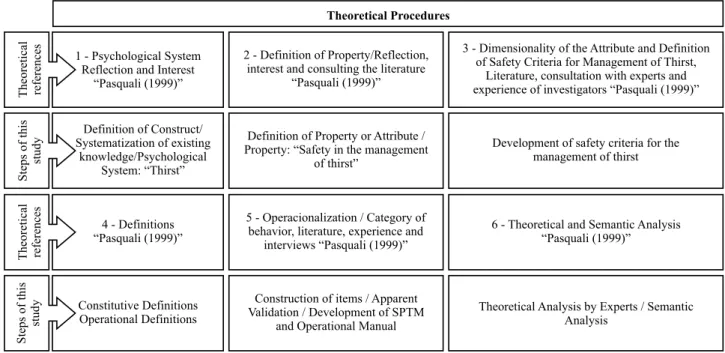
-logical construct that the instrument will measure(12). The theoreical procedure shave six stages: psychologi
-cal system, properies, dimensionality, deiniions, opera
-ionalizaion, and theoreical and semanic analyses. The
Figure 1 – Graphical representation of activities performed during preparation of the Safety Protocol for Management of Thirst, as
proposed by Pasquali(12) in the theoretical pole - southern Brazil, 2013.
irst three steps are related to the theory of the construct, the fourth stage includes both theory and construcion of the instrument, and the ith and sixth steps refer to the construcion of the instrument(12). The steps and corres -ponding aciviies of this study are shown in Figure 1.
Theoretical Procedures
1 - Psychological System Reflection and Interest
“Pasquali (1999)”
Theoretical references
2 - Definition of Property/Reflection, interest and consulting the literature
“Pasquali (1999)”
3 - Dimensionality of the Attribute and Definition of Safety Criteria for Management of Thirst,
Literature, consultation with experts and experience of investigators “Pasquali (1999)”
Definition of Construct/ Systematization of existing
knowledge/Psychological System: “Thirst”
4 - Definitions “Pasquali (1999)”
Constitutive Definitions Operational Definitions
Steps
of
this
study
Theoretical references
Definition of Property or Attribute / Property: “Safety in the management
of thirst”
5 - Operacionalization / Category of behavior, literature, experience and
interviews “Pasquali (1999)”
Construction of items / Apparent Validation / Development of SPTM
and Operational Manual
Development of safety criteria for the management of thirst
6 - Theoretical and Semantic Analysis “Pasquali (1999)”
Theoretical Analysis by Experts / Semantic Analysis
Steps
of
this
study
STEPS 1–2 – Psychological system and deiniion of property
Determinaion of the psychological system and deini
-ion of property are essenial because they make explicit the theory on the construct being built(12). In this study, relecion on the subject has simulated the creaion of a tool that would allow to measure safety criteria in the ma
-nagement of thirst in IPO. As a result, it was established that thirst refers to the psychological system and safety in the management of thirst in the IPO is the property atri
-bute whose measurement is the subject of this study.
STEP 3 – Dimensionality of the atribute and deiniion of safety criteria for the management of thirst
Dimensionality of the atribute is related to its internal or semanic structure. The disinct components of safety cri
-teria in the management of thirst that must be assessed to ensure safety are deined here(12).
Deiniion of items assessed by the SPTM was based on the following sources of informaion: scieniic litera
-ture, analysis of theoreical foundaions, available eviden
-ce, experise of invesigators in paient care in the IPO, interview with professionals with clinical experience and knowledge added by the Group for Study and Research of Thirst of the State University of Londrina.
Extensive consultaion was carried out in the Lain American and Caribbean Literature on Health Sciences (LILACS), Cumulaive Index to Nursing and Allied Health Literature (CINAHL), PubMed, EMBASE, and The Cochra
-ne Library databases, and the following descriptors were used: thirst, perioperaive period, anestheic recovery, nausea and vomiing, swallowing, postoperaive compli
-caions, return of swallowing relexes, complicaions in maintaining the airways and breathing ice, water, evalua
-ion in IPO, airway patency, hydra-ion of the mucosa, oral hydraion, and discharge criteria in the post anesthesia ca
-re unit (PACU). Publicaions in books and inclusion criteria were: aricles indexed in databases with descriptors selec
-ted in Portuguese, Spanish, and English since the 1980s. In order to deine these criteria, a convenient sample of experts (n=18) was consulted, including anesthesiolo -gists(13), surgeons(3), and PhD nurses(2). Inclusion criteria
were: having experience in caring for paients in the IPO, act in medium and large size public and private hospitals in the city of Londrina, be accessible, agreeing to parici
-pate in the studyand sign the Term of Free and Informed Consent. For this purpose, they answered the following quesion: What are the criteria that, in your pracice, you assessto release administraion of a method for relief to
paients who refer thirst in the PACU? The number of in
cause this professional releases or not the administraion a strategy for thirst relief in the IPO.
The leading thought for inal selecion of safety crite
-ria was guided by the following quesion: What would be
important to assess during recovery from anesthesia that
could actually jeopardize paient safety? Responses we
-re grouped by f-requency, thus deining safety categories that werethen confronted withboth perinent literature and experience of invesigators. Knowledge gained by the GSRT was another relevant source of informaion during selecion of criteria given the embryonic state of research of this subject.
STEP 4 –Consituive and Operaional Deiniions
Ater the selecion of safety criteria is ready, conceptua
-lizing the constructs in detail is necessary. This step compri
-ses a clear and precise conceptualizaion of the factors that mater in the construcion of the measuring instrument(12).
Consituive deiniion is one that deines a construct using others constructs. It characterizes the construct, gi
-ving it the dimensions that it should havein the semanic space of the theory in which it is inserted(12).
In turn, the operaional deiniion representsa passage from abstract to concrete, and there are two main con
-cerns, (1) the deiniions should be in fact operaional, so that they can be reproduced by physical behaviors and (2) the deiniion of the constructs should be as comprehen
-sive as possible. They come from the literature, opinion of experts, and knowledge of the invesigator. The more complete the list of behavioral categories, the simpler the construcion of the instrument will be(12).
STEP 5 – Operaionalizaion
This step is related to the construcion of the items, to the to the expression of the behavioral representaion of the construct, i.e., the acions the user of the instrument must perform to assess the magnitude of the presence of the construct(12).
In order to build theresearch instrument it is neces
-sary to take into accounthe following criteria: behavior, objecivity, simplicity, clarity, relevance, accuracy, variety, modality, typicity, credibility, amplitude, and balance(12). These criteria guided the construcion of the irst version of the protocol, including six safety indicators and 16 eva
-luaion items which were shownin a graph algorithm. Then the Operaional Manual was prepared, specifying the operaions that must be executed to collect the informa
-ion required and including the criteria for observa-ion and measurement of the variable being assessed(11). The structure of the Operaional Manual was adapted from a study conduc -ted to develop and validate an instrument for measurement
of nursing carequality(13). The manual consists of descriptor, scieniic basis, assessment sources, operaional procedures, and criteria for qualiicaion and periodicity of assessment.
STEP 6 – Theoreical and semanicanalysis
The set of selected items that consitute the instru
-ment, should indicate an adequate representaion of the construct. In order to characterize the relevance of items, a theoreical and semanic analysis by judges is necessary.
Theoreical analysis by judges
The protocol items were analyzed by three PhD-prepa
-red nurses with experience in the care of paients in the IPO, who evaluated that the structure of instrument and the item sin each proposed category were adequate.
These procedures assured that the choice of safety cri
-teria was determined by its relevance, giving face validity to the SPTM. Apparent validity indicates whether, a priori, the measurement measures what it is supposed to mea
-sure. Even though it does not determine surely that the measurement scale is valid, it is fundamental in the de
-velopment of the process, thus enabling other validaion methods(12). With this evaluaion, the number of items are reduced, according to the decision of judges(14).
Semanic Analysis of the Safety Protocol for Thirst Management (SPTM)
This analysis assesses the semanic structure of the items and the compaibility of wriingto the level of the target populaion, allowing to check whether all items are understandable to all members of the populaion to whi
-ch the instrument is intended(12). The instrument should not require reading skill beyond that of a 12-years ado
-lescent. This means that the items should be short and simple, without complicated words or jargon terms(14).
This analysis was conducted at the University Hospital of Londrina (HUL), which is a teriary-level, public teaching, and a reference insituion for the Uniied Health System (SUS), with 313 beds, one Surgical Center, and a PACU with seven beds. Eight health professionals were invited to par
-icipate in the analysis, being divided into two groups. The irst group consisted of four nursing assistants, and the se
-cond of two MSc-studentand two PhD nurses. Both groups had experience in paient care in the PACU.
The SPTM was presented orally, item by item, to both groups in separate meeings. Paricipants were asked to re
-produce the acions or content reported, recording them in a speciic instrument. At this stage, some wriing adjustments and spelling changes were made. Such changes were made ater two rounds with the paricipants. It was possible to ve
-rify that the SPTM was well understood by both groups.
Ethical procedures
All steps of this study met the guidelines of the Legal Resoluion No. 196 (10 Oct 1996). Ater the project was ap
-proved by the Ethics Commitee of the insituion where the study was conducted (CAAE: 02299412.6.0000.5231), all par
RESULTS
In this study, thirst was deined as psychological sys -tem and safetyin the managementof thirst as an atribute
of property. From this point, establishing the dimensions and deiniions of the protocol was possible. Consultaion of 18 professionals with experience in IPO indicated the following safety criteria: assessment of consciousness le
-vel (n=15), protecion of the airways (cough and swallo
-wing; n=4), absence of nausea and vomiing (n=3), oxygen saturaion (n=1), surgical procedure (n=5), quaniicaion of diuresis (n=2), bowel sounds (n=1), anestheic techni
-que (n=1) and blood pressure (n=1).
Given the evidence found in the literature, authors’ ex
-perience, and ater extensive and rigorous analysis of the criteria suggested by experts, wechose the following items for assessment: level of consciousness, protecion of the ai
-rways (coughing and swallowing), nausea, vomiing, oxygen
saturaion, and surgical procedure. In selecing these items, we sought to meet the maximum requirements of safety, simplicity, and ease of applicaion in clinical pracice.
Analysis by experts
Ater analysis of face validity, nausea and vomiing indi
-cators were combined, and oxygen saturaion and surgical procedure were excluded. Ten out of 16 items included in the irst version of the assessment remained in the list, making the inal version shorter, more objecive, and speciic.
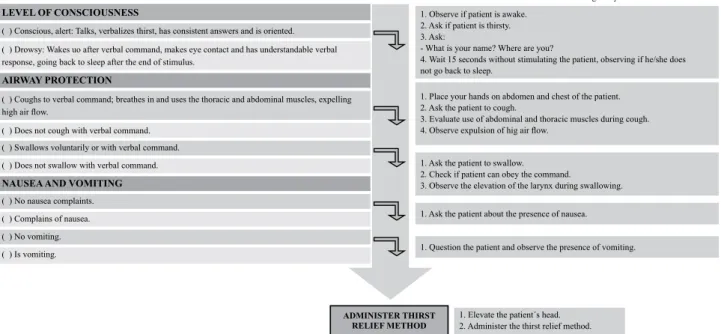
The inal criteria were then organized in a graph algori
-thm (Figure 2), by which the posiive evaluaion of all indi
-cators allows to determine the degree of safety necessary to administer the strategy for thirst relief. The Operaing Manual, which presents scieniic evidence and assists the professional in the evaluaion of each security item, was also prepared (Appendix).
Safety Protocol for Thirst Management in the immediate postoperative period (SPTM) In presence of thirst, perform the clinical assessment following the itens below:
LEVEL OF CONSCIOUSNESS
( ) Conscious, alert: Talks, verbalizes thirst, has consistent answers and is oriented.
( ) Drowsy: Wakes uo after verbal command, makes eye contact and has understandable verbal response, going back to sleep after the end of stimulus.
AIRWAY PROTECTION
( ) Coughs to verbal command; breathes in and uses the thoracic and abdominal muscles, expelling
high air low.
( ) Does not cough with verbal command. ( ) Swallows voluntarily or with verbal command. ( ) Does not swallow with verbal command.
NAUSEA AND VOMITING
( ) No nausea complaints. ( ) Complains of nausea. ( ) No vomiting. ( ) Is vomiting.
ADMINISTER THIRST RELIEF METHOD
Operating Procedures
Procedures to be carried out for assessing every item of the SPTM 1. Observe if patient is awake.
2. Ask if patient is thirsty. 3. Ask:
- What is your name? Where are you?
4. Wait 15 seconds without stimulating the patient, observing if he/she does not go back to sleep.
1. Elevate the patient´s head. 2. Administer the thirst relief method. 1. Question the patient and observe the presence of vomiting. 1. Place your hands on abdomen and chest of the patient. 2. Ask the patient to cough.
3. Evaluate use of abdominal and thoracic muscles during cough.
4. Observe expulsion of hig air low.
1. Ask the patient to swallow. 2. Check if patient can obey the command.
3. Observe the elevation of the larynx during swallowing.
1. Ask the patient about the presence of nausea.
Figure 2 – Safety Protocol for the Management of Thirst - southern Brazil, 2013.
The lanes in dark tone and itles in bold (dark green tone in the SPTM) represent the indicator being asses
-sed. The lane with a clear tone (light green tone in the SPTM) represents the safety criterion (rule of thumb) required to determine whether the evaluaion may pro
-gress through the following steps of the protocol. The clearer tone lanes (light yellow in the SPTM) represent the cuing criterion, indicaing that the paient clinical condiion is not safe for administraion thirst relief stra
-tegies. During clinical assessment, it should be emphasi
-zed that ideniicaion of a condiion diferent from the irst established in each safety criterion signals for inter
-rupion in the protocol use. Ater a period that allows realizing a change in the clinical status of the paient, a new assessment should be iniiated.
Ater the judges analyzed the protocol, they suggested including a session that describes the necessary steps for its implementaion. Thus, Operaional Procedures were develo
-ped and added to the protocol to standardize evaluaion of each criterion. Ater the contents were validated (not descri
-bed here), the inal protocol was presented (Figure 2).
Semanic analysis
The groups of nurses and nursing assistants found no diiculty in interpreing the items; minor changes were made only in the order of sentences. The schemaic de
-sign of the SPTM, its colors, and direcion by arrows were analyzed, being well understood by all. The Operaing Ma
DISCUSSIOn
As this study presents a novel approach regarding a construct that has been insuiciently researched, deve
-lopment of a protocol for paient safety was not an easy task. However, we do hope that its applicaion be the beginning of a scieniic evidence-based management of thirst. Both the deiniion of safety criteria and develop
-ment of a protocol to assess the clinical condiion of pa
-ients, bring subsidies so that the professional can mana
-ge thirst relief using a chosen strategy.
This study has allowed us to see that the criteria used by professionals who are in charge of releasing a strategy for thirst relief were diverse and subjecive. It was observed that there were wide criteria and they were generally nons
-peciic in the assessment of paient safety in the manage
-ment of thirst. This stems mainly from the state of know
-ledge about perioperaive thirst and its scieniic evidence, which are sill insuicient for a safe management of thirst.
Diferent professionals gave their opinions or had con
-tradictory beliefs about the possibility of releasing the use of a strategyfor thirst relief. Someimes they argued that the type of procedure and the afected site determine the release of using some strategy for thirst relief, as in the case of abdominal surgery, when this pracice would bepracice would be prohibited. In other situaions, they considered that regard less of the surgical procedure, the amount of li
-quid to be administered is small and therefore there would not be a negaive repercussion for the paient.
Urine output, skin turgor, and hypotension are related to dehydraion, so they are not safety criteria in the strict sense. The need for prolonged postoperaive fasing presupposes that bowel rest is important for healing of gastrointesinal anastomoses with less risk, although this assumpion is not based on scieniic evidence. On the other hand, early fee
-ding brings beneits such as early hospital discharge, less inci
-dence of infecious complicaions, and cost reducion(15). Assessment of the item Level of Consciousness, as menioned by the experts surveyed (83%), it is essenial to determine the degree of emergence of the anesthe
-ic state during POI. The level of consciousness is closely related to the return of protecive relexes such as cough
and swallowing(16). In the clinical experience, we have ob
-served that paients seem to respond adequately to other safety criteria of the protocol even when they are sleepy. However, we sought to establish a high cuing criterion in order to insitute a stringent safety standard at that ime. For protocol coninuity, paients should therefore remain awake and alert without going back to sleep.
Assessing the Protecion of the Airways criterion en
-sures checking whether the protecive relexes of cough and swallowing returned because they are part of a group of physiological relexes that prevent bronchopulmonary aspiraion of salivary and gastric secreions. Assessing this
item is criical because paients remain in dorsal decubitus during anestheic recovery and they may be sill under the efect of both anestheic and muscle relaxant medicaion. These relexes indicate that paients are able to defend hi
-mself against a possible broncho pulmonary aspiraion(17). In order to administer a strategy to relieve thirst, absen
-ce of nausea and vomiing is primordial. Occurren-ce of nau
-sea and vomiing in the postoperaive period is high and va
-ries in the range 20-30% in general anesthesia. Nausea and vomiing are associated with worse outcomes, increase in costs and duraion of stay, and various other complicaions that interfere with the recovery of the surgical paient(18).
In pracice, we found that several myths interfere with acions of professionals in the management of thirst. We believe that the main one refers to the need to maintain absolute fasing in the IPO, being related to the risk of vo
-miing and consequent pulmonary aspiraion. Thus, the pa
-ient remains long periods in absolute fasing extending the discomfort caused by thirst. Validaion of an instrument to intenionally assess the presence or absence of nausea or vomiing is an advance in the care of thirsty paients.
Regarding ime of procedure and anestheic techni
-que, scieniic evidence that could conirm inclusion of these criteria in the protocol was not found. Release to administer a strategy for thirst relief as proposed in this protocol is linked to a rigorous assessment of the level of consciousness, relexes protecing the airways, and ab
-sence of nausea and vomiing. These criteria are indicated to assess whether paients have or not safe condiions for the management of thirst.
COnCLUSIOn
Assessment of level of consciousness, protecion of the airways (cough and swallowing), and absence of nausea and vomiing were the safety criteria selected for the SPTM. These criteria allowassessing safety in the management of thirst and were grouped into aneasy to understand graph algorithm. The operaing manual was developed on the basis of an extensive literature review on each of the criteria. In addiion, operaional proce
-dures were indicated in each phase of the protocol thus standardizing its applicaion. Regarding semanic analy
-sis and pre-test of the protocol, experts and groups sho
-wed that it is easy to understand and quick to apply. It should be menioned that lack of studies that could guide the development of acion protocols in nursing hampered this study. We hope that this study can support and encourage other invesigators who need to develop other acion protocols.
This Safety Protocol for Thirst Management is propicia
-tes further studies on the management of a discomfort as common and intense as thirst in the immediate postope
REFEREnCES
1. Leiper J. Thirst. In: Caballero B, Allen L, Prenice A. Encyclo
-pedia of human nutriion. 2nd. ed. Aberdeen (UK): Elsevier; 2005. p. 278-86.
2. Arai S, Stots N, Punillo K. Thirst in criically ill paients: from
physiology to sensaion. Am J Crit Care [Internet]. 2013 [cited 2013 Aug 10];22(4):328-35. Available from: htp://www.ncbi. nlm.nih.gov/pubmed/23817822
3. Lisboa Gois CF, Maimoni Aguillar O, Santos V, Llapa Rodri
-guész EO. Stress factors for paients undergoing cardiac surgery. Invest Educ Enferm [Internet]. 2012 [cited 2013 Jun 20];30(3):312-9. Available from: htp://www.scielo.org.co/ pdf/iee/v30n3/v30n3a03.pdf
4. Figueredo E, Sánchez G, Pérez J. Thirst is the most common minor complicaion in the immediate postoperaive period. Rev Esp Anestesiol Reanim. 1996;43(2):74.
5. Soler RRS, Sociats IC, Pes AS, Ribas MG, Vila RD. Studio del
grado de saisfacción del paciente quirúrgico críico y sus fa
-miliares atendido en una unidad de reanimación post-quirúr
-gica. Rev Calidad Asistencial. 1993;8(2-3):35-9.
6. Aroni P, Nascimento LA, Fonseca LF. Assessment strategies for the management of thirst in the post-anestheic recovery room. Acta Paul Enferm [Internet]. 2012 [cited 2013 June 20];25(4):530-6. Available from: htp://www.scielo.br/pdf/ ape/v25n4/en_08.pdf
7. Cho EA, Kim KH, Park JY. Efects of frozen gauze with normal
saline and ice on thirst and oral condiion of laparoscopic cholecystectomy paients: pilot study. J Korean Acad Nurs. 2010;40(5):714-23.
8. Yoon SY, Min HS. The efects of cold water gargling on thirst, oral cavity condiion, and sore throat in orthopedics surgery paients. Korean J Rehabil Nurs. 2011;14(2):136-44.
9. Pancieri AP, Santos BP, Ávila MAG, Braga EM. Checklist de ci
-rurgia segura: análise da segurança e comunicação das equi
-pes de um hospital-escola. Rev Gaúcha Enferm [Internet]. 2013 [citado 2013 jun. 25];34(1):71-8. Disponível em: htp:// www.seer.ufrgs.br/index.php/RevistaGauchadeEnfermagem/ aricle/view/33863
10. Whitaker CDK, Booth H, Clyburn P, Harrop-Griiths W, Hosie
H, Kilvington B, et al.; Associaion of Anaestheists of Great Britain and Ireland. Immediate post-anaesthesia recovery 2013: guidelines. Anaesthesia [Internet]. 2013 [cited 2013 Sept 12];68(3):288-97. Available from: htp://onlinelibrary. wiley.com/doi/10.1111/anae.12146/pdf
11. Lo Biondo-Wood G, Haber J. Pesquisa em enfermagem: mé
-todos, avaliação críica e uilização. 4ª ed. Rio de Janeiro: Guanabara-Koogan; 2001.
12. Pasquali L. Instrumentos psicológicos: manual práico de
elaboração. Brasília: LABPAM/IBAPP; 1999. Testes referen
-tes a constructo: teoria e modelo de construção; p. 37-72.
13. Vituri DW, Matsuda LM. Content validaion of quality indica
-tors for nursing care evaluaion. Rev Esc Enferm USP [Inter
-net]. 2009 [cited 2013 Nov 25];43(2) :429-37. Available from: htp://www.scielo.br/pdf/reeusp/v43n2/en_a24v43n2.pdf 14. Terwee CB, Bot SD, De Boer MR, van der Windt DA, Knol
DL, Dekker J, et al. Quality criteria were proposed for mea
-surement properies of health status quesionnaires. J Clin Epidemiol. 2007;60(1):34-42.
15. Bankhead R, Boullata J, Brantley S, Corkins M, Guenter P,
Krenitsky J, et al. Enteral nutriion pracice recommenda
-ions. JPEN J Parenter Enteral Nutr. 2009;33(2):122-67. 16. Leder SB, Suiter DM, Lisitano WH. Answering orientaion
quesions and following single-step verbal commands: efect on aspiraion status. Dysphagia. 2009;24(3):290-5.
17. Souza TM, Carvalho R, Paldino CM. Diagnósicos, prognósi
-cos e intervenções de enfermagem na sala de recuperação
pós-anestésica. Rev SOBECC. 2012;17(4):33-47.
18. Veiga D, Pereira H, Moreno C, Marinho C, Santos C, Abelha
F. Postoperaive nausea and vomiing: validaion of the por
-tuguese version of the postoperaive nausea and vomiing intensity score. Rev Bras Anestesiol [Internet]. 2013 [cited
2013 Jan 25];63(4):340-6. Available from: htp://www.scie
1. Indicator: Assessment of Level of Consciousness. Descriptor: Consciousness is deined as the ability of the individual to recognize himself, the environmental si
-muli, and respond correctly to these simuli. Changes in the level of consciousness are related to states of disorien
-taion in ime and space, including deep coma. Interme -diate states of altered consciousness can also be observed.
Sleepiness or lethargy is a state of decrease in the le
-vel of consciousness, in which paients can remain awake with light simuli, responding verbally in an understanda
-ble way but going back to sleep when not simulated. The American Society of Anesthesiologists (ASA) recommends periodic assessment of paients’ mental state during their post-anestheic recovery for detecion and rapid soluion of possible complicaions.
Scieniic foundaions:
Pracice guidelines for postanestheic care: a report by the American Society of Anesthesiologists Task Force on Postanestheic Care. Anesthesiology. 2002;96(3):742-52.
Berger JR. Clinical approach to stupor and coma. In: Bradley WG, Darof RB, Fenichel GM, Jankovic J. Neurolo
-gy in clinical pracice. Principles of diagnosis and manage
-ment. 4th ed. Salt Lake: Elsevier; 2004. p. 43-64.
Sociedade Brasileira de Enfermeiros de Centro Cirúrgi
-co, Recuperação Anestésica e Centro de Material e Esterili
-zação (SOBECC). Práicas recomendadas. 6ª ed. São Paulo: SOBECC; 2013.
Sources of Informaion: Assessment of the level of consciousness must cover a descripion of alertness of pa
-ients in response to verbal simuli. The purpose of this assessment is to determine whether there is any change in the level of consciousness and thus assess the paient regarding safety in administering strategies of thirst relief.
Operaional procedures: Observe/whether the paient is awake. Ask whether the paient is thirsty. Ask: What is your name? Where are you? Wait 15 seconds without si
-mulaing the paient, checking whether he/she does not go back to sleep.
Criteria for Assessment Qualiicaion: Paient is cons
-cious, alert: he/she talks, verbalizes thirst, responds con
-sistently, and is oriented; Paient is sleepy: he/she wakes up ater a verbal command, makes eye contact, responds verbally in an understandable way, going back to sleep at the end of simulus.
Frequency of Assessments: Checking the level of cons
-ciousness is the irst item to be assessed by the Safety Protocol for Management of Thirst in the postoperaive period. If the paient is sleepy or if his/her level of cons
ciousness is lowered, stop the protocol and resume asses
-sment ater 15 minutes.
2. Indicator: Protecion of the Airways.
Descriptor: Is a set of physiological mechanisms that work concurrentlywith the purpose of prevening laryngo
-tracheal aspiraion (food, saliva or gastric contents led to the trachea). Two mechanisms for protecion of the airways, cough and swallowing, were deined for this protocol.
Voluntary or involuntary cough is a relex for protec
-ion of the airways. Their beneits are related to expelling secreions by an increase in the posiive pleural pressure, which leads to a compression of the small-caliber airways, producing high low rate in the airways. It triggers a high expiratory low, using kineic energy of the expiratory mus
-cles and elasic recoil of the lungs. There is then a displa
-cement of liquid and solid materials eventually aspirated, which are conducted to the pharynx for later expectora
-ion or swallowing. Efecive cough comprises four phases: nervous (irritant receptors in the upper airways capture the simulus sending it to the bulbar center, from where it returns to trigger the respiratory muscles and glois); inspiratory (contracion of inspiratory muscles occurs, in
-creasing lung volume and strength of elasic recoil of the lung); compressive (just ater the inspiratory phase, the glois closes and an expiratory efort allows muscles to generate high pressures in the lung); and explosive (ater the compression stage, the glois opens with a high expi
-ratory low, thereby causing removal of secreions). Cough is considered inefecive when the peripheral receptors, central control of respiratory muscles, or musculoskeletal apparatus are somehow afected by an abnormality.
Swallowing is the displacement of the bolus from the mouth to the stomach in a safe and efecive manner. It consists of two phases, which are voluntary and involunta
-ry. The oral phase is voluntary and occurs by preparatory steps during which the food is prepared to be swallowed; the involuntary phase corresponds to the laryngeal and esophageal stages that are automaic and cannot usually be interrupted. Diferent simuli iniiate the swallowing process – responses to cold simuli have been beter than simuli near body temperature, especially in structures such as the uvula, tonsils, and palatoglossi arches in their upper porion.
Scieniic foundaions:
Guyton AC, Hall JE. Tratado de isiologia médica. 11ª ed. Rio de Janeiro: Elsevier; 2006.
Lynch CS. Análise da isiologia da degluição por meio da ultrassonograia [tese doutorado]. São Paulo: Faculda
-de -de Medicina, Universida-de -de São Paulo; 2008. APPEnDIX
Pereira NAV, Mota AR, Vicente LCC. Relexo da de
-gluição: análise sobre eiciência de diferentes esímulos em jovens sadios. Pró Fono Rev Atualização Cieníica. 2008;20(3):159-64.
Sociedade Brasileira de Enfermeiros de Centro Cirúr
-gico, Recuperação Anestésica e Centro de Material e Es
-terilização (SOBECC). Práicas recomendadas 6ª ed. São Paulo: SOBECC; 2013.
Sociedade Brasileira de Pneumologia e Tisiologia. II
Diretrizes Brasileiras no Manejo da Tosse Crônica. J Bras Pneumol. 2006;32 Supl. 6:S403-46.
Machado MGR. Bases da isioterapia respiratória: te
-rapia intensiva e reabilitação. Rio de Janeiro: Guanabara Koogan; 2008.
Sources of Informaion: Assessment of mechanisms of protecion of the airways requires observaion of paient’s cough on request for him to cough. The following phases of the cough cycle must be observed: inspiraion, use of the abdominal and thoracic muscles, and the consequent expulsion with a high low rate. When a paient does not display the sequenial phases of the cycle, he/she must be characterized as paient does not cough.
Assessment of swallowing follows in a manner similar
to that of cough. Ask the paient to swallow and it note the movements that are characterisic of the process. If these movements are not present, report that the paient
does not swallow.
Operaional procedures: Place your hands on the ab
-domen and thorax of the paient. Ask the paient to cou
-gh. Assess the use of abdominal and thoracic muscles du
-ring cough. Note the expulsion of a high low rate. Criteria for Assessment Qualiicaion:Cough: Paient coughs to a verbal command: Paient inspires and uses the thoracic and abdominal muscles expelling high low rate; Paient does not cough to a verbal command. Swallowing:
Paient swallows voluntarily or to a verbal command; Pa
-ient does not swallow.
Frequency of Assessments: Assessment of the mecha
-nisms of protecion of the airways covers the second item in the Safety Protocol for Thirst Management in the IPO. If the paient does not cough and/or swallow spontaneou
-sly or to a verbal command, then the assessment must be interrupted and resumed in 15 minutes, reassessing the paient from the beginning.
3. Indicator: Nausea and Vomiing.
Descriptor: Nausea and vomiing may occur at any ime during or ater a surgical procedure. They are frequent com
-plicaions of anesthesia in the postoperaive period; curren
-tly, their overall incidence remains in the range 20-30%. The risk for nausea and vomiing could be related to three diferent factors: the paient, anestheic technique,
and surgical procedure. Both visceral mobilizaion during surgery and use of anestheic medicaion or opioids in the postoperaive period oten cause nausea and vomiing. Several drugs used in the anestheic-surgical procedure can cause adverse reacions such as nausea and vomiing. Alfentanil, Remifentanil, Sufentanil, Dopamine hydrochlo
-ride Esmolol, Etomidate, Furosemide, Hydrocorisone, Metoprolol, Midazolam, Morphine sulfate, Neosigmine, Halothane, Isolurane, Nitrous oxide, and Sevolurane are among such drugs.
Aspiraion pneumonia is the most serious complica
-ion relaing vomiing and anesthesia.
For this reason, fasing is recommended in the pre
-operaive period. However, fasing is oten extended for a long ime to the postoperaive period without need. A gastric volume in the range of 16-36 ml was considered insigniicant when correlated with the incidence of nau
-sea and vomiing in the postoperaive period, indicaing that administraion of a small volume of liquid is safe, as proposed in this protocol.
Nausea is described as being muscular contracions of vomiing but without expelling gastric content. It refers to a subjecive feeling of the need to vomit. Paients with nausea may or may not vomit.
Vomiing is a serious post-anestheic complicaion and occurs by contracion of the diaphragm and abdominal mus
-cles and relaxaion of the esophageal sphincter expelling gastric content. If the paient did not yet regain his relexes of protecion of the airways, he/she may aspirate the gastric content and thus have a serious complicaion. This situaion leads to a picture of aspiraion pneumonia with a high mor
-tality rate. Recovery is ime-consuming and expensive be
-cause it occurs partly in the Intensive Care Unit.
The ASA emphasizes that rouine assessment and monitoring of nausea and vomiing in the postoperaive period to detect complicaions and reduce the number of
adverse outcomes.
Scieniic foundaions:
Pracice guidelines for postanestheic care: a report by the American Society of Anesthesiologists Task Force on Postanestheic Care. Anesthesiology. 2002;96(3):742-52.
Bogossian L. Manual de pré e pós-operatório. 2ª ed. Rio de Janeiro: Médica e Cieníica; 1995.
Guyton AC, Hall JE. Tratado de isiologia médica. 10ª ed. Rio de Janeiro: Guanabara Koogan; 2002.
Lages N, Fonseca C, Neves A, Landeiro M, Abelha FJ. Náuseas e vômitos no pósoperatório: uma revisão do “pequeno grande” problema. Rev Bras Anestesiol. 2005;55(5):575-85.
Perlas A, Davis L, Khan M, Mitsakakis N, Chan VW. Gas
-tric sonography in the fasted surgical paient: a prospeci
-ve descripi-ve study. Anesth Analg. 2011;113(1):93-7. Sources of Informaion: Presence of nausea or
vomi-ing must be assessed by askvomi-ing the paient. If there is vo
-miing or a posiive response to the presence of nausea, the assessment must be interrupted.
Operaional procedures: Ask the paient to swallow. Check whether he/she can swallow to your verbal com
-mand. Note elevaion of the larynx during swallowing.
Criteria for Assessment Qualiicaion: Presence of
nausea and/or vomiing contraindicates administraion of ice to relieve thirst. Nausea: Paient does not complain of nausea; Paient complains of nausea. Vomiing: Paient does not vomit; Paient vomits.