Comprehensive care from the perspective of
health care workers from Belo Horizonte
A INTEGRALIDADE SOB A ÓTICA DOS PROFISSIONAIS DOS SERVIÇOS DE SAÚDE DE BELO HORIZONTE
LA INTEGRALIDAD BAJO LA ÓPTICA DE LOS PROFESIONALES DE LOS SERVICIOS DE SALUD DE BELO HORIZONTE
1 Student of the Masters in Nursing Programa at School of Nursing, Federal University of Minas Gerais. Member of the Research Center: Núcleo de Pesquisa Administração em Enfermagem NUPAE/CNPq. Belo Horizonte, MG, Brazil. [email protected] 2 PhD. in Nursing Philosophy by Federal University of Santa Catarina. Professor at School of Nursing, Federal University of Minas Gerais. Member of the Research Center: Núcleo de Pesquisa Administração em Enfermagem NUPAE/CNPq. Belo Horizonte, MG, Brazil. [email protected] 3 PhD. in Administration by Federal University of Minas Gerais. Professor at School of Nursing, Federal University of Minas Gerais. Vice-leader of the Research Center: Núcleo de Pesquisa Administração em Enfermagem NUPAE/ CNPq.
O
RIGINAL
A
R
TICLE
RESUMO
Trata-se de estudo de caso qualitativo, com o objetivo de apresentar a compreensão sobre integralidade para os profissionais e gestores que atuam em serviços de saúde de Belo Horizonte. Foram entrevistados 32 profissionais a partir de um roteiro semies-truturado. A análise dos dados mostrou que os diferentes níveis de atenção perpassam à integralidade, agregando a noção de pro-moção à saúde. O trabalho interdisciplinar emerge como elemento fundamental para esta prática, que se concretiza por meio de compartilhamento de sentimentos. Em contrapartida, os dados mostram que as práticas de integralidade só se concretizam em condições básicas, que os serviços mui-tas vezes não oferecem. Conclui-se que é preciso eliminar as fragmentações presen-tes tanto na forma de organização dos ser-viços de saúde quanto nas práticas cotidia-nas dos profissionais que atuam nesses ser-viços, para oferecer uma assistência inte-gral, resolutiva, e humanizar as práticas de saúde, visando sempre a qualidade de vida da população.
DESCRITORES
Enfermagem em saúde pública. Pessoal de saúde.
Atenção à saúde. Saúde pública.
Equipe de assistência ao paciente.
Lívia Cozer Montenegro1, Cláudia Maria de Mattos Penna2, Maria José Menezes Brito3
ABSTRACT
The objective of this qualitative case study was to present the understanding that health care workers and administrators of Belo Horizonte have about comprehensive care. Thirty-two workers were interviewed using a semi-structured questionnaire. Data analysis showed that comprehensiveness permeates the various levels of health care, adding the concept of health promotion. Interdisciplinary work emerges as a key el-ement for the health care practice, which is made effective by sharing feelings. On the other hand, data show that comprehensive health care is only made effective provided that basic conditions are present, and ser-vices often do not provide those conditions. In conclusion, it is necessary to eliminate the fragmentations that exist in the form of health care organization as well as in the everyday practice of health care workers at the referred services so that it is possible to offer comprehensive, problem-solving care and humanize health care practices always aiming at the quality of life of the population.
KEY WORDS Public health nursing. Health personnel. Health care. Public health. Patient care team.
RESUMEN
Se trata de un estudio de caso cualitativo con el objetivo de presentar la comprensión de la integralidad para los profesionales y ges-tores que actúan en servicios de salud de Belo Horizonte, Minas Gerais, Brasil. Fueron entrevistados 32 profesionales a partir de una guía semiestructurada. El análisis de los datos mostró que la integralidad abarca los diferentes niveles de atención, agregando la noción de promoción de la salud. El trabajo interdisciplinario emerge como elemento fundamental para esta práctica, que se con-creta a través de compartir los sentimien-tos. En contrapartida, los datos muestran que las prácticas de integralidad sólo se con-cretan en condiciones básicas que los servi-cios muchas veces no ofrecen. Se concluye en que es preciso eliminar las fragmentacio-nes presentes, tanto en la forma de organi-zación de los servicios de salud cuanto en las prácticas cotidianas de los profesionales que actúan en dichos servicios, para ofrecer una asistencia integral, resolutiva, y huma-nizar las prácticas de salud, observando siempre la calidad de vida de la población.
DESCRIPTORES Enfermería en salud publica. Personal de salud.
Atención a la salud. Salud pública.
INTRODUCTION
The new social, political and cultural challenges, along with the exhaustion of the biomedic paradigm and the change in the epidemiological profile of the population over the last decades have driven every professional involved in the delivery process towards changing their health-care practice. With the development and implementation of the national public health system – SUS (acronym for
Sistema Único de Saúde, which translates to Unique Health System), the biomedical model, founded on curative prac-tices and hegemonic at the time, began to lose space to a health care model in which the individual should be under-stood as a subject embedded in different contexts and strongly influenced by social determinants, i.e., as a whole, comprehensively.
The health concept, which no longer represents a mere state in which there is no disease, gained a wider charac-ter, and is understood as a state of physical, mental and
social wellbeing. The expansion of that concept has caused
changes to the management of the health-disease process and the development of public health
poli-cies that aim not only at recovering from dis-eases, but also at promoting health.
Health promotion does not refer to a re-sponsibility exclusive of the health sector; rather it should result from the integration of the vari-ous sectors of the municipal, state and federal governments, all of which articulate policies and actions that culminate with improvements to the life conditions of the population and with the delivery of essential services(1).
In this sense, health in Brazil regards the
logic of health promotion, aiming at delivering comprehen-sive care to users, their family and the community. Com-prehensive health care is the foundation for achieving bet-ter quality in the services and activities for promoting
health, prevention, recovery and rehabilitation(2). Therefore,
the various departments of the SUS should play the role of encouraging changes and implementing the doctrinaire principles of the SUS, in primary care as well as in all other sectors delivering health.
Comprehensiveness in care refers to practices that emerge within a field of powers and battles formed by move-ments of users, workers, and administrators, by means of political propositions, limited funding, programming and planning of the three governmental spheres, all of which share a unique social-historical reality(3). In other words,
com-prehensive care is developed within the praxis of the group of health care professionals and in the different forms of
encounter of those professionals with and at the service(4).
We understand that the importance of addressing health care comprehensively is founded on the articulation of all those involved, who work in the many areas where health
care delivery takes place. Therefore, each health institution plays a strategic role in the production of new forms of work-ing and producwork-ing comprehensive care while collectwork-ing dif-ferent perspectives, interests and distinct social actors.
In this context, as of 1998, the City Administration of Belo Horizonte has been discussion on and implement-ing strategies for the health sector, based on comprehen-sive care by establishing team work integration, with sup-port from the local administrator and with the participa-tion of the populaparticipa-tion. One of the necessary goals to achieve comprehensive care in the macro setting is having compre-hensive care in the service of each professional and in the group of services that those professionals deliver to each
individual and or the community (5).
In 2003, the comprehensive health care issue, in the
BH-VIDA (BH standing for Belo Horizonte, and VIDA
trans-lating to life) project, began to be looked upon not only considering the aspects related to organizing resources, but, more specifically, taking into consideration the path of user
accessibility to those resources(6). Since then, it is
under-stood that to deliver comprehensive care, some changes should be made to the production of care, from primary, to secondary, to emergency medical services, and to all other care levels, including hospital care.
Considering the referred information and the importance of addressing the universe of subjectivities that permeate the everyday practice of health professionals, we aimed at understanding those professionals’ concep-tions of comprehensiveness, as well as those of administrators of health centers, emer-gency medical services, polyclinics, and me-dium and large hospitals belonging to the health care network of Belo Horizonte. The purpose of the present article is to understand what comprehensiveness means to health professionals and administrators who in-tegrate the hierarchy health care network of Belo Horizonte based on actions of their everyday practice.
METHOD
The present article is part the study “Integralidade,
Equidade e Resolutividade nas Ações Cotidianas de Gestores e Trabalhadores do Setor Saúde: Um Estudo de Caso na Rede Hierarquizada de Saúde do Município de Belo Horizonte” (Comprehensiveness, Equity and Problem-solving in the Daily Activities of Administrators and Professionals of the Hierarchy Level Health Sector in Belo Horizonte), which is a qualitative study developed with the purpose to understand the doctrinaire principles of the SUS in the daily health ac-tivities of health administrators and professionals who in-tegrate the Belo Horizonte health network. Hence, in this study, we chose to present the principle of comprehensive-ness reported by the informants.
Comprehensive health care is the foundation
for achieving better quality in the services
and activities for promoting health, prevention, recovery
It should be emphasized that cases studies are charac-terized by a deep and exhaustive investigation about one or few objects with the purpose to achieve a broad and deep understanding about the investigated object or ob-jects. Therefore, it consists of a task that is barely
impos-sible in any other type of study design(7). Case studies have
been broadly used in Social Science and is considered an adequate strategy when addressing issues that involve
con-temporary phenomena embedded in real life contexts(8).
Case studies are used as a research strategy in studies about organization and management, thus making an incompa-rable contribution to understanding complex phenomena, at the individual, organizational, social and political levels, in addition to permitting to preserve meaningful
charac-teristics of real life events(8). This methodological approach
consists of a deep and exhaustive investigation about one or few objects with the purpose of reaching a broad and detailed understanding about that object or objects, which may be achieved by means of the following phases: in the
first phase, characterized as an exploratory phase, the
re-searcher considers the presupposition that there is no pre-determined view of reality, and searches for relevant as-pects involving a given situation. That view of openness to reality should be captured exactly as it is, as opposed to
the way one would wish it to be(9). The second phase in the
case study development corresponds to the delimitation
of the study, which is performed following the identifica-tion of the key-elements and the estimated outlines of the problem. The researcher then performs a systematic data collection, using instruments that may be more or less struc-tures and techniques more or less varied, which are cho-sen based on the characteristics of the studied object. Hence, the most relevant aspects are selected and the cut-ting is determined, which are crucial elements to reaching the purposes of the case study and obtaining a more pre-cise and complete understanding of the studied situation.
The systematic analysis and the elaboration of the report
comprise the third development phase of the case study and results from the need to systematize and analyze the information that will be passed on to the informants so they are able to present their reactions about the relevance and
preciseness of what is being reported(9). In this phase, there
is a need for a constant movement between theory and
empirical data. The final phase, referred to as study case
practice refers to the possible problems that may be evoked when planning or developing this type of study. Among the main problems, the highlight is on choosing what is typical
or atypical, that is, empirically representative of a given
population(9) and on the generalization of the results.
Re-garding the referred problems, it should be emphasized that
the fact of the case being typical or not has a direct effect
on the issue of generalization. Considering that each case
is treated individually, as unique, singular, the possibility of generalizing is considered as having less relevance(9).
Taking into account the aforementioned considerations, the Case Study method was seen as appropriate for perform-ing the present study, due to the real complexity of the
ad-dressed phenomenon, its contemporaneity and its insertion in the context of health organizations in Belo Horizonte.
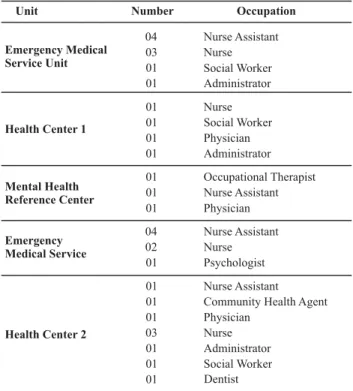
Subjects were 32 health professionals and administra-tors who experience the everyday health practice of health centers, emergency medical services, polyclinics, and me-dium and large hospitals of the health care network in Belo Horizonte, who interact with the assisted population, de-veloping specific social realities. Hence, workers of differ-ent categories were involved, because comprehensive care has, necessarily, an interdisciplinary character. One of the preliminary criteria for choosing the subjects was they should have at least ten years on the job in any of the net-work sectors, because if they had not been net-working when the SUS was implemented in Belo Horizonte in 1993, they were graduating and, thus, in a moment of transition. It should be clarified that despite the distinction regarding administrators, there was no differentiation in this regard when analyzing their statements and, therefore, all the re-spondents, regardless of their professional category or work position, are identifies by the letter E followed by a sequen-tial number for their distinction.
The workers were invited to participate in the study in their work sector, and they could suggest colleagues to participate. During the invitation they were informed about the objective of the study, as well as about all of its proce-dures, and were free to accept or decline to participate, as
per Resolution 196/96(10). The project was approved by the
Ethical Review Board at UFMG, under the following proto-col: ETIC 592/04.
Table 1 - Relationship between the work units and the study
subjects’ occupation- Belo Horizonte - 2006
Unit Number Occupation
Emergency Medical Service Unit
04 03 01 01
Nurse Assistant Nurse Social Worker Administrator
Health Center 1
01 01 01 01
Nurse Social Worker Physician Administrator
Mental Health Reference Center
01 01 01
Occupational Therapist Nurse Assistant Physician
Emergency Medical Service
04 02 01
Nurse Assistant Nurse Psychologist
Health Center 2
01 01 01 03 01 01 01
Nurse Assistant Community Health Agent Physician
Nurse Administrator Social Worker Dentist
Data collection was performed by means of semi-struc-tured interviews performed at times and locations pre-de-termined by the interviewees, from October to December 2006. To do this, permission was obtained from subjects to record the interviews with the purpose of assigning reli-ability to the information. Data collection was completed
when data saturation occurred, i.e., when we obtained a
sufficient number of interviews that would allow a certain recurrence of the information, without disregarding the
contents that were considered meaningful(11).
Data were treated and analyzed using the content
analy-sis technique(12). During the process of analysis, the
inter-views were fully transcribed, according to the question script. After the tapes were transcribed, the interviews were read thoroughly to obtain the relevant themes that emerged from the statements.
RESULTS AND DISCUSSION
Comprehensive health care is a concept with several
meanings(13). The organization of health services as one of
the meanings of comprehensiveness appears as the main issue to be dealt with in order to change health services to make it centered on users and their needs. In this study, the interviewees’ statements show the importance of the meaning of comprehensiveness as a full care/assistance by the health system at the three health care levels:
What I understand by comprehensiveness. It is continuity; it is an answer to the patient’s need at all health care lev-els. It is full continuity. That is what I understand for com-prehensiveness. Considering the needs at every level of the system (E13).
My understating of comprehensiveness related to the SUS is patients receiving full assistance, that is, at the primary, secondary, or tertiary level, whatever they need. The SUS divides health care in three levels: primary health care level that concerns the care by a general practitioner at the health center, the secondary level consists of care delivered at the health posts, or secondary reference health center, and the tertiary level refers to hospital care. So these three lev-els of care compose the comprehensive health to SUS users (E21).
It is coordinating the 3 levels, you know? Primary, second-ary and tertisecond-ary. That’s how I understand it(E16).
It is observed, in the presented statements, that com-prehensiveness and inter-sector relationships are intimately related in everyday health care practices. Inter-sector rela-tionships, in this sense, involve not only the articulation of health sector activities, but also the possibility of sequen-tial and comprehensive activities at each level of care.
Despite the constitutional documents of the SUS ap-pearing to portray a health system that is organized by pub-lic activities and services that form a hierarchy level net-work, this set of institutions and activities should be
coor-dinated among themselves. That proposition is in line with
law 8.080(14), which addresses the comprehensiveness of
care and established an articulated and continuous set of
activities and services, preventive and curative, individual and collective, which are required for each case and at ev-ery level of complexity of the system. Health services are organized in levels of care that range according to the avail-able technology, with the aim to ensure solving the health problems of the population and, therefore, the concepts of comprehensiveness and inter-sector relationships con-verge. Comprehensive health actions do not occur within a single sector, thus the need for articulating with the other sectors involved and with the many professionals compos-ing the health team. In this dimension, interdisciplinary work has been the constant object of discussion when ad-dressing comprehensiveness:
It is care per se, where the individual is examined, and may be referred to a place where it is possible to solve and treat his or her problem, because we don’t work with the patient only on one occasion, in one appointment. We follow that patient for two or three years. So, that means he or she will automatically come and go, because of the cervix pathol-ogy. So the team is essential to provide the continuity of care (E17).
The comprehensiveness issue would be establishing a connection between every health professional, and the as-pect of promoting health in several areas, that is, it involves dentistry, nursing, physicians too, a team that is integrated in several ways to promote adequate care (E26).
The Principle of comprehensiveness seeks to orient health practices, organize work and the policy. It is emphasized that health work is marked by particularities that make interper-sonal relationships highly meaningful and, therefore, indispensible in reaching the established goals. Hence, the relationship with others, either users, workers or adminis-trators, consists of the structure of the activities, which as-sume a particular dimension, because health care practices depend on a strong and decisive interpersonal bond to imple-ment health care itself. In fact, that bond is not identified only during an appointment; rather, it requires continuing follow up to establish a certain knowledge regarding that user, which would allow for continuous health care.
Over the last decades, the restructuring of the health sector has posed new challenges for health care workers, as they must articulate among them to become organized to meet the expectations of the population and face the problems that emerge in the different fields of work. This may be observed in the current market with the changes in the health work process, because the work that was once done alone are no longer sufficient to provide the solution to the needs presented in the different levels of care.
an-other. Therefore, the new knowledge becomes more quali-fied, allowing professionals to reach comprehensive care. It is emphasized that the work of health teams is directed by a number of values produced in and outside the work envi-ronments and not only by different knowledge, methods and techniques that originate from the plurality of professions
and specialties composing those environments(15).
Another aspect that should be considered is the ap-proximation of comprehensiveness with the care concept. That concept implies the treatment, the respect, the wel-coming and the assistance provided the human beings
and their needs(16), which was expressly mentioned by the
interviewees:
Comprehensiveness, in my opinion, is to respect people, be honest, be truthful (E1).
Comprehensiveness is assisting the patient in all his or her needs, so it would be to assist the person in the physical, mental and even spiritual aspects (E8).
This is how I understand comprehensiveness: when I as-sist a patient, I should asas-sist him or her in full... it means to think of them as human beings, considering several as-pects. It is trying to look at them and not seeing that they are here only because they have a disease (E10).
From that perspective, care is characterized as an activ-ity that involves different professionals with several types of knowledge and with the purpose of minimizing the ten-sions that make the population’s health more fragile. Health care may be seen as a comprehensive action that has mean-ings and senses directed towards understating health as
the right to be(17). It should be stressed that the study
sub-jects’ understanding of comprehensiveness refers to the principle of assisting the demands and health needs of the population, which results in comprehensive care. A
previ-ous study(18) showed that the participants understand
com-prehensive care as a presupposition to meet the biopsycho-social, spiritual and emotional needs of the population, including their sufferings, fears, financial and family prob-lems, justifying that the characteristic of comprehensive-ness in terms of health care, is made effective when users, with all their needs, meet a health professional with the required knowledge or resources to help solve their prob-lems. The statements showed that when the interviewees met with users, they were taken by feelings and emotions, which sometimes hindered and sometimes facilitated their application of their professional knowledge with a view to interpreting the demands presented by the used. It is in-ferred that, for those professionals, meeting the needs of the population is beyond that which is considered patho-logical, thus assuming a dimension that considers the par-ticularities of each individual:
So when I have a patient, I try to see him/her beyond the fact that he/she feels sick. Actually, I try to look at him/her and realize that the person who is here, sick, is not only a sick person, there are other aspects in him/her life that I should try to understand. For example, him/her family, that
he/she has a family, a career, a social life; and also con-sider the cultural aspects, because when I see a patient, how I will assist him/her, depends on those factors, be-cause, for instance, the orientations I will provide depend on him/her cultural knowledge, hence, for me it is neces-sary to understand the patient (E10).
Comprehensiveness means that in everyday health care we perceive the individual as a whole. Therefore, it means to realize that a headache that he/she feels may be a prob-lem that he/she is facing at home...(E30).
Comprehensiveness means having the right to health care in every sector and being seen as a person, not as a dis-ease, so you are able to look at the patient and discover his/her family environment, the place where he/she lives, his/her financial situation, that is it (E12).
You have to consider the patient that is in that house, what causes hypertension, what is responsible for that that patient’s hypertension, not only when the patient comes here with high pressure... it is during the visits that we take orientations, such as what he/she shouldn’t do, and con-tinue helping. The hygiene at the patient’s home, so I think it is not only about the disease, it is about things in general (E24).
It is emphasized that comprehensive health care prac-tices seek to assist subjects as a whole and to avoid any fragmentation and reductionism. Therefore, the care ex-pressed by the interviewees concerns the improvement of the human condition or their form of living. We know that in the process of human living, every element that involves the individuals’ social position may affect their quality of life. Hence, we recall the National Policy for Humanization, which aims at meeting the subjective needs expressed by users and health workers, exceeding the simple care and access to medication. The idea of humanization may be em-ployed on the quality of care from a technical standpoint of recognizing the users’ rights, taking into consideration
their subjectivity and cultural references(19).
When addressing the comprehensiveness of care fo-cused on the user, it is necessary to consider the human-ization of health care, because, just as comprehensive care, humanized accessibility is one of the SUS guidelines, and,
therefore, of its workers towards the users(20).
Health care humanization, as a policy proposition, is defined based on the aspects regarding the valorization, the autonomy, sensitivity in the perception of social needs, and others. Thus, the need for respect, welcoming, attach-ment and listening are indispensible as values and every-day practices. These practices become a challenge for some health workers from institutions and services where their everyday work is still founded on the logic of disease and fragments the subject, with a prevalence of the quantity of pathologies that they need to tend to and the consequent lack of time, harming comprehensive and humanized care:
diabe-tes, hypertension. It is really hectic here, overcrowded, sometimes the patient stays three days with diabetes, hy-pertension, some elderly patients go without adequate food, or without bathing. So the care becomes too poor. It is very hectic, there is no comprehensiveness (E7).
I understand that the team and the health proposal itself should be analyzing the patient in the most complete way. But the patient, here, is a front door, they are either dis-charged right there or transferred to another hospital to solve their complaints (E8).
Comprehensiveness encompasses the psychic, social, cultural aspects. For example, there is a social worker here only Monday to Friday, but not on the weekend, so it is not comprehensive. And other conditions such as feeling, ac-commodation, to sit for the medication does not mean com-prehensiveness. What I understand is to offer the basic conditions, which are not offered (E3).
The subjects’ statements show that the lack of the mini-mal conditions hinders the development of comprehensive care at health services. Therefore, comprehensiveness be-comes vulnerable when there is a demand for answering the subjects’ needs and services are not prepared to offer the minimal conditions, lack sufficient material or adequate physical space, which are indispensible in health care. Those condition, though considered bbasic, are relevant when designing the care model, as they may determine the forms that health services care, how they the demand and an-swer the affected health needs, i.e., the form how they ef-fectively solve the health problems and, consequently de-termine the subjects’ involvement in the health actions.
We may infer that if health care is centered exclusively on the disease, without addressing the subjects’ other di-mensions, it will require organization, because besides be-ing apparently dehumanized, and rushed, it is performed without the time for effective, though minimal, actions, such as hygiene or feeding. After all, patients are there only temporarily. They are either discharged or referred to an-other location, and, therefore, it appears that the lack of continuity in health care justifies the lack of comprehen-siveness, the subject’s fragmentation; even though in the statement the worker demonstrates the knowledge of the form that health care should be delivered.
Although health care requires mainly the use of soft technologies, the aimed user-centered model remains hin-dered by practices that are based on diagnosing and treat-ing diseases, defined by scientific knowledge, harmtreat-ing
sub-jects and their needs(21). The statements point directly at
the issue of how the education of health professionals has taken place, because it is common, in the academic envi-ronment, for health knowledge and practice to be frag-mented. In this regard, several authors report that health workers’ education should be based on teaching the com-plexity that permeates the SUS today and, for that reason, demand educational actions that are able to perform a pro-cess of collective construction with the subjects involved.
The study subjects raise the issue of addressing health care practices that value the subjective dimension, which im-plies to develop a model for health care and education that recognizes individual aspects without disregarding the col-lective aspects, which should also be centered on the
per-son who is receiving that care(18). To do this, health
educa-tion should aim at changing professional practices as well
as the organization of health work(22). Furthermore, health
care practices should be developed using a problem-pos-ing strategy regardproblem-pos-ing the workproblem-pos-ing process and should be based on its capacity of welcoming and providing care for the various dimensions and health needs of individuals, groups and populations.
CONCLUSION
Comprehensiveness, as the guiding principle of the SUS, should be the indispensible activator of a new posture in health care. In this sense, we aimed at obtaining from the subjects the perceptions and meanings that health workers have about comprehensive care in public services in Belo Horizonte.
Comprehensiveness is unspecific and has several mean-ings. The present study revealed that the meanings assigned to comprehensiveness surpass health care in its different levels, adding health care to the concept of health promo-tion, a broader view of quality of life, in which human be-ings are seen as subjects who are more than a mere bio-logical body.
The statements point at the important of interpersonal relationships between health service subjects. Furthermore, they represent comprehensiveness when those relation-ships are made effective when health workers share the feelings among them, and especially when that sharing occurs between worker and user. In this context, compre-hensiveness consists of a space of inter-subjectivity, which favors the dialogue between health workers, as well as a collective definition of user-centered health care.
In agreement with the meanings of comprehensiveness, interdisciplinary work is reported as a fundamental element to ensure permanent continuity and comprehensive care to clients of the public health care network. Furthermore, it strengthens the communication between the different health services.
It is important to state that the policy adopted in the referred municipality is in agreement with the subjects’ statements, as they realize that the problem-solution as-pect in the health network is connected to the instrumen-tal resource and technical knowledge of the workers, but also to the welcoming action, the attachment that is estab-lished with users, and the meaning that is assigned to the worker/user relationship, suggesting the encounter of sub-jects with the purpose of working in the health area.
for the statements to become effective in practice. We be-lieve that one of the reasons why they have not been made effective concern the workers’ professional education, con-sidering that the subjects, who were selected by conve-nience, graduated over 10 years before the study, when a transition period regarding the policy was in effect and they learned the new proposals through everyday practice and, for this reason, their statements and practices reflect more what they learned by experience than in theory, in school.
Hence, there is a need to rethink about the forms of integrating the spaces of health care practice and theory, creating reflections about the doing and thinking in health. If, on the one hand, it is expected that workers become updated for developing comprehensive care that value at-tachment, listening and give effective responses to the needs of the population at all health care levels; on the other hand, it is necessary to rethink the education of fu-ture workers, so students are put into contact earlier with the real spaces of health care practice in the logic proposed by the current health policy, i.e., of comprehensive care, which requires actions from an interdisciplinary team.
We acknowledge that we currently live a time of transi-tions regarding the forms of delivering health care in Bra-zil. The comprehensiveness model, which is user-centered, shares the environment with the biomedical,
disease-cen-tered, model, which fragments health work as well as health education. It should be emphasized that health work and education based on comprehensiveness should establish new bonds and solutions that aim at extrapolating the spe-cific, fragmented care for health problems, and should truly contribute to improve the conditions of organizing and plan-ning health actions in a mutual effort to improve the health conditions of the population.
Finally, we believe there is a need for a joint effort by administrators, health workers, students and social groups with the purpose to guarantee the right to health. There is a need to rethink health education and practice in micro-environments, where inter-subjectivities take place among all those involved with the process of comprehensiveness, which emphasize on welcoming, establishing attachments and assuming responsibility in health services and by health workers towards citizens. To do this, an accessible and per-tinent health care network should be guaranteed especially for those within it. In this sense, it is necessary to eliminate the fragmentations present in the form that health services are organized as well as in the daily practice of workers at those services, so as to offer comprehensive, problem-solv-ing care and humanize health practices, always aimproblem-solv-ing at the quality of life of the population and the health as a citizen right.
REFERENCES
1. Machado MFAS, Monteiro EMLM, Queiroz DT, Vieira NFC, Bar-roso GT. Integralidade, formação de saúde, educação em saú-de e as propostas do SUS: uma revisão conceitual. Ciênc Saúsaú-de Coletiva. 2007;12(2):335-42.
2. Fontoura RT, Mayer CM. Uma breve reflexão sobre integralida-de. Rev Bras Enferm. 2006; 59(4):532-6.
3. Bonaldi C, Gomes RS, Louzada APF, Pinheiro R. O trabalho da equipe como dispositivo de integralidade: experiências cotidianas em quatro localidades brasileiras. In: Barros MEB, Pinheiro R, Mattos RA. Trabalho em equipe sob o eixo da integralidade: valores, sa-beres e práticas. Rio de Janeiro: ABRASCO; 2007. p. 53-72.
4. Mattos RA. Direito, necessidades de saúde e integralidade. In: Pinheiro R, Mattos RA. Construção social da demanda: direito à saúde, trabalho em equipe, participação e espaços públicos. Rio de Janeiro: ABRASCO; 2005. p. 33-46.
5. Rei CB, Andrade SMO. Representações sociais das enfermeiras sobre a integralidade na assistência à saúde da mulher na rede básica. Ciênc Saúde Coletiva. 2008;13(1):61-70.
6. Franco BT, Magalhães Junior HM. Integralidade na assistência à saúde: a organização das linhas do cuidado. In: Merhy EE, Franco TB. O trabalho em saúde: olhando e experiênciando o SUS no cotidiano. São Paulo: Hucitec; 2003. p. 125-33.
7. Gil AC. Métodos e técnicas de pesquisa social. 5ª ed. São Pau-lo: Atlas; 1999.
8. Yin RK. Estudo de caso: planejamento e métodos. 2ª ed. Porto Alegre: Bookman; 2001.
9. Lüdke M, André MEDA. Pesquisa em educação: abordagens qualitativas. São Paulo: EPU; 1986.
10. Conselho Nacional de Saúde. Resolução n. 196, de 10 de ou-tubro de 1996. Dispõe sobre diretrizes e normas regulamen-tadoras de pesquisas envolvendo seres humanos. Bioética. 1996;4(2 Supl):15-25.
11. Minayo MCS. O desafio do conhecimento: pesquisa qualitati-va em saúde. 9ª ed. São Paulo: Hucitec; 2006.
12. Bardin L. Análise de conteúdo. Lisboa: Edições 70; 2004.
13. Mattos RA. Os sentidos da integralidade: algumas reflexões acerca de valores que merecem ser defendidos. In: Pinheiro R, Mattos RA. Os sentidos da integralidade: na atenção e no cui-dado à saúde. 3ª ed. Rio de Janeiro: ABRASCO; 2001. p. 39-64.
15. Pinheiro R, Barros MEB, Mattos RA. Trabalho em equipe sob o eixo da integralidade: valores, saberes e práticas. Rio de Janeiro: ABRASCO; 2007.
16. Luz MT. Cultura contemporânea e medicinas alternativas: novos paradigmas em saúde no fim do século XX. Physis Rev Saúde Coletiva. 2005;15 Supl:145-76.
17. Pinheiro R, Guizardi FL. Cuidado e integralidade: por uma genealogia de saberes e práticas no cotidiano. In: Pinheiro R, Mattos RA. Cuidado: as fronteiras da integralidade. Rio de Janeiro: ABRASCO; 2005. p. 21-36.
18. Silva KL, Sena RR. Integralidade do cuidado na saúde: indica-ções a partir da formação do enfermeiro. Rev Esc Enferm USP. 2008;42(1):48-56.
19. Deslandes SF. Análise do discurso oficial sobre a humaniza-ção da assistência hospitalar. Ciênc Saúde Coletiva. 2004;9(1): 7-14.
20. Cunha GR. Integralidade da atenção na assistência hospita-lar: um estudo com profissionais que participam do atendi-mento ao usuário [dissertação]. Belo Horizonte: Escola de Enfermagem, Universidade Federal de Minas Gerais; 2007.
21. Merhy EE. Saúde: a cartografia do trabalho vivo. São Paulo: Hucitec; 2002.