A R T I C L E
The Legislative Work in an Authoritarian
Regime: the Case of the São Paulo
Administrative Department*
Adriano Codato
Universidade Federal do Paraná, Brazil
This article describes the legislative process of the Administrative Depart-ment of the state of São Paulo (DAESP) during the Estado Novo dictatorship and seeks to answer three questions: i) what were its real attributions? ii) what was its place among the state-level government agencies? iii) what was its role in the dictatorial regime’s public decision-making structure? Ordering and interpreting information on the DAESP’s deliberative process will allow us to establish wheth-er or not it exwheth-ercised powwheth-er (undwheth-erstood as the capacity by those who controlled it to impose their preferences), what was the magnitude of this power, what type of power was exercised, over what and whom. The frequency of its meetings, the coordination of the agendas of the dictatorial State’s apparatuses involved in the decision chain, the activism of each councillor of DAESP and a sample of the legal opinions produced by it between 1939-1947 were all analysed. The findings can be summarised into three propositions: i) DAESPwas not a decision-making arena per se as it did not make important decisions, but instead produced a huge amount of decisions regarding the formal aspects of the decree-laws issued by the Interventoria Federal(appointed governors); ii) therefore, the president of the DAESP did not have greater political or bureaucratic power than the interventor, and iii) although the Department mimicked some legislative routines, it cannot be considered a substitute of the state legislature.
Keywords: Decision-making process; Estado Novo; legislative process;
state system; DAESP.
Introduction
H
ow does the “legislative process” of a regime with no legislative branch work? This article deals with the internal life of the Administrative Department of the state of São Paulo (Departamento Administrativo do Estado de São Paulo – DAESP)from 1939-1947. It is an examination of the agenda, the decision-making routines, legisla-tive procedures and bureaucratic connections of this specific agency, created during the Estado Novo(New State) regime in Brazil.
The coup that established the Vargas dictatorship in Brazil on November 10, 1937 swapped the elected governors for appointed governors, revoked parliamentary terms and shut down the legislative houses (city councils, state legislatures, Chamber of Deputies and Federal Senate). Soon after, Decree-Law nº 37 of December 2, 1937 cancelled the reg-ister of Brazilian political parties and civil militias. With this, the government intended to eliminate the influence of traditional politicians and state party machines on government processes. According to the then dominant anti-liberal conception (VIANNA, 1927), a bureaucratic department linked to the federal Executive branch that acted only “adminis-tratively” (and not politically) would be preferable to a Legislative branch occupied by the traditional oligarchies. To the official discourse, the Legislative branch that came out of the 1934 Constitution and was moulded according to the “classical models of liberalism and the representative system”, would not only be an “inadequate and costly apparatus”, but a real “obstacle” to “government works” (VARGAS, 1938, pp. 23-24). According to the writings of thinkers of the regime, the style of the Brazilian legislative bodies only hin-dered the process of government and blocked technocratic objectivity, hence the need for Administrative Departments that would play the role of regional parliaments.
Studies on Brazilian political history have likened the functions of the Administra-tive Departments, or “daspinhos” (little DAEs) to those of the former state Legislatures1.
This was the opinion current at the time of the Vargas dictatorship and also the view of the President himself (VARGAS, 1941, p. 219). According to Minister for Justice and In-ternal Affairs Francisco Campos, these Administrative Departments had been created in order to be “an instrument of ‘legislative cooperation and budgetary oversight’ of the Inter-ventoria Federal”(CAMPOS, 1940a, p. 115). And this, according to what the
authoritar-ians believed, had advantages over the political order prior to 1937, which repeated in the states the division between the Executive and Legislative spheres. All the dictatorship’s ideological propaganda emphasised the alleged superiority of the bureaucratic procedures of these offices compared to the “discursive methods of liberal democracy” and the empty “legalistic dialectic” of traditional parliaments (CAMPOS, 1940a, pp. 29-30).
In this context, the authoritarian ideology and the opinion of its disseminators on the inefficiency of Brazilian parliamentary politics worked as a source of theoretical inspira-tion for the law-making process that led to Decree-Law 1,202 of April 8, 1939. This decree instituted an Administrative Department in each one of the 20 Brazilian states. According
to this document, between four and ten members directly appointed by the Brazilian Pres-ident were to oversee the decision-making process in their states, approving or vetoing all the decrees issued by the Interventor Federal. Given this, Graham deduced that “the president of the daspinho was usually more powerful than the interventor” (GRAHAM, 1968, pp. 27-28).
This article aims to empirically test this proposition, examining the type and amount of power that this political system’s actors – the interventor and the president of the De-partment – possessed. This requires a descriptive study of the decision-making processes of the political-bureaucratic apparatuses of the authoritarian State.
The second aim of this article is to verify whether the distribution of the power of political initiative in the Interventorias and of the power of veto in the Administrative Departments made the latter the successors of the state Legislatures.
Focusing on the legislative production of the Administrative Department of the State of São Paulo, this article seeks, by means of a quantitative approach, to define the actual role (not just the legal role) of the DAESP in São Paulo politics during the dictatorial re-gime: 2,231 meetings and 3,387 legal opinions out of 20,875 issued by it were analysed. The idea behind this is that defining what the actual patterns of functioning of the paulis-ta Department were will allow us to see how the division of government work was organ-ised and how it operated in one of the states during the authoritarian regime.
The first part of the article mentions the political meaning – rather than the merely bureaucratic meaning – of the institutional reform that followed the 1937 coup d’État and led to the re-creation of the system of Interventorias Federais in the states, and later of the “daspinhos” as agencies of control over the interventores. The differences between this institutional arrangement and the 1931 Interventore’s Code and the political order that ensued are also detailed.
In the second part, The decision chain, I will state the frequency of meetings and the amount and types of decisions that the DAESP produced so as to give a more exact dimension of its bureaucratic activism. I will show the interdependence of the dictatorial State’s decisions through the DAESP’s linkages with other agencies and, based on this type of evidence, will suggest the bureaucratic connections between their administrative processes and the political connections among those who controlled them.
In the third part, The legislative procedure, I will examine the agenda and the deci-sion-making routines of the Administrative Department of São Paulo so as to understand the actual capacity of the very reduced group established in the “daspinho” to influence the decision-making process of the regional state apparatus. I did not manage to obtain complete data for all of the DAESP’s years in existence (1939 to 1947)2. With the
terial available, I ordered its resolutions by type of topic created from its processing of paperwork. These topics will allow us to establish how its real agenda (as opposed to the bureaucratic agenda defined in the decree-laws) was formulated. Following that, by means of a random sample, I will show the use that the DAESP made of the ability to change the decree-laws of São Paulo’s Interventoria and city governments.
Whenever possible, I have attempted to avoid giving a meticulous account of the agency’s bureaucratic minutiae, except when it was indispensable to understanding the system’s logic and not just its mechanics. I also sought to avoid excessively repeating ref-erences to several documents where only one mention sufficed for exemplifying a claim. The intention behind this method is to place in the foreground of the study the principles that governed this decision-making system and the DAESP’s particularities compared to other bureaucratic agencies of the dictatorial regime.
The political meaning of the administrative reform
With the end of the oligarchic pact in 1930, and after the constitutional failure of the República Nova (New Republic) decreed by the 1937 coup, power relations between national political groups and state political groups could no longer depend on improvised arrangements based on mutual trust between the old and the new oligarchies, on infor-mal arrangements such as the “politics of the governors”, or on the liberal procedures typical of the 1st Republic (1889-1930), such as regular elections and regional party
rep-resentation. Thus, two complementary provisions were consecutively created in order to formalise these relationships and impose a new and lasting hierarchy between the national apparatus and the regional apparatuses of the State and their respective controllers: the Interventorias Federais(as early as 1937) and the state Administrative Departments (in 1939). Decree-Law 1,202 of April 8, 1939, which instituted an Administrative Department in each of the Brazilian states, functioned, from then on, as a type of “Administrative Code” of the Vargas dictatorship.
In certain aspects, these Administrative Departments were a rehash of the old Con-selhos Consultivos de Estado(State Advisory Councils) instituted in August 19313. The
deposed President Vargas). However, Decree-Law nº 9,974 re-instated the Administrative Depart-ments on February 13, 1946 and they operated until the promulgation of the respective state con-stitutions (in 1947). The measure was adopted in order to fill the gap in the political system left by the non-existence of state Legislatures.
idea of recreating them with a new name in April 1939 had less to do a with response to pressures by oligarchic groups left out of the political schemes hurriedly arranged in the Interventoriasheaded by the tenentes [lieutenants] (as was the case of the 1931 arrange-ment) than with the authoritarian State’s intention to reorganise the whole process of gov-ernment along new lines4. In this sense, the legal text of 1939 can be read as a sign of two
limitations of the Estado Novo’s system of Interventorias: i) the regulation of federal inter-vention in states and municipalities decreed by art. 176, sole paragraph of the Constitution of 1937, bureaucratically organizing public administration, was missing; and ii) there had yet to be created an instrument politically able to guarantee and further the centralisation of decision-making power at the federal level, thus ensuring strict obedience by states to the objectives of the Varga’s regime, a purpose that only a direct relationship between the dictator and the interventores would be able to achieve (CODATO, 2011).
The Administrative Code of 1939 split the executive functions of the states into two bodies: an Interventoria Federaland an Administrative Department (Decree-Law 1,202, art. 2). The interventores, appointed by the President, had their power to appoint town mayors and executive secretaries (secretários de estado), to employ or dismiss public ser-vants and to manage their state with sovereignty guaranteed by decree (articles 5-11). Department members, also directly chosen by the Brazilian President (art. 13), had to examine all the decree-laws issued by the interventor and the mayors, as well as the bud-get planning and execution of their state and its municipalities (art. 17). According to the official ideology (or rhetoric), Administrative Department councillors had to carry out their work with greater neutrality (in political terms) and more efficiency (in bureaucratic terms) than the old state legislatures and city councils. In addition, because it regulated budgets, this new agency would also carry out the informal function of a “Court of Audi-tors” (Tribunal de Contas). It would suffice for two-thirds of Administrative Department representatives (art. 22) to oppose the measures of the municipal Executives or the state Executive to refuse their decisions, with the final decision – in case the interested parties exercised their right to appeal – to be taken by President Vargas himself (art. 19), who would be informed of the suit (“appeal”) by the Minister for Justice (art. 20).
The meaning of these “political reforms” – as the official vocabulary defined De-cree-Law 1,202 (CAMPOS, 1940b) – introduced into the regime’s institutional frame-work must be understood in a wider context. Schwartzman has observed that “more than governing, the new generation that came to power in 1930 saw a total reorganization of the Brazilian State as its main task and believed that, once it was achieved, good policies would almost naturally ensue” from the new administrative structure (1983, p. 04). It was precisely these idealised representations of government processes that placed in the foreground the alleged virtues of the economic policy corporate councils (DINIZ, 1978, pp. 157-219) and of political institutions such as the “daspinhos”. In this sense, blind faith in the importance and efficiency of bureaucratic bodies such as these for conducting the State in this new way was the real basis on which the authoritarian ideologues promoted the “new” Brazilian state in the 1930s.
However, much in the same way as the “sectorial economic councils” (of rubber, sug-ar, coffee etc.), the state’s Administrative Departments cannot not simply be considered part of the programme of “modernisation” of the Brazilian state. They were neither less politicised legislative bodies, nor more efficient administrative bodies.
The official propaganda on the Estado Novo could not hide with its exaggerations the fact that the aim of the “daspinhos” in the arrangement of the regime was much more political than managerial. For this reason, these Administrative Departments can be seen as both an institutionalised way of containing the “Union, states and municipalities” sys-tem’s centrifugal tendencies and a way in which to limit sectors of the old oligarchies instated by the president of the Interventoriain the states. The more the Administrative Department members were able to incorporate and/or influence the agenda of other re-gional apparatuses and their decisions, and to actually exercise their veto power over the initiatives of theInterventoria Federal, the greater their power over the interventores (and mayors and other state authorities). It is this political capacity that I will be testing.
The decision chain
policy, inaugurating a new form of clientelism – “State clientelism”, as opposed to the “pri-vate clientelism” of the coronéis (colonels) of the Old Republic (1889-1930).
The internal routines
The Administrative Department of São Paulo operated in “a modern building where it… [occupied] five storeys, containing 30 rooms, in appropriate facilities” (RAMOS, 1943, p. 44). It was situated at Rua Boa Vista, 119, in São Paulo. In 1945, it had only 18 staff members.
Regarding its financial costs, Administrative Rule nº 2,083 of June 12, 1939 had de-fined the interventor as the person responsible for allocating funds to the Departments, depending on the number of members in each state. For those with seven members (São Paulo’s case), the figure was 50:000$000 (50 contos de réis). As well as this budget, the decree-law that created the Administrative Departments also included a bonus for their members. It was decided on by the Minister for Justice and paid by the National Treasury. The bonus (called a jeton deprésence) for each councillor was Cr$ 200.00 (200 cruzeiros) per session, reaching up to a maximum of Cr$ 4,000.00 (4,000 cruzeiros) monthly5.
The first session of the DAESP took place on July 11, 19396 and its members
start-ed meeting practically every working day, except Mondays and Saturdays (on a one ses-sion per day basis). Extra sesses-sions could take place at any time or day, depending on the amount of work accumulated.
A typical meeting followed this sequence: after a roll call to verify the councillors present, if there was quorum, the president of the Department declared the session open. According to the House’s internal regulations, the “Business” of the meeting then began. Second Secretary José Antonio da Silva Junior proceeded to read the minutes of the previ-ous meeting, which were (very rarely) debated and (often) approved, with rectifications, if necessary. First Secretary João Franco de Souza proceeded to read the “communications” that is, the requests by interested parties (the system’s inputs). These documents could come from seven different government agencies: i) from the Ministry of Justice, communi-cating decisions by the Brazilian President regarding matters that depended on his direct approval, in accordance with articles 31 and 32 of Decree-Law 1,202/39; ii) from the State Chief of Staff’s Office, forwarding proposed executive decrees from the Interventor Feder-al; iii) from state Secretarias(Departments), with specific requests to the Administrative
5 Cf. Administrative Rule/Ministry of Justice nº 2,083 of Jun. 12, 1939. In 1945, the bonus was raised to Cr$ 5,000.00 per month. Administrative Rule/Ministry of Justice nº 10,694 of Jul. 5, 1945. By way of comparison, the Brazilian minimum wage in 1943 was Cr$ 300.00.
Department, or providing information requested to better inform the suits in progress; iv)
from the Department of Municipalities, sending proposed executive decrees and city gov-ernment budgets; v) from city governments themselves, offering or requesting information from the Administrative Department; vi) from other government authorities; and lastly,
vii) from private individuals asking for measures to be taken regarding non-compliance
with DAESP decisions by mayors. All documents were then forwarded to the Depart-ment’s office to inform or be annexed to their respective suits.
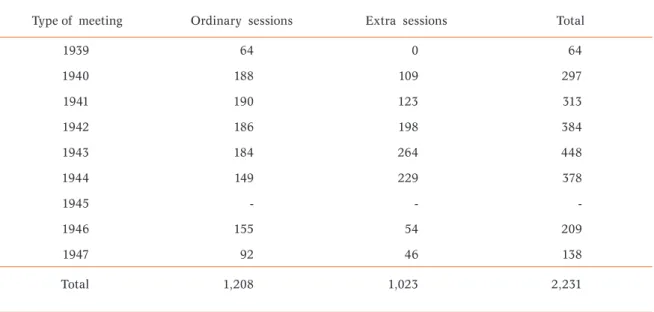
In order to be able to deal with all the work, in São Paulo, the Administrative De-partment was highly active. Between July 14, 1939 and July 8, 1947, it held more than 2,200 sessions (not including 1945, for which there is no data). Considering that in 1939 and 1947 the Department only functioned in the first and second semesters, respectively, we have the following:
Table 1. Absolute number of sessions of the Administrative Department
of the state of São Paulo, 1939-1947
Type of meeting Ordinary sessions Extra sessions Total
1939 64 0 64
1940 188 109 297
1941 190 123 313
1942 186 198 384
1943 184 264 448
1944 149 229 378
1945 - -
-1946 155 54 209
1947 92 46 138
Total 1,208 1,023 2,231
Source: author’s own
N.B: There is no information for 1945.
when the Administrative Departments were brought back to life in 1946, they did not come back with the same force as before, although they played the same role. When they were not held in the context of the dictatorship, the number of sessions dropped signifi-cantly, to less than half compared to 1943 and even further in 1947 (to only 138 meetings). The average number of sessions per week gives us a clearer idea of these values and this curve. Comparing the two pieces of information, we see that the story they tell is almost the same. With a lower frequency of meetings in 1939 (2.4 per week), even consid-ering the powers vested in the DAESP by the Administrative Code, it reached a maximum number of 8.6 sessions per year in 19437.
Looking at the paulista Department’s productivity, what we can see is the following: even at the beginning of its activities in 1939, or in 1946-7 – under the liberal regime of the Charter of 1946, when there were fewer sessions –, it was the source of a staggering amount of State resolutions. In a 1939 meeting, no fewer than 22 legal opinions were voted on, an average that dropped proportionately to the meetings becoming more frequent: in 1943 (with almost 450 meetings), there was an average of six legal opinions dealt with per session.
The origin of the propositions examined gives us a more precise idea of the horizontal and vertical connections between the Departments and the State’s other centres of power.
The decision-making paths
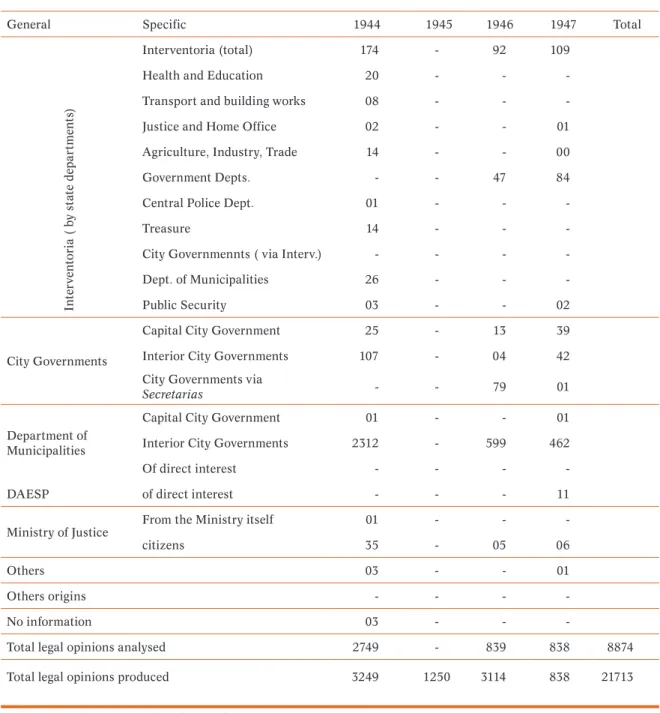
According to its own classification, there were four types of demands made to the agency, which can be summarised according to their scope and origin – individual/sectori-al, nationindividual/sectori-al, regional or local. For example, i) “leave requests” by public servants, “govern-ment procure“govern-ment, petitions, requests for official docu“govern-ments and pay“govern-ment of associated charges, proposals, communications of irregularities by the Interventoria Federal or City Governments etc.” were individual/sectorial; ii) “all the proposed executive decrees sub-ject to art. 32 of Decree-Law 1 202” – that is, those whose validity was subsub-ject to approval by the Brazilian President – “and the appeals sent to the DAESP by the Ministry of Jus-tice” were nationalinputs; iii) “all the proposed executive decrees from the Interventoria Federal, as well as those from the Capital City Government” (regional); and iv) “all the proposed executive decrees of city governments of the interior” (local) (RAMOS, 1943, pp. 49-50). What we see from Table 2 is that it was an agency specialised in policy matters that were mostly local and, to a much lesser degree, regional.
Table 2. Origin of requests made to the Administrative Department of the State of São
Paulo by apparatus and year - 1939 to 1942
ORIGIN YEAR
General Specific 1939 a 1940 1941 1942 1943
In
te
rv
en
to
ri
a
(
b
y
st
a
te
d
ep
a
rt
m
en
ts
)
Interventoria (total) 232 - - 203
-Health and Education 71 - - 14
-Transport and building works 43 - - 03 -Justice and Home Office 32 - - 03 -Agriculture, Industry, Trade 30 - - 06
-Government Depts. 19 - - 19
-Central Police Dept. 14 - - 01
-Treasure 14 - - 12
-City Governmennts ( via Interv.) - - - 01 -Dept. of Municipalities - - - 34
-Public Security 09 - - 04
-City Governments
Capital City Government 26 - - 42 -Interior City Governments - - - 47 -City Governments via
Secretarias - - - -
-Department of Municipalities
Capital City Government - - - - -Interior City Governments 1502B - - 2602
-Of direct interest 07 - - -
-DAESP Of direct interest 25 - - -
-Ministry of Justice
From the Ministry itself - - - 03
-citizens 09 - - 36
-Others - - - 01
-Others origins 98 - - 02
-No information - - - -
-Total legal opinions analysed 1415 - - 3033
-Total legal opinions produced 1415 3545 2564 3033 2705
Table 2. Origin of requests made to the Administrative Department of the State of São
Paulo by apparatus and year - 1943 to 1947 (continued)
ORIGIN YEAR
General Specific 1944 1945 1946 1947 Total
In te rv en to ri a ( b y st a te d ep a rt m en ts )
Interventoria (total) 174 - 92 109 Health and Education 20 - - -Transport and building works 08 - - -Justice and Home Office 02 - - 01 Agriculture, Industry, Trade 14 - - 00
Government Depts. - - 47 84
Central Police Dept. 01 - -
-Treasure 14 - -
-City Governmennts ( via Interv.) - - - -Dept. of Municipalities 26 - -
-Public Security 03 - - 02
City Governments
Capital City Government 25 - 13 39 Interior City Governments 107 - 04 42 City Governments via
Secretarias - - 79 01
Department of Municipalities
Capital City Government 01 - - 01 Interior City Governments 2312 - 599 462
Of direct interest - - -
-DAESP of direct interest - - - 11
Ministry of Justice From the Ministry itself 01 - -
-citizens 35 - 05 06
Others 03 - - 01
Others origins - - -
-No information 03 - -
-Total legal opinions analysed 2749 - 839 838 8874
Total legal opinions produced 3249 1250 3114 838 21713
Source: compiled by the author from figures of the DAESP’s accountancy dept.
A - Compiled by the author from: “ Relatório apresentado pela Diretoria Geral referente ao ano de 1939” on Jan. 9, 1940. Departamento Administrativo do Estado de São Paulo, Anais de 1940, vol. II ( Sessões), 2ª parte, Apêndice, pp. 2861-2862.
B - Here, the volume of demands, not of legal opinions, was counted.
The proposed executive decrees and appeals sent to the DAESP dealt with the most different of issues. In fact, it dealt with any issue, as it had to rigorously examine
name or the name of a square (which not uncommonly was named “Getúlio Vargas”), to reorganising staffing and setting the wages of employees of a state Department; from authorising the purchase of real estate to land expropriation and setting new municipal fees and charges8.
The greatest amount of paperwork came from the city governments of the interior, brokered by the Department of Municipalities, which shows an unexpected connection between the agenda of the two apparatuses. The same pattern could also be seen in Rio Grande do Sul (CAMARGO, 1983, p. 118)9. The direct demands from Secretarias
(depart-ments) were great in number and their total in the Interventoria accounts for the second largest number of requests. But, as we can see from these figures, they are much lower than the policy of observing the demands of politicians of the interior practised by the Administrative Department. In 1942, no less than 85% of proposed executive decrees ex-amined were from city governments. Even after the regulatory hardening of 1943 – which further subjugated the Interventoria to the Department10 –, in 1944, 84% of documents
ex-amined (not the total number of inputs) were still coming from municipal administrations, and this counting only requests made via the Department of Municipalities. Everything leads us to believe that the latter came to operate as a political agency of division between the Interventoria Federal and the Administrative Department. The mediation that the De-partment of Municipalities made between mayors and interventores contributed to filter the mayor’s initiatives and demands. At the same time, it upheld and guaranteed the pow-er of the intpow-erventor ovpow-er the mayor appointed by him, limiting the prpow-erogative that the Administrative Department had by law to also regulate municipal life. Hence the DAESP member’s insistence on stating that the Department of Municipalities caused the agen-das to overlap, duplicated the work and confused their respective regulatory functions. A light-hearted comparison would be to say that Department of Municipalities was to the interior city governments as the Administrative Department was to the Interventoria Fed-eral. As mentioned previously, the Brazilian President appointed the members of the Ad-ministrative Departments and the interventor appointed the mayors. The President used
8 For example, Arthur Whitaker examined and approved the request by the city government of Itirapina to prohibit the traffic of ox-drawn carts in the municipality’s streets and roads. Legal Opinion 2 122 of Dec. 6, 1941 (cf. São Paulo. Departamento Administrativo do Estado, 1941). Cesar Costa drafted legal opinion 2 574 (of Dec. 23, 1943) refering to the granting of special sup-plementary credits for the state’s city governments (See São Paulo. Conselho Administrativo do Estado, 1943).
9 In this specific case, 83% of documents originated from city governments.
the Administrative Departments to survey the political and bureaucratic life of states (in-cluding, mainly, the movements of the interventores appointed by him). The interventores, in turn, used the Department of Municipalities to oversee the political and bureaucratic life of municipalities, thus guaranteeing the loyalty of the mayors appointed by them (in local language, guaranteeing the “situação” (“situation”) of the municipalities).
Looking at the decision-making system as a whole, the strict regulation of the mu-nicipalities’ administrative routines was, in principle, useful for two reasons. We can even cogitate that if it was not a calculation by Getúlio Vargas and Francisco Campos when they drafted the dictatorship’s Administrative Code, it was at least a very welcome by-product of the policy of centralisation. The provision that made it compulsory for municipal deci-sions to be validated by the Administrative Departments succeeded in bringing back an entity that had, until then, played a central role in the intra-oligarchic game – the munic-ipality. Via the Administrative Department, it was made directly subject to the federal political sphere (i.e. to the Minister for Justice and therefore to the President himself), thus removing the mayors, one of the mainstays of coronelismo, from the Interventor’s sphere of influence. To Souza, Kerbauy and Truzzi, this unexpected power allowed the DAESP to undo and substitute coronelista clientelism with a new form of “State clien-telism” (2003) – as it implied centralising in one sole place the resources of patronage pre-viously dispersed along the decision chain and divided by the “smaller” politics –, which would mean the final blow to municipalism and the “private powers”. This was the most important political opportunity that the apparatus could provide its tenants with, and the institutional relevance of the Administrative Department would ensue precisely because of this right being exercised11.
However, via the Department of Municipalities, the actions of the Interventoria went around this prerogative, which could then only be informally exercised by members of the daspinho (and not only by the Administrative Department institution) at two points in the decision chain: either when the Reporting Commissioner requested more information from the mayors to give his legal opinion about the appropriateness of decree-laws, for alterations to the budget’s execution to be made, and even for special credits to be granted at the end of this exercise; or after the initial version of his legal opinion was published in the state’s Official Gazette so as to receive “contributions” from interested parties
before it was discussed and voted on in the council. The other difficulty with validating
the “State clientelism” hypothesis lies in the fact that the Administrative Department was
conditioned by law to not having any power of initiative, therefore having little to offer to
its clients in material terms.
Looking at the system through another angle, inputs by the Ministry of Justice were
virtually non-existent, which shows at least two important things: the interventores and
mayors did not appeal the decisions mandated by the Department’s opinions, which
sug-gests an absence of significant conflicts among the apparatuses and factions that
con-trolled them, or, if there were contradictions, they were resolved within the
Administra-tive Department (or at another point in the decision chain). The second thing is that the
connections between the federal and the state/municipal decision-making processes were
null, constituting two separate bureaucratic worlds. The requests by private individuals, as
seen from the documents examined, were applications for bureaucratic reviews, overdue
holiday pay, labour rights, salary readjustments and a few complaints of municipal
polit-ical persecution when promotions were postponed. Initiatives of “direct interest”, which
would signify real legislative activity, only took place in 1939, and this because of the
need for an internal organisation of the Department’s bureaucratic machine. In the period
1946-7, when it was brought back to life, the pattern of demands was unsurprisingly
re-peated but their volume dropped considerably. From 1,502 city government suits in 1939,
it fell to 462 in 1947. But quantity does not indicate quality. Only one request by the
Inter-ventoria (considering its political and/or economic importance) could be worth thousands
of requests by mayors. But this piece of information does not help to define the agency’s
power, as it had to examine everything. The low number of inputs from specific
Secretar-ias and from the Interventor’s office suggests a weak link between the two agencies.
However, as the Department was the compulsory bureaucratic checkpoint for all of
the dictatorship’s “legislative” procedures, it was able to guarantee for itself, along with
the Interventoria Federal, one of the central posts of all the state decision-making system.
Its superior position in the State’s regional apparatus and its high degree of autonomy,
both political (as it was subject only to President Vargas, i.e. it did not politically depend
on the Interventor) and bureaucratic (the agendas of other apparatuses legally depended
on its agenda, but the opposite was not true) made it one of the nodal points of the
dicta-torship’s politics, at least in São Paulo.
As the political opportunities of the Department’s members were formally linked to
their veto power, and, in truth, to the potential exercise of this power, this is what we will
The legislative procedure
Understanding the political structure of the Estado Novo and the bureaucratism of the regime as a whole and its science of governing requires not only an explanation of the formal power of the Administrative Departments in this new decision-making structure (through the decree-laws), or of their place in the bureaucratic chain (as a result of the decision chain), but also of their exact role in the new bureaucratic order.
What were the political themes processed by this agency? What is the relevance of these themes? And what were its real chances to influence or modify the provisions of the dictatorial State’s other apparatuses, that is, its power of agenda?
In the assessment Miguel Reale made of the Department’s actions when he resigned from his post in 1945, he stated that “precisely because of the body’s transitory nature, it was the legislative activity that predominated, although we exercised, to a reasonable degree, the functions of control and criticism” (REALE, 1986, p. 190). Let us examine this statement with due detail, precisely by means of the “legislative activity” of the DAESP referred to.
How did the legislative process function in practice? This is equivalent to asking: what was the magnitude of its power, in the sense defended by Kaplan and Lasswell12?
By legislative process, I mean not only the traditional political method of “law-mak-ing”, but also the operation that includes the legislative procedures, that is, the technical part of the activity of legislating. The former is subject to the more general political pro-cess, which implies both its “constitutional” rules, defined by the political regime, and its conflicts, occurring in the political universe. The text that formally decides the legislative process and stipulates its parameters is the federal Constitution. Legislative procedures, in turn, are the real sequences of stages and actions, generally legally defined by a Regimento (set of rules), which conducts the normal law-making process. In the legislative arena, this procedure transforms requests into resolutions. The interaction between these three levels – the political process, the legislative process and legislative procedures – should allow us to grasp this system’s logic, even just by looking at its mechanism.
All legislative phases are political, as the mechanism implied in the practical activity of legislating is itself an object of dispute. If the specific principles of the legislative pro-cess were defined by Decree-Law 1,202 (it being the crystallisation of political struggles), its procedural rules – the typical trajectory of a decision – were stipulated by the Internal
Rules of each Department. Decree 1,202 decided who in this bureaucratic system had the primacy of the power of initiative and who had the monopoly of veto power. In the second section of this article, I referred to this question when discussing the bureaucratic division of labour between interventorias and departments, itself the result of both institutional choices and the actual political process. In the third part, I will seek to establish a link between the respective agendas of state apparatuses of the State and their relations of interdependence and subordination. Now, let us examine the domain and routine of the suits – according to the set of institutionalised rules for processing the inputs – and their weight in the “legislative process” of a regime without a legislative branch.
The internal rules
The Internal Rules of the Administrative Department of the State of São Paulo dealt with the legislative procedures (the path of the decisions, the intermediate stages, the form of the documents, etc.) and with two other essential things in this system: who controlled the House’s agenda and at what point in their decisions the councillors had to listen to the “interested parties”. That is the last stage in discriminating the political-institutional duties of the Administrative Departments and what is now in question is two types of evi-dence: its real agenda (what it decided on) and its real power (what was the influence of its decisions). However, first of all, we must state some of the peculiarities of this “legislative system” so as to understand its “legislative process”.
The Administrative Department dealt with laws but did not produce laws. Its “legis-lative activity” (as per Miguel Reale’s expression) is an inexact formula if we only consider its outputs – “legal opinions” and “resolutions” regarding the legality or adequateness of an interventor’s or mayor’s proposed executive decree. Aside from that, seen from the inside, this decision-making process seems to be closer to the traditional workings of a Parliament: there was a “commission on admissibility” of the inputs (the General Di-rectorate), a technical commission and a legal commission. There was also a “legislative service”, as well as a president who oversaw the work and defined the agenda and voting order. There were even debates in plenary13.
What was typical of the dictatorial regime, on the other hand, were two things. Its members were not elected, which contributed to keep party politics at bay, and its organisa-tion was shaped according to the principle of bureaucratic efficiency, not of the representa-tiveness of interests, hence the formalism of its procedures. From the sum of all these char-acteristics results its hybrid character: political in form, but bureaucratic in content. This is what we will find by means of a diagnostic of the DAESP’s decision-making routines.
For each proposed executive decree (sent by the Interventor Federaland the mayors) or appeal (filed by the Ministry of Justice against decisions by the Interventor or acts by the mayors, initiated by the interventores) filed in the Department (the inputs of a deci-sion-making process), a councillor was designated by the president of the Department to read out his legal opinion – a type of intermediate decision by the agency. When deemed necessary, the president appointed a commission from its members, which chose the suit’s judge-rapporteur. Councillors had ten days to study the state or municipal proposed exec-utive decrees when the topic in question was subject to the direct approval of the Brazilian President (in other cases the deadline was longer – 30 days). For appeals, there was up to a maximum of 20 days to draft the legal opinion. However, this ideal timeline was depen-dent on the “requests for information” to the authorities interested in the decision so as to better inform each suit, a procedure similar in form to public hearings and, in practice, to an opening of the system to the influence of interest groups.
The standard path the documents went through was the following: when the pro-posed executive decree or appeal went through the filing department, it was numbered and filed. It was then sent to the General Directorate of the Administrative Department of São Paulo and distributed to the technical-financial aides or the legal aides (depending on the topic), or to both, successively, who would then evaluate the evidence and give their opinions – according to their functions – on its economic aspect (particularly in budgetary matters) or legal aspect (whether or not it was correct and appropriate to the current leg-islation etc.)14. Armed with this initial technical opinion, “and after having been informed
by the Legislative Service about the drafting of the proposed executive decree, suggested in compliance with the jurisprudence of the House or with prior decisions by the Ministry of Justice or the Brazilian President”, the suit returned to the General Directorate, which studied it once again and finally sent it to the DAESP presidency to be distributed to the Councillors – this when it was not preceded by requests for information or if the decision was of the exclusive scope of the president of the House (RAMOS, 1943, p. 44). Given
these processing rules, the Department president had, in principle, a merely bureaucratic incumbency. However, it could well become a political prerogative – a specific judge-rap-porteur could always be appointed for a specific matter.
Once the suit was received by the Reporting Commissioner (or the Reporting Com-mission), if he was satisfied with the information and did not request more, he would issue his opinion either in the form of a “proposed resolution” (such as in the case of an ordinary proposed executive decree), or in the form of “conclusions” (in the case of appeals or decrees subject to final approval by President Getúlio Vargas). Having read these documents, and provided they were not limited to legal technique, each councillor offered his reasons for approval, approval with amendments, or non-approval of the proposed executive decrees from the city governments or the Interventoria. Once the legal opinion was issued, which was then typed and checked by the Legislative Service, the suit went back to the president of the Department, who only then designated its inclusion into the “order of the day” of a session assigned to discussion and voting, “waiting, beforehand, except in the case of urgen-cy claims by colleagues, for it to be published in the Official Gazette, which often resulted in great cooperation from the interested parties and the collective” (RAMOS, 1943, p. 44).
It could happen that the interested parties, aware of the legal opinions before the final decision, contacted the appointed judge-rapporteur(s) so as to try to convince him/ them of the fairness of their requests. In this case, the councillor submitted to the presi-dent of the Department a “Request” asking to see the suit and to postpone the discussion and voting in plenary on the “Draft Resolution”. This wide cooperation, starting from the judge-rapporteur’s decision being published in the State Official Gazette, meant the only opportunity for action by interest or pressure groups, which shows the degree of the system’s authoritarianism. This reintroduced into the DAESP’s closed and secret deci-sion-making process the ill-famed “politics” that the institutional system was not only incapable of terminating, but actually promoted – although according to its own rhythm, agenda, power and the degree of elitism that characterised the whole principle of occupy-ing institutional positions. Councillors had in this their opportunity to develop a network of contacts and cultivate a potential clientele, whether in their dealings with the bureau-cracy of the Interventoria or, mainly, with the mayors of the interior. This is why it is more precise to speak of a power of “bureaucrats” – power understood as the ability to choose, although restricted to bureaucratic questions – rather than an impersonal, objective, ratio-nal “bureaucratic power”. Once the legal opinion was voted on, a resolution – the Admin-istrative Department’s output – was drafted. It could change the initial decree-law or not15.
There were, among the councillors, certain legal specialties, rather than explicit pref-erences for certain subjects. These areas were defined according to the field in which they had acted as legal representatives before entering into state politics. The arithmetic division of suits per judge-rapporteur was quite balanced. I selected around 18,000 legal opinions from different years in order to test this proposition (see Table 3). As the work was huge and intense, an equal share of suits per councillor was a compulsory part of the agency’s rationale. Figures very discrepant amongst each other indicate absences from the Department, either due to leave or because of a member having left or having only just joined the House.
Table 3. Administrative Department of the State of São Paulo. Number of legal opinions
examined by judge-rapporteur per year and total
Rapporteur/year 1939 A 1940 B 1941 C 1942 1942-43 D 1943 1944 1945 C Total
Antonio Feliciano 232 576 355 91
Antonio Gontijo 260
Armando Prado 15 94
Arthur Whitaker 259 267 647 389 88
Cesar Costa 237 628 509 88
Cirilo Júnior 282 294 729 516 86
João Carvalhal Filho 24
Marcondes Filho 209 259 Mario Lins 191
Marrey Júnior 273 664 445
Miguel Reale 517 468 25
Plinio de Morais 214 Renato Paes de Barros
Unidentified 2 8 4
Total legal opinions
analysed 1,415 1,562 2,705 496 6,178
Total legal opinions
voted on 1,415 3,545 2,564 3,033 2,705 3,249 1,250 17,761
Source: author’s own
A – The figures are from the DAESP’s accounting department. Compiled by the author from: “Relatório apresentado pela Diretoria Geral referente ao ano de 1939” on Jan. 9, 1940. Departamento Administrativo do estado de São Paulo, Anais de 1940, vol. II (Sessões), 2ª. parte, Apêndice, p. 2861-2862;
B – It was not possible to establish the information for 1940, 1942 and 1944; C – There is no complete data;
D – 1942-1943: Departamento Estadual de Imprensa e Propaganda, Dois anos de governo: 1941-1943. São Paulo, s. c. p., 1943, p. 24-25. Period considered: Jan 1, 1942 to Jun. 30, 1943.
When a councillor’s position on a matter already examined had not been previously published, the legal opinion and other paperwork sent to the DAESP, as well as requests formulated by councillors, were read during the course of the session in which the draft resolution or the conclusions would be debated and voted on16. If there was quorum to
hold a Department session, the documents were separately placed under discussion “in closed sessions, with no public access” (REALE, 1986, p. 171) and then voted on. Regard-less of the result – whether the decision was approved or not – the final Resolution of the Administrative Department was issued. It was typed up and checked by the Legislative Service, and, after, being authenticated by the presidency, by the draft Resolution’s or legal opinion’s judge-rapporteur(s) and by the General Directorate, it was sent to the Interven-toria Federal or the mayors for the respective decree-law to be promulgated, or even to the Ministry of Justice (in case of matters subject to the Brazilian President). It was then requested that the body publish the Resolution in the State Official Gazetteand send the document to the Department “for the necessary check, made by the Legislative Service, which, upon finding any irregularities, duly communicated the fact to the General Direc-torate for the relevant actions to be taken” (RAMOS, 1943, p. 45). In this way, changes in the resolution’ wording in favour of the petitioner at the time of press were prevented. This degree of caution suggests that this practice was not uncommon.
Although the decision-making methodology (discussion and vote in “plenary”) was secret and the processing of initiatives excessively complicated, the coordination of in-terests in the name of “high collective causes” (as the president of this council, Gofre-do Telles, emphasised) was more explicit, as political pressure and bureaucratic interest groups could have access to members of the Department in at least two stages of the de-cision-making process: when the former asked for more information to back up the legal opinion and at the point in which the latter became aware of the intermediate decision via the Official Gazette of the State of São Paulo. Regarding this, Miguel Reale notes the following:
If we think that, at this time, Brazil – and especially São Paulo – was emerg-ing from agrarian civilisation, buildemerg-ing its first points of industrial expansion, we can well understand that the uncontested primacy of the Executive made it into a permanent target of class demands, from the bureaucratised and docile worker’s unions to the leaders of finance, agriculture and industry […] As a Councillor, I complied with the law in force, seeking to listen as much as possible to the in-terested parties so as not fall prey to unilateral pressures, but I felt, in the flesh, the system’s precariousness, the dead weight of the legislation that had supressed
local differences and the spontaneous life of groups, even though there was a cer-tain merit in assigning rational organisation schemes to it (REALE, 1986, p. 173).
Even within these “rational organisation schemes”, a somewhat intense circuit of pressures and counter-pressures was created. Although open conflict among the system’s agents was infrequent (or at least imperceptible given the administrative nature of the material analysed), there were specific disagreements – of the Councillors amongst each other regarding their respective legal opinions, among specific interested parties and spe-cific councillors when legal opinions came out in the Official Gazette, and of the Council and with the intentions of the Interventor and the mayors when the final resolution was published.
It is certain that the councillors derived their power from the legislative procedure and it was all the more important the fewer the alternatives in the decision-making sys-tem. However, this power could only be used in this same circuit, as it was not usable in other ways, such as in “State clientelism”, for example.
The themes of politics
Because of Decree-Law 1,202, the Administrative Department of São Paulo had a vast and unspecific agenda (no less than all the decisions of the state and all the munici-palities), which diluted its bureaucratic power. It is therefore useful to highlight the areas of the themes voted on.
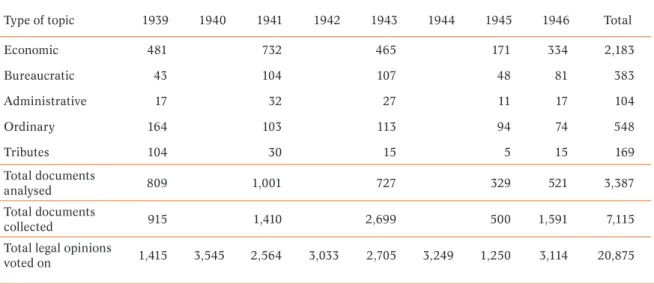
Table 4 lists the topics examined and discussed by type of subject.
These classifications were created inductively based on research of the DAESP ma-terial itself, and having as reference the typology employed by Amorim Neto e Santos (2003)17. For my own benefit, I fused two variables of different weights normally separated
in studies on the legislative process: content and scope. Economic themes (basically, bud-getary matters: granting special credits, and other examples such as tax exemptions, creat-ing charges, altercreat-ing tax regimes, assessments of city government balance sheets etc.) are either state or municipal matters; bureaucratic themes are individual and concern public servant careers (their posts, retirement and other pensions, transferrals); administrative themes (including provisions on the functioning of bureaucracy, the creation or alteration of public management bodies) are mostly state-related and, to a lesser degree, local; or-dinary themes are almost always municipal (expropriations, donations, building, trade opening hours, specific provisions on local management themes etc.); tributes(changing street names or the names of squares etc.) are almost always municipal.
By definition, the Administrative Departments did not decide on national matters. They examined a decree-law proposed by an interventor or a mayor, altered it or not, and when it concerned matters pertaining to the specific authority of the Brazilian President, they submitted it to his approval prior to publishing the final resolution18.
Table 4. Topics examined by the Administrative Department
of the State of São Paulo by type (sample)
Type of topic 1939 1940 1941 1942 1943 1944 1945 1946 Total
Economic 481 732 465 171 334 2,183
Bureaucratic 43 104 107 48 81 383
Administrative 17 32 27 11 17 104
Ordinary 164 103 113 94 74 548
Tributes 104 30 15 5 15 169
Total documents
analysed 809 1,001 727 329 521 3,387
Total documents
collected 915 1,410 2,699 500 1,591 7,115 Total legal opinions
voted on 1,415 3,545 2,564 3,033 2,705 3,249 1,250 3,114 20,875
Source: author’s own.
N.B. Three months per year were chosen at random; 1939, Sep, Nov and Dec; 1941, Aug, Nov and Dec; 1943, Feb, Aug and Nov; 1945, Jan, Feb and Mar; and 1946, Apr, Jun and Dec.
From these figures, we can have a more precise idea of the agency’s specialisation in certain themes of politics.
In all the years considered in this survey, the pattern was rigorously the same. The Administrative Department of the state of São Paulo was an agency focused on economic matters; on budgetary matters, to be precise (particularly the inspection of budget execu-tion by mayors of the interior). This item’s value is much greater than that of others. In 1939, 59% of decisions were regarding the São Paulo economy; in 1941, the figure was 73%; and in 1945, 64%. Problems of the ordinary management of the State municipal ma-chine came second, and proposing administrative rationalisation and modernisation, as authorised by Decree-Law 1,202, where the council could actually exercise greater power of initiative and veto power, came last, rivalling the examination of decree-laws pertaining to tributes (which it lost to by a wide margin in 1939).
In the hierarchy of the themes of politics, economic matters are an important spe-cialisation and those who control the use of economic resources tend to also control the agenda of other agencies. Added to the Department’s administrative autonomy, defined by law, the political capacity of the group that directed the apparatus tended to be great and its position in the hierarchy of groups contained in the structures of the dictatorial State comes out as high. However, in order to relativise this point of view, we must consider a final measure.
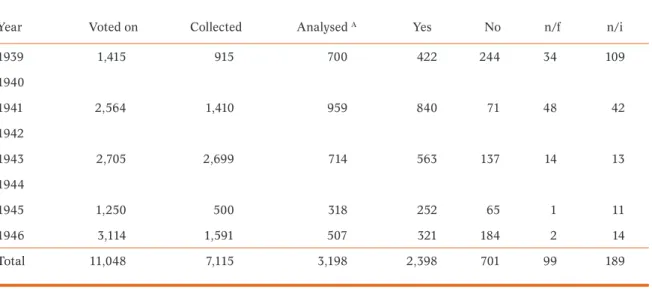
The last series of specific issues of the agency’s decision-making process to be evalu-ated is its actual relationship with the mayors and interventores. What was the DAESP’s degree of cooperation in the decision-making process? Did it approve the initiatives of the Interventoria and city governments or not? Is there a complementary quality to the inter-ests among the groups contained within the several apparatuses of the dictatorial State? How can this be measured? Table 5 suggests some conclusions regarding these questions.
Table 5. Decree-laws modified by the Administrative Department of the state of São
Paulo by year (sample)
Year Voted on Collected Analysed A Yes No n/f n/i
1939 1,415 915 700 422 244 34 109
1940
1941 2,564 1,410 959 840 71 48 42
1942
1943 2,705 2,699 714 563 137 14 13
1944
1945 1,250 500 318 252 65 1 11
1946 3,114 1,591 507 321 184 2 14
Total 11,048 7,115 3,198 2,398 701 99 189
Source: author’s own
Key: n/f. = not found; n/i = no information.
A – three months were chosen at random per year (same sample as Tab. 3).
The difference from the total documents analysed in Tab. 3 is that here, there is at times is no precise information (n/f), or it was not possible to determine what happened with the input, which is different from suits with no information (n/i).
its progressively acquired bureaucratic capacity finally enshrined by the 1943 decree-law, it seems that the faction that governed the Department held a good part of the system’s
political power.
There is, however, a problem with this finding. The disadvantage of treating these data at this level of aggregation is that two types of information are lost: the type of de-cree-law modified and what this modification was like.
In the majority of times, a circumstantiated analysis of this sample has shown that the DAESP altered the provisions proposed by the mayors, sent by its greatest bureaucrat-ic rival, the Department of Munbureaucrat-icipalities (see Table 2). Considering the information in
Ta-ble 4, what was modified the most were the city government budgets, followed by ordinary local administration matters. As the budgets were prepared by the Interventoria, it could be that this was precisely the greatest source of friction between the two apparatuses and their crew. Yet regarding the decree-laws, the “amendments” by the São Paulo councillors were generally superficial, almost always concerning wording problems or their appropri-ateness with regard to the law in force, and did not alter the actual content (or subject) of the decree-laws at all. When they were more substantive, the interventor ignored their
recommendations or did not sanction them.
In short, behind this political scenery, the agency’s legislative procedure shows ba-sically formalistic behaviour, where the evaluation of a procedure substituted an actual legislative capacity. That is, it was a segment that did not make decisions but, above all, produced decisions, as its power was essentially bureaucratic. The problem of the hierar-chy among the state apparatuses of the State and, consequently, of the hierarhierar-chy of the
political themes that concern them must therefore be considered in this rather paradoxical manner. In spite of the legislation that guaranteed their formal powers, the “daspinhos” were less agencies of bureaucratic supervision of the country’s state system than a possible means of regulated participation by a political group in this political system by means of an intense – and innocuous – bureaucratic activity.
Conclusion
The data resulting from a detailed analysis of the decision chain and the internal routines of the Administrative Department of the State of São Paulo showed that the pres-ident of the DAESP was not more important (as in more powerful) than the Interventor. They also showed that in spite of mimicking some legislative routines, the apparatus never actually functioned as a legislative house and neither did it exercise its veto power over the decrees of the Interventor Federal and the mayors.
Although the volume of the paulista Department’s decisions was very significant (more than 20,000 legal opinions voted on), and although its meetings were very frequent (more than 2,200 between 1939-1937), its members did not always decide on very im-portant matters. In the same way, open conflicts with the Interventor Federal on specific decisions were very rare. The many changes to the ordinary legislation that the DAESP carried out were more legal corrections than political vetoes.
Translated by Priscila Moura Submitted in July 2013 Accepted in February 2014
References
CAMARGO, D. D. (1983), Centralização e intervenção: padrão político e institucional do Estado Novo no Rio Grande do Sul – o Departamento Administrativo de Estado - RS. Universidade Federal do Rio Grande do Sul, Porto Alegre - RS.
CAMPOS, F. (1940a), A política e o nosso tempo. In: O Estado nacional: sua estrutura; seu conteúdo ideológico (pp. 1–32). Rio de Janeiro: José Olympio.
CAMPOS, F. (1940b), Síntese da reorganização nacional. In: O Estado nacional: sua estrutura; seu conteúdo ideológico (pp. 111–144). Rio de Janeiro: José Olympio.
CARONE, E. (1975), O tenentismo: acontecimentos; personagens; programas. São Paulo: Difel. CARONE, E. (1978), A Segunda República (1930-1937) (3ª ed.). Rio de Janeiro; São Paulo: Difel. CODATO, A. (2011), Intervenção estatal, centralização política e reforma burocrática: o significado
dos Departamentos Administrativos no Estado Novo. Revista Do Serviço Público, 62(3), 321–339.
DEPARTAMENTO Administrativo do Estado - São Paulo (1941), Pareceres do Departamento Administrativo do Estado de São Paulo de 1941 (nº 2001 a 2564). São Paulo: s.c.p.
DEPARTAMENTO Administrativo do Estado - São Paulo (1943), Pareceres do Conselho Administrativo do Estado de São Paulo de 1943 (nº 2501 a 2705). São Paulo: s.c.p.
DEPARTAMENTO Estadual de Imprensa e Propaganda- São Paulo (1943), Dois anos de governo: 1941-1943. São Paulo, s. c. p.
DINIZ, E. (1978), Empresário, Estado e capitalismo no Brasil: 1930-1945. Rio de Janeiro: Paz e Terra.
DINIZ, E. (1991), Estado Novo: estrutura de poder; relações de classes. In: B. Fausto (Ed.),
História geral da civilização brasileira (5ª ed., Vol. Tomo III: , pp. 77–120). Rio de Janeiro: Bertrand Brasil.
FAUSTO, B. (1972), Pequenos ensaios de história da República: 1889-1945. Cadernos CEBRAP, Nº10.
GRAHAM, L. S. (1968), Civil Service Reform in Brazil: Principles versus Practice. Austin; London: University of Texas Press.
KAPLAN, A., & LASSWELL, H. (1998), Poder e sociedade (2ª ed.). Brasília: Editora UnB. LOEWNSTEIN, K. (1944), Brazil under Vargas. New York, NY: The Macmillan Company.
MARREY JUNIOR, J. A. (1943), No Departamento Administrativo de São Paulo, discursos e pareceres. São Paulo.
NUNES, E. (1997), A gramática política do Brasil: clientelismo e insulamento burocrático. Rio de Janeiro; Brasília: Jorge Zahar; ENAP.
RAMOS, F. A. (1943), O Departamento Administrativo do Estado de São Paulo. Revista Do Serviço Público, Vol. 02, Nº 01, 43–50.
REALE, Miguel (1986), Memórias : destinos cruzados. São Paulo : Saraiva, Vol. 01.
SCHWARTZMAN, S. (Ed.)(1983), Estado Novo, um auto-retrato. Rio de Janeiro; Brasília: CPDOC/FGV; Editora UnB.
SOUZA, M. do C. C. de (1976), Estado e partidos políticos no Brasil (1930-1964). São Paulo: Alfa-Omega.
TAYLOR-ROBINSON, M. M. (1999), Who Gets Legislation Passed in a Marginal Legislature and is the Label Marginal Legislature Still Appropriate?: A Study of the Honduran Congress.
Comparative Political Studies, Vol. 32, nº05, 589–625. doi:10.1177/0010414099032005003 VARGAS, G. (1938), Proclamação ao povo brasileiro (“À Nação”. Lida no Palácio Guanabara e
irradiada para todo país na noite de 10 de novembro de 1937). In: A nova política do Brasil,
Vol. V. Rio de Janeiro: José Olympio.
VARGAS, G. (1941), O Departamento Administrativo do Estado. In: A nova política do Brasil,
Vol. VIII. Rio de Janeiro: José Olympio.