Beyond Brazilian Coalition Presidentialism: the
Appropriation of the Legislative Agenda
*Rafael Silveira e Silva
Universidade de Brasília and Senado Federal, Brazil
Even though they possess several power resources, Brazilian Presidents also elaborate their legislative proposals based upon bills already being processed in Congress through a phenomenon called Appropriation of the legislative agenda. In this paper I examine the conditions under which this phenomenon occurs by means of a typology and a qualitative comparative analysis (QCA). I conclude that Appropriation provides the President with the expansion of the formal support base by controlling the agenda of allied and opposition parties as well as obtaining the "paternity" of several policies already in motion in Congress, thus enabling a public association of the President's actions and his or her party with the possibility of social benefits. Be it in the pursuit of promising agendas or for the maintenance of their own dominance, Appropriation shows that Brazilian Presidents must go beyond coalition presidentialism.
Keywords: Appropriation; coalition presidencialism; agenda power; ad hoc coalitions; QCA.
he Brazilian experience, consolidated in the legislative predominance of the Presidency, often leads to the general idea that the Executive, with its broad powers and self-sufficiency in drafting policy propositions, would make the Legislative a subservient power or simply a mere ceremonial stage in the law-making process. However, a more attentive eye on the legislative work
(*)http://dx.doi.org/10.1590/1981-38212014000100022
The replication dataset can be found in bpsr.org.br/files/arquivos/Banco_Dados_Silva.html.
I would like to thank the anonymous referees of this journal for their precise comments and suggestions. Possible mistakes and omissions are the sole responsibility of the author.
reveals that, even for such a powerful political actor, the mission to govern is complex and requires much more than power, but the ability to use them. Furthermore, the set of ideas and perceptions of problems and propositions to address national challenges does not exclusively pass through decision makers operating within the Executive. In addition to the various forms of influence from organized interest groups, we also find the active participation of political actors in the National Congress. These aspects create a favorable setting for several parliamentary propositions to call the attention of the Presidency, which then seeks to act on the legislative process in different ways, among which we highlight the recently observed phenomenon of Appropriation of the Legislative agenda.
Appropriation occurs when the Executive builds on ongoing bills in Congress, as well as the content of the debates and other byproducts of the ongoing legislative process, to prepare and submit its own propositions, incorporating additional elements to the legislative agenda, and in some cases impeding the development of the agenda being debated in Parliament (ARAÚJO and SILVA, 2012; SILVA and ARAÚJO, 2013). Moreover, this phenomenon features bills originating from within the Presidential coalition as well as the opposition.
From the point of view of policy content, the phenomenon shows different traits and can reach a point where the President practices Appropriation through verbatim copying of bills in Congress. A typical case was the approval of Law nº 11.520/2007, which granted special pension to people affected by leprosy and subjected to isolation and compulsory hospitalization. This law had its origins in Provisional Measure (PM) 373/2007, of which its text and explanatory statement were almost literally copied from Senate Bill 206/2006, which had already passed the Senate and was proceeding through the Chamber of Deputies when the PM was published.
propositions greatly diverged from the intentions of the Executive Branch.
Appropriation was the easiest path for the President, presenting their own proposition rather than to work to change bills already under discussion. It should be stressed that Appropriation cases are not rare or isolated facts. In a survey conducted between 1995 and 2010 (ARAÚJO and SILVA, 2012) it was shown that approximately 18% of provisional measures and 40% of the bills had full or partial association with Appropriation.
Graph 01. Propositions of President - total & originated by Appropriation (1995-2010)*
Source: Banco_Dados_Silva.
* Six-month moving average of the propositions, excepting the exclusive initiative (art. 61, § 1º, and art. 165 of Constitution).
Therefore, Appropriation is part of the current practices within the Brazilian political system, regardless of the political party in power.
The question that arises is why and under which conditions the head of the Executive Power makes use of this strategy, taking into account the system of governance and the building of formal majorities known in the Brazilian case, since Abranches (1988), as coalition presidentialism1. My argument is that in spite of the
1 Abranches (1988) reflected on the institutional dilemma marked by strong presidents
and a fragmented party system, influenced by regional and private characteristics and lacking an ideological and programmatic identity. However, evidences have demonstrated the ability of the President to mobilize majorities via coalitions, ensuring the stability and success of mandates and converting coalition presidentialism as being practically synonymous with governability in Brazil. Although his researches have collaborated to emphasize the positive factors of this system Limongi (2006) argues that the use of this
0 3 6 9 12 15
Executive's success rates, the act of governing is not always in accordance with the very strict premises regarding this system. Furthermore, while the Presidency's power to legislate does have institutional foundations there are also strategic and contingent reasons, which depend on the complexity of the issues at stake and the capacity of the head of the Executive Power.
Under these terms, Appropriation demonstrates President's capacity in determining which propositions shall be taken under consideration in Congress and at what moment this occurs, thus showing a clear indication of the power of the agenda, but in a way hitherto not perceived within the scholarly debates on coalition presidentialism.
Therefore, the existence of the phenomenon gives rise to an investigation of an alternative form of association between the power of the agenda from the Executive and the formation mechanisms of party majorities, especially when it comes to the hegemony of the Executive in passing laws.
So, in this article, I intend to identify the game of interactions within the Appropriation and verify under what circumstances this phenomenon combines the power of the head of the Executive's agenda with the management of multiparty coalitions.
To this end I propose an analytical model that establishes dynamic and conjectural relations between the phenomenon and some of the explanatory factors for coalition presidentialism. To conduct the empirical test I used a comparative analysis tool known as Qualitative Comparative Analysis (RAGIN, 1987; 2000). This methodological choice intended to establish and verify associations between occurrences of Appropriation through a configurational view of the variables.
My view is that this article expands the insights established in studies on the relationship between the Executive and Legislative, especially on the need to better understand the relationship between the power of an agenda and the formation of majorities. There are ample opportunities for the insertion of propositions that depend on the nature, origin, and priorities, underlining
elements rarely addressed in explanations pertaining to the power of Executive agenda: the content of the bills and the motivations sustaining them. My argument is that the Legislative and the Executive act and react in different forms according to the agenda in debate, determining the strategic use of Presidency powers. Thus, these elements must be confronted with the political party scenario so that we may also comprehend the existing connections with some of the premises of coalition presidentialism.
Lastly, this article places the legislative arena once again as being a central focus for the actions of parliamentarians, reevaluating the established notion that they lack resources to generate their own legislative propositions (COX and MORGENSTERN, 2002). With Appropriation a small inversion occurs: Presidents also formulate their strategies by considering the actions from Congress and not just its reaction.
Majority formation and agenda power
It is the goal of the head of the Executive Power to maintain their political guild in power. In order to make this happen one of the guarantees is the extent of governability, sustained mainly under the condition that the governmental agenda is approved. The two main factors to explain governability in Brazil are the construction and maintenance of a party coalition and the power of the President's agenda. And both factors are often associated with coalition presidentialism.
The explanatory mosaic to cast this system as a success factor first came as a counterpoint to the notion that the electoral system arrangement would tend to exacerbate the politicians' individualism (AMES, 2003; MAINWARING, 2001). Under these terms the response by Figueiredo and Limongi (2000) to this challenge signposted that the heterogeneity of preferences in Congress would be shaped by centralized decision-making, functioning as a measure of equilibrium to the incentives present in the electoral arena. The institutionalization of rules within the Legislative Parliament places control and coordination at the hands of leaders, which would ensure a high party discipline and, consequently, the functioning of coalitions. Under this scenario Brazilian political parties, fragile in the electoral arena, occupy a prominent position in the legislative arena.
However, when considering limitations present in centralization mechanisms, Pereira and Mueller (2003) advocate that the existence of rules is insufficient to explain the government's influence over the legislative agenda. This control would be reinforced when defining distributive policies and offices in exchange for support for propositions agreed between party leaders from the governing coalition and the President. Amorim Neto (2002) adds that, in order for this to be successful, occupation of offices must obey party representation in Congress. The greater the proportion between the parties' ministerial portion and their parliamentary weight, the more cohesive and consistent will the coalition become. Lastly, the budgetary process is also pointed as being relevant within a conception that would structure coalition presidentialism. With full control over the budgetary process, the Executive allows for a wide adoption of parliamentary amendments to use, through leaderships, as a tool to control coalition members voting in Congress (PEREIRA and MUELLER, 2002).
coalition by other mechanisms and by selectively using its powers. By adopting this line of thought, Raile, Pereira and Power (2010) tested the association between occupation of government positions and budgetary execution. The authors conclude that these political-institutional tools are complementary, covering different aspects to ensure the cohesion of the coalition. The variety of situations which demanded a selective use of the tools available for the President showed that oversized coalitions with high ideological heterogeneity, together with a heavy concentration of power within parties, represented severe challenges for the President.
In an alternative view Limongi and Figueiredo (2009) once again call attention to the power of the President's agenda. They reverse the previous explanatory axis, claiming that it is the power of the agenda that ensures unity in the coalition. The policy agendas of the Executive and Legislative would be defined in a coordinated manner so as to be complementary rather than antagonistic. Thus, the agenda approved would not be the Executive's, but a governmental agenda of the majority2. The conclusions reached by the authors, however, were based
within the budgetary sphere, a process that is largely dominated and driven by the Executive.
Therefore, it would still remain important to discover how the fusion of agendas within the legislative arena would occur, whose complexity is a complicating factor in the relations between the powers. Another issue is to which majority the authors were referring to. Even assuming that they mean formal coalitions, the authors' idea is based on the absence of conflict or competition between parties, including those comprising the governmental basis. Party fragmentation in Brazil entails very heterogeneous formation of coalitions and the pursuit of electoral projection does not disappear with the participation of the party in the coalition.
All of these researches mentioned above highlight the role of the head of the Executive, but the Brazilian scenario indicates that the results achieved will
2Limongi and Figueiredo (2009) show unease with approaches dealing with the
almost always impose on the President the use of ability and exertion in conducting these processes. This demonstrates that the Legislative cannot be overlooked, including its concrete actions in building its agendas, even if its agency occurs under strong institutional restrictions. In order to govern, the Executive must act strategically in the placement of its policy agenda.
This aspect draws attention to the need to look at Brazilian presidentialism in a more dynamic and interactive manner, particularly regarding the association between the power of the agenda and the characteristics of the coalitions in a fragmented partisan environment. Excessively incisive analyses on the presuppositions attributed to the Brazilian presidentialism3 hamper the ability
to explain certain phenomena, as is the case with Appropriation.
My argument is that partisan and ideological diversity as well as the multitude of topics up for debate in Congress do not always make formal majorities as malleable as the President's need to govern. Additionally, I understand that agenda power may be applied to the articulation of new expressions for forming parliamentary majorities, both for the strengthening of formal coalitions as well as the construction of majorities, also external to the party base of government support. And this is the new way of looking at the power of the agenda as indicated by the practice of Appropriation.
Analytical model for Appropriation
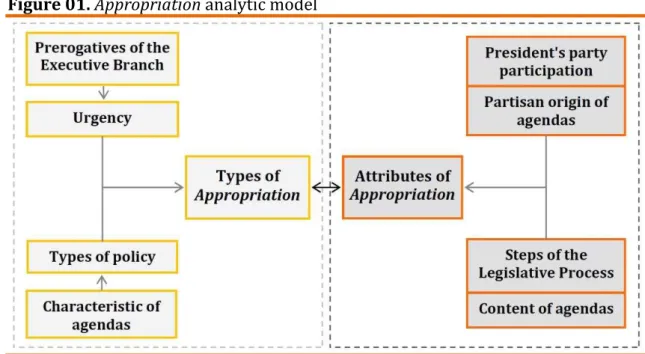
Since Appropriation is part of the set of practices espoused by the Executive, I adopt the idea that it is the result of a particular decision making process, albeit inserted within the scope of power of the President's agenda. In order to comprehend this process I prepared an analytical model that combines two research fronts.
The first refers to the motivations with the presentation of propositions resulting from Appropriation and how it articulates itself with the power of the Presidency's agenda. Similarly to the claim by Lowi (1972, p. 299) that "policies determine politics", I hereby argue that policies determine the type of Appropriation
3Either way, in spite of controversies that still exist, this study intends to question the view
based on the principle that the occurrence of the phenomenon presupposes its utility to politics. Thus, I propose the creation of categories in order to differentiate the phenomenon.
In the second analytical front I propose attributes or characteristics of Appropriation that may provide subsidies to assess the phenomenon as a type of power of the Executive's agenda and its relationship with Brazilian presidentialism.
Figure 01. Appropriation analytic model
Source: Prepared by the author.
Appropriation categories
The first analytical front was prompted by the following question: what would spark the President's interest on bills already underway in Congress? This is a question that is difficult to be answered solely by considering the existing explanations on coalition presidentialism. The fact is that Appropriation carries in itself a set of motivations that can be aligned to common objectives.
The existence of the phenomenon suggests that a relevant option for the Executive is to present its own bill. By assuming the authorship of the proposition, the President would stand as the legitimate idealizer and conductor of a particular agenda. Stemming from the idea that the phenomenon is intrinsic to the sense of opportunity generated by the agenda being pushed forward in Congress, I opted for the specification of the effects desired by the President when using Appropriation, based on a construction of categories to define the phenomenon.
There are some traditionally established categories for classifying policies, among which I highlight Lowi (1972). The argument used by the author states that each policy type has groups providing support and rejection, and these debates take place in specific arenas, respecting the different expressions of power from a government. The categories I hereby propose for this research are grounded on different dimensions. I propose that Appropriation should be considered a strategy for reframing the political game against allies and opponents in Congress, by means
of which the President attempts to maximize the attainment of the government's
objectives while opting for the more useful option. Through this viewpoint, when the opportunity to conduct Appropriation presents itself there is a formal and an informal perspective to be considered by the Executive so as to submit a policy to Congress. The formal one depicts that the government's central goal, by principle, is problem solving by which social justice prevails. The informal perspective addresses the social impact in approving a policy. These would be secondary objectives from a social point of view, but at the same underlying motivators for a decision towards Appropriation. These can be synthesized into categories within a pragmatic approach aggregated to the repercussions caused by the political cost-benefit of the proposed measures.
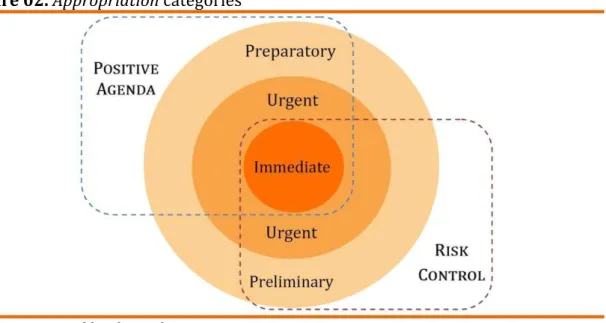
excluding categories. On the one hand, the Legislative agenda may be promising to the Presidency and other government parties and with positive repercussions. On the other hand, the agenda can be threatening to the interests of these political agents, which would force the President to submit a proposition that overrides the one in Congress. Thus, the proposed bills are classified as positive agenda bills and risk control bills.
Positive agenda bills are those that attract the attention of the President since they hold greater potential for being converted into political gains. The interests of the Executive are expressed in obtaining credit claiming4, i.e., that the
policy would allow members of the government to capitalize the attention or visibility in the eyes of public opinion. Within this category we find one of the most celebrated policies during President Lula's second term: "Minha Casa Minha Vida" (My House, My Life) established by PM 459/2009. It addressed several issues associated with housing, among them a chapter on the land regularization of urban settlements. It was precisely on this issue that the government conducted Appropriation, reproducing with minor differences an important section of the replacement to Bill 3057/2000. This bill was on the agenda of the Plenary of the Chamber of Deputies awaiting to be voted. Another expression of positive agenda is the practice of blame-avoiding (WEAVER, 1986), indicating the interest in presenting policies that have the condition of nulling other unpopular decisions (such as tax increases) or problems that might compromise the government's image (such as corruption allegations). One interesting example is PM 169/2004, which allowed for financial transactions of the Guarantee Fund for Time of Service (FGTS) in case of urgent personal needs deriving from natural disasters. This PM was very similar to PL 3762/2000 and was presented at a delicate moment in which the media was extensively covering suspected acts of corruption by government officials5.
4This expression, created by Mayhew (1974), is commonly attributed to the strategies of
parliamentarians to improve their reelection conditions. We opted to use it so as to indicate the possibility of securing a positive visibility and subsequently the implementation of the measure while also adding the notion of position taking, which in this research refers to public disclosure of the Executive's actions during the Presidency term.
5This pertains to the case in which the former advisor to the President, Waldomiro Diniz,
A reverse situation is attributed to bills classified as risk control. In these cases, in order to ensure the prevalence of its preferences, the Presidency intervenes in the Legislative Agenda by presenting its own proposition. This is done in cases of threats to the status quo advocated by the government or in cases where the Parliament's proposition for change goes against the President's intentions. The risk control category may also be characterized by an action intended to control populist urges in Congress, especially those dealing with sensitive issues for the public administration. These issues are seen by the Executive as a sort of "monopoly", given that the administration's perspective prevails. The President is the one interested in any negative consequences arising from an improper handling of the matter. They are also policies aligned with strategies to maintain dominance over some agendas on which successive governments go to great lengths to control, despite the great insistence from parliamentarians in presenting different alternatives. Within this category, for example, we find all the measures that need to be reviewed periodically, causing a significant impact the budgets of state governments, such as the definition of the minimum wage and Social Security benefits. The Congress periodically presents dozens of bills on these topics. Within it also fall policies pertaining to a more typical state control, such as regulatory policies, inspection policies, and implementation of administrative and penal punishments.
So that the categories of Appropriation may also encompass the Presidency's modulation to the sense of opportunity generated by Congress agenda it is necessary to add another dimensional space: the priority level. This is an important aspect of the power of the President's agenda, since, by defining the speed of the processing rate it attempts to maintain the debate calendar under control (DÖRING, 1995). The works in Congress also interfere with the processing rate desired by the Executive. By studying the mechanisms of acceleration of the presidential agenda, Pereira and Mueller (2000) observed that the prerogative to request urgency in discussing propositions can vary according to the differences between the interest shown by the committees and the President. The smaller these preferences, the smaller would be the need to speed up work.
measures (PM). Although any introduction of a government bill should significantly demarcate works in Congress, it is natural that those with a higher priority shall occupy most of the legislative debate. As for the PMs, they are the most effective form for the Executive to legislate and to quickly convert its propositions into laws. Its effects are immediate and the discussion rite in Congress has precedence over all others, besides the fact that they are brief. This aspect imposes differentiated conditionalities.
For the Presidency it would be much simpler to send all legislative propositions via provisional measures. But the reality is not consistent with this practice. That is why some explanations are required to justify the use of different legislative instruments in presenting propositions submitted to Appropriation.
Thus, through the priority level one can observe the selective use of presidential prerogatives by means of the speed of the processing rate of its propositions. The priorities depend on the interactive game between the Executive and the Legislative branches and the level of influence of internal government decisions, be it from the Presidency, the cabinet post which proposed the agenda, or even from other parties within the coalition. Different priorities also determine different treatments between governmental agendas concurrently transiting in Congress. Diniz (2005) points to the existence of such behavior as being a "hierarchical agenda". The author emphasizes that many of the propositions placed forward by the President are merely used as instruments of negotiation or accommodation of interests within the coalition. They do not come accompanied by the use of resources to expedite processing and are usually left to transact according to the timing of the National Congress itself.
the Executive with no expectation of such bills being approved. On the other hand, it is also a manifestation of a phenomenon that enables the government to gain more time to act at the most opportune moment and thus focus in due course in approving its agenda. In this situation the Legislative is used as an "incubator" for the Presidency's bills, hence the category being named "preparatory". In the same line of reasoning, Appropriation by Preliminary Control Risk are those in which the government invests just enough effort to ensure that the status quo does not change or is modified except under the President's strictly authorized terms. These are cases that function merely as a prevention.
Figure 02. Appropriation categories
Source: Prepared by the author.
Appropriation attributes
In this second research front I outline the modulation attributes or parameters from which the categories of Appropriation shall be analyzed.
has the characteristics of an early game strategy6: an anticipatory movement by
starting a new legislative game, that is to say, by presenting new proposition stemming from those already being processed in Congress. Appropriation would take place even before the Legislative's final decision and would be boosted by the Executive's ability to coordinate or to persuade others of the substantive value of the bills involved.
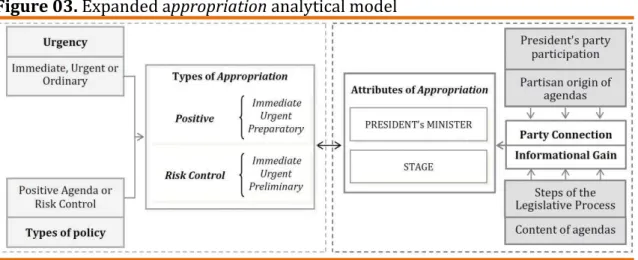
With this understanding the choice of attributes shall follow the proposed model, being divided into two explanatory axes: informational gain and party connection. In the first, the attributes will be based on the content of the propositions and the set of factors promoted by the legislative process which favor the President's interests in Congressional bills. The second axis will lead to the choice of attributes dealing with how agents performing Appropriation occupy, divide and articulate in power.
Informational Gain
This perspective relates to the substantive part of the "appropriated" agenda, as well as all of the work subsidizing the development of the proposition's text. The approach here is bound to the origin and as to how the information subsidizing the Executive's alternative strategy is treated.
Pereira and Mueller (2000), by using the informational perspective adopted by Gilligan and Krehbiel (1987), call attention to the importance of evaluating the President's strategic use of the work from the committees in Congress, both in terms of factor adhesion among the preferences from the Legislative and Government bills, as well as the stage of such discussions in Congress. The authors underline that depending on the works performed, the committees could serve the interests of the Executive Power. This perspective reveals just how important the legislative process can be as a source of information for decision making by Appropriation. When such a decision happens one deduces that a range of information was analyzed by government agents
6When observing the American case, Beckmann (2010) argues that the Executive is
(party leaders, parliamentary advisers, coalition members), from the content and merit of the proposition produced in Congress up to the conditions and actors fostering its presentation.
On the one hand, the path traveled by bills in Congress and its discussion momentum indicate the manner by which parliamentarians and parties have handled their agenda, also generating relevant information for decision-making by external agents, including the Executive itself. On the other hand, the idea that it was "appropriated" is the established link between the preferences of the Executive, tied to political beliefs as well as governmental objectives, and the parliamentarians' preferences. To analyze the path followed by the bills, I propose that one of the attributes necessary to understand Appropriation is the STAGE of the legislative process. Depending on the STAGE, the process of Appropriation assumes different directions. For each bill that draws the Executive's attention we need to know the latest product of legislative works, so that we can assess how contributions from Congress were appropriated. The possibilities of the government finding something of interest within the Legislative are varied, but they are dependent on the "informational load" offered by the processing of bills. The more advanced the processing, the larger set of information will be available by the process (content of the discussions, amendments, opinions, which political actors participated, which parties and interest groups are involved, among others). Thereby, STAGE is defined by the phase the bill was found when being handled in Congress until being submitted to Appropriation by the Presidency.
I established four categories for STAGE, described in an increasing scale as to their informational load (see Table 01).
Table 01. Categories for the STAGE attribute
Stage Detailing
FROZEN
When the issue was not discussed, there was no joint processing alongside another project or any processing at all over the course of one year.
AWAITING DISCUSSION
When joint processing occurs in a time period under one year, but with no debates in the committees and presentation of reports.
PROGRESSIVE
When there are discussions, reports and hearings. The discussion of the opinion report must not exceed one year, otherwise the STAGE may be considered to be "frozen".
VETO
The decision towards Appropriation begins with the President's veto. Through the vetoed project it becomes possible to extract high amount of information, more than in all other stages, considering the concluded discussions on both Houses of Congress.
Source: Prepared by the author.
The closer the Executive's preferences are from the parliamentarian's bills the more Appropriation will be characterized as a strategy aimed at persuading Congress, even if the bill's origin came from an opposition party. In fact, in such cases it becomes quite evident that by taking an interest and investing on a legislative agenda led by the opposition, the greater are the President's chances to overthrow the oppositional urges of these parties when deliberating the governmental proposition.
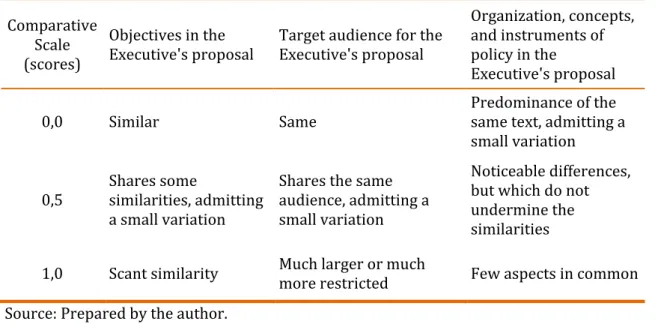
To measure PREFERENCE I created an index consisting of criteria for determining the distance between preferences at different levels. The guideline for each criterion was achieved by comparing the content of texts, collating the proposed government bill with propositions submitted to Appropriation (see Table 02).
Table 02. Calculation of the preference attribute
Comparative criteria with the proposals from Congress
Comparative Scale (scores)
Objectives in the Executive's proposal
Target audience for the Executive's proposal
Organization, concepts, and instruments of policy in the
Executive's proposal
0,0 Similar Same
Predominance of the same text, admitting a small variation
0,5
Shares some
similarities, admitting a small variation
Shares the same audience, admitting a small variation
Noticeable differences, but which do not undermine the similarities
1,0 Scant similarity Much larger or much
more restricted Few aspects in common
Source: Prepared by the author.
Party connection
When looking at the international experience there are some consensuses regarding party behavior and their stance on government support. The characteristics of the American system, for example, indicate that legislative prevalence in Congress and the control of its institutions are crucial to governability. This requires for the President to dialogue, negotiate, and bargain with the party dominating the main positions in Congress (CAMERON, 2000; COX and McCUBBINS, 2005).
In light of these arguments how would Brazilian parties behave? In a Brazilian coalition government with a strong President it is relevant not only to know which parties compose the support base, but also to know the dynamics between them within the government. The possibilities most frequently cited to reduce potential tensions among government members are the distribution of offices and the distribution of resources by budgetary amendments. However, the foundations for understanding party policymaking still lack depth. From the viewpoint of studies on coalitions, the strong interest in verifying which parties participate in the government coalition is usually founded on the belief that merely
knowing who is in government is enough to infer what type of policies will be
presented. However, for the Brazilian scenario this path still merits further analysis. The parties do not make clear the nature of the policies advocated by them and the context of a coalition government makes this comprehension much more nebulous.
I understand that the study of Appropriation helps to clarify this question as it favors the analysis of the relationship between parties occupying ministerial offices and parties in which parliamentarians associate themselves to "appropriate" draft bills. Depending on the partisan association between political agents practicing Appropriation and those linked to the "appropriate" bill, it becomes possible to infer these policies capacity to interfere and to shape policies. I named this explanatory axis party connection.
agenda, the parties seek to anticipate preferences, also conducting a "negative control" over its members. By clearly establishing the boundaries of what is amenable to be accommodated, propositions coming from outside the party would be blocked, thus reducing the pressure on how their members vote. The major difference between the reality interpreted by the authors and the Brazilian reality is that the main driving force of a "cartelized" behavior lies in the participation of the Executive (AMORIM NETO, COX and McCUBBINS, 2003).
Furthermore, if in the Brazilian reality there is no prior party control over what their parliamentarians in Congress presents there may be a subsequent selection process by which propositions may count with the support of party leaders and receive special referral. I understand that this is where Cox and McCubbins provide an important association with Appropriation. Even though Brazilian parties lack enough programmatic identity to influence bills placed forward by its members, the possibility of Appropriation may encourage parties to exercise the role of filters and selectors, especially by means of a governmental coordination. This would provide a well paved path for bills with a consistent content insofar that they are resubmitted by the President. Beyond the use of parties to verify promising bills so as to conduct Appropriation, the Presidency may also use this same procedure for propositions submitted by other parties (INÁCIO, 2009). Thus, the phenomenon may serve to displace opposition visibility in obtaining political benefits from the authorship of good policies.
At the same time, Appropriation would also play the role of a control mechanism by pointing possible dangers and dissensions that could impose harm on governmental interests. Similarly to the legislative cartel theory, the Executive may hold negative agenda control, thus blocking propositions from parliamentarians within the coalition base as well as from the opposition. Nevertheless, the hue brought by Appropriation is that negative agenda power occurs indirectly, by presenting competing propositions and not solely through other mechanisms such as veto.
explanatory axis the first attribute of the phenomenon concerns the party ties to the one occupying the head of the Executive Branch, indicating the Presidency's influence power and how representative its party is within the Appropriation process. I have named this attribute PRESIDENT'S MINISTER. It will assume the characteristic of a dummy variable that registers whether the Executive's proposition to configure Appropriation was signed by a minister of the same party as the one in Presidency (value"1"), or if it was introduced from the initiative of ministers from other parties (value "0").
The other attribute reflects the counterpart relation to the phenomenon, that is, with the author or rapporteur of the bill in the Congress' agenda, which was subsequently submitted to Appropriation. This attribute, called CONVERGENCE, was drawn from parameters aimed at locating the parties of the authors or rapporteurs in relation to the President's party, much like a pattern of partisan adhesion.
Taking as reference the party of the author or rapporteur for the "appropriated" proposition, the CONVERGENCE level stems from the composition of three evaluation filters7, as shown in Table 03.
Table 03. Elaboration of codes applicable to party convergence
Situation of the author/writer of the "appropriate" project Parameters Party Convergence Member of the supporting coalition Same party as the President's Same party as the Minister who signed the proposition
Conditions (scores) Yes = 1 No = 0
Possibilities (∑ scores)
1 1 1 3
1 1 0 2
1 0 1 2
1 0 0 1
0 0 0 0
Source: Prepared by the author.
7In this case it is important to rely on the stage of the legislative process so that we may
The first three situations appear to be similar. It so happens that the coalition is multi-partisan and heterogeneous, and therefore a closer inspection is required. The argument for this attribute is that there could be a greater integration between parliamentarians and the government through their party affinities, implying that the greater the convergence, the greater the scope for negotiation and coordination, thus benefiting both sides. In contrast, the lower the CONVERGENCE, more the Appropriation would be a strategy for cancelling or blocking parliamentary initiatives.
Figure 03. Expanded appropriation analytical model
Source: Prepared by the author.
The analytical model allows us to explain Appropriation by different combinations of attributes, grouping them into similar categories. It means that this type of construction admits that there is no ideal format for this type of phenomenon, which is consistent with its complexity. From this argument the question that needs to be answered is: what method should be used to verify the association between the Appropriation categories and its attributes?
Comparative analysis
of more than one attribute. The very recognition of equifinality as an analytical perspective for Appropriation is a consequence of the relationship with set-theoretic methods.
The method choice was Qualitative Comparative Analysis (QCA), initially developed by Ragin (1987). QCA allows for the researcher to study cases from a configurational notion so as to understand the phenomenon stemming from the idea of "multiple conjectural causation" (RIHOUX and RAGIN, 2009). This concept is associated with phenomena that are highly dependent on simultaneous actions from multiple causes and with causal heterogeneity. This configurational notion fits in very well with the argument by Fiss (2011) that classification systems tend to be based on a "logical consistency", that is, in the adjustment between the different parts that make up the configuration with the proposed category.
With this method it is possible to verify that Appropriation is not supported by a single attribute, but based on relationships and complementarities among the selected attributes. Furthermore, the method allows for a simultaneous analysis of multiple cases, an unusual trait in traditional case studies. To accomplish this goal, QCA offers operations based on Boolean algebra, whose algorithms allow for the identification of regularities within subsets of the considered conditions. In this research we applied a fuzzy-set type QCA, since this method indicates that relevant objects can have participation variations within a given set of solutions (RAGIN, 2000)8.
A critical aspect of configurational analysis is determining the attributes that matter most within the explanatory structure for each Appropriation category. Accordingly, I have adopted Fiss' definition of "centrality" (2011), which underlines the causal relationships between attributes and the types of Appropriation offering the highest theoretical potential. The author suggests that core attributes are those indicating a strong causal relation with the result and through which the grouping of solutions occurs. In contrast, peripheral attributes present a relatively weak causal relationship.
To simplify the understanding of the results generated by the QCA minimization algorithms I adopted the graphical notation by Ragin and Fiss (2008) and Fiss (2011) within the following terms and interpretations:
Table 04. Notation of the configurations Symbol Role in the
Configuration Analytical interpretation of the attributes
●
Core Close PREFERENCE Advanced STAGE of the legislative process
Acting MINISTER from the PRESIDENT'S party
high party CONVERGENCE
•
Peripheral⊗ Core distant PREFERENCE
little advanced STAGE of the legislative process
Acting MINISTER from a different party than the coalition
low party CONVERGENCE ⊗ Peripheral
Empty
space None
Any of the interpretations outlined above can be suitable, although they do not contribute to define a causal relationship with the type of Appropriation
Source: Prepared by the author.
Results and discussion
Using the selection procedures9, between 1995 and 2010, 209 bills were
found where the Presidency had its elaboration done wholly or partially through Appropriation. This sample does not indicate a typical small-n research, but the methodological strategy allowed for a comparison of the cases found. Configurational analyses were carried out for each Appropriation category.
Appropriations by positive agenda
These Appropriations, whereby the Executive pursues greater visibility in the objectives undertaken to generate policies and laws are the most frequent, collecting almost 67% of cases.
Chart 01. Resultant configurations from positive agenda appropriations
Solutions (Configurations) Positive Agenda
Appropriation
Immediate Urgent Preparatory
1 2 3a 3b 3c 4a 4b 5 6
Informational Gain
PREFERENCE
●
●
●
●
●
●
●
●
STAGE
●
● ● ⊗●
●
Party Connection
PRESIDENT’S MINISTER ● ● ● ● ● ●
CONVERGENCE
●
⊗ ⊗ ● ⊗ ⊗Consistency 0,81 0,77 0,82 0,81 0,84 0,88 0,91 0,90 0,85 Raw coverage 0,42 0,55 0,41 0,48 0,41 0,68 0,23 0,42 0,35 Unique coverage 0,08 0,22 0,10 0,17 0,11 0,25 0,02 0,08 0,03
Overall solution
consistency 0,77 0,83 0,88
Overall solution
coverage 0,64 0,68 0,81
Number of cases (%) 28 (13%) 43 (21%) 68 (33%)
Source: Prepared by the author.
Observing the overall picture for Appropriations by Positive Agenda as to their informational gain, the results indicate that the attribute with larger causality is proximity among the preferences of the propositions involved in the phenomenon. This truly indicated that the positive interest shown by the Executive for a particular policy was attuned with propositions already being processed in Congress. The strong presence of the advanced STAGE attribute as an explanatory factor for the configuration indicates that Legislative works were widely used in decisions pertaining to this type of Appropriation.
Another aspect to draw our attention is the existence of several configurations indicative of Appropriation intended to form "ad hoc coalitions", i.e., used as an strategy to encourage the Executive's adhesion to the proposition, regardless of the political party. Apart from a formally constituted majority, similar preferences between the Executive and Legislative may aggregate votes beyond the formal support base. As for the opposition adhesion is enforced since it becomes coerced to not vote against bills with which it shares preferences with the Presidency. To illustrate, 50% of cases of Appropriations by Positive Agenda have their origins in propositions presented or drafted by the opposition. In another vein, we should stress the lack of evidence pointing towards strategies from the Executive with a cooperative profile with respect to coalition parliamentarians, especially with those not directly belonging to the President's party.
It is worth noting that the presence or absence of some attributes pervaded all categories, indicating its modulation in relation to the primacy of agendas. Furthermore, the priority level discerning Appropriation types also indicated the focusing of strategies: the higher a category priority the smaller the number of configurations observed.
An additional analysis of the solutions generated by QCA points to the possibility of aggregating them based on typical strategies adopted when conducting Appropriation.
STAGE is a strong indicator that negotiations took place outside Congress, and which facilitated the positive interest of the government for the bill. Furthermore, there was ambiguity regarding the attribute PRESIDENT'S MINISTER. This is a typical case of Appropriation as an accommodation of interests within the coalition. However, as there is no clear emphasis for approval, this cooperation strategy associates itself with the priority level much like a "disguised agenda".
Alternatively, the strategy inferred in solutions "3b" and "6", marked by the presence of the PRESIDENT'S MINISTER and low party CONVERGENCE shows the Appropriation as a type of blockade to the opposition's legislative actions. In solution "3b" the blockade is explained by the fact that besides direct interference from the President's party, the positive interest was roused regardless of the STAGE where the opposition's bill was found. In turn, in solution 6, the distance shown in the PREFERENCE attribute and the origin of the agenda mobilized the President's party in order to advance the STAGE of the legislative process. However, in this case, the blockade also assumes the nature of a "disguised agenda" since its purpose is to limit the opposition's scope of action and does not necessarily indicate a firm intention of converting the bill into law. This is why solution 6 is within the category Appropriation by Preparatory Positive Agenda.
With solutions "2" and "3a" we find examples of Appropriations with the formation of ad hoc coalitions. Both maintain a high PREFERENCE and the protagonism of the President's party occupying the government. Furthermore, it can be stressed that the process took into account the work performed within the legislative process. The more advanced STAGE attribute of legislative works produced propositions which positively caught the attention of the Presidency regardless of whether the origin of the bills was from the opposition or the situation. The only difference among the solutions is that in solution "3a" the causality relationship is less relevant for the STAGE attribute.
actions at the same time in which it strengthened the coalition in favor of the President's initiative. I stress here that solution "5" indicates that the formation of an ad hoc coalition is also applicable to low priority bills, making it clear that the government's main interest is the demarcation of its territory within the agenda under discussion in Congress without the need to employ its political strength in the process. The advanced STAGE offered a wide array of information, albeit not sufficient to elevate the level of interest in relation to the set of agendas.
Information guide decisions, but alone and in itself does not determine the government’s priorities.
Lastly, out of all configurations, solution "4a" showed the wider range of possibilities and it could be inserted in any of the previously described strategies. The solution reveals that the proximity between preferences and the President's party centralizing action are not sufficient factors to determine the priority of the agenda. The lack of consensus within the government or simply the cost-benefit ratios of other political agendas of the Executive also determine the hierarchy of propositions.
After the configurational analysis I verify that the perspective of the phenomenon of Appropriation points to an alternative use of the agenda power that does not present as much adhesion to formal coalitions, which ground many of the arguments on coalition Presidentialism. For this to be accomplished there should be a higher frequency of cooperation strategies between the base of the government and the Presidency in Appropriations by Positive Agenda, which would indicate stronger alliances and harmony of interests between the executive and its support base in Congress.
This panorama reveals that within these Appropriation actions there is a great concern from the Presidency in obtaining the "paternity" or authorship of policies that are of its interest in Congress, a tenuous cooperation with the support base and a major dispute with the opposition. Thus, in seeking to enhance governability, the Presidency seeks to expand its array of agendas in Congress, using in a more or less cooperative manner its own support base, but also increasing its chances through alternatives initially placed forward by the opposition.
Appropriations by risk control
Appropriations classified within this category demand systematic monitoring from the government on policy areas that the Presidency considers being its sole responsibility. Being rigidly demarcated, when increased the frequency of bills developed in Congress in these areas, that is, the more pressure there is within the Legislative for change in the status quo the greater the risk and the burden of Executive intervention in the debate.
As for the results, firstly it is worth mentioning that cases of Appropriation by Urgent and Preliminary Risk Control failed to produce consistent configurations, making it impossible to find relevant theoretical associations. In the opposite direction, Appropriations by Immediate Risk Control display a different scenario. Although presenting only one configuration, coverage and consistency indexes remained above recommended levels. The result confirms that not only the nature of policies, but also the major difference between the preferences of the Presidency and Congress were crucial for characterizing this type of Appropriation.
Chart 02. Resultant configurations from Risk Control Appropriations Solution (configuration)
Risk Control Appropriation Immediate
Informational Gain
PREFERENCE ⊗
STAGE
Party Connection
PRESIDENT'S MINISTER ●
CONVERGENCE
Consistency 0,89
Raw coverage 0,81
Unique coverage 0,81
Overall solution
consistency 0,89
Overall solution coverage 0,81
Number of cases (%) 34 (16%) Source: Prepared by the author.
Conclusions
Within the Brazilian scenario the Executive's success in approving its legislative agenda is clear. However, this result gives to a misleading idea regarding the President's ease in making laws and that merely by holding powers and a formal majority would be sufficient to achieve the desired results. Instead, the multi-partisan reality and the variety of topics addressed within the Congress impose challenges that constantly demand for a strategic use of institutional tools by the Presidency. Our argument is that merely holding these tolls is insufficient; one must know how to use them.
In this article we advanced the examination of one such strategy: Appropriation of the Legislative Agenda, by which the head of the Executive branch elaborates and presents bills based on propositions already in progress in Congress. This phenomenon reveals an interesting manifestation of the actions of the President insofar as the agenda's content entails how to articulate the
President's own agenda power with the creation of majorities in Congress.
Therefore, we observed that the association that Appropriation makes between the agenda power and the management of multi-party coalition is not solely founded on the principles of coalition presidentalism, even though the Executive does not neglect such principles for achieving its intended goals. In fact, the phenomenon is a creative expression of the agenda power of the President. Appropriation indicates that it is possible to use it in a more independent manner, expanding the ability to achieve majorities without rupturing the formal coalition fabric. This was well documented in the indicative cases of strategies related to the formation of ad hoc coalitions. They are interesting insofar as they ensure votes in the opposition to compensate for any lack of support within the coalition and assist in understanding the conditions that would justify the efforts to merge the agendas of the Legislative and the Executive.
of other parties from the coalition or from the opposition. In order to reach this result through a broad set of institutional tools, the President can avoid problems with the formal coalition, even when the ratio of Appropriation occurs over risk control policies. On the other hand, the President also dribbles opposition parties by taking an interesting agenda from them that could provide the Executive with greater visibility among the electorate. Thus, in addition to increasing the odds of building majorities in Congress and to amalgamate the agendas between the powers, the Presidency and its party also gain the "authorship" of many policies being discussed in parliament. More than any political actor, the President can capitalize on the public disclosure of their actions and correlate them with social benefits.
Lastly, an analysis of Appropriation once again places the legislative arena as a potential source for policies, in spite of the inefficiency of the institutions in Congress to carry out the parliamentarians' propositions. As it can be seen such aspect is effectively explored by the Head of the Executive.
It continues to be very important to understand the relations between the Executive and the Legislative in multi-party environments, stressing the strategic use and the complementarity of the tools available for the Executive in forming majorities. In countries where the party system is sprayed into several associations without programmatic identity, the maintenance of a formal coalition is a process whose complexity imposes high political costs on the person occupying the Presidency. Within this scenario, strategies such as Appropriation compensate the dependence of governing by coalition without compromising formal agreements. Whether in search of promising agendas or maintaining their own dominance, the head of the Brazilian Executive must go beyond coalition presidentialism.
Translated by Paulo Scarpa Submitted in July 2014 Accepted in October 2014
References
AMES, Barry (2003), Os entraves da democracia no Brasil. Rio de Janeiro: Editora FGV.
AMORIM NETO, Octavio (2002), Presidential cabinets, electoral cycles, and coalition discipline in Brazil. In: MORGENSTERN, Scott and NACIF, Benito (orgs). Legislative politics in Latin America. Cambridge, UK: Cambridge University Press, pp. 48-78.
AMORIM NETO, Octavio; COX, Gary W. and McCUBBINS, Mathew D. (2003), Agenda Power in Brazil's Câmara dos Deputados, 1989-98. World Politics. Nº 55, pp. 550-78.
ARAÚJO, Suely M. V. G. e SILVA, Rafael Silveira e (2012), Reflexões e Novas Agendas de Pesquisa para os estudos legislativos no Brasil. Revista Iberoamericana de Estudos Legislativos. Vol. 02, Nº 02, pp. 58-74.
BECKMANN, Matthew N. (2010), Pushing the Agenda: Presidential Leadership in US Lawmaking, 1953-2004. New York: Cambridge University Press.
CAMERON, Charles M. (2000), Veto Bargaining: Presidents and the Politics of Negative Power. Political Economy of Institutions and Decisions Series. Cambridge University Press.
COX, Gary W. and MORGENSTERN, Scott (2002), Epilogue: Latin America's Reactive Assemblies and Proactive Presidents. In: MORGENSTERN, Scott and NACIF, Benito. Eds.. Legislative Politics in Latin America. New York: Cambridge University Press.
COX, Gary W. and McCUBBINS, Mathew D. (2005), Setting the Agenda. Responsible Party Government in the U.S. House of Representatives. Cambridge: Cambridge University Press.
DÖRING, Herbert (1995), Time as a Scarce Resource: Government Control of the Agenda. In: DÖRING, Herbert (org). Parliaments and Majority Rule in Western Europe. New York: St. Martin's Press, pp. 223-246.
DINIZ, Simone (2005), Interações entre os poderes executivo e legislativo no processo decisório: avaliando sucesso e fracasso presidencial. DADOS. Vol. 48, Nº 02. Rio de Janeiro.
FIGUEIREDO, A. and LIMONGI, F. (2000), Presidential power, legislative organization, and party behavior in Brazil. Comparative Politics. Vol. 32, Nº 02, pp. 151-70.
GEORGE, Alexander and BENNETT, Andrew (2004), Case studies and theory development in the social sciences. Cambridge, MIT Press.
GILLIGAN, Thomas and KREHBIEL, Keith (1987), Collective decisionmaking and standing committees: an informational rationale for restrictive amendment procedures. Journal of Law, Economics, and Organization, Nº 03.
INÁCIO, Magna (2009), Mudança Procedimental, Oposições e Obstrução na CD. In: INÁCIO, Magna e RENNÓ, Lúcio (Org.). Legislativo Brasileiro em Perspectiva Comparada. Belo Horizonte: UFMG.
LIMONGI, F. (2006), A democracia no Brasil: presidencialismo, coalizão partidária e processo decisório. Novos estud. - CEBRAP. Nº 76. São Paulo: pp. 17-41.
LIMONGI, F. e FIGUEIREDO, A. (2009), Poder de Agenda e Políticas Substantivas. In: INÁCIO, Magna e RENNÓ, Lúcio (Orgs.). Legislativo brasileiro em perspectiva comparada. Belo Horizonte: UFMG.
LOWI, Theodor (1972), Four Systems of Policy, Politics, and Choice. Public Administration Review. Nº 32, pp. 298-310.
MAINWARING, S. (2001), Sistemas partidários em novas democracias: o caso do Brasil. Rio de Janeiro: Editora FGV.
MARTIN, Lanny W. and VANBERG, Georg (2011), Parliaments and Coalitions: The Role of Legislative Institutions in Multiparty Governance. New York: Oxford University Press.
MAYHEW, David R. (1974), Congress: The Electoral Connection. New Haven: Yale University Press.
PEREIRA, Carlos e MUELLER, Bernardo (2000), Uma teoria da preponderância do Poder Executivo: o sistema de comissões no Legislativo brasileiro. Revista Brasileira de Ciências Sociais. Vol. 15, Nº 43, pp. 45-67.
PEREIRA, Carlos e MUELLER, Bernardo (2002), Comportamento estratégico no presidencialismo de coalizão: as relações entre Executivo e Legislativo na elaboração do orçamento brasileiro. DADOS. Vol. 45, Nº 02. Rio de Janeiro. pp. 265-301.
PEREIRA, Carlos e MUELLER, Bernardo (2003), Partidos fracos na arena eleitoral e partidos fortes na arena legislativa: a conexão eleitoral no Brasil. DADOS. Vol. 46, Nº 04. Rio de Janeiro. pp. 735-771.
PEREIRA, Carlos; POWER, Timoty and RENNÓ, Lúcio (2005), Under What Conditions Do Presidents Resort to Decree Power? Theory and Evidence from the Brazilian Case. Journal of Politics. Vol. 67, Nº 01, pp. 178-200.
RAGIN, Charles C. (2000), Fuzzy set social science. Chicago: University of Chicago Press.
RAGIN, Charles C. (2006), User's Guide to Fuzzy-Set/Qualitative Comparative Analysis 2.0. Tucson, Arizona: Department of Sociology, University of Arizona.
RAGIN, Charles C.; KRISS, A. Drass and DAVEY, Sean (2006), Fuzzy-Set/Qualitative Comparative Analysis 2.0. Tucson, Arizona: Department of Sociology, University of Arizona.
RAGIN, Charles C. (2008a), Qualitative Comparative Analysis Using Fuzzy Sets (fsQCA). In: RIHOUX, B.; RAGIN, Charles C. (orgs.) Configurational comparative methods: Qualitative comparative analysis (QCA) and related techniques. Thousand Oaks, CA and London: Sage Publications.
RAGIN, Charles C. (2008b). Redesigning social inquiry: Fuzzy sets and beyond. Chicago: University of Chicago Press.
RAGIN, Charles C. and FISS, P.C. (2008), Net effects analysis versus configurational analysis: An empirical demonstration. In: RAGIN, Charles (Org.). Redesigning social inquiry: Fuzzy sets and beyond. Chicago: University of Chicago Press, pp. 190-212.
RAILE, Eric D.; PEREIRA, Carlos and POWER, Timothy (2010), The Executive Toolbox: Building Legislative Support in Multiparty Presidential Regime. Political Research Quarterly. Vol. 64, pp. 323-334.
RIHOUX, Benoît and RAGIN, Charles C. (Org.) (2009), Configurational comparative methods: Qualitative comparative analysis (QCA) and related techniques. Thousand Oaks, CA: Sage.
SILVA, Rafael Silveira e e ARAÚJO, Suely Mara Vaz Guimarães de (2013), Ainda vale a pena legislar: a atuação dos agenda holders no Congresso brasileiro. Revista de Sociologia e Política. Vol. 21, Nº 48, pp. 19-50.
Methodological note
Selection and sampling protocols
We selected the period encompassed by the presidencies of Fernando Henrique Cardoso and Luiz Inácio Lula da Silva to conduct the research. This option emerged, firstly, since we considered it to be important to incorporate different presidential administrations to observe if the existence of the phenomenon was associated with the type of presidential leadership or even with the nature of the formed coalition. Secondly, because they were the last two governments to have faced oversized coalitions, an aspect that is challenging both in terms of managing propositions originating from the support base as well as controlling propositions from the opposition. Therefore, the paper considers the period prescribed starting from 1995 until the end of 2010.
Once the survey period was selected, further cuts were still necessary for the start of the selection process. The most convenient strategy for tracing links among the propositions from parliamentarians and the government, in order to verify the presence of Appropriation, was to carry out a reverse analysis, by which we first selected bills coming from the Executive branch and then investigated the possible connections with propositions being processed in Congress. It was then established that each legislative proposition originating from an Appropriation process would be a unit of analysis in our research. The goal was to achieve a set of representative information regarding part of Presidential initiatives, but one which could encompass all Appropriation cases within the period.
It would not make sense to speak of Appropriation of propositions where its contents are solely from the President's initiative. Constitutional prerogatives, which determine the cases of Presidential private initiative in the submission of legislative propositions are clear (Federal Constitution, art. 61, § 1). Even if we take into consideration that these prerogatives open broad possibilities for a rich legislative production, there would still remain a large list of issues that could be handled concurrently by the Legislative and the Executive, and therefore subject to Appropriation.
1995 until 2010. Each one was evaluated in the light of the constitutional criterion for determining the Presidency's private initiative. We then started the selection phase for the President's propositions that had ties with bills in Congress. From this analysis it was possible to observe the Appropriation's connections.
The procedure begins by taking each bill originating from the government and, by means of keywords from the text's summary and indexing we carry out a search using the available tools in the website of the Chamber of Deputies and the Federal Senate for bills being processed at the time. In this case, we recommended a
prior reading of the proposition's summary and text, and, if necessary, the
justifications presented by Presidency, since these texts provide information that helps to identify the main issues addressed in each proposition.
Another important factor for this selection is the deadline for the incorporation of parliamentary bills for a possible comparison with the Presidential proposition in focus. We therefore established a standard selection where a parliamentarian bill could be traced until the date immediately preceding the submission of the Presidency's proposition. Through this we avoid the mistake of taking into account propositions where the President had no basis for conducting Appropriation. It is worth mentioning that we did not include an analysis of bills already archived/concluded at the time of submission of the government's proposition. Although the researcher was aware that the circulation of ideas is part of the maturation process of the propositions in Congress, it was assessed that the empirical verification of Appropriation should privilege active propositions pending within the Legislative.
Lastly, after all of the observed details above for the selection of cases, the most relevant aspect identifying the occurrence of Appropriation is to check whether the analyzed texts share the same policy's object. This is the political subfield handled by the proposition, the focus in change or legislative innovation desired by the political actor; a specific agenda. Obviously, the object of the proposition is not "health", "education", "taxation", among others, but a propositional action concerning a specific issues wrapped in a wider theme.