The Clock Drawing Test
Performance differences between the
free-drawn and incomplete-copy versions in
patients with MCI and dementia
Bárbara Costa Beber1, Renata Kochhann1,2, Bruna Matias1, Márcia Lorena Fagundes Chaves1,3
ABSTRACT. Background: The Clock Drawing Test (CDT) is a brief cognitive screening tool for dementia. Several different presentation formats and scoring methods for the CDT are available in the literature. Objective: In this study we aimed to compare performance on the free-drawn and “incomplete-copy” versions of the CDT using the same short scoring method in Mild Cognitive Impairment (MCI) and dementia patients, and healthy elderly participants. Methods:
90 participants (controlled for age, sex and education) subdivided into control group (n=20), MCI group (n=30) and dementia group (n=40) (Alzheimer’s disease – AD=20; Vascular Dementia – VD=20) were recruited for this study. The participants performed the two CDT versions at different times and a blinded neuropsychologist scored the CDTs using the same scoring system. Results: The scores on the free-drawn version were significantly lower than the incomplete-copy version for all groups. The dementia group had significantly lower scores on the incomplete-incomplete-copy version of the CDT than the control group. MCI patients did not differ significantly from the dementia or control groups. Performance on the free-drawn copy differed significantly among all groups. Conclusion: The free-drawn CDT version is more cognitively demanding and sensitive for detecting mild/early cognitive impairment. Further evaluation of the diagnostic value (accuracy) of the free-drawn CDT in Brazilian MCI patients is needed.
Key words: dementia, Alzheimer’s disease, cognition, diagnosis.
O TESTE DO DESENHO DO RELÓGIO: DIFERENÇAS DE DESEMPENHO ENTRE A VERSÃO DESENHO-LIVRE E A VERSÃO CÓPIA-INCOMPLETA EM PACIENTES COM MCI E DEMÊNCIA
RESUMO. Introdução: O Teste do Desenho do Relógio (TDR) é um instrumento breve de triagem cognitiva para demência. A literatura apresenta diferentes formas de aplicação deste instrumento, assim como diferentes métodos de escore.
Objetivo: O objetivo deste estudo foi comparar a performance da versão desenho-livre do TDR com a versão cópia-incompleta, utilizando o mesmo método breve de escore, no Comprometimento Cognitivo Leve (CCL), em pacientes com demência e em participantes idosos saudáveis. Métodos: foram recrutados para este estudo 90 participantes subdivididos em grupo controle (n=20), grupo CCL (n=30) e grupo demência (n=40) (Doença de Alzheimer – DA=20; Demência Vascular – DV=20), controlados para a idade, sexo e educação. Os participantes realizaram as duas versões do TDR em diferentes momentos e um neuropsicólogo cego para o estudo realizou o escore utilizando o mesmo método de escore. Resultados: Os escores da versão desenho-livre foram significativamente inferiores que os da versão cópia-incompleta em todos os grupos. O grupo demência apresentou escores significativamente inferiores que o grupo controle na versão cópia-incompleta. Os participantes com CCL não diferiram dos com demência e do grupo controle. A versão desenho-livre foi significativamente diferente entre todos os grupos estudados. Conclusão: A versão desenho-livre do TDR é mais cognitivamente exigente e sensível para detectar prejuízo cognitivo leve ou precoce. São necessárias avaliações adicionais a respeito do valor diagnóstico (acurácia) do TDR versão desenho-livre, em pacientes Brasileiros com CCL.
Palavras-chave: demência, doença de Alzheimer, cognição, diagnóstico.
This study was conducted at the Dementia Clinic, Neurology Service, Hospital de Clínicas de Porto Alegre (HCPA), RS, Brazil.
1Dementia Clinic, Neurology Service, Hospital de Clínicas de Porto Alegre (HCPA), RS, Brazil; 2Graduate Program in Psychology, Human Cognition, Pontifícia
Uni-versidade Católica do Rio Grande do Sul (PUCRS), RS, Brazil; 3Department of Internal Medicine, Faculty of Medicine, Universidade Federal do Rio Grande do Sul
(UFRGS), RS, Brazil.
Márcia Lorena Fagundes Chaves. Rua Ramiro Barcelos, 2350 / sala 2040 – 90035-903 Porto Alegre RS – Brazil. E-mail: [email protected] Disclosure: The authors report no conflicts of interest/
Received March 23, 2016. Accepted in final form June 15, 2016.
INTRODUCTION
T
he Clock Drawing Test (CDT) has beenrecom-mended as a brief screening tool for Alzheimer’s disease dementia (AD), with its clinical importance extensively described in the literature.1–4 Several
difer-ent formats of presdifer-entation and scoring methods for the CDT are also available.5,6
Diferent formats of presentation are the free-drawn, the pre-drawn, and the copy methods. In the free-drawn method, the subject is asked to draw a clock from mem-ory on a blank sheet, including the numbers and hands at a ixed time.5,6 In the pre-drawn method, a circular
contour is given to the subject and he/she is asked to draw the numbers and hands at a ixed time on the clock face.5,6 he copy method is less used and consists
of presenting a clock drawing to the subject who is then asked to copy it. he free-drawn method may be used in combination with the copy method, as in the case
of the CLOX instrument.6–9 he CLOX comprises two
parts: CLOX1, an unprompted task that is sensitive to executive control; CLOX2, a copied version that is less dependent on executive skills and more dependent on praxis. In the cited study, the authors hypothesized that the diference between CLOX1 and CLOX2 scores indi-cated the speciic contribution of executive control ver-sus visuospatial praxis to overall performance assessed by the CLOX1.9,10 Although not discussed in the
origi-nal CLOX study, the CLOX1, as for any free-drawn task, also encompasses visual memory function3,5 which is not
canceled by subtracting it from CLOX2.
he CDT scoring method, as well as the score range, varies greatly in the literature. he score range may be narrow (0-4 or 0-5) or broad (0-20 or 0-33), and the scoring methods may be based on qualitative or quan-titative evaluation.2,6
Many cognitive skills are necessary to complete the CDT (comprehension, planning, visuospatial/construc-tive abilities, visual memory, motor programming and execution, numerical knowledge, abstract thinking, inhibition of the tendency to be distracted by perceptual features of the stimulus, concentration and frustration tolerance).3,5 Cognitive demands and skills may difer
according to the CDT version (free-drawn, pre-drawn, and copy).
CDT sensitivity as a screening tool for dementia is widely recognized.3 he CDT´s sensitivity for detecting
MCI as a pre-dementia stage has been studied on the premise that the CDT is more dependent on executive functions, which are predictors of early functional and cognitive impairment.11 However, data on the ability of
the CDT to identify MCI remains inconsistent.11–13 It is
necessary to create diferent forms of CDT administra-tion and to verify their ability to diferentiate patients with dementia and MCI from healthy elderly subjects.
We hold that the ideal CDT version for detecting early cognitive impairment in prodromic or preclini-cal stages of dementia should: (1) increase cognitive demand as a whole, such as by using the free-drawn version; OR (2) speciically focus on executive func-tions rather than on memory or praxis. For this pur-pose an intermediate version between free-drawn and full copy was proposed – the incomplete-copy version. In this version, patients are asked to copy the clock face presented with numbers and to set the hands at a ixed time. Although the CLOX task entails a two-step strat-egy, we did not intend to propose the same approach, but instead to use diferent versions of the CDT with diferent underlying cognitive functions. herefore, the aim of the study was to compare the performance of the free-drawn and incomplete-copy versions of the CDT, scored using the same narrow method, in MCI and dementia patients and healthy elderly participants.
METHODS
Participants. he total sample consisted of 90 partici-pants: 20 from the control group, 30 amnestic MCI, and 40 from the dementia group (AD n=20; VD n=20). he control group comprised individuals with normal (education adjusted) MMSE scores recruited from social groups in the local community, with no history of neurological or psychiatric conditions, alcohol, drugs or benzodiazepines consumption, or non-corrected visual or hearing deicits. Dementia patients were diagnosed with AD or VD according to DSM-IV and NINCDS/ ADRDA14 and NINDS-AIREN15 criteria, respectively.
Dementia severity according to the CDR scale was mild (CDR=1) or moderate (CDR=2), with similar distribu-tion in both dementia subgroups (AD and VD). he amnestic MCI patients were diagnosed according to Petersen et al. (2004).16
All participants were ≥60 years of age and recruited from the Dementia Clinic of the Hospital de Clínicas de Porto Alegre (Brazil).
he study was approved by the HCPA Research Ethics Committee, and all participants gave written informed consent.
Procedures. he MMSE was administered to all partici-pants to assess cognitive status.17,18
with all the numbers on it and set the hands to 2:50” (CDT – free-drawn version).19 After the clinical
evalua-tion, participants were given a clock face with numbers and asked to “copy the clock and set the hands to 2:50” (CDT – incomplete-copy version). We decided to use the CDT copy but instructed participants to set the time (no copy of the hands). herefore, the incomplete-copy ver-sion used in this study was more complex than a simple copy that demands less cognitive abilities than the free-drawn version.
A blinded neuropsychologist carried out the scoring on both CDT versions using the AD Cooperative Group scoring method.20,21 According to this scoring method,
one point is given for each of the following items: draw-ing an approximately circular face, placdraw-ing numbers symmetrically, the correctness of numbers, presence of two hands and hands exhibiting the correct length/time. Scores range from 0 to 5.
Statistics. All analyses were performed using the Statis-tical Package for Social Sciences (SPSS) version 18. he continuous variables were expressed as mean and standard deviation, while categorical variables were expressed as absolute and relative frequencies. he one-sample Shapiro-Wilk test was used to evaluate normality. he Kruskal-Wallis ANOVA with median test for contrasts was used to compare the variables among groups. he Wilcoxon Signed Rank Test was used to compare within-group performance on the CDT free-drawn and incomplete-copy versions. he Spearman correlation test was employed when applicable. A crit-ical alpha of .05 was employed for the analyses.
RESULTS
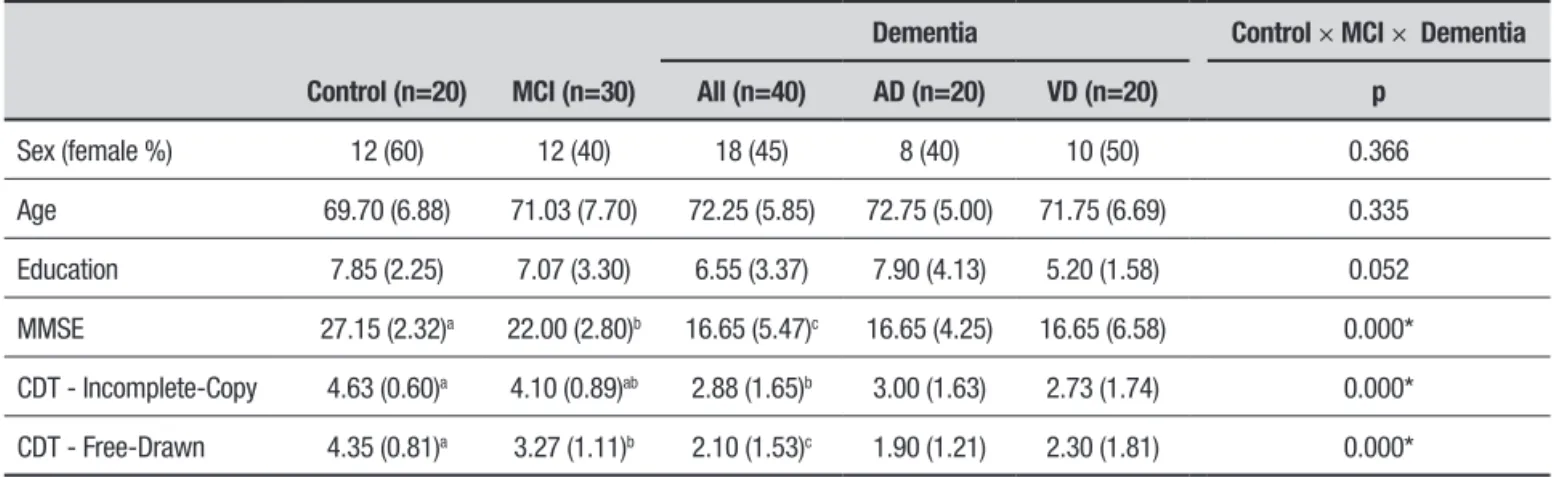
Table 1 shows the main characteristics of the groups studied. he Spearman correlation test was carried out
Table 1. Descriptive data and between-group comparisons for incomplete-copy and free-drawn versions of CDT.
Control (n=20) MCI (n=30)
Dementia Control × MCI × Dementia
All (n=40) AD (n=20) VD (n=20) p
Sex (female %) 12 (60) 12 (40) 18 (45) 8 (40) 10 (50) 0.366
Age 69.70 (6.88) 71.03 (7.70) 72.25 (5.85) 72.75 (5.00) 71.75 (6.69) 0.335
Education 7.85 (2.25) 7.07 (3.30) 6.55 (3.37) 7.90 (4.13) 5.20 (1.58) 0.052
MMSE 27.15 (2.32)a 22.00 (2.80)b 16.65 (5.47)c 16.65 (4.25) 16.65 (6.58) 0.000*
CDT - Incomplete-Copy 4.63 (0.60)a 4.10 (0.89)ab 2.88 (1.65)b 3.00 (1.63) 2.73 (1.74) 0.000*
CDT - Free-Drawn 4.35 (0.81)a 3.27 (1.11)b 2.10 (1.53)c 1.90 (1.21) 2.30 (1.81) 0.000*
*p<0.05, Kruskal-Wallis test, Chi-square test; a,b,c different letters indicate significantly different values between groups on pairwise comparison.
between education and the CDT versions within each group (rho values were <0.28; p values >0.08). No signif-icant correlation was found.
he two versions of CDT were compared within each group studied (Wilcoxon Signed Rank Test). Per-formance on the free-drawn version was signiicantly worse than on the incomplete-copy version for all groups (Control, p=0.014; MCI, p=0.003; Dementia, p=0.002) (Figure 1).
Table 1 shows the comparisons of incomplete-copy and free-drawn versions among groups. he dementia group showed signiicantly lower scores than the control group on the incomplete-copy. No signiicant diference was observed on the incomplete-copy version between MCI and the other two groups. he free-drawn version difered signiicantly among all the groups studied. he control group had higher scores; MCI patients had an intermediate performance while dementia patients had lower scores (Table 1).
DISCUSSION
he current study aimed to compare performance on the free-drawn and incomplete-copy versions of the CDT in participants with MCI and dementia, as well as to verify whether the diferential cognitive aspects (especially memory) between the two versions could help diferen-tiate early stages of cognitive impairment. Our indings showed that patients (MCI and dementia) performed worst on the free-drawn than on the incomplete-copy version of the CDT. his inding indicates that the free-drawn version is more cognitively demanding because memory is also involved and consequently may be more sensitive to mild cognitive impairments, especially those with amnestic characteristics. his result was also corroborated by the between-group comparisons. While the incomplete-copy version was able to diferentiate healthy participants from dementia patients, the free-drawn version could detect earlier cognitive impairment because it diferentiated MCI patients from controls and dementia patients.
Although the conventional objective of the CDT test is to screen cognitive dysfunction without focusing on diferential diagnosis,1-3 it would be better if the test
were able to detect early cognitive dysfunction. Accord-ing to our results, the free-drawn version of the CDT displayed this ability. Another objective of efective screening tools is to be simpler and quicker to admin-ister. Additionally, screening tests with narrow score ranges are easier to use and have higher inter-rater reli-ability.2 hus, the incomplete-copy version of the CDT
is easier to perform, but may not be as efective as the free-drawn method for diferentiating the various levels of impairment.
Considering the approach of combined use of dif-ferent versions of the CDT, a previous study with the CLOX task showed good sensitivity to detect executive dysfunction in subcortical ischemic vascular disease,22
this inding, however, cannot be extended to other types of cognitive impairments. Furthermore, no information
on the severity of cognitive impairment of the sample in the investigation was provided. Other studies evalu-ated the utility of the CLOX to screen MCI patients, but their indings were inconsistent.11,23 Another
investiga-tion tested six CDT scoring systems (semi-quantitative and quantitative) in subjects with and without MCI, but none of these could reliably screen MCI, irrespective of the scoring system used.12 It has been suggested that
focusing on speciic details of the clock, such as hands and time setting, could improve the CDT´s clinical value.12,13 his was what we sought to achieve with our
CDT incomplete-version.
Because of the limited sample size, we were unable to evaluate the diagnostic accuracy of the CDT versions investigated. However, one of the strengths of our study is the application of the narrow-range scoring system and the inclusion of patients pertaining to diferent diagnostic categories (with greater heterogeneity).
In conclusion, our indings support that the free-drawn version of the CDT is more cognitively demanding and sensitive for the detection of cognitive impairment in MCI and dementia patients. Further investigations evaluating the diagnostic value (accuracy) of the free-drawn CDT with MCI patients are needed. Moreover, future studies should also evaluate diferential scores for hands and time settings in an efort to improve the clinical value of these versions.
Author contributions. Bárbara Costa Beber: analysis of the data, writing of the manuscript. Renata Kochhann: design of the study, data collection, review of the manu-script. Bruna Matias: design of the study, data collec-tion, review of the manuscript. Márcia Lorena Fagundes Chaves: design of the study, analysis of the data, intel-lectual contribution to the writing of the manuscript.
Support. his work was supported by the Fundo de
Incentivo à Pesquisa e Eventos (FIPE) of the Hospital de Clínicas de Porto Alegre (HCPA).
REFERENCES
1. Chaves MLF, Godinho CC, Porto CS, Mansur LL, Carthery-Goulart MT, Yassuda MS, et al. Doença de Alzheimer. Avaliação cognitiva, compor-tamental e funcional. Dement Neuropsychol. 2011;5(Supl. 1):21-22. 2. Mainland BJ, Amodeo S, Shulman KI. Multiple clock drawing scoring
systems: simpler is better. Int J Geriatr Psychiatry. 2014;29(2):127-136. 3. Shulman KI. Clock-drawing: is it the ideal cognitive screening test? Int J
Geriatr Psychiatry. 2000;15(6):548-561.
4. Shulman KI, Shedletsky R, Silver IL. The challenge of time: Clock-drawing and cognitive function in the elderly. Int J Geriatr Psychiatry. 1986;1(2):135-140.
5. Agrell B, Dehlin O. The clock-drawing test. 1998. Age Ageing. 2012;41 (Suppl 3):iii41-45.
6. Pinto E, Peters R. Literature review of the Clock Drawing Test as a tool for cognitive screening. Dement Geriatr Cogn Disord. 2009;27(3):201-213. 7. Crowe M, Allman RM, Triebel K, Sawyer P, Martin RC.
Norma-tive Performance on an ExecuNorma-tive Clock Drawing Task (CLOX) in a Community-Dwelling Sample of Older Adults. Arch Clin Neuropsychol. 2010;25(7):610-617.
8. Kato Y, Narumoto J, Matsuoka T, et al. Diagnostic performance of a combination of Mini-Mental State Examination and Clock Drawing Test in detecting Alzheimer’s disease. Neuropsychiatr Dis Treat. 2013;9: 581-586.
10. Royall DR, Mulroy AR, Chiodo LK, Polk MJ. Clock drawing is sensitive to executive control: a comparison of six methods. J Gerontol B Psychol Sci Soc Sci. 1999;54(5):P328-333.
11. Forti P, Olivelli V, Rietti E, Maltoni B, Ravaglia G. Diagnostic performance of an Executive Clock Drawing Task (CLOX) as a screening test for mild cognitive impairment in elderly persons with cognitive complaints. Dement Geriatr Cogn Disord. 2010;30(1):20-27.
12. Ehreke L, Luck T, Luppa M, König H-H, Villringer A, Riedel-Heller SG. Clock drawing test - screening utility for mild cognitive impair-ment according to different scoring systems: results of the Leipzig Longitudinal Study of the Aged (LEILA 75+). Int Psychogeriatr IPA. 2011;23(10):1592-1601.
13. Leyhe T, Milian M, Müller S, Eschweiler GW, Saur R. The minute hand phenomenon in the Clock Test of patients with early Alzheimer disease. J Geriatr Psychiatry Neurol. 2009;22(2):119-129.
14. McKhann G, Drachman D, Folstein M, Katzman R, Price D, Stadlan EM. Clinical diagnosis of Alzheimer’s disease: report of the NINCDS-ADRDA Work Group under the auspices of Department of Health and Human Services Task Force on Alzheimer’s Disease. Neurology. 1984;34(7):939-944.
15. Román GC, Tatemichi TK, Erkinjuntti T, Cummings JL, Masdeu JC, Garcia JH, et al. Vascular dementia: diagnostic criteria for research studies. Report of the NINDS-AIREN International Workshop. Neurology. 1993;43(2):250-260.
16. Petersen RC. Mild cognitive impairment as a diagnostic entity. J Intern Med. 2004;256(3):183-194.
17. Kochhann R, Varela JS, Lisboa CS de M, Chaves MLF. The mini mental state examination: Review of cutoff points adjusted for schooling in a large southern Brazilian sample. Dement Neuropsychol. 2010;4:35-41. 18. Folstein MF, Folstein SE, McHugh PR. “Mini-mental state”. A practical method for grading the cognitive state of patients for the clinician. J Psychiatr Res. 1975;12(3):189-198.
19. Sunderland T, Hill JL, Mellow AM, et al. Clock drawing in Alzheimer’s disease. A novel measure of dementia severity. J Am Geriatr Soc. 1989;37(8):725-729.
20. ADCS ADCSG. A randomized, double-blind, placebo-controlled trial to evaluate the safety and efficacy of vitamin E and donepezil HCL (Aricept) to delay clinical progression from mild cognitive impairment (MCI) to Alzheimer’s disease (AD). Protocol no. ADC-008, 1999.
21. Powlishta KK, Von Dras DD, Stanford A, et al. The clock drawing test is a poor screen for very mild dementia. Neurology. 2002;59(6):898-903. 22. Margraf N, Bachmann T, Schwandner W, Gottschalk S, Seidel G. Bedside